Scottish Folds are cute, but the genetic mutation responsible for their folded ears also causes lifelong pain, joint problems and misshapen bones.
In 1961, a shepherd named William Ross found a barn cat with a curious feature: instead of the upright, swiveling, satellite dish ears of a normal feline, this cat’s ears were floppy and shapeless, resting atop her head like a tiny knitted cap.
Ross took the cat home and named her Susie. Susie gave birth to a litter of kittens with the same floppy ears, and it all gets a bit murky from there, with a dozen variations of the story online claiming it was Ross himself or a neighbor who “created” the breed.
Regardless of who it was, the floppy ears were transformed from an abnormal feature into the unmistakable characteristic of a breed, and the Scottish Fold was born.
The cute cats quickly caught on and were officially recognized in competitions by 1971.
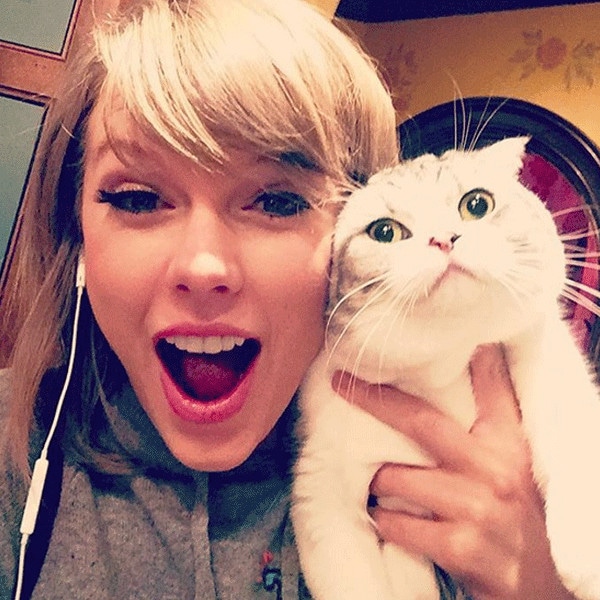
Now they’re more in vogue than ever. They’re the preferred pets of music superstars Taylor Swift and Ed Sheeran, who regularly feature photos and videos of their Scottish Folds in social media posts. People across the world are buying them, and they routinely appear in “best breed” lists online, lauded for being cuddly and docile in addition to adorable.
Ed Sheeran with his Scottish Fold cat. Credit: Ed Sheeran/Instagram
But they’ve also been banned by the same cat fancy groups that initially welcomed them, they’re prohibited outright in some countries, and animal welfare groups are begging people to stop emulating celebrities by buying them.
That’s because the same deformity that gives Scottish Folds their distinctive ears is also responsible for weak and brittle cartilage and bones elsewhere in the body, which results in lifelong pain and disability.
“The disease is evident on x-rays of cats from as young as seven weeks of age. Serious abnormalities in joints and bone growth lead to arthritis (painful, swollen joints), short, abnormally thick, and inflexible tails, spinal abnormalities and short, stiff legs. The welfare impacts of Scottish Fold Osteochondrodysplasia can be severe in terms of pain and inability to perform natural behaviours, as these cats can be lame, walk with an abnormal gait, can be reluctant to engage in normal movements such as walking or jumping, and can even become completely crippled.
There is no cure for this progressive condition.”
Sadly, the deformities and resulting pain may be the reason Scottish Folds are considered docile and cuddly: they may simply be in too much pain to move or protest when their humans hug them or pick them up.
Ross and Turner didn’t know it in 1961, but the folded ears and brittle cartilage were the result of a genetic mutation. It wasn’t until 2016 that a group of American and Australian scientists found a mutation in a single gene, TRPV4, was responsible for weak cartilage and bones, leading to the deformities highlighted by the RSPCA in the passage above, as well as “progressive joint destruction.” The condition is called osteochondrodysplasia.
Swift’s cats have appeared in her music videos, feature prominently in her online posts, and were photographed in her arms for her 2024 post announcing she was supporting Vice President Kamala Harris in November’s presidential election.
Cats Protection, a UK charity, raised the issue in 2024, warning that Scottish Folds were becoming even more popular, with breeders struggling to meet high demand. The group issued a public statement asking cat lovers and Swift fans to avoid buying Scottish Folds. Scottish Folds are equally popular in the US, spurring resistance from stateside animal welfare groups as well.
The Governing Council of Cat Fancy, which registers breeds in the UK — and no longer recognizes Scottish Folds — was even more direct.
“We strongly advise members of the public not to try to acquire cats of this breed,” Steve Crow, chairman of Cat Fancy’s governing board, told The Guardian.
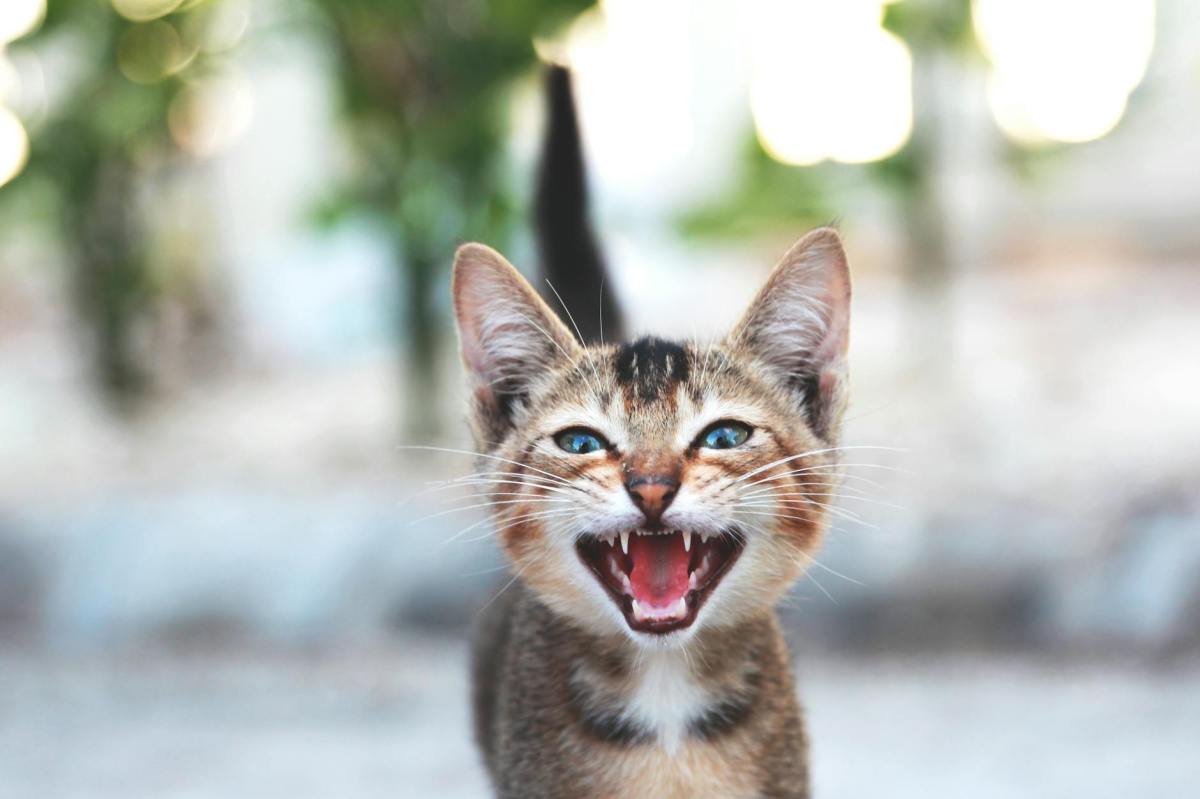
A 23-second clip of a cat growling and yowling has become one of the most-used sound effects over the past three decades. The Guardian traced the clip back to the man who recorded it and got the full story.
We’ve all heard Cheeta the cat yowling, we just don’t know it.
Cheeta was a house cat who belonged to Wylie Stateman, a sound engineer who lives in LA.
In 1988, Stateman recorded an argument between Cheeta, a “remarkably small” half-Siamese void, and her mate, a tomcat named Sylvester.
The 23-second clip made it onto The Premiere Edition, a 20-CD library of sound effects Stateman produced in 1990.
Stateman, called “one of the great recorders of the time” by a colleague, told The Guardian he brought his sound recorder with him everywhere he went for three decades, recording thousands of sounds that have been used in movies for 35 years.
Buddy is also an accomplished sound effects cat.
Cheeta’s yowls are one of his greatest successes. The cranky cat can be heard in Toy Story, Home Alone 3, Les Miserables, Pet Sematary, 101 Dalmations, Venom: Let There Be Carnage, Babe, End of Days, How The Grinch Stole Christmas, and many more.
Although it’s difficult to get an exact count, it’s believed Cheeta’s distinct voice can be heard in some 330 films over the years. If you’re interested in learning more, check out The Guardian’s deep dive into the sound effect and its origins.
Buddy the Magnanimous
I went to visit my brother and his family in Washington this past week, leaving Buddy in the care of my mom.
Regular readers will recall that Bud has a bad reputation for trying to maul his cat sitters, which obviously complicates things.
The incorrigible little lunatic.
Sue, his regular sitter, has known Bud since he was a kitten. She’s literally one of the first humans he met, yet that has not stopped him from ambushing and attacking her. Incredibly, she still agrees to care for him in my absence despite his belligerence, though she’ll no longer play with him. She feeds him and gets out ASAP. I can’t blame her.
This time my mom cared for the little stinker. He’s also tried to murder her when she’s watched him on previous occasions, including one incident in which his bites and scratches necessitated a trip to urgent care and a round of antibiotics.
So yeah, the happy news is that he didn’t attack her this time, although she told me every time she came back, he’d be waiting right by the door, and when he saw it wasn’t me, he would sniff derisively before turning and padding away.
They have an uneasy truce, but I’ll take it. You know you have small dreams when you celebrate a trip in which your cat doesn’t try to maul anyone in your absence.
On a tangential note, I had a first phone interview with a wild cat conservation organization this week, and for the first time in a long time, Bud didn’t make a peep.
He’s meowed loudly during other phone interviews, he’s put his butt in front of the camera like it’s his job during video calls, and he won’t shut up at any other time, but the one time when having a cat might benefit me, he decides to be silent. Thanks, Bud. You’re the best.
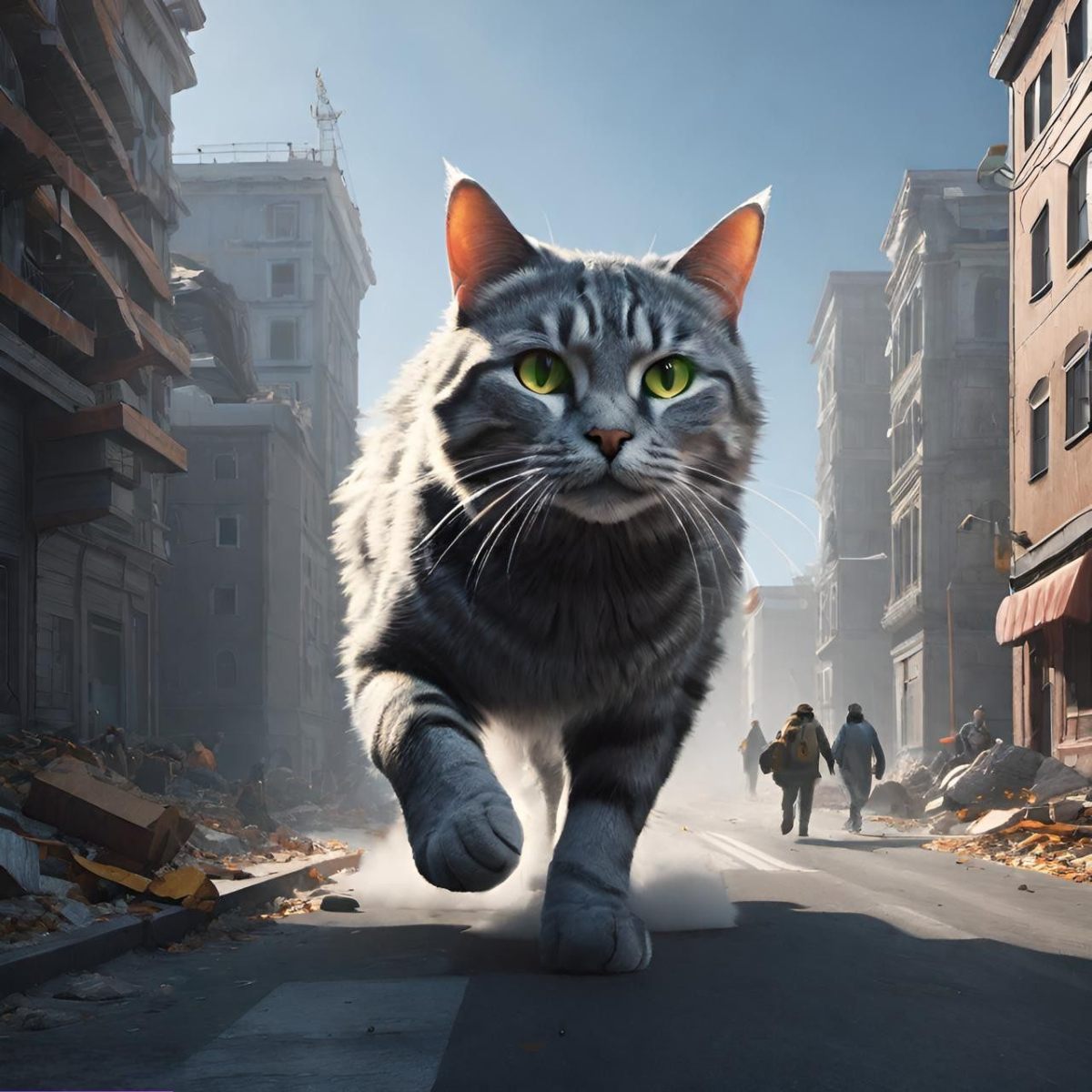
The feline laid waste to entire restaurants and food stalls during his rampage through the city, sending residents running for cover.
NEW YORK — The island of Manhattan was brought to a standstill this week after a massive and menacing wildcat was seen stalking the streets.
The first reports came in Wednesday afternoon after panicked callers told 911 dispatchers a “yuge gray tiger” had barreled into Gray’s Papaya on Broadway and 72nd, gorging itself on the eatery’s famous hot dogs.
Social media posts timestamped an hour later showed clips of the terrifying felid running full speed toward an Atomic Wings, where it tore through the entire inventory of chicken and hamburgers.
“Holy [bleep], that’s not a tiger, that’s a kaiju!” one TikTok user said in a video uploaded to the popular social media site.
The TikToker’s footage showed the gargantuan cat emerge from the Atomic Wings, hot sauce dribbling down the fur on its chin, and belch with such force that car alarms began shrieking in a three-block radius.
“We’re receiving reports that the colossal cat’s name is Buddy, and he escaped earlier Wednesday from an apartment where some lunatic was illegally keeping him as a pet,” Fox News’ Brett Baier told viewers. “A law enforcement source says the man has been taken into custody as a person of interest, and will likely face charges of harboring a dangerous wild animal.”
Detectives were seen escorting the cuffed man, who screamed incoherently that Buddy is allegedly “just a house cat.”
“He invented a laser that increased his size 70 fold!” the deranged man shouted as news cameras followed the detectives from the squad car. “He’s a wimp! Rustle a paper bag! Bring out a vacuum! You’ll see!”
New York Mayor Eric Adams dismissed the man’s claims as “the rantings of a clearly insane person,” and assured residents that the so-called Buddinese tiger would be “swiftly caught and dealt with by the brave men and women of the NYPD.”
“You’ll be able to make your dinner reservations, folks,” Adams said as an interpreter translated his words into American sign language behind him. “In the meantime, keep your doors and windows locked, and don’t cook anything pungent. This is a hungry beast who has eaten his way through dozens of restaurants.”
Police had set up a trap in midtown, with more than 900 pounds of roast turkey and baseball-size Temptations to lure the rampaging tiger.
The ill-fated turkey trap.
But the plan went horribly wrong on Thursday evening when the tiger approached.
“This beast is truly gargantuan!” ABC reporter Stephan Kim whispered during a live broadcast. “Each footfall seems to shake the earth. Look! The concrete is cracking and spidering beneath his paws as if it were brittle ice!”
The Buddinese Tiger stopped, sniffed, then launched himself at the pile of turkey, not even registering the tranquilizer darts fired by NYPD snipers stationed on top of nearby buildings until one hit him in the buttock.
The vicious cat roared and looked as if he would take down the building where the offending officer stood until he was distracted by the smell of Peruvian food wafting from a nearby Pio Pio.
“Arroz chaufa!” the tiger yelled, turning his enormous frame and stomping off into the distance.
City leaders admitted they’d underestimated the threat and had officially requested the National Guard, which was being mobilized late Thursday evening.
But an NYPD detective, speaking on condition of anonymity, said authorities were beginning to reconsider the claim that the rampaging animal could be a house cat.
“One of our officers called him a ‘good boy’ in a last, desperate attempt to save his own life when he was cornered by the beast,” the detective said. “To his surprise, the tiger pounced on him, licked his face, then went on his way, repeating ‘I’m a good boy!’ Maybe there’s some truth to this claim about the size-increasing laser.”
Rep. Marjorie Taylor-Greene of Georgia siezed on the story, posting a message on X claiming credit for “warnin’ ya’ll about these space lasers.”
“One of these lasers has turned a cuddly little house cat into a terrifying tiger,” Greene wrote. “So who’s a conspiracy theorist now?”
Cats aren’t equipped to use human language and there’s nothing wrong with that. Our feline friends already go to great lengths to communicate in ways we can comprehend. The least we can do is meet them halfway.
I would love it if my cat could talk to me.
Sure, he never shuts up, but if he could speak English I’d know why he meows at the same spot at the same time every morning, or what he wants on the occasions when he’s still meowing insistently at me despite the fact that his bowls are full, his box is clean, he’s had his play time, and every possible need and want of his — that I can fathom — has been met.
Most of all, I’d really like to know he understands I’ll be back soon when I go away for a few days, and my (mostly ignored) pleas for him not to attack his long-suffering, way-too-kind sitter.
Alas, Bud cannot speak. No non-human animal has ever demonstrated even basic proficiency in human language. People will point to examples like Koko the Gorilla and Nim Chimpsky, but there’s a reason why funding dried up for that kind of experiment.
It doesn’t work. It never did.
The scientists who end up taking on dual roles as researchers and parents to the animals invariably serve as interpreters, get too close to their subjects and swear that a gorilla pounding shiny buttons for “food tree food submarine” means the ape wants to have a picnic next to the ocean, or “car fly house car star” means she wants to ride a Tesla Roadster to Mars and start a colony with Elon Musk.
Koko, Nim, Chantek and the other apes who were the subjects of decades-long attempts to humanize them — and teach them language in the process — were ultimately not much different than Clever Hans the horse, who was reading subconscious nonverbal cues from his owner and convinced tens of thousands of people that he could do math and understand spoken language.
Hans had scores of experts fooled until the German psychologist Oskar Pfungst figured out how the horse was coming up with the correct answers.
Regardless of which famous example we’re talking about, no animal has ever mastered syntax, and the best that could be said of their proficiency with language, or lack of it, is that they learned they’d get attention and food when they pounded on a talking board or approximated a word in sign language.
Even if non-human primates were able to learn a handful of words by frequently reinforced association with an object, there has never been any evidence that they are actually using the words as language rather than simply understanding “Pushing the button that makes this sound means I get a treat!” (And yes, there is a profound difference. The former reveals the presence of cognitive processes while the latter is a conditioned response.)
Despite decades of intense effort, no animal has ever demonstrated the ability to use human language. At best an animal bangs on a few buttons and people are left to speculate on the intent. Maybe Fluffy likes the way a certain word sounds. Maybe it’s just fun to hammer on buttons the way it’s fun to pop bubble wrap. Most likely, these cats and dogs know that using a talking board is a guaranteed way to get attention, a treat and a head scratch from their caretakers.
Influencers and their talking boards
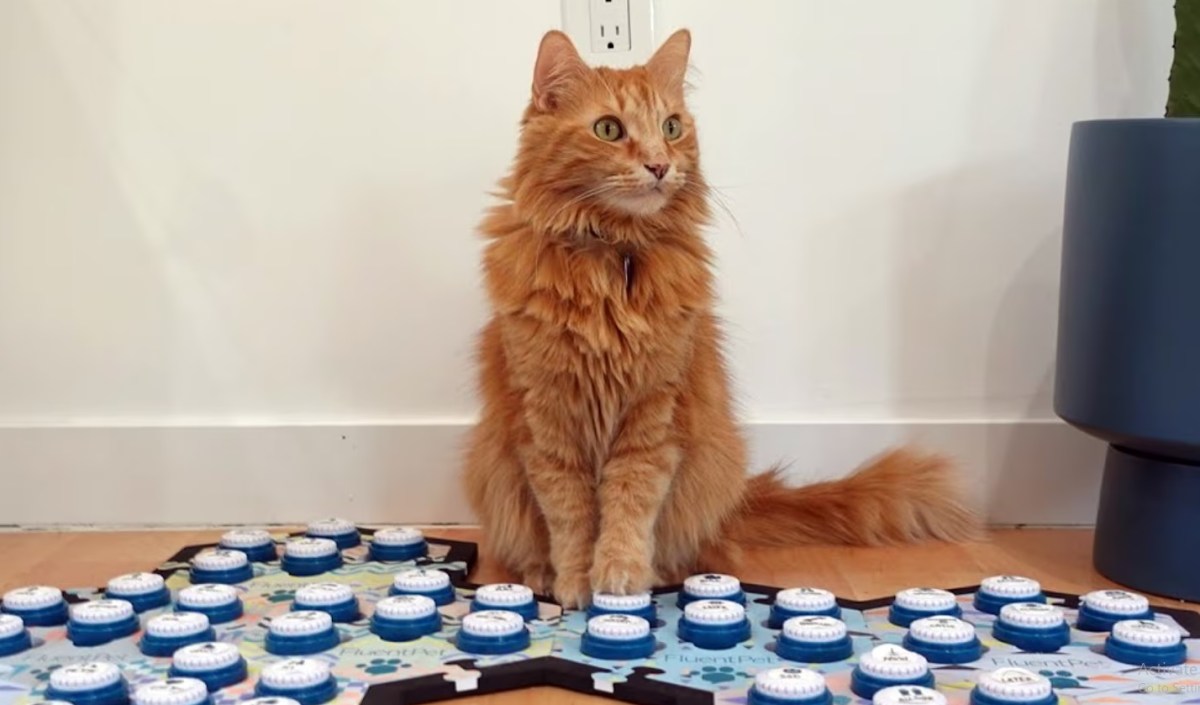
TikTok, which spawns inane trends with the reliability of an atomic clock, has provided a platform for people who insist their cats and dogs can talk. Using “talking boards” — elaborate set-ups in which words are assigned to their own buttons — they “teach” their cats how to express themselves in English and provide proof in the form of heavily edited, out-of-context clips that require the same sort of creative interpretation pioneered by Penny Patterson, Koko’s caretaker.
Seriously?
I just watched a video in which a woman claims her cat, named after Justin Bieber, was describing an encounter with a coyote by stomping on buttons for “stranger,” “Justin,” “Mike,” and “stranger.”
The woman says she thought Justin was asleep at the time, but now she believes the orange tabby saw the coyote outside and was still stressing about it well into the next day.
While she’s repeating Justin’s “words” back to him, two of her other cats come by and step all over the talking board. I guess whatever they had to say wasn’t important.
Justin’s talking board has 42 buttons, which stresses credulity well beyond the breaking point. More than half of the buttons are used for abstract concepts.
But forget all that for a moment and ask yourself how our own efforts to decode the meow have been going.
Despite our status as intelligent, sapient animals, despite the powerful AI algorithms at our disposal, despite the benefit of being able to digitally record and analyze every utterance, we haven’t come close to a reliable method for interpreting feline vocalizations.
Likewise with dolphins, whale song, corvid calls and the sounds made by other animals at the top of the cognition pyramid.
Mostly, we’re learning we’ve underestimated the complexity of our non-human companions’ inner lives, especially when it comes to the kind of multi-modal communication humans also engage in, but only subconsciously. We say what we want with our mouths, while our eyes, facial expressions and body language say what we’re actually thinking.
Likewise, the meow is an unnatural way for cats to communicate, and it contains only a fraction of the information cats are putting out there. It’s just that we can’t reliably read feline facial expressions, let alone tail, whisker and posture. (Studies have shown most of us, even when we live with cats, don’t get measurably better at this. In fact, we’re often no better than people with limited feline experience, but we think we’re better.)
Putting the burden on our furry friends
If we can’t crack a simple and limited system of vocalizations, aren’t we putting unrealistic expectations on cats? The average person has a vocabulary of tens of thousands of words, yet somehow we expect cats can latch on to an arbitrary number of them, approximate mastery of syntax that has eluded even our closest cousins, and bridge a cognition gap we haven’t been able to bridge ourselves.
It’s all too much.
I’ve had Buddy since he was eight or nine weeks old, and in more than nine years I still don’t know why he makes this praying motion. We may be best buds, but some things just don’t translate.
There’s a simple truth at the heart of this: Cats did not evolve to speak or parse human language, and that’s perfectly fine.
The little ones already meet us more than halfway because they understand we are hopelessly incompetent at reading tail, whisker or body language, and they understand we communicate with vocalizations.
By forgoing their natural methods of communication in favor of ours, cats are already taking on most of the burden in interspecies communication. Asking them to do more than that, to learn many dozens of words and the rudimentary rules of language, seems like laziness, wishful thinking or insanity on our part. Pretending that certain cats are successful is an exercise in the same kind of cynical opportunism that fuels every other desperate attempt by people trying to turn their pets into influencers. People do it because the reward is money and attention.
Worse, it contributes to the spread of misinformation. TikTok’s talking board videos routinely net millions of views, converting a credulous audience into an army of true believers who are convinced that, with just a little effort, their feline pal can shoot the shit with them.
If people want to construct elaborate talking boards in their homes and pretend their cats are expressing themselves in English, who am I to object? It’s not the smartest use of time, but have at it. What I won’t do is participate in the delusion that felines are a few buttons away from being able conversation partners, nor will I pretend these efforts have any relationship to science.
So to the journalists who keep writing credulous stories about these supposedly talking animals: please familiarize yourself with the example of Clever Hans, and please, I beg you to stop promoting these videos as if they’re anything more than wishful thinking. You are doing your readers a disservice for the sake of a few clicks.
Note: Jackson Galaxy isn’t a fan either, saying he’s “got some serious problems” with the talking board trend. Calling it “problematic,” he points out that cats are not only partially domesticated and the only animal species in history to take that step without human prompting, but humans have never selectively bred cats for specific behaviors or to bring out intelligence traits as we have with canines. (Think of sheep dogs or retrievers, who are the products of thousands of years of breeding for well-defined tasks.) There simply hasn’t been a need to breed cats for behavioral traits since the thing humans traditionally valued most about them — their ability to reliably eradicate rodents and protect human foodstuffs — is innate. No one had to teach cats how to hunt or breed them for the task. It’s only in the last two hundred years or so that certain human societies began breeding cats, and they did so for aesthetic attributes like coat patterns. Galaxy also notes that animals do not express emotions the same way humans do. Like monkeys, who “smile” when they’re terrified, felines express joy, anger and fear with their tails, whiskers, ears and body language. It’s not in their nature to tell us they’re happy or scared by padding up to a contraption and hammering on a button.
Top image of “Justin Bieber” the cat credit Sarah Baker.
Health authorities said thousands of female cats around the world fainted when they heard the news that Buddy the Cat is launching his very own OnlyFans.
After resisting calls from his admirers for years, Buddy the Cat has finally joined OnlyFans.
“It’s a dream come true,” said Nala, 5, a Burmese who describes herself as “Buddy’s biggest fan.”
Other felines posted celebratory messages online after the news broke, with most expressing an intent to subscribe to Buddy’s OnlyFans “no matter how much he charges.”
“A dollar a month, ten bucks a month, a hundred bucks a month, it doesn’t matter. It’s worth it,” said Penny, a puma who said she has posters of Buddy in her enclosure at a wildlife sanctuary. “Buddy is the sexiest beast of them all.”
A sizzling snap of Buddy being sizzling for his new OnlyFans site.
Buddy’s new OnlyFans site promises “sizzling snaps of Buddy napping,” “hot photos of him yawning and stretching,” and regular videos of the mercurial tabby being handsome.
“Finally, my fans can get more Buddy without having to read that stupid blog my human writes,” Buddy wrote in his announcement. “It’s full of ridiculous slander, vile lies and claims that I’m wimpy when everyone knows I’m, like, brave and stuff.”
As of Friday, the new site featured a handful of clearly photoshopped images of the gray tabby with bulging muscles as he lifted weights, and a poorly produced video depicting the diminutive feline “ambushing” a stuffed alligator, with the sounds of a jaguar dubbed into the footage.
“Just catching me some lunch!” Buddy captioned the clip. “Us apex predators don’t eat from a can, we hunt our own meals.”
Buddy the Cat poses in a box, striking a handsome pose as he gazes yonder.
There was no sign that questions about the veracity of the images bothered the egotistical feline’s admirers.
“OMG ADORBZ!” commenter princess2017 wrote.
“My handsome little prince!” wrote another poster, LioNeSS, who also added several heart and turkey emojis.
Soon after Buddy’s OnlyFans launch, it was announced that Smudge, his arch-nemesis, signed a deal to create a show about his life for Netflix. Titled “Smudge: New York’s Most Heroic Cat,” the series will “follow Smudge as he fights for truth and justice against the evil Dubby the Cat, a chubby gray tabby with an inflated ego.”