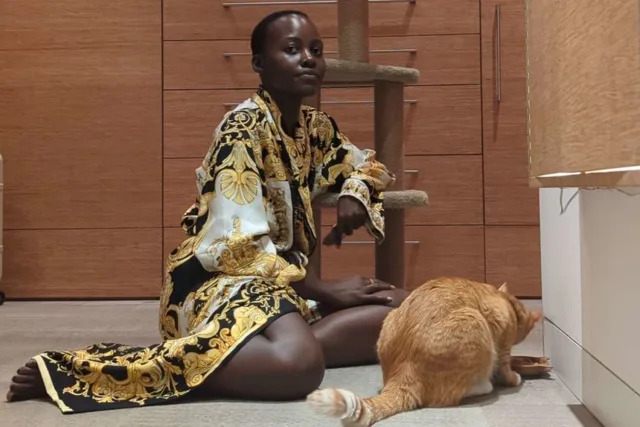
Lupita Nyong’o not only shares the screen with a feline co-star in the new film A Quiet Place: Day One, she’s also a devoted cat mom to a ginger tabby named Yoyo.
Although I haven’t seen most of Lupita Nyongo’s movies — I really liked her performance in Us and her voice work in Disney’s Jungle Book remake — I’m a big fan now that I know she’s a cat lover.
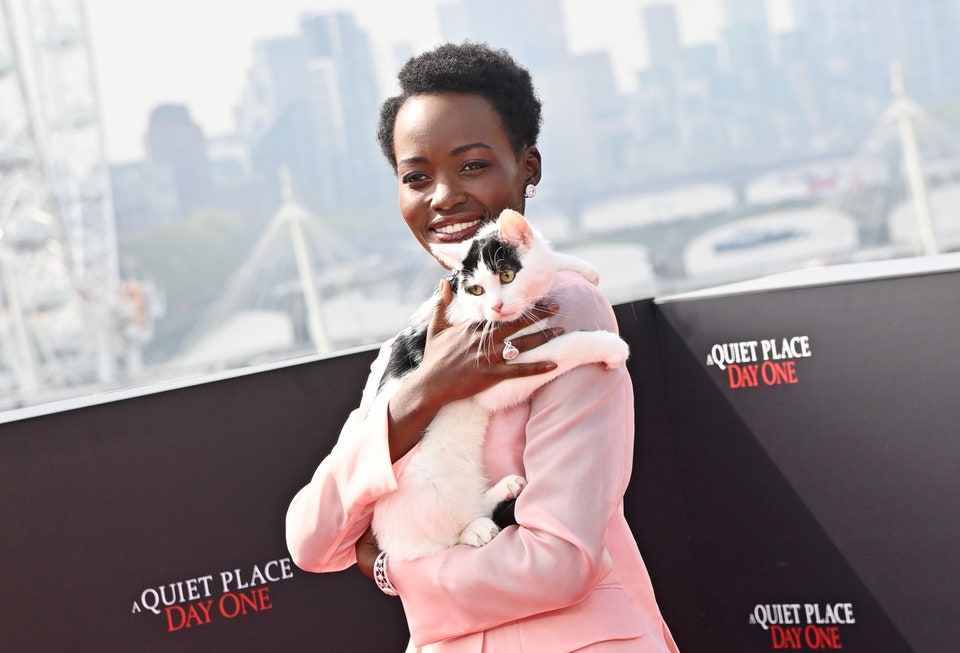
Nyong’o took to the red carpet for the premiere of her newest film, A Quiet Place: Day One in London on Wednesday, and her plus-one was a cat named Schnitzel, who also stars in the movie. Photos show Nyong’o posing along co-star Joseph Quinn, smiling as she cradles Schnitzel in her arms.
Lupita Nyong’o with her cat, Yoyo. In addition to posing with a cat on the red carpet premiere of her new film, Nyong’o proudly dotes on Yoyo and mentions him often. Credit: Lupita Nyong’o/Instagram
A Quiet Place is a 2018 film about a family that lives a completely silent life on a farm after the civilization has fallen to monstrous creatures that can’t see but are exceptionally sensitive to sound.
The film received nearly universal positive reviews for its use of sound — and the complete absence of it for long stretches — as a tension-building device, and a 2020 sequel continued the story.
Day One, which hits theaters on June 28, promises audiences a look at how the creatures appeared and civilization collapsed.
Schnitzel’s role isn’t entirely clear, but if it’s anything like 2022’s Prey, cats will fill their usual niche as predators, highlighting the difference between terrestrial and extraterrestrial hunters.
Caring for a cat in a world like A Quiet Place could be a double edged-sword: a super vocal cat like my Buddy wouldn’t last very long unless he quickly learned to keep a lid on his constant commentary, but cats are also incredibly sensitive to things that pass beneath the notice of us humans.
Thanks to their incredible hearing, exceptional sense of smell, the advantage of an extra olfactory organ and whiskers that pick up even the slightest stirring, felines are keenly aware of their surroundings.
As for Nyong’o, while Schnitzel is not her cat, she’s the proud cat mom of Yoyo, an orange tabby she fostered in late 2023. It only took her three days of fostering the little guy before she realized “I could not give him up,” she said last year shortly after the adoption was made official.
“I never understood people whose phones were full of photos and videos of their pets — now I am one of those people,” she wrote when she adopted the tabby. “It may look like I saved Yoyo, but really, Yoyo is saving me.”
Lupita Nyong’o with Yoyo. Credit: Lupita Nyong’o/Instagram
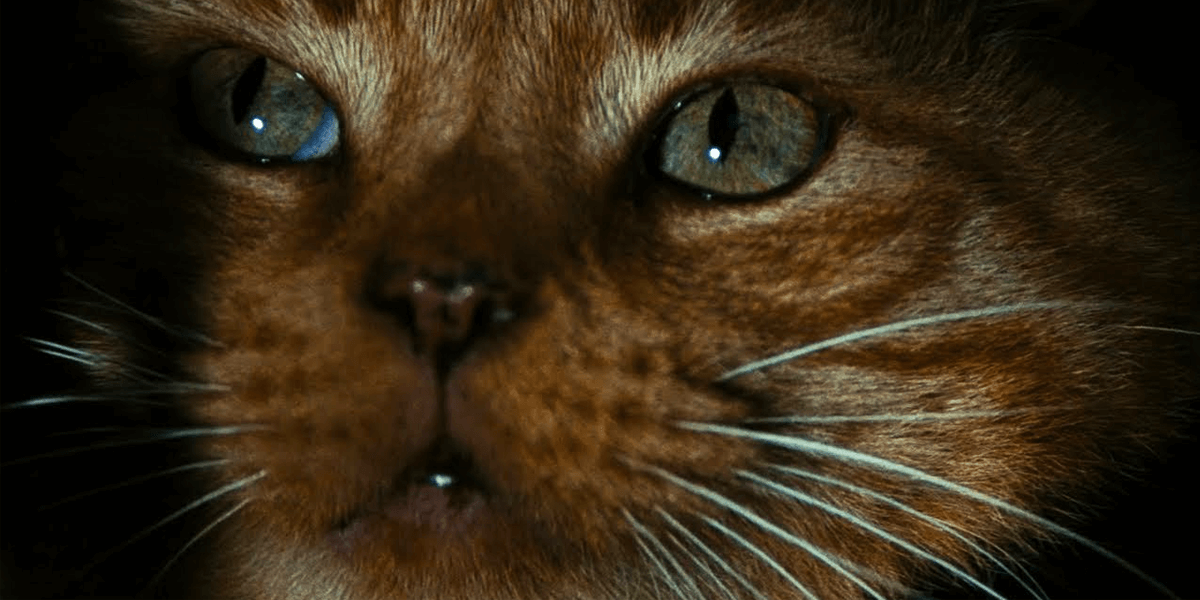
Making his debut in 1979’s Alien, Jonesy is one of the most famous felines in cinema history.
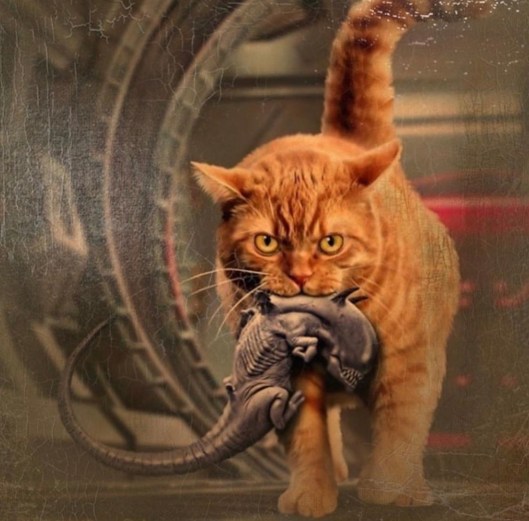
There’s a popular meme among Alien fans that depicts Jonesy the Cat walking nonchalantly down one of the starship Nostromo’s corridors with his tail up, carrying the corpse of the recently-spawned alien in his mouth like he’s about to present a dead mouse as a gift to his humans.
The joke is self-evident: if the crew of the Nostromo had allowed Jonesy to take care of business from the get-go, the alien would have been disposed of before it had the chance to grow into the monstrosity that haunted the decks of the Nostromo and the nightmares of viewers.
“Who’s a good boy? Who just saved his crew from certain violent death at the claws of a ruthless alien predator? That’s right, you did!”
Of course then there’d be no movie. No ripples of shock in theaters across the US as audiences were confronted by something more nightmarish and utterly alien than popular culture had ever seen before. No indelible mark left on science fiction.
Despite the film’s retrofuturistic aesthetic, it’s difficult to believe Alien first hit theaters almost half a century ago.
That’s testament to director Ridley Scott working at the height of his powers, the carpenters, artists and set dressers who created the starship Nostromo’s claustrophobic interior, the design of the derelict starship where the alien was found, and the bizarre creature itself.
The alien ship and creature designs were the work of Swiss surrealist H.R. Giger, who was little-known at the time but floored Scott and writer Dan O’Bannon with his hyper-detailed paintings of grotesque biomechanical scenes.
Signourney Weaver and one of the cats who played Jonesy in the first film.
Kane explores the infamous egg chamber in the derelict alien ship.
Fan art of Jonesy
A close-up shot of the retrofuturistic tech used in the series, a design decision that departed from the gleaming visions of the future common at the time.
A set photo showing the first film’s crew on the iconic space jockey set.
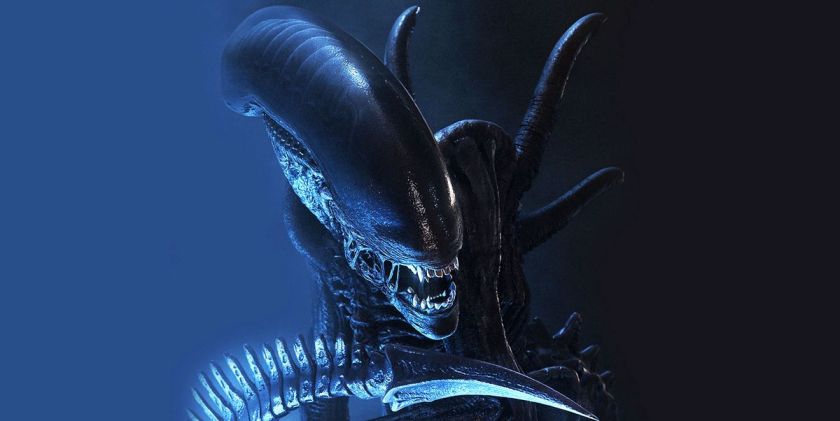
Giger’s work, specifically his 1976 painting Necronom IV, was the basis for the titular alien’s appearance. The alien, called a xenomorph in the film series, is vaguely androform while also animalistic. It is bipedal but with digitgrade feet and can crawl or run on all fours when the situation calls for it. It hides in vents, shafts and other dark spaces, coiling a prehensile tail that ends in a blade-like tip.
But it’s the creature’s head that is most nightmarish. It’s vaguely comma-shaped, eyeless and covered in a hard, armored carapace that ends just above a mouth full of sinister teeth like obsidian arrowheads. There’s perpetually slime-covered flesh that squelches when the creature moves but there are also veins or tendons or something fully exposed without skin, apparently made of metal and bone. Maybe those ducts feed nutrients and circulate blood to the brain. Maybe they help drain excess heat from the creature’s brain cavity.
Regardless, it’s a biomechanical nightmare that the Nostromo’s science officer, Ash, admiringly calls “the perfect organism” whose “structural perfection is matched only by its hostility.”
The alien, Ash declares, is “a survivor, unclouded by conscience, remorse, or delusions of morality.”
The alien, also referred to as a xenomorph, “that thing,” a “dragon,” “the perfect organism” and various other names by characters in the series. Credit: 20th Century Studios
Part of what makes Jonesey so beloved is the fact that, together with the xenomorph and Ripley, he completes the triumvirate of survivors. We see Jonesy scurry into the protection of tiny confined spaces to escape the alien, hissing at it in the dark. We see him dart into the bowels of the ship after sensing the stalking creature, adding another blip to the crew’s trackers. Finally we see him settling into a cryosleep pod with Ripley, like so many other cats with their humans, when the threat has passed.
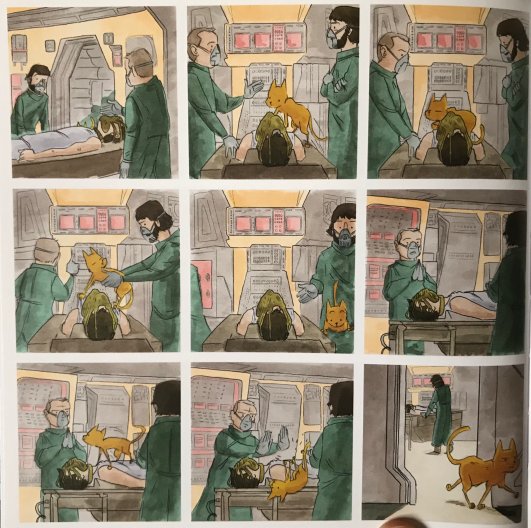
Jonesy — affectionately referred to as “you little shithead” by Ripley in the second film — appears in the franchise’s two most famous films, his own comic book series titled Jonesy: Nine Lives on the Nostromo, a 2014 novel (Alien: Out of the Shadows), and in hundreds of references in pop culture over the last half century, from appearances in video games (Halo, World of Warcraft, Fortnite) to references and homages in movies and television shows.
A page from Jonesy: Nine Lives On The Nostromo, which tells the story of Alien from the cat’s perspective. These panels depict Jonesy watching Ash and Dallas examining Kane in the ship’s medical lab.
He’s like the anti-xenomorph. Cats are predators, after all, and Jonesy might be the xenomorph to the ship’s rodents just like every ship’s cat in thousands of years of human naval endeavors. But to the crew members Jonesy’s a source of comfort, a warm, furry friend to cuddle with. Unlike the xenomorph he’s got no biological programming urging him to impregnate other species with copies of himself in one of the most horrific gestation processes imaginable.
Xenos are like predators on steroids, gorging themselves on their victims to fuel unnaturally swift cell reproduction and growth. As a result, over the decades some have speculated that the alien simply ignored the cat, deeming its paltry caloric value unworthy of the effort to kill.
The idea that Jonesy was too small to interest the alien is proved a fallacy in later franchise canon when we see the aftermath of a xenomorph consuming a dog. It’s indiscriminate in its quest for energy, feasting on adult humans and animals alike until two or three days pass and it’s a 12-foot-tall, serpentine nightmare the color of the void of interstellar space.
Just imagine sitting in a theater in 1979. Your idea of science fiction is sleek jet-age spacecraft, Star Trek and Stanley Kubrick’s clinical orbital habitats from 2001: A Space Odyssey. You’re expecting astronauts, heroes, maybe a metal robot or an alien who looks human except for some funky eyebrows, green skin or distinct forehead ridges.
Instead you get a crew of seven weary deep space ore haulers inhabiting a worn, scuffed corporate transport ship, complaining about their bonuses and aching for home, family and the familiar tug of gravity.
But home will have to wait. The ship has logged an unusual signal of artificial origin broadcasting from a small planet in an unexplored star system. The crew has no choice but to investigate. It’s written into their contracts, which stipulate the crew will forfeit their wages if they disregard the signal.
So they land, suit up, move out and find a derelict starship. An incomprehensibly massive vessel so strange in detail and proportion that it could only have been built by an alien mind, with unknowable motivations and psychology.
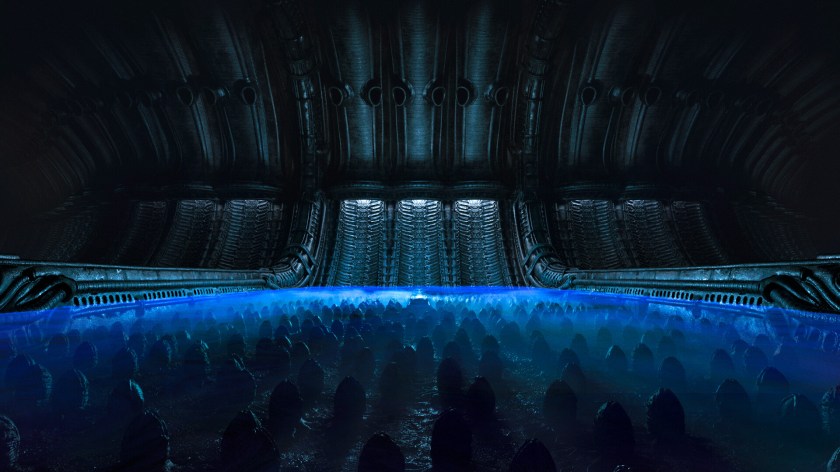
The egg chamber of the derelict alien ship, designed by Giger.
Inside, hallways that look like ribcages lead to vast chambers with utterly bizarre, inscrutable machinery that seems to consist of biological material — skin, bone, joints, organs — fused with metal. In one of them the corpse of an alien, presumably a pilot, is integrated into a complex array. It’s at least twice the size of a large human man. Its elephantine head is thrown back in the agony of its last moment, when something exploded outward from its body, leaving a mangled ribcage, torn papery skin and desiccated organs.
And beneath that, a shaft leading to another horror — a chamber that seems to stretch for kilometers in either direction, where leathery eggs are cradled in biomachinery and bathed in a bioluminescent cerulean mist.
The decision to enter that chamber sets off one of the most shocking scenes in cinema history, leads to the birth of pop culture’s most terrifying monster, and sent millions of theater-goers home with nightmares in the spring and summer of 1979.
It’s almost too much to handle. But take heart! The unlikely female protagonist makes it to the end, and so does the cat. What more can you ask for?
Jonesy grooming himself on the flight deck of the starship Nostromo. Credit: 20th Century Studios
The whole pet thing takes on a different vibe in Asia.
I first saw it in Tokyo where people push their cats along in baby strollers and luxury shops sell thousand-dollar accessories for felines and canines alike.
In countries like China it’s become a thing to dress pets in “cute little outfits” and pose them like dolls for social media snaps.
Now in Thailand — which is second only to China in pet ownership on the continent — people can bring their cats and dogs to the movies.
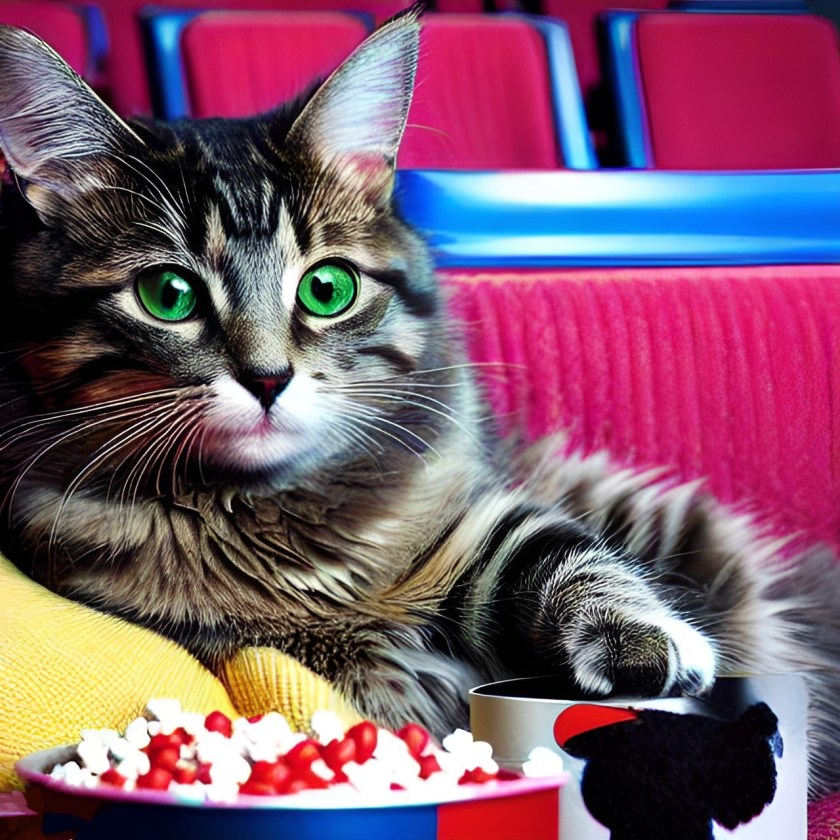
Agence France-Presse sent a reporter there to witness costumed Chihuahuas and poodles arrive by stroller and sit next to their humans for a screening of The Little Mermaid. A cat, who probably had no idea what the hell was going on, was plopped down on the seat next to her human.
“Shhhh! Some of us are trying to watch The Lion King here!” Credit: PITB
A spokesman for the Bangkok cineplex told AFP he thinks pet-friendly cinemas will bring people back to the movies after the pandemic. Pet owners, he said, have been less likely to leave home because their animals are now used to having them around all the time and experience separation anxiety when they leave.
As Bud’s loyal servant I know he does have separation anxiety, but I wouldn’t bring him to the local Alamo Drafthouse or AMC even if they had pet-friendly screenings here.
For one thing, he’s a damn cat! He’s not interested in screens unless they’re showing birds feasting on seeds in a forest, with all the accompanying sounds, while he’s viewing it from the safety of his own home
Second, I know precisely how he’d react, and he wouldn’t take well to being in a theater with a bunch of dogs and a handful of other cats. He’d spend half the movie hissing and the other half crying. I can’t imagine it being a fun experience for him.
Then there’s the “dress code.” Pets in Thailand’s new animal-friendly screenings must wear diapers and sit in bags provided by the theater. This is to ensure they won’t defecate all over the seats, obviously, but my cat has never even tolerated a collar. The chances of him accepting a diaper are zero.
“You gotta see Keanu in IMEOWX, my feline friends. It’s meowgnificent.” Credit: PITB
Lastly, at the risk of getting myself into trouble, the entire idea sounds about as appealing as trying to watch a non-kids movie in a theater full of screaming six-year-olds.
Don’t get me wrong, I loved accompanying my nieces to see the Super Mario Brothers movie, watching their delight at seeing the Mushroom Kingdom, Princess Peach, Mario and Luigi brought to life. (“You kids today with your Nintendo Switches, your fancy graphics and your networked games. We had Gameboy. It only had two colors, and you had to put little cartridges inside it to play games, and when they didn’t work we had to blow the dust out of ’em. You don’t know how good you got it, you kids today!”)
But do I want to be responsible for a feline with the intellectual development of a young child while I’m trying to watch a movie? If by some miracle Bud would stop hissing and/or crying, he’d focus on me and start yapping for snacks.
The movies just aren’t a great place for cats, and I’m not sure dogs would be thrilled to be there either.
Now, a hookah bar where you could bring your cat and give him his own little hookah filled with catnip? Maybe that could work.
“Yes, I’ll take an Amstel Light and a bag of your best Meowie Wowie for my little buddy here. Can I see the bar food and pate menus as well? We’ve just come from seeing John Wick 11 at the movies and we’re both famished!”
The protesting felines, tired of being cast as villains, demanded “cuddlier representation” in movies and TV.
LOS ANGELES — Marching in a broad circle outside the Universal Studios headquarters on Monday, a group of about 200 cats demanded “more cuddly representation” in television and film.
The felid contingent included house cats, pumas, bobcats, tigers, lions, leopards and even a few jaguars, each holding signs with messages like “Cats are more than claws!” and “Stop The Stereotyping!”
“What do we want?” a house cat shouted into a megaphone.
“Cuddlier representation!” the crowd of cats shouted.
“When do we want it!”
“After our nap!” they replied in unison.
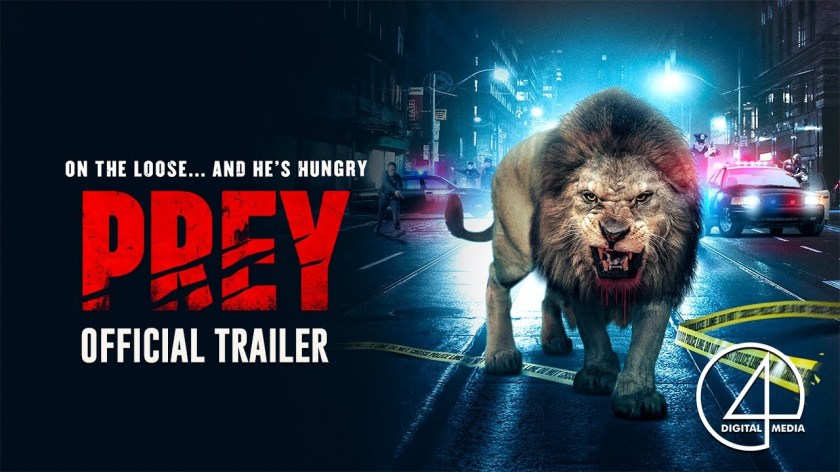
Monday’s protest was prompted by Universal Studios’ 2022 thriller, Beast, but protest organizer Buddy the Cat said the felid group was protesting “decades of tropes and injustices committed against cats by Hollywood and TV.” Examples include the undead cat in Stephen King’s Pet Sematary, the rampaging lion in Dutch horror-comedy film Prey (called Uncaged in the US), the many murderous felids in the CBS series Zoo, and Jackson Galaxy’s My Cat From Hell.
“We’re tired of always being cast as villains while dogs are the heroes. Take a cat like me, for instance,” Buddy told a reporter. “It’s easy to mistake me, with my razor sharp claws and ripped physique, for a threat to humans. But really I’m just a cuddly little guy who likes chin scratches.”
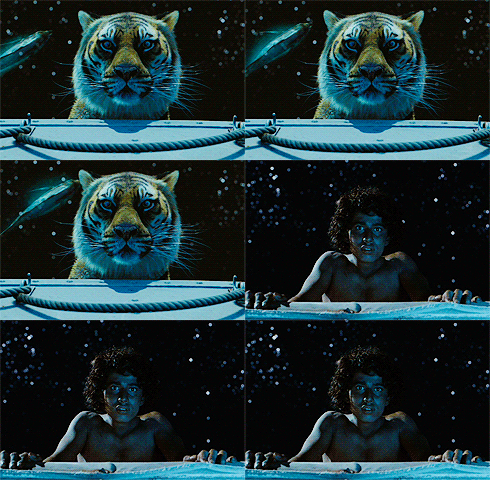
Linus, a 14-year-old Bengal tiger who starred as Richard Parker in the 2012 hit Life of Pi, said he was a young actor who didn’t know better when he agreed to portray the threatening antagonist.
“Now that I’m older and I have all this Frosted Flakes money coming in, I can be picky about the roles I accept and only choose movies I think will be Grrreat!” he told an interviewer. “But what about the next young tiger, or the jaguar fresh off the boat from the Amazon, who doesn’t have the power to tell the director a certain scene is offensive?”
Linus also took issue with the script, in which the writers have him refusing to share fish with Pi.
“Did you see the boat? It was filled with fish! What am I, some sort of glutton who’s gonna eat 200 pounds of fish while the human starves?” Linus asked, bewildered. “I mean, according to Hollywood we’re angry, dangerous, murderous criminals and we stuff our faces all the time. No wonder people are scared of us!”
Prey, also known as Uncaged, depicts an angry lion rampaging through Amsterdam and eating pretty much everyone.
Beast stars British actor Idris Elba and tells the story of a widowed medical doctor who takes his two daughters to South Africa, where they stay with a family friend and embark on a tour of the native wildlife.
Unbeknownst to them, an adult male lion is on a rampage after a team of poachers entered the reserve the previous night and slaughtered his entire pride. While Elba’s character, his two daughters and his friend (Sharlto Copley) explore the reserve, they discover the mutilated remains of an entire village’s population and eventually come face to face with the murderous lion.
“What’s all this barney, then?” Elba said when asked about the felid protest. “Well that’s unfortunate, innit, mate? I played a tiger in The Jungle Book, a proper tiger. I love cats.”
The actor, who rocketed to fame off the strength of his portrayals of Stringer Bell in American police drama The Wire, the title character in British detective thriller Luther, as well as major roles in franchises like the Marvel Cinematic Universe, the Star Trek reboot movies and science fiction action-adventure Pacific Rim, said he’s taken the cat’s criticism to heart.
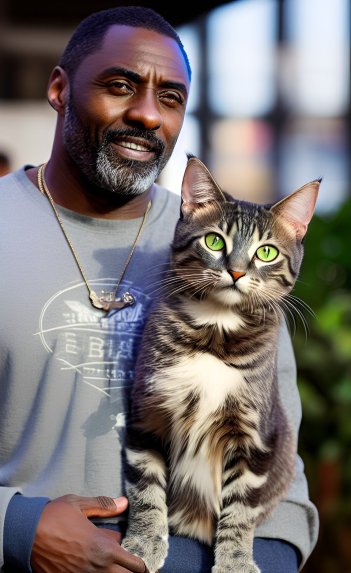
“Buddy’s a good bloke,” says Elba, pictured with his feline friend.
“Me and me mate Buddy, we like to grab a pint on the regular, d’ya know what I mean?” Elba said. “This tosh with the movies, it’s gotta stop. Me mate Buddy is a good bloke, innit? So if he says Hollywood has to have more positive portrayal of cats, then that’s what we’ll do.”
In addition to their negative portrayal in films, which felids likened to the offensive portrayal of Italian-Americans as mafia figures, many cats cried foul at the idea that one of their kind would harm the beloved South African actor Sharlto Copley.
“That’s a very offensive portrayal,” said Chonkmatic the Magnificent, King of All Cats. “Sharlto Copley is the guy who made District 9, about aliens who eat cat food. Everyone knows cats love District 9. We wouldn’t lay a claw on Sharlto!”
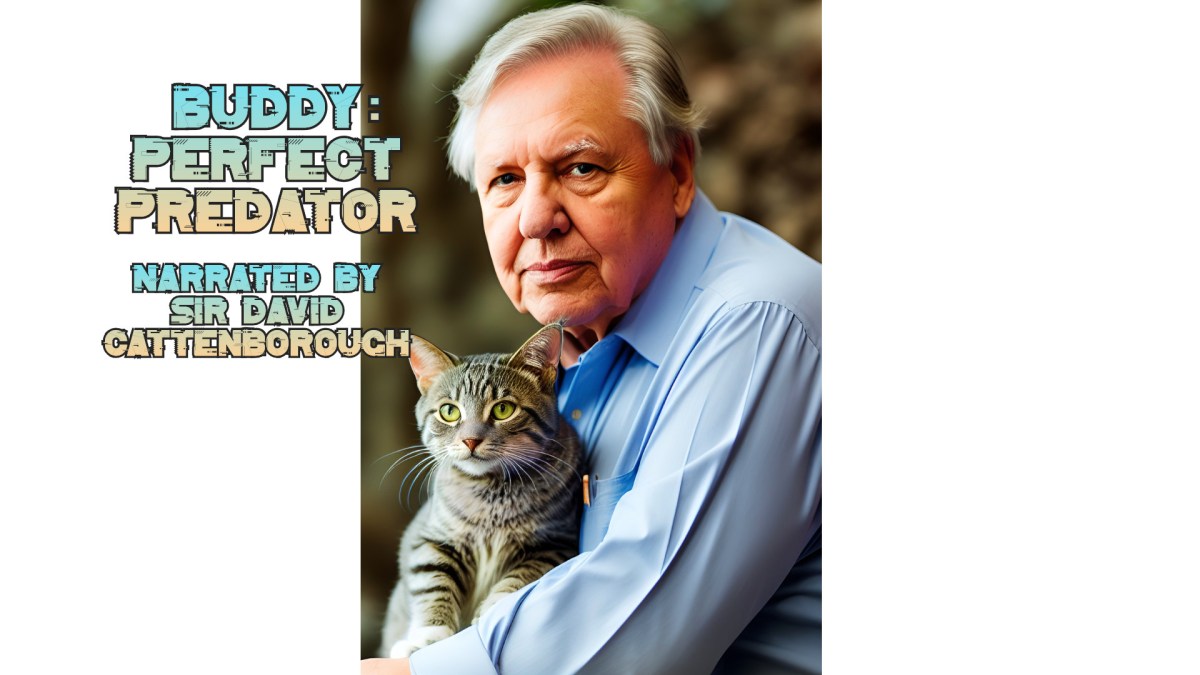
Watch the premiere of Buddy: Perfect Predator exclusively streaming NOW on PITB!
It’s here!
The long-awaited documentary feature: “Buddy: Perfect Predator” has arrived on PITB.
Join Sir David Cattenborough and his intrepid crew of wildlife videographers as they follow the elusive Buddinese tiger through the dense undergrowth and dangerous terrain of its natural habitat in suburban New York.
Watch never-before-seen footage of the silver-furred Buddy stalking his prey, lounging, sleeping and eating, and follow a tense encounter between the Buddy and a red laser dot.
“I’m extremely proud of the work we’ve done here, and I believe our audience will be thrilled to learn more about this little-known creature, who shares so many qualities with tigers, lions, jaguars and leopards,” Cattenborough said.
“We fell in love with the silver-furred Buddy as we kept our cameras trained on him, and we think our audiences will find him just as charming as we did,” the British naturalist said. “He’s such a good boy!”
(Please ensure your sound is enabled or wear headphones to hear the narration and the atmospheric sounds.)
About this video:
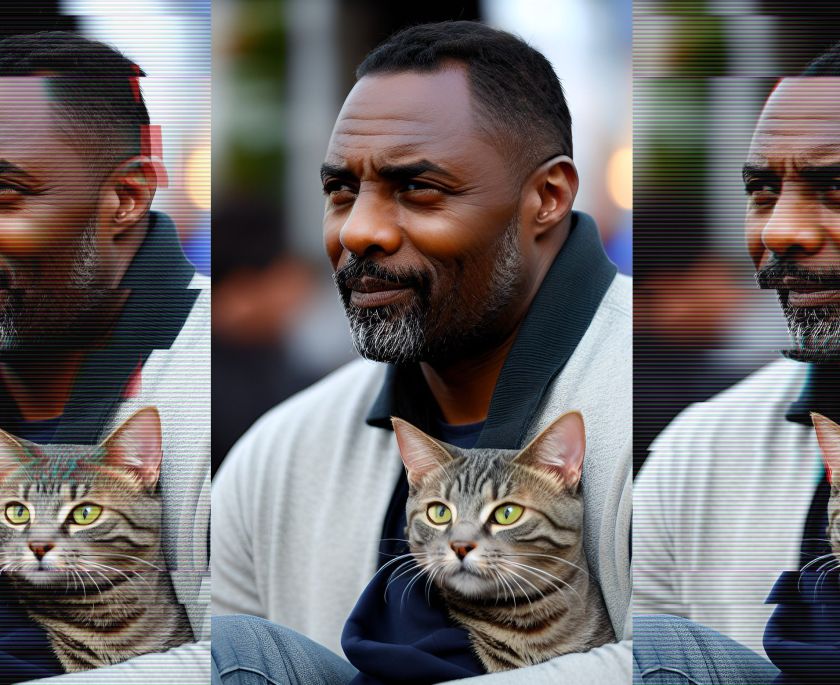
This story was made possible with the use of artificial intelligence tools. To create the images of Sir David Attenborough with Buddy, we used a natural language processing AI trained to output realistic-looking images and Pixlr to refine the images in post. To create the narration, we assembled samples of Attenborough speaking and trained a vocal synthesis AI, based on brand new technology, to mimic Attenborough’s unique pronunciation, cadence and rhythm, then layered the audio with a background of various nature sounds and incidental sounds, such as a tiger roaring.
Just a year ago it would not have been possible to generate images like this or faithfully recreate Attenborough’s famous narrative style, proving AI not only allows users to achieve things that were previously impossible, but has been making major leaps forward in short periods of time.
We believe AI, when properly used, can be a great instrument in the creative toolbox.
Finally, a thank you to Buddy for being a good sport about having cameras in his face. Great job, Bud!