OwlKitty Becomes Tom Cruise’s Wingman In ‘Top Gun With A Cat’

The famous cat takes to the skies in her latest movie cameo.

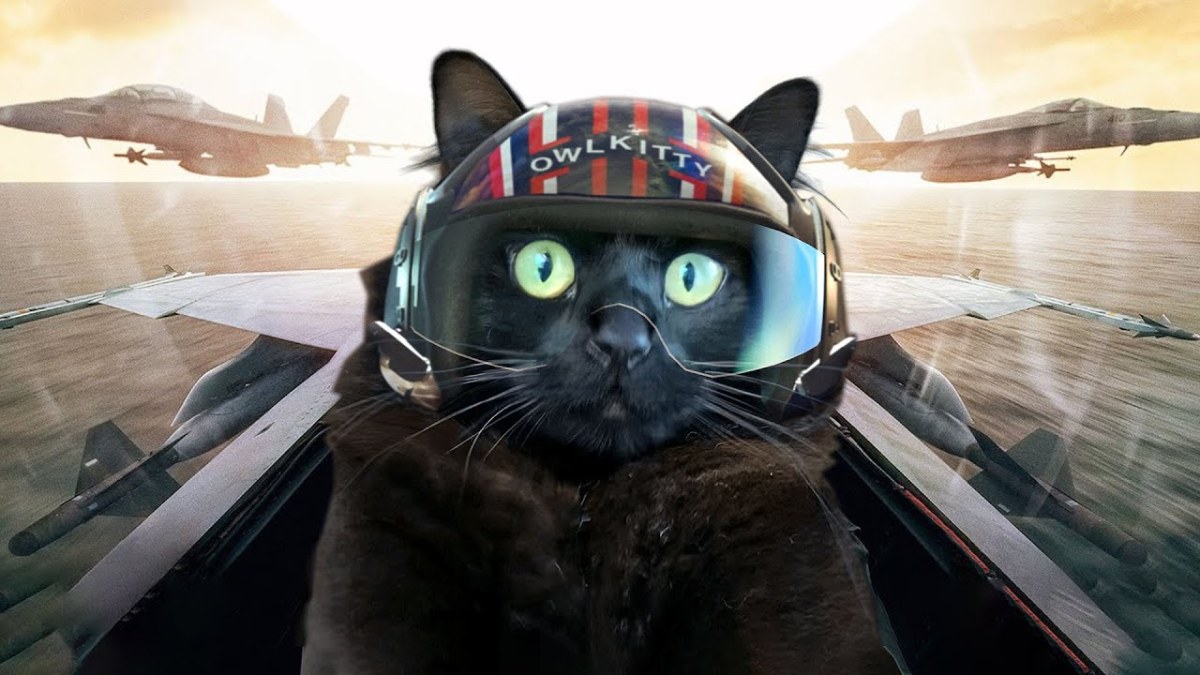
The infamous OwlKitty has returned to the big screen, this time flying wing alongside Tom Cruise’s Maverick in a meowified version of Top Gun.

OwlKitty’s patient humans are known for meticulously filming their beloved black cat in front of green screens and inserting the cute moggie into various movies and TV shows, from Jurassic Park to Titanic, Home Alone and even Netflix’s The Witcher.

OwlKitty’s female, so technically she’s Cruise’s wingwoman, and we see her in the cockpit of an F-18 Super Hornet, with Cruise getting a dressing down by the admiralty, and in the iconic beach volleyball scene.

10 Signs From Your Cat You’ve Misinterpreted As Love

Buddy the Cat clears up common misconceptions people have about cats expressing affection for their loyal human servants.

The internet is awash with listicles claiming your cats love you, insisting you’ll know for sure once you’re able to recognize the signs.

Well we’re here to tell you that love is a strong word, and if you’re lucky your cat merely acknowledges your existence, human. Here are the 10 feline behaviors most commonly mistaken for love:

  1. Grooming: “Grooming means one thing, and one thing only: We think you’re gross and you need a bath,” Buddy the Cat says. “You’re disgusting creatures, allowing your dead skin cells to accumulate all over you without washing them off until you take those horrific ‘showers.’ I could take a claw right now, run it down your arm, and come up with enough dead skin cells to season a salad. Now that’s nasty.”
  2. Kneading: “The Feline Propaganda Ministry seeded a story that kneading is some sort of affectionate behavior left over from kittenhood, and that by kneading you, we’re identifying you as our surrogate moms. That’s hilarious,” says Buddy. “We’re simply tenderizing our meat.”
  3. Head boops: “In ancient Rome, slaveowners would mark their property with brands or tattoos saying ‘PROPERTY OF POMPEY MAGNUS’ and that sort of thing. That’s what we’re doing with head boops. We’re using the pheromone glands on our heads and cheeks to mark you as our slaves, so other cats don’t try to lay claim to you.”
  4. Bringing you presents: “You humans eat the most disgusting food, like broccoli, potatoes and oranges, which are particularly revolting. When we bring you presents, we’re trying to fatten you up for later when we eat you.”
  5. Sleeping on you. “You’re warm. End of,” Buddy explains. “By sleeping on top of you, we also ensure you aren’t going anywhere, and will be available to fetch us snacks should we wake up hungry.”
  6. Putting our butts in your face: “You like that? Sniff it, human servant!”
  7. Tails held straight up: “The tips of our tails are actually quite sharp, and we brandish them like weapons. Weapons that say ‘There will be no disobedience or dilly-dallying here. Run along now and fetch us some yums.'”
  8. Meowing: “There is no equivalent for ‘please’ in meowenese. We meow because we know you’re hopelessly obtuse creatures and you can’t read the simplest tail, ear or whisker movements. Meowing is like speaking slowly to a child who’s had too many head injuries. ‘Massage…my…head…human. That’s a good human!'”
  9. Purring: “A purr is just a quiet roar. It means we’re happily thinking of ways to kill you.”
  10. Tolerating you: “Humans often mistake grudging acceptance for love. Just because we tolerate you doesn’t mean we love you. It means you provide useful services, but if that calculus should change — say, by providing subpar treats or not serving wet meals as delicious as the ones served by the neighbor two houses down — then we’ll simply move house.”

Kitten With No Sex Organs Up For Adoption, Plus: Cat Proves The Dog Is HIS Pet (VIDEO)

Hope the Cat’s condition is so rare it doesn’t have a name, but her rescuers say it won’t lead to health complications and Hope is otherwise a very normal and friendly cat.

We all know what it’s like — you’re trying to get something done when your pet, beloved as he or she is, has decided to be really annoying in insisting on treats.

Finn the cat was in this position recently when his pet, Piper the Cavalier King Charles Spaniel, had her eye — or more likely her nose — on a small bowl of Cinnamon Toast Crunch on the kitchen counter. Piper couldn’t reach the tasty snack, so Finn climbed up, fished out a piece of cereal one at a time and dropped them for his loyal canine companion. (Finn himself had no interest in the sugary cereal, lacking in meat as it is.)

This should settle any remaining questions about where cats and dogs stand relative to each other:

Homeless kitten from UK has rare condition, is neither male nor female

A kitten rescued by a shelter in Warrington, about 20 miles west of Manchester, was originally listed as female and given the name hope. However, during a routine exam, a veterinarian found Hope does not have reproductive organs, according to The Guardian.

“There’s an outside possibility of some ectopic ovarian tissue hiding away internally but we think this is extremely unlikely … This is so rare that there isn’t really a commonly used term for this condition, but it is effectively sexual organ agenesis,” said Fiona Brockbank, senior veterinarian at Cats Protection in Warrington. “While this means we don’t have any previous cases [on which] to base our knowledge of how this will affect Hope in the future, we spent time monitoring this cat to ensure they can urinate and defecate appropriately before they were considered ready for rehoming.”

Hope’s condition is so rare it doesn’t have a name, but shelter manager Beni Benstead told the newspaper that shouldn’t dissuade potential adopters. Hope is very friendly with other cats at the shelter and “has been a delight to care for.”

Vote BUDDY 4 America!

Americats need great leadership. Who but Buddy can lead ‘Murica into the shining future?

Today is Tuesday, Nov. 8, and Buddy needs YOU to vote!

As patriotic Americats know, our beloved President Buddy was impeached after jealous rivals claimed his brilliant plan to move the Earth closer to the sun to fight Coronavirus would have been disastrous, and enlisted the help of “scientists” who scared felines into believing our planet would be in danger despite President Buddy assuring everyone that we’d all have nice weather.

Also, there was the small matter of a “scandal” involving turkey embezzlement, but that was never proven in a court of law.

votebuddy2022

Real patriotic Americats know Buddy was the best president of all time, and it’s their duty to lay the groundwork for his triumphant return in 2024 by voting in his hand-picked candidates today! If turkey raining down from the sky, treats aplenty and mandatory siestas 10 times a day sound like good policies to you, then obviously you’re a smart kitty, you’re patriotic, and you should vote Buddy!

If you like the idea of Roombas for every cat, catnip dispensaries on every corner, a new government agency dedicated to developing new toys, and a badly-needed infusion of new boxes, you should vote Buddy! Because you’re smart!

If for some reason a Buddesian-aligned candidate is not listed on your ballot, you should write in “Buddy the Cat” and send a strong message that you’re an intelligent, patriotic voter.

Paid for by BUDDY 4 PRESIDENT and THE UNITED PATRIOTS FOR BUDDY ASSOCIATION. ‘Murica!

votebuddy

What Is Schrödinger’s Cat?

Cats are at the heart of one of the most famous thought experiments in science.

If you’ve spent time around physics types, listened to media appearances by science educators like Michio Kaku and Brian Greene, or even watched episodes of The Big Bang Theory, you’ve almost certainly heard of Schrödinger’s cat.

But what is it, why is it important, and what does it really have to do with cats? Most importantly, if you’re a cat lover, does it involve harming cats?

I promise you, if you stick with me and have a little patience, you’ll not only understand Schrödinger’s cat, but a hugely important element of physics will be demystified for you.

QuantumEntanglementCat

Let’s take a step back. First, we all learned in school that Isaac Newton was the “father of physics,” and Albert Einstein came along about two centuries later, revolutionizing physics by adding to Newton’s work and coming up with his own, more accurate model.

To this day, Newton and Einstein are in a class by themselves among physicists because they single-handedly changed everything we know about the natural world.

We all remember the famous story about Newton watching an apple fall from a tree, wondering why the apple fell down instead of up, and eventually developing his theory of gravity. Newton went on to develop his theories, which describe everything we see in the natural world, from that apple falling to the complexities of orbital mechanics.

Everything seemed to work perfectly, until a physicist named Max Planck came along in 1905 and published a paper introducing quantum physics.

What is quantum physics?

Now the word “quantum” has been incorporated into practically everything these days and has been so utterly abused as a marketing buzzword, a way to add a veneer of science to things that are otherwise nonsense, that it’s essentially a meaningless word to most people. Practically everything is described as quantum, from deodorants to claims of psychic telepathy.

But the gist of it is this: While Newtonian physics does indeed describe everything we see with our own eyes accurately, it does not accurately describe things at the subatomic level.

In other words, there are two sets of rules in our universe. Everything larger than an atom behaves according to one set of rules in our universe, and everything the size of an atom or smaller — which includes subatomic particles — behaves according to a different set of rules.

Not only that, but at the quantum scale, things get really, really weird.

They behave in ways that are completely at odds with everything we intuitively understand about reality, so much so that even Einstein himself was disturbed by what he found. Einstein famously described quantum entanglement — the ability of two different objects to be linked and share properties, regardless of how far apart they are — as “spooky action at a distance.”

So what the hell does this have to do with cats?

Ready to get even weirder?

Thanks to Planck, Einstein, John Stewart Bell and innumerable physicists — who are still studying these concepts, and still winning Nobel prizes for them in 2022 — we know that two particles can be “entangled” and will remain that way no matter how far apart they are.

You could take one particle, transport it 10,000 light years away, and it would still be entangled with the other particle.

But it gets even stranger than that.

Schrödingerscat

Our entangled particles have certain properties, such as their spin, which are unknowable until we measure them. In fact, they exist simultaneously in all possible states until the moment when we observe them, at which time the wave function “collapses.” It’s called quantum superposition.

Not only that, but when we measure one particle in an entangled pair, the second particle’s wave also “collapses” (settles on a certain state) and we know its spin instantaneously, regardless of how far apart the particles are.

If I measure an entangled particle here on Earth and find its spin is up, I know the corresponding particle that’s been moved to, say, Epsilon Eridani, 10.47 light years away, is spin down.

You can see why this would be profoundly disturbing to scientists. It violates the speed of light, and it’s completely counterintuitive. How can the mere act of observation change something in the physical world, and how can it change something else potentially thousands or millions of light years away? Everything we know, every gut instinct we have, screams that this should not be true.

But it is true.

These aren’t just ideas kicked around by scientists smoking the sticky stuff, by the way. They’ve been proven experimentally many times over. No matter how much we might dislike the idea, no matter how weird or spooky it may seem, it’s true.

Schrödingerdeadalive

Enter Erwin Schrödinger, an Austrian physicist. He devised a thought experiment that goes like this:

Imagine you have a sealed box with a cat inside. Inside the box are two buttons: One button feeds the cat a yummy treat, the other button kills the cat. There is an equal (50/50) chance of the cat pressing either button. (Other versions use a more complex system involving radioactive material, or poison, that could kill the cat, again with a 50/50 chance.)

We don’t know if the cat is alive or dead until the moment we open the box. So in this thought experiment, we can think of the cat as both alive and dead until we “measure” or “observe” by opening the box.

That’s what’s happening in the above example of quantum entanglement and the idea that a particle is neither in one position or another until we measure it.

Why is measurement the key here? No one knows. Scientists are still arguing about that. Some believe that there’s some special quality of consciousness that interacts with the universe, so the mere act of observing something can change physical reality.

Others scoff at that idea and insist we’re missing something, that it’s not the act of observation that determines the final state of a particle at all.

Regardless, the important thing here for cat lovers is that Schrödinger’s cat is just a thought experiment.

Schrödinger never had a cat, as far as anyone has been able to ascertain, and no one has used an actual cat in an attempt to reconstruct the thought experiment because 1) You wouldn’t learn anything, since cats are not subatomic particles, and 2) Anyone intelligent enough to be a physicist is presumably intelligent enough to understand how absurd, pointless and cruel it would be to use a living being in an experiment that can’t give you any answers.

For those of us who aren’t geniuses, here’s Sheldon explaining the thought experiment as a child (in Young Sheldon) and as an adult (in The Big Bang Theory):