Blog Posts

Wordy Wednesday: Visiting Japan’s Snow Monkeys

Meet the Japanese macaques, also known as snow monkeys, living in an enclosure on the side of Mt. Takao, about an hour from Tokyo.

A note on this series: Although I published some of these photos earlier, the majority have been recovered from an old drive that took a circuitous route of more than five years, three continents and four countries to get back to me. I plan to run them in themed segments on Wednesdays this summer, including Tokyo nightlife, shrines, cityscapes and more. This week’s photos are from the snow monkey exhibit at Mt. Takao.

Japanese macaques are the northernmost-dwelling of any non-human primate species.

They’re built for the cold, with heavier coats than their cousins, the rhesus, long-tailed and bonnet macaques. They also sleep in well-organized groups, rotating so each monkey gets time in the center to soak up body heat, and they’re famous for keeping warm in northern Japan’s hot springs.

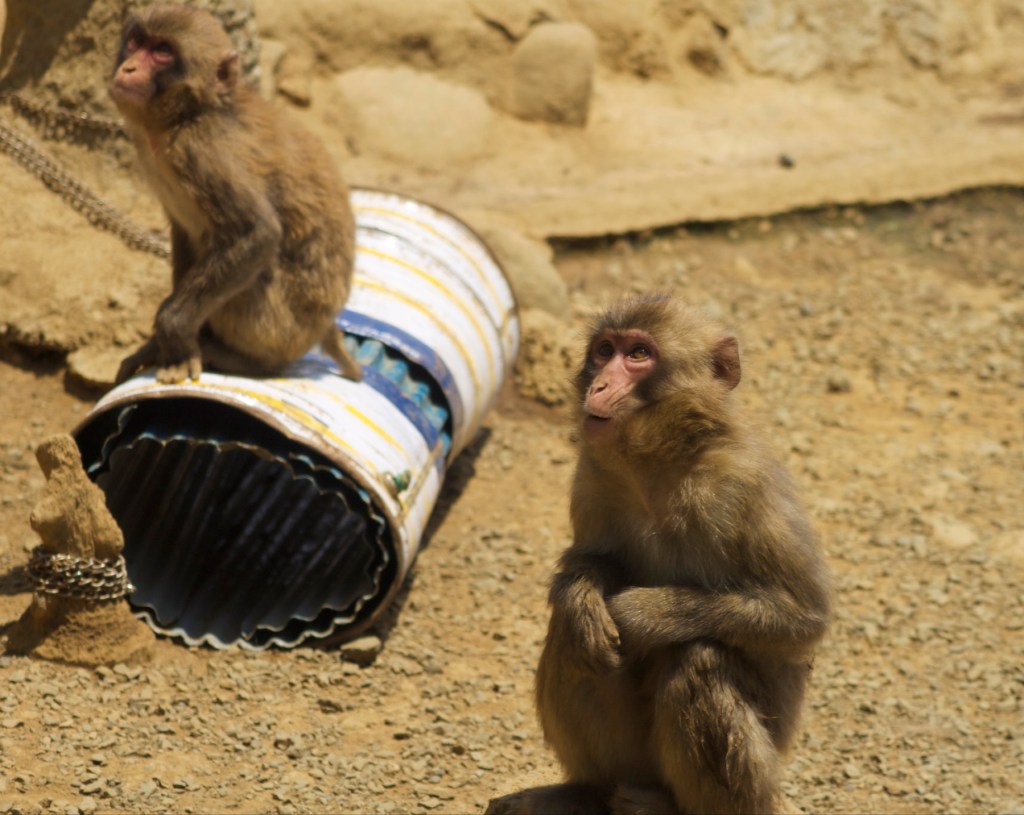
But as these photos show, snow monkeys are also adaptable, and they make the best of things during the hot, humid summers at Mt. Takao, about 51 km (30 miles) from Tokyo.

These photos were taken on a hot day in June when I was one of only a handful of visitors.
Welcome to Mount Takao! So you want to see snow monkeys?
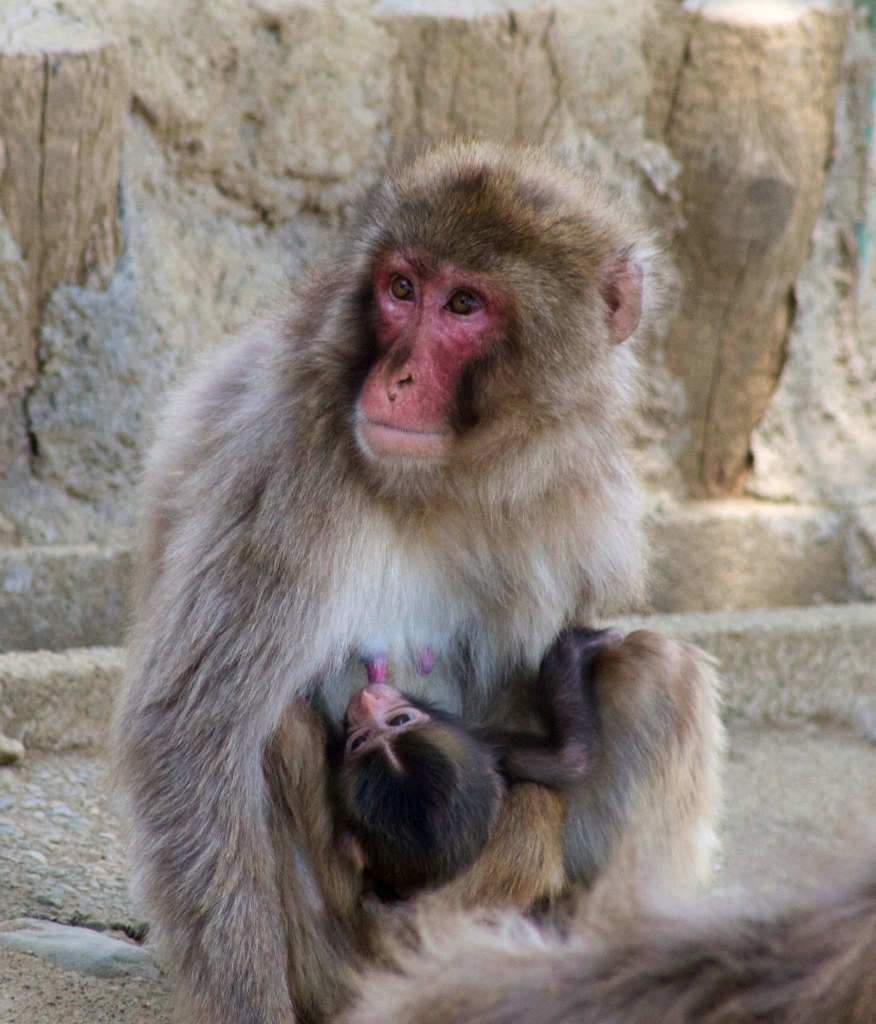
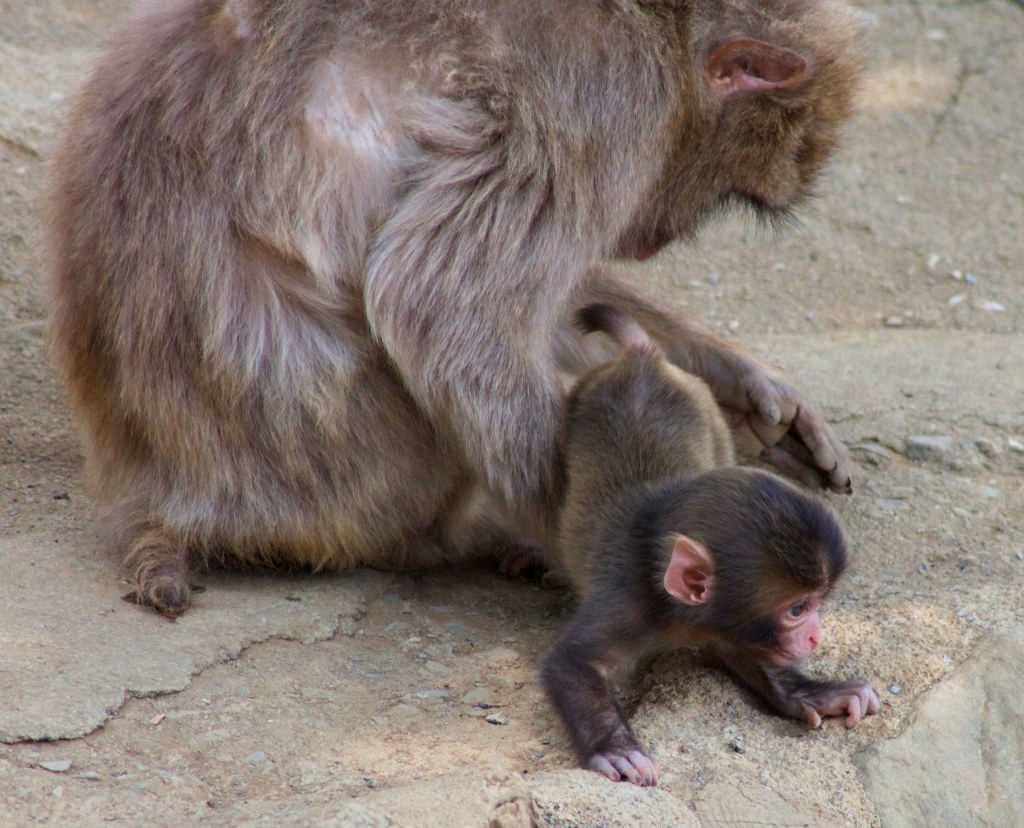
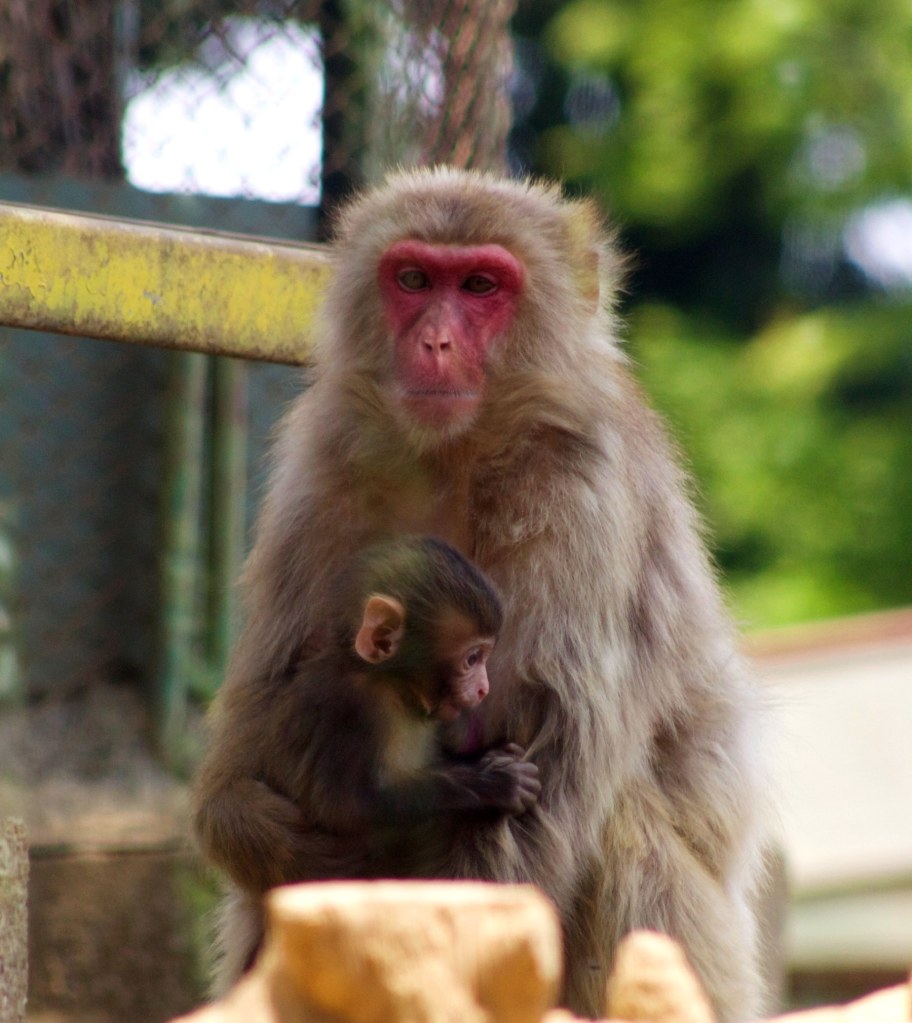
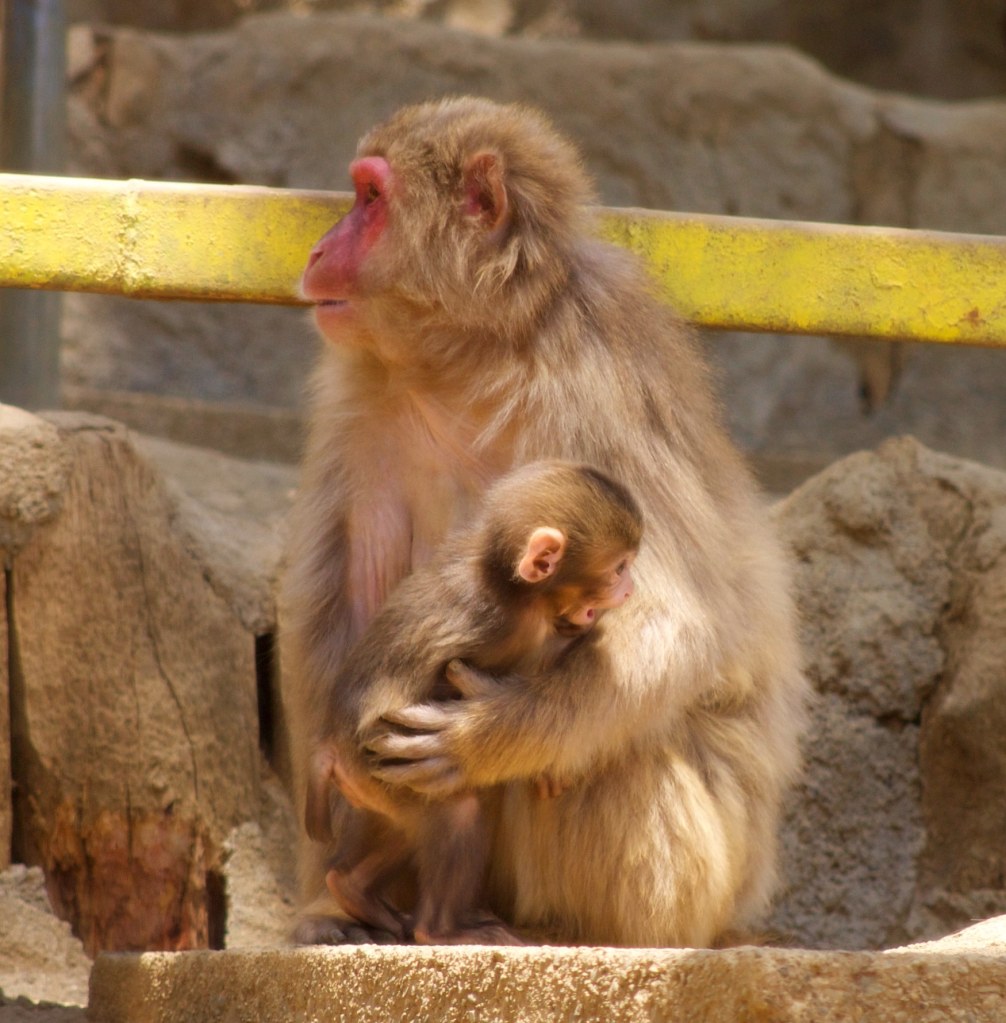
“The milk bar’s open!” Snow monkeys, aka Japanese macaques, are extremely attentive mothers. This baby is is about 8 to 10 weeks old and completely dependent on mom.
“I’ve had my fill of milk, now it’s time to explore!”
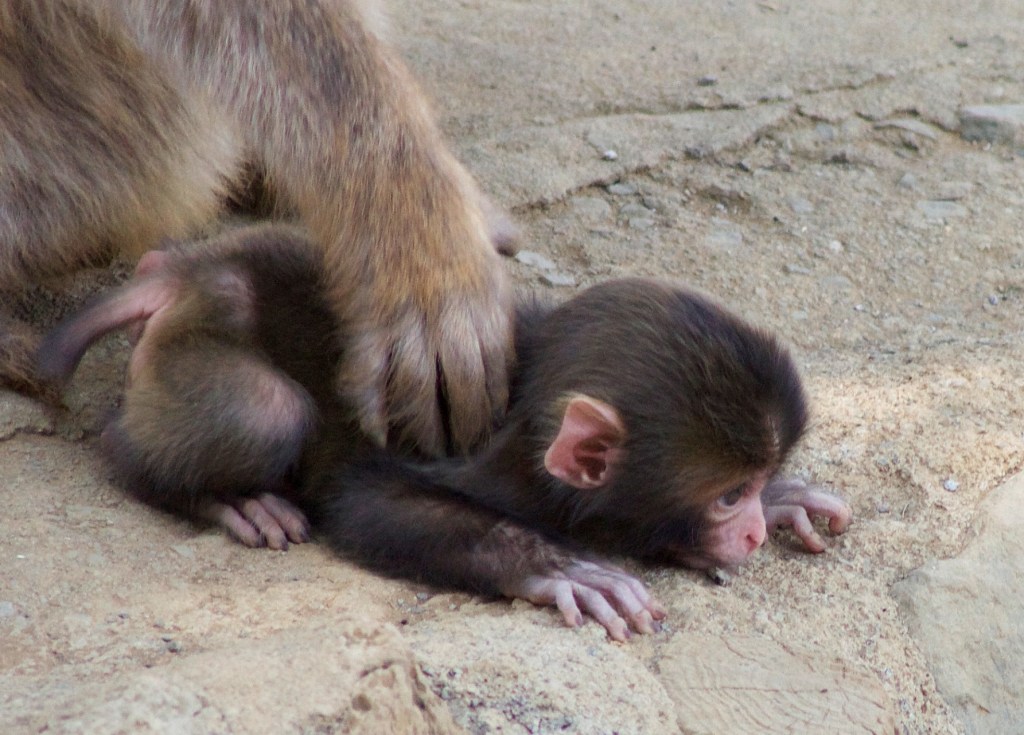
“But mom won’t let me go far! I’m too young to go off on my own, and mom is really protective of me.”
“If I could…just…get away…for a sec!”
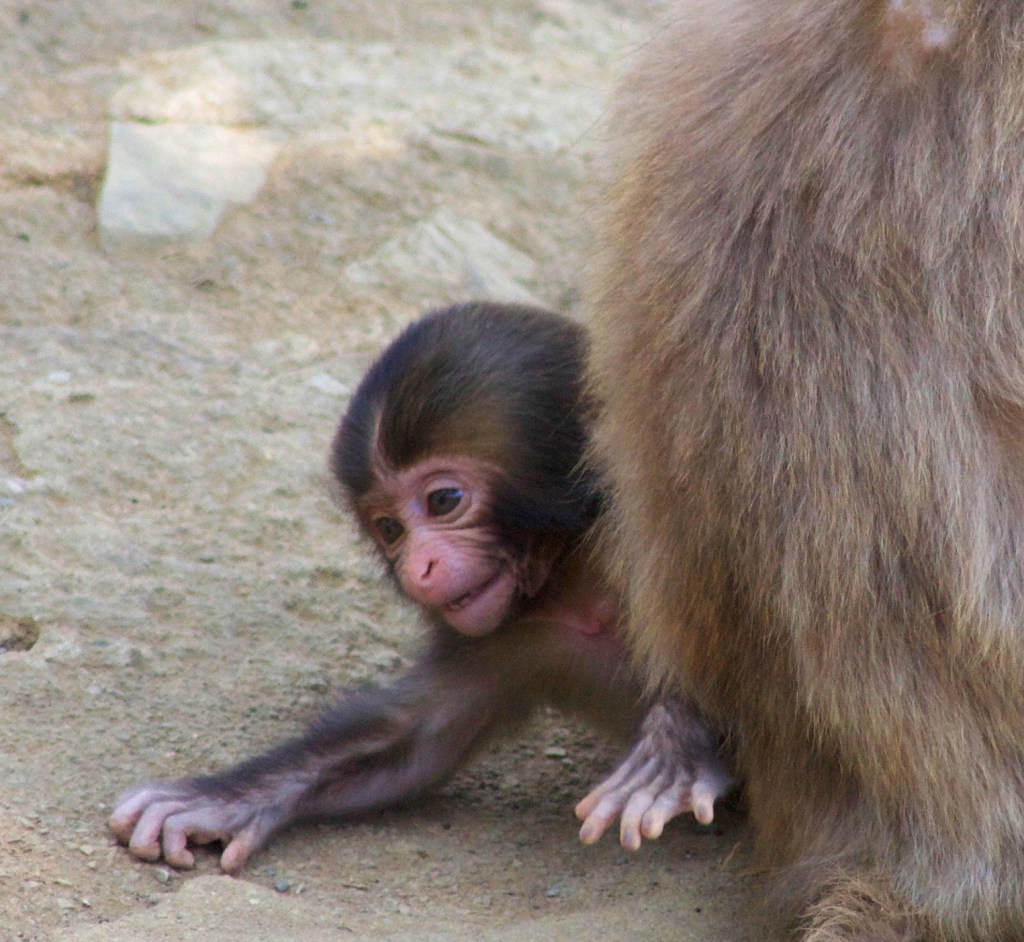
“Come on, mom! Let me play!”
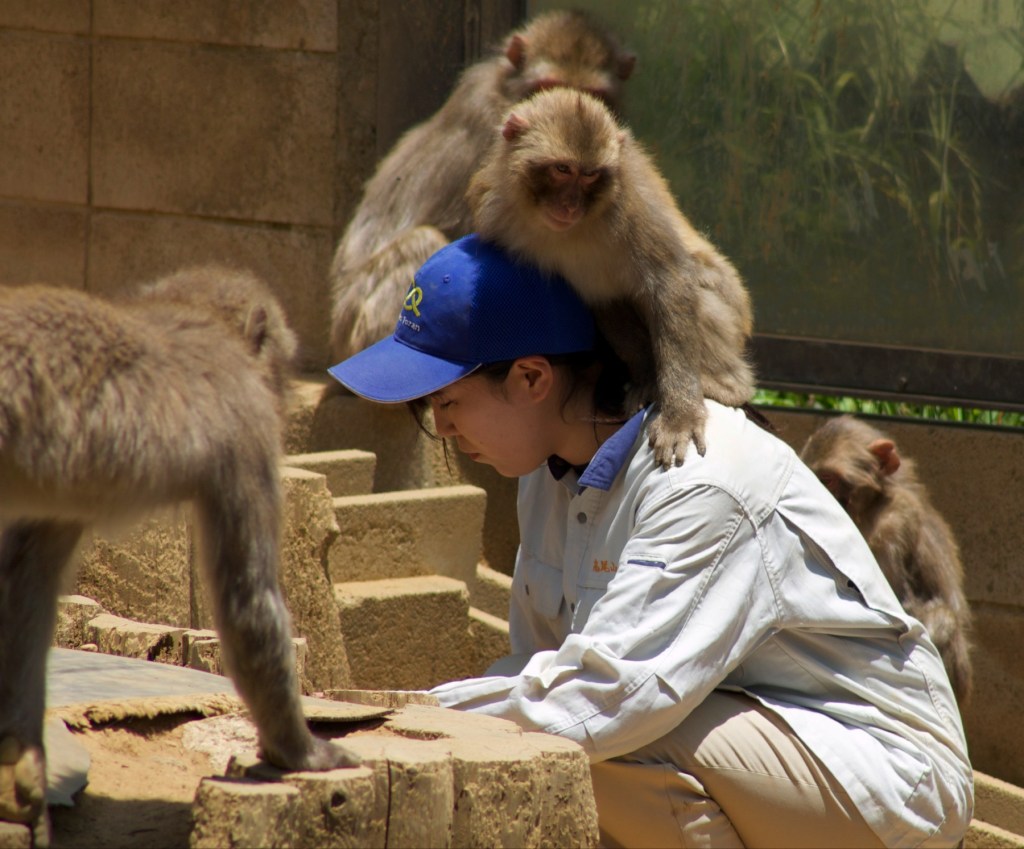
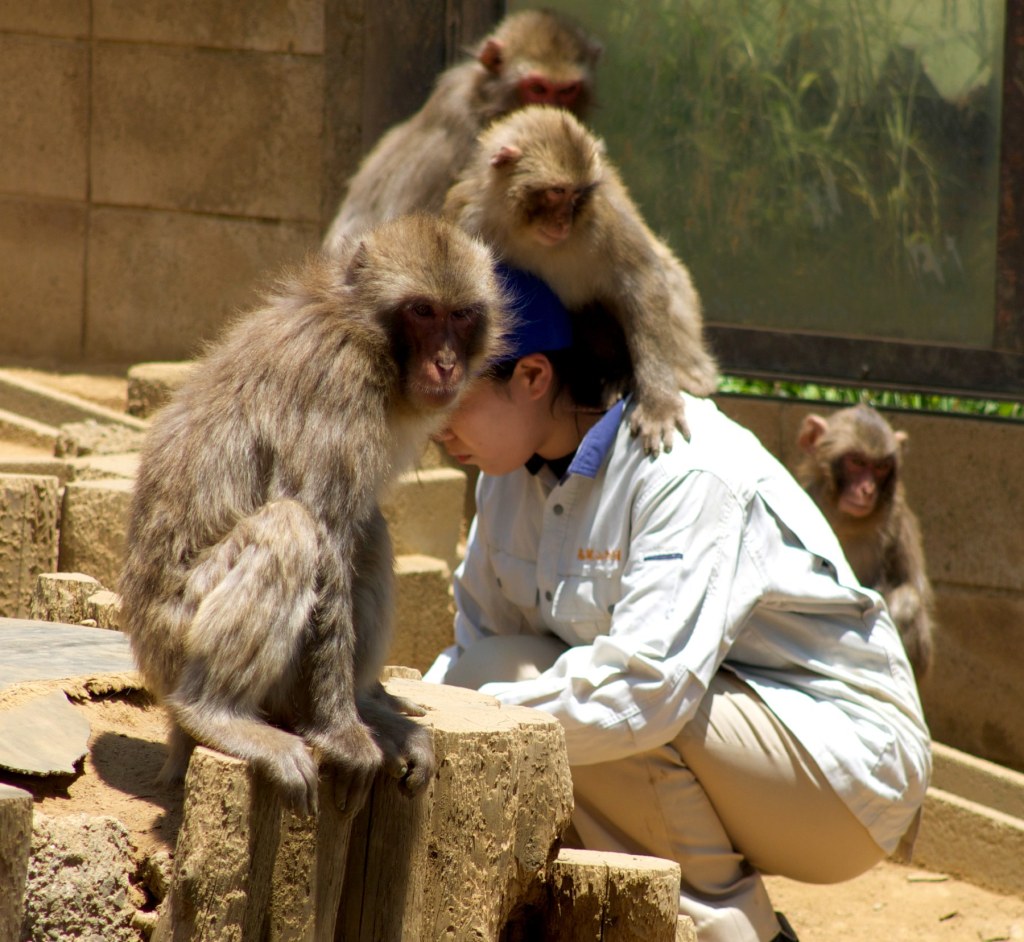
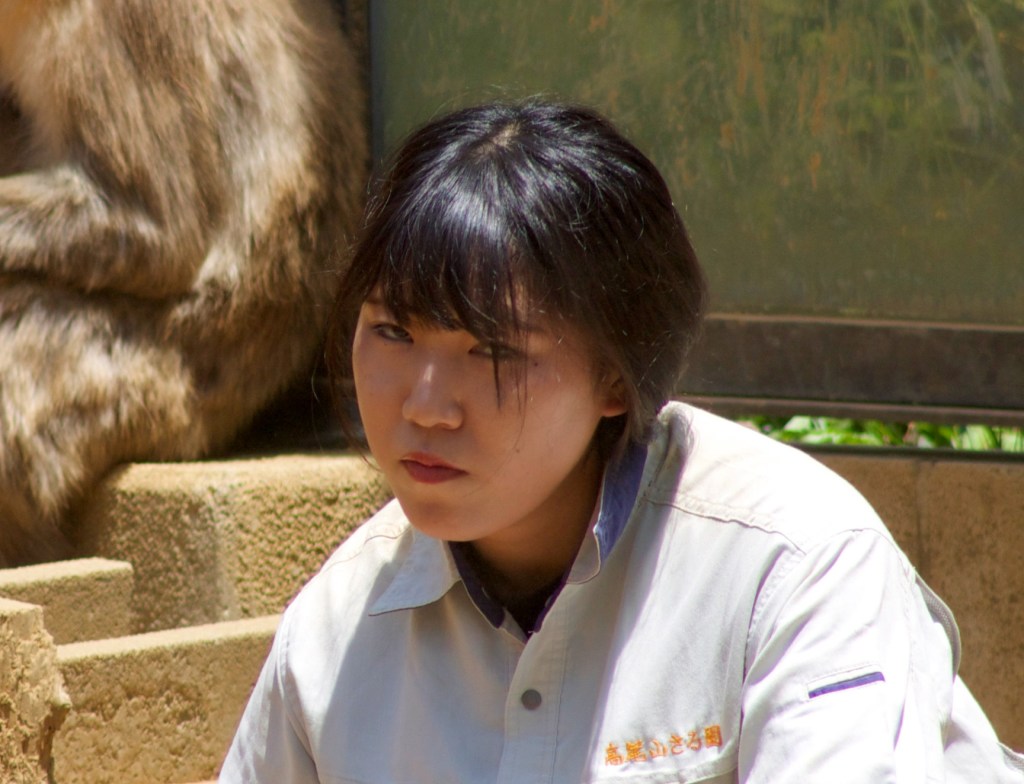
A keeper at the Mt. Takao monkey enclosure. She has a hat…but not for long. Note the mischievous monkey on her shoulders, who’s waiting for just the right moment to grab her hat and run.
The monkey on the left is like: “Oh crap, here it comes!”
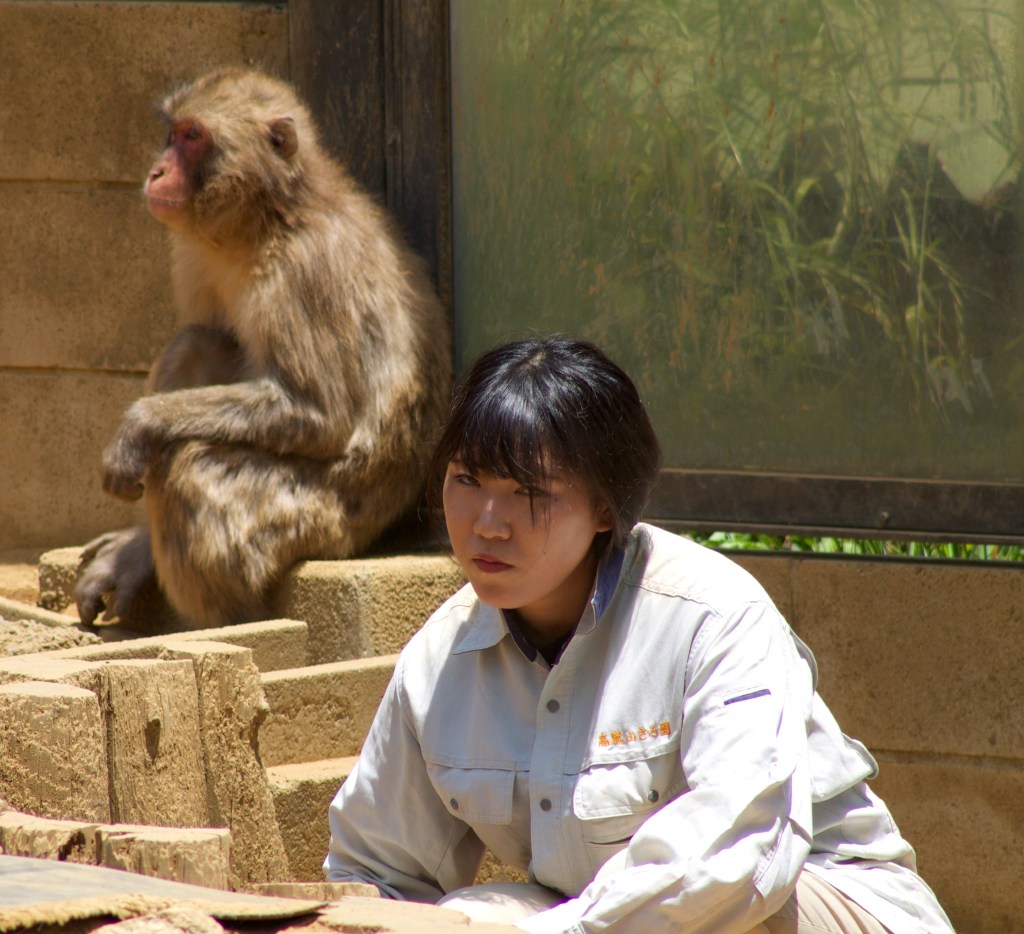
The keeper is staring daggers directly at me. There was a small crowd at the Mt. Takao snow monkey exhibit that day, and while the Hat Incident delighted the onlookers, the keeper was not amused when she saw me snapping away. I’m pretty sure she wanted to throttle me. Sorry!
Yeah, she definitely hates me.
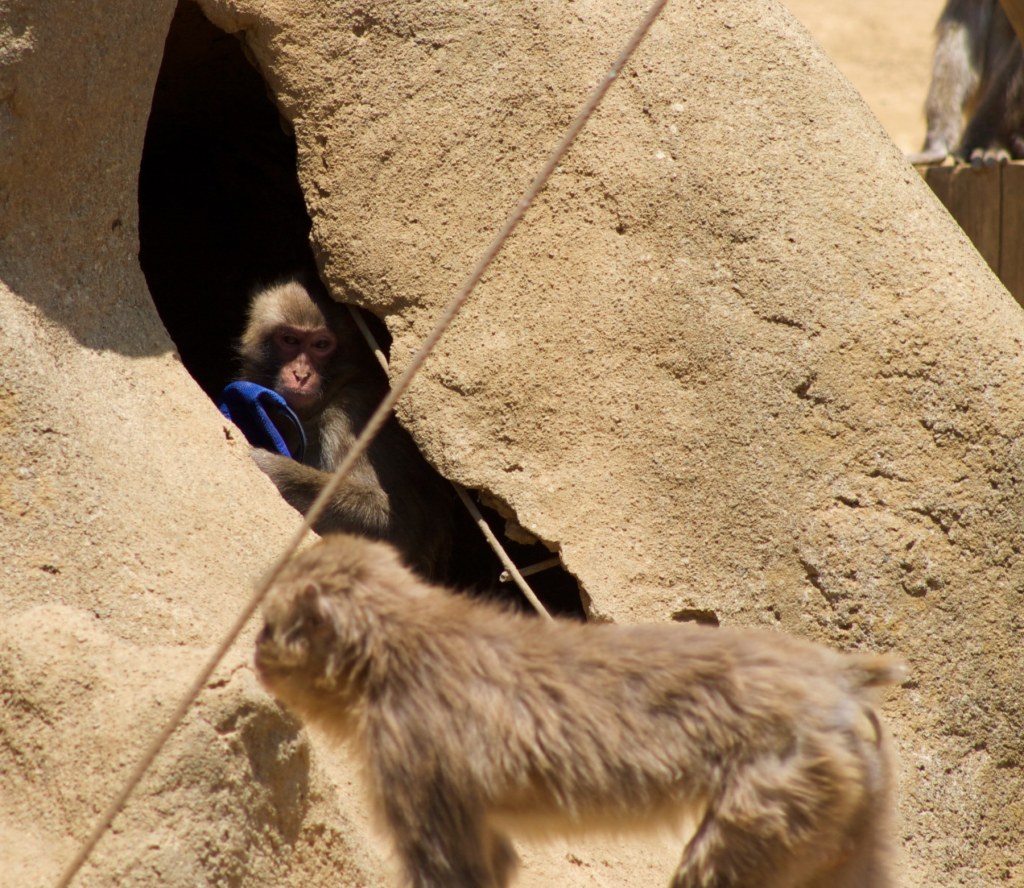
Getting her hat back was not an easy task. The devious little monkey who made off with it immediately retreated into a small cave/shelter system big enough for the macaques, but too small for humans to enter. Making matters worse, there were at least four or five entrances and exits. Every time the keeper approached, the little monkey darted inside and popped up through a different hole, like a game of wack a mole. Eventually it took both keepers to retrieve the hat.
“Oh, you know, just chillin’.”
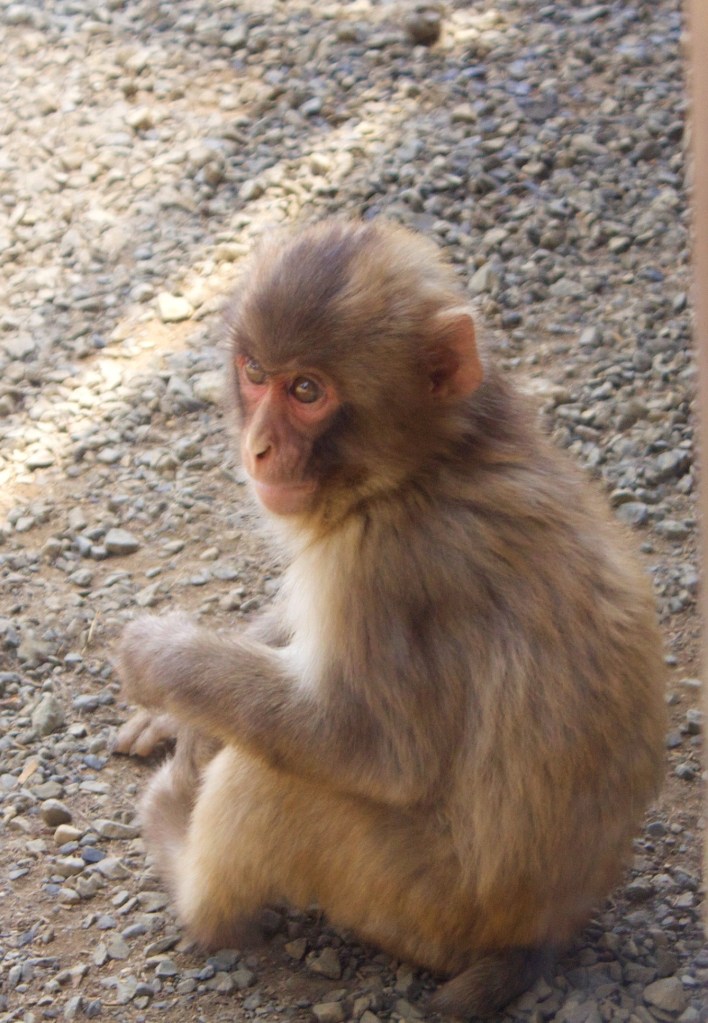
I was super close to this little lady. She was probably about two or three years old.
Macaques live in troops of up to 300 members, and their societies are matrilinear, meaning an individual monkey’s “rank” in the troop’s social hierarchy is determined by who their mother is.

Macaque troops are headed by alphas who are the strongest males and deal directly with protecting troop members, but the matriarch runs most aspects of troop life.

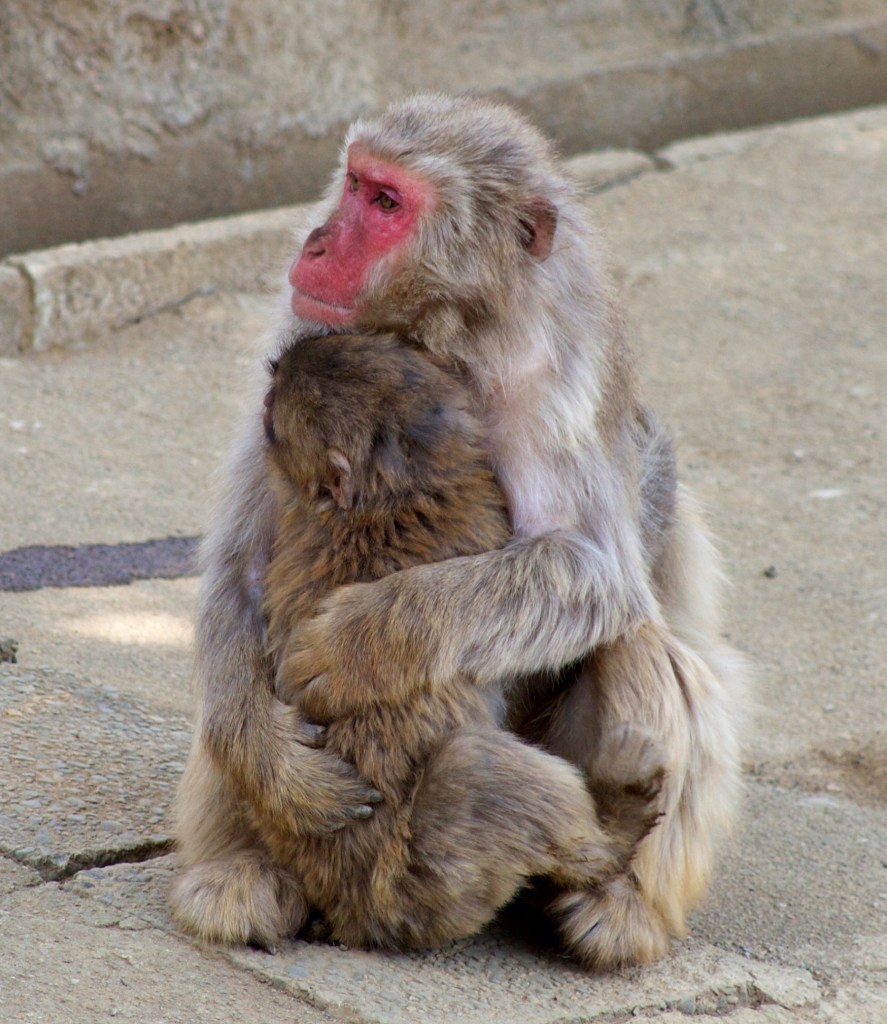
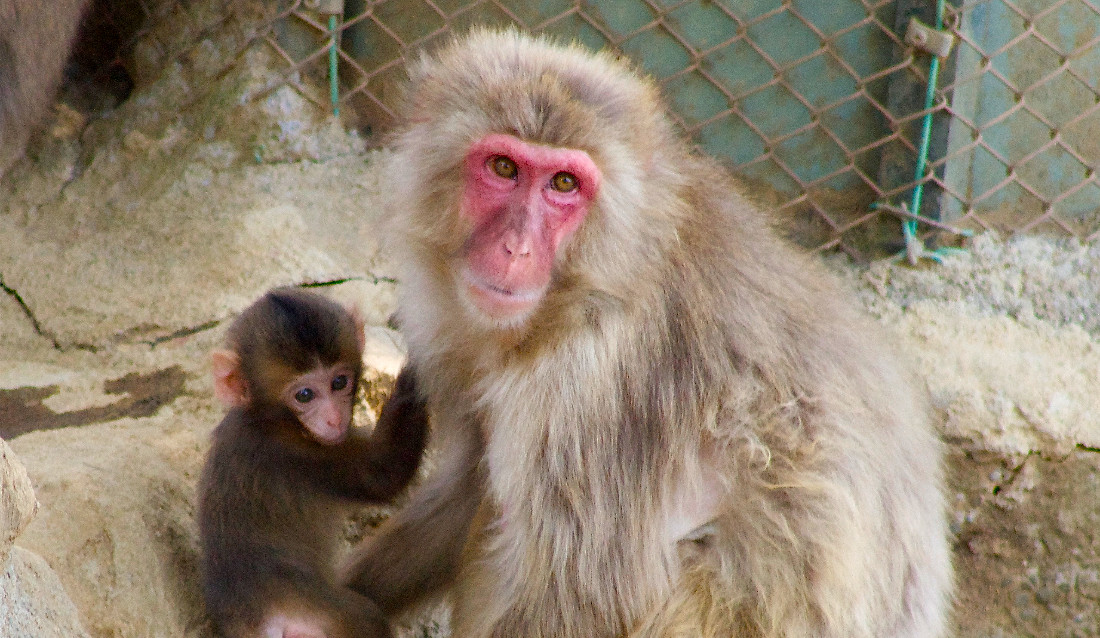
Here, a snow monkey mom hugs her child. The bond between moms and their kids is strong. Daughters stay with their mothers and their troops for life, while sons remain in the troop until they’re about five years old, at which time they depart to avoid inbreeding. They often go on to live as bachelors in small groups before joining or starting their own troops.
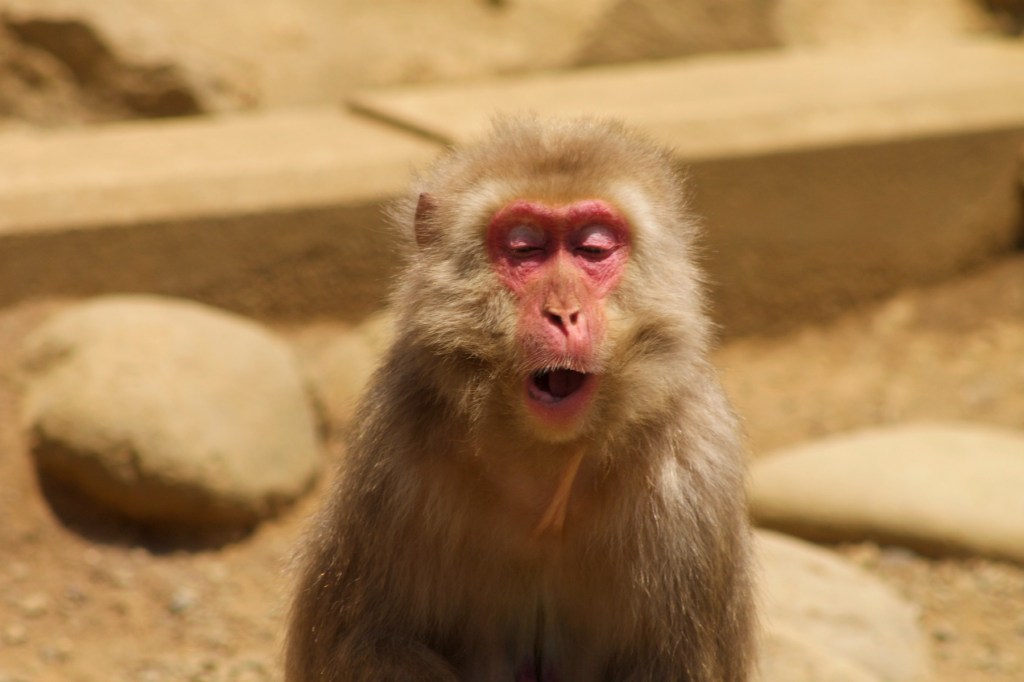
This baby is geckering. A gecker is a “loud, pulsed vocalization” usually described as a “broken, staccato noise.” People often think of it as a baby macaque throwing a temper tantrum, but it’s more than that, and it’s involuntary, meaning the babies can’t control it. In plain English, it’s a noise, accompanied by spasms and made by babies and young macaques when they’re particularly upset. Babies usually gecker when they’re separated from their mothers, being bullied by older monkeys, or in situations when they want to nurse but their moms won’t let them.
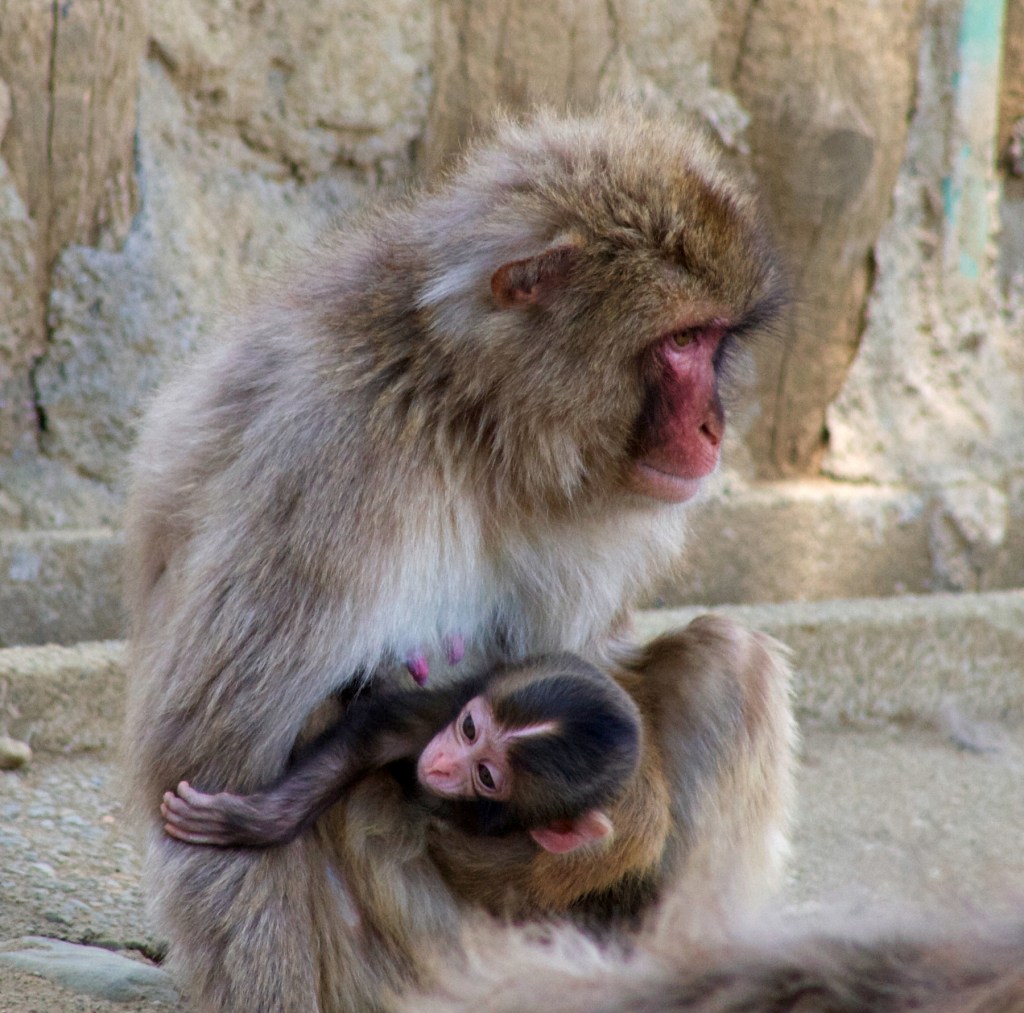
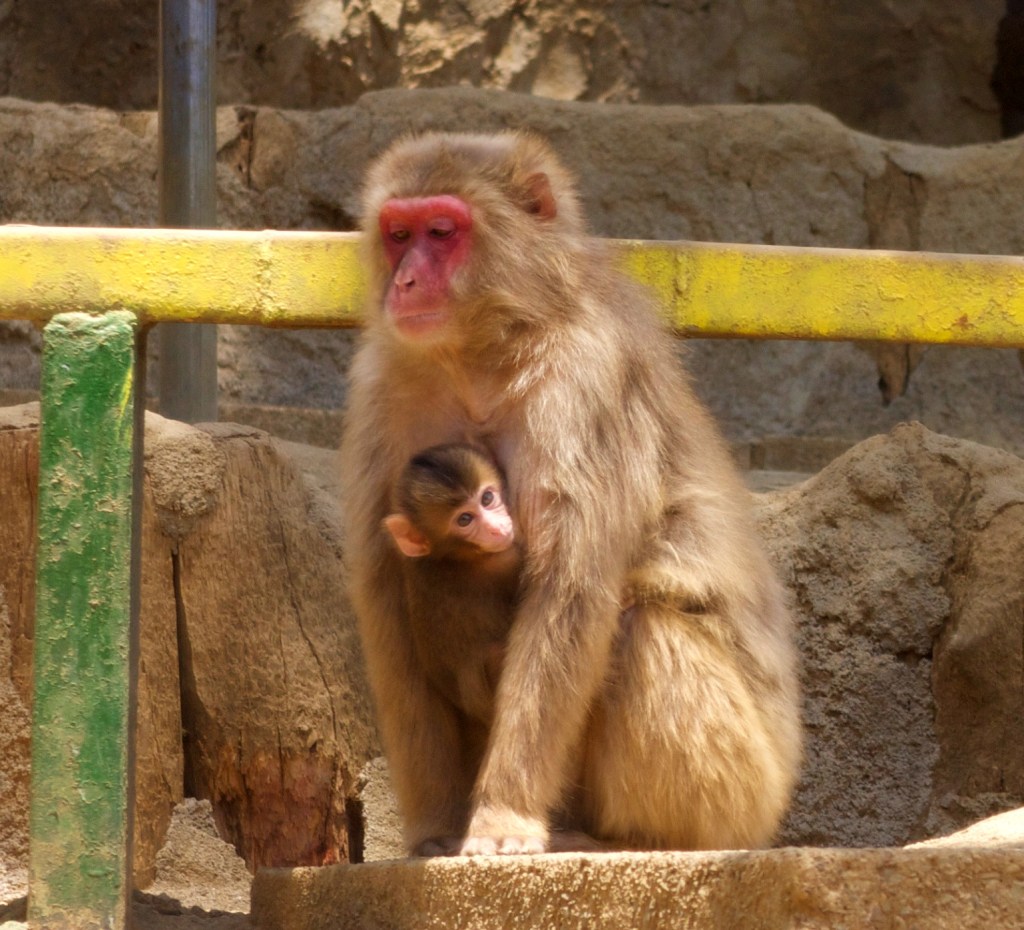
Another mom with a young nursing baby. This baby is a bit older than the one above, probably about three months old.
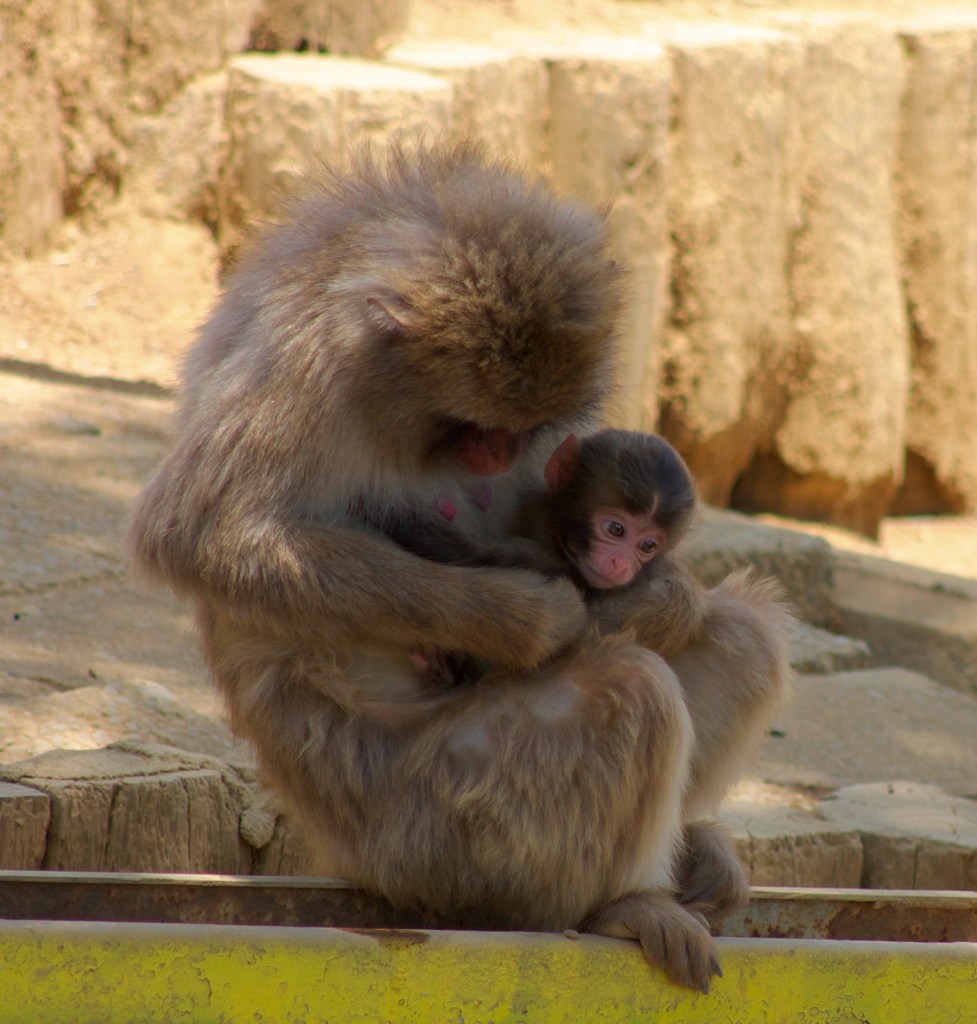
The first baby again. Notice how mom is grooming the baby. Grooming is an important aspect of macaque social relations, in addition to serving the practical function of clearing insects and other debris from fur.
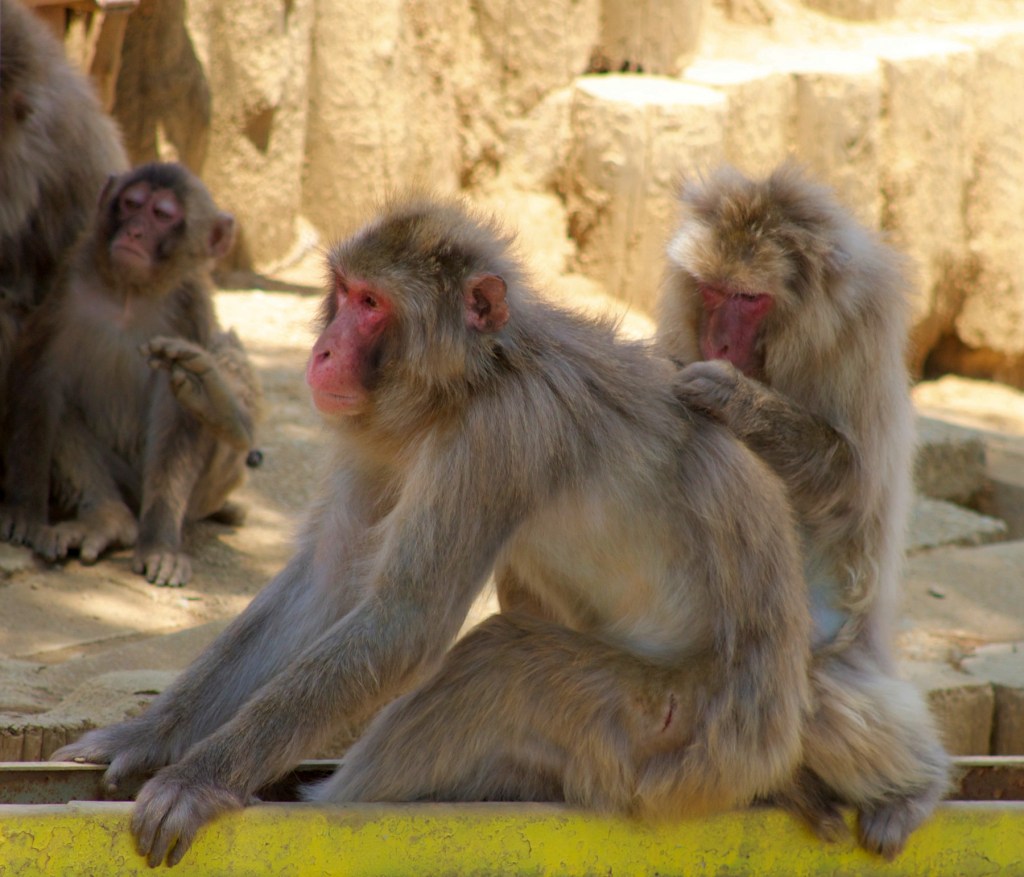
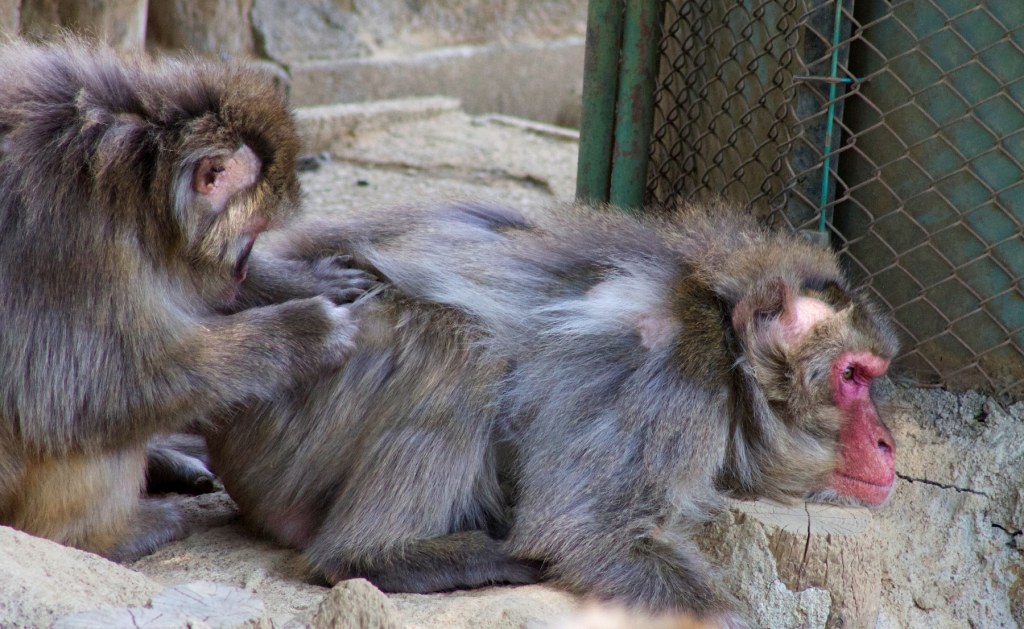
More social grooming. The monkey on the right is attentively picking insects from the fur of the monkey on the left.
He’s big, he’s old, he’s battle-scarred. He’s the alpha, and he always gets groomed first, whenever he wants. He also eats first, enjoys the best lounging spots, and gets to mate with his choice of females. In the wild, alphas don’t retain their thrones long, often being deposed within a year or two. Extraordinary alphas who keep their troops in good stead and enjoy an aura of invincibility can last a decade or longer.
Babies nurse for as many as two years and spend almost the entire first year of their lives holding onto their moms. That’s one reason why the practice of buying baby monkeys — or any monkeys — as pets is incredibly cruel, and it’s why pet monkeys are always seen clinging to stuffed animals. They’re taken from their mothers within hours or days, and they need the tactile comfort of holding onto — and being held by — their mothers.

Harry Harlowe’s infamous experiments in the 1960s proved that the physical comfort of being held is crucial to the psychological development of all primates, humans included. If a baby is denied that, the consequences manifest as severe psychological issues later in life.
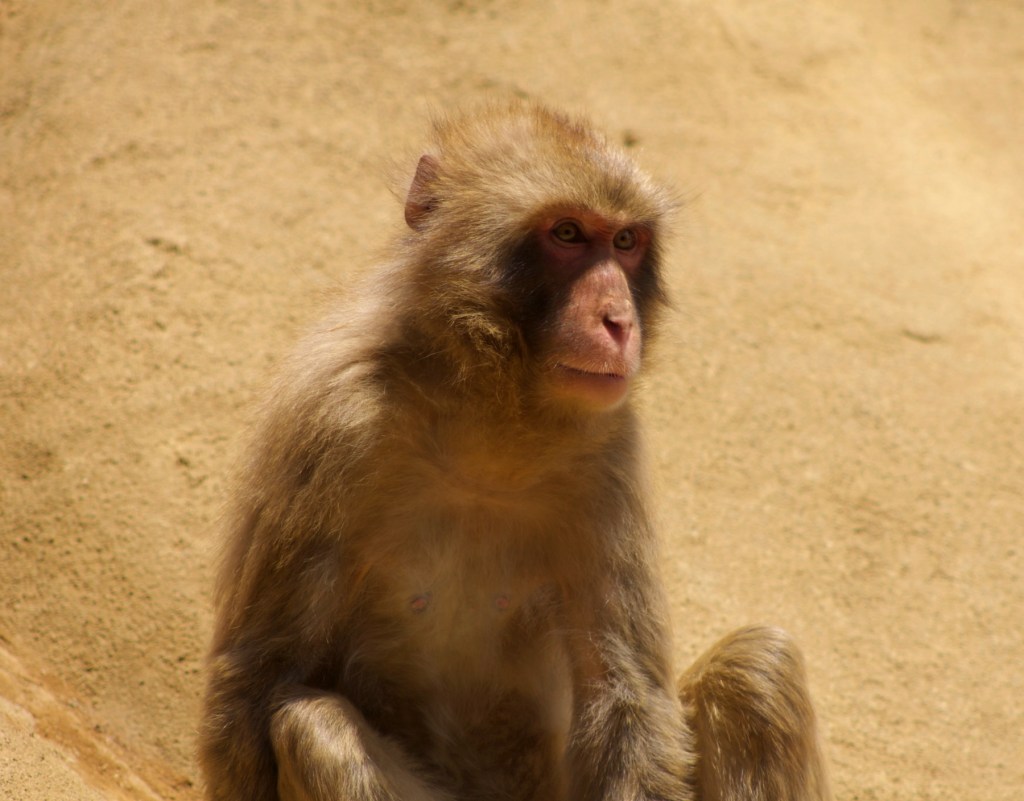
A male member of the troop. It’s not clear if this guy was brought in from another captive troop elsewhere in the country, or if he’s native to the Mt. Takao troop. If it’s the latter, at his age — about four or five years old, give or take — he’ll be expected to soon depart. Young males leave their troops to avoid inbreeding and potential violence as they become stronger and are viewed as potential rivals to the alpha and/or his lieutenants.

Adios, humans!

Critics Laud Buddy As A ‘Master Of Horror’ After His Film Debut, ‘The Empty Bowl’

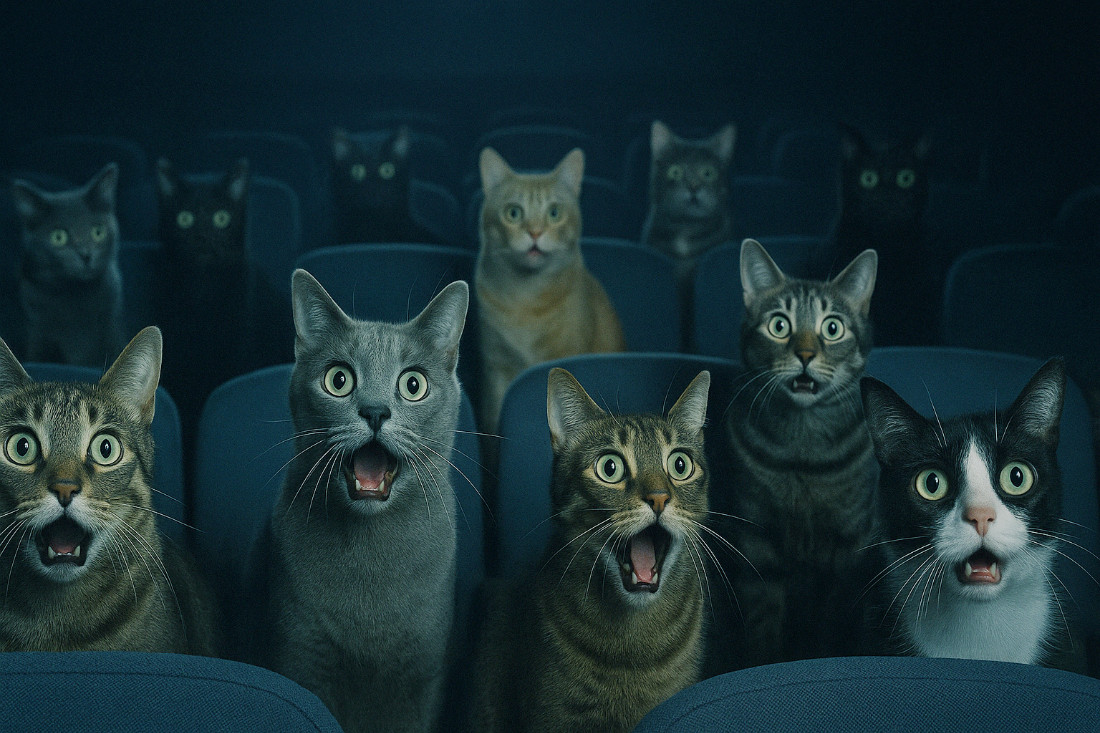
“I found myself subconsciously rationing my popcorn as I sat in the theater,” one critic wrote of the harrowing experience that is ‘The Empty Bowl.’

With a Rotten Tomatoes critic score of 94 percent and an equally enthusiastic reception by fans, Buddy the Cat’s directorial debut. “The Empty Bowl,” has already cemented his place among the modern masters of the horror genre.

The movie follows Dubby, a tabby cat from New York who awakens one day to find his human gone, and most horrifically, his food bowl essentially empty, with just a few morsels pushed to the sides of the ominously hollow container.

Time is measured in the growls of Dubby’s stomach and the lengthening shadows inside his domicile as a sinister score ratchets up the tension.

“Buddy the Cat presents a master class in exploring trauma via the absence of yums,” Associated Press critic Misty Lemire wrote. “We feel Dubby’s hunger as he carefully rations out his remaining pieces of kibble, made worse by the unknowns in front of him: when will Dubby’s human return? Will it be five minutes from now, or five hours? What if there’s nothing left in the cat food cupboard, and he has to go to the store? These are harrowing questions the audience is asked to ponder.”

The film “makes us feel Dubby’s hunger on a visceral level,” feline horror aficionado site YummyDisgusting noted in its review.

Indeed, test audiences indicated they “felt guilty” chowing down as they watched Dubby writhe with hunger.

“I found myself subconsciously rationing my popcorn as I sat in the theater,” New York Times critic Meowchio Mewkatani wrote. “How could I enjoy the buttery goodness in the bucket on my lap as Dubby’s stomach growled in excruciating Dolby surround sound? This is a film that really makes you stop and consider.”

The director told reporters he “wanted to tap into authentic fear, not the fantasy violence that often comes with genre cinema.”

“Obviously there’s something aesthetically primal about an evil, slobbering dog emerging from the shadows,” he said. “But I’m interested in pushing boundaries, not taking the well-padded path. The fear that our minds create is often much more terrifying than any trope.”

In one particularly brutal sequence, Dubby’s human returns home toting several heavy grocery bags, and the snap of a tin can of tuna opening is precisely timed to the crescendo of the orchestral score.

The camera focuses on the meaty morsels tumbling into the bowl, landing with saliva-inducing, moist thuds.

Dubby races toward the feast, his tongue comes within millimeters of the juicy tuna…and he awakes tragically in a cold sweat to find himself laying in a still-empty apartment rendered dark as the last of the sun’s rays disappear over the horizon.

“If that doesn’t hit you right in the feels,” Lemire wrote, “then you’re not a real feline.”

Cops Claim There’s Nothing They Can Do After Bloodthirsty Thugs Sicced Their Pitbulls On Beloved Shop Cat

“Harm or death to an animal caused by another animal is not a criminal matter,” even when footage shows dog owners urging their pets to attack, the NYPD claims.

The NYPD says its hands are tied after a group of people sent their pit bulls after a well-known shop cat in Manhattan and cheered as they dogs brutally ended the tabby’s life.

Freddy was the resident moggie at Michelle Flowers, a florist on Amsterdam Avenue in Washington Heights. The little guy was outside the shop at about 9 p.m. on July 4 when a man and two women set their dogs loose on him, then celebrated and cheered as they killed him.

Credit: Cat Collective

The pit bull owners then “smoked, danced and ate food while taking photos and mimicking the grisly scene,” according to the New York Post. Surveillance cameras caught the attack and its aftermath, showing the three black-clad dog owners and others who witnessed the violence and did nothing.

A disgusted neighbor contacted the Cat Collective, a group of volunteers who feed and care for strays in the neighborhood, and they collected Freddy’s remains, then told the florist’s owner what happened.

“Someone deliberately set dogs on a defenseless cat while people watched and cheered,” Dan Rimada of Bodega Cats of New York told the Post.

Cat Collective is offering cash rewards to anyone who can identify the dog owners and the celebrating bystanders, but the police won’t do anything.

An NYPD spokesman told the paper that “harm or death to an animal caused by another animal is not a criminal matter,” citing a gap in the law.

A proposed bill, dubbed Penny’s law after a chihuahua that was mauled by pit bulls earlier this year in Manhattan, hasn’t made it out of committee in the New York State legislature, while New York’s city council is looking at a municipal law that would make it a crime to set dogs on other animals.

Credit: Cat Collective

It’s actually difficult to believe nothing can be done to get justice for Freddy, Penny and other animals aside from civil cases, which can only result in monetary damages.

Manhattan DA Alvin Bragg, who is controversial to say the least for creatively interpreting the law, seems like just the kind of district attorney who could find a way to prosecute the dog owners. The fact that the authorities are outright dismissing the possibility indicates Bragg doesn’t see this as a priority.

Working with the police to find ways to get justice is Bragg’s job, as well as the job of the attorneys working for him in the district attorney’s office. At the very least, they should be able to find something with which to charge the suspects, even if it really turns out there’s no way to hold them criminally accountable for Freddy’s death.

We hope Freddy’s killers are identified and held responsible, and we hope no more pets and strays have to be killed before lawmakers at the city and state level make it a priority to close an obvious gap in the law.

Lost Photos Of Kitten Bud!

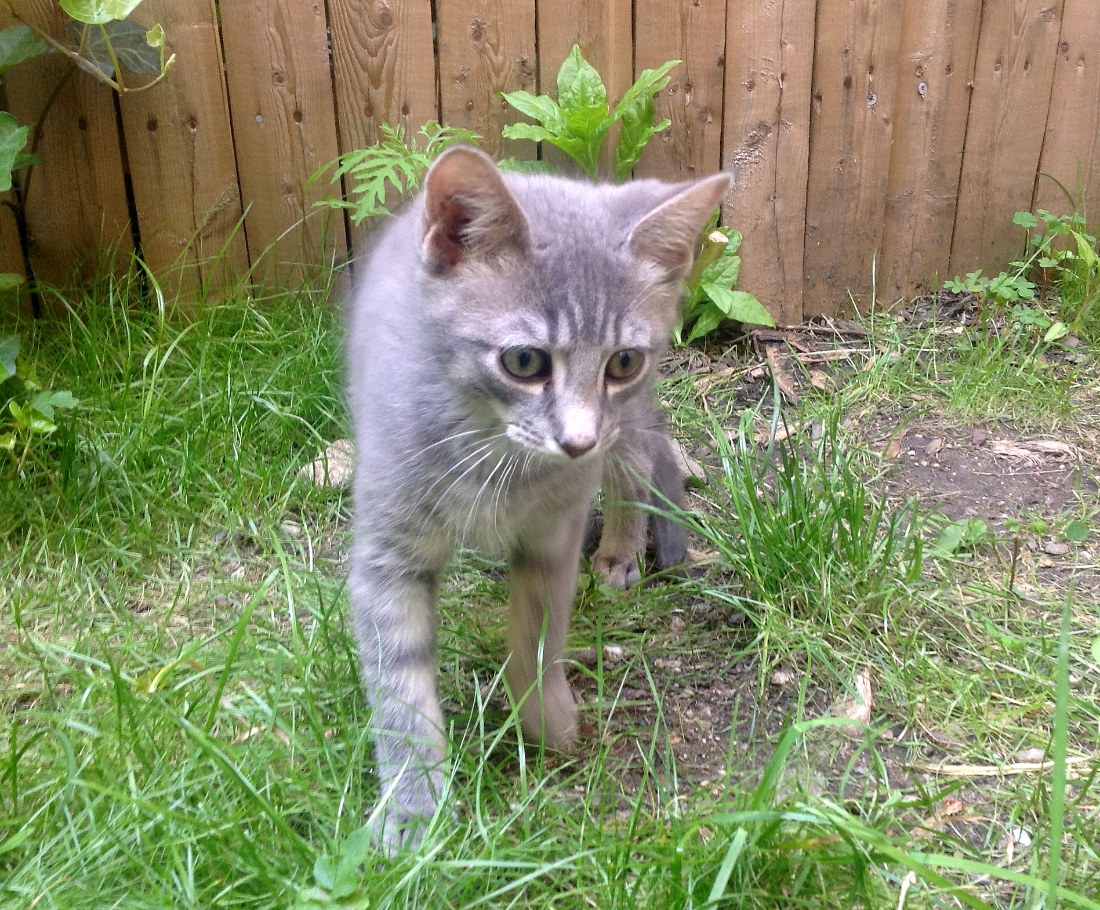
From summer 2014 when Bud was about five months old.

Bud says: “Derp derp derp! I’m a bug-eyed kitten! Derp!”
Bud says: “Now THIS is a more regal image befitting my status as a handsome feline!”
Bud says: “Here I am in action! As you can see, I was ripped but not quite as meowscular as I am now.

Happy Independence Day 2025!

Happy ‘Merican Birthday from the Buddies!

The Buddies would like to wish everyone a happy Fourth of July!

We hope you have a great Independence Day, whether you’re spending it in the company of family and friends or quietly at home.

Buddy has bravely endured the fireworks show a block away from Casa de Buddy, shrugging it off like the fearless feline he is!