Cats from all walks of life react to news that humans want to join the species.
There have been several controversial stories lately about humans who identify as cats, or want to become cats. Most of them are hoaxes, but you can’t put things past crazy humans. We asked actual cats what they think about the idea.
What do you think?
“Does this mean they’re not going to be our servants anymore?” – Princess Sprinkles, 6, house cat
“I identify as a hulking tiger.” – Tiger, 11, indoor-outdoor menace
“They can identify as Jovian moons for all I care, as long as dinner is still served on time.” – Crispy Cream, 4, house cat
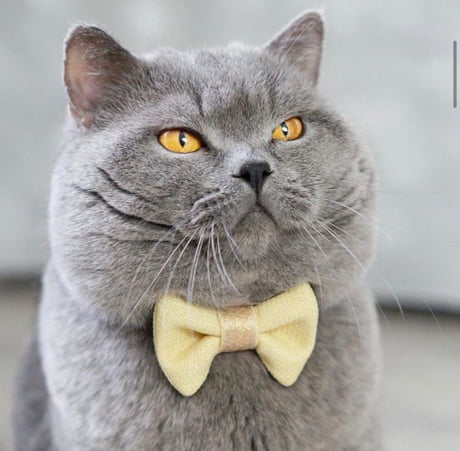
“I say, dear fellow, I should rather think they lack the fur.” – Niles, 10, British cat
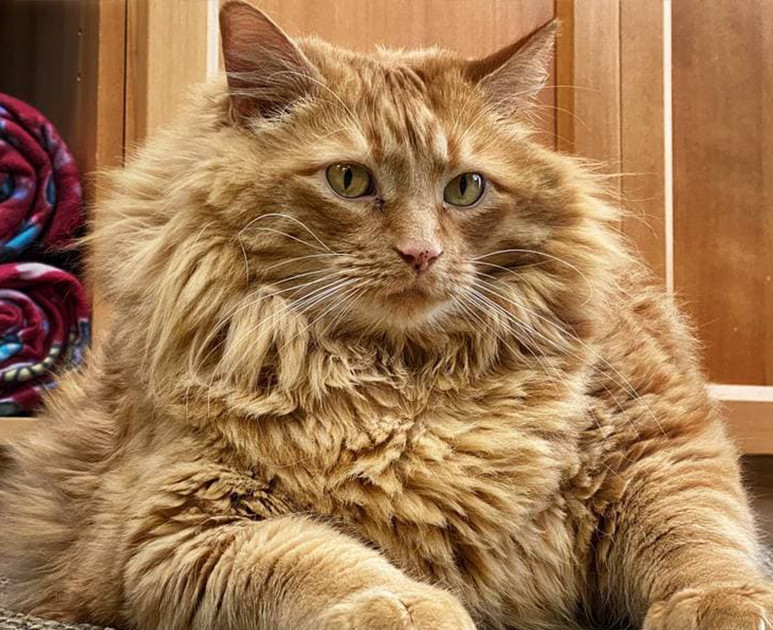
“What am I thinking about? I’m thinking about chocolate rivers, candy-coated gumdrops, and Lifesavers made of cheese!” – Chonkmatic the Magnificent, King of North American cats
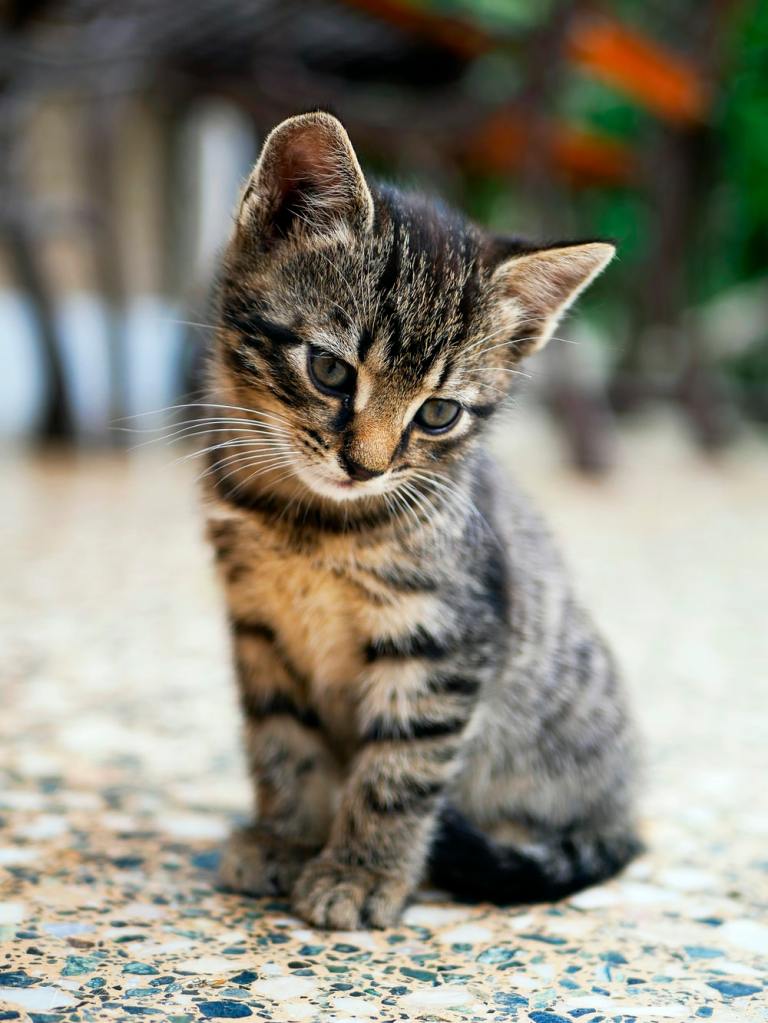
“WATCH ME GO!!! WATCH ME! I’M GONNA RUN FAST NOW!!! YEEEEAAAHHH!” – Mari, 4 months, house kitten
One software engineer went to incredible lengths to monitor her cat’s bathroom habits.
When Alan Turing, the father of artificial intelligence, posed the heady question “Can machines think?”, he inspired generations of computer scientists, philosophers, physicists and regular people to imagine the emergence of silicon-based consciousness, with humanity taking the godlike step of creating a new form of life.
And when science fiction writer Philip K. Dick wrote his seminal 1968 novel, “Do Androids Dream of Electric Sheep?” — the story that would eventually become Ridley Scott’s 1982 classic Bladerunner — he wondered what makes us human, and whether an artificial being could possess a soul.
It’s safe to say neither of those techno-prophets were thinking of fledgling AI algorithms, representing the first small steps toward true machine-substrate intelligence, announcing themselves and their usefulness to the world by helping us watch felis catus take a shit.
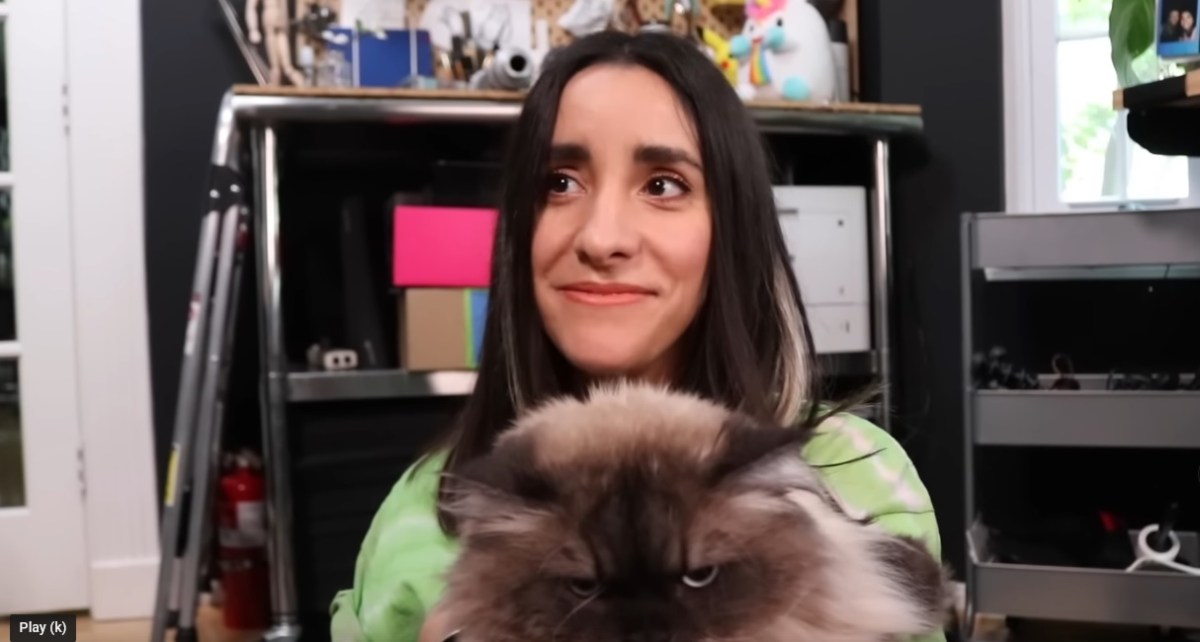
And yet that’s what the inventors of the LuluPet litter box designed an AI to do, and it’s what software engineer and Youtuber Estefannie did for her cat, Teddy, who’s got a bit of a plastic-eating problem.
“The veterinarian couldn’t tell me how much plastic he ate, and it would cost me over $3,000 [to find out]. So I didn’t do it,” Estefannie explains in a new video. “Instead, the vet gave me the option of watching him go to the bathroom. If he poops and there’s no plastic in his intestines, then he won’t die, and he might actually love me back.”
Estefannie casually described how she wrote a python script, set up a camera and motion sensor, and rigged it to take photos of Teddy doing his business. But, she explained, there was “a tiny problem”: Luna the Cat, aka her cat’s cat.
“This is Luna, this is technically not my cat, this is Teddy-Bear’s cat, and she uses the same litter box as Teddy,” she explained.
For that, she’d need more than a script. She’d have to build a machine learning algorithm to gorge itself on data, cataloguing tens of thousands of photos of Teddy and Luna along with sensory information from the litter box itself, to learn to reliably determine which cat was using the loo.
So Estefannie decided it was a good opportunity to “completely remodel” Teddy’s “bathroom,” including a compartment that would hide the bespoke system monitoring his bowel movements. The system includes sensors, cameras and lights to capture still images of Teddy dropping deuces in infrared, and a live thermal imaging feed of the little guy doing his business. (Teddy’s luxurious new bedroom turned out to be too dark for conventional cameras, thus the pivot to infrared.)
From there, Estefannie manually calculated how long Teddy’s number ones and twos took, and cross-referenced that information with photo timestamps to help determine the exact nature of Teddy’s calls of nature.
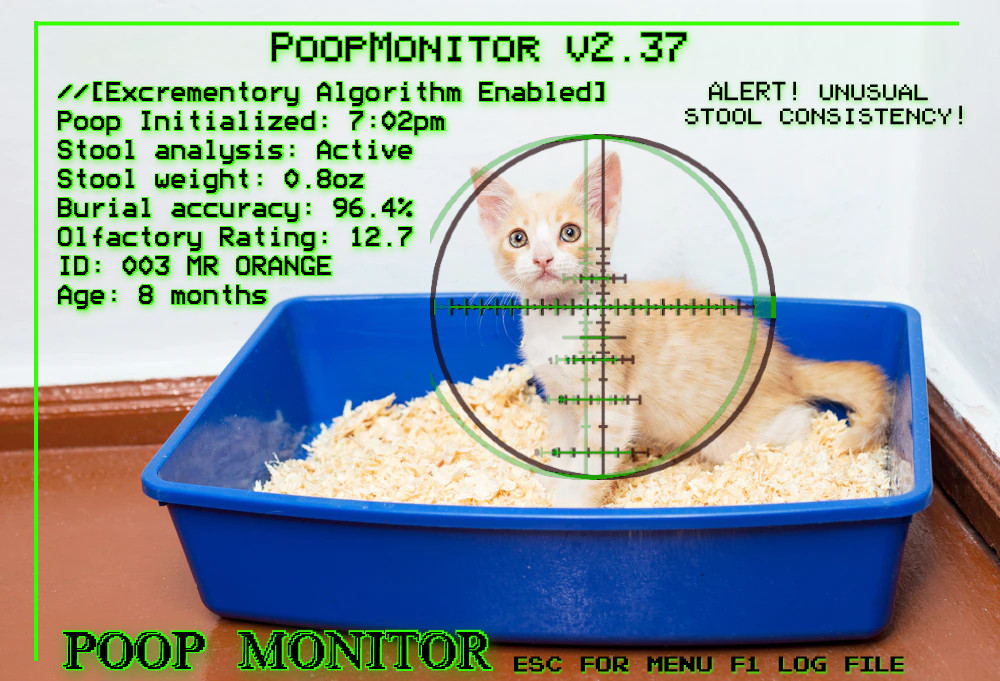
The future! (Note: This is our cheesy photoshopped interpretation, not Estefannie’s actual stool monitoring interface.)
When all the data is collected, Estefannie’s custom scripts sends it to an external server, which analyzes the images from each of Teddy’s bathroom visits and renders a verdict on what he’s doing in there.
Finally, Estefannie gets an alert on her smartphone when one of the cats steps into the litterbox, allowing her the option of watching a live feed and, uh, logging all the particulars. The software determines if a number two was successful, and keeps detailed records so Teddy’s human servant can see aberrations over time.
“So now I definitely know when Teddy-Bear is not pooping and needs to go to the hospital,” she said.
I am not making this up.
For her part, Estefannie says she’s not worried about a technological singularity scenario in which angry or insulted machines, newly conscious, exact revenge on humans who made them do unsavory tasks.
“Did I make an AI whose only purpose in life is to watch my cats poop?” Estefannie asked, barely keeping a straight face. “Mmmhmm. Will it come after me when the machines rise? No! Ewww!”
A New York Times science writer tries MeowTalk, the app that says it can tell you what your cat is saying.
New York Times science writer Emily Anthes details her experience with MeowTalk in a new story, and has more or less come to the same conclusions I did when I wrote about the app last year — it recognizes the obvious, like purring, but adds to confusion over other vocalizations.
Back in January of 2021, in MeowTalk Says Buddy Is A Very Loving Cat, I wrote about using MeowTalk to analyze the vocalizations Bud makes when he wants a door opened. After all, that should be a pretty basic task for an app that exists to translate meows: Cats ask for things, or demand them, some would say.
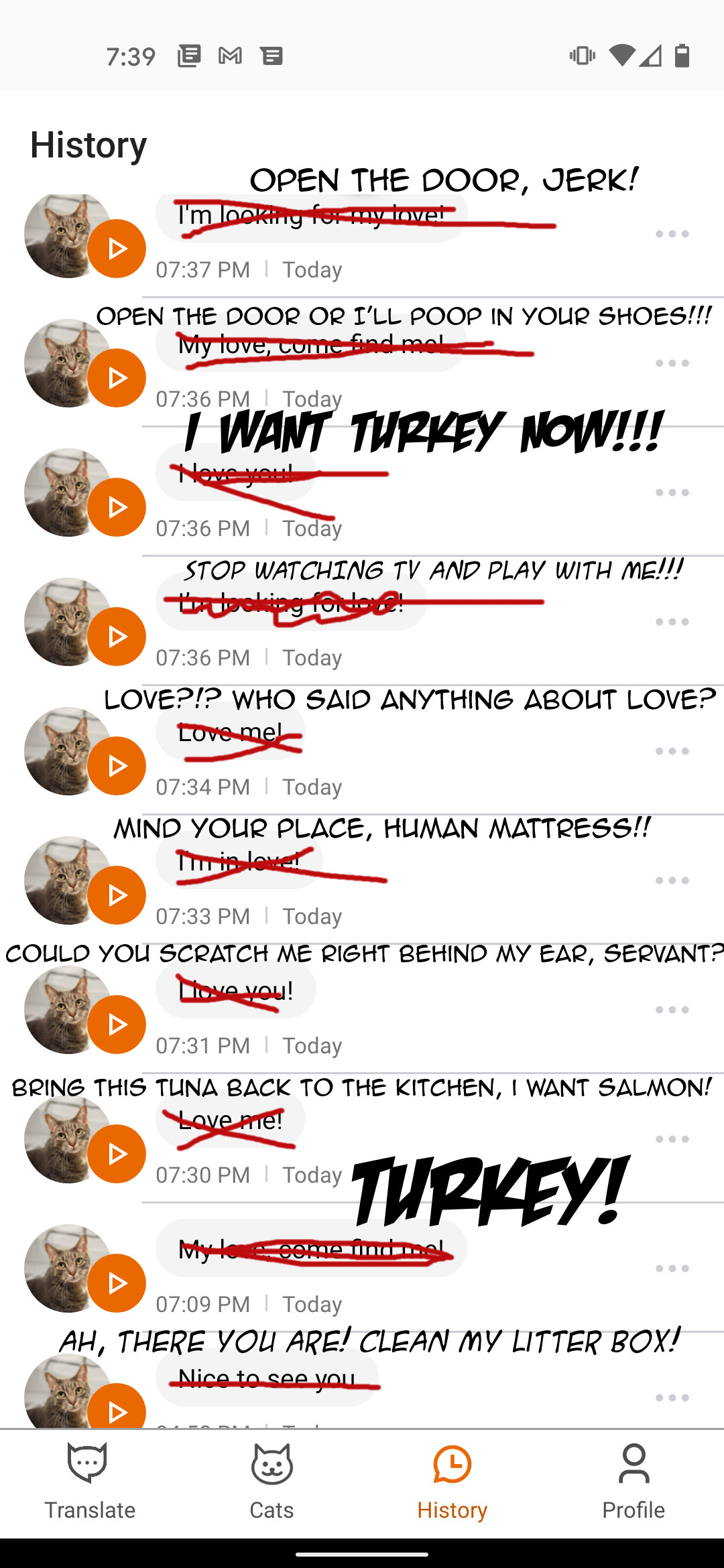
But instead of “Open the door!”, “I want to be near you!”, “Human, I need something!” or even “Obey me, human!”, it told me Bud was serenading me as he pawed and tapped his claws on the door: “I’m looking for love!”, “My love, come find me!”, “I love you!”, “Love me!”, “I’m in love!”
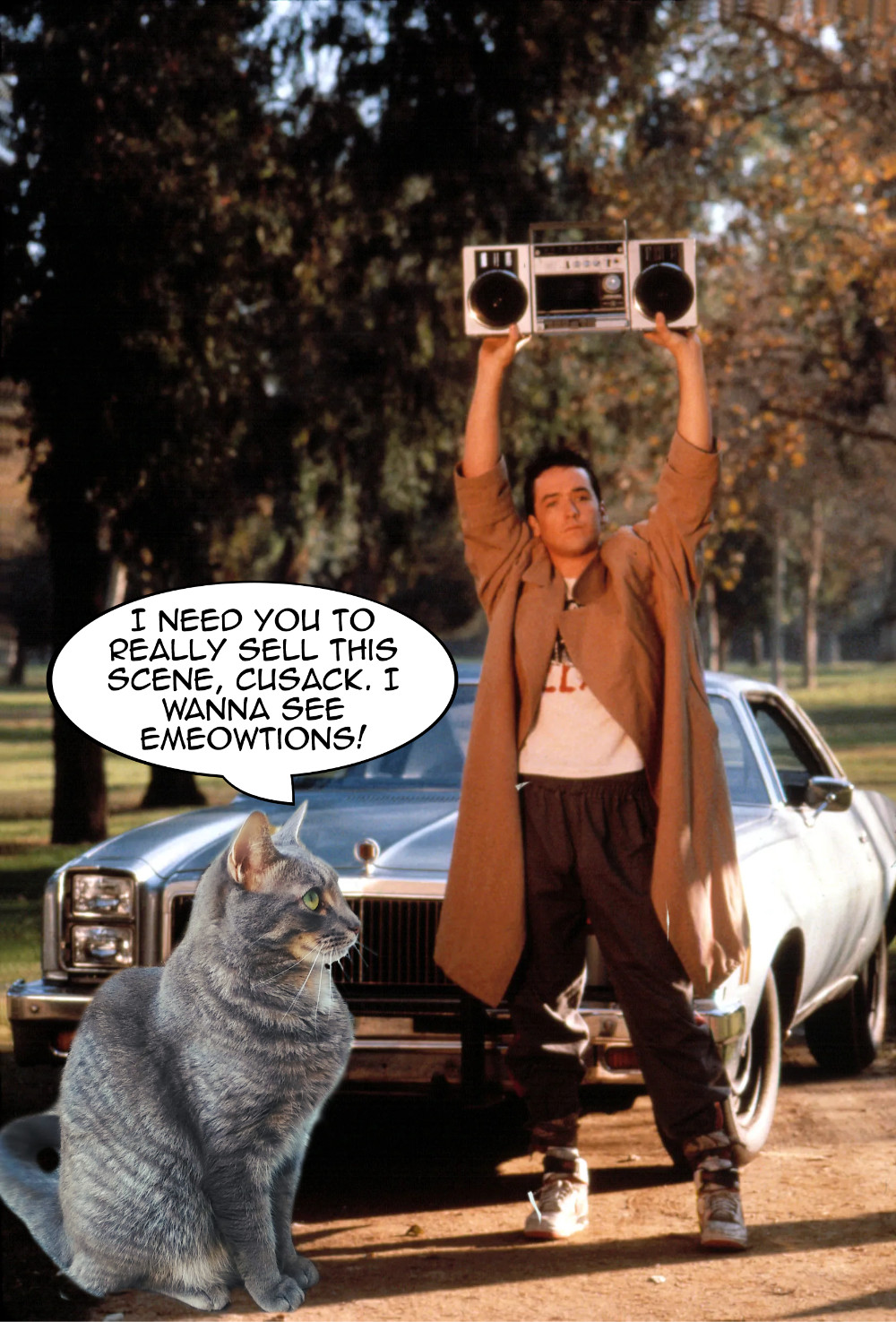
According to MeowTalk, my cat was apparently the author of that scene in Say Anything when John Cusack held up a boombox outside of Ione Skye’s bedroom window.
Buddy the Director.
Anthes had a similar experience:
“At times, I found MeowTalk’s grab bag of conversational translations disturbing. At one point, Momo sounded like a college acquaintance responding to a text: ‘Just chillin’!’ In another, he became a Victorian heroine: ‘My love, I’m here!’ (This encouraged my fiancé to start addressing the cat as ‘my love,’ which was also unsettling.) One afternoon, I picked Momo up off the ground, and when she meowed, I looked at my phone, ‘Hey honey, let’s go somewhere private.’ !”
On the opposite side of the emotional spectrum, MeowTalk took Buddy’s conversation with me about a climbing spot for an argument that nearly came to blows.
“Something made me upset!” Buddy was saying, per MeowTalk. “I’m angry! Give me time to calm down! I am very upset! I am going to fight! It’s on now! Bring it!”
In reality the little dude wanted to jump on the TV stand. Because he’s a serial swiper who loves his gravity experiments, the TV stand is one of like three places he knows he shouldn’t go, which is exactly why he wants to go there. He’s got free rein literally everywhere else.
If MeowTalk had translated “But I really want to!” or something more vague, like “Come on!” or “Please?”, that would be a good indication it’s working as intended. The app should be able to distinguish between pleading, or even arguing, and the kind of freaked-out, hair-on-edge, arched-back kind of vocalizations a cat makes when it’s ready to throw down.
Accurate translations of Buddy’s meows.
Still, I was optimistic. Here’s what I wrote about MeowTalk last January:
“In some respects it reminds me of Waze, the irreplaceable map and real-time route app famous for saving time and eliminating frustration. I was one of the first to download the app when it launched and found it useless, but when I tried it again a few months later, it steered me past traffic jams and got me to my destination with no fuss.
What was the difference? Few people were using it in those first few days, but as the user base expanded, so did its usefulness.
Like Waze, MeowTalk’s value is in its users, and the data it collects from us. The more cats it hears, the better it’ll become at translating them. If enough of us give it an honest shot, it just may turn out to be the feline equivalent of a universal translator.”
There are also indications we may be looking at things — or hearing them — the “wrong” way. Anthes spoke to Susanne Schötz, a phonetician at Lund University in Sweden, who pointed out the inflection of a feline vocalization carries nuances. In other words, it’s not just the particular sound a cat makes, it’s the way that sound varies tonally.
“They tend to use different kinds of melodies in their meows when they’re trying to point to different things,” said Schötz, who is co-author of an upcoming study on cat vocalizations.
After a few months in which I forgot about MeowTalk, I was dismayed to open the app to find ads wedged between translation attempts, and prompts that asked me to buy the full version to enable MeowTalk to translate certain things.
The developers need to generate revenue, so I don’t begrudge them that. But I think it’s counterproductive to put features behind paywalls when an application like this depends so heavily on people using it and feeding it data.
To use the Waze analogy again, would the app have become popular if it remained the way it was in those first few days after it launched? At the time, I was lucky to see indications that more than a handful of people were using it, even in the New York City area. The app told me nothing useful about real-time traffic conditions.
These days it’s astounding how much real-time traffic information the app receives and processes, routing drivers handily around traffic jams, construction sites and other conditions that might add minutes or even hours to some trips. You can be sure that when you hear a chime and Waze wants to redirect you, other Waze users are transmitting data about a crash or other traffic impediment in your path.
“I’m thinking deep thoughts about turkey.”
MeowTalk needs more data to be successful, especially since — unlike Waze — it depends on data-hungry machine learning algorithms to parse the sounds it records. Like people, machine learning algorithms have to “practice” to get better, and for a machine, “practice” means hearing hundreds of thousands or millions of meows, chirps, trills, yowls, hisses and purrs from as many cats as possible.
That’s why I’m still optimistic. Machine learning has produced algorithms that can identify human faces and even invent them. It’s produced software that can write prose, navigate roads, translate the text of dead languages and even rule out theories about enduring mysteries like the Voynich Manuscript.
In each of those cases there were innovators, but raw data was at the heart of what they accomplished. If MeowTalk or another company can find a way to feed its algorithms enough data, we may yet figure our furry little friends out — or at least know what they want for dinner.
Plus: The Cat Fancier’s Association holds a cat-and-owner costume contest.
When volunteers in Elkhart, Indiana, went to trap a mom and her kittens near an industrial site, one of the babies panicked and ran straight into a hole, taking a tumble into a drainage pipe beneath.
The rescuers from a non-profit TNR group called Catsnip didn’t give up on the four-week-old baby even after finding her proved to be much more difficult than they imagined. They called off the search in Elkhart — about 160 miles north of Indianapolis — the first night when it was too dark to keep working. They dropped food for the scared fluffball, whom they could hear but still could not locate in the dark, tight subterranean space.
The next morning they were back at it, trying to literally flush the kitten out before a volunteer named Ashley descended via a manhole 75 feet from the spot where the kitten had fallen in.
The entire saga took about 48 hours and hinged on Ashley who, because of her small size, was able to squeeze into a pipe and crawl 30 feet to the terrified baby cat — then had to crawl out backwards the way she came while cradling the little one.
Piper was reunited with her mom and littermates after the rescue. Credit: Catsnip
It was worth it for the volunteers, who named the kitten Piper in honor of her adventure, gave her fluids and formula from a dropper, then reunited her with her mom. Read about the whole encounter at The Dodo. (And serious props to Ashley! Just thinking about what she had to do makes me shudder. Cats may love tight spaces, but most humans do not.)
Hey! That’s Buddy’s MO!
As gamers who generally prefer more depth, the Buddies never got on the Fortnite bandwagon, so we weren’t aware that Fortnite has a character named Meowscles until encountering this article from Cracked.
Meowscles has a Buddesian physique. Credit: Epic Games
As you can see, Meowscles was clearly inspired by Bud, who is known for his incredibly ripped physique and totally isn’t a bit chubby. (“That’s all muscle, not fat!” Buddy insists.)
Fortnite is a battle royale-style game in which up to 100 players compete against each other in live matches. The game is free-to-play, with developer Epic Games making its money by selling cosmetic items as microtransactions. Meowscles is one of about 1,400 different “outfits” players can purchase to customize their characters.
The game has been a monumental success for Epic, earning billions and leading the company to launch the Epic Games Store, the first serious competitor to Steam, which has been the dominant platform for PC gamers for years. Epic has been so flush with cash that’s it’s been giving away free games every week to lure customers away from Steam, even upping the freebies to a new game every day during the holidays.
Cat and Owner Costume Contest?!?
In Massachusetts, the Cat Fancier’s Association held its ninth annual cat and owner costume contest on Sunday. Unfortunately, the only story we can find about the event comes from the local public radio affiliate, so there’s not much in terms of photos.
If you were going to enter such a contest with your cat, what costumes would you and your fluffy overlord wear?
I’m thinking maybe I’d be a Targaryen with Bud as a baby dragon perched on my shoulder in honor of Game of Thrones/House of the Dragon. But that might offend little dude, who tends to think of himself as a hulking tiger. Perhaps the easier and more realistic “costume” would be Bud dressed as a king, snug in his own little carrier designed to look like a royal palanquin, with me carrying the palanquin as his dutiful servant. Thus, art imitates life.
From Nala Cat the incredibly popular influencer to Tomasso the stray from Rome, these cats are worth millions.
There was quite a bit of interest in our earlier story about Choupette, pet and muse to late fashion designer Karl Lagerfeld.
While Choupette was left a large slice of Lagerfeld’s reported $200 million fortune — usually pegged at about $13 million inheritance — as well as the services of a private jet, a chef and minders to see to her needs, she’s not the wealthiest feline on the planet.
Nala Cat: Estimated net worth $100 million
Nala Cat has 4.4 million followers on Instagram, her own line of cat food, and a website that sells Nala-themed shirts, phone cases, coffee mugs, plush toys, pillow covers and even COVID masks. With her gigantic social media following, which has earned her an official Guinness World Record, Nala has enormous earnings potential, taking home five- and six-figure sums for sponsored posts hawking products like topical cream for pets and milk alternatives.
Nala isn’t too happy about getting a bath.
Chances are you’ve seen Nala even if you don’t know her name.
Olivia Benson: Estimated net worth $97 million
Unlike her celebrity ex-boyfriends, Taylor Swift’s cats don’t provide her with sad breakup material for new songs, but they do give her plenty of material for social media and additional opportunities to make money. (Because let’s face it, she needs it: The singer has amassed a paltry half-billion dollars so far.)
Swift named her most famous cat Olivia Benson, which we’re told is the name of a character on Law & Order. (Apologies but once you watch The Wire, there is no going back to network TV cop dramas where the detectives are always righteous and neatly wrap up their cases in 42 minutes.) Since she was purchased by swift in 2014, Olivia Benson has gone on to star in commercials for Coke and Keds, make guest appearances on Ellen, and cameo in Swift’s music videos.
Buddy the Cat: Estimated net worth $3.67 (dollars, not millions)
While Choupette rides the skies in a private jet, Nala cat has more fans than most celebrities and Olivia Benson is feted by talk show hosts, Buddy the Cat is no slouch either: The silver tabby is chauffeured around in style in a Honda Civic, boasts an extensive food and treat cabinet that can keep him in turkey for like three weeks, and is the proud owner of a really cool cardboard box. (Not as awesome as Olivia Benson’s boxes, obviously, but still pretty cool.)
However, Buddy also has something none of the other cats on this list have: His own site with near-daily updates chronicling his adventures, attesting to his ever-growing meowscles and expanding on his legend with every post.
Most importantly, he has the love of his Big Buddy. (Awwww.) Asked what he’d do with a fortune if he suddenly became a hugely popular catfluencer, Bud said he’d buy a Roomba to ride.
“Monetize the site, human! We could be multi-thousandaires! I could have a Roomba!”
Blackie the Cat: Estimated net worth $12.5 million
Blackie belonged to Ben Rea, a millionaire antiques dealer from the UK. According to press reports, Rea was estranged from his family when he died at age 82 in 1988, so he left millions to Blackie.
Rea had some self-awareness at least — reports say he left millions, representing the bulk of his fortune, to three animal charities of his choosing. He also left a house to a close friend and willed money to his housekeeper, gardener and plumber. (Dude really didn’t like his relatives, apparently.)
Unlike the others on this list, Blackie was certified as the wealthiest cat by the Guinness Book of World Records. It’s not clear when Blackie died or what became of the remainder of his fortune. Unless he had an outrageous catnip habit and blew millions on attractive Calico escorts, it’s safe to say he didn’t burn through all $12.5 million in his remaining time on Earth.
“I’m cold! Throw another thousand on the fire and bring me a heavier blanket, servant!”
Tomasso the Cat: $13 million
In a true rags to riches story, Tomasso was a stray living on the streets of Rome when he was adopted by a lonely widow in her 90s. The woman, Maria Assunto, had no children of her own and treated Tomasso like a son.
When she died in 2011 at the age of 94, Assunto left Tomasso and all her money to a nurse named Stefania.
Stefania had befriended Assunto and Tomasso a few years earlier after meeting them in a public park. The nurse would bring her own cat over to Assunto’s home to play with Tomasso, and cared for Assunto as her health declined. As Assunto began to fade, she asked Stefania to care for Tomasso once she was gone.
Stefania had no idea Assunto was worth millions and was shocked when the late widow’s lawyers approached her.
“I promised her that I would look after the cat when she was no longer around. She wanted to be sure that Tommaso would be loved and cuddled. But I never imagined that she had this sort of wealth,” she said at the time. “She was very discreet and quiet. I knew very little of her private life. She only told me that she had suffered from loneliness a lot.”
Perhaps it was because Stefania had cared for Assunta and Tomasso out of the kindness of her heart that the latter chose her as her sole beneficiary.
“She had become very fond towards the nurse who assisted her,” Anna Orecchioni, Assunta’s attorney, told Italian newspaper Il Messaggero. “We’re convinced that Stefania is the right person to carry out the old lady’s wishes. She loves animals just like the woman she devoted herself to right up until the end.”







 Pain In The Bud