Critics Heap Praise On PITB, The Web’s Greatest Cat Blog

Entering its sixth year as the most incredibly awesome cat blog in the universe, PITB continues to chronicle the amazing adventures of Buddy the Cat.

It looks like 2025 is shaping up to be quite a year!

Flow won an Oscar, the Yankees are primed for mediocrity, this is the year Nostradamus predicted we’d get those awesome hoverboards from Back To The Future, and PITB will turn six years old in the summer!

Can you believe it? Six years of thrilling millions of readers with stories of Buddy’s incredible adventures, covering the most important cat news and setting all the hot new trends in the cat world!

buddy_gentlemanlogo
LITTLEBUDDYTHECAT.COM: The elegant choice for discerning cat lovers.

buddy_catpeople_edited

Critics have lavished praise on PITB:

“You won’t find two more reprehensible characters. The ill-mannered cat who’s always hatching ludicrous schemes and the human who glorifies him. They don’t have two neurons to rub together between them.” – WIRED

“Incredible! Buddy the Cat is the most dashing, dapper and daring feline on the planet, and his fans are fortunate to read about his thrilling exploits!” – Buddy Monthly (starred review)

“Two of the worst representatives of their respective species. Fate smiled cruelly upon the world when these two joined forces. Thankfully their epic incompetence prevents them from taking over.” – The Guardian

“A titan of the feline world and his human sidekick, the Buddies join forces — and combine their considerable mental resources — for the betterment of feline- and mankind. Is there anything Buddy can’t do? That’s a rhetorical question, by the way.” – The Buddy Review of Awesome Felines

“A chubby house cat who thinks he’s a tiger and a human whose writerly ambitions far exceed his talents. Both live in a fantasy world that puts them one harebrained scheme from fame and fortune. If PITB had a print edition we’d recommend it as a birdcage liner.” – The New York Times

“Buddy is an 80s action hero in furry form, a one-cat army whose skill in martial arts is matched only by his razor-sharp wit. We feel privileged to read about his many adventures.” – The Buddinese Shinbun

“The blog works mostly as a celebration of a delusional cat’s ego.” – Associated Press

“Astonishing! With clever and awe-inspiringly beautiful prose, Big Buddy is like a bard expanding the legend of our furry little hero with every post. It’s no wonder Taylor Swift’s cat loves Buddy the Cat so much and wants to share her vast fortune with him.” – El Magnifico Buddenisto

“Buddy the Cat is a legend in his own mind, where his chubby frame becomes ‘meowscle’ and his half-baked plots become ‘genius.’ In that depraved little mind exists a world where kittens plaster his posters on their walls, female cats fight for his affections, and humans argue over who should have the privilege of serving him. Somehow, both cat and human labor under the misconception that what they’re doing is ‘humor,’ but they’re both morons.” – Newsweek

“Like the contents of a particularly foul litter box upended and assembled into crude approximations of words.” – Pitchfork

“Compulsively readable and addicting, like Michael Crichton on crack. Come to think of it, why isn’t there an amusement park based on Buddy and his legend? That’s a billion-dollar idea!”- The Daily Buddy

“Shunned by tigers, nearly murdered by lions, chased out of the White House by thousands of angry Americats and laughed at by rodents. Buddy’s track record is one of infamy and failure, and he’s not cute enough to make up for it. Avoid this blog like the COVID ward of your local hospital.” – The Economist

“So handsome, so kawaii! Budditsu-chan is dreamy!” – CrunchyRoll

“Immature, asinine and frankly offensive, [PITB] chronicles the ‘adventures’ of its titular feline, a delusional lunatic who harbors a single-minded obsession with turkey. When they’re not eating paste or laughing at their own poop jokes, the Buddies are probably smoking catnip, for only drug-addled idiots will find their ‘humor’ amusing.” – GQ
Shrill Editorial Calls Cats ‘Domestic Terrorists’ And ‘Skulking, Disobedient Destroyers’ Who Should Be ‘Locked Down’

The more bunk studies claim cats are driving wildlife to extinction, the more people in media and government call for extreme measures to contain them.

Seventy nine cats.

That’s how many felines stood in for the entirely of the UK in a 2022 study, which is the genesis for the claim that cats kill 270 million birds and small animals in that country.

Using GPS collars, owner questionnaires and samples of prey brought home by those 79 outdoor cats, a research team from the University of Reading applied data from a mix of studies dating as far back as 23 years ago, extrapolated and massaged numbers using things like “kernel density estimates” and “generalized mixed models,” and came up with that 270 million figure, which is cited routinely and credulously by UK media.

Actually, their estimate was between 140 and 270 million. An earlier study put the number at 92 million, and a 2016 study estimated UK cats kill 55 million birds and small animals. That’s a range of 215 million!

The Reading team even quotes the infamous US meta-analysis that claims domestic cats kill as many as 4 billion birds and 22.3 billion mammals a year here. That paper, as skeptics in the science community have noted, has virtually no relationship with reality, involves no original research, and relies on data from unrelated studies and surveys in which cat owners were asked to rate their pets’ hunting prowess on a point scale while imagining what the little ones get up to when they’re outside.

All of this is to say that aside from the thorough, labor-intensive and expensive D.C. Cat Count, which brought together cat lovers, birders and scientists to work cooperatively, the 2022 UK study and its counterparts in the US and Australia are exercises in pushing an agenda masquerading as honest academic research.

That’s how we get editorials like The Spectator’s “We need a cat lockdown now” by Zoe Strimpel. Though the tone isn’t tongue in cheek, I can’t imagine Strimpel dislikes cats nearly as much as she claims, and the post was probably written with wry anticipation for the click-generating fury of cat lovers indignantly sharing it on Facebook and X.

Still, it quotes the Reading study without skepticism and portrays cats as furry little wretches who abuse their human caretakers with their claws and their disdain while gleefully eating their way through endangered birds.

A cat stares down a mouse. Credit: Wikimedia Commons

Cats are predators, that much we can agree on, and outdoor cats are much more likely to negatively impact local wildlife, for obvious reasons.

Likewise, I can understand the concern with cat culture in the UK, where allowing pet cats to roam outside is the norm.

But every time the media cites the above-mentioned studies, more people are given an inaccurate impression of feline ecological impact, and more lawmakers at the local and national level consider “solutions” ranging from prohibiting people from keeping pet cats, as a government commission in Scotland recently proposed, or exterminating them outright, as some Australian states and municipalities in New Zealand have tried to do.

It’s worth pointing out that there is no data, not even a single study, showing that air-dropping poisoned sausages or arbitrarily shooting cats actually has any positive impact on birds and small mammals. All it does is terrorize sentient, intelligent domestic animals who have real emotions and experience real fear and pain.

The primary drivers of declining bird and small mammal populations — including habitat loss, environmental destruction, wind turbines and glass buildings — have nothing to do with cats. We have killed off 73 percent of the planet’s wildlife since 1970 and every species of iconic megafauna — from orangutans and gorillas to tigers and pangolins — is headed toward extinction. Are domestic cats responsible for that too, or can we be adults and fess up to our role as the main antagonist here?

An orange tabby and a mouse. Credit: Wikimedia Commons

Strimpel actually goes even further, claiming cats don’t have real affection for their caretakers and are more like psychopaths, faking love because it gets them what they want, primarily food and shelter.

Dogs have true affection for their humans but cats do not, she additionally claims, while adding that cat people are undateable because they share qualities with the “loutish and numerous creatures” they care for.

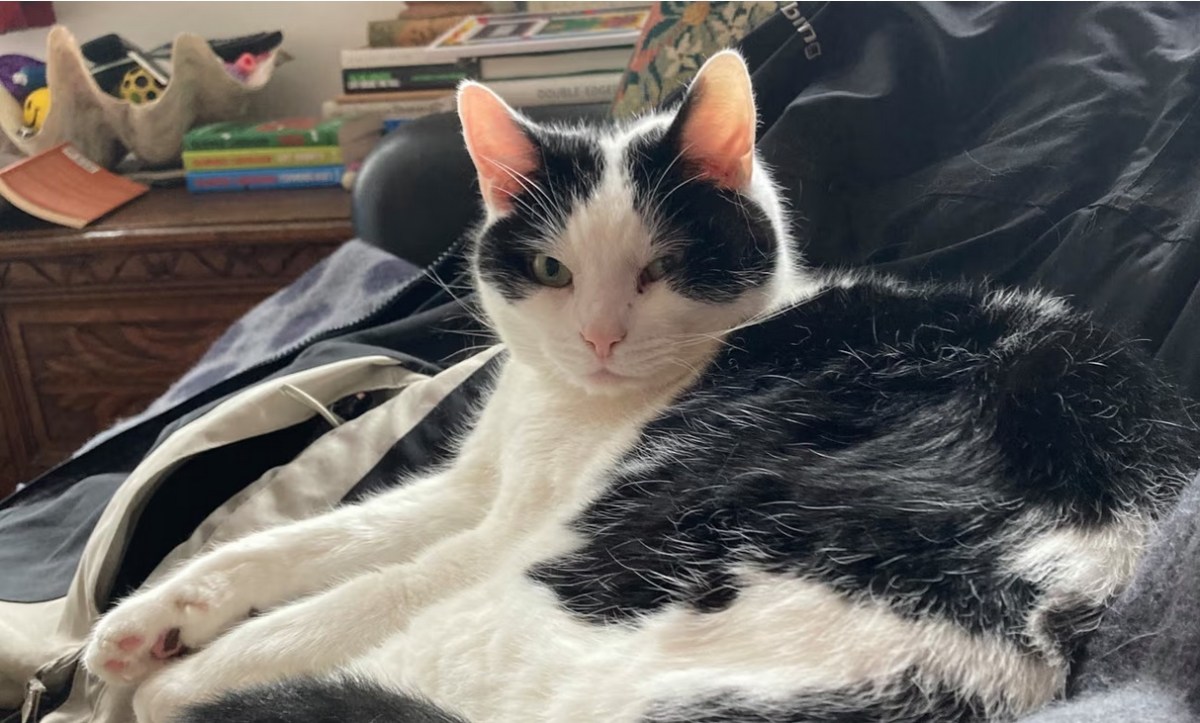
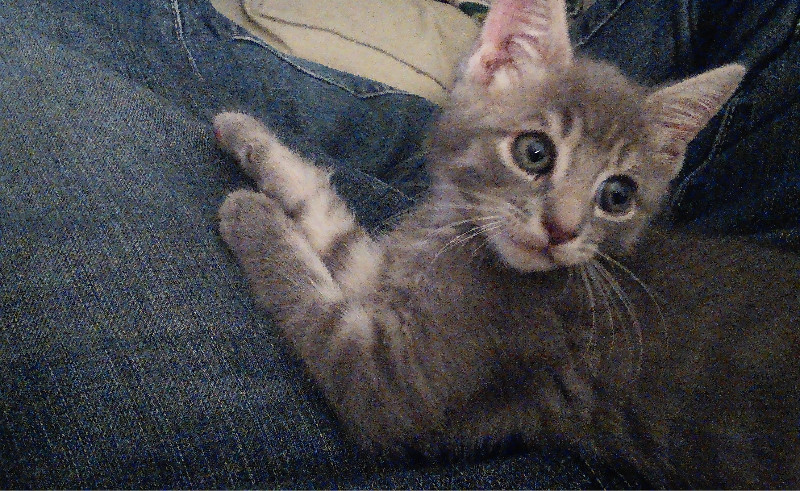
There was a time when I would have been ambivalent about Strimpel’s attitude toward cats, if not her cavalier treatment of basic facts. But then a drool-happy, friendly tuxedo cat showed me I could interact with his species without my allergies going haywire, and a tiny gray tabby kitten became my animal cognition teacher while blindsiding me with love.

Now every time I hear about some psychopath abusing cats, or terribly misguided politicians advocating a plan to kill millions of domestic felines, I think about my Bud. I think about how he cries for his Big Buddy when he’s hurt or stuck, how he meows and trills with excitement when he experiences something new, and how he began shaking, then threw up from overwhelming relief and happiness the first time I returned from a vacation after adopting him.

Buddy the Cat chillin’ on the balcony in the summer. Credit: PITB

He’s got a vibrant mind in his little head, with strong opinions and emotions. So does every cat on the street, in a shelter cage, and in the cross hairs of a birder or biologist playing God by “culling” or “harvesting” cats to protect another species.

Real science, not activism packaged as science, has proven that many times over in recent years. If people want to do harm to cats because they think birds and other animals will benefit, the burden of proof is on them to show not only that their methods work, but that the results could somehow justify the fear and misery they would inflict on innocent animals to achieve their goals.

Cats are obligate carnivores who don’t have a choice. We do.

Cats Listed On Google Maps Are Getting Showered With Treats By Enamored Visitors. Buddy Wants In!

Some friendly felines boast five-star ratings in their listings, beating out top restaurants, hotels and nightclubs for highest-rated tourist attractions in their cities.

People have been listing their cats as tourist attractions on Google Maps, drawing five-star reviews from feline fans who come bearing snacks.

Titan the orange tabby, an absolute unit of a chonky cat who lives in Athens and is regularly fed by admirers, as well as “friendly neighborhood cats” in cities like Sydney, Australia, are earning ratings that most restaurateurs would envy.

“Visitors are evaluating a cat’s overall behaviour: enthusiastic purring, chonkiness, politeness and general adorability,” a story in The Guardian notes.

Titan, who likes to hang out in the ruins of the Acropolis, is the venerated subject of hundreds of glowing reviews on Google Maps.

“If there was a king in Athens, it would be him,” one reviewer declared, while another was laconic but no less enthralled: “HE IS GLORIOUS!”

In Sydney, where listing affable cats has become a trend, a moggie simply known as “friendly orange cat” had 117 reviews and a 4.9 rating before someone, presumably the cat’s caretaker, removed the listing.

Friendly orange cat’s listing before it blew up in popularity and the feline’s humans took the little one’s page down. Credit: Google Maps

Perhaps they were concerned F.O.C. was in danger of becoming the next Gacek, a famous chonkster in Poland who was the highest-rated tourist attraction in Szczecin, a city of almost 400,000.

Gacek had his own little house on the street complete with a bed, blankets, a spot where admirers could leave treats, and a note asking them to hold off on feeding him directly because he was gaining too much weight.

While Gacek’s popularity never waned, and in fact increased with each new press story or Youtube video about him, his humans made him an indoor-only cat after too many people ignored their pleas not to feed him. There were also a handful of incidents involving people who tried to take him, which was another factor in the decision to move him inside. It’s a reminder that there are dangers that come with publicly listing cats.

Buddy the Cat was giddy when he learned tourists were visiting specific cats and showering them with treats.

That said, Buddy is enamored with this idea. He envisions a Google Maps listing headlined: “MAGNIFICENT Cat In New York!” and a court of sorts where he can lounge on a gilded throne with red velvet cushions while “supplicants” line up to pay tribute to him in Tempations and Sheba Meaty Sticks.

“Your Grace, it is my life’s honor to greet your esteemed personage and to tell you that I have always been…”

“Yes, yes! What are those, crunchies? Leave them at the base of the steps to my dais and move along, there’s a whole crowd of people here who want to lavish snacks on me. Did anyone here bring any of those soft Blue turkey treats? Well, step forward! Lay ’em on me!”

It really is his dream: to get attention and an endless supply of snacks without having to actually do anything. He could spend the entire day lounging and napping, and people will simply bring him food and give him head scratches when he wants them.

Although, now that I think about it, I’m not sure how that’s really different than the arrangement he has now.

Header image credit: Hasan Albari/Pexels

The Cat Whose Voice Is Heard In More Than 300 Movies, Plus: Buddy Didn’t Attack His Sitter!

A 23-second clip of a cat growling and yowling has become one of the most-used sound effects over the past three decades. The Guardian traced the clip back to the man who recorded it and got the full story.

We’ve all heard Cheeta the cat yowling, we just don’t know it.

Cheeta was a house cat who belonged to Wylie Stateman, a sound engineer who lives in LA.

In 1988, Stateman recorded an argument between Cheeta, a “remarkably small” half-Siamese void, and her mate, a tomcat named Sylvester.

The 23-second clip made it onto The Premiere Edition, a 20-CD library of sound effects Stateman produced in 1990.

Stateman, called “one of the great recorders of the time” by a colleague, told The Guardian he brought his sound recorder with him everywhere he went for three decades, recording thousands of sounds that have been used in movies for 35 years.

Buddy is also an accomplished sound effects cat.

Cheeta’s yowls are one of his greatest successes. The cranky cat can be heard in Toy Story, Home Alone 3, Les Miserables, Pet Sematary, 101 Dalmations, Venom: Let There Be Carnage, Babe, End of Days, How The Grinch Stole Christmas, and many more.

Although it’s difficult to get an exact count, it’s believed Cheeta’s distinct voice can be heard in some 330 films over the years. If you’re interested in learning more, check out The Guardian’s deep dive into the sound effect and its origins.

Buddy the Magnanimous

I went to visit my brother and his family in Washington this past week, leaving Buddy in the care of my mom.

Regular readers will recall that Bud has a bad reputation for trying to maul his cat sitters, which obviously complicates things.

The incorrigible little lunatic.

Sue, his regular sitter, has known Bud since he was a kitten. She’s literally one of the first humans he met, yet that has not stopped him from ambushing and attacking her. Incredibly, she still agrees to care for him in my absence despite his belligerence, though she’ll no longer play with him. She feeds him and gets out ASAP. I can’t blame her.

This time my mom cared for the little stinker. He’s also tried to murder her when she’s watched him on previous occasions, including one incident in which his bites and scratches necessitated a trip to urgent care and a round of antibiotics.

So yeah, the happy news is that he didn’t attack her this time, although she told me every time she came back, he’d be waiting right by the door, and when he saw it wasn’t me, he would sniff derisively before turning and padding away.

They have an uneasy truce, but I’ll take it. You know you have small dreams when you celebrate a trip in which your cat doesn’t try to maul anyone in your absence.

On a tangential note, I had a first phone interview with a wild cat conservation organization this week, and for the first time in a long time, Bud didn’t make a peep.

He’s meowed loudly during other phone interviews, he’s put his butt in front of the camera like it’s his job during video calls, and he won’t shut up at any other time, but the one time when having a cat might benefit me, he decides to be silent. Thanks, Bud. You’re the best.

‘No One Goes Hungry On Our Watch’: A Pet Food Pantry And A Tribute To An Incredible Cat

Misty the Cat “was an agent of chaos and misrule,” had a Krameresque entrance style and was deeply loved by his people.

With inflation taking a major toll on families over the last few years, one of the most frequently cited reasons for surrendering pets is that their people can’t afford them anymore.

A vet tech in Ohio is trying to prevent that from happening to people in her area with The Little Black Cat Collective, a pet food pantry she founded in honor of her late rescue cat, Lila, who died at 16 years old.

Laura Zavadil founded the pantry — which also helps people with dogs, guinea pigs, ferrets and rabbits — in 2021, and since then it’s grown, serving “30 to 40 families and more than 200 animals each month,” she told her hometown newspaper, the Vindicator of Warren, Ohio.

“I wanted to do my part to help the community through struggles,” Zavadil told the paper. “The pantry’s main goal is to get the needs of these animals met and help the people, but also — considering the limited amount of shelter space in the area — if it means the animals can stay in the home, that’s just icing on the cake.”

Remembering Misty the Cat, whose death “drained all the colour from the world”

Speaking of honoring deceased pets, Keith Miller has a heck of a tribute to his cat, Misty, in The Guardian.

It’s been six months since Keith Miller’s beloved cat (pictured above), came up to him “with a series of unusual cries, stretched his mouth wide like a yawning lion, shivered, collapsed and died.” Misty, Miller wrote, “was a fortnight shy of his ninth birthday,” and his absence has been keenly felt.

Tributes are difficult to write, and tributes to pets may be harder still. It’s tough to feel you’re doing justice to an animal you loved while conveying their personality, and in the back of your mind you’re thinking of the people who don’t get it, who don’t have pets and might find your tribute saccharine or melodramatic.

Miller strikes just the right notes and makes the reader feel Misty’s loss without knowing the little guy.

“I have thought a lot about this particular cat and this particular loss. I think what most pains and enrages me about it has something to do with the role Misty played in our life: a larger-than-life vibe, faux-heroic and mock-epic (and so often richly comic). He used to skid on the floor when he came into a room, like Kramer in Seinfeld. He was an agent of chaos and misrule, knocking objects off surfaces with gallumphing carelessness one day, dead-eyed precision the next. He was gormless yet prodigious, a fluffier cousin of Homer Simpson. He didn’t shyly solicit affection, as his sister does; he demanded it by right, thrusting his jaw up and out like Mussolini to accept strokes on his throat and chest.

All in all, he didn’t really have the makings of a tragic character. And he wasn’t a will-o’-the-wisp, either, on loan from another world, as most cats are. His unscheduled exit wasn’t just an emotional body blow; it was a violation of the rules of genre.”

The Mussolini bit resonated with me, since I’ve referred to Bud as “a furry little Genghis Khan” on occasion, and often joke that he’s a tyrant ruling over the place with an iron paw. Miller’s homage to his pal isn’t overly long, and I recommend reading the whole thing.