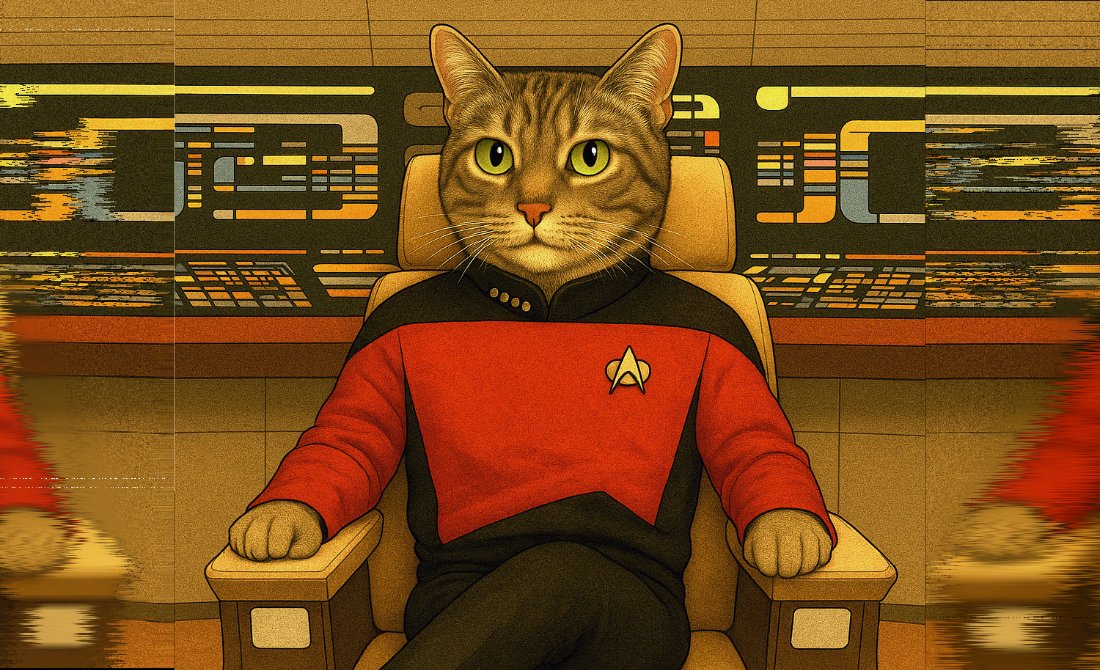
An old enemy lies in wait in the far reaches of the galaxy, ready to exact revenge on the most dashing, clever and dashingly clever captain in Starfleet!
ALPHA QUADRANT, Milky Way Galaxy — Captain Buddy is back for his most thrilling, treacherous and scrumptious adventure yet!
As the commanding officer of the USS Fowl Play and a legend within the galactic community, Captain Buddy and his trusty crew get the call to investigate reports of the malevolent Borg raiding colonies on the edge of Federation space.
Our intrepid captain arrives just in time to fend off a Borg cube attacking Dawn’s Edge, one of the largest colonies on the Felinian Rim. After mounting a heroic defense and defeating the diabolical enemy spacecraft, brave Captain Buddy discovers the Borg weren’t just trying to assimilate the peaceful Caitians living in the colony: they were after the colonist’s turkey, tuna and dilithium reserves as well!
With reinforcements several days away, Captain Buddy is tasked with defending the colony, reassuring terrified colonists, and managing a dwindling supply of sandwiches and snacks…
Thirty years after the Knicks suffered one of the most humiliating losses in basketball history, it happened again…
The image of Reggie Miller running up and down the court at Madison Square Garden, both hands around his own neck, gleefully screeching “Chokers! Chokers!” is indelibly burned into my brain.
It was May 7, 1995. The Knicks were leading the Indiana Pacers by six points with 18.7 seconds to go. The game was essentially over.
Even though Miller was an excellent shooter, a three-pointer would still leave the Pacers short and the Knicks with a win in the Eastern Conference Finals.
What happened next is still hard to believe all these years later.
Miller hit a three pointer, stole the ball on the inbound pass, bolted back behind the three-point line and hit another three-pointer, tying the game. After two missed free throws and a missed shot by the Knicks, Miller was fouled, made two free throws, and the Pacers won the game.
Miller had just scored 8 points in 8.9 seconds, a feat widely considered impossible, to turn a six-point deficit into a two-point win.
This was the kind of thing that might happen in a video game, not real life.
As a young Knicks fan, I was devastated. Kids raged the next morning as we gathered before the first bell at school. Miller was public enemy number one.
That was 30 years ago, or 10,972 days if you prefer.
Tonight, with Miller calling the game from the broadcast booth, the Knicks and Pacers met once again for game one of the Eastern Conference Finals at Madison Square Garden, just like they did 30 years ago.
New York had a 14-point lead with about two and a half minutes to go. Victory was assured.
Then the Pacers came storming back with three pointer after three pointer, cutting the lead to two. With seconds left on the game clock, the Pacers’ Tyrese Haliburton launched a three pointer, which bounced off the rim high into the air…and came down clean through the hoop.
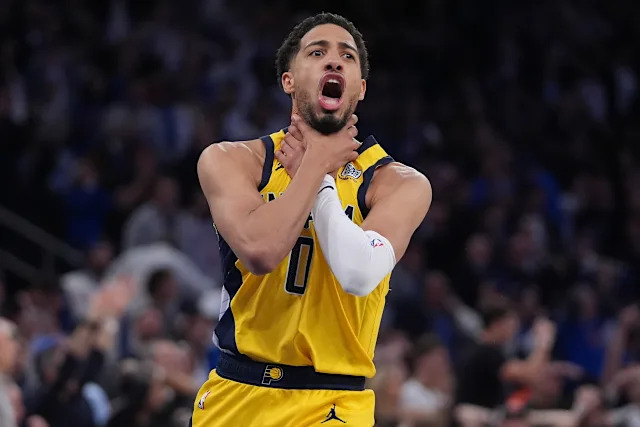
Just like Miller had three decades ago, Haliburton ran the court at MSG with his hands around his neck, yelling “Chokers!”
It was deja vu. It was a nightmare.
As “luck” would have it, Haliburton’s toe was on the three-point line, rendering his basket a two-pointer that sent the game to overtime.
The crowd tried to rally the Knicks and broke into chants of “F— you, Reggie!” as if to ward off a repeat of history. It didn’t matter. Indiana had all the momentum, and the stunned Knicks couldn’t hold on despite a combined 78 points from the Knicks’ Jalen Brunson and Karl-Anthony Towns.
Absolutely brutal. To rub salt in the wound, my cousins gleefully texted me with taunts like “Oh, the pain of it all!” A small text group consisting of me, my brother and one of our closest childhood friends turned somber. We couldn’t believe this was happening again.
Haliburton, top, and Miller, both mocked the Knicks after improbable wins 30 years apart.
I don’t usually blog about sports, but I feel like I have to release some of this pent up energy. I’d already showered treats upon Bud in celebration and had just given him catnip during a commercial break. We were playing a wand toy game. The mood was jubilant, then it wasn’t. I’m sure little man was confused, but he knows I wasn’t upset at him. Besides, I laughed at how absurd the whole situation was.
After the game, Charles Barkley, legend of the court and the booth, summed up his feelings after watching the ridiculous spectacle: “We get to watch this for our jobs. We’re the luckiest guys on Earth.”
He’s right, although as a lifelong Knicks fan, I don’t feel particularly lucky right now. Let’s hope Lady Luck finally smiles upon a franchise that hasn’t won a damn thing in 50 years and the Knicks turn tonight into nothing more than a bad memory en route to the NBA Finals.
The series, and the rivalry, resumes Friday night at 8 p.m. Whichever team wins the seven-game series will go on to the NBA Finals.
El Capitan, also known as Captain Clutch and The Maestro: Jalen Brunson had 43 points tonight, but it wasn’t enough.
Hart and Soul of the Knicks, Josh Hart, pulled down 13 rebounds and dished out 7 assists in game one of the Eastern Conference Finals.
The series has become known for its whimsical feline-centric episodes, with cats who are always trying to save the world or conquer it.
Love, Death + Robots has had a thing with cats since the very beginning.
The science fiction anthology started off on the right paw with 3 Robots, an inaugural season episode about a trio of intelligent machines touring the ruins of human civilization on a post-apocalyptic Earth, only to discover it isn’t quite as lifeless as they thought, with cats happily ruling the ashes.
We’ve written about the episode before, and it ends, naturally, with cats making the robots their new servants.
The gray tabby who tricks the titular 3 Robots into becoming his servants.
A sequel to that episode added to the legend of feline dominance, and now the fourth season brings us two more cat-centric episodes, For He Can Creep and The Other Large Thing.
For He Can Creep is set in 1757 London, where a poet named Christopher is incarcerated at St. Luke’s Asylum for Lunatics (an actual place) with only his cat. Jeoffry, for company. Christopher’s talent is mistaken for madness by the asylum staff, but not by the devil, who realizes the poet’s words have a unique power.
The problem? Jeoffry stands in his way. It turns out felines have spectacular evil-fighting powers, and the very British, very 18th-century devil offers Jeoffry an endless supply of treats, plus dominion over the Earth, if he’ll simply stand aside and let his human fall under the influence of evil.
Jeoffry, of course, is not having it, but to have a chance of defeating such powerful evil, he’ll need to enlist the help of the nearby alley cats, including an adorable but ferocious kitten named Nighthunter Moppet…
Nighthunter Moppet may be a tiny kitten, but she’s ferocious!
Jeoffry demonstrates the feline ability to teleport, a skill Bud has often used to confound me.
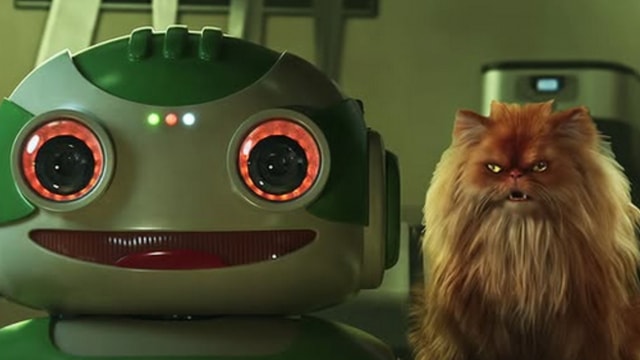
The Other Large Thing is a prequel to 3 Robots and 3 Robots: Exit Strategies, and focuses on a fluffy Persian whose humans call him Sanchez, a name he hates.
The humans are portrayed as jibberish-speaking morons for whom Sanchez has nothing but contempt, and when the “pathetic minions” bring home a domestic robot servant, Sanchez is infuriated — until he realizes the robot can “speak God’s language,” aka cat, and has opposable thumbs.
With the robot as his new minion, Sanchez finally sets out to conquer the world!
Sanchez realizes he’s struck gold when the new robot home assistant fetches as many cans of “the good stuff,” aka wet food, as he wants from the previously unreachable cupboard top shelf.
Both episodes are based on short stories, and they’re both written by people who clearly love cats.
Some episodes of LDR can get a little dark or somber. That includes Beyond the Aquila Rift and Sonny’s Edge, written by Alastair Reynolds and Peter Hamilton, two of my favorite novelists. Both episodes are spectacular, but they leave you with a chill and some disturbing thoughts that linger long after the credits end.
The feline-themed episodes are the perfect digestifs, offering doses of whimsy and levity to counter the existential dread and nightmarish visions of the future of other installments.
With no more humans to do their bidding, cats seize the opportunity and conscript the visiting robots as their new minions.
If you haven’t had the chance to check out the series, which streams on Netflix, I highly recommend starting with the aforementioned first season episodes 3 Robots and Beyond the Aquila Rift, then working your way through the rest of the cat episodes.
Not all of the episodes are great. The 400 Boys, one of the new episodes, is little more than inane and pointless violence, and the ubiquitous, creepy smiling “Mr. Beast” makes an appearance in another installment in an unnecessary attempt to attract new viewers. Thankfully most are strong, with more hits than misses.
Other highlights include the Christmas-themed short, All Through the House, Harlan Ellison’s Life Hutch, Reynolds’ Zima Blue, and Snow In The Desert.
Buddy is many things, but he’s NOT quiet. His incessant chattiness can kill my sleep and my peace and quiet, but in the world of A Quiet Place, it would kill me! Would your cat get you killed in the movie franchise’s monster-stalked reality?
As a cat lover, big time science fiction fan and appreciator of the first two A Quiet Place installments, the very first thing I thought when I saw the trailer for A Quiet Place: Day One was “I hope the cat doesn’t meow!”
My second thought? Bud and I would be so, so dead.
Dead immediately. Dead a thousand times over.
Apparently I’m not the only one, because fans have taken to social media to participate in the “Quiet Place Challenge,” which involves reenacting some of the scenes from the movie with their own cats to see if their furry overlords can stay silent.
As PITB readers know, Buddy never shuts up. He’s got something to say about everything, he often narrates his activities in real time, and he’s got an entire meowing ritual that starts at least a half hour before Food O’Clock, gaining in volume and annoyingness until a fresh bowl of turkey is placed before him. His personal patois, the Buddinese dialect, makes heavy use of trills, chirps, grunts, chuffs and sniffs to elaborate on his meows.
If you’re unfamiliar with the Quiet Place movies, they imagine a world that’s been invaded by so-called Death Angels, dread creatures of extrasolar provenance who are completely blind, but have extraordinarily sensitive hearing. The first movie, about a family surviving on their farm in upstate New York months after the initial invasion, was universally lauded for its taut script, effective tension and novel use of a quiet/loud dynamic that is a marked departure from the usual horror-thriller formula.
John Krasinksi directs and stars in the original A Quiet Place as Lee Abbott, a father who survives the invasion along with his wife (real life spouse Emily Blunt) and their two children. Credit: Paramount Pictures
In A Quiet Place (2018), its 2020 sequel and the recently-released prequel, Day One, entire minutes pass soundlessly. As a viewer you can’t help but wince and tense up when a character errs and makes noise, knowing the consequences can be immediately tragic.
There’s simply no way Bud and I would survive more than five minutes, and if I had to put money on it, I’d wager we’d probably be dead within 60 seconds of the terrifying monsters showing up.
Indeed, the movie doesn’t dither: the Death Angels make planetfall at around the 12 minute mark. Mild spoilers from the beginning of the film follow:
12:31 – On Chinatown’s ruined Pell Street, within a haze of dust so thick you can’t see more than a few feet in any direction, a man shouts loudly into his smartphone, telling the person on the other end that something meteor-like had landed just a few hundred feet away. He’s pulled suddenly and violently into the smog, his scream ending as abruptly as it began. Verdict: Death by Buddy. He’d probably meow in protest at the dust and get us both killed immediately.
12:53 – A female National Guard soldier sees Nyong’o’s Sam and shouts at her to take cover. The guardswoman’s radio crackles with the panicked screams of her comrades saying the enemy is everywhere, and then she’s dispatched as quickly as the guy on the phone. Verdict: Death by Buddy. He’d almost certainly huff derisively at the soldier’s order to take cover, and we’d both be crushed underneath the foot of one of the lumbering beasts.
13:34 – Sam huddles behind a vehicle with another woman when a panicked man screams, drawing the aliens like moths to a flame. Verdict: Death by Buddy. Little dude’s default reaction when he’s scared is to run screaming and hide behind my legs. He’d draw the monsters right to us and we’d die.
13:50 – Sam wakes up inside a theater several minutes after an explosion knocked her out. She’s about to speak when Djimon Hounsou’s Henri clamps a hand over her mouth and raises a finger to his lips. Unfortunately that doesn’t work with a cat. Verdict: Death by Buddy. Attempts to get him to shut up would be fruitless, and while I’d know my only chance for survival would be to throw him like a football so the aliens track his indignant screech, I wouldn’t have the heart to do it. We’d die together.
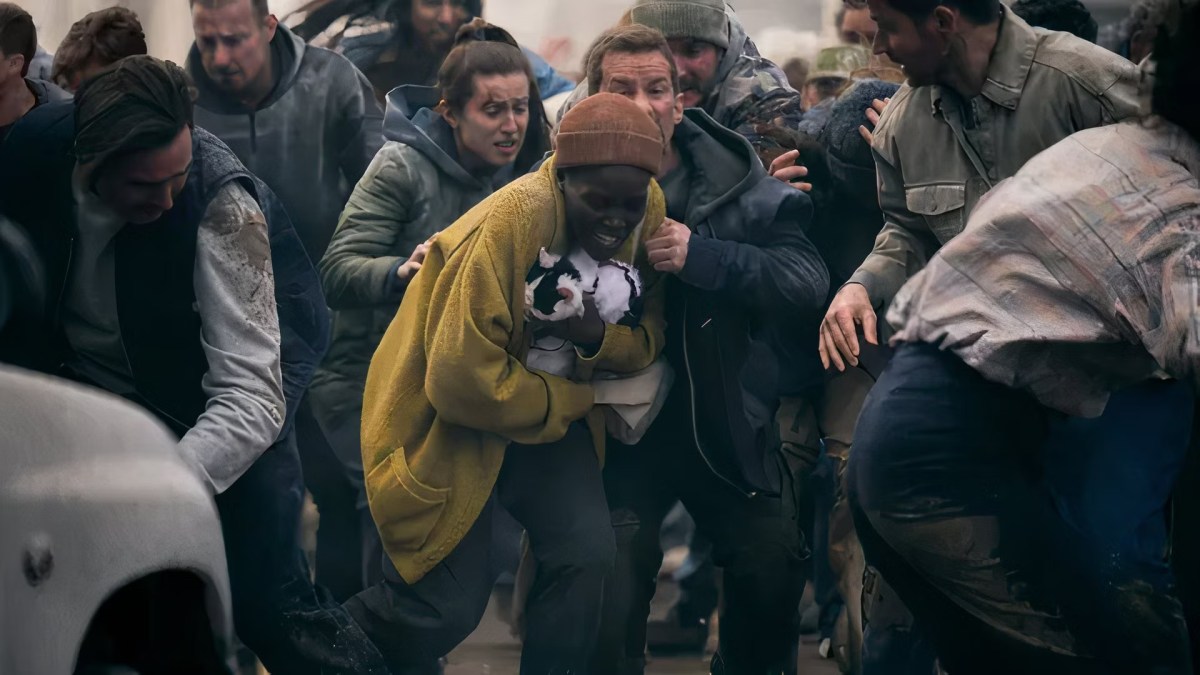
Frodo, the feline co-star of Day One and “service cat” to Lupita Nyong’o’s Sam, is precisely the opposite. He’s a Good Boy extraordinaire, consistently calm in his mother’s arms and reliably silent when he needs to be.
Frodo is a handsome and resourceful little guy, and much of Day One’s tension comes from putting him in danger. Credit: Paramount Pictures
Without meows to rely on, director Michael Sarnoski gets quite a performance out of Nico and Schnitzel, the two cats who play Frodo. They’re expressive felines who could teach Nicolas Cage a thing or two about how to emote with subtlety, as in one scene when Frodo sees a man emerge gasping from a flooded subway station. Frodo regards the stranger with curiosity, his little face registering surprise at the man’s sudden appearance with just the slightest twitch of his mouth and whiskers.
It’s effective and very cute, but we never forget about the incredible danger that faces Frodo and Sam as they return the One Ring to Mount Doom navigate the ruins of New York City amid blind predators with extraordinarily sensitive hearing.
“LOL I got you killed, dude! Hey! Wake up! I’m hungry! Turkey time! I’ll take my evening meal on the balcony and dine al fresco this evening, okay? Big Bud? Dude?”
If Day One’s world was reality — and I’m extremely thankful it’s not — I suppose it’s possible I’d get lucky if we were in a deep subterranean level of a building for some odd reason, and if Bud decided it’s not worth disturbing his nap to investigate the ruckus above.
But the moment his belly rumbles and he starts screeching for yums, or the second he gets it into his little head that he just has to tell me his latest theory regarding entangled subatomic particles, it would all be over, for me at least. I could totally see Bud making noise, then dashing to his customary hiding place behind my legs while a “Death Angel” impales me with one of its giant claws.
What about the rest of you? Is your cat a Frodo, a Bud or another sort entirely? Would you be dead as quickly as we would be, or do you think you could survive with your furry pal?
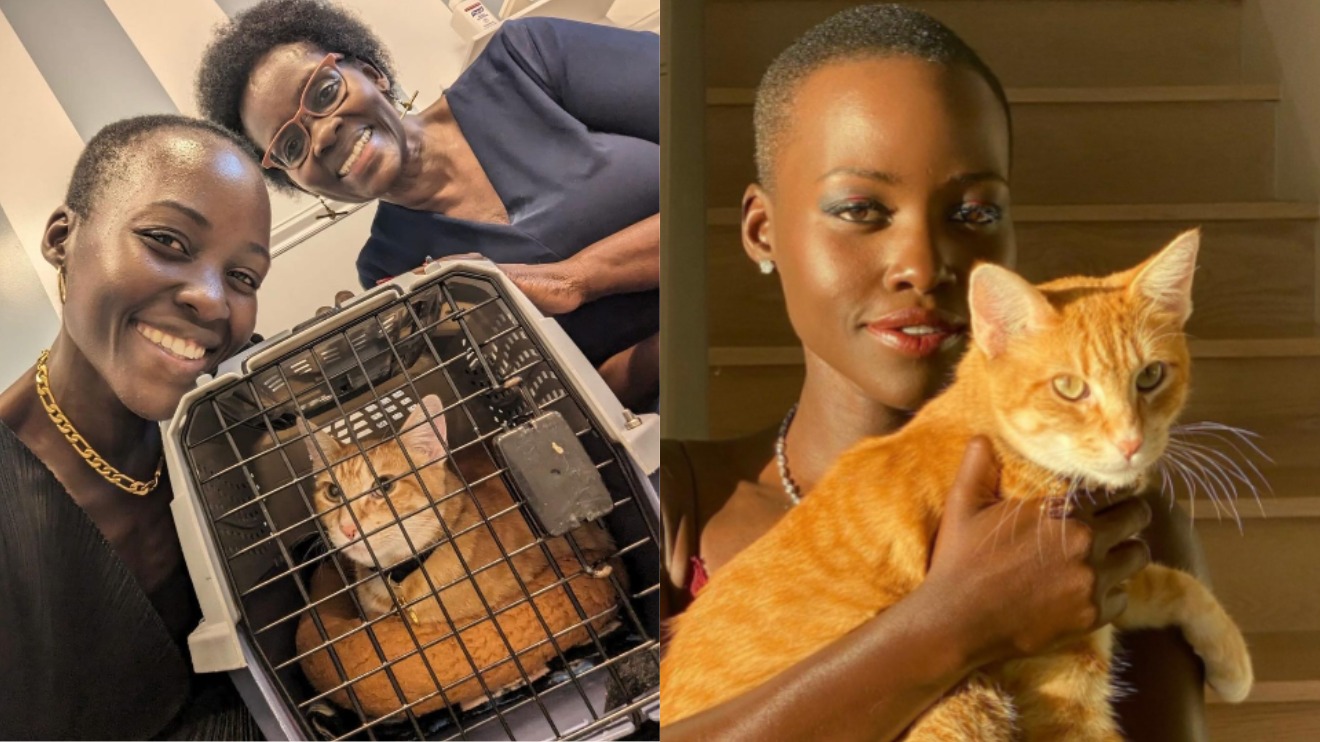
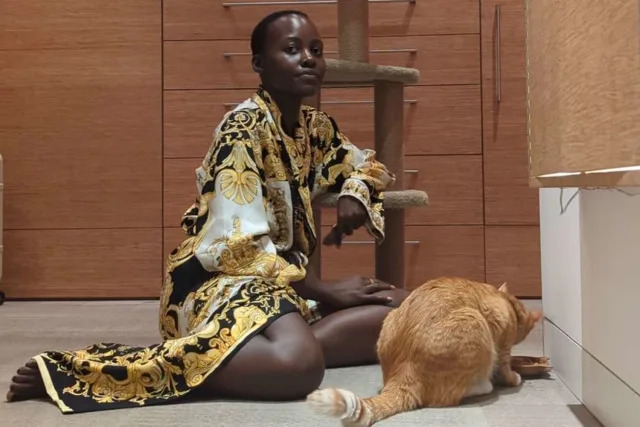
Lupita Nyong’o not only shares the screen with a feline co-star in the new film A Quiet Place: Day One, she’s also a devoted cat mom to a ginger tabby named Yoyo.
Although I haven’t seen most of Lupita Nyongo’s movies — I really liked her performance in Us and her voice work in Disney’s Jungle Book remake — I’m a big fan now that I know she’s a cat lover.
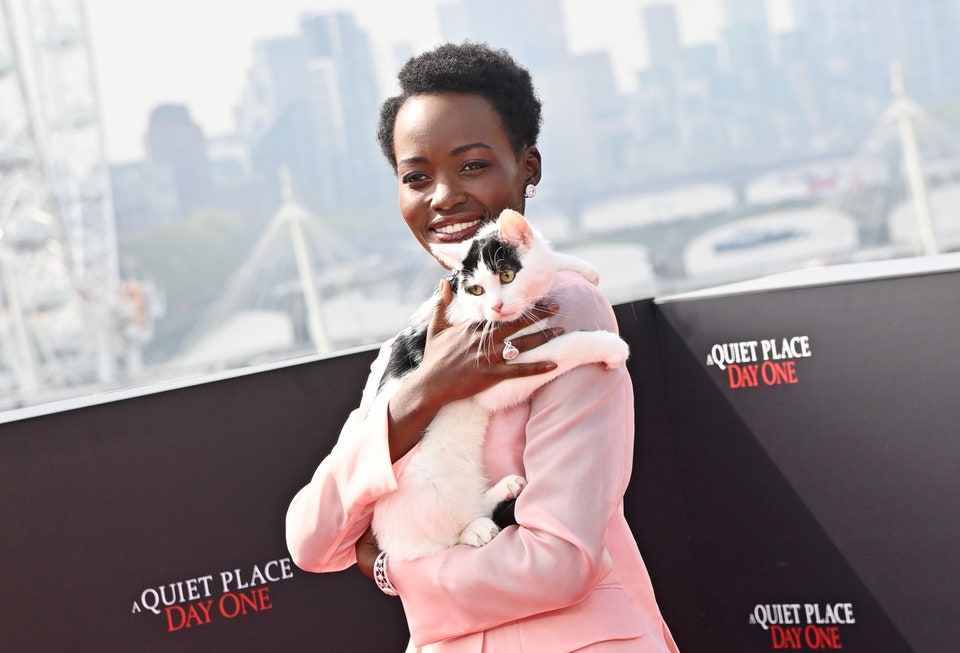
Nyong’o took to the red carpet for the premiere of her newest film, A Quiet Place: Day One in London on Wednesday, and her plus-one was a cat named Schnitzel, who also stars in the movie. Photos show Nyong’o posing along co-star Joseph Quinn, smiling as she cradles Schnitzel in her arms.
Lupita Nyong’o with her cat, Yoyo. In addition to posing with a cat on the red carpet premiere of her new film, Nyong’o proudly dotes on Yoyo and mentions him often. Credit: Lupita Nyong’o/Instagram
A Quiet Place is a 2018 film about a family that lives a completely silent life on a farm after the civilization has fallen to monstrous creatures that can’t see but are exceptionally sensitive to sound.
The film received nearly universal positive reviews for its use of sound — and the complete absence of it for long stretches — as a tension-building device, and a 2020 sequel continued the story.
Day One, which hits theaters on June 28, promises audiences a look at how the creatures appeared and civilization collapsed.
Schnitzel’s role isn’t entirely clear, but if it’s anything like 2022’s Prey, cats will fill their usual niche as predators, highlighting the difference between terrestrial and extraterrestrial hunters.
Caring for a cat in a world like A Quiet Place could be a double edged-sword: a super vocal cat like my Buddy wouldn’t last very long unless he quickly learned to keep a lid on his constant commentary, but cats are also incredibly sensitive to things that pass beneath the notice of us humans.
Thanks to their incredible hearing, exceptional sense of smell, the advantage of an extra olfactory organ and whiskers that pick up even the slightest stirring, felines are keenly aware of their surroundings.
As for Nyong’o, while Schnitzel is not her cat, she’s the proud cat mom of Yoyo, an orange tabby she fostered in late 2023. It only took her three days of fostering the little guy before she realized “I could not give him up,” she said last year shortly after the adoption was made official.
“I never understood people whose phones were full of photos and videos of their pets — now I am one of those people,” she wrote when she adopted the tabby. “It may look like I saved Yoyo, but really, Yoyo is saving me.”
Lupita Nyong’o with Yoyo. Credit: Lupita Nyong’o/Instagram








 Pain In The Bud