Cat Beds, Feline Football Experts, And The ‘Elitism’ Of Paying For Veterinary Care

Do cats ever do what we want them to do?

I expected something truly extravagant when a reader wrote to Slate’s advice column to say she was considering doing something “wildly elitist” involving her cat.

What could it be? I wondered. Pure gold or silver eating and drinking bowls, a la Choupette? A fashionable $600 pet stroller like the young, childless women of Tokyo favor for their felines? Feeding premium meat from the butcher exclusively to her cat?

None of the above, it turns out. The allegedly “wildly elitist” thing this woman was deliberating was simply paying a veterinarian to have dental work done on her cat, with costs estimated at between $800 and $2,000, depending on the extent of the kitty’s cavities.

To make matters even stranger, the letter writer says the cost won’t be a financial hardship for her family. Their cat is only three years old, she notes, and the family has had him since he was found on the street as a kitten.

“I guess I didn’t think that part of taking him in would entail thousands of dollars to keep him alive at this stage of the game,” she wrote. “At what point do people draw the line on what it costs to save a cat’s life?”

Credit: Wikimedia Commons

The writer was essentially looking for “permission” to have the cat put down, for Slate’s advice columnist to virtually pat her on the head, say “There, there!” and agree that taking care of your own cat is “wildly elitist.”

Thankfully, Slate columnist Athena Valentine was having none of it, telling the woman seeking advice that “when you adopt an animal, you take financial responsibility.” Spending money on veterinary care when needed, Valentine noted, is “exactly what you signed up for” by adopting the little guy. A cat who, by the way, could easily live another decade at least.

“If you do not want to pay for your cat’s treatment, please surrender him to a rescue that will,” Valentine wrote. “The rescue will raise the funds you do not want to part with to pay for his teeth and will then adopt him out to a new home that understands the responsibilities of pet ownership. I also advise you to not adopt any more animals until you’re fully ready to accept the financial obligations that come with it.”

Cheers to Valentine for not taking the bait.

Do your feline overlords use their own beds?

One of the first things I bought for Bud, along with his litter box, bowls and toys, was a bed. It’s nothing extravagant, but it does look pretty comfortable.

He has never used it.

Or rather, he lounged on it a handful of times when he was a kitten, but he claimed my bed as his own. He was very clear on the new ownership situation, and generously allowed me to continue sleeping on my his bed as long as I accepted the fact that he would use me as a pillow, which he has been doing for more than a decade now.

A Newsweek story details the efforts of a woman who bought her cat a new bed, hoping he’d let her sleep at night, only for the feline overlord to drag his new bed onto her bed. Essentially, she bought him a new pillow.

Do cats ever do what we want them to? That’s a rhetorical question, by the way.

A cat whose fantasy soccer team ranked 222 out of 13 million players

At The Athletic, Conor Schmidt writes about creating a fantasy football (soccer) team for his cat, and letting the little guy choose who to draft and trade by writing the names of players on a dry erase board and putting treats next to each name. The first treat his cat goes for is the one whose associated player is dealt or drafted.

He says his cat reached an astonishing world ranking of 222 out of almost 13 million players on the same platform worldwide, which means either the little dude has incredible luck, or he’s a genius who knows a lot more than he lets on.

Maybe I should register a fantasy basketball or baseball team for Buddy, smear turkey gravy next to players’ names, and see how he does.

We’re Snowed In, And Buddy Doesn’t Like It!

“Turn the snow off, human! What do you mean you don’t control the weather? I want the warm!”

It’s a frigid nine degrees out right now — down to one degree with wind chill — the storm arrived earlier than expected, and we’re already getting buried.

The exact numbers change depending on the forecaster, but the National Weather Service predicts eight to 14 inches for the New York City area.

That’s actually not bad compared to some places that will be in the heart of the storm when it passes, and it’s actually warmer than yesterday, if you can believe it.

Buddy, however, is having none of it.

He’s alternating between sitting on the radiator to soak up heat and staring at the accumulating snow through the sliding glass doors, occasionally turning to meow at me in protest as if I control the weather.

“I don’t like this, human!” he seems to be telling me. “Fix it! I want lots of warm, sunshine, leaves on the trees, and crickets!”

Meanwhile, my brother and his cat, Twix, are kickin’ it in 80 degree weather in Italy.

We hope our fellow ‘Mericans are safe at home with plenty of supplies for the next two days, that your feline masters are inside and warm, and that you avoid power outages. This storm is supposed to touch 40 states, which is remarkable, and it’s expected to dump snow on places that rarely see it.

If you’re looking for something to read, here’s a story about the recent string of movies that have featured cats as protagonists or significant characters. It notes that while CGI makes it easier to digitally include felines — and the surprise hit Flow famously featured a digitally animated cat — directors like Michael Sarnoski (A Quiet Place: Day One) have opted for real kitties, favoring their expressiveness and cuteness.

It mentions Bring Her Back, which was an exceptional and disturbing horror film in its own right. It’s also the only one on the list in which the cat doesn’t survive, so heads up on that. (Horror fans will note Bring Her Back was made by the same writer/director team that debuted with the exceptional Talk To Me. Those guys know horror.)

If you ever wondered what happened to Ser Pounce from Game of Thrones, the story also details how the showrunners cut the kitty’s role for being a “diva” on set. Poor King Tommen.

While you’re snowed in and bored, check out this short video of a “red Burmese,” which is a ginger cat without stripes except for faint lines on the back of his front legs. Maybe cats like this aren’t as rare as they seem, but I can’t recall seeing an orange cat who wasn’t a tabby:

@chestertthecat

Replying to @flavor I love his colouring but I never knew it was rare! #catsoftiktok #fyp #crosseyedcat #catmom #cute

♬ Little Sparrow – Paul Alan Morris

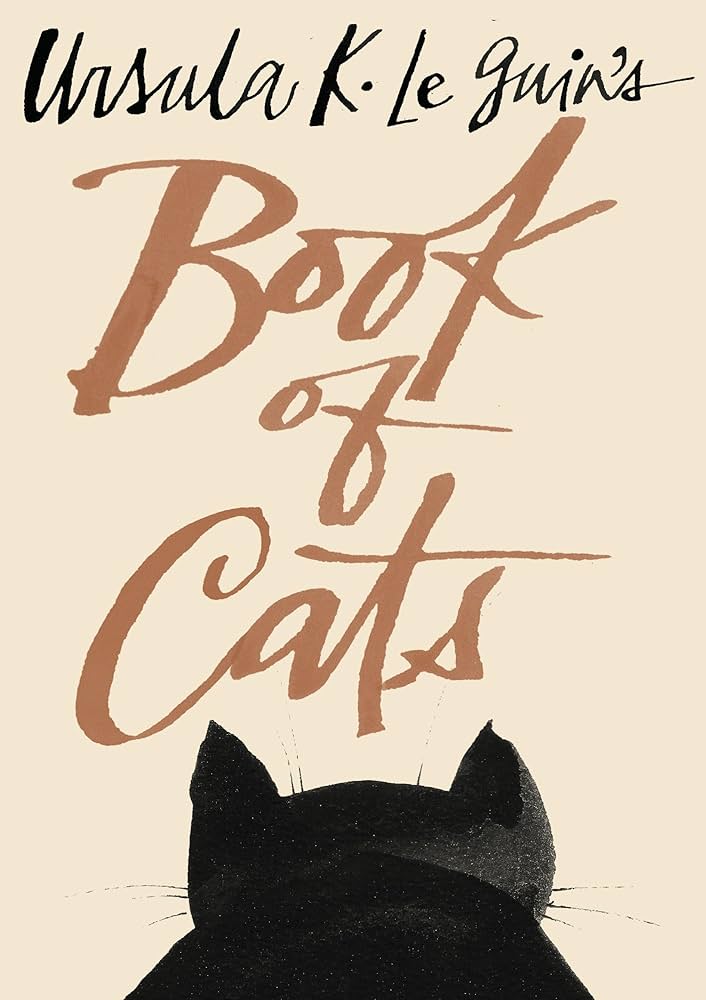
And finally, Ursula K. Le Guin is best known as a prolific science fiction writer who published for more than half a century, winning Hugos, Nebulas and every other award in the genre, but you don’t need to be a science fiction fan to appreciate Ursula K. Le Guin’s Book of Cats.

The posthumous collection includes Le Guin’s observations about our feline friends, meditations on what human society can learn from them, and lots of stories about the cats in her life.

You can check out a review here if you’d like to know more, and read community reviews on Goodreads here.

That’s all for now. I may blog intermittently throughout the storm if we really get buried here. We’re prepared to hunker down, with a full cupboard of yums for Bud and the excellent Clair Obscur: Expedition 33 beckoning me with its strange adventures. Bud is also more attached to me than usual as he tries to soak up as much heat as he can.

In the meantime, stay safe and stay warm!

US Law Treats Pets As Property, UK Law Treats Them As Sentient Creatures With Real Emotions

Your cat may mean the world to you, but in American courts she’s no different than a TV or an air fryer.

With a quick resolution to a UK cat theft that made international news, it’s become clear that our friends across the Atlantic are way ahead of us in crafting laws that protect animals.

In the US, the legal system views pets as property. You can see the vestiges of our agricultural past in the way animal-related crimes are categorized. Here in New York, they’re found in Agriculture and Markets law, not the state penal code.

The former was written to handle things like compensation for killed or stolen livestock, not to recognize the emotional damage a thief does to both the person and pet when they’re separated.

Today laws forbidding puppy mills and defining the responsibilities of municipal pounds are lumped in with legislation governing things like farm fencing and how horses may be tested for performance-enhancing drugs ahead of county fairs. It’s archaic, confusing and limits the legal consequences for mistreating pets.

Credit: Breno Cardoso/Pexels

That means the penalties for stealing someone’s beloved dog or cat amount to a slap on the wrist. Your cat may mean the world to you, but in the eyes of the court she’s worth the $175 fee for adoption and shots you paid to a shelter.

That’s also why police enforcement is a crapshoot. If someone makes off with your furry friend, you might get lucky when you find out the local sheriff loves his dogs dearly and makes sure animal-related crime is taken seriously.

Or you might get a desk sergeant who thinks you’re wasting department resources, glowers at you from behind the desk as you submit your report, and leaves it in a pile with other things he believes are beneath the dignity of real police.

It’s easy to blame the police, but their attitudes are impacted by the outdated laws and a society that hasn’t caught up. SPCA law enforcement officers are often treated like Ace Ventura with a badge, and police agencies are reluctant to devote significant resources to cases that will amount to misdemeanor charges, which can be pleaded down further in court.

Credit: Alexandros Chatzidimos/Pexels

Compare that to the West Yorkshire police, who launched an investigation when security camera footage showed an Amazon delivery driver stealing a family’s cat a week ago. Happily the feline has been reunited with her people and is back home, but neither the driver nor the company are off the hook, as the police still have an active investigation.

In the UK, courts take animal-related crimes seriously, and so do the police. That’s because of several important pieces of legislation, starting with the Animal Welfare Sentience Act of 2022.

The law finally frees cats and dogs from any remaining association with property laws. Instead they’re viewed as what they are, sentient creatures who have their own feelings. It also recognizes animals like the octopus, which can be startlingly intelligent.

That opens the door to legislation like the Pet Abduction Prevention Act of 2024, which takes into account the trauma to the human and animal victims. Both dogs and cats are likely to be deeply confused and distressed at being taken from their people, and cats in particular don’t do well when removed from their territory.

When a judge sentences a person for, say, stealing a family’s beloved senior dog, he can take into account the stress both the family and dog endured, and the disruption to their lives. When a couple breaks up and both sides fight over a cat, the judge can base a decision at least in part on what’s best for the kitty.

You can’t do that when a law says the animal in question is no more important than a toaster.

The 2024 law cited more than 2,000 dog abductions and more than 400 cat thefts in 2020, and it has legal teeth — judges have discretion to put convicted pet thieves behind bars for as many as five years.

American lawmakers should take a look at how things are done across the pond. At a time when rancorous politics and divisive ideology stains almost everything, this is an opportunity for legislators of all ideological stripes to work together, earning a win for themselves, and most importantly, for animals.

‘I Tread Where I Please’ Said Cat Who Left Paw Prints On Manuscript 500 Years Ago

It turns out cats have been adding their special sauce to our communications for as long as written language has been a thing.

Illuminated manuscripts date back long before the printing press, and their manufacture was arduous.

Literacy itself was rare in the Dark Ages and usually only the province of educated nobility and the professionally religious. Most people had no hope of learning to read, so the monks charged with copying religious texts were already practitioners of a rare skill for their time.

They weren’t just writing either. They carefully illustrated each page with drawings, cartouches and other decorative touches, and the text itself was a form of art in its calligraphic symmetry, designed to be beautiful as well as legible.

It took thousands of hours to complete a manuscript. There was no whiteout and no do-overs: a mistake meant the page had to be scrapped even if it represented a week’s worth of work.

So when a Flemish scribe finished a page of his manuscript and set it aside, he thought he was in the clear — until a cat came along and left its own signature in the form of paw prints.

Three of them, in fact, representing one and a half kitty strides. Two of the feline’s little feet found white space, but another landed right on top of the meticulously rendered text.

The feline-marked parchment in all its glory.

It kind of puts keyboard cats in context, doesn’t it? Our four legged friends may occasionally ruin our drafts or emails — or in my case wreck a music recording session with a discordant keyboard solo by walking across a synthesizer at an inopportune time — but at least they don’t cost us dozens of hours of work.

The 500-year-old, kitty-marked manuscript is now the centerpiece of “Paws On Parchment,” a new exhibit at Baltimore’s Walters Art Museum.

Click here for more details from the museum, which is open Tuesday through Saturday, with late hours on Thursday evenings. Admission is free.

And if you ever take up calligraphy as a hobby, keep your work hidden from your feline overlords!

What’s Your Cat’s Petting Limit?

A netizen’s cat tolerated an astonishing 176 pets from his human!

An Instagrammer decided to test the limits of his feline overlords’ tolerance for pets, and it was instructional.

Porky, who looks like he’s a British shorthair, lasted 107 repetitions of his human’s hand rubbing his head before he’d had enough. His brother, Jim, lasted 176 repetitions!

Both are extraordinarily polite. Porky just got up and left when his human kept going despite clear signs that he was at his limit, like a swishing tail and shifting positions. Jim was still enjoying having his head stroked after the 100 pets mark.

I could not get away with this. Not even close.

First, Bud doesn’t like that kind of palm-open head petting. I’ve gotta be gentle and very precise, being careful not to touch his ears, which clearly annoys him. The limit is maybe…four? Five?

He likes it when I rub his cheek glands, under his chin, and around his jowls. I know enough to stop and let him give me a signal if he wants more.

He’ll move if he’s had enough, but if I’m not paying attention and I persist, he’s got no qualms about smacking me or biting down on my hand. He’s learned that warning bites should be gentle, but after a clear warning, all bets are off.

I was awarded with ELEVEN scratches on my left arm last week, although that was a case of misdirected aggression, not an overstimulation outburst. I should have seen it coming, since I know the signs indicating he’s frustrated about something and needs to release energy.

Yes, my cat is a jerk. Yes, I still love him. In fact, I’m glad he’s my Buddy and he didn’t end up with people who think cats do things out of spite, or would physically punish him for acting like a cat. A jerk of a cat, but a cat all the same.

He’s taught me to pay very close attention to body language, ears, whiskers, tail swishing, and all the other ways cats signal to us aside from verbalizing their feelings.

How do your feline masters respond to petting, and what are their limits?