The trail camera is operated by a team studying the behavior of wolves, but this felid became the main character for a short while, posing majestically right in front of the lens.
Happy Monday! We’re starting the week off in style with an amazing video courtesy of the Voyageurs Wolf Project.
As its name implies, the project is a collaboration between wildlife biologists, ecologists and academics to learn more about wolves, specifically how they survive in the summer months.
While there’s a wealth of research on the behavior of wolves during winter, the pack animals go their separate ways in the warm weather to raise newborn cubs and hunt smaller prey.
Because it’s much more difficult to track individual wolves under the cover of heavy brush compared to following entire packs in the snow, the project relies on a combination of GPS collars and trail cameras. The latter pick up all sorts of wildlife in the Minnesota wilderness, which is how the Voyageurs Wolf Project captured this clear, close-up footage of a stunning medium size wild cat:
We captured some really neat footage of lynx this past year on our cameras but this is definitely the coolest. In fact, might be the best video of a lynx we have ever captured, not least because the lynx decided sit right in front of the camera…
— Voyageurs Wolf Project (@VoyaWolfProject) July 31, 2024
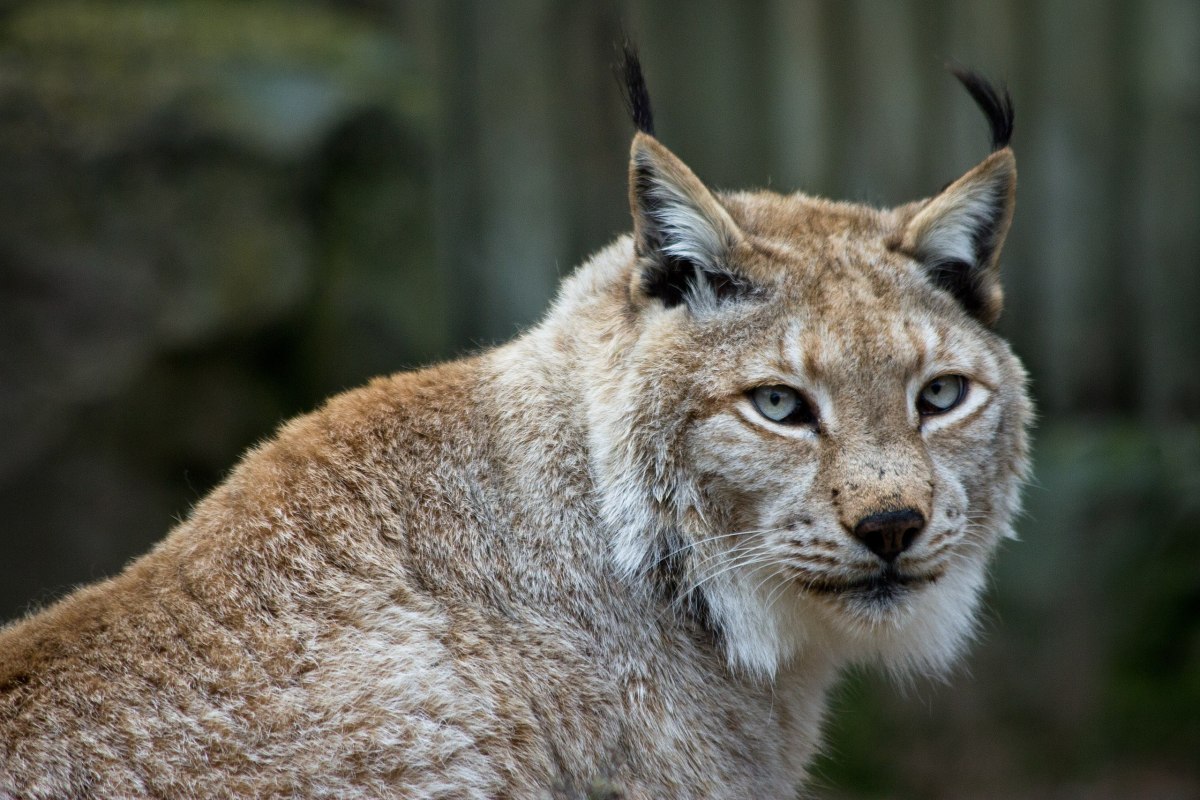
That’s lynx canadensis, better known as the Canadian lynx, and the footage is so perfect it’s as if the wild cat said “Ah, a trail camera! I’m gonna sit right here and let the humans see how beautiful and regal I am!”
From its pronounced ear tufts to its snow-soft fur and dark stump of a tail, this lynx is a fantastic example of its species. Canadian lynx are well adapted to the demands of their environs in Canada and the northern US, with heavy coats and soft, wide feet that allow it to traverse snowy landscapes quickly and silently.
They’re famously elusive and difficult to track in the wild, but maybe all we have to do is give the lynx a chance to strut its stuff.
Top image credit Carlos Delgado/Wikimedia Commons.
Feefee the cat’s family is deeply frustrated at the lack of answers about their cat and the lack of urgency by the company in trying to locate her after an Amazon delivery driver stole the 13-year-old tabby on July 21.
After a 10-day saga in which tan Amazon driver stole their cat — and Amazon did little to help recover her — a Washington family has been told the feline is gone, and has been offered stuffed animals in her stead.
Feefee the cat was taken from the Ishak family’s driveway in Everett, Washington, on July 21. Footage from a motion-activated security camera shows an Amazon delivery driver crouching in the driveway and petting Feefee, then driving off.
A representative from Amazon’s customer service department confirmed the driver took the cat, but has not helped reunite Feefee and the Ishaks beyond giving the family an email address that law enforcement can use to contact the company.
At first, an Amazon rep told Ray Ishak that the driver — who has not been named by the company — contacted law enforcement to return Feefee. However, neither the Everett Police Department nor the Snohomish County Sheriff’s Office said they had any record of anyone approaching them about surrendering a cat.
An Amazon customer service representative told the Ishak family that the driver “contacted the police to return your cat.”
Amazon declined to put Ray Ishak in touch with the driver or to tell him the general area where the driver lives, so he might contact local law enforcement there.
The story changed on the morning of July 30, when the sheriff’s office told Ishak that the driver now says Feefee “allegedly escaped a few days ago,” Ray Ishak told PITB.
“They will not tell me where. If I could find out the vicinity I’m pretty sure I could have found the cat,” Ishak said. “I asked the sheriff’s deputies how I can find out the area and the only way is for the driver that stole the cat to tell me.
“I asked them to have her text me or call me from a blocked number or [create] a temporary email, just to tell me where it is because [the police] can’t tell me. It has to come from her and she has refused to do so so far. I fear that [Feefee’s] gone.”
PITB has reached out to Amazon and will update this post if the company responds.
In the meantime, while Amazon will not assist Ishak in trying to recover Feefee himself, a customer service representative asked the Washington man for a description of the 13-year-old tabby “so they can send me a stuffed animal that looks like her,” Ishak told PITB.
“I am serious,” he said, adding that he’s kept copies of the email correspondence with Amazon’s customer service department.
An Amazon customer service representative said the company would do “everything we can to investigate” and offered to send stuffed kittens “that look like” Feefee for the family’s grandchildren, who are close to the cat. Credit: Ray Ishak
As we wrote in our earlier post about the incident, Amazon has handled the case as if it were a dispute over a returned item or a delivery problem, even asking Ishak to rate his experience with the company’s customer support immediately after informing him they can’t give him more information. The company has not taken active measures to reunite the Ishak family with their cat, and has refused to provide any information about the driver, even vague information that could help Ishak find Feefee.
“What baffles me is that no one seems to understand that this is a CRIME and we the people who were hurt by this crime are being kept in the dark when we should be able to find her,” the family wrote in response to Amazon’s most recent reply.
The language reflects the deep frustration the family has felt over the incident and the company’s response.
“I just pray we find her alive. I am also tired of getting the brush off, generic emails and no information on our case.”
An Amazon driver playing with Feefee in the Ishak family’s driveway before driving away with the cat. Credit: Ray Ishak
If the driver is telling the truth and Feefee escaped, finding her quickly is critical. The vast majority of house cats do not do well when forced to fend for themselves, and Feefee has been a member of the Ishak family for 13 years, since she was a kitten.
If the driver is not being truthful and still has the cat, there’s no way for the family to know, and no indication Amazon or law enforcement can be convinced to find out if she’s telling the truth.
As one of our readers wrote in response to our previous story, few things are more heartbreaking than someone stealing a family’s well-loved cat. The saga has been stressful for the Ishak family, and has undoubtedly taken a toll on Feefee, who was taken from the only home she’s ever known. Feefee suffers from asthma, Ray Ishak said, which is why she was allowed to spend time outdoors immediately outside the family’s home.
Ray Ishak said his family was gathered this weekend for his son’s wedding and he had to tell his grandkids, who are particularly close to Feefee, that the cat was elsewhere. That quickly backfired.
“The emotional distress for me having to lie to my grandkids that the cat is safe and fine,” Ishak told KING5, a Seattle NBC affiliate, earlier this week. “Then, watching my granddaughters cry after they found out because they heard us talk about it. It was a double whammy from every single front.”
This is not the first time a delivery driver has stolen a pet, and not the first time an Amazon driver has done so.
In 2021, a driver for Uber-owned Postmates stole an 11-month-old ginger tabby named Simba from a Colorado family’s driveway after delivering a package. Postmates was similarly reticent to help the victims, and the family was never reunited with Simba.
In 2020, a 23-year-old delivery driver stole a Minnesota woman’s cat from outside her home and repeatedly denied taking the 12-year-old tabby until, three months later, he wrote an apologetic letter admitting he nabbed her, felt guilty and tossed her out of his truck later the same day.
In 2022, an Amazon driver stole a Michigan family’s dog. The pup was returned four days later.
Earlier this year, an Amazon driver tried to steal a family’s dog after admiring the pup and telling the family he wanted a puppy of his own. The family caught the driver in the act, and the driver did not escape with the dog.
On July 3, a FedEx driver stole a French bulldog named Tori after delivering a package to her owner’s home in North Carolina. The driver, 44-year-old Kimani Joehan Marshall, left Tori in his truck as he continued making deliveries and the pooch died as temperatures pushed well into the 90s with high humidity. Marshall dumped Tori’s body by the side of a road and the family continued to post missing flyers and search for her until July 10, when police confirmed their dog was dead. Marshall remains in jail on $50,000 bail and faces a felony cruelty to animals charge as well as larceny and possession of stolen property.
Most recently, an Amazon Flex driver allegedly stole an Austin, Texas woman’s dog on July 25. The woman, with help from friends and online sleuths, tracked the driver to his home 50 miles away and was able to recover her dog after confronting the man with evidence — including video from a neighbor’s security camera — showing he’d taken the pup.
That’s not a comprehensive list, and the cases that make the news involve pet thefts caught on camera. Victims who don’t have security or doorbell cameras generally have no recourse, and thefts by delivery drivers won’t make the news unless the victims take their stories to local newspapers or TV news stations, or local reporters discover reports by checking police blotters. The latter situation is becoming increasingly unlikely as so-called “news deserts” — locales not covered by any local media — expand with every newspaper that folds and every round of newsroom layoffs.
We hope someone in Amazon management is paying attention and can help the Ishak family get Feefee back. After all, who wants Amazon drivers delivering packages to their homes if the company allows those drivers to steal from customers with impunity?
As we wrote previously, this isn’t a customer returning a sweater or complaining about a late package, and it shouldn’t be handled that way. Feefee is a living being with emotions, and she’s been part of the Ishak family for 13 years. The very least Amazon can do is have a compassionate and empowered manager call them, apologize profusely, and vow to do everything possible to reunite the family with their well-loved cat.
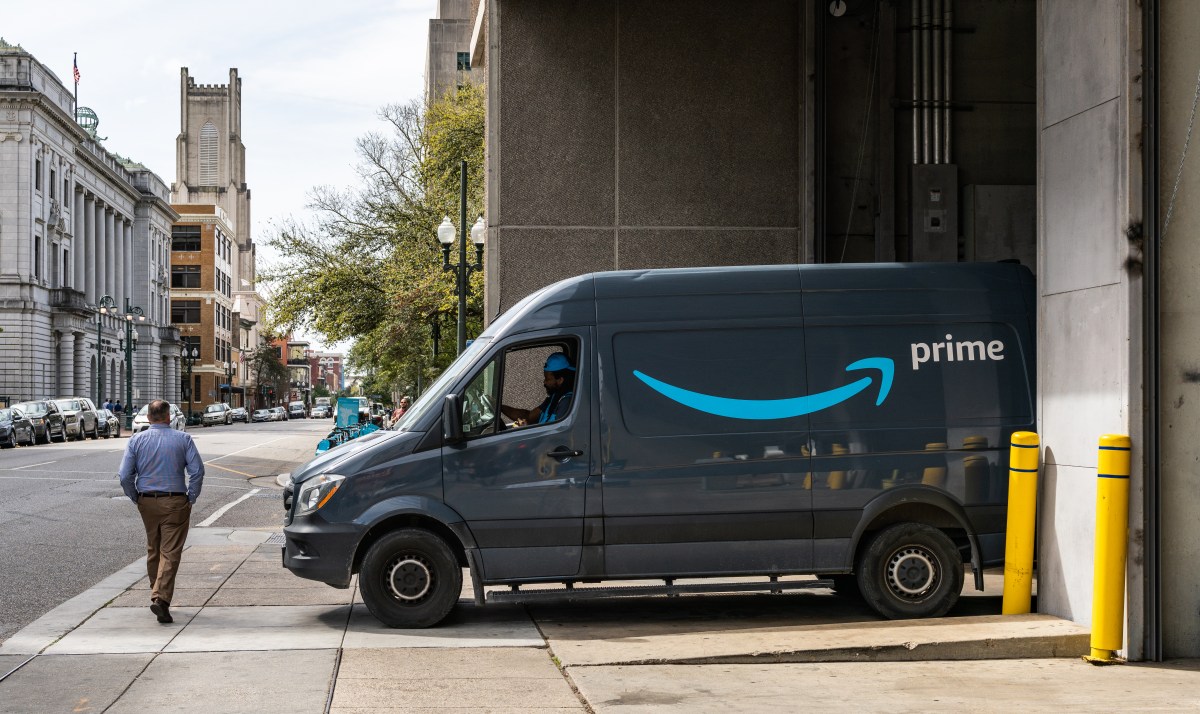
Top image of an Amazon delivery driver in a Prime van courtesy of Wikimedia Commons.
The days of tiny backyard enclosures for big cats are over.
The passage of the Big Cat Public Safety Act has been a massive win, resulting in the end of the wild cat trade in the US and the cruel practice of taking cubs from their mothers for use in roadside zoo petting attractions.
But there’s another, often-overlooked component of the new law that’s about to result in big changes for captive tigers, jaguars, pumas and other wild cats.
While current “owners” of big cats were grandfathered in under the BCPSA, they have until June 18 to register with the federal government, and with registration comes requirements, inspections and minimum standards of living for the wild felids.
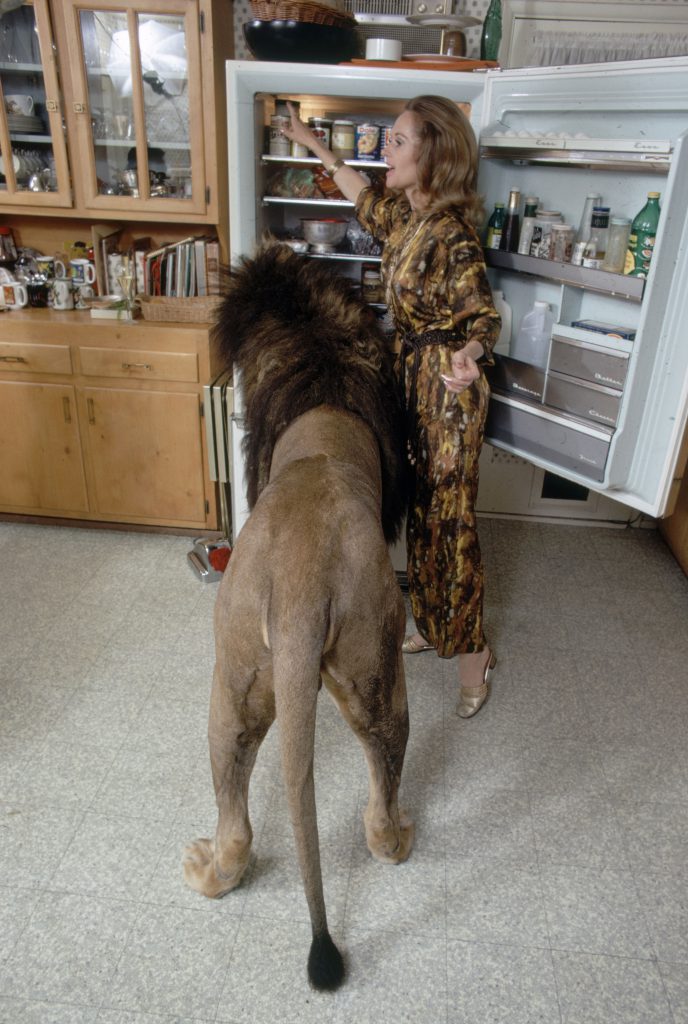
In other words, most of the people who “own” the estimated 20,000 privately held big cats are about to get a rude awakening. The days of tiny makeshift enclosures in backyards are over, as is the practice of keeping big cats in the home as if they’re domestic felines. (With apologies to Tippi Hedren, who once owned as many as 60 lions and tigers, and at 93 years old still has “13 or 14” big cats, according to her granddaughter, actress Dakota Johnson.)
Tippi Hedren with one of her lions in a vintage LIFE magazine photo. Hedren kept the lion and other big cats as pets in her home.
If people who have possession of big cats don’t register with the U.S. Fish and Wildlife Service, they’ll have their animals taken away. Likewise for people who don’t provide adequate enclosures that not only provide enough space, but are built to contain the apex predators.
As a result, sanctuaries are bracing for an influx of tigers, lions, jaguars, leopards, cheetahs, snow leopards, clouded leopards and pumas, all of whom are protected under the Big Cat Public Safety Act.
Experts anticipate a significant number of big cat “owners” could try to part with their animals if they can’t or won’t provide adequate enclosures, and the government is already cracking down on people who are trying to sell their “pets.”
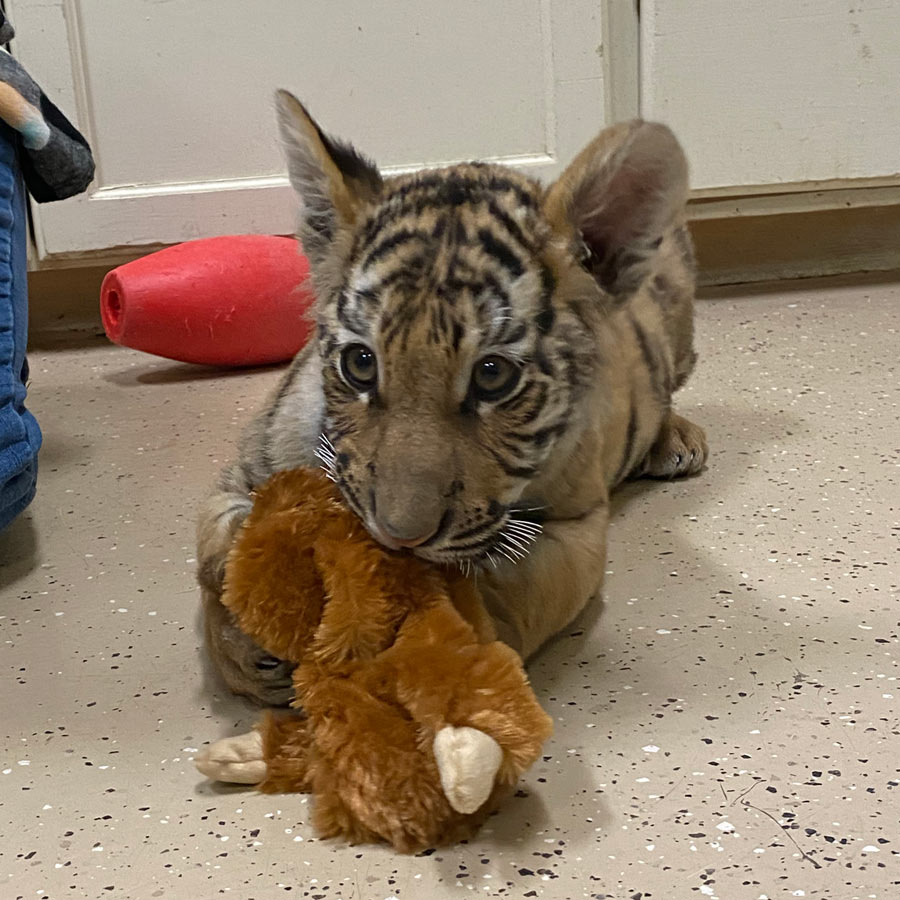
A tiger cub named Indy is one of the first to be taken out of private hands and placed in an accredited sanctuary. Indy was recently sold by her original “owner” and the man who purchased her for $25,000 tried to flip her, advertising the cub online.
Authorities moved in and found Indy in a dog kennel in a closet inside the man’s Arizona home. Police, who said they could hear Indy “moaning” from inside the closet, also seized an alligator and a dozen snapping turtles.
Tammy Thies, founder of the Wildcat Sanctuary in Sandstone, Minn. — Indy’s new home — said the cub is lucky she wasn’t confined to the small space for long.
“Many of the cubs we get are suffering from metabolic bone disease, malnutrition, sometimes they have such long confinement that they don’t have use of their back end, so Indy’s a lucky one,” Thies told WKQDS, the local Fox affiliate.
Indy was found in a tiny cage in a man’s closet. Now she’s enjoying sunshine in an accredited sanctuary. Credit: Wild Cat Sanctuary
Indy arrived in May and has adjusted well to her new home in less than a month, according to the sanctuary. A page dedicated to tracking her progress has photographs of her meeting another tiger cub for the first time and playing in the grass.
As the deadline fast approaches, we hope Indy’s story is just one of many, and big cats who have suffered for years in tiny enclosures, under the “care” of people who aren’t qualified to keep them, find their way to accredited sanctuaries so they can live out the rest of their lives in sunshine, feeling grass and earth underneath their paws, with enrichment programs created by professionals who care about their well-being.
The “kids identifying as cats” claims are popping up everywhere ahead of midterm elections. Why are we dragging cats into our culture wars?
The physicist Michio Kaku was a guest on a radio show and was answering a question about possible intelligent life visiting Earth when Joe Rogan interrupted him.
“The three pyramids are aligned with Orion’s belt,” Rogan said. “Do your research, man. Look it up.”
Rogan, who was into 9/11 truther conspiracies at the time, went on to explain how the Egyptians couldn’t possibly have built the pyramids on their own, and that aliens helped them align the positions of the giant structures to correspond to important celestial features.
Here was Kaku, one of the brightest minds in human history, co-founder of string field theory, a man whose textbooks are required reading for PhD-level physics students, getting talked over and “educated” by a pothead who rose to fame hosting a game show in which he forced contestants to eat cockroaches.
Rogan’s source was rock solid if you’re the type of person who thinks ancient aliens traveled thousands of lights to the Earth of deep antiquity to teach human beings how to stack stones on top of each other: Rogan’s friend’s wife, who works at the school district, insisted the litter box story is true.
Like previous claims of school administrators gone mad in service to alleged furries, Rogan’s claim was intentionally nebulous and unverifiable. He didn’t name the school, the district or the teacher. We have to take his word for it.
If you like that sort of thing, I have good news for you! Rogan’s in great company.
Marjorie Taylor Greene — the congresswoman who once claimed “Jewish space lasers” were responsible for California wildfires, the shining testament to US education standards who warned “the Gazpacho police” will imprison patriotic Americans, the genteel stateswoman who said scientists are creating fake meat in “Peach tree dishes” to “zap” Americans — has also warned of the apparently widespread practice of furry school children shitting in litter boxes.
Heidi Ganahl, GOP nominee for Colorado governor:
"they're mute and they don't talk, they growl and meow. it's bizarre. that's an extreme example but it's happening." pic.twitter.com/be2syn012e
Not to be outdone, Rep. Lauren Boebert has co-signed the cat conspiracy, telling donors that evil cat-loving people are hell bent on destroying wholesome American values by unleashing cat-identified children on an innocent and unsuspecting public.
Say it enough and it becomes true
The claims have been repeated so many times that they’ve spread to school board meetings and state legislatures across the country, perpetuated by gerontocratic leaders who think The Onion is a real news source. Two current gubernatorial candidates, in Colorado and Minnesota, have also repeated the claim.
“Schools are not disclosing that they are allowing children who identify as snakes, cats, whatever, they’re providing litter boxes for the [student] cats,” a Tennessee state representative said during a hearing in September. “And obviously it’s very disruptive to the learning process. If a child has that much of a self-identity issue they probably need a different environment, and it’s creating a lot of anxiety, a lot of confusion with the children who are boys and girls.”
“But Big Buddy,” you might be thinking, “I thought you said PITB was apolitical and you’re a moderate?”
It is, and I am.
I dislike all ideology equally because it invites people to abdicate their responsibility to think for themselves. I believe our two-party system and the divisiveness it fuels could be the ruin of our great nation, particularly at a time when polls show up to half the US population expects to fight in an ideologically-driven civil war. I worry that we are doing precisely what our enemies want by feuding amongst ourselves. Indeed, we know for a fact that “troll farms” in countries like Russia and China exist to sow the seeds of division and crank up poisonous political rhetoric online.
But I’m also against pure, abject, mind-boggling, depressing, Idiocracy-style stupidity and the idea that anything is true if someone says it is. Neither party has a monopoly on this kind of thing.
In particular, I’m not a fan of injecting cats into the American culture wars. (Although it’s not just cats at this point. A Texas school district was forced to deny rumors that administrators were allowing “furries” to eat out of dog bowls in school cafeterias.)
Three minutes of two state lawmakers in Tennessee insisting this week in a hearing that there is a “crisis” of kids identifying as cats and peeing in litter boxes in school hallways “across the state” pic.twitter.com/DDHWKIJtLz
We already fail these innocent creatures in myriad ways, from allowing declawing and doing little to improve weak animal welfare laws, to tolerating the idea that it’s perfectly acceptable for people to shoot cats with arrows, BBs and real firearms as some grotesque form of entertainment.
Now people want to use cats as the rope in a perverse game of cultural tug-of-war, which could further degrade their status and lead to more proxy violence against them.
Cats are vulnerable, and are already targets of hate
Violent criminals, including the perpetrators of the recent mass shootings in Uvalde and Buffalo, often get their start by killing cats before “graduating” to humans.
Cats are also frequent victims of redirected anger, with studies showing they’re abused and killed in domestic violence situations because they’re viewed as extensions of the feminine, or simply because killing them causes emotional distress to the people who care for them.
Politics have pervaded and infected so many things, cats and dogs are now staked to territory on either side of the political fault lines.
So how long will it be before an Alex Jones type claims the government is using cats to spy on Americans? The best conspiracy theories always have a nugget of truth to them, after all, and in the 1960s the CIA tried — and failed, spectacularly — to use cats implanted with transmitters to spy on Soviet officials.
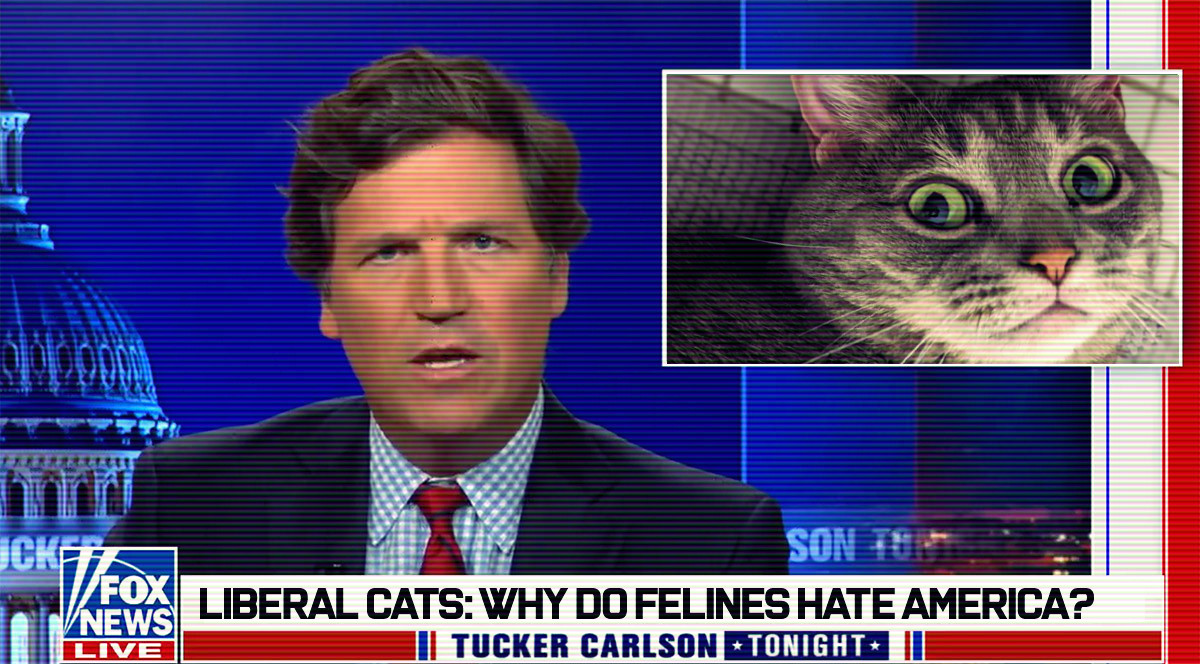
How long before a Boebert or a Greene tells a crowd that it’s their patriotic duty to shoot “liberal cats” on sight? How long before Tucker Carlson follows up one of his thrilling UFO/crop circle/cow mutilation investigative specials with a breathless exclusive about America-hating cats?
“Why do so many cats want to see America burn? Why do cats like to line their litter boxes with the American flag? Does the government allow cats to vote? Hey, I’m just asking questions!”
If you think that’s outlandish, I’d point out that we’ve been there, done that.
Tucker Swanson Carlson has already claimed that “decadent rich people” who “detest the country” like to plot America’s downfall from cat cafes. Those evil America-haters stroke cats and sip lattes while “working through the night to destroy” our great nation, Carlson told his viewers. I’m not making this up.
Europeans almost extirpated domestic cats in the middle ages when people were convinced they carried the Black Plague, and cats had even bigger targets on their backs after the Inquisition’s most overzealous prosecutors insisted felines were used in Satanic rituals.
Likewise, my Google News alert for cat-related articles shows a depressing, never-ending feed of stories about people chugging beer and shooting cats with BB guns, mystery killers strangling neighborhood kitties and “hunters” who put arrows through these sentient, innocent animals who have the mental and emotional capacity of three-year-old human children.
And there’s already plenty of nonsense online about how our choice of pet reflects our political beliefs, as well as unhinged rants about the kind of people who prefer cats. There are even research studies about the intersection of politics and attitudes toward companion animals, and research shows certain people consider cats “liberal” because they don’t adhere to social hierarchies and don’t recognize authority.
Is it really a stretch to imagine some 85, deep into a case of Miller High Life, taking target practice at neighborhood cats because he sees them as evil, feminine, America-hating animals? Are we sure it doesn’t happen already?



 Pain In The Bud