The series has become known for its whimsical feline-centric episodes, with cats who are always trying to save the world or conquer it.
Love, Death + Robots has had a thing with cats since the very beginning.
The science fiction anthology started off on the right paw with 3 Robots, an inaugural season episode about a trio of intelligent machines touring the ruins of human civilization on a post-apocalyptic Earth, only to discover it isn’t quite as lifeless as they thought, with cats happily ruling the ashes.
We’ve written about the episode before, and it ends, naturally, with cats making the robots their new servants.
The gray tabby who tricks the titular 3 Robots into becoming his servants.
A sequel to that episode added to the legend of feline dominance, and now the fourth season brings us two more cat-centric episodes, For He Can Creep and The Other Large Thing.
For He Can Creep is set in 1757 London, where a poet named Christopher is incarcerated at St. Luke’s Asylum for Lunatics (an actual place) with only his cat. Jeoffry, for company. Christopher’s talent is mistaken for madness by the asylum staff, but not by the devil, who realizes the poet’s words have a unique power.
The problem? Jeoffry stands in his way. It turns out felines have spectacular evil-fighting powers, and the very British, very 18th-century devil offers Jeoffry an endless supply of treats, plus dominion over the Earth, if he’ll simply stand aside and let his human fall under the influence of evil.
Jeoffry, of course, is not having it, but to have a chance of defeating such powerful evil, he’ll need to enlist the help of the nearby alley cats, including an adorable but ferocious kitten named Nighthunter Moppet…
Nighthunter Moppet may be a tiny kitten, but she’s ferocious!
Jeoffry demonstrates the feline ability to teleport, a skill Bud has often used to confound me.
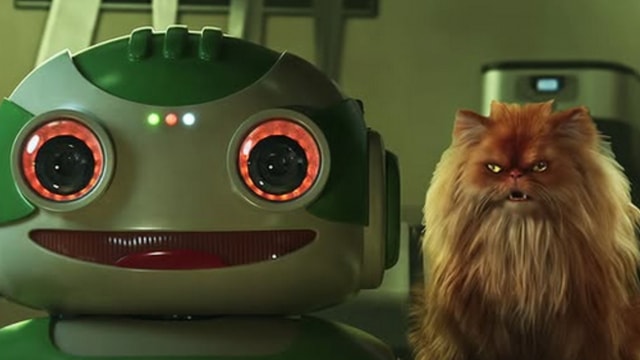
The Other Large Thing is a prequel to 3 Robots and 3 Robots: Exit Strategies, and focuses on a fluffy Persian whose humans call him Sanchez, a name he hates.
The humans are portrayed as jibberish-speaking morons for whom Sanchez has nothing but contempt, and when the “pathetic minions” bring home a domestic robot servant, Sanchez is infuriated — until he realizes the robot can “speak God’s language,” aka cat, and has opposable thumbs.
With the robot as his new minion, Sanchez finally sets out to conquer the world!
Sanchez realizes he’s struck gold when the new robot home assistant fetches as many cans of “the good stuff,” aka wet food, as he wants from the previously unreachable cupboard top shelf.
Both episodes are based on short stories, and they’re both written by people who clearly love cats.
Some episodes of LDR can get a little dark or somber. That includes Beyond the Aquila Rift and Sonny’s Edge, written by Alastair Reynolds and Peter Hamilton, two of my favorite novelists. Both episodes are spectacular, but they leave you with a chill and some disturbing thoughts that linger long after the credits end.
The feline-themed episodes are the perfect digestifs, offering doses of whimsy and levity to counter the existential dread and nightmarish visions of the future of other installments.
With no more humans to do their bidding, cats seize the opportunity and conscript the visiting robots as their new minions.
If you haven’t had the chance to check out the series, which streams on Netflix, I highly recommend starting with the aforementioned first season episodes 3 Robots and Beyond the Aquila Rift, then working your way through the rest of the cat episodes.
Not all of the episodes are great. The 400 Boys, one of the new episodes, is little more than inane and pointless violence, and the ubiquitous, creepy smiling “Mr. Beast” makes an appearance in another installment in an unnecessary attempt to attract new viewers. Thankfully most are strong, with more hits than misses.
Other highlights include the Christmas-themed short, All Through the House, Harlan Ellison’s Life Hutch, Reynolds’ Zima Blue, and Snow In The Desert.
The more bunk studies claim cats are driving wildlife to extinction, the more people in media and government call for extreme measures to contain them.
Seventy nine cats.
That’s how many felines stood in for the entirely of the UK in a 2022 study, which is the genesis for the claim that cats kill 270 million birds and small animals in that country.
Using GPS collars, owner questionnaires and samples of prey brought home by those 79 outdoor cats, a research team from the University of Reading applied data from a mix of studies dating as far back as 23 years ago, extrapolated and massaged numbers using things like “kernel density estimates” and “generalized mixed models,” and came up with that 270 million figure, which is cited routinely and credulously by UK media.
Actually, their estimate was between 140 and 270 million. An earlier study put the number at 92 million, and a 2016 study estimated UK cats kill 55 million birds and small animals. That’s a range of 215 million!
The Reading team even quotes the infamous US meta-analysis that claims domestic cats kill as many as 4 billion birds and 22.3 billion mammals a year here. That paper, as skeptics in the science community have noted, has virtually no relationship with reality, involves no original research, and relies on data from unrelated studies and surveys in which cat owners were asked to rate their pets’ hunting prowess on a point scale while imagining what the little ones get up to when they’re outside.
All of this is to say that aside from the thorough, labor-intensive and expensive D.C. Cat Count, which brought together cat lovers, birders and scientists to work cooperatively, the 2022 UK study and its counterparts in the US and Australia are exercises in pushing an agenda masquerading as honest academic research.
That’s how we get editorials like The Spectator’s “We need a cat lockdown now” by Zoe Strimpel. Though the tone isn’t tongue in cheek, I can’t imagine Strimpel dislikes cats nearly as much as she claims, and the post was probably written with wry anticipation for the click-generating fury of cat lovers indignantly sharing it on Facebook and X.
Still, it quotes the Reading study without skepticism and portrays cats as furry little wretches who abuse their human caretakers with their claws and their disdain while gleefully eating their way through endangered birds.
A cat stares down a mouse. Credit: Wikimedia Commons
Cats are predators, that much we can agree on, and outdoor cats are much more likely to negatively impact local wildlife, for obvious reasons.
Likewise, I can understand the concern with cat culture in the UK, where allowing pet cats to roam outside is the norm.
But every time the media cites the above-mentioned studies, more people are given an inaccurate impression of feline ecological impact, and more lawmakers at the local and national level consider “solutions” ranging from prohibiting people from keeping pet cats, as a government commission in Scotland recently proposed, or exterminating them outright, as some Australian states and municipalities in New Zealand have tried to do.
It’s worth pointing out that there is no data, not even a single study, showing that air-dropping poisoned sausages or arbitrarily shooting cats actually has any positive impact on birds and small mammals. All it does is terrorize sentient, intelligent domestic animals who have real emotions and experience real fear and pain.
The primary drivers of declining bird and small mammal populations — including habitat loss, environmental destruction, wind turbines and glass buildings — have nothing to do with cats. We have killed off 73 percent of the planet’s wildlife since 1970 and every species of iconic megafauna — from orangutans and gorillas to tigers and pangolins — is headed toward extinction. Are domestic cats responsible for that too, or can we be adults and fess up to our role as the main antagonist here?
An orange tabby and a mouse. Credit: Wikimedia Commons
Strimpel actually goes even further, claiming cats don’t have real affection for their caretakers and are more like psychopaths, faking love because it gets them what they want, primarily food and shelter.
Dogs have true affection for their humans but cats do not, she additionally claims, while adding that cat people are undateable because they share qualities with the “loutish and numerous creatures” they care for.
There was a time when I would have been ambivalent about Strimpel’s attitude toward cats, if not her cavalier treatment of basic facts. But then a drool-happy, friendly tuxedo cat showed me I could interact with his species without my allergies going haywire, and a tiny gray tabby kitten became my animal cognition teacher while blindsiding me with love.
Now every time I hear about some psychopath abusing cats, or terribly misguided politicians advocating a plan to kill millions of domestic felines, I think about my Bud. I think about how he cries for his Big Buddy when he’s hurt or stuck, how he meows and trills with excitement when he experiences something new, and how he began shaking, then threw up from overwhelming relief and happiness the first time I returned from a vacation after adopting him.
Buddy the Cat chillin’ on the balcony in the summer. Credit: PITB
He’s got a vibrant mind in his little head, with strong opinions and emotions. So does every cat on the street, in a shelter cage, and in the cross hairs of a birder or biologist playing God by “culling” or “harvesting” cats to protect another species.
Real science, not activism packaged as science, has proven that many times over in recent years. If people want to do harm to cats because they think birds and other animals will benefit, the burden of proof is on them to show not only that their methods work, but that the results could somehow justify the fear and misery they would inflict on innocent animals to achieve their goals.
Cats are obligate carnivores who don’t have a choice. We do.
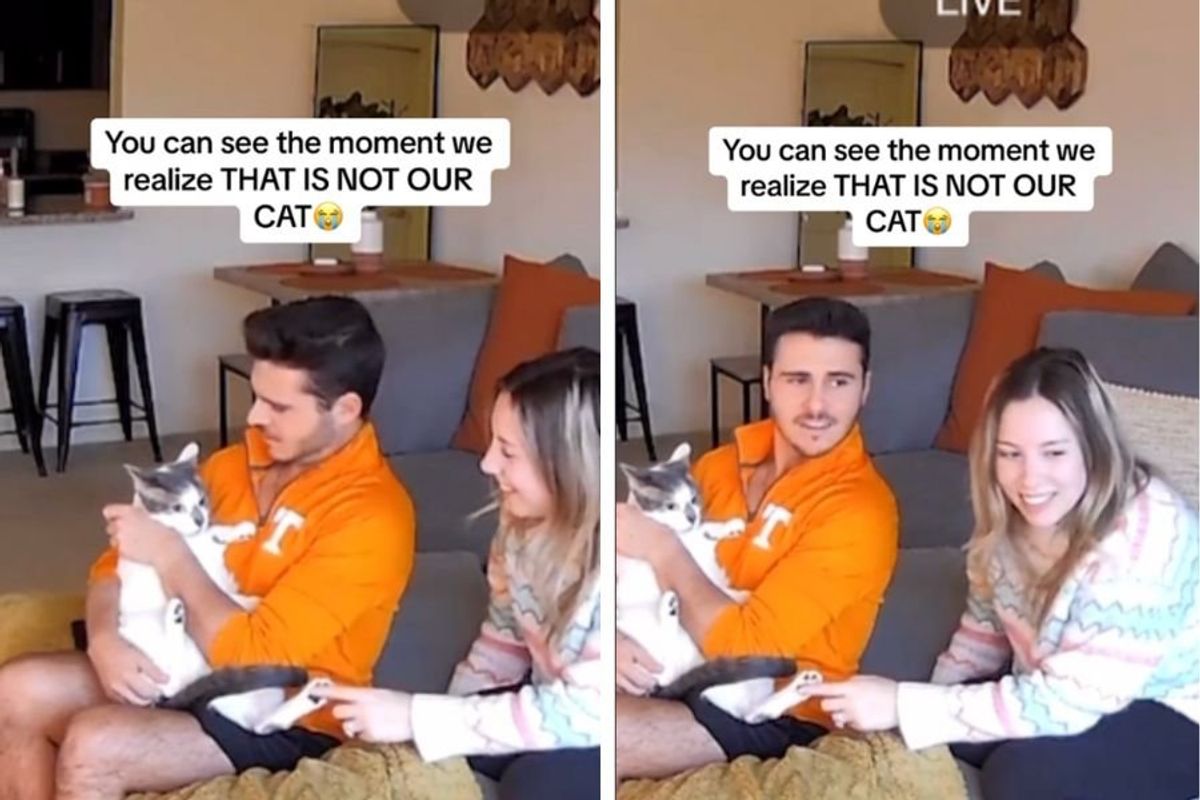
A man and woman on TikTok claim they took in a stray, believing it was their own identical-looking cat.
Back in 2021 we were fascinated by the story of a Redditor who thought he found his missing cat after three weeks, only for his actual cat to come walking through the door a week later.
The cats did look remarkably similar, and it’s conceivable that the Redditor was so happy to have his cat back that he didn’t realize there were very small differences.
Now a couple on TikTok claims something similar has happened to them, although it should be taken with a grain of salt. They claim they brought a cat inside, believing it was their feline overlord, only to begin cuddling him the exact moment they realized their actual cat was outside looking in, appearing none too happy about the situation.
Of course to take the story at face value you’d also have to believe that the entire incident happened to be captured on video by an unnamed third person who happened to be filming them at that moment, and happened to have their camera in portrait mode for maximum TikTok compatibility.
The TikTokers
I’m not linking to the account or the Upworthy story that takes it at face value because I’m not a fan of clickbait or content scrapers, but it did remind me of the interesting 2021 story and my reaction to it.
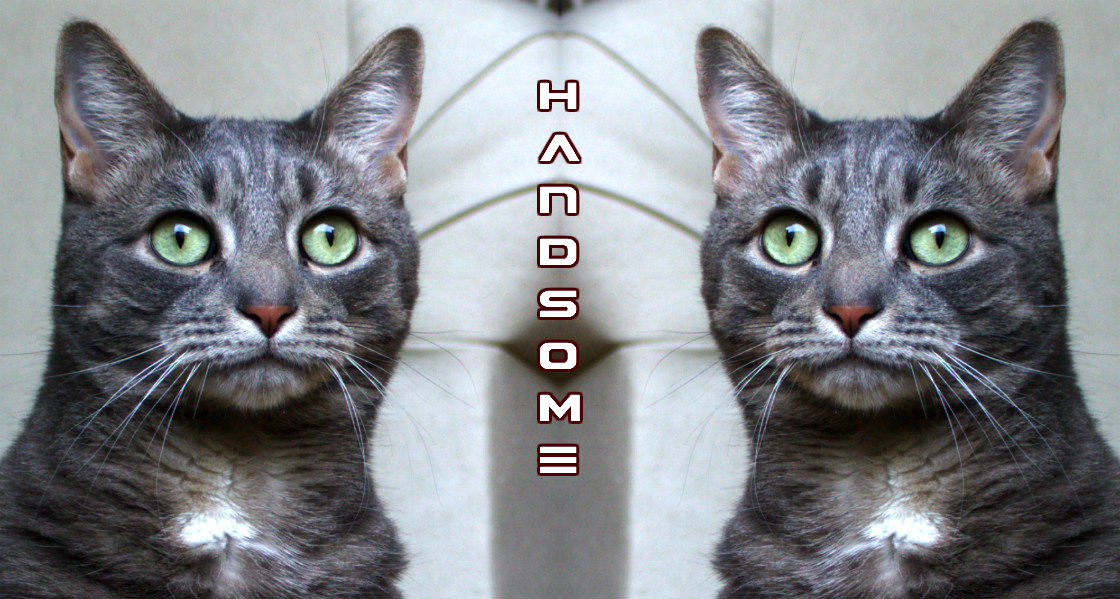
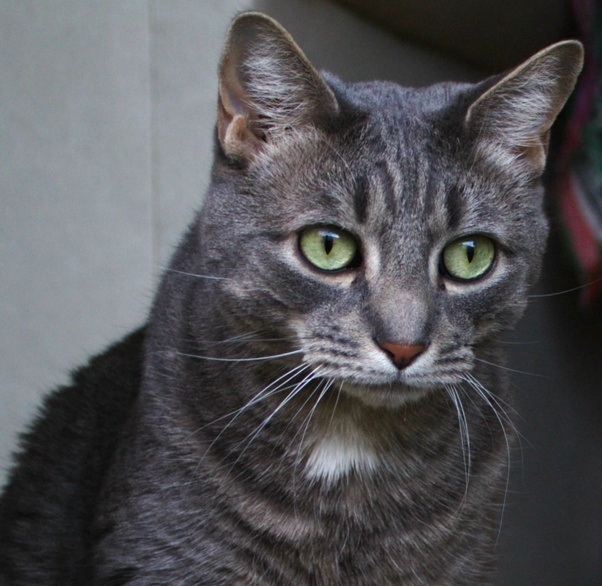
At the time I noted three of Bud’s unique physical characteristics: his bright green eyes framed by dark “guyliner,” the unique tuft of white fur on his chest and perhaps his most obvious distinguishing feature, his pronounced muzzle. You can see it in this photo thanks to the angle:
A Buddy like no other.
But most of all, Buddy’s personality is utterly unique. I could probably search to the ends of the Earth and hell would freeze over before finding a gray tabby cat with the same physical features, the same tyrannical Elmo voice and the same imperious personality.
I cannot fathom mistaking another cat for Bud because I can’t imagine another cat with all of the above qualities who also narrates his own activities in real time like a play-by-play announcer who sounds like a disco-funk vocalist singing in falsetto.
“Jumping off the couch now…funky! I can see the bottom of my bowl, dude, and that is decidedly un-funktacular! I’m gonna do a few laps around the living room at 27mph while filling you in on my latest theories about the multiverse, okay? Prepare to get funky! So I think there are — ooh, I found a crunchy treat I must have missed earlier! Nomnomnom! — anyway, I was doing some calculations and I believe if we extend out to 11 dimensions, we solve some of the incompatibilities I was telling you about earlier. In simple terms, all particles in our universe are like vibrations on a tiny rubber band, physics is the harmonies on the string, chemistry is the melodies we play on vibrating strings, the universe is a symphony of strings, and the mind of God is cosmic music resonating in 11-dimensional hyperspace! Bring me catnip! I need catnip! Can’t you see I’m on the verge of another breakthrough here?”
Buddy: Catnip aficionado, play-by-play announcer and theoretical physicist. Also, beefcake.
I’ve described Bud as a lunatic, and that’s one reason I love him. He’s crazy in the best way, unpredictable, amusing and never boring.
Could you ever mistake another cat for your own? What makes YOUR cat unique?
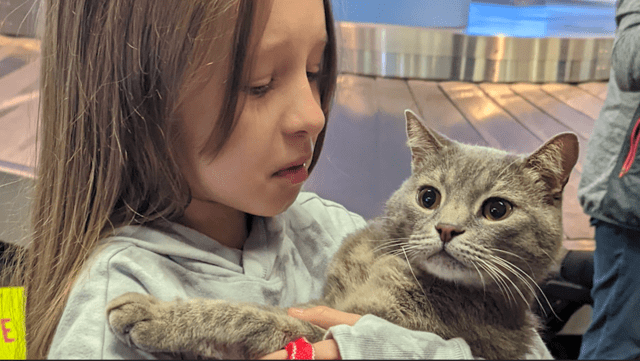
Ten-year-old Agnessa had to leave her cat, Arsenii, behind in Romania and was distraught at being separated from him.
Call me cheesy, but despite the polarization in our country, despite our disgusting political system and despite the fact that we’ve got plenty of flaws, America is still a good place to live and most Americans are good people.
I’m reminded of how lucky we have it here when I see photos of Uyghurs lined up by the thousands with their dead eyes in China’s concentration camps, and when I see clips of ghoulish Putin cronies on Russian state TV gleefully cackling at footage of destroyed Ukrainian hospitals, and laughing as they talk about drowning Ukrainian children.
I’m reminded of it in a much more hopeful way when I read stories like this one about 10-year-old Ukrainian Agnessa Bezhenar, whose family fled their war-torn country, spent time in Romania as refugees and eventually ended up in California.
Not only did Agnessa have to leave the only country she’d ever known and adjust to two foreign countries, and not only does she have to learn a new language and adjust to a new school, but her heart’s been broken since she had to leave behind her cat, Arsenii.
Agnessa was overcome with emotion after reuniting with Arsenii. Credit: Maria Bezhenar
Thanks to the efforts of two kind flight attendants, a volunteer at an animal rescue and her supportive new community in Cloverdale, Cali., Agnessa was finally reunited with Arsenii, a silver tabby with decidedly Buddesian looks. (No wonder Agnessa loves him so much!)
Geoffry Peters, the Californian who provided his second home to the Bezhenar family, also helped arrange to have Arsenii brought to the US.
“Can you imagine your life being turned upside down and you have to leave a country you’ve never left before, ride on an airplane you’ve never done before? Arrive in a new country, learn a language,” Peters told CBS News. “I mean, it’s like starting from scratch, only it’s on steroids. It’s like everything moving 100 miles an hour.”
Peters connected with the family through a program that helps Ukrainian refugees find homes in the US.
“Maria [Bezhenar] sent an email saying we’ve been matched and we have a family of six,” Peters said. “And so I went to my son and I said instead of renting this house, which he was planning on doing, would you be willing to donate it for two years?”
A flight attendant the Bezhenars met en route to the US connected the family with a fellow flight attendant who does animal rescue and recommended a local animal non-profit. When the staff at that rescue were told about Agnessa’s predicament, they contacted a colleague who was vacationing in Greece. That colleague agreed to travel to Bucharest, where Agnessa’s uncle had stayed behind and was caring for Arsenii. (A Ukrainian version of the Greek name Arsenios.)
The colleague brought Arsenii to California, a trip that took human and cat from Bucharest to Greece to Montreal, then Seattle and finally to Cloverdale. In all, Arsenii traveled more than 7,000 miles to be reunited with Agnessa.
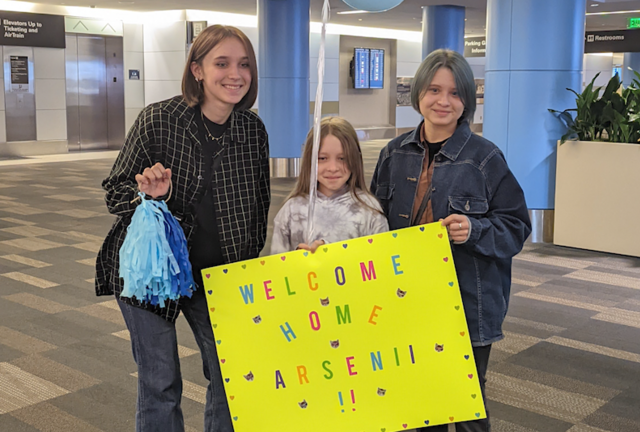
Agnessa and her older sisters waiting for Arsenii to arrive at the airport. Credit: Maria
Much like the Bezhenar family had arrived in the US to find Cloverdale locals holding up signs welcoming them to the US, the Bezhenars greeted Arsenii with their own signs — and lots of tears — when his long journey was finally over.
It’s been a rough year filled with trauma for the Bezhenar family, but they’ve found a new community, new friends like Peters, and have the support of people in Cloverdale, who worked together to make sure the Bezhenar’s new home was furnished when they moved in. They even got a piano for the home after hearing the kids liked to play.








 Pain In The Bud