The battle between the UK’s most prominent felines could upend the political order and engulf the realm in chaos!
LONDON — Larry the Cat patrolled his familiar route through Downing Street, nodding at the fully armored soldiers and security professionals who lined the narrow passage as if to say “Alright, then!”
The UK’s most beloved feline and de facto head of state felt it was important to personally inspect the defenses and raise the morale of his men as more reports arrived of intense fighting on the edges of the city, where Larry loyalists clashed with supporters of Palmerston, the former chief mouser at Whitehall and Larry’s longtime nemesis.
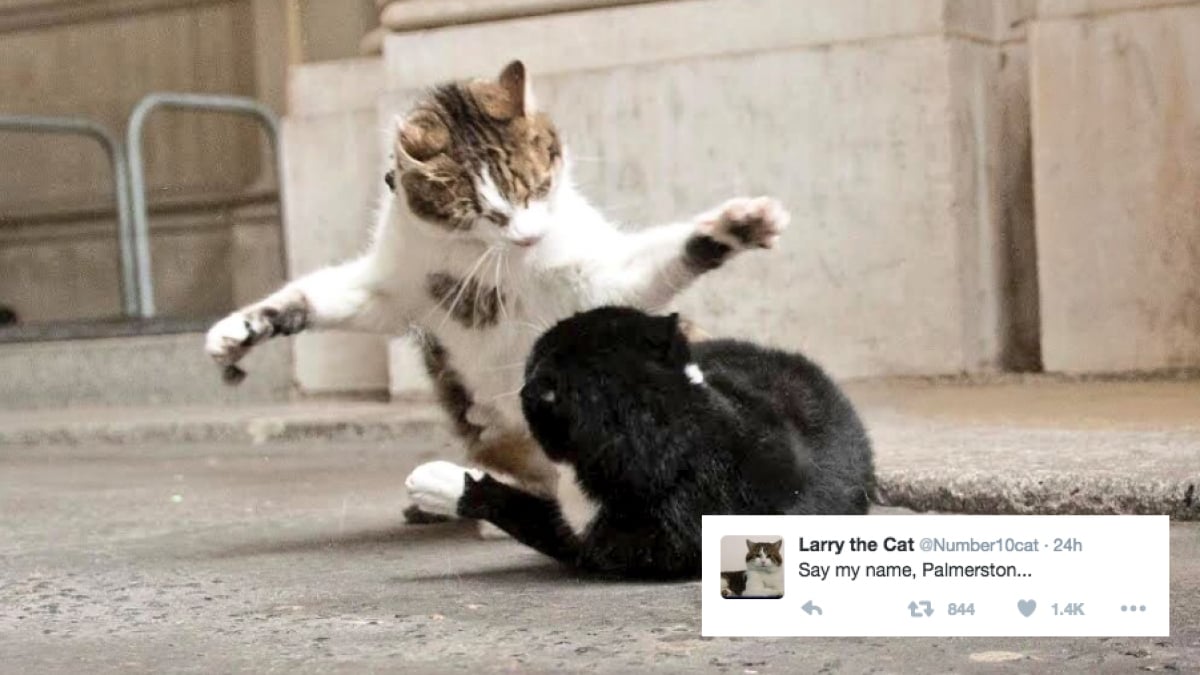
Palmerston, left, and Larry, right, during one of their epic battles while Palmerston was still top cat at Whitehall.
The British public were told Palmerston “retired” in 2020 to enjoy a more leisurely life at his countryside estate, putting an end to the intense skirmishes between himself and No. 10’s chief mouser.
But it appears Palmerston’s “retirement” was but a ruse, and the calculating tuxedo has spent the past four years laying the foundations for a coup aimed at deposing Larry.
“This has come as quite a shock to us all, obviously,” Prime Minister Keir Starmer told reporters. “Larry’s primacy was always viewed as ironclad. He’s outlasted five prime ministers and will remain here long after I’m booted out of the job. A challenge to his rule is unthinkable, and we will not allow this vile Palmerston-led rebellion to endanger our nation!”
A diplomatic party led by Sir Jacob Rees-Mogg was dispatched to the Palmerstonian camp to discuss a cessation of hostilities, but the former MP was sent back tied to a donkey and smelling powerfully of feline urine.
Palmerston during his Whitehall days. The tuxedo was the highest ranking feline in the UK’s foreign office.
Analysts called the rebellion the most serious threat to the UK’s political stability in centuries, warning of potential uprisings of Palmerston sympathiers in Wales and Scotland.
“As loved as Larry is, he’s come to be seen as an insider, comfortably ensconced in the halls of power,” said Nigel Bancroft, a political columnist with the Times. “Palmerston has reinvented himself as a populist fighting for the interests of the common man. That rebranding, so to speak, has allowed him to gain favor with working class citizens.”
“But make no mistake,” he added, “Palmerston is ruthless.”
The Palmerstonian loyalists delivered a letter with a list of demands to No. 10 Downing St., beginning with the voluntary resignation of Larry and his banishment to the Isle of Man.
They also warned Starmer to banish his two family cats from No. 10, clearing the way for Palmerston to assume power unchallenged.
Despite leading an uprising, Palmerston was making inroads with the public
“That Larry, he’s an okay bloke,” said Alastair Hughes of Gravesend. “But Palmerston is a cat of the people. He gets us. He’s the kind of lad you can have a pint with, know what I mean?”
The city, which was abandoned after a natural disaster, was an important hub of civics, trade, napping and indigenous dishes such as the cheeseburger.
XQOCHOATL, Yucatán — Archaeologists announced the discovery of a vast and prosperous ancient Mayan jungle city whose inhabitants once worshiped an unusually handsome gray tabby as a feline god.
X’Budiso was an important center of trade, religious life, architecture and art, according to Ferdinand Lyle, an archaeologist with the British Museum of London and lead researcher on the project.
His team located the long-lost city using LiDAR — light detection and ranging — a technology that allowed them to peer beneath the cover of heavy jungle and detect the ruins beneath.
Previously, there was only one indication that humans had once inhabited the area — a feline paw holding a cheeseburger, rendered in stone and poking out of a thick tangle of jungle flora. When archaeologists cleared the brush and trees, they revealed the rest of the statue which depicted a regal-looking cat on a plinth, holding the cheeseburger aloft in triumph.
An artist’s impression of the Mayan deity Budacoatl surrounded by offerings of cheeseburgers, dipping sauces and artisanal cheeses inside the Temple of a Thousand Snacks. A cult devoted to Budacoatl, the Ancient Order of Yums, was responsible for taste-testing the snackly offerings.
The city was a bustling metropolis for hundreds of years before its abrupt abandonment, which researchers said was likely caused by a natural disaster such as a flood or pestilence.
“The Budiso people worshiped a pantheon, and at the top of that pantheon was Budacoatl, the tabby jaguar god of snacks, handsomeness and war,” Lyle explained. “Our research indicates that doom fell over the city, likely in the form of a plague, and that its inhabitants believe they may have angered Budacoatl by skimping on their offerings of snacks.”
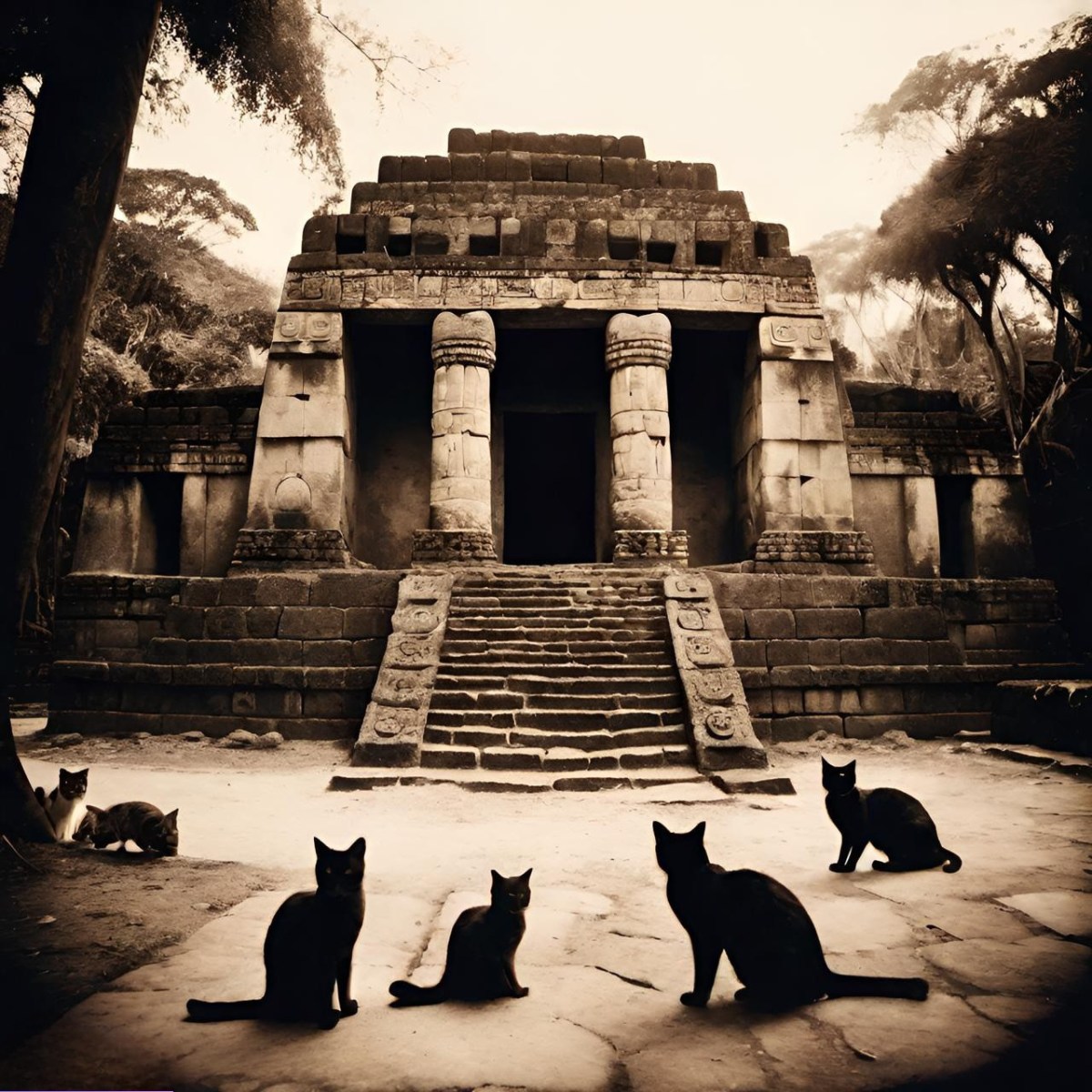
Feral felines, like the pair pictured here in front of the Temple of Turkey, still live on the grounds of the long-lost city. Source: Buddesian University Archaeological Department
Partially translated glyphs tell of unprecedented growth for the once-prosperous city, which the people believed stemmed from the favor they enjoyed from Budacoatl. Employing a force of more than 100,000 laborers, they built a magnificent temple to the feline deity in the very center of their city.
An architectural wonder, the Temple of Budacoatl featured more than 500 depictions of the feline in statues and relief carvings. The structure was comprised of tiered gardens with artificial waterfalls and tribute chambers, while gilded food and water bowls were placed at regular intervals for the hundreds of mortal cats who lived on the temple grounds.
A nearby structure, the enigmatic Grand Napitorium, was possibly the first sound-proof building in history and affirmed the X’Budiso people’s communal commitment to satisfying siestas.
The city gained a reputation for culinary innovation, and is considered the birthplace of aji sauce, deep fried turkey, huevos rancheros and Temptaciones, the ancient precedessor to Temptations.
The Artisanal Guild of Nectarean Condiments and the Sacred Order of Saucemasters were two particularly prosperous factions in the ancient city, which developed a reputation in the pre-Conquistadorial world for producing the tastiest guacamole.
“It was said that Budacoatl was particularly fond of sandwiches, and the people sang hymns about his power, influence and ripped physique,” Lyle said. “An epic poem, chiseled into the edifice of the temple, told of battle in the heavens between Budacoatl and the mighty Vakuum, scourge of the Maya. Budacoatl prevailed over Vakuum, banishing him to the underworld where his screeching could not be heard by the inhabitants of the Earth.”
Richly detailed relief carvings from the Palace of Pâté depict figures from the feline pantheon. Source: Buddesian University Archaeological Department
At the foot of the wall where the poem is inscribed stands a statue of Budacoatl, one paw holding a pastrami sandwich and the other raised in a sign of peace.
“Budacoatl was a big deal among the Maya,” Lyle said. “At one point he was bigger than Gozer and Zuul, ruling atop the pantheon. As a result, cats enjoyed enormous favor in the city.”
Professor Ferdinand Lyle, foreground, stands in front of the Napitorium, where the Budiso people would take siestas. Napping was an important part of the culture. Source: Buddesian University Archaeological Department
Sir Buddy’s fortunes have risen dramatically, while Prince Harry’s future looks bleak.
LOS ANGELES — Buddy the Cat, rumored to be on the short list for a dukedom after establishing a warm friendship with the late Queen Elizabeth II in recent years, has been spotted in the company of the Duchess of Sussex, per TMZ.
Photographs and surreptitiously-recorded footage show the handsome silver tabby and Meghan Markle enjoying a cozy private karaoke session with friends over the holiday. Later they were seen getting close at Dorsia, the ultra-exclusive Manhattan eatery where A-listers rub elbows with investment bankers and cabinet secretaries.
Prince Harry is said to be “enraged” and “deeply wounded,” not only that his wife is enjoying the company of a desirable bachelor, “but also because he thinks it would be really awesome to hang out with Sir Buddy, and he feels left out,” a royal insider said on condition of anonymity. Notably, the prince has not been able to secure a reservation at Dorsia.
The famed feline was knighted Sir Buddy by the late queen in 2021. He was created Earl of Budderset the following year in what palace insiders called a “meteoric rise” in favor with the royal family.
He had become a trusted confidante to Her Majesty, with the two parties speaking by telephone weekly and Buddy earning the endearing diminutive “my dearest Bud-Bud” from her. With his soft fur and playful nature, he’s also a favorite of young Princess Charlotte and Prince George, forming fast friendships with the rest of the family.
Markle was spotted at a popular LA nightclub with the famous feline in December of 2023.
Then the Sussexes resigned as “working royals” amid controversy and left the UK for Los Angeles. Shortly after, Prince Andrew was swiftly disowned for his role in the Jeffrey Epstein scandal. With the palace looking to take the focus off that unpleasantness, royal observers and palace stalwarts alike named Sir Buddy as a likely candidate for elevation to dukedom.
With Earl Buddy in favor and her current husband persona non grata, Markle may be eyeing the next rung on the ladder, said Gavin Northbridge, a royal observer and author of Your Highness: The Royal Family’s Favorite Marijuana Strains.
Paparazzi have also photographed the Duchess and her feline companion at an exclusive Los Angeles nightclub, an art gallery opening in the Hollywood Hills and a trendy restaurant. Prince Harry, who burned bridges with his family via a series of high-profile interviews and an autobiography, Spare, was nowhere to be seen in the photos.
“Here he is making himself vulnerable with his book, speaking out about the injustices done to him by his family, and his wife is out fraternizing with a handsome young bachelor,” said Devon Camden Dankworth, author of Grand Tyromancy: The Royal Family’s Secret History of Cheese Divination.
If King Charles follows through on his mother’s plans and grants his feline friend a dukedom, it would instantly render the current Earl of Budderset the most powerful member of the British aristocracy. The king has already thrown his enthusiastic support behind the earl’s charity, Food For Buddies, which provides delicious meals to London’s stray cats.
Markle and Sir Buddy in a trendy LA restaurant.
In an honor unprecedented at the time, Sir Buddy was knighted in 2021 “for his innumerable contributions to human-feline understanding, unprecedented innovations in the art of napping, and status as tastemaker supreme in the world of delicious snacks,” according to the Central Chancery of the Orders of Knighthood at St James’s Palace.
Since then, he’s further endeared himself to the British public by starring in ads for Aston Martin and his own detective series, The London Underfoot.
“If you’re Meghan, a future with Harry looks bleak,” said Dankworth, “but a future with Buddy looks absolutely delicious.”
Lost In Space is a rare reboot with heart that updates the classic story with gorgeous visuals and a compelling narrative for kids and adults.
I wasn’t quite sure what to expect from Netflix’s reboot of Lost In Space.
Would it hew closely to the brightly-colored 1960s original in all its cheesy glory? Would it aim for a darker tone, as so many television series do these days? Would it be a low-effort nostalgia cash-in like so many ill-advised reboots of the past decade? And would the series, which was slated to keep things PG, have enough going on to appeal to adults as well as kids?
With Netflix delivering the third and final season last month, my verdict is in: Lost In Space is the rare worthy reboot, a visually spectacular retelling of the original that tweaks and modernizes the details in all the right places. There’s a generous amount of adventure, quiet character moments, and an overarching theme about the importance of family. Over the course of the story, the latter group that widens to include not only the Robinsons but also their closest friends who brave the cosmic dangers alongside them.
Speaking of danger, the original show’s most-used catchphrase — the robot’s “Danger, Will Robinson!” — will be familiar to almost anyone, even those of us who were born in the decades after the show went off the air. It’s become part of the pop cultural fabric.
In the original Lost In Space the Robot is a human-engineered tin can, a 1960s retrofuturistic vision of what sentient machines might look like that was dreamed up at a time when servers occupied entire rooms and a computer’s output came in the form of punch cards.
In the reboot, the Robot is an alien intelligence: a towering, six-limbed, digitigrade machine with an inscrutable face and serrated claws. Where the 1960s Robot was risible, the reboot Robot is terrifying in its default form — until a brave Will Robinson, who encounters it after crash landing on an unnamed planet, helps the dying machine repair itself.
He does so as a raging fire engulfs the forest around them, reasoning that he can’t escape, but perhaps the robot can.
The curious Robot, awash with gratitude, immediately rescues Will and, on safe ground, studies the boy for a moment before rearranging itself into an androform shape to mirror Will. From that point on, boy and Robot become inseparable.
The Robot and Will Robinson form a mysterious bond, with the machine becoming fiercely protective of the boy.
It’s Robot who gets the Robinson family out of trouble in the first episode and many times over subsequent installments, earning the trust and eventually the love of the Robinson family, their friend, mechanic Don West (Ignacio Serricchio), and the mercurial Dr. Smith (Parker Posey).
It’s a credit to the writers and visual effects team that the series appeals to kids as well as adults. I watched the first episode with my eight-year-old niece, who’s younger than the target audience. She was absorbed in the story, her attention beginning to wane only during moments of expository dialogue.
The series is probably better suited for kids at 11 or 12 years old, as there are some relatively heady science fiction concepts and subsequent episodes range from PG to PG-13ish.
There’s no sex, the relatively little violence happens off camera, and the narrative regularly stresses the importance of family. Will, his sisters Penny and Judy, and the Robinson parents all rely on each other to meet challenges. There are, however, adult themes like divorce and near-death experiences, and occasional bad language which never gets more profane than Dr. Smith derisively calling Don West out on his “bullshit” in one episode.
Judy (Taylor Russell) and Penny (Mina Sundwall) play important parts in the narrative and bring different skills to the table.
The show takes off right away and delivers excitement and mystery, but it takes a little while to find its rhythm, with early episodes following a “crisis of the hour” format more suited to episodic television. The writers were clearly trying to convey the power of the united Robinson family, and how each member brings different skills and ways of thinking to the table, but the show is at its best when storylines work in service to the overarching narrative.
Mom Maureen is a brilliant engineer who designed the colony starship Resolute and its Jupiter landers. Dad John Robinson is a former Navy SEAL, a man of action who encourages his children to make bold choices. Eldest daughter Judy Robinson is a young medical doctor who, despite her obvious talent, often feels she has something to prove. Her younger sister, Penny, is the least scientifically-minded member of the family. Penny’s better with people, serving as a peacemaker and scribe who documents the Robinson family’s adventures.
Last but not least, young Will Robinson is a dreamer who marvels at alien worlds and distant stars, and takes after his mom in scientific aptitude. He becomes something of a legend among the colonists for his inexplicable bond with Robot, who is extremely protective of the boy.
The Resolute is attacked en route to Alpha Centauri, forcing its passengers to flee to their Jupiter “lifeboats” and make emergency landings on a nearby planet.
Of course there wouldn’t be much of a story to tell if the Robinsons and the other colonists simply made it to the idyllic colony at Alpha Centauri without incident. It turns out the colonists fled the Resolute — and crash landed on an inhospitable planet — because Robot’s brethren attacked the ship.
Although the viewers are shown the act of kindness that sparks the bond between Will and Robot, the other colonists aren’t as trusting once they realize Will’s seven-foot-tall protector came from the same place as the murderous machines that attacked the Resolute. Dr. Smith also has her own designs on the mysterious Robot, and the Resolute’s crew has been hiding a secret from its passengers that will come back to haunt them.
Can the colonists survive on a dangerous world without the resources they need? Will they ever reach Alpha Centauri?
Why did the robots attack the colony ship? What do they want from humans? And who made them?
Those are the questions at the heart of the mystery, but the characters can’t hope to answer them if they’re stranded on a hostile alien world.
Netflix spared no expense with Lost In Space and the writers clearly had a complete vision for the story, wrapping it up in just three seasons over the course of 28 roughly hour-long episodes. (The first two seasons had 10 episodes each, while the final season had only eight.)
In a sea of Netflix content, Lost In Space stands out as one of the streaming giant’s best original shows, especially for fans of science fiction and parents looking for a show they can watch with their kids.
Buddy’s Verdict: Four Paws out of Five
Big Buddy’s Verdict: Recommended
Will Robinson, front, with Dr. Smith, Judy, Robot, Penny and Maureen Robinson.
Join us in reading stories of cats in space and big cats in the jungles of India.
Welcome to the inaugural post of Buddy’s Book Club, where we’ll read stories about cats and stories involving cats!
We’re going to start things off easy with a classic short story of the cat canon, which is available for free online via Project Gutenberg, and a seminal book about big cats from a man whose name is indelibly linked with them.
The Game of Rat and Dragon (1954) by Cordwainer Smith
Read it here for free from Project Gutenberg, a collaborative effort to create a digital archive of important cultural literary works that have fallen into the public domain. For those unfamiliar with Project Gutenberg, it’s completely above-board, legal and safe for your devices, and the story opens in plain HTML with illustrations included as image files. You can read the story in a browser or download it onto a reading device, tablet or phone.
The Game of Rat and Dragon first appeared, as so much short fiction of the era did, in a digest. Although Smith had penned it the year before, the story was published in Galaxy Science Fiction’s October 1955 issue and became an instant classic among cat-lovers and science fiction aficionados. (There is considerable overlap between the two, not surprisingly: Introverts whose imaginations run wild when they look to the stars tend to have many of the same personality traits as people who prefer the more sublime antics of cats.)
The Game of Rat and Dragon imagines a far future in which humanity has become a star-faring culture, meaning we’ve conquered interstellar flight and have begun to colonize planets in star systems other than our own.
There is, of course, a problem. The dark, lonely void between stars isn’t as empty as we thought it was, and is inhabited by invisible (to the human eye), inscrutable, inexorable entities eventually dubbed “dragons.”
When dragons attack they leave only death and insanity in their wake, putting the entire idea of interstellar travel at risk. Imagine if there was a not-insignificant chance of your passenger jet being attacked by impervious creatures every time you hopped on a plane. It wouldn’t be long before the entire air industry collapsed and the world suddenly became a much bigger place, with other continents unreachable by air.
Who can help humans with this problem? Cats, of course! To say more would be to spoil the fun. Meow!
Man-Eaters of Kumaon (1944) by Jim Corbett
Available as an ebook for 99 cents from Barnes and Noble.
Jim Corbett was a sportsman, the son of a government official in the British Raj who was raised in India’s jungles and came to know them intimately. He’s best remembered as the fearless hunter who finally brought down the infamous Champawat tigress, who officially claimed 436 lives over a years-long rampage as a man-eater, and likely many more that went unrecorded.
To understand the gravity of Corbett’s accomplishments, it’s necessary to understand the effect of a man-eater on rural India. The people living in India’s tiny villages are subsistence farmers. If they don’t farm, they don’t eat.
But when a man-eater as dangerous as the Champawat tigress claims an area as its hunting grounds, everything grinds to a halt: Farmers refuse to tend their fields, villagers disappear behind locked doors, and a simple walk to a neighboring village becomes an impossibility unless escorted by a group of two dozen or more armed men. Even then it’s a risk, for as Corbett notes, when tigers become man-eaters they have no fear of humans and will kill people in broad daylight, even when they’re in groups.
And yet for all their power and predatory instincts, tigers are never deliberately cruel and don’t harm humans willingly. Tigers become man-eaters by unfortunate circumstance, usually due to negligence or stupidity on the part of humans.
The Champawat tigress, for example, was like any other big cat until a human hunter took aim and shot her in the mouth, destroying one lower canine completely and shattering another. The tiger could no longer take down her usual prey, or at least not without serious difficulty. At some point — perhaps after encountering the body of a person it did not kill — the tigress realized she could survive on human flesh.
If that hadn’t happened, those 436-plus souls wouldn’t have been lost, an entire region wouldn’t have been brought to its knees, and the tigress would have continued life as normal.
The vast majority of the time, tigers are content to let humans be.
“I think of the tens of thousands of men, women and children who, while working in the forests or cutting grass or collecting dry sticks, pass day after day close to where tigers are lying up and who, when they return safely to their homes, do not even know that they have been under the observation of this so called ‘cruel’ and ‘bloodthirsty’ animal,” Corbett writes.
Despite his reputation as the man to enlist when a man-eater terrorized a region, Corbett saw the way things were trending a century ago, and begged people to let the big cats live undisturbed.
“A tiger is a large-hearted gentleman with boundless courage,” he wrote, “and that when he is exterminated — as exterminated he will be unless public opinion rallies to his support — India will be the poorer by having lost the finest of her fauna.”
Corbett would undoubtedly be deeply disturbed by the situation today, with only some 4,000 wild tigers remaining in the entire world, and the glorious species mostly reduced to spending life in captivity, constantly sedated so that idiots can pay to take selfies with them.
The Man-Eaters of Kumaon follows Corbett on 10 hunts of man-eating tigers and leopards. It’s also a story of life in the British Raj, rural life in India, Corbett’s jungle adventures, his love for his loyal hunting dog and his turn toward conservation.
Schedule:
We can do the short story in a week, yeah? Let’s shoot for one week for The Game of Rat and Dragon, and two weeks for The Man-Eaters of Kumaon. We’ll adjourn and discuss in follow-up posts. Happy reading!