Cats see the world differently, in objective physical terms as well as psychologically.
Have you ever wondered what the world looks like to your cat?
Veterinarians, animal ophthalmologists and researchers from the University of Pennsylvania’s ophthalmology group provided insight for this article and the accompanying images, which show how scenes look to us humans and to our feline friends.
The images are striking and show the relative strengths and weaknesses of feline vision. While cats see the world in muted colors and in less acuity than typical humans, they make up for it with their astounding night vision and their ability to instantly detect motion within their visual fields.
This image shows feline night vision at work thanks to the tapetum lucidum, a layer of tissue that acts as a retroreflector, increasing the amount of light that makes it to the photoreceptors in cats’ eyes. The tapetum lucidum is best known as the reflective “lens” that makes cat eyes appear to glow in the dark:
This image shows the trade-off compared to human vision. Cat eyes have a wider field of view, seen below, but they don’t pick up reds or greens, and their overall vision is blurry compared to average human eyesight, represented in the top image:
Night vision and extreme visual sensitivity to movement are important to cats as crepuscular hunters, allowing them to spot prey in low light conditions and to negate advantages from natural camouflage, as motion gives away the presence of prey animals.
Cats have a slightly wider visual field than people do, at approximately 200 degrees compared to the human 180 degrees, while most cats have between 20/100 and 20/200 vision. (That’s much better than Big Buddy sans glasses, whose 20/600 vision enables him to see blurry, colorful shapes and not much else. No wonder Little Buddy likes to torture his human by swiping his glasses.)
Of course, these images do not entirely account for how cats see the world, which is why I’ve created my own image. Behold a Buddy’s Eye View, showing how the world — and humans — look to him:
From Buddy the Cat’s perspective, humans are all servants, constantly standing by to attend to him.
Cats are deeply traumatized when they hear the distinct sound of a food package opening and discover it’s not for them.
NEW YORK — Buddy the Cat was enraged Friday night when he was woken from a deep sleep by the sound of an aluminum can being opened, then bolted upright, jumped off the bed and ran to the kitchen only to find his human with a freshly-opened can of corn in his hands.
Calling such incidents “cruel teases” and “deeply unfair” to him and other felines, the silver tabby demanded the food industry develop alternate methods of packaging human food.
“We’ve all heard the plasticky rustle of a bag and come running, just drooling with anticipation for the Temps only to skid to a halt as we catch that first putrid whiff of sour cream and onion potato chips or tortilla chips,” Buddy told reporters at a press conference later Friday evening. “I’m not judging, by the way, but human food is disgusting. I mean, you literally eat leaves and call it ‘salad’ so you forget you’re eating leaves. Give me a mound of chicken in a paste-like consistency any day.”
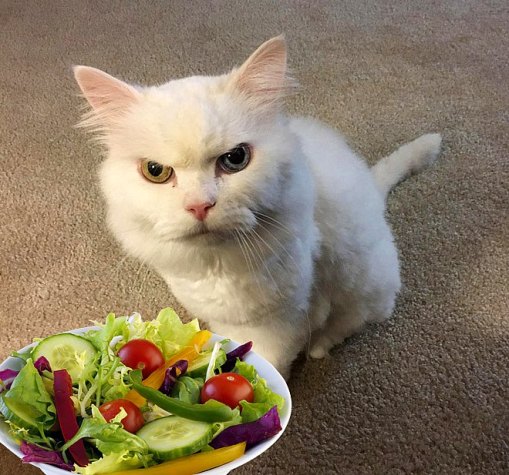
Torture: Cats are offended by the very presence of salad. How can humans consume such disgusting food?
Joining him at the podium, four-year-old Siamese Burton recalled his disappointment at hearing the crinkle of an aluminum package and scurrying to the kitchen to witness his servant, Olivia, scattering 4C breadcrumbs onto a vegetarian casserole bound for the oven.
“I almost puked,” Burton said, shuddering from the trauma as Buddy placed a supportive paw on his shoulder. “Vegetarian casserole! Vegetables! How do you people eat this stuff? It’s madness!”
If humans were genuinely considerate of their feline friends, Buddy insisted, they’d make some of their own food palatable to cats.
“I’m not just talking about cooking a nice steak without any spices or sauces,” Buddy said. “Why not make beef pate flavor potato chips or apples that taste like salmon? Has anyone ever thought of tuna-flavored ice cream? I bet you wouldn’t even be able to keep it in stock, that’s how popular it would be.”
Salmon-flavored potato chips would be a hot seller, President Buddy insists. Credit: Reddit
The former president of the Americats said his bad experiences with food have even prompted ideas about opening up his own restaurant for cats.
“Not one of those lousy casual dining places either,” he said. “I’m talkin’ about a nice type of joint where the waiters wear bow ties and open the cans right in front of you at the table. The kind of place that has you check your collar at the entrance, where you could take a lady friend.”
Reached after his feline’s hastily-arranged press conference, human Big Buddy said he wasn’t aware his cat was campaigning for alternative forms of food packaging.
“That’s tragic,” he said, “because I’ve got a big bag of pistachio nuts I’m planning on opening later. Maybe I’ll wait to do that until Bud’s fast asleep. You know, for entertainment purposes.”
Buddy the Cat tries to sell his human. Meanwhile, UK soccer stars adopt their own new buddy from Qatar.
Happy Sunday, dear readers. Buddy’s apparently angry with me about something, because I found a copy of this on the printer:
Listed under “For sale by owner.”
What could I have done to deserve this? And $16? Isn’t that a little low? It’s insulting! We’re gonna need to have a little chat, Buddy to Buddy.
Should Cats Be Allowed On Airplanes?
CNN’s Jacqueline Swartz has a column about the challenges of traveling when you’re afflicted with severe allergies. Swartz is thoughtful, isn’t resentful of cats and understands it’s on her — for the time being, at least — to prep for flights by taking allergy medication, but she also believes airlines can do more to accommodate people who are allergic to pets.
As a cat guy and someone who dealt with really bad cat and dog allergies in my childhood and teenage years, I can sympathize with Swartz’s plight, and I agree that airlines can do more.
Of course, by “Should cats be allowed on airplanes?” she’s really asking if cats should be allowed in the passenger cabin. Even if a feline’s snug in a carrier, tucked beneath its human’s seat and well-behaved during the flight, a relatively short six-hours from New York to LA can cause all kinds of havoc on the immune systems and sinuses of people who are ultra-sensitive to cat dander.
Credit: Wikimedia Commons
Putting cats in cargo compartments is not an answer, and neither is banning cats from flights. Sometimes flying with a cat is a necessity, whether you’re moving cross-country or planning to live abroad temporarily. But airlines are notorious for trying to extract every dime from passengers, whether it’s charging thousands for business class or up-selling regular seats as “premium coach” by offering a Louis Vuitton-branded pillow or whatever.
Perhaps some enterprising airline executive could build goodwill with travelers, earning extra business and loyalty along the way with an innovative and friendly way to handle animals. How much space could possibly be required for a quiet, closed-off, climate-controlled closet where six or eight cats in carriers can snooze during a flight? That would solve the allergy problem, make life easier for everyone and probably make traveling easier on cats too.
Dave the Cat has a new home in England
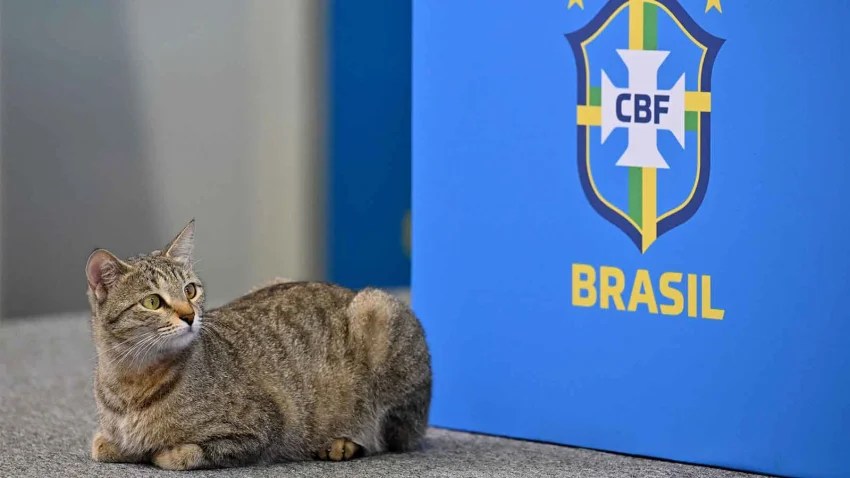
While a thoughtless PR official for Brazil’s national team drew the ire of animal lovers for the way he mishandled a cat during a press conference — an unforced error, since the cat wasn’t bothering anyone — some good is coming out of the World Cup for at least one feline.
Dave the Cat, a friendly stray befriended by England defenders Kyle Walker and John Stones, will be adopted by the players, who both suit up for the Premiere League’s Manchester City during normal club play.
Dave, a cream-colored tabby, won’t be reunited with his new pals right away. He’ll have to endure four months of quarantine first, as per the UK’s rules on bringing animals to the country, and then presumably he’ll be adopted by Walker, Stones or the entire team.
An official with Brazil’s national team caught heat for the way he picked up and tossed a cat in Qatar. (Screengrab)
Buddy the Cat argues that personal space is sacred, while Buddy the Cat argues there should be no boundaries when it comes to cats sleeping on their humans.
‘Personal Space is Sacred!’
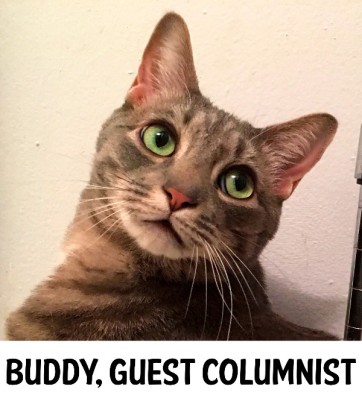
Hey! Unhand me, human! Did I say you could assault my cheeks and ears?!?
Well, yes, usually I do like when you give me scritches, but right now I could do without your sweaty, no-fur-having, clumsy human paw.
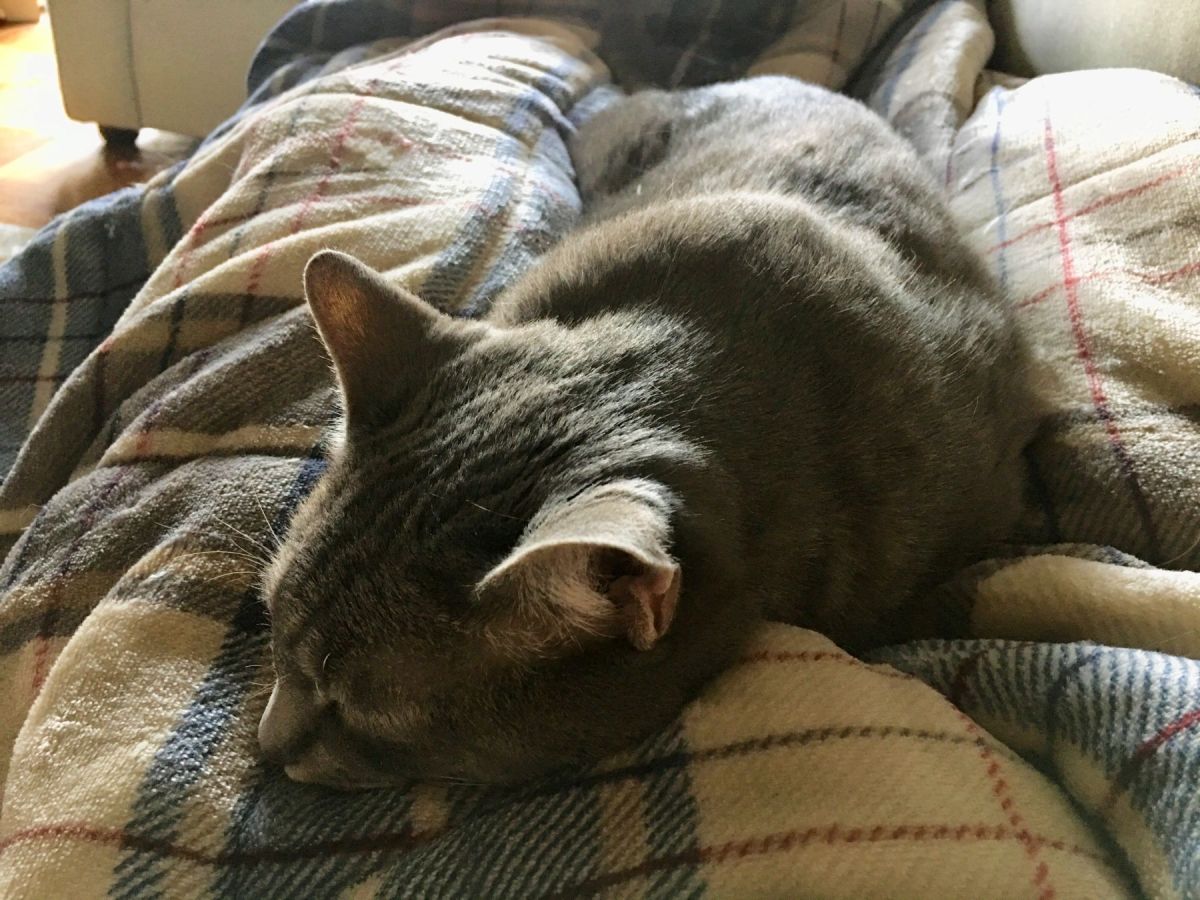
As a matter of fact, get away from me! I was here first! This is my couch, I merely let you occupy it out of the goodness of my heart because I’m such an unselfish feline. I would like to remain undisturbed until further notice!
What is it with humans and personal space, huh? What kind of malfunction leads your supposedly intelligent and “superior” species to sidle up uninvited and just start stroking feline fur? Did we call you over? Did we paw deliver a “Come pet me!” card in golf leaf ink? Did I personally invite you to groom me?
I think not.
We’re gonna have to start working on boundaries, human. Now fetch me a snack while I mull this over.
‘You’re My Mattress, Human!’
Nothing’s better after a long day of eating and sleeping than having a nice dinner and settling down on your lap for a comfortable nap. Don’t get me wrong, your my bed isn’t bad. The chair is comfy. I even nap on your computer chair from time to time, especially after you vacate it and it’s nice and warm. The rug underneath the table even has its charms.
But nothing beats sleeping in your lap, or on your legs, or on your chest, or even sleeping on your back and using your butt as a pillow. When you woke up the other night and could hardly breathe because I was draped over your face, that was pretty funny, wasn’t it?
Yep. It’s nice that we’re such good pals, human and cat, that I can use you as my mattress!
As you know, it’s impossible for me to catch some Zs without sleeping directly on top of you, burrowed into your side, or even with a paw resting on you if it’s a hot summer night. That way you can’t get out of bed without me knowing about it, and you can’t sneak off to the bathroom without me.
What’s a bit of personal space between feline and human friends?
Two new reports estimate the cost of caring for a cat over a typical 15-year lifespan.
Two stories published in recent days give wildly varying estimates of how much it costs for the privilege of serving a cat.
First we should note that both reports assume the cats are adopted in kittenhood and the average lifespan of a cat is 15 years. That’s in line with current data showing well cared-for, indoor-only cats live between 12 and 18 years, with outliers on both ends. It’s not uncommon to hear about cats living well into their 20s just as some cats sadly pass on before their time, whether due to natural causes, illness or accidents.
A Texas cat named Creme Puff is the Guinness World Record holder for longest-lived house cat, holding on for an astonishing 38 years until her death in 2005.
Caring for a house panther can cost between $4,250 and $31,200 over kitty’s lifetime, according to an analysis of associated costs by The Ascent, a vertical of financial literacy site The Motley Fool.
The estimates break costs down into recurring expenses — which include food, treats, litter and veterinary care — and fixed expenses like scratching posts, toys, additional cat furniture, bowls, grooming tools and similar items.
Not surprisingly, the biggest expense is food, the cost of which has been exacerbated by inflation, rising fuel costs and lingering supply chain issues that caused a cascade effect during the pandemic. Everything from sourcing metal for cat food tins to meat availability was impacted as ports were closed and meat processing plants were shuttered at various points since early 2020.
An unrelated estimate from OnePoll, based on a survey commissioned by pet food company Solid Gold, put the lifetime estimate of cat servitude at $25,304. Like the Motley Fool analysis, OnePoll’s respondents cited food as the primary expense, followed by veterinary care.
The wide range from the Motley Fool analysis could be attributable to geography, how well the cat is fed, and how many extra things caretakers do for their cats. A person who lives in Manhattan, splurges on bespoke feline furniture and buys ultra-premium cat food at almost $3 a can is going to spend significantly more than an eastern European cat servant who feeds raw or home-cooked food and builds their own ledge loungers and scratching apparatus.
“Welcome to Teh Bank of Kitteh, you may make a deposit but not withdraw!” Credit: @catsandmoney/Twitter
Here in New York the cost of cat food in local grocery stores has spiked dramatically, but online prices have remained steady. Keeping in mind we’ve never really endorsed any particular brand or vendor on PITB, I switched from occasionally buying food online to Chewy auto-shipments during the pandemic because Bud’s favorite food was becoming very difficult to find locally, and that arrangement has worked out cost-wise as well.
Bud’s a true Pain In The Bud when it comes to “leftovers” so his primary wet food is Sheba Perfect Portions. It’s reasonably priced, comes in variety packs and helps avoid waste since each meal comes in its own 1.3oz recyclable blister-like plastic package. (Recycling is especially important with these single-serve packages, tiny as they are.) His dry food is Blue Buffalo Wilderness Adult Chicken recipe, although occasionally I’ll buy the weight control version of the same dry food when it looks like Little Man has gotten a bit chubby. He doesn’t protest, thankfully.
I feed him two 1.3oz wet meals a day and fill his dry bowl less than halfway at night so he can have his late snack and doesn’t have to wake me up if and when he gets hungry overnight. Sometimes I’m dimly aware of him sliding off me, padding over to his little dining nook and munching on dry food before hopping back onto the bed and dozing off again.
Overall it works out to about $21 a month, so I’d call it an even $25 with treats. You can schedule your auto-ship at any interval you choose, edit it at any time, and prompt the shipment immediately if you’re running out of food, so you can save more by ordering a few months’ worth of food at a time and taking advantage of free shipping on orders of more than $50.
Has inflation impacted cat food prices in your local area? How much does it cost to feed your cat(s) every month?







 Hey! Unhand me, human! Did I say you could assault my cheeks and ears?!?