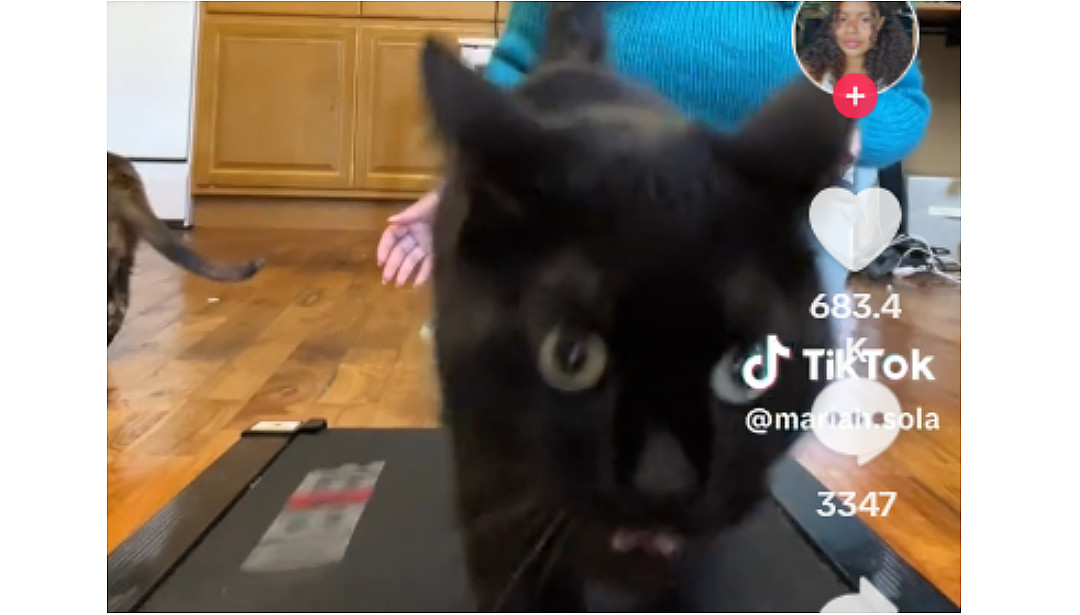
Archie the cat, with his love of exercise, is the anti-Buddy.
This is unbelievable.
A three-year-old cat named Archie, who also hails from New York, loves running on his human’s treadmill. Mariah, his 27-year-old servant, keeps a close eye on the little guy while he gets his run in to make sure he doesn’t get hurt, but he seems entirely unperturbed and pumps his little legs, keeping a steady pace:
Honestly, I can barely comprehend this. Bud would be more likely to engineer a treadmill into an automated system to deliver snacks to him so he doesn’t have to lift a paw. He is, after all, remarkably dedicated to the craft of being as lazy as possible.
Cheers to Archie for showing not all cats are loafing blobs!
Last night I was in the kitchen looking for something, anything, to satisfy a sudden craving for sugar when Bud padded up and gave me one of the standard greetings in his Buddinese repertoire.
It’s just a “Hmmmmph!” in his high, Elmo-like voice, an acknowledgement that he sees me and he’s watching with interest, but without any of the typical demands or strong opinions attached.
“Hmmmmmph!” I replied.
“Hmmmmmph!” he said again, and we went back and forth until he stopped, tilted his head curiously, and gave me a look that said “Are you making fun of me again?”
I couldn’t help myself and busted out laughing, bending down to mess up the fur on top of his head as he rubbed up against my leg.
Of course I can’t actually prove that he understands our little exchange, but I know in my heart that he does. Sometimes he gets indignant when I laugh at him. Sometimes I get indignant when he gleefully smacks me or tries to chew on my glasses.
But mostly we laugh together, and he understands that human laughter is a happy sound, even when he’s deeply confused about what exactly I find so funny.
Will I ever have this kind of bond with another cat? I don’t know. It’s taken more than a decade to get here, a decade of being inseparable and understanding each other on a fundamental level.
But I’m not going to spoil it by spending too much time thinking about it. That would ruin the joke.
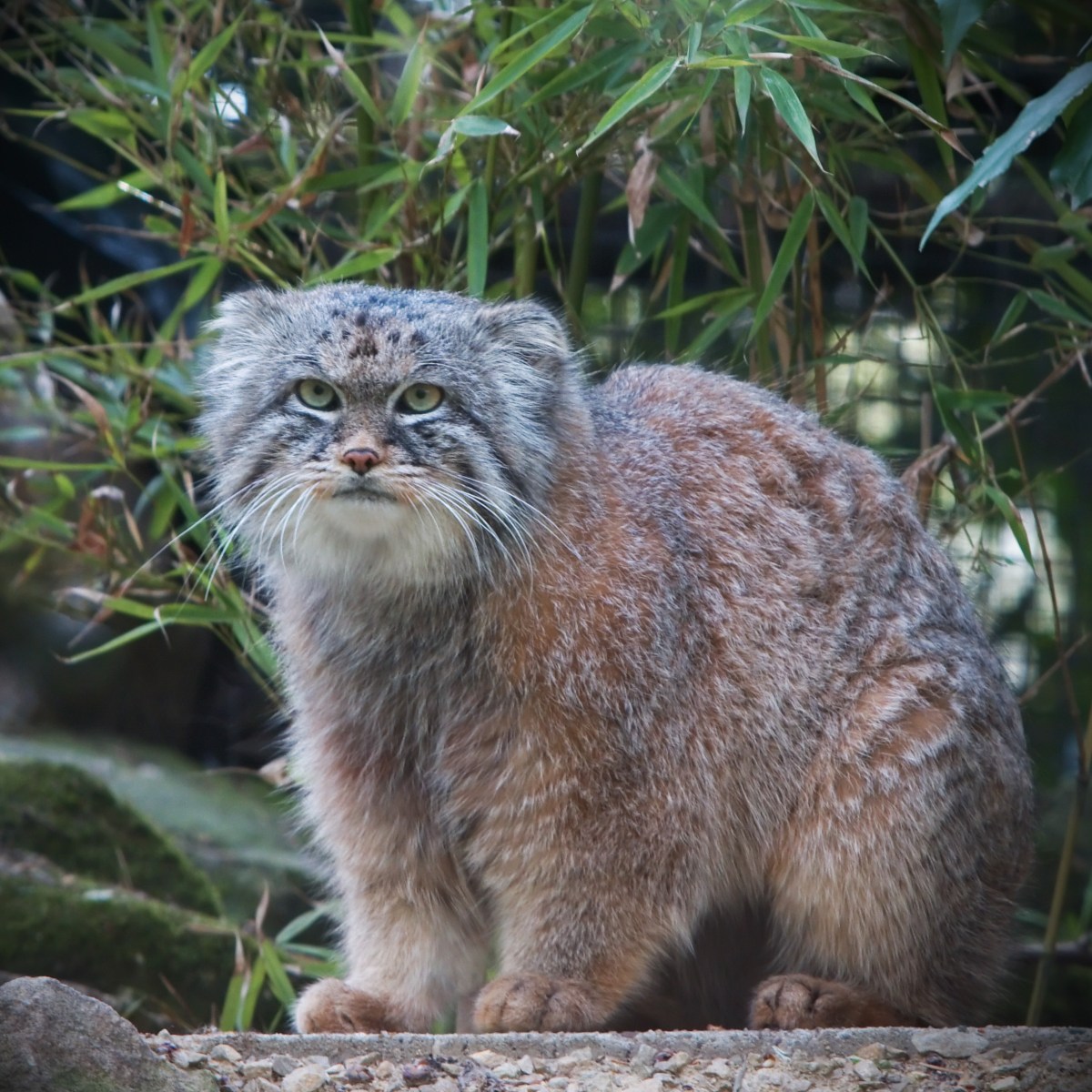
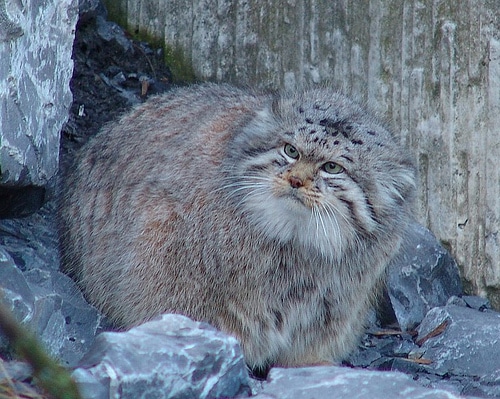
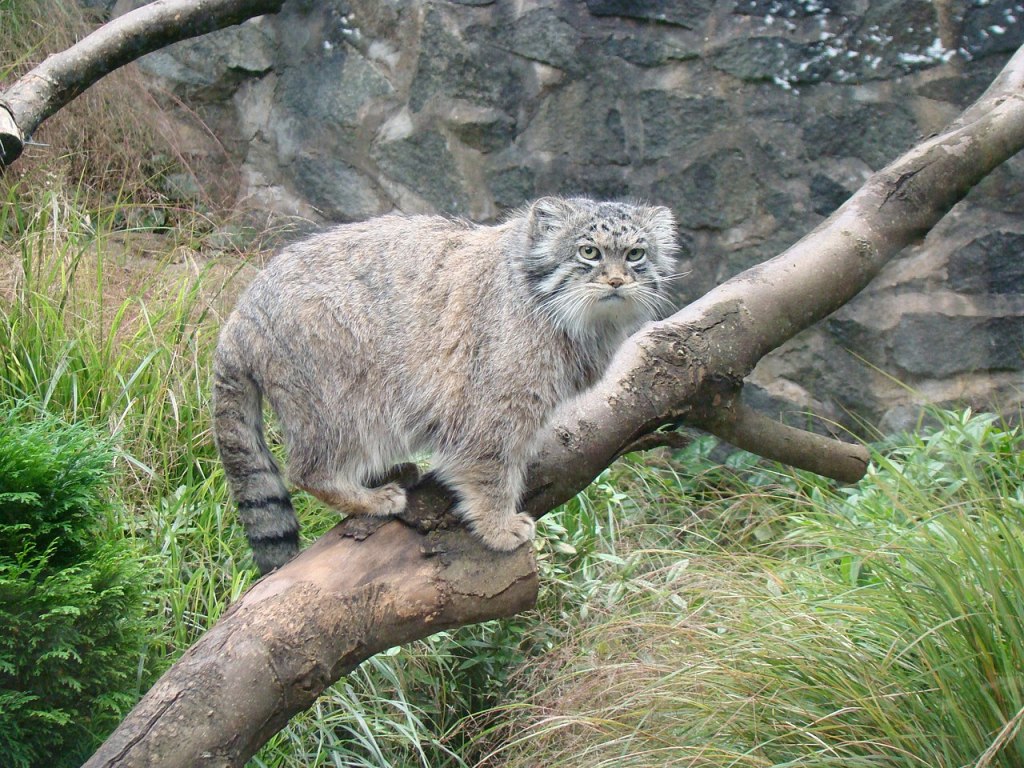
The Gremlin-like felids have some unusual habits compared to other cats in addition to the trademark scowls that distinguish them from other feline species.
The fact that they live in burrows and crevices is the first indication that Pallas cats are the weirdos of the feline family.
The small, bushy little creatures greet the day by poking their heads out of their burrows just enough to see what’s going on. Thanks to the low profile of their ears, which stick out almost horizontally, only their eyes and tufts of frosty-looking fur are visible in those first moments.
When they’re satisfied nothing’s going to vex them further than their usual, seemingly perpetually-annoyed default, they fully emerge from their dens, and that’s when their true form becomes apparent.
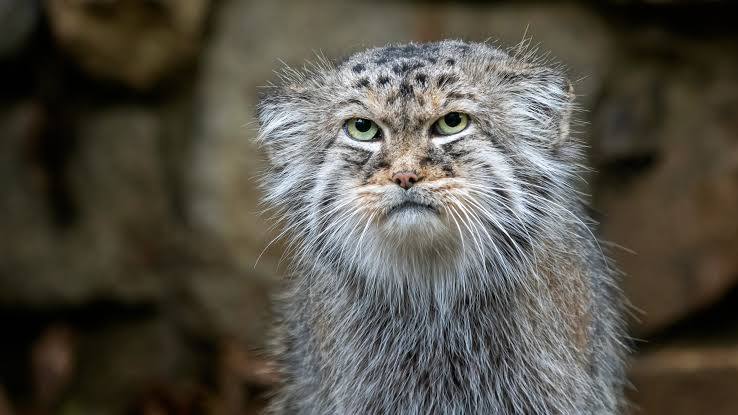
Behold grumpiness incarnate:
“These kittens today, they want everything now. No patience and not a lick of common sense between ’em. Hey! Get off my lawn, you little cretins…” Credit: Wikimedia Commons“Would it kill these dogs to clean up after themselves? Sheesh! You don’t see me defecating all over everything. When nature calls, I do what civilized cats do, find a private spot and bury my business. Hey! Hey! Don’t you dare move that rock!”
These little guys look like they start every day off getting rained on while birds with impeccable aim empty their bowls on their heads. Then they file out, each one grumbling, and engage in their species’ favorite pastime — complaining about everything, like a perpetual Airing of Grievances on Festivus or a communal bitching session about joint pain at the local senior center.
“Oh, my back! For crying out loud! They couldn’t have dug this tunnel at a more forgiving angle? Aww crap, look at the weather! Hunting in this is gonna suck. Lenny, is there any more of the rabbit from last night? No? Of course not. And we’re out of coffee again! I don’t know why I even roll out of the burrow. This place is a dump!”
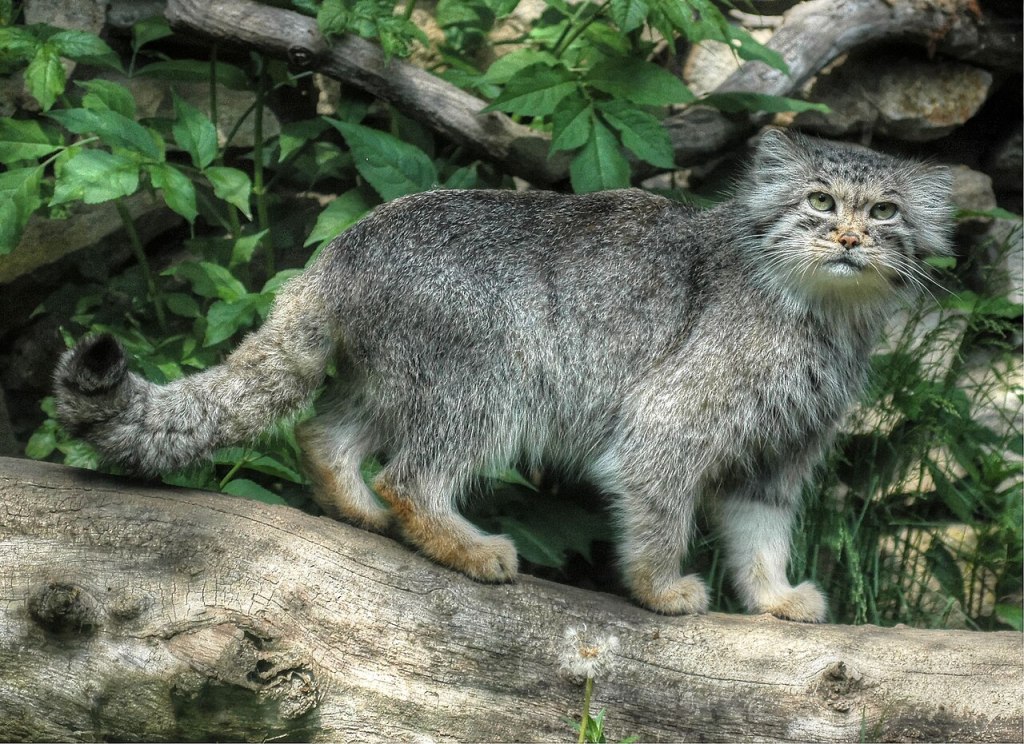
First observed and written about — in the western world, at least — by Peter Simon Pallas in 1776, Pallas cats are about the same size as our domestic feline buddies, but they look stockier thanks to their heavy coats. Pallas, a Prussian explorer and naturalist, was presumably going about his day when he heard a group of these malcontents complaining from a mile or two away.
“Whatchu lookin’ at?” Credit: Wikimedia Commons
Jokes aside, Pallas cats only look angry to us because we anthropomorphize them. Difficult as it is to believe with their convincing scowls, there’s no evidence to suggest they’re actually grumpy.
The fact that they sometimes co-occupy burrows means they have a cooperative and social component to their behavior that many cat species lack. You won’t find tigers cooperatively hunting, napping in communal burrows or padding out together to greet the crepuscular morning, but that’s what Pallas cats do. That’s a pretty good indication of a sunnier disposition than their trademark scowls indicate.
Here’s a remarkably clear and close video showing a Pallas cat mom poking her head out from a burrow and making sure the coast is clear before emerging with her four cubs close behind her:
Spread throughout mainland Asia, and concentrated most heavily in Mongolia, Kyrgyzstan, Bhutan and parts of China, individual Pallas cats move between different burrows and crevices depending on the need for cover and the season. They’re found on the vast plains of Mongolia, as well as in mountains like the Himalayas and the Altai range.
They usually top out at about 10 pounds and primarily hunt rodents, pikas, shrews and other small, ground- and underground-dwelling prey, but like most cats they’re adept ambush hunters and take opportunities where they find them.
Happily, and owing partly to their remote habitats, Pallas cats are one of the few wild species that are not listed as threatened or endangered on the IUCN Red List.
Header image credit: Wikimedia Commons
Proof they don’t scowl in every photo. Credit: Wikimedia Commons
A netizen’s cat tolerated an astonishing 176 pets from his human!
An Instagrammer decided to test the limits of his feline overlords’ tolerance for pets, and it was instructional.
Porky, who looks like he’s a British shorthair, lasted 107 repetitions of his human’s hand rubbing his head before he’d had enough. His brother, Jim, lasted 176 repetitions!
Both are extraordinarily polite. Porky just got up and left when his human kept going despite clear signs that he was at his limit, like a swishing tail and shifting positions. Jim was still enjoying having his head stroked after the 100 pets mark.
First, Bud doesn’t like that kind of palm-open head petting. I’ve gotta be gentle and very precise, being careful not to touch his ears, which clearly annoys him. The limit is maybe…four? Five?
He likes it when I rub his cheek glands, under his chin, and around his jowls. I know enough to stop and let him give me a signal if he wants more.
He’ll move if he’s had enough, but if I’m not paying attention and I persist, he’s got no qualms about smacking me or biting down on my hand. He’s learned that warning bites should be gentle, but after a clear warning, all bets are off.
I was awarded with ELEVEN scratches on my left arm last week, although that was a case of misdirected aggression, not an overstimulation outburst. I should have seen it coming, since I know the signs indicating he’s frustrated about something and needs to release energy.
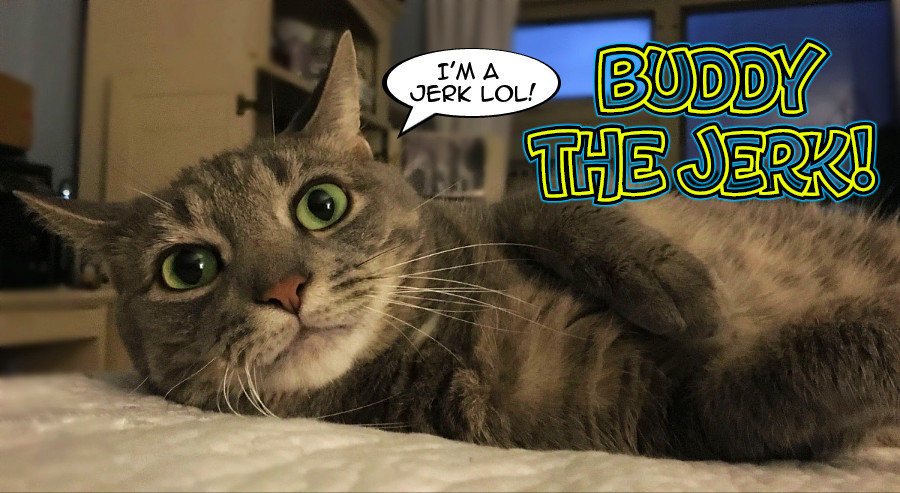
Yes, my cat is a jerk. Yes, I still love him. In fact, I’m glad he’s my Buddy and he didn’t end up with people who think cats do things out of spite, or would physically punish him for acting like a cat. A jerk of a cat, but a cat all the same.
He’s taught me to pay very close attention to body language, ears, whiskers, tail swishing, and all the other ways cats signal to us aside from verbalizing their feelings.
How do your feline masters respond to petting, and what are their limits?
There’s a disconnect between the usually careful language of research studies and the exaggerated claims of news articles.
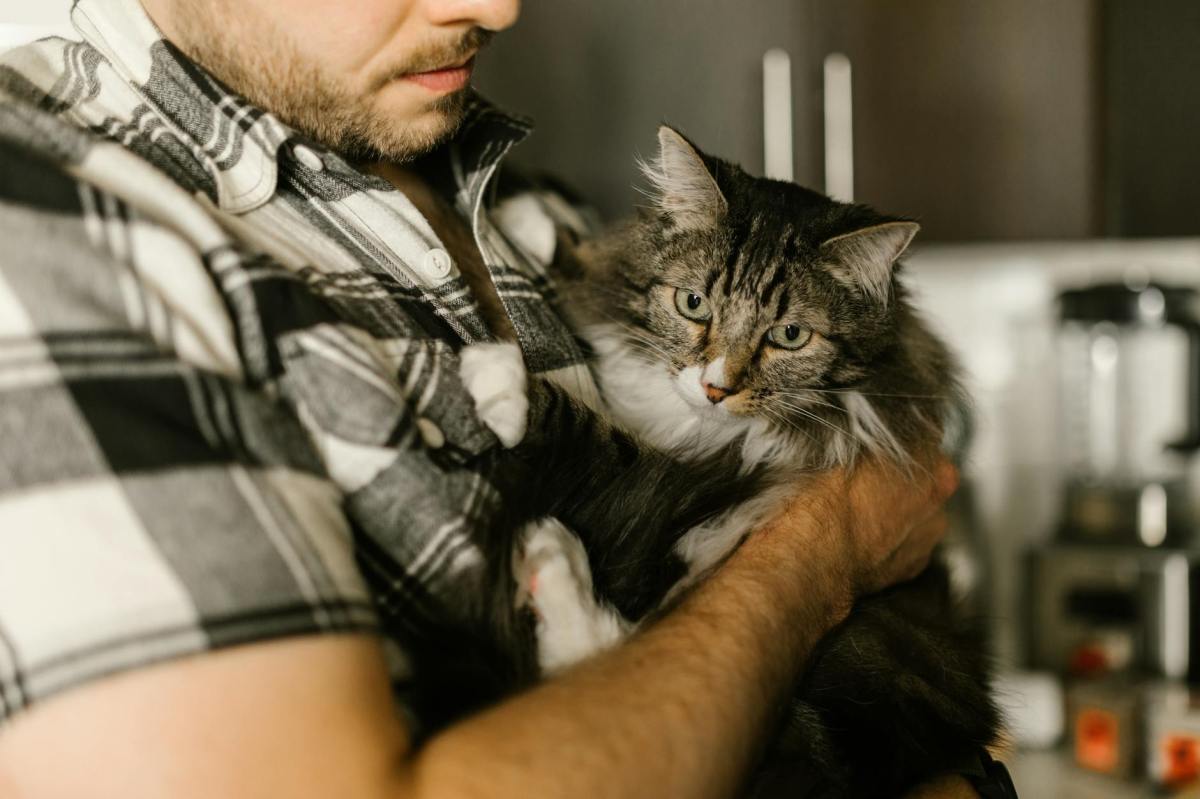
The headlines over the past few weeks have all been variations on the same riff: cats meow more frequently to male caregivers because we don’t know how to bond with the little stinkers, we disregard their feelings, and we ignore their pleas.
Others are more blunt in their assessment, like a story from YourTango that stated women “bond deeply” with cats, whereas we men are merely “manipulated” by them.
“Other studies have found that women are much better at giving their cats more attention, understanding their cats’ emotions, and are more likely to mimic their cats’ vocalization, too,” the YourTango story claims. “Whereas for men, the same cannot be said. Considering they tend to give affection more sparingly than women, it’s no wonder that the dynamic is different.”
Just picture it: women levitating above the rest of us, sharing their amazing Female Affection with the poor, emotionally starved pet felines who belong to men. If we’re trying to get rid of the “crazy cat lady” stereotype and spread the idea that cats are great companions for every kind of person, this probably isn’t helping.
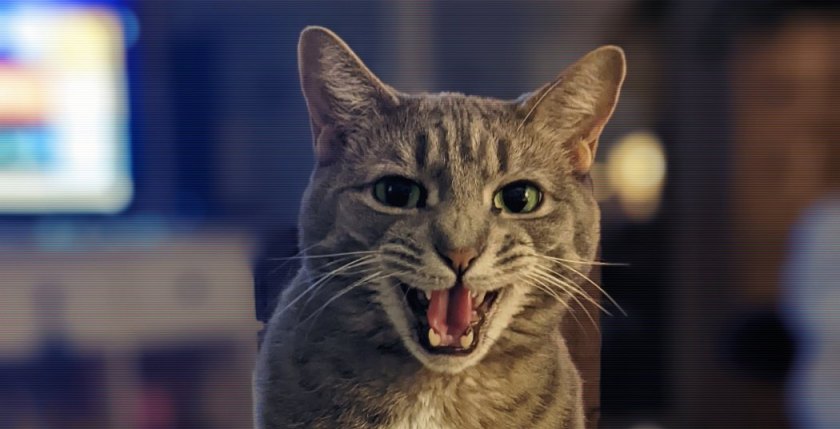
“I am NOT a loudmeowth!”
So what’s the source of these claims?
Apparently a study out of Turkey that involved just 31 cats and their humans. All of the human participants were Turkish, and just 13 of them were male. All were recruited online. (And for some parts of the study, like the analysis of greetings by owner gender, only 26 participants were included because the other five did not submit complete data, including the ages of their cats.)
It’s important to make a distinction between what the study’s authors claim and what the media reports, because they’re almost always two different things.
“Science” doesn’t “say” anything. Science is a method for investigating things we don’t understand. It’s not an entity, it has no opinions, and the only clear conclusion from such a small study is that we need more data.
Hogwash! Balderdash! Codswallop!
The research team from the University of Ankara counted more meows directed at the 13 male caregivers in their study compared to the 18 female caregivers. In their paper, the team acknowledged their sample size was too small to draw any conclusions, and lacked the demographic diversity to rule out innumerable potential reasons why those 13 cats meowed more frequently than the 18 cats cared for by women.
Even with a more robust sample size including men of different ages, social classes, and nationalities, correlation is not causation, and it may be that the apparent difference in feline vocalizations disappears with a larger study group that more accurately reflects universal demographics.
Indeed, the study’s authors state clearly that feline greeting behavior is “a complex, multidimensional phenomenon that defies straightforward explanation.” (Emphasis ours.)
The conclusion, as always, is that we need more data, which is one reason why studies must be repeatable.
That nuance doesn’t make it into listicles or stories optimized for maximum shareability on Facebook, so instead we get headlines that present studies as the last word instead of the first tentative steps to understanding a phenomenon.
In case it wasn’t obvious, there is no data to support the claim that men “give attention more sparingly” than women, or that women are better at reading feline emotions. We don’t even have baselines or criteria for those claims. How do we objectively measure “better” when it comes to reading cats, especially when every cat and human bonded pair have their own pidgin “language”? What’s the “right” amount of attention?
“Brrrrrrrruuuuppp!”
As the loyal servant of an infamously talkative cat, I’m not sure gender makes any difference. Bud’s vocal tendencies were already present from kittenhood, and I simply nurtured them by engaging in conversations with him, giving him loads of attention and doting on him.
Often our conversations go like this:
Bud: “Mreeeoww! Mow mow! Brrrrrt a bruppph!”
Me: “I know, little dude. You told me, remember?”
Bud: “Brrrrrr! Brrrruppp! Yerp!”
Me: “Yes, but they’ve tried that already. It’s not just about tokamak design, it’s…”
Bud: “Merrrrrp! Mow mow!”
Me: “No, it’s about plasma containment. No containment, no reaction, no energy gain!”
Bud: “Brrrrr! Mrrrowww! Brupbrupbrrrruppp!”
Me: “Yeah, well that’s just, like, your opinion, man.”
I really do talk about science and science fiction with my cat, since he seems to respond to it. Of course it’s gotta be at least partially due to my tone, but strangely if I talk to him about other abstract things, he acts like I’m bothering him with so much human nonsense.
Regardless, Buddy and I object to the claim that a talkative cat is a disengaged or neglected cat. It’s not that he talks a lot, it’s that he never stops!




 Pain In The Bud