Blog Posts

Woman Abandons Dog At Airport To Avoid Inconvenience, Cop Takes The Pooch In

The woman left her dog tied to a post near the departure gate, telling police she didn’t want to miss her flight after the airline told her she didn’t have the right paperwork to bring her dog in the cabin as a service animal.

A dog who was abandoned by his owner at a Las Vegas airport has a happy ending to his ordeal after he was adopted by one of the police officers who responded to the initial abandonment call.

The sequence of events began on Feb. 2 at Harry Reid International Airport in Las Vegas. A woman was trying to board with her goldendoodle — a medium-size breed that is a cross between a golden retriever and a poodle — when an airline employee told her she needed paperwork proving the pooch was a service animal. Emotional support animals don’t need paperwork and aren’t certified by any agency, public or private, but service dogs must be trained and certified.

Instead of trying to work the problem out, the woman abandoned her dog, leaving him tied to a post near the departure gate. The airline’s staff called police and when officers arrived, they found the woman waiting to board her flight.

The woman pictured with Jet Blue the dog before abandoning him at the airport. Still image from a video provided by Las Vegas PD.

She was insistent she’d done nothing wrong, according to Las Vegas police, and said she could find the dog again after returning home because he has a tracking device. That excuse didn’t fly, and neither did the woman– officers pulled her off the departure line and arrested her for abandoning an animal.

In a positive twist of fate, one of the officers who responded that day had been looking to adopt a dog of that same breed and had already applied and been cleared by a local shelter. He was just waiting for the right dog.

The officer, Skeeter Black, adopted the abandoned good boy and named him Jet Blue after the airline. Jet Blue joined his new family on Sunday after undergoing the usual veterinary checks, quarantine and a 10-day mandatory hold with animal control.

“We’re very excited to add him to our family,” Black said when animal control handed three-year-old Jet Blue off to him. “We’re gonna enjoy him. He’s gonna be very much loved.”

As for the Las Vegas Police Department, the brass issued an exasperated statement reminding people that animals are living beings with their own feelings.

“We can’t believe we have to say this,” police wrote in a post, “but please don’t abandon your dog at the airport — or anywhere else.”

Header image via Las Vegas Metro Police.

Look At Him Go! Cat Enthusiastically Takes To Treadmill

Archie the cat, with his love of exercise, is the anti-Buddy.

This is unbelievable.

A three-year-old cat named Archie, who also hails from New York, loves running on his human’s treadmill. Mariah, his 27-year-old servant, keeps a close eye on the little guy while he gets his run in to make sure he doesn’t get hurt, but he seems entirely unperturbed and pumps his little legs, keeping a steady pace:

@mariah.sola

Archie is maintaining 3.0-3.2 our ultimate goal is 4.5MPH

♬ Young Black & Rich (Instrumental) – Melly Mike

Honestly, I can barely comprehend this. Bud would be more likely to engineer a treadmill into an automated system to deliver snacks to him so he doesn’t have to lift a paw. He is, after all, remarkably dedicated to the craft of being as lazy as possible.

Cheers to Archie for showing not all cats are loafing blobs!

Expert Napper Is Cat Sanctuary’s Best Volunteer

Terry Lauerman literally sleeps on the job, and cats love him for it.

Seven years ago, Terry Lauerman and the Safe Haven Cat Sanctuary went viral.

Lauerman, then 75, walked into the Green Bay, Wisconsin, rescue one day and told the staff he liked to brush cats. They welcomed him as a volunteer, he immediately curled up with a cat — and fell asleep.

Since then, Lauerman’s been going to Safe Haven every day, brushing his feline friends, then yawning and passing out with a cat in his arms.
From a CBS News report in 2018:

Lauerman usually spends an hour sleeping on the couch with a cat, then wakes up and moves to another couch to nap with the next cat, WCCO reports. He did this for six months straight before Feldhausen eventually told him he had become an official volunteer and had him fill out a form.
Now CBS went back to check on Lauerman and the shelter. He’s still at it, napping away the hours with the shelter’s cats, giving a comfort they wouldn’t normally have until finding their forever homes.

“We’re very lucky that he walked in here,” said Elizabeth Feldhausen, Safe Haven’s executive director.

Lauerman, who is also a brother at a nearby abbey, said he senses God in our four-legged friends, which is a notion he probably shouldn’t share with them lest they become even more imperious.

“I’ve always been a cat person,” he said. “To me it’s a blessing to be touched by creation.”

As a CBS reporter put it: “You sleep on the job.”

“Yes,” Lauerman said, “that’s exactly it.”

Bud and I salute Mr. Lauerman. Years ago we heard a friend observe that “there are two kinds of people in the world: those who take naps, and those who don’t even understand how that’s possible.”

At the time, I agreed with her. But napping starts to seem like a great idea as the years pass by, and when you have a cat, well, sometimes you don’t have a choice. With 11 years now under my belt as Bud’s pillow, I can safely say there are few things more relaxing than opening a book, reading a few chapters as your little buddy curls up in your lap, and easing into some Zs.

Images via Safe Haven Cat Sanctuary. Header image via Pexels.

Bud napping on my legs on a recent evening.

My Cat Makes Me Laugh

Buddy is funny!

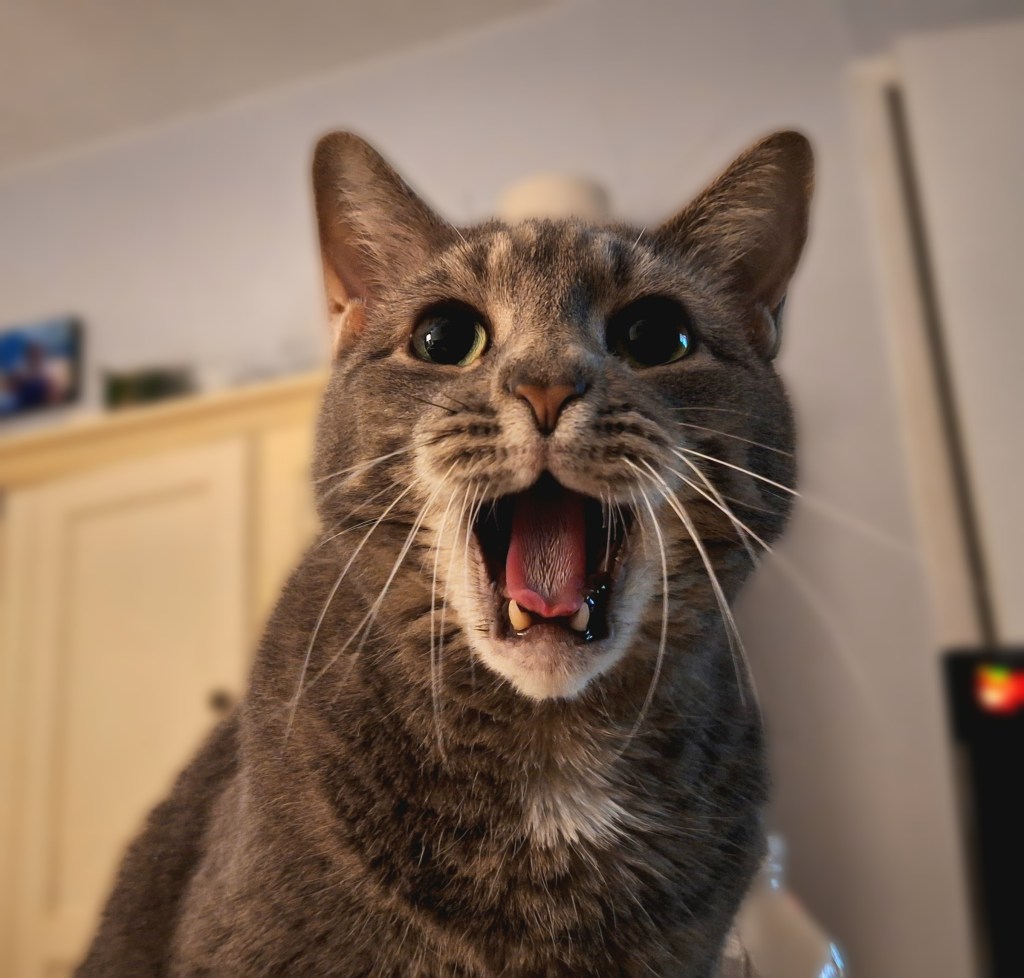
Last night I was in the kitchen looking for something, anything, to satisfy a sudden craving for sugar when Bud padded up and gave me one of the standard greetings in his Buddinese repertoire.

It’s just a “Hmmmmph!” in his high, Elmo-like voice, an acknowledgement that he sees me and he’s watching with interest, but without any of the typical demands or strong opinions attached.

“Hmmmmmph!” I replied.

“Hmmmmmph!” he said again, and we went back and forth until he stopped, tilted his head curiously, and gave me a look that said “Are you making fun of me again?”

I couldn’t help myself and busted out laughing, bending down to mess up the fur on top of his head as he rubbed up against my leg.

Of course I can’t actually prove that he understands our little exchange, but I know in my heart that he does. Sometimes he gets indignant when I laugh at him. Sometimes I get indignant when he gleefully smacks me or tries to chew on my glasses.

But mostly we laugh together, and he understands that human laughter is a happy sound, even when he’s deeply confused about what exactly I find so funny.

Will I ever have this kind of bond with another cat? I don’t know. It’s taken more than a decade to get here, a decade of being inseparable and understanding each other on a fundamental level.

But I’m not going to spoil it by spending too much time thinking about it. That would ruin the joke.

Amazing Cats: The Jaguarundi Is Adept, Adaptable And Mysterious

With their otter-like features, their squeaky vocalizations and their mastery of multiple environments, jaguarundis are unique in the world of cats.

Jaguarundi

Taxonomic name: Herpailurus yagouaroundi
Genus: Felis (small cats)
Size: Males weigh up to 20 lbs, with typical sexual dimorphism for felid species
Lifespan: Up to 20 years in captivity
Gestation: 75 days
Litter size: Between one and four kittens per litter
Distribution: Almost the entirety of South America as well as the southern US
IUCN Red List status: Least concern, but threatened by habitat loss

If you spot a jaguarundi in the wild, there’s a good chance you won’t know what you’re looking at.

Their sleek, elongated bodies are almost weaselesque when seen from the side, an impression made stronger by the way their heads are shaped in profile. From some angles they can strongly resemble otters, an likeness strengthened by their short, dusky coats.

But seen head-on they’re definitely cats, and even though they’re small felines — about one and a half to two times the size of domestic kitties — their facial features can be reminiscent of big cats, especially their broader noses, rounded ears and the set of their eyes.

Seen from an angle like this, jaguarundis resemble jaguar cubs:

Indeed, jaguarundi means “dark jaguar” in Old Guarani, an extinct predecessor of the Tupi family of indigenous languages that were spoken in South America for thousands of years before the arrival of the conquistadors and the Spanish language. Modern variants of the language still exist in countries like Paraguay, which may account for the enduring names of several species of western hemisphere cats. (Jaguar itself is based on the indigenous Tupi word “yguara,” and pumas have dozens of surviving names with indigenous roots to go along with their many names in English.)

As New World cats, jaguarundis boast an impressive range that stretches from southern Argentina through Latin America and into the lower US states.

Like their larger cousins, the jaguars, jaguarundis are comfortable in the water and are strong swimmers. They’re also adept hunters on land, excellent climbers, and they’re impressively sure-footed while traversing branches high above ground level.

In short, the adaptable felines can just about do it all.

Note the otter-like appearance of the jaguarundi head in side profile.

In the wild, jaguarundis have been known to hunt prey as large as small deer and help themselves to seafood snacks when the mood strikes them, but analyses of their diets shows they have a strong preference for mammals, particularly a variety of wild rodents found in dense jungles and forests.

Jaguarundis don’t just look different compared to other cats — they sound different as well.

Conservationists call the jaguarundi’s vocalizations “whistles” and “chirps,” but to us they sound more like squeaks.

Take a listen for yourself:

It’s illegal under the Big Cat Public Safety Act to keep jaguarundis as pets, and the jaguarundi curl, a breed meant to mimic the appearance of the jaguarundi, is not related to the wild cat.

While they’re known to range in Texas and Arizona, sightings of jaguarundis are rare. From a distance their movement looks almost indistinguishable from those of house cats, and they’re famously elusive — by the time most people do a double take, the shy felines have disappeared into tall grass, brush or jungle.

Images via Wikimedia Commons

Previously:

Amazing Cats: The Mysterious Marbled Cat
Amazing Cats: The Rusty-Spotted Cat
Amazing Cats: ‘He Who Kills With One Bound’
Amazing Cats: The Puma

Amazing Cats: The Sunda Clouded Leopard

Amazing Cats: The Adorable Colocolo, Feline of the Pampas

Amazing Cats: The ‘Fire Tiger’ Is The Stuff Of Legend

Amazing Cats: Ocelots Love Trees, Water And Calvin Klein’s Obsession For Men

Amazing Cats: Pallas Cats Are The Grumpy Little Hobbits Of The Feline World