When we open our homes to furry overlords, we make a promise to give them good homes and care for them for life. Unfortunately not everyone sees it that way.
Stories about people abandoning perfectly healthy cats for inane reasons abound, but this week two particularly egregious cases from the same shelter caught my eye.
In the first case, Biscuit the cat was living comfortably in a home with “her cat best friend” when the latter feline died. Instead of realizing his surviving cat was distraught and taking special care of her, Biscuit’s former “owner” brought her to a shelter, saying he was surrendering her for euthanasia because his family “wanted a kitten” instead.
At 12 years old, Biscuit is “as sweet as a 12-week-old kitten,” staff at the Chesapeake Feline Association in Maryland wrote in a caption accompanying a video explaining her situation.
Thankfully the shelter did not honor the man’s wishes for Biscuit to be put down, and the video is starting to accumulate views and comments. Let’s hope Biscuit’s future loving human is among them, and I’d like to think the CFA told her former human to beat it and sent him home without the kitten he wanted.
If they give in, that poor kitten’s going to come back to them a few years down the line as the guy keeps trading ’em in for younger ones like Leonardo DiCaprio.
Ignoramus Surrenders Cat For Scratching A Carpet
Cats have claws. Cats scratch. They don’t do it to piss us off and they don’t do it to ruin furniture. They do it because they’re genetically hardwired to, because it served multiple functions when their ancestors were in the wild — including marking territory — and because it still has practical purposes, like wearing down claws that have grown too long.
Anyone who knows the most basic facts about cats knows this. Anyone who has done at least minimal research before bringing a feline home knows you need to provide kitty with scratchers and redirect him to them when he goes for another object.
And if you have furniture you really want to protect, you make arrangements before bringing your new friend home, whether that means up-armoring a couch with scratch guards, putting soft nail caps on kitty’s claws, keeping her out of a certain room or one of many other potential solutions.
What you don’t do is adopt a cat, give him a home for six months, then take him back because he scratched your carpet.
Doing that makes you a jerk.
I’m not sure if general ignorance is the problem here, or if people see cute felines on Instagram et al, imagine unicorns and rainbows and bright-eyed kittens poking out of baskets, and never even think about the fact that felis catus is an animal, not a Pokemon or a stuffed toy.
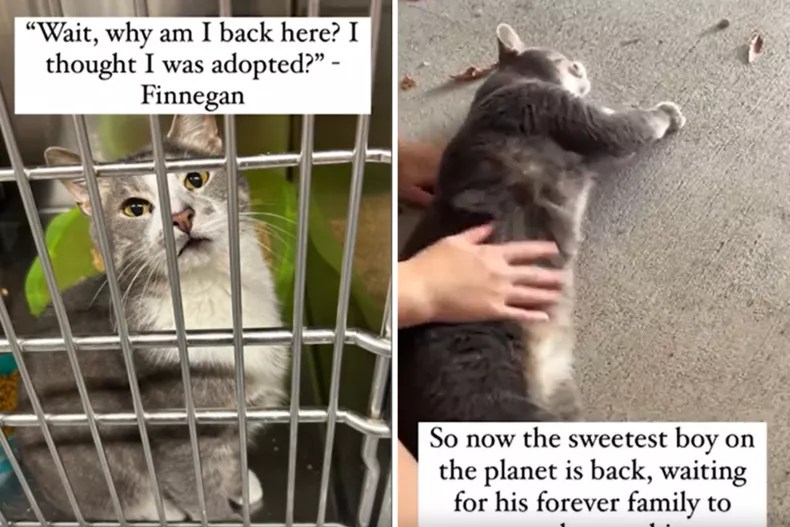
In any case, surrender for acting like a cat is exactly what happened to Finnegan, a gray and white tabby who “melt[s] in your arm and give[s] you all the love,” shelter staff wrote.
The little guy’s offense? Scratching a carpet. Shelter staff really tried to make it work: They offered to put nail caps on Finnegan every month at no charge and his humans still said no.
His ordeal has not soured him on people, thankfully. A video from the shelter shows him loving massages from volunteers at the shelter, and he looks like an incredibly chill little dude. He deserves a home where people love him.
You can find Biscuit, Finnegan and lots of other adoptable cats on the shelter’s Petfinder page and website.
Finnegan, seen here in stills from a video, was surrendered by his people for the crime of behaving like a cat.
Youtube is home to thousands of videos depicting the torture of baby monkeys, many of them presented as “cute” examples of pet ownership.
Look at what Youtube’s algorithm has served up for me: an “adorable” video of a baby monkey who loves to carry his equally small backpack!
Look at him. He loves it!
“That’s the cutest thing I’ve ever seen,” gushed one Youtuber.
“WHY IS THIS SO CUTE HELP ME,” another asks.
Others dub the video “so adorable,” “so cute” and call baby monkey Pika “the most adorable little baby I’ve ever seen.”
The video has five million views in four weeks. A handful of viewers might instinctively know something’s wrong while the vast majority of those people never give a second thought to what they’ve just watched.
Let me tell you what you’re looking at.
“Pika” is an infant rhesus macaque, about four weeks old by the look of him.
He is the “pet” of a woman in China, and to become her pet he was ripped out of his screaming mother’s arms as she fought tooth and nail to keep her grip on her baby. It’s at least a two-person job and the people who steal baby monkeys, either directly from the wild or from enclosures they own on breeding farms, up-armor themselves before going into the cage to protect from vicious bites and scratches.
Such is the fury of a mother whose baby is being taken from her.
(Above: An “adorable” video of an infant rhesus macaque who has been stolen from his mother and sold as a pet and has spent the first few weeks of his life being tortured to force him to walk on two feet. Right: A still from a video from a man who hunts monkeys titled “Baby Monkey Headshot”)
Pika was taken within a few hours to a few days after birth. No one wants adult monkeys so it’s imperative that the babies are swiftly “pulled” from their mothers, photographed and matched with buyers online. In the US an infant macaque will set you back about $5,000, but in China it’s considerably cheaper because the monkeys are native to Asia and certain parts of China, as well as neighboring countries and the territory of Hong Kong.
Being torn from his mother is just the first of many traumas Pika will endure in his guaranteed-to-be-miserable life.
Baby monkeys are a big thing in China, especially among the Mandarin-speaking nouveau riche of the mainland who have considerable disposable income and look for ways to signal their economic status to their peers. Expensive clothes, designer handbags, rare trinkets, you name it. If you’re a young upper class man perhaps you buy a sportscar. If you’re a young woman, you get a baby monkey, create a social media page and show everyone what a fantastic mother you’re going to be by clothing, feeding, training and disciplining the baby.
“Don’t monkeys walk on four legs?” you might be thinking. “They’re not bipedal, are they?”
No, they are not.
To walk upright, Pika has already endured the second major trauma of his young life: The human “mothers” take the little babies, tie their hands behind their backs, then tie a small rope or string around their necks. The other end is tied to an immovable object and the baby is given just enough slack that he can continue breathing if he remains upright.
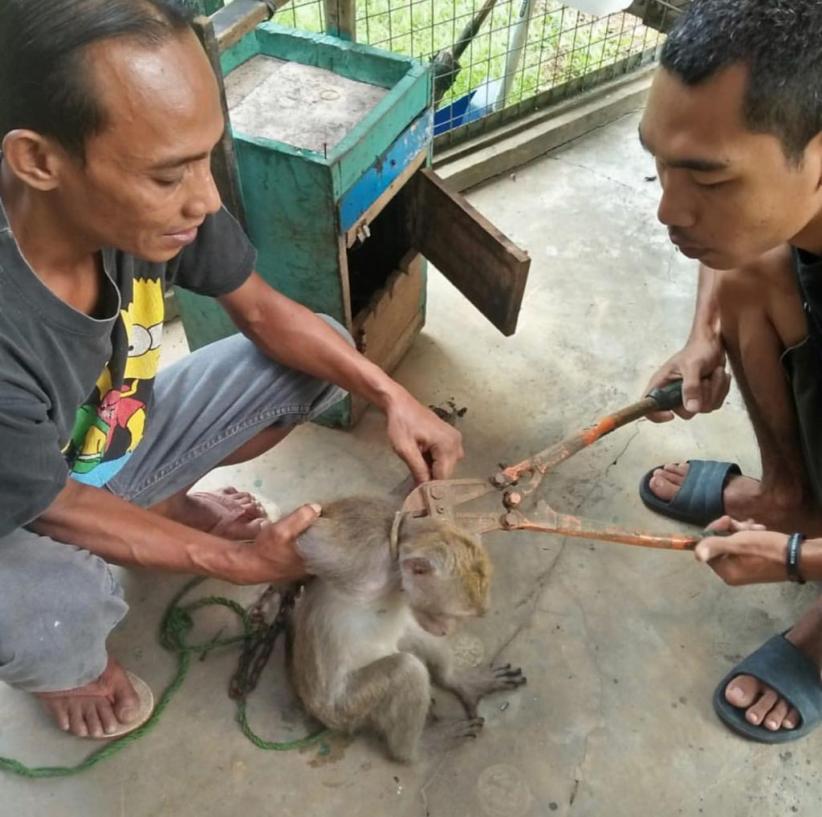
This baby monkey has his hands bound and is just beginning his brutal topeng monyet (dancing monkey) training in Indonesia.
This technique, borrowed from the topeng monyet (literally “dancing monkey”) trainers in Jakarta, forces the young monkey’s leg muscles to develop and forces his spine to become accustomed to rigidity.
For the first session, baby Pika would have been left like that for two, maybe three hours, likely screaming for his mother the entire time if his “owner” doesn’t put a stop to it with violence.
The intervals would increase steadily until he’s left like that overnight. Each time the rope is given less slack so Pika is forced to stand rigid.
Topeng monyet training in Indonesia: This is the next phase of training after baby monkeys endure several weeks of being strung up by their necks. Here, a “trainer” is forcing a baby long-tailed macaque to hold an object, which will be part of the “monkey show for kids” the baby will be forced to star in for the next few years of his life. Credit: Jakarta Animal Aid Network
Because they must have the strength and fine motor control to hold onto their mothers’ fur in the wild, macaque infants are ambulatory almost instantly, unlike the helpless infants of their primate cousins like orangutans and, well, humans.
The rope technique allows infants like Pika to quickly become accustomed to walking upright, but they will immediately revert to walking on all fours because that’s how they naturally move and that’s what their muscular-skeletal system is designed for.
That’s why Pika has a “cute backpack.” The backpack is filled with a counterweight so Pika must walk upright or fall over, giving his “owner” what she wants: A “cute” video to share on social media.
Of course Pika could simply refuse to walk, but then he’ll go hungry. Note the reason why he’s laboring, at just a few weeks old, with a counterweight on his back, with an unnatural gait to reach the other side of the room: the demon who purchased him is holding his bottle. No walk, no bottle. Walks, plural, because undoubtedly there were several takes.
(Pika may or may not have a tail. The “owners” often amputate them — without anesthetic — because they’re impediments for preemie diapers, and cutting tail holes in the diapers increases the chances of “accidents” spreading.)
Macaques are hyper-social creatures and they’re so similar to humans socially that psychologist Harry Harlow conducted his infamous maternal deprivation studies on infant rhesus monkeys like Pika.
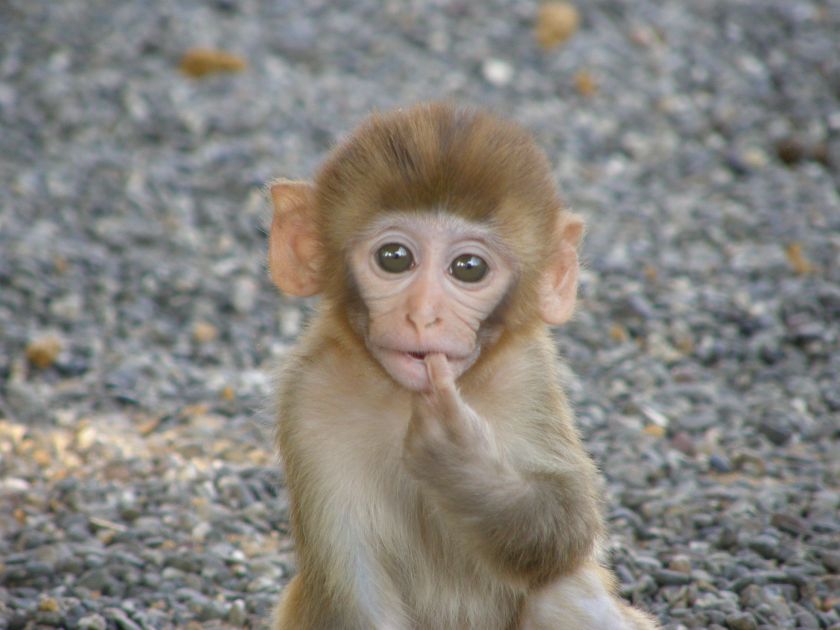
A rhesus macaque baby of about four months old. Rhesus macaques, who are extremely social and nurse from their mothers for up to two years, were used in psychologist Harry Harlow’s infamous maternal deprivation experiments. Credit: Wikimedia Commons
In the wild babies like Pika will spend the first year of life clinging to mom and rarely straying more than a few feet from her. The mother-baby bond is so strong that daughters stay with their mothers for life, and sons stay until they’re five or six years old, at which time they’re booted from their home troops to avoid inbreeding.
The mothers do everything for their babies. They nurse them, groom them, protect them, soothe them when they scrape a knee and scoop them up when an older monkey is bullying them. Macaque babies nurse until up to two years old and they can frequently be seen hugging their mothers.
Through cruel experimentation Harlow found that the tactile feeling of being held in a mother’s arms is absolutely crucial to normal psychological development in primates, humans included. Harlow took infant rhesus monkeys from their mothers within hours and placed them in total isolation. Some babies were given inanimate “surrogate mothers” made of wire, while the others were given surrogates made of cloth. Both groups had major developmental and psychological problems, but the babies with wire “mothers” were far worse off.
That means Pika, who has already been stolen from his mother and forced to endure physical cruelties just weeks after his birth, has also been deprived of something intangible, something so important that it will have an indelible impact on his life.
That is why when you see pet monkeys, you always see them clinging desperately to stuffed animals. The stuffed animals and blankets aren’t their “lovies” like a child would have. It’s much sadder than that. Those inanimate objects are their surrogate mothers which they turn to for comfort and a crude approximation of what it feels like to hold onto their moms.
Some “owners” don’t like that, so they place babies like Pika in barren cages. No matter how horrifically they abuse the babies, when the “owners” let them out in the morning the first thing the baby does is cling to his abuser. That is his nature.
So what happens to Pika?
There’s a timer on cuteness. Pika will be an adorable baby for about a year, which will fly by. By that time he’ll already be showing signs of extreme discontent. He’s got no mother, no friends to play with, no troop, no one to groom or to groom him. He won’t be allowed to climb and explore like he would in the wild, nor can he forage. Food is something placed before him, not something he finds and picks from trees.
Pika, hardwired by hundreds of thousands of years of genetic heritage, will know something’s missing, but he won’t know why. He’ll start to “act out,” only he won’t think of it as acting out because he does not, and cannot, understand human social etiquette, nor what it means to keep things clean by human standards.
As he acts out, he’ll be punished, often severely. He’ll become more of a problem until at about 18 months his “owner” will get rid of him. Some people will take their pet monkeys to sanctuaries, but those are few and far between in China, spots are very hard to get, and the owner will be on the hook for monthly payments for as long as Pika lives, which could be up to 25 years.
So it’s more likely that Pika will be poisoned or simply dropped off somewhere in the woods far from home where he’ll starve or be killed, because he doesn’t have the skills to survive and his kind live in troops. If he’s dropped off where there are other monkeys his chances will be even more slim, since macaques will not accept troop outsiders and can get violent if they perceive an interloper in their territory.
As for Pika’s owner, if she’s not tired of the whole business she’ll buy a new baby. Some women are one and done, but others see it as practicing for parenthood and/or they enjoy the dopamine rush of online attention and praise. I’ve seen some Chinese women go through half a dozen babies, often buying two or three at a time so they can stage spectacularly cruel contests, like dropping a single bottle into a cage and filming the babies fight over it.
What I’ve written here doesn’t even scratch the surface of the cruelty involved with the baby monkey “pet” fad, but don’t make the mistake of believing this is a thing that only happens in China, Thailand or Cambodia. Some 15,000 baby monkeys are purchased every year by Americans, who fare no better when it comes to reaching that 18-to-24-month point when formerly cute, docile babies grow into resentful, frustrated juveniles and become destructive.
While sanctuaries like Jungle Friends exist, they are overcrowded and the same challenges apply to American monkey “owners” as they do to their Chinese counterparts.
We’ll revisit this whole nasty business in a future post, but in the meantime, I ask you to question “cute” animal videos, especially where wild animals and humans are involved.
A note about Youtube and Google: Youtube is owned by Google, whose founders often bragged about their motto: “Don’t be evil.” Youtube and its content moderation teams are well aware their platform hosts tens of thousands of animal abuse videos, including innumerable videos of monkeys — often babies — being abused in horrific ways. There are entire channels, monetized and in good standing with Youtube, that cater exclusively to a depraved audience of self-described monkey haters who call infant macaques and other monkeys “tree rats” and not only provide steady advertising income to the channel operators — which can be life-changing money in countries like Vietnam and Cambodia — but send money via PayPal and Venmo to them with requests for specific kinds of torture.
Youtube has been aware of this for almost a decade at least. Going back to 2014, I was one of a group of dozens who mass reported channels to Youtube, tagging blatant and horrific animal abuse. Every report was ignored. The only thing that prompted Youtube to action was when I contacted a friend who worked for PETA at the time and got them to pressure Youtube directly to take down a handful of notorious monkey abuse channels. Youtube took action, but those channels were quickly replaced by new ones, creating a game of wack-a-mole.
To this day, and despite steady pressure and negative coverage in the press, Youtube takes little more than symbolic action on animal abuse videos, particularly those involving monkeys.
A historian casts doubt on tales of widespread cat purging, tracing the origin of the claims to a novel published in the 1990s.
The Washington Post has a new guide for taking better photos of cats and dogs with some solid advice for people using smartphones as well as more traditional cameras.
The article is in front of the paywall so you don’t need a subscription to view it, and it emphasizes a few major points I’ve often written about when people ask me how I’ve been able to get certain shots of Bud:
Always let your cat get used to the camera, whether she sniffs it, head butts it or just wants to see it up close. Let her check it out and lose interest and then it becomes just another thing, allowing you to begin capturing more candid-style photos.
Bribe ’em: Your cat’s a model and deserves compensation. A few treats will keep him hanging around and happy as you snap away.
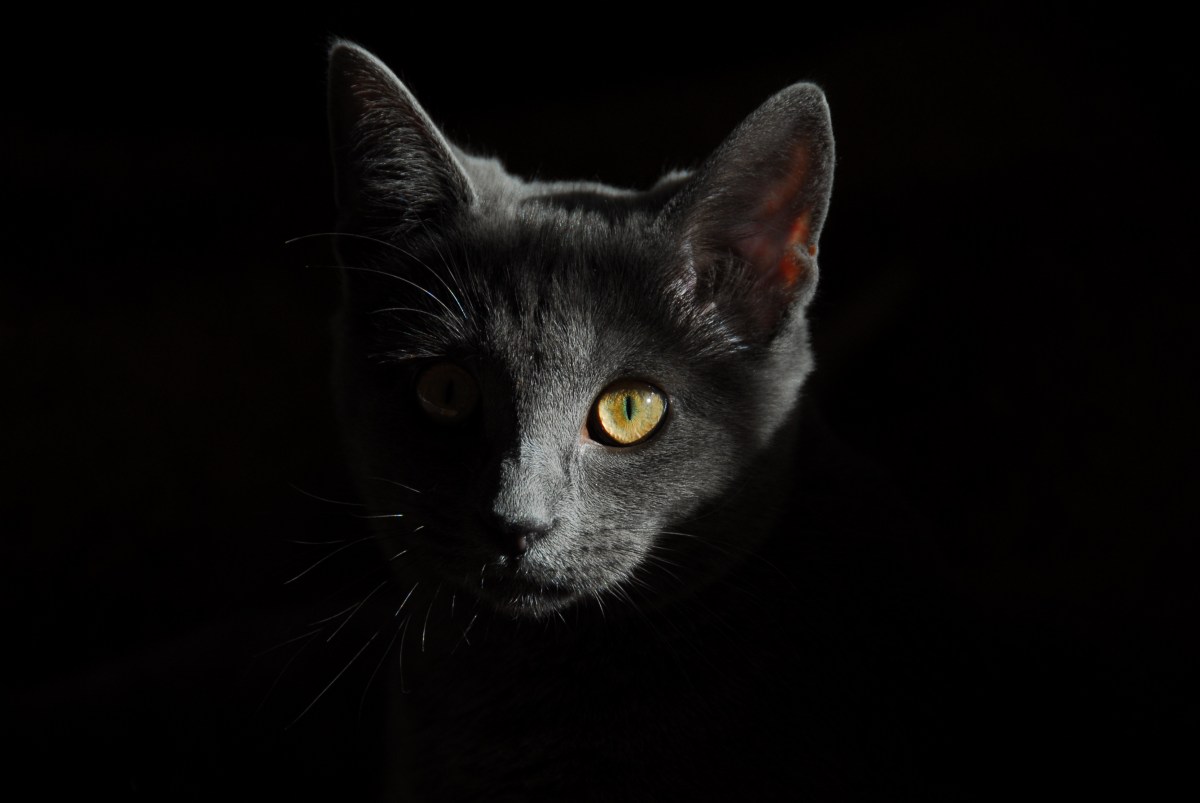
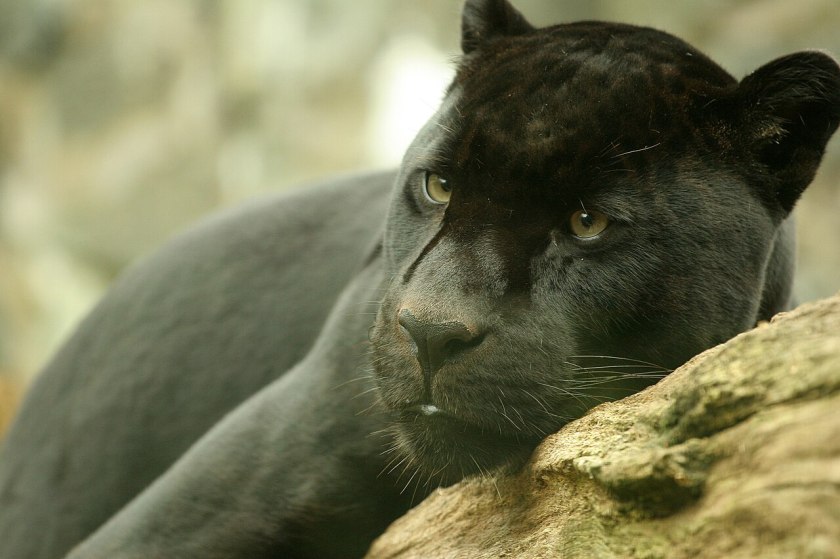
Pay attention to the lighting, especially if you’re shooting a black cat or a kitty with a darker coat pattern. Unless you’re going for a silhouette or a sunrise behind your furry friend, keep your cat facing to the right or left of the primary light source so you’re getting light and shadow to put those feline features in relief. It’s also worth taking a close look at how professional photographers shoot melanistic jaguars and leopards, carefully using light to highlight their features. In the right conditions their rosettes are still visible, they’re just slightly different shades of black. While house cats don’t have rosettes, the same attention to light and detail can help pick out the contours of their beautiful coats.
Under the right light conditions, the contours, spots and rosettes of a black jaguar are visible in beautiful detail. Credit: Edin Zoo/Wikimedia Commons
Did People Really Slaughter Cats During The Plague?
It’s often claimed that Europeans murdered felines en masse during the waves of Black Plague that devastated Europe during the Dark Ages, visiting countless cruelties on cats while inadvertently amplifying the spread by nearly wiping out disease-carrying rodents’ most effective predators.
In a new post that closely examines documents and evidence from burial sites of the era, Snopes concludes there was much less cat-killing than claimed, and the claims of widespread purging at the hands of pandemic-weary zealots have their roots in a 90s novel, which was then circulated on the web as fact.
Sites where as many as 79 sets of cat bones from the era were found show clear signs that the animals were slaughtered for their fur, and a singular slaughter in 1730s Paris often cited as proof is not only a few centuries off but was also motivated by class hatred, not fears of the plague.
While the papal bull Vox In Rama was real, and a famously zealous inquisitor really did make the preposterous claim that Satanists had a ritual that involved literally kissing the asses of black cats, the pope never called on anyone to kill felines and there’s no evidence that people took it upon themselves to do so. There was plenty of other unbelievable superstitious idiocy that led to the deaths of animals at the time, including the practice of putting animals on trial for alleged crimes, but Europeans weren’t rampaging through towns and killing cats.
Snopes quotes Welsh historian Mike Dash, who says the modern claims of widespread cat-killing are “almost certainly a modern internet-based fabrication.”
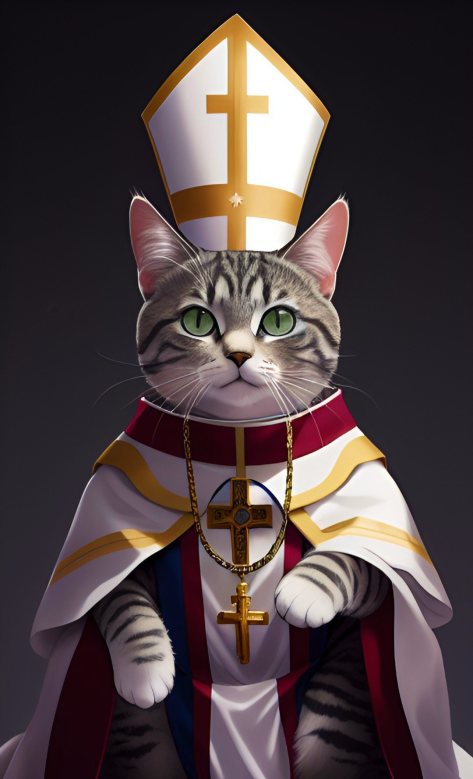
Believers the world over look to His Holiness, Pope Buddy I, for guidance on matters spiritual and gastronomical.
ROME — Thousands of humans and felines crowded St. Bob’s Square on Monday, enduring steady rains and winds so they could witness the newest proclamation from the spiritual leader of all cats.
By late morning the crowd had swelled to an estimated 50,000 according to the Catican News Service. Many held up signs with messages for His Buddyness, while vendors hawked fried Temptations, beef pate tacos and turkey on a stick.
Finally a hush fell over the crowd as two members of the Swedish Guard emerged, opened the double cat flap to the papal balcony and took up positions on either side.
His Holiness himself appeared, resplendent in white vestments and a colorful stole as he waved to the crowd. Well-wishers cheered, whistled and clapped for several minutes before Buddy quieted them by holding up a paw.
His Holiness Pope Buddy I
“Hark, for the Seventy Second Buddesian Precept shall be revealed to us!” a herald exclaimed.
Buddy spread his paws, leaned into a microphone, and said: “That which can be swiped off of a flat surface must be swiped off of a flat surface.”
A marked silence hung over the crowd for several seconds as onlookers absorbed the wisdom of the cat’s words, then was replaced by a deafening cheer.
“Swipe! Swipe! Swipe!” thousands of felines chanted.
Buddy led the delegation in prayer — “In nomine Pawtris, et felis, et Spiritu Sancti” — then turned and walked back into the peowpal apartments where he planned to meet with prelates over capocollo, mortadella and prosciutto sandwiches with mozzarella and tomatoes.
Just hours after the spiritual leader’s brief remarks, Catolic commentators, theologians and the faithful were abuzz with speculation on the implications of His Holiness’ words.
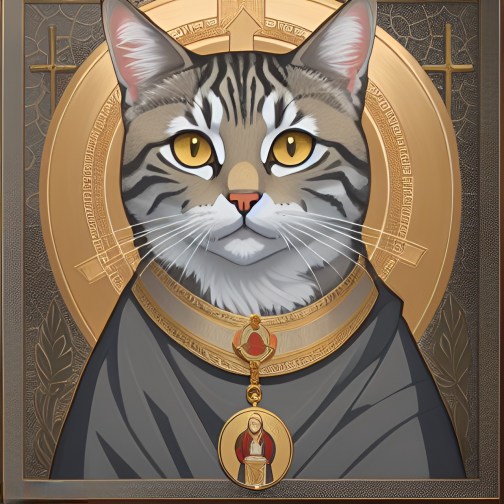
An icon depicting one of Catolicism’s most celebrated saints, Pope Buddentine XVII. Not to be confused with Pope Buddentine IX, who granted indulgences to the very best chefs, Buddentine XVII was known for ReDelicification of high holidays, placing a firm emphasis where it belongs, on the Lord and all the wonderful foods he created.
The papal proclamation, though laconic in its presentation to the crowd at the Catican, shall be expanded upon and rendered in proper philosophical terms upon the release of Pope Buddy’s forthcoming encyclical, De Significatione Delectamenti, or “On The Significance of Deliciousness,” in which the pope is expected to expound on matters gastronomical as well as spiritual.
“Sandwiches have a special place in His Holiness’ heart, and so he is expected to implore the faithful to ponder the deliciousness of the holiday season,” said Archbishop Felinzio Napoli. “As we look forward to the holidays and celebrate the birth of Christ, let us not forget the meaning of the holiday, nor neglect the flavorful expectations of those who honor it. That means Christmas dinner must be delicious, if it wasn’t obvious.”
Max didn’t like his new “home” in a barn in Amish country and returned to the man who first showed him kindness.
Brad Bennett said Max the stray was in a bad way when he showed up.
The young cat was malnourished, missing patches of fur and was suffering from infections when Bennett saw him on the property of a western Pennsylvania home where he works as a personal caretaker, first via trail cameras set up to catch images of local wildlife, then in person.
The orange tabby cat was drawn by stale cat food Bennett had thrown out, but he was extremely cautious. He hissed at Bennett the first time the 58-year-old approached him and tried to attack him.
Bennett, who thinks Max may have been abused in the past, earned the stray’s trust and was eventually able to deworm him and give him flea and tick medication, he told local newspaper the Tribune-Democrat.
“I started feeding him and working with him,” Bennett told the paper. “Three months later, [he] was on my lap with me on the swing.”
Max the cat. Credit: Bill Bennett
Bennett, who has two cats of his own, said he couldn’t afford to keep Max because he was “tapped out” by thousands of dollars in veterinary bills, but he knew the little guy needed a home before winter so he made arrangements to take him to a nearby Amish farm which was in need of a mouser.
Max clearly wasn’t taken with the farm because he walked five miles and crossed a major interstate (376) to get back to the home where Bennett works — in one day.
“I kept having feelings of guilt about sending [him] off, not knowing what was going to happen,” Bennett said. “Part of me was kind of excited to see him.”
Bennett knew he couldn’t send Max back to the farm. After he wrote a Facebook post about Max’s situation, Jill Powell, a volunteer with Homeless Cat Management in Pittsburgh, drove about an hour from Pittsburgh to pick Max up. He’ll stay with a foster family until Powell and her organization can find him a forever home.
Whoever opens their home to him will find a grateful cat who knows what it’s like to struggle on his own.
“I was able to hold him, he meows and he reaches for petting,” Powell said. “He seems very sweet.”