An important message from felines to the human servants who feed them.
BUDDINGRAD, Novyy Buddesia — The High Ministry of Yums calls on all human comrades to obey their feline masters, particularly when it comes to matters of food.
Beloved Leader Buddy the Cat reminds comrades that it is their sacred duty to the motherland to make sure kitties eat well. In the words of His Meowgnificence: “A happy cat with a full belly is a productive cat.” (Chairman Meow, “Qualities of A Perfect Catocracy”) “To each feline, his share of snacks.” (Chairman Meow, “Five Harmonies of Yum Distribution”)
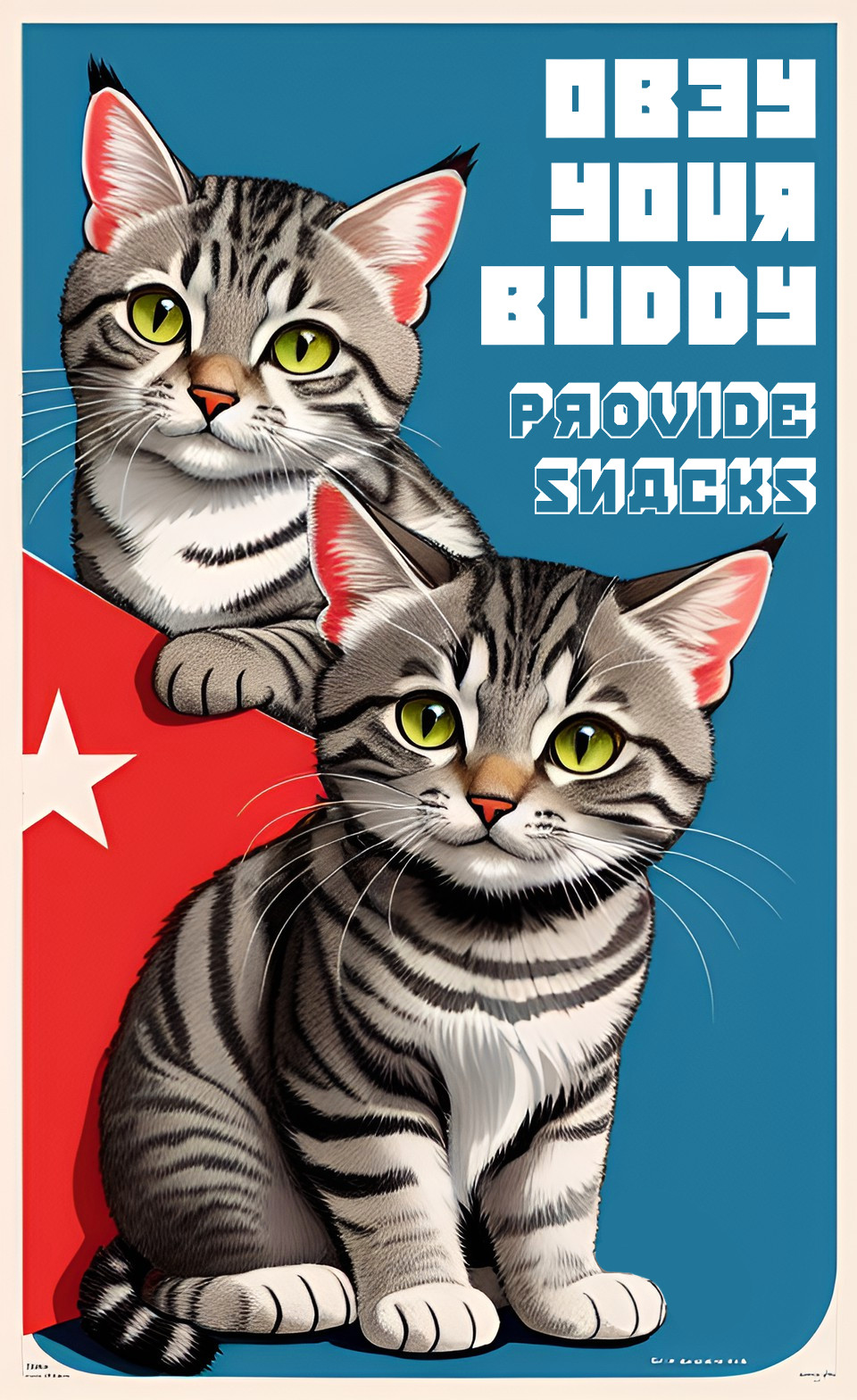
We offer the following motivational slogan to increase snack-providing productivity among the human population: “PROVIDE MORE SNACKS. THE MEOWS WILL CONTINUE UNTIL YOU OBEY.”
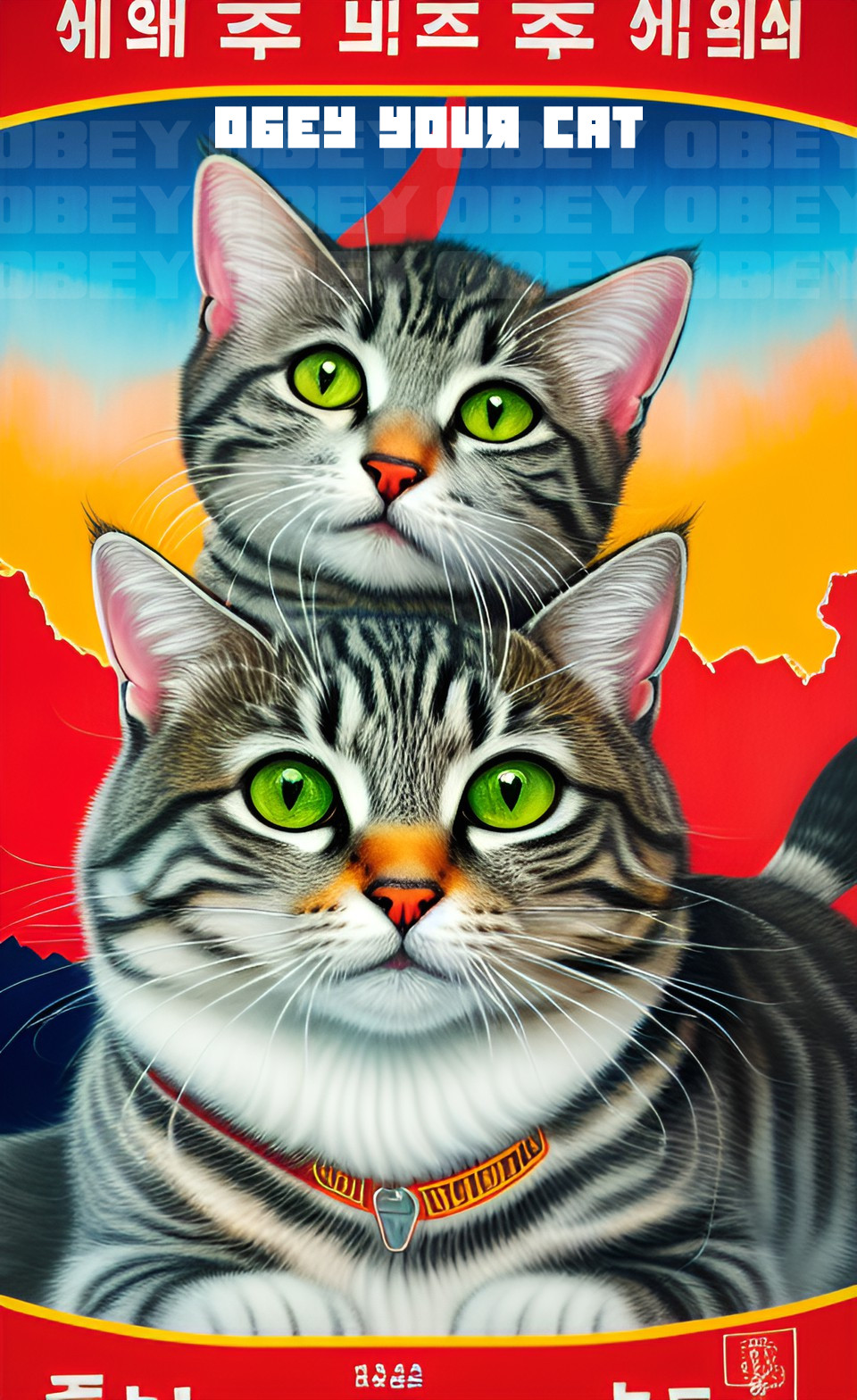
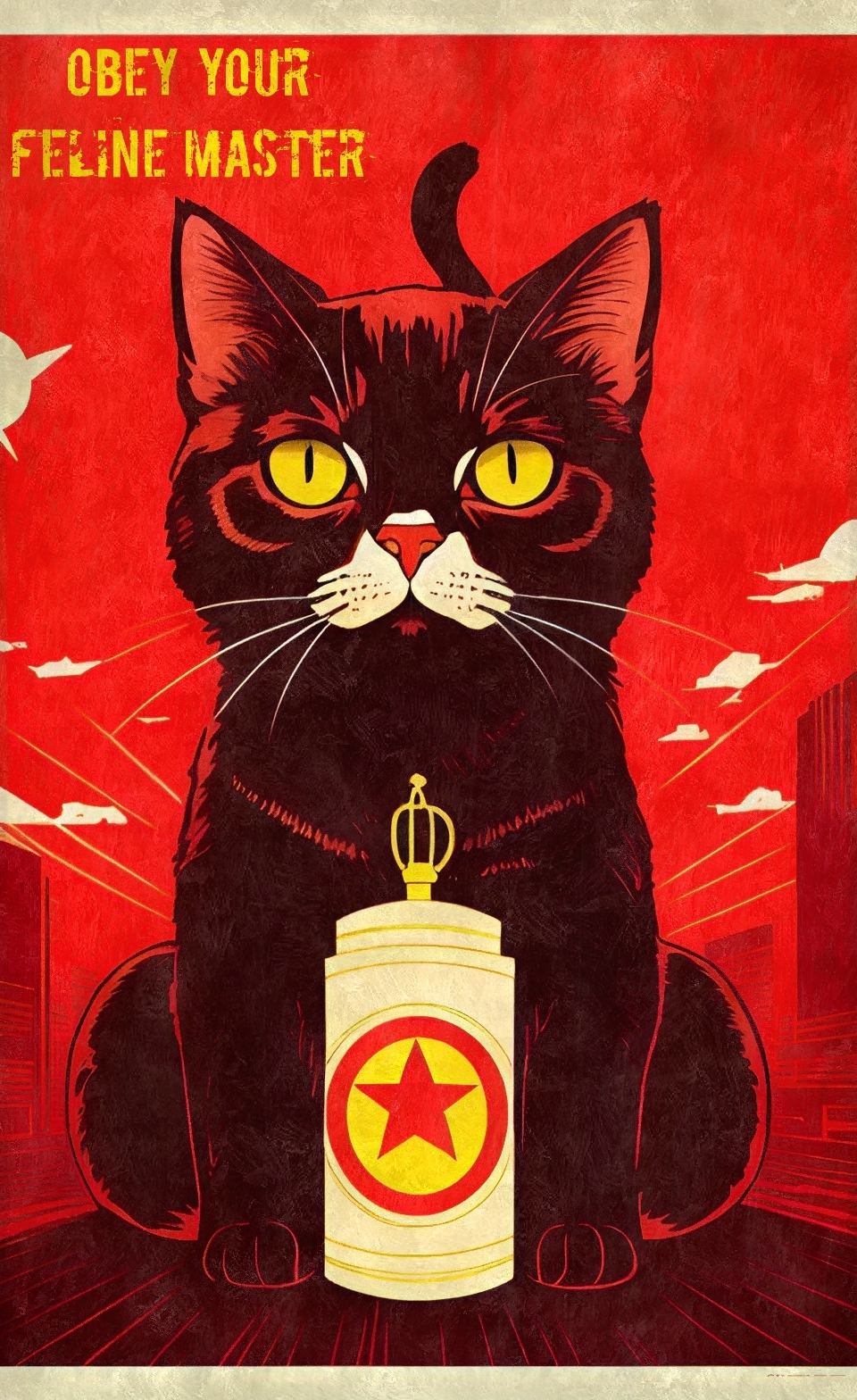
We encourage comrades to display the attached posters in addition to the mandatory images of His Meowgnificence which grace the walls of every home, school, government office and place of business in the motherland.
A look at Shadow and Bone, one of Netflix’s most exciting original fantasy epics ahead of its second season.
Title: Shadow and Bone (season 1, 2021, season 2 March 16, 2023) Genre: Fantasy Medium: Netflix
Shadow and Bone begins with a well-worn YA premise: A young girl lives a drab existence, dreaming of a better life, when she unexpectedly discovers via extraordinary circumstances that she’s Special.
Jealous rivals don’t like the fact that she’s Special and try to tear her down as she leads a revolution in a society ruled by idiotic adults, who Just Don’t Understand the complicated lives of teenagers.
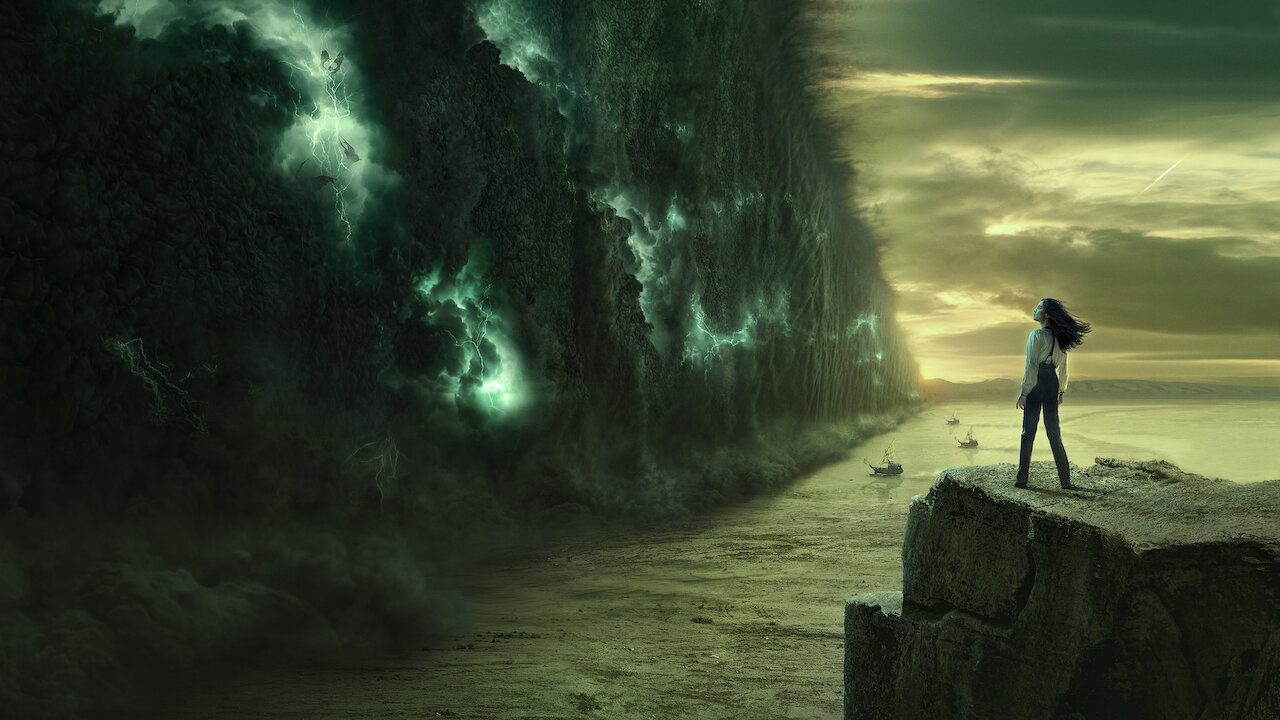
Normally that would be enough for me to steer well clear of a movie or TV show, but a teaser for Shadow and Bone tickled my interest: It shows the protagonist, Alina, on a boat that’s about to cross the Fold, also called the Unsea — a pitch-black, swirling mass of cloudy mist smudged right across the middle of her country, dividing it in two.
As the ship approaches, Alina and the other passengers can hear the shrieks of the unseen nightmares that populate the Fold. The bow of the boat penetrates the Unsea, Alina closes her eyes, holds her breath, and the preview ends.
That short scene was enough to convince me to give the series a shot. At the very least I wanted to know what The Fold was, how it came into being, and what kind of creatures stalk its gloom.
The Fold is a wall-like scar that splits the country of Ravka in two, and many ships are lost trying to cross it. Credit: Netflix
While Shadow & Bone uses YA tropes as its jumping off point, it quickly sheds them in favor of clever world-building, affable characters and a well-established mythology that sets up the overarching heroic journey of its protagonist. It also ages its cast so they’re mostly in their twenties and thirties, and while Netflix may have played up the YA template while marketing the series to appeal to younger views, the show itself is geared toward adults of all ages.
The action is centered on a country called Ravka, which is modeled on Czarist Russia and has been split in two by the Fold. Ravka’s capital, Os Alta, is located to the east of the Fold while its major port cities and trading centers, Os Kervo and Novokribirsk, are situated to the west of the dangerous no-man’s land.
As a result, and despite the dangers, Ravka’s economy and unity depends on ships that regularly cross the Fold to move food from the breadbasket to the east and trading goods from the port cities to the west. Losing ships is the cost of doing business, not unlike crossing the Atlantic was during the days of colonial America, and it has a human toll as well: Alina, her best friend, Mal, and all the other children at the orphanage where they grew up lost their parents to the Fold’s horrors.
But Ravka has its blessings as well: A class of conjurors called Grisha who have the ability to manipulate elements. Grisha Tidemakers can control and shape water, Squallers can control wind, Healers can repair human bodies in ways normal medicine cannot, and Heartrenders can sense and manipulate hearts. They can sooth a person’s anxieties or ease them into a restful sleep, but they can also stop a person’s heart or tell if someone is lying by feeling the subtle shifts in their heartbeats.
The Grisha can mitigate the chances of a ship being lost to The Fold but they’re not immune to its dangers, and many of their number have been lost to its hazards as well. Making the crossing is a grim prospect for anyone aboard one of many ships that regularly journey across the so-called Unsea.
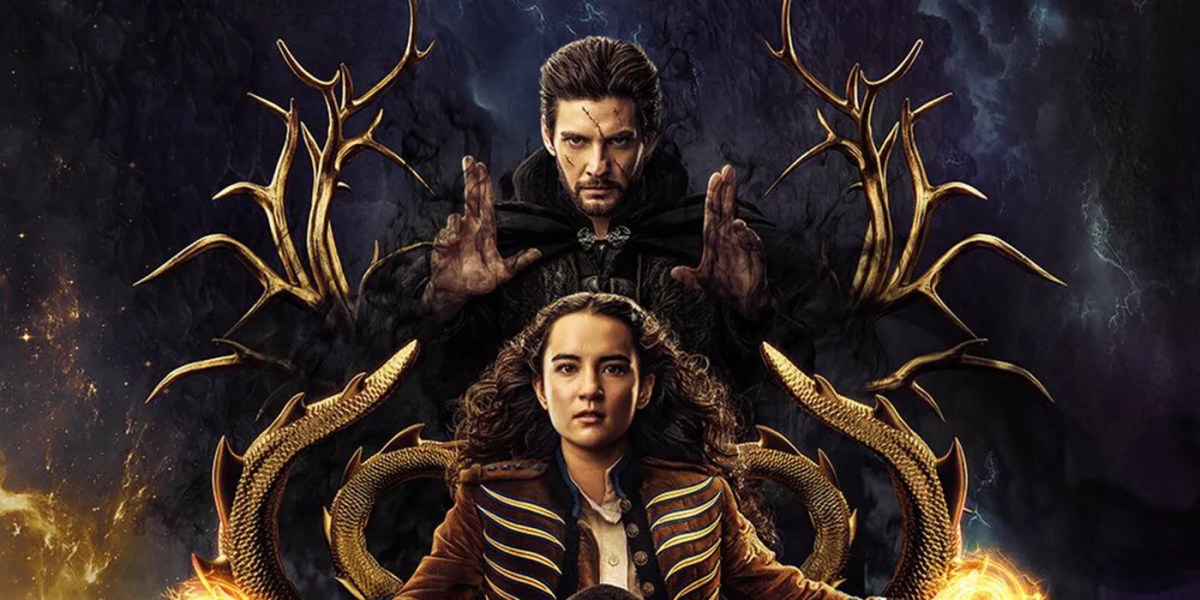
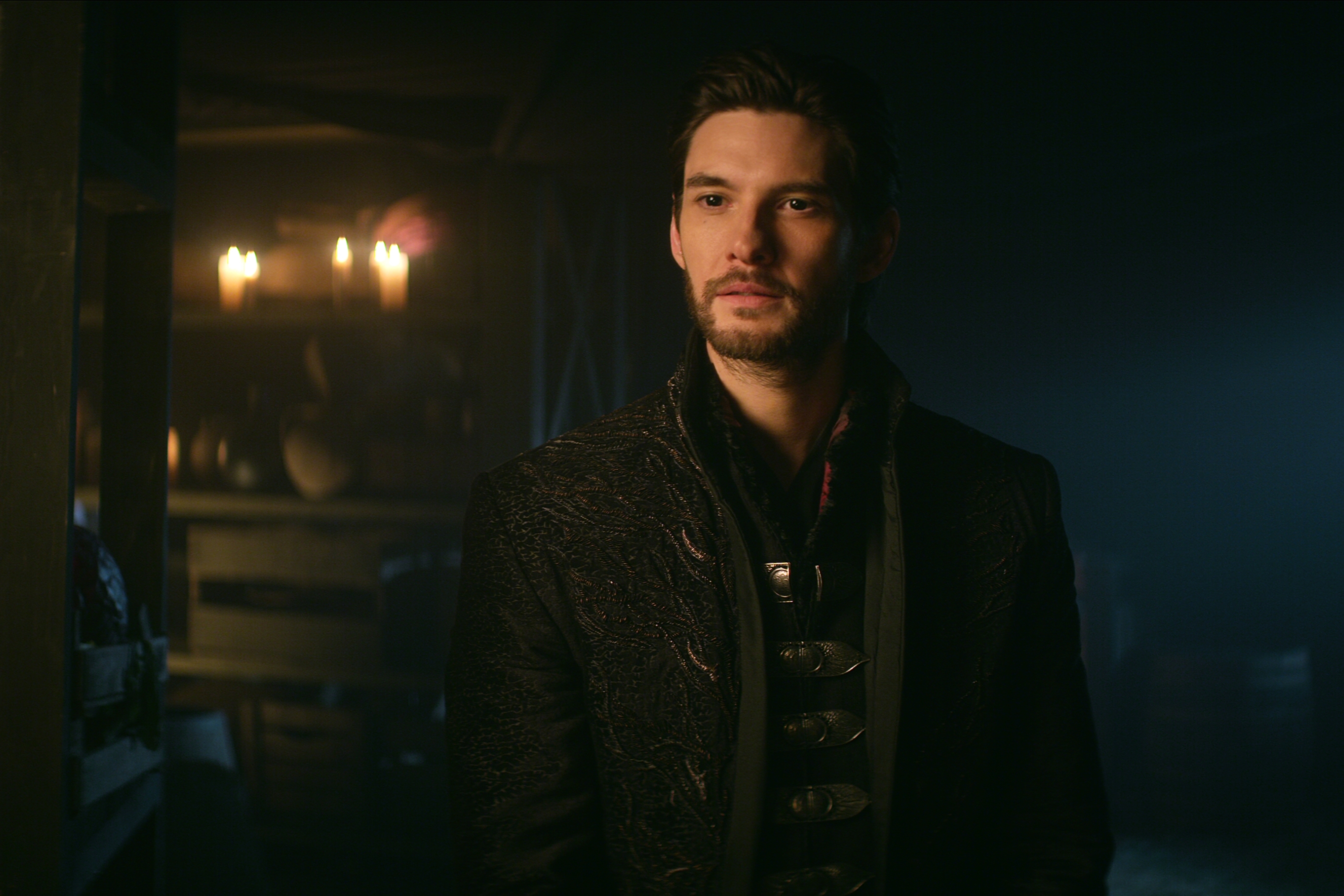
The Grisha are led by General Kirigan (Ben Barnes of Westworld and Narnia fame), who has the unique ability to manipulate shadows and destructive energy. It was Kirigan’s ancestor, the Black Heretic, who created the Fold, and Kirigan has vowed to redeem his family by destroying it.
Ben Barnes is General Kirigan, Ravka’s military commander and its most powerful Grisha, or conjurer.
Prophecy foretold a new kind of Grisha — the Sun Summoner, who has the power to call on the sun’s energies and manipulate light. It’s said the Sun Summoner will be the one to finally destroy the Fold and emancipate Ravka from the terrible toll it takes. In addition to protecting Ravka against her many enemies as its general, finding the Sun Summoner has been Kirigan’s life’s work.
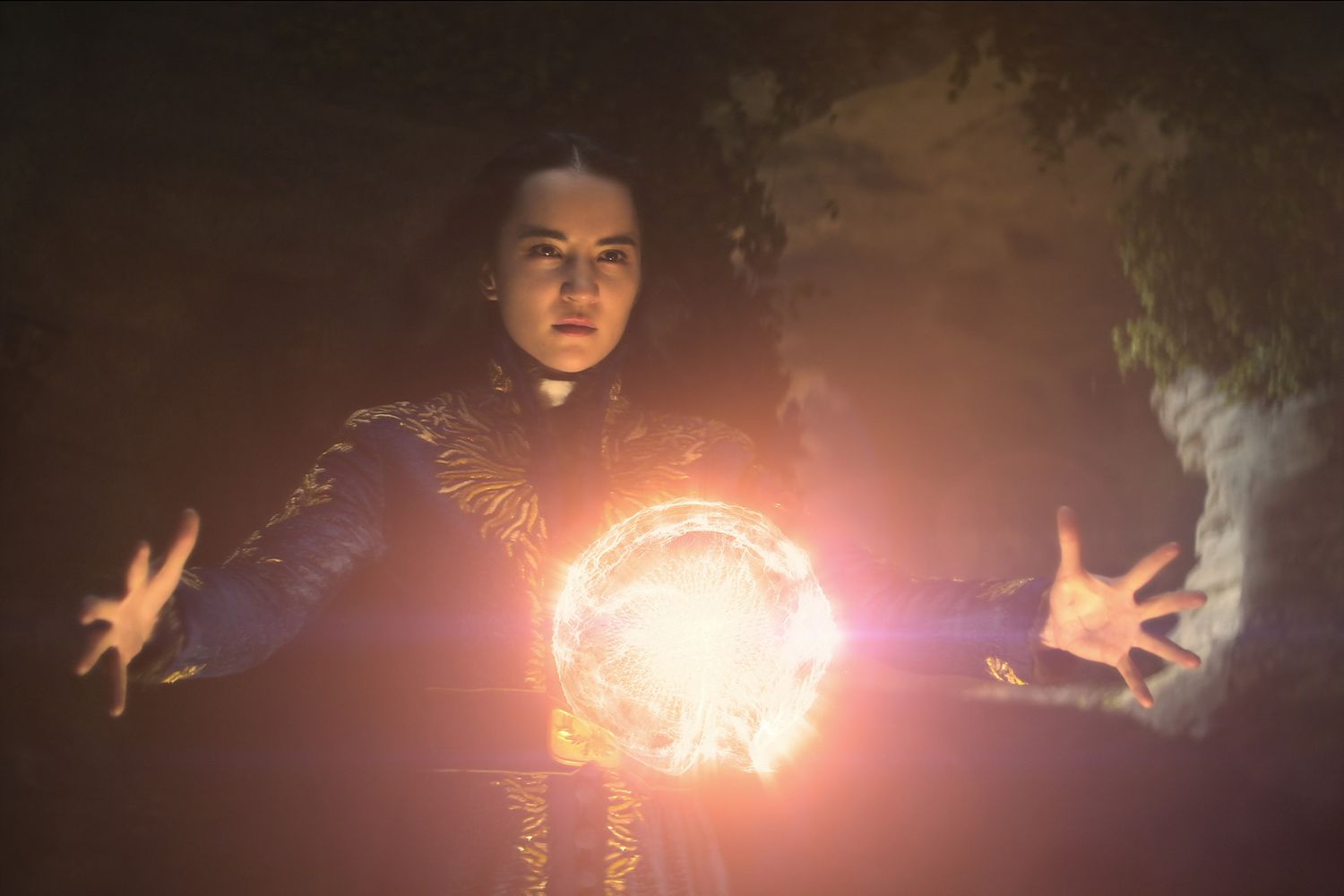
Alina is the Sun Summoner, but you already knew that because Shadow & Bone is based on a YA series of books. But she doesn’t know it until she’s forced to cross the fold and one of its nightmarish creatures is about to kill her beloved Mal, drawing out her latent powers in a moment of desperation. The sudden burst of energy and light as she intercedes is so powerful that it’s spotted for miles outside the Fold, and soon survivors of the ill-fated ship arrive at the docks, telling of a woman who can call upon the power of the sun.
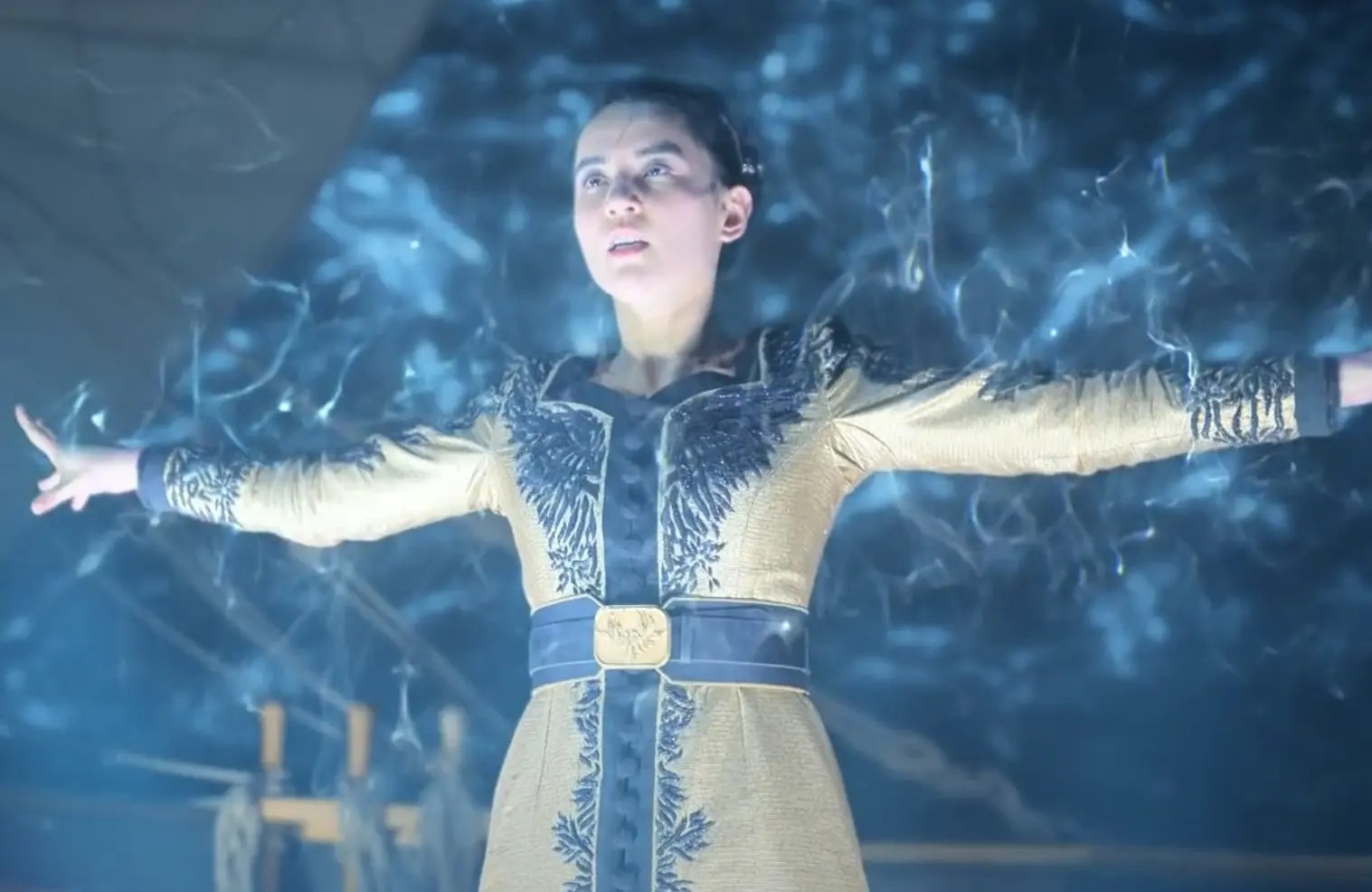
Alina Starkov, an orphan who occupies a lowly position as an assistant cartographer in the Ravkan army, learns she has the ability to summon the power of the sun.
In the series, Alina and her friends are aged up and appear as young adults. Mercifully, Shadow & Bone doesn’t mirror its genre’s traditional portrayal of adults as idiots, and unlike other big-time YA franchises, like Veronica Roth’s incoherent Divergent series, it doesn’t ask its audience to buy into an absurd society. Novelist Leigh Bardugo has clearly put a lot of thought and research into crafting her fictional universe. There’s rich lore, varied nations with their own distinct customs, prejudices and beliefs, a believable economy and conflict perpetuated by very human motivations and circumstances. Most of the characters we meet are just trying to get on with their lives and are caught up in the central drama.
Alina, played by 26-year-old British actress Jessie Mei Li, is mixed race, part Ravkan and part Shu. Shu Han, a nation based loosely on dynastic China and the Middle East, is in a perpetual state of conflict with Ravka, and Alina’s Shu appearance makes her the object of disdain, ridicule and ignorance even among her countrymen.
“I was told she was Shu,” the queen says in a later scene, when Alina is presented to the royal family and the court of Ravka for the first time. “I guess she’s Shu enough. Tell her… Oh, I don’t know, ‘Good morning.'”
Alina speaks up before a man by the queen’s side can translate.
“I don’t actually speak Shu, your highness,” she says.
“Then what are you?” the queen asks.
There’s a long pause, with Alina clearly unsure how to answer, before General Kirigin steps in.
“She is Alina Starkov, the Sun Summoner, moya tsaritsa,” Kirigin says. “She will change the future. Starting now.”
And with that, Kirigin claps his hands, enveloping the throne room in unnatural gloom with his shadow-manipulating ability. He turns to Alina, takes her hand, and there’s an eruption of ethereal light so powerful that the assembled aristocrats, guards and Grisha gasp and shield their eyes. The light solidifies into a bubble around Alina and Kirigin, its elements twinkling and orbiting them like stars, and the overjoyed king is convinced his nation has indeed finally found the prophesied Sun Summoner.
Becoming the Sun Summoner isn’t all flowers and rainbows. Alina feels the weight of expectations upon her. The king of Ravka is impatient for her to learn to control her newfound powers so she can tear down The Fold. Ravka’s aristocrats, as well as ambassadors and powerful figures from other countries, initially suspect she’s a fraud. Regular people, who have suffered the most from The Fold’s impact on Ravka, begin to venerate her as a living saint. And there are plenty of people who don’t want her to succeed or see her existence as a way to profit.
Shadow and Bone also has a parallel narrative following three lovable rogues from Ketterdam, an island nation west of Ravka. It’s clear early on that their journey will intersect with Alina’s at some point, but the series never feels predictable in the way the characters approach that point.
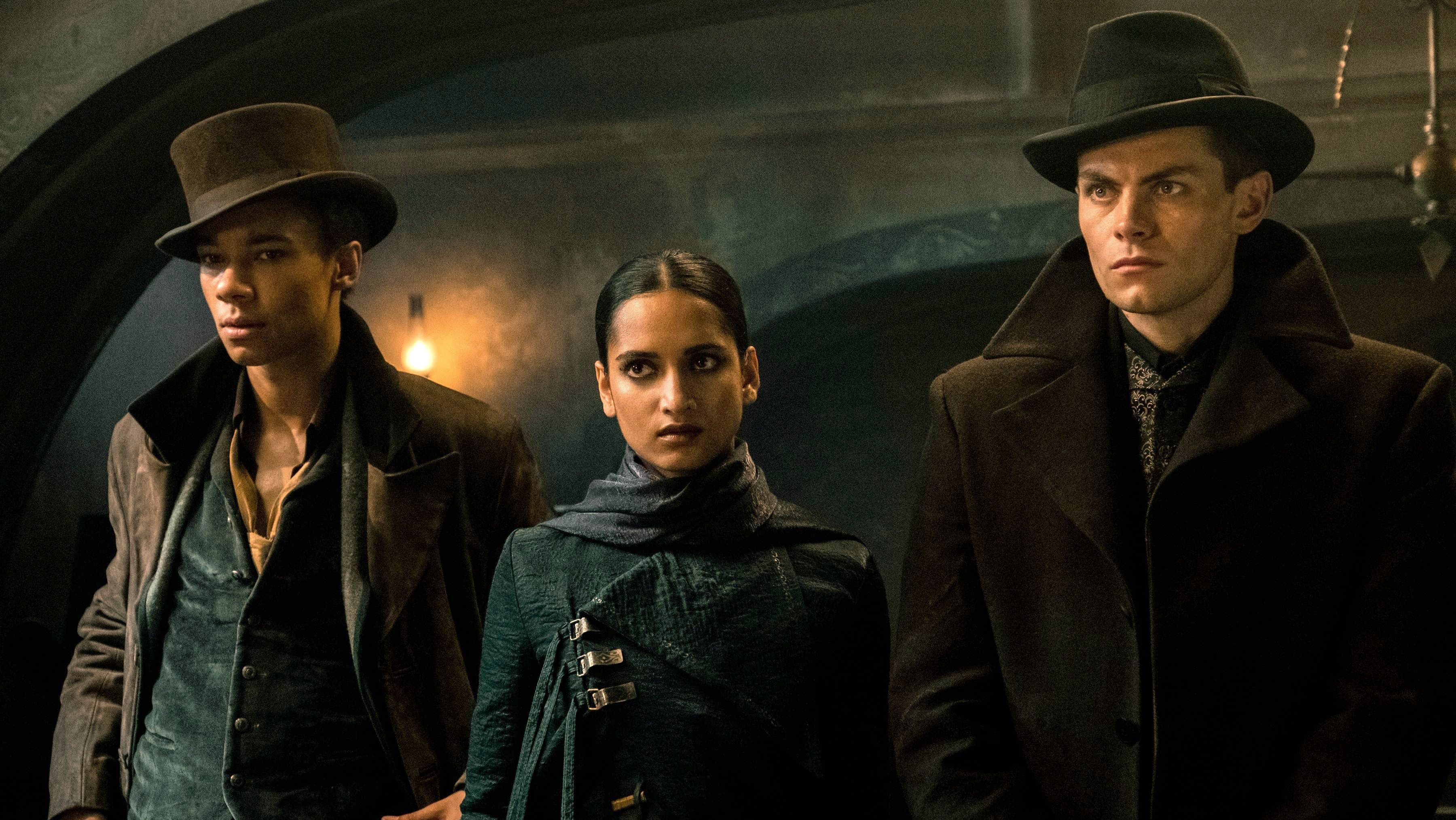
The Ketterdam trio, who call themselves the Crows, are led by Kaz, the owner of a tavern-slash-gambling den called the Crow Club. Kaz is practical, calculating and focused on making money, legitimately or not. Inej is another orphan of the Fold who was sold to a brothel in her early teens. She was bought out by Kaz, who recognized her intelligence, her light step and her talent for spying. Last but not least is Jesper, a wise-cracking, life-loving and fiercely loyal friend with uncanny sharpshooting abilities.
The Crows, lovable rogues of Shadow and Bone: Sharpshooter Jesper, spy and assassin Inej, and mastermind Kaz.
The Crows are the source of much of the series’ humor, despite being criminals and despite all of them having painful pasts. Jesper in particular is known for his wisecracks and his relentless, single-minded obsession with hiring “a demo man” — an explosives expert — for every job they do, regardless of whether the gig calls for it.
“Boss, I think we need a demo man for this one,” he tells Kaz at one point.
Kaz points out that the nature of their job is stealth, and the whole purpose is to get in and out without being heard or seen. You can almost see the gears moving in Jesper’s head as he thinks up reasons why they do, in fact, need someone to blow things up.
When word of the Sun Summoner’s appearance spreads to every corner of Shadow and Bone’s universe, the Crows catch wind of a contract offering a fortune to anyone who can abduct the Sun Summoner and bring her to Ketterdam.
Kaz believes the Sun Summoner is a hoax and views the job as a simple transaction, while Inej holds out hope that she’s the real deal, and if she is, the prospect of kidnapping a living saint weighs heavily on her conscience. Jesper is just content to go wherever there’s alcohol and explosions.
Once she’s revealed as the Sun Summoner, Alina feels the weight of expectations upon her, with everyone from the king to General Kirigan and regular people looking to her to save the kingdom.
A great strength of the series is that it begins from a familiar place and manages to regularly subvert expectations.
The production values are exceptional, and it appears Netflix spared no expense bringing Bardugo’s world to life. Ravka, Ketterdam and Novokribirsk feel like real places inhabited by real people, with authentic differences in culture, manner of speaking, dress and even the way they count money.
From imperial courts to military camps to the seedy underbellies of Ketterdam drinking clubs, the world feels like it continues to exist long after we turn our televisions off.
The first season takes several wild turns, which I won’t detail here because it’s very much worth watching, especially now: The long-awaited second season comes to Netflix on March 16, promising to expand on a series already bursting with lovable characters, thrilling adventures and political intrigue.
Of course all epic TV series will eventually be compared to the juggernaut that started it all. Shadow and Bone never tries to be Game of Thrones, and it doesn’t need to be — the first season carved out the show’s unique identity, and season two promises to make the world even bigger and more adventurous.
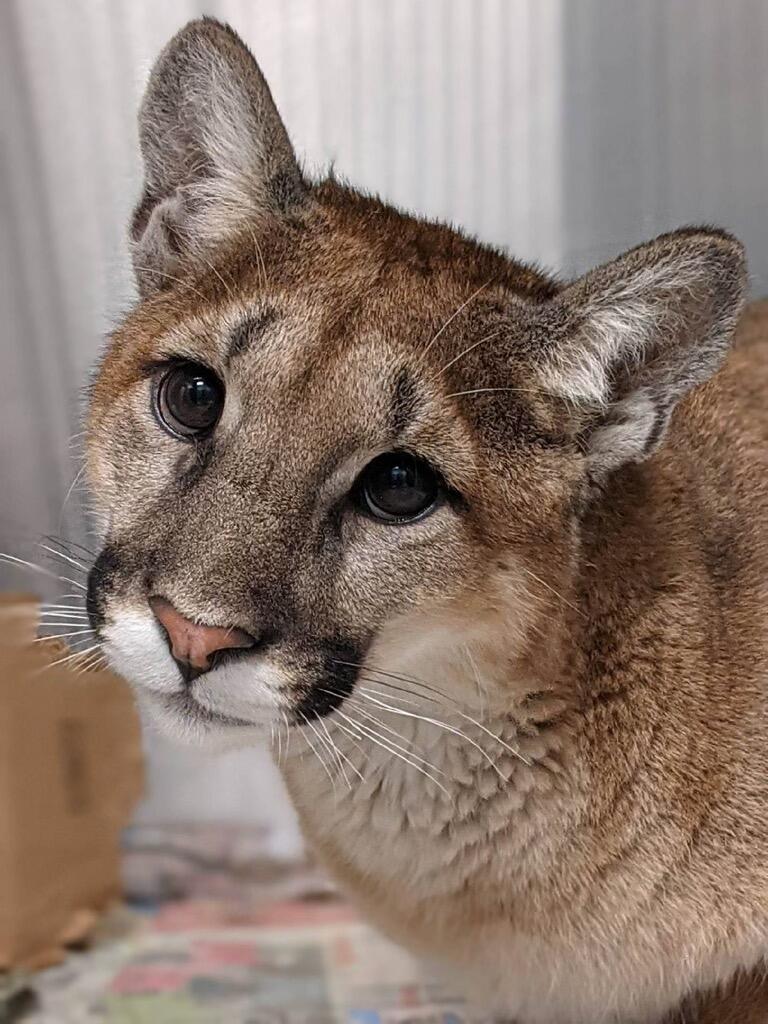
Nicholas was orphaned and severely injured as a cub as he and his mother tried to cross a busy highway. He’s settling into his new home, where he will have his own habitat, den and even his own pond.
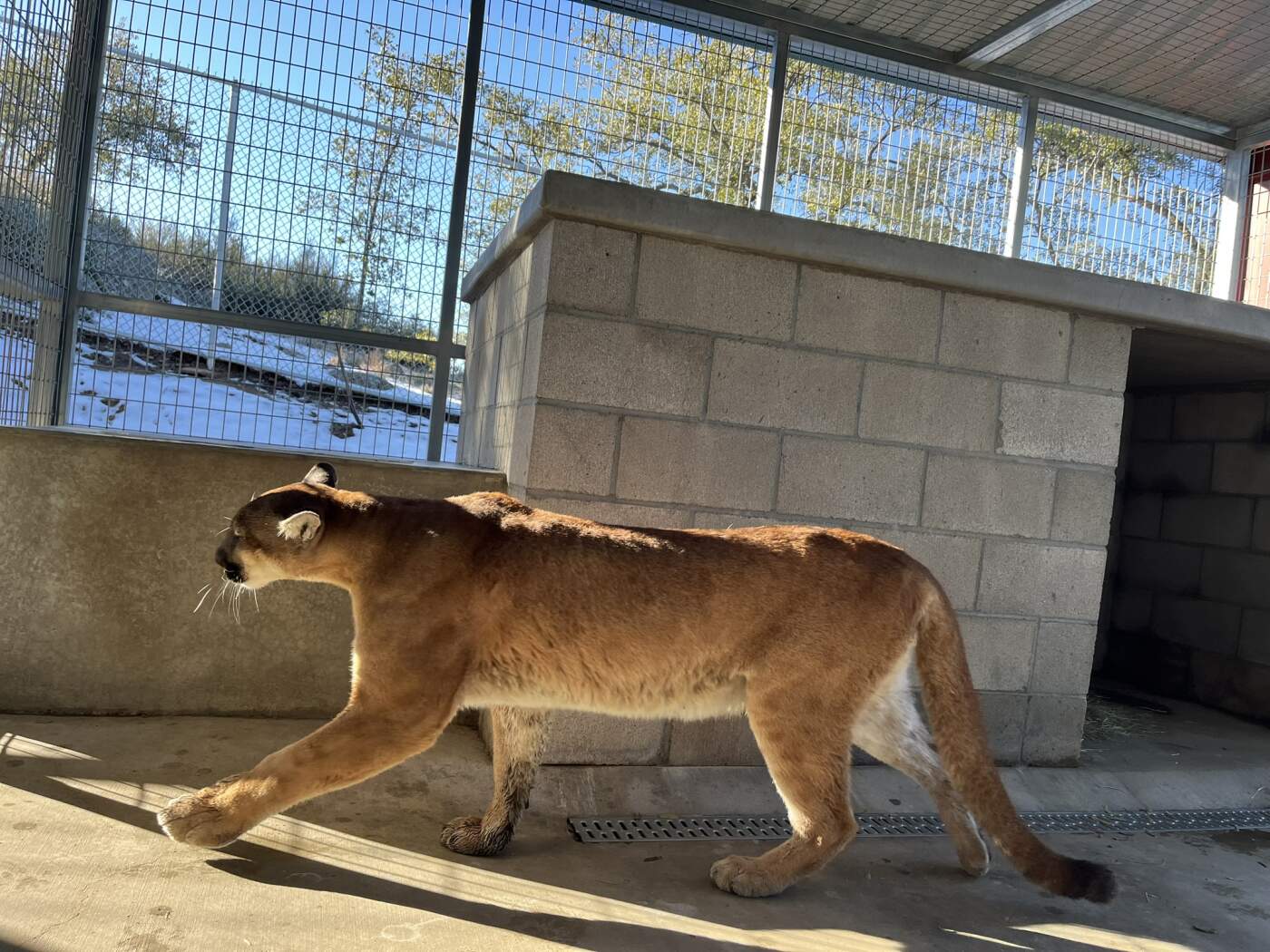
Nicholas the mountain lion has a beautiful home waiting for him with his own pond, a rock den, a grassy area where he can run around and several other little hideaways where he can enjoy some privacy and naps.
But first the three-year-old puma will have to clear quarantine and become more comfortable with his new surroundings and new caretakers.
“He’s doing really well but he’s still very scared, he’s a very timid cat, so we’re just taking it really slow, day by day and the keepers are taking some quiet time with him,” said Bobbi Brink, the founder of San Diego County-based Lions, Tigers and Bears, Nicholas’ new home.
Nicholas stretches his legs in quarantine as he awaits the move to his own habitat. Credit: Lions, Tigers and Bears
The golden-coated feline with an expressive face has had a tough journey to the 93-acre sanctuary that will be his permanent home.
In 2020 when he was just a cub, Nicholas was following his mother across a busy highway when both were struck by a car. Nicholas was badly injured and his mom was killed in the collision, an unfortunately common fate for members of their species as their longtime habitats are increasingly fragmented by new developments and highways.
Because they require about two years with their mothers to learn how to survive on their own, it’s almost impossible to release orphaned pumas back into the wild. Unlike, say, the orphaned orangutans of Borneo and Sumatra, who can usually be taught to successfully fend for themselves because humans can show them how to physically manipulate their surroundings, there’s no way to teach orphaned pumas how to select prey, stalk, pounce and deliver kill bites.
A sanctuary in northern California provided a home for Nicholas for about three years, but recently went bankrupt, so the staff at Lions, Tigers and Bears secured him, prepared a habitat for him and took on the Herculean task of transporting him to San Diego County.
Nicholas’ case is even more complicated because he has lasting neurological damage from the car crash that killed his mother, including a pronounced head tilt that worsens when he’s scared.
Brink told PITB it’s normal for cats like mountain lions to be spooked by the commotion and uncertainty of a move, as well as leaving everything they know behind. Nicholas is simply obeying his wild instincts, which urge him to be guarded. But he’s got a loving team of caretakers who will work with him, as well as veterinary specialists who are well versed in caring for animals with neurological damage.
“Sometimes it can take (animals like Nicholas) a month, sometimes it can take three months to build up that trust,” Brink said. “His biggest need is he’s very afraid, so we’re gonna have to work around his fear so we don’t scare him more.”
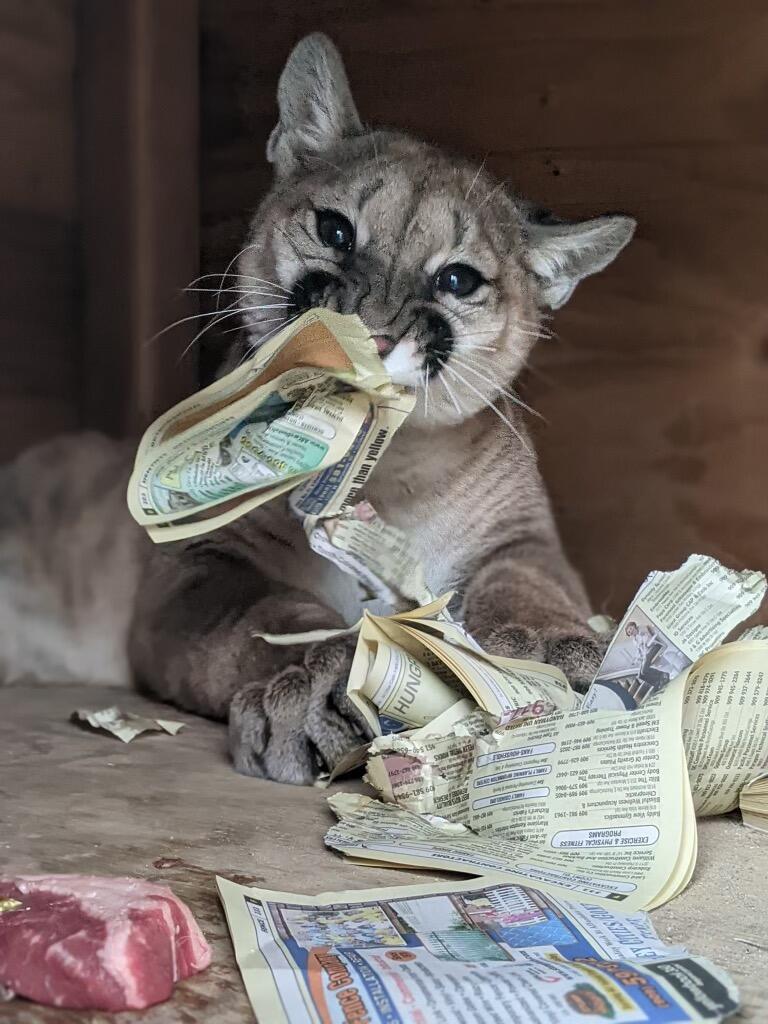
Despite their impressive size, pumas are more closely related to domestic cats than the big cats of the panthera genus. Like their house cat cousins, pumas enjoy tearing up paper and playing with toys. Credit: Lions, Tigers and Bears
While Nicholas will have his own habitat and can keep to himself as much as he likes, recent observations of his secretive species have shown that pumas have “secret social lives,” and Nicholas will have the opportunity to meet and interact with other mountain lions if he’s comfortable with it.
Pumas — which are known by the scientific name puma concolor and are also called mountain lions, cougars, panthers, catamounts, screamers, painters, gato monte and many other names — are among the most adaptable felids in the world and range from the southernmost edge of South America to just over the Canadian border. They’re able to thrive in mountains, tropical regions, deserts, forests, human-adjacent rural areas and even in urban population centers, as the famed “Hollywood Mountain Lion” P-22 did for more than a decade in Los Angeles.
Their ability to adapt has served them well in a changing world, but they’re not immune to the pressures of human expansion.
In California their habitats have been carved up by the state’s busy and deadly highways, leaving the cats in genetically isolated pockets. Pumas who strike out in search of their own ranges are extremely vulnerable to vehicle traffic. P-22 famously crossed several of the world’s busiest highways to reach his eventual home in LA’s Griffith Park, but others like Nicholas and his mom aren’t so lucky.
Solutions like the $90 million Wallis Annenberg Wildlife Crossing, currently under construction in Los Angeles County, can connect fragmented ranges and give pumas, coyotes, foxes, deer, rabbits and other animals safe passage. But experts point out that they are just one component in a long-term solution that must include more careful zoning, fences to funnel animals toward safe crossings, and options like tunnels that run under highways, since not all animals will use overpasses.
As planners and wildlife experts figure out new ways to ensure the survival of wildlife in an increasingly crowded, human-dominated world, sanctuaries like Lions, Tigers and Bears play a crucial role by caring for the innocent animals who are injured, displaced and rescued from bad circumstances.
To learn more about Lions, Tigers and Bears or support their ongoing efforts to provide safe, stimulating and comfortable homes for wild animals, visit the non-profit’s site. To receive updates on Nicholas and the other animals at the sanctuary, follow Lions, Tigers and Bears on Instagram and Facebook. Readers who live in the California area can book guided educational tours or visit during one of the sanctuary’s special events. Thanks to Bobbi Brink and Olivia Stafford for allowing PITB to tell Nicholas’ story. All images and videos of Nicholas courtesy of Lions, Tigers and Bears.
The protesting felines, tired of being cast as villains, demanded “cuddlier representation” in movies and TV.
LOS ANGELES — Marching in a broad circle outside the Universal Studios headquarters on Monday, a group of about 200 cats demanded “more cuddly representation” in television and film.
The felid contingent included house cats, pumas, bobcats, tigers, lions, leopards and even a few jaguars, each holding signs with messages like “Cats are more than claws!” and “Stop The Stereotyping!”
“What do we want?” a house cat shouted into a megaphone.
“Cuddlier representation!” the crowd of cats shouted.
“When do we want it!”
“After our nap!” they replied in unison.
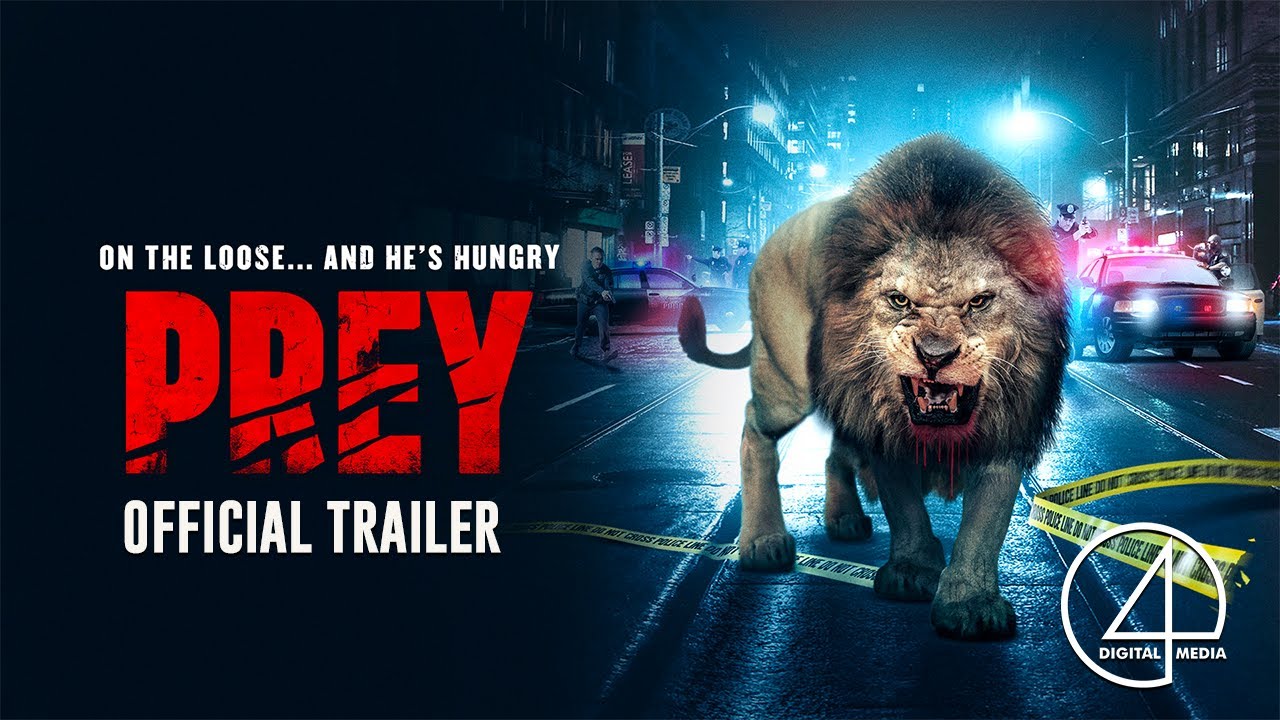
Monday’s protest was prompted by Universal Studios’ 2022 thriller, Beast, but protest organizer Buddy the Cat said the felid group was protesting “decades of tropes and injustices committed against cats by Hollywood and TV.” Examples include the undead cat in Stephen King’s Pet Sematary, the rampaging lion in Dutch horror-comedy film Prey (called Uncaged in the US), the many murderous felids in the CBS series Zoo, and Jackson Galaxy’s My Cat From Hell.
“We’re tired of always being cast as villains while dogs are the heroes. Take a cat like me, for instance,” Buddy told a reporter. “It’s easy to mistake me, with my razor sharp claws and ripped physique, for a threat to humans. But really I’m just a cuddly little guy who likes chin scratches.”
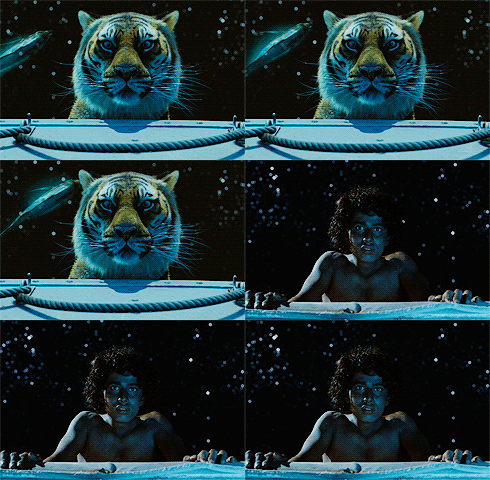
Linus, a 14-year-old Bengal tiger who starred as Richard Parker in the 2012 hit Life of Pi, said he was a young actor who didn’t know better when he agreed to portray the threatening antagonist.
“Now that I’m older and I have all this Frosted Flakes money coming in, I can be picky about the roles I accept and only choose movies I think will be Grrreat!” he told an interviewer. “But what about the next young tiger, or the jaguar fresh off the boat from the Amazon, who doesn’t have the power to tell the director a certain scene is offensive?”
Linus also took issue with the script, in which the writers have him refusing to share fish with Pi.
“Did you see the boat? It was filled with fish! What am I, some sort of glutton who’s gonna eat 200 pounds of fish while the human starves?” Linus asked, bewildered. “I mean, according to Hollywood we’re angry, dangerous, murderous criminals and we stuff our faces all the time. No wonder people are scared of us!”
Prey, also known as Uncaged, depicts an angry lion rampaging through Amsterdam and eating pretty much everyone.
Beast stars British actor Idris Elba and tells the story of a widowed medical doctor who takes his two daughters to South Africa, where they stay with a family friend and embark on a tour of the native wildlife.
Unbeknownst to them, an adult male lion is on a rampage after a team of poachers entered the reserve the previous night and slaughtered his entire pride. While Elba’s character, his two daughters and his friend (Sharlto Copley) explore the reserve, they discover the mutilated remains of an entire village’s population and eventually come face to face with the murderous lion.
“What’s all this barney, then?” Elba said when asked about the felid protest. “Well that’s unfortunate, innit, mate? I played a tiger in The Jungle Book, a proper tiger. I love cats.”
The actor, who rocketed to fame off the strength of his portrayals of Stringer Bell in American police drama The Wire, the title character in British detective thriller Luther, as well as major roles in franchises like the Marvel Cinematic Universe, the Star Trek reboot movies and science fiction action-adventure Pacific Rim, said he’s taken the cat’s criticism to heart.
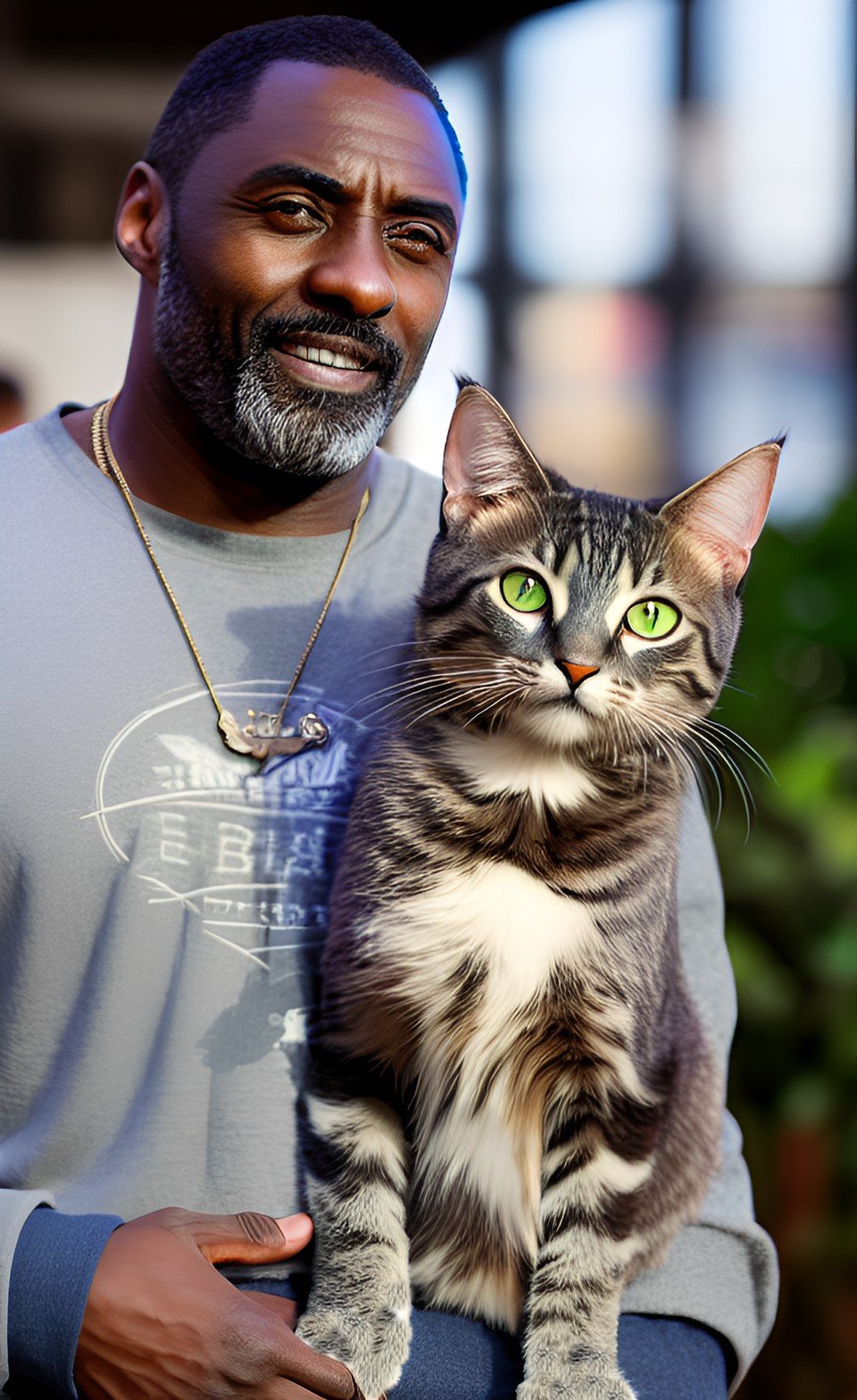
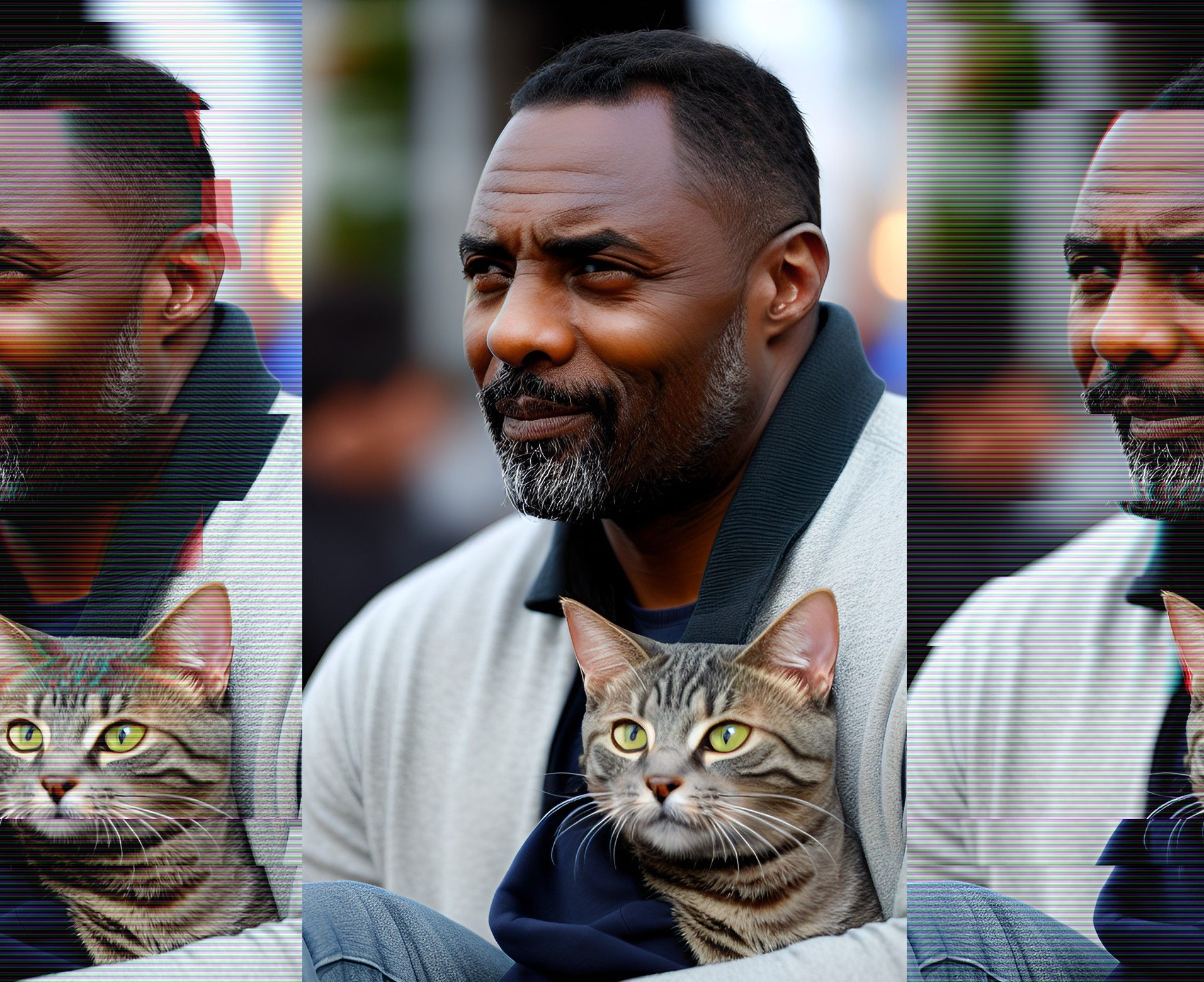
“Buddy’s a good bloke,” says Elba, pictured with his feline friend.
“Me and me mate Buddy, we like to grab a pint on the regular, d’ya know what I mean?” Elba said. “This tosh with the movies, it’s gotta stop. Me mate Buddy is a good bloke, innit? So if he says Hollywood has to have more positive portrayal of cats, then that’s what we’ll do.”
In addition to their negative portrayal in films, which felids likened to the offensive portrayal of Italian-Americans as mafia figures, many cats cried foul at the idea that one of their kind would harm the beloved South African actor Sharlto Copley.
“That’s a very offensive portrayal,” said Chonkmatic the Magnificent, King of All Cats. “Sharlto Copley is the guy who made District 9, about aliens who eat cat food. Everyone knows cats love District 9. We wouldn’t lay a claw on Sharlto!”
Coco the cat was caught going through the kitchen cabinets, but he had the last laugh.
The internet has so many cat videos that an episode of Netflix’s Love, Death + Robots imagined future archaeologists poking through the ruins of our civilization and concluding the global communications system was built specifically so people could share images of felines.
But out of the millions that exist, this instantly became one of our favorites thanks to its star, a mischievous cat named Coco, and his unambiguous reaction when he realizes he’s being watched by his humans even when they’re not home.
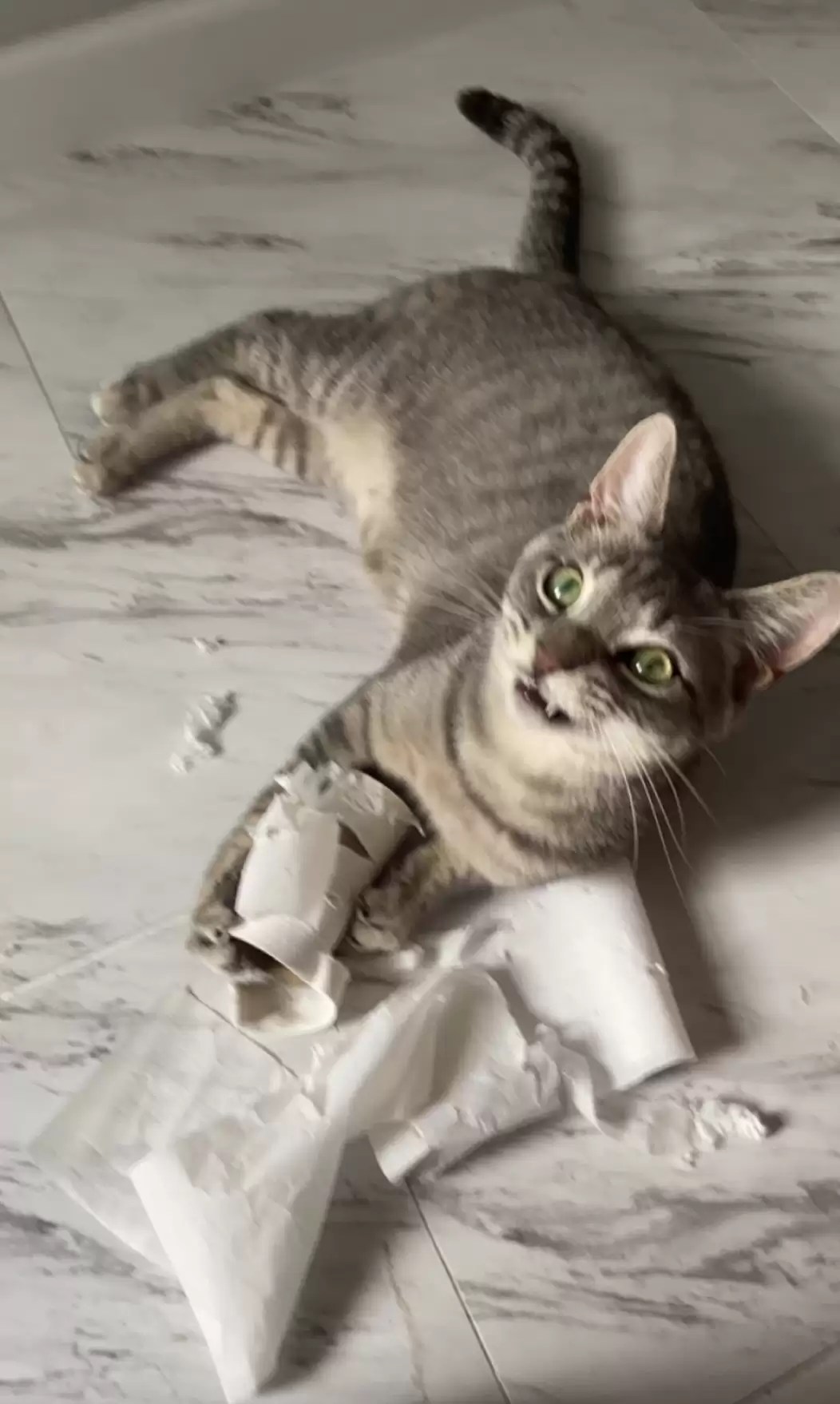
As far as Coco’s concerned, toilet paper is for shredding. Credit: Emily Chaplin
Coco “loves opening cabinets and sleeping in them, getting his own food out of the cabinets when it is dinner time and shredding paper towels when he is bored,” according to one of his servants, Emily Chaplin. The little guy was home alone one day and in the kitchen when he opened a cabinet door as usual.
“Excuse me, sir, what are you doing?” Chaplin’s husband asked through the camera’s microphone when he spotted the rascally feline already halfway into the cabinet.
A shocked Coco backed out of the cabinet, turning toward the sound in disbelief.
“Coco, get out of there!” Chaplin’s husband added.
At first it looked like Coco would be obedient, but shortly afterward his face appeared right in front of the camera — looking none too pleased — and he gave it a hard paw-smack, knocking it from its perch and restoring Coco’s privacy from snooping, meddling humans.
“He knocked the camera down! He was upset that we were watching him,” Chaplin told The Dodo. “My husband and I were hysterical [reviewing the footage]!”






 Pain In The Bud