After 10,000 Years, Dire Wolves Walk The Earth Again

The surprise announcement came from Colossal Biosciences, a company best known for its project to bring back the woolly mammoth.

A US biotech company shocked the world Monday when it announced the births of three dire wolf puppies, bringing back a species that hasn’t lived for more than ten millennia.

Or a version of that species, at least.

Scientists with Colossal Biosciences extracted DNA “from a 13,000 year old tooth and a 72,000 year old skull and made healthy dire wolf puppies,” Colossal CEO Ben Lamm said in a statement.

Of course, it wasn’t that simple.

The dire wolf, Aenocyon dirus, was heavier, stockier and had thicker fur than modern-day gray wolves. In addition, its bite was incredibly strong, generating more force than any living species of canid.

To create the dire wolf puppies, Colossal used the genomes reconstructed from the tooth and skull, spliced them with gray wolf DNA, and made 20 gene edits in 14 genes. Healthy embryos were implanted in three surrogates — large, mixed-breed dogs — and were successfully delivered.

Romulus, one of two male dire wolf pups born late in 2024. Credit: Colossal Biosciences
Remus, who was born at the same time as Romulus. Credit: Colossal Biosciences

Whether the new puppies are officially dire wolves is up for debate and beyond the scope of this post, but just like humans and chimpanzees share 98.7 percent of their DNA, dire wolves and gray wolves share 99.5 percent of their DNA.

The species also existed concurrently with gray wolves and there was interbreeding between the populations, meaning gray wolves already have dire wolf lineage.

As a result, the puppies may be more dire wolf than some are willing to admit. Just how far a “de-extinction” project has to go for the animals to qualify as their namesakes will be debated for years, and there are innumerable questions for which we won’t have answers until the pups grow and scientists monitor their behavior in addition to their physical health.

They won’t behave precisely the way their ancestors did, since they are growing up in a captive environment with teams of specialists constantly monitoring them. The wolves are “essentially living the Ritz Carlton lifestyle of a wolf. They can’t get a splinter without us knowing about it,” Colossal’s chief science officer, Beth Shapiro, told the New York Times.

Whether bringing back dire wolves is a “good” thing is also a topic for another day, at least as far as this post goes. You may disagree, and feel free to say so in the comments, but this is a subject you could write half a library of books on, encompassing ecological, moral and philosophical questions that don’t have easy answers.

It’s made even more complex by the situation we find ourselves in, with our own behavior and relentless expansion killing off more than 70 percent of the world’s wildlife since 1970, according to the World Wildlife Fund. The company wants to use its technology to help critically endangered species, like the red fox, avoid extinction.

Colossal has partnered with leaders in the fields of genetics and bioethics, as well as organizations that specialize in animal welfare. The puppies are in a sizable, custom-built facility in an undisclosed location, secured by “zoo grade” barriers, and the company enlisted the help of the SPCA to create an environment appropriate for them. Colossal says their care regimen will include socialization and the development of pack dynamics.

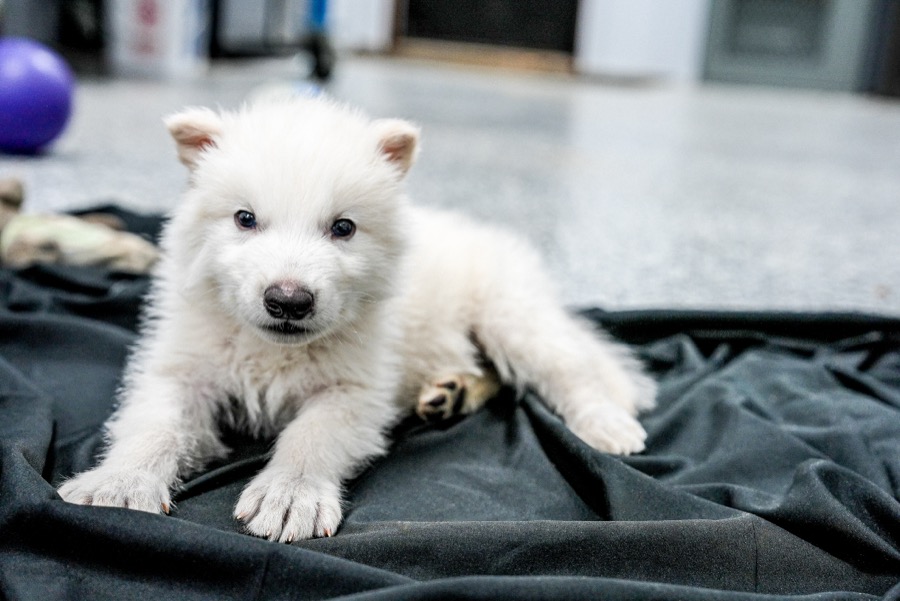
A newborn dire wolf pup. Credit: Colossal Biosciences

The company has well-publicized projects to bring back woolly mammoths and the dodo, and ultimately, its founders say they want to restore balance in places where apex predators have been brought to extinction by human activity.

“This project demonstrates the awesome potential for advances in genetic engineering and reproductive technologies to recreate lost diversity,” Andrew Pask, a Colossal board member and professor of biosciences at the University of Melbourne, said in a statement. “Apex predators are critical to stabilizing entire ecosystems and their loss from the landscape can have profound impacts on biodiversity.”


The pups are named Romulus, Remus and Khaleesi. That last name is in homage to the character Daenerys Targaryen (Emilia Clarke) from the book series A Song of Ice and Fire, and Game of Thrones, the television adaptation. Dire wolves play a major part in the narrative, and the series is credited with bringing the long-extinct animals back into the popular imagination.

Jon Snow (Kit Harrington) discovers an orphaned dire wolf pup in the first season of Game of Thrones. The pup, who grows into a fierce and massive adult wolf named Ghost, plays a pivotal role in many major events in the series. Credit: HBO
Khaleesi, a female dire wolf, named after the character Daenerys Targaryen from Game of Thrones. Credit: Colossal Biosciences

Buddy — Er, Budhotep — Is Apparently Descended From Royal Pharaonic Felines

Sheba and a geneticist who specializes in cats are looking for felines descended from ancient Egypt’s royal buddies.

“You may call me Budtum Ra Budhotep Bhufu Amun Buddeses, human. Now serve me!”

Bud’s already enormous ego just got a little bigger after I used Sheba’s Pharaoh Cat Finder to analyze his pharaohness.

The online tool says he’s up to 75 percent pharaoh:

I didn’t do it entirely out of altruism to give the little guy an ego boost. The winner of the Pharaoh Cat contest gets a lifetime supply of Sheba, and Bud’s been eating Sheba for 10 years. We’ve never endorsed any particular cat food here on PITB, partly because every cat is different, some have special nutritional needs and what works for one furry overlord may not work for another.

But as food motivated as he is, Buddy cannot scarf down more than half a can of wet food at a time, and he’s an enormous pain in the Bud when it comes to leftovers, so Sheba’s Perfect Portions saves me from wasting food.

While the online Pharaoh Cat Finder tool looks like it may be RNG combined with clever marketing,  there’s a genetic basis for the search. The company is working with Dr. Leslie A. Lyons, a geneticist who specializes in the DNA of our furry little friends at the University of Missouri’s Feline Genetics and Comparative Medicine Lab.

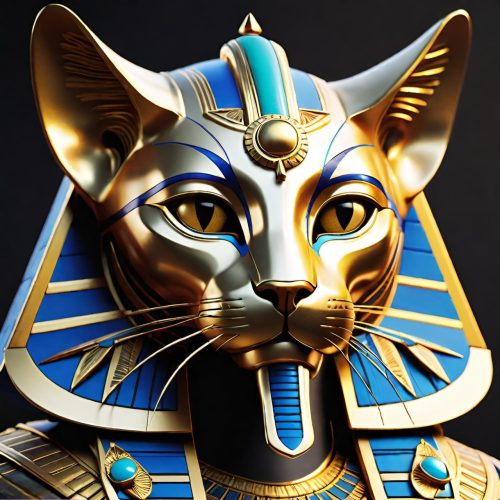
The legendary funerary mask of pharaonic feline Buddankhamun Budstet Ra Budshepsut, Buddy’s royal Egyptian ancestor. Credit: The Grand Museum of Magnificent Feline Stuff

Lyons was part of a research team that extracted DNA from mummified cats buried in ancient Egyptian tombs and sequenced their genetic code.

While the project verified that the Egyptians domesticated cats long before they began mummifying them and affording them revered status, Lyons says a DNA sequence from the ancient felines “has only been found in cats in Egypt and the U.S., unlocking even more questions to be explored.”

“We are looking at mitochondrial DNA only found in these pharaoh cats and a few cats in the U.S. So it’s really hard to find these cats, hence this hunt with Sheba pet food,” she said. “We’re on that quest to find the cats that went from Egypt into the U.S. and are the divine cats of the pharaohs. They should be worshiped like they were.”

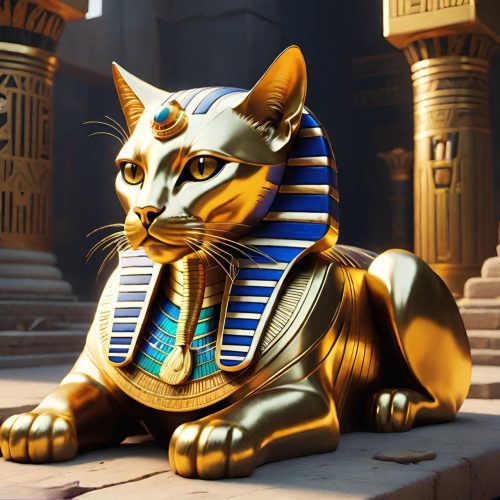
The Temple of Amun Bud is guarded by gold statues of domestic cats instead of sphynxes. Credit: National Gallery of Buddesian Artifacts

I don’t think there’s any doubt that the aptly named Dr. Lyons is on team cat.

So here’s to hoping Bud gets a lifetime supply of Sheba, and Dr. Lyons is successful in her quest to find the elusive pharaoh cat lineage. In the meantime, we should probably start work on an impressive new pyramid here in the US, lest we disappoint our new feline pharaoh.

Investigators Rule Sanctuary Fire ‘Not Suspicious’ As Vets And Volunteers Treat 200 Surviving Cats

As veterinarians treat the surviving animals for ailments like smoke inhalation and burned paws, donors from all over the world have contributed $750,000 to help the newly homeless moggies and ensure Happy Cat continues in some form.

Investigators are still looking for the exact cause of Monday’s fire, which claimed the life of a New York cat sanctuary founder and about 100 of its feline residents, but they now say the blaze doesn’t look suspicious.

The fire started inside the main structure at Happy Cat sanctuary, Brookhaven Fire Marshal Chris Mehrmann told local media, and investigators “cannot rule out a fire caused by propane-fed portable heaters that were in the area of fire origin.”

Happy Cat founder Christopher Arsenault, 65, was found on the second floor of the building surrounded by animals he was trying to rescue. Neighbors told investigators that they saw Arsenault emerge from the home with several cats, then dash back inside in an attempt to rescue more of the felines he cared for.

When Arsenault converted the home into a sanctuary, he cut holes in the walls and floors to create passages for the cats. Unfortunately, Mehrmann said, the fire spread more quickly because of those modifications.

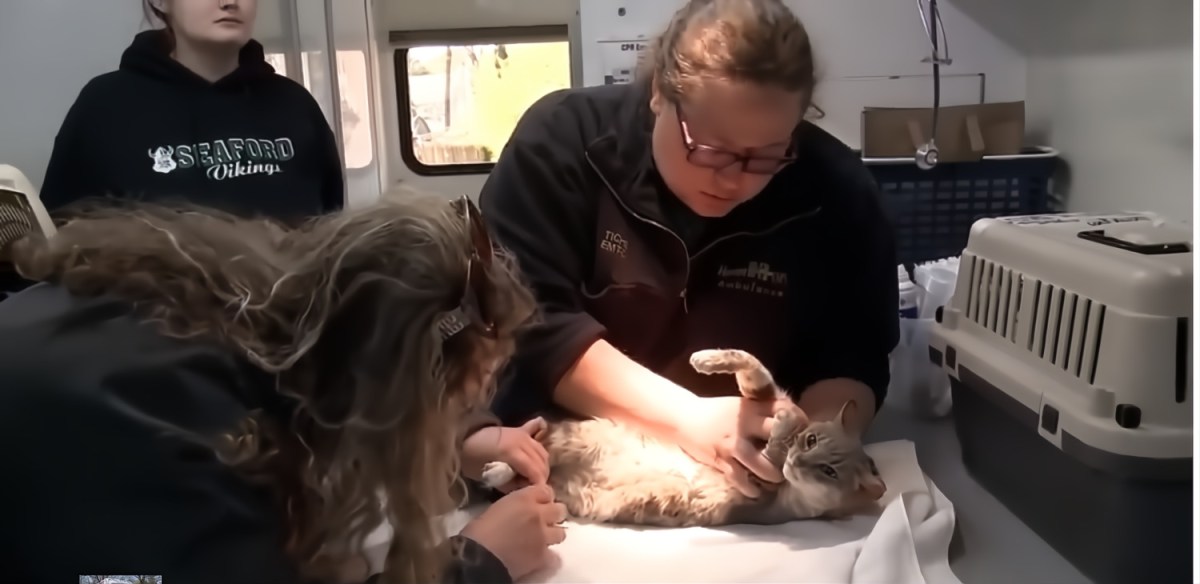
In the meantime, people from the local community, the SPCA and privately run animal welfare organizations have teamed up to care for the 200 or so surviving felines. Donations have also come pouring in from all over the world, totaling more than $750,000 as of Friday morning.

More than $670,000 of the funds have come from 13,000-plus cat lovers from dozens of countries who contributed to a GoFundMe drive started by Lisa Jaeger of Jaeger’s Run Animal Rescue in nearby Port Jefferson, NY.

A memorial image created by Loving Paws, a small rescue in Suffolk County, Long Island.

The surviving cats have a range of injuries, from minor sprains to life-threatening lung damage from smoke inhalation. Volunteers have spent the past several days trying to collect the traumatized animals from the vicinity of the destroyed sanctuary.

“I knew Chris well. I knew when he started. He died doing what he loved… rescuing animals,” said Robert Misseri, co-founder of Paws of War, which brought a mobile veterinary clinic to the site of the former sanctuary this week. “The very least we can do is continue his legacy and make sure that every single one [of the] cats get the proper love and care that they need to move forward.”

Veterinarians said they’ve treated lots of cats with burnt paws. Although the animals are skittish from the harrowing experience, rescues and shelters in the area are helping them find forever homes, veterinarian Jason Michael Heller told ABC News.

“We’re going to ask for our colleagues in the area here, hopefully, to take a few cats and try to get them healthy enough to be able to eat and be adopted,” Heller said.

People in the Long Island rescue community are also working on a public memorial for Arsenault, a man who dedicated his entire life to the animals in his care.

“There’s not going to be another Chris, ever, who does this,” said John Spat of Animal Protection Service, “and all we can do is try to recover what he was trying to do and try to move forward and help his organization work forward.”

Does The Budster Love Me?

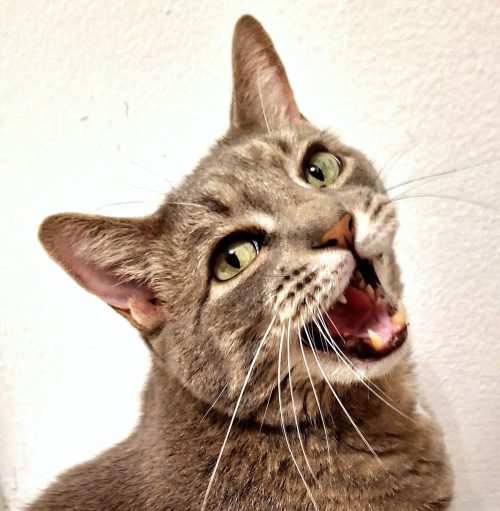
“Love is a strong word, human. I prefer ‘tolerate.’ On days when you anticipate my snack cravings before I verbalize them, you could maybe say I’m fond of you.”

Newsweek has an interesting interview with a cat behaviorist on the subject of whether cats love their humans.

Chantal Howard, a certified cat trainer with Feline Focus Training in Ottawa, told the magazine there are nine primary behaviors that indicate — or confirm — a house tiger loves his or her person. Most of these won’t be new to PITB readers, who are of course among the most cat-savvy people out there and have magnificent taste in cat blogs, but it’s still a handy way to ascertain how your feline overlord feels about you.

So how does Buddy do according to this checklist? Let’s see:

Headbutting: ✅ His Lordship is quite fond of headbutting me and favors me with dozens of headbutts throughout the day, ensuring his pheromones remain on me. You know, in case some other cat somehow comes wandering in and there’s a dispute about which furball owns me.
Kneading: ✅ Considering the fact that I’ve had to toss quite a few t-shirts because of claw rips, I’d say that’s a yes. At least he doesn’t knead my face anymore, as he liked to do when he was a kitten and would take his perch on my shoulder, nuzzle up to my neck and make biscuits against my beard.
Purring: ✅ Nine times out of 10, Buddy’s purr is inaudible, but it’s there. It’s a bit odd that such a talkative, loud cat barely makes a buzz. He likes to lay on my chest and purr up a storm while I rub his head and tell him he’s got admirers all over the world.
Chirping: ✅ Yes! In fact, chirps and trills make up a significant part of the Buddinese language. While meows can be positive, negative or demanding (“I can see the bottom of my bowl! This is an outrage, human!”), trills and chirps are always happy sounds.
Nipping: ✅ Unfortunately, yes.
Licking: ✅ He grooms my hair and my beard, and when I shave he licks my face, which is pretty gross.
Bringing Gifts: ❌ Negative. Then again, what kind of gifts can he bring me when he’s an indoor cat and doesn’t fully understand the concept of hunting?
Exposing Belly: ❌ Does he expose his belly? Yes. Does he feel comfortable enough to snooze in my lap with his belly exposed? Of course. Does he want me to give him belly rubs? No, he emphatically does not. The primordial pouch is not to be touched!
Tail Position: ✅ One of the most awesome things is the fact that Bud’s tail goes immediately into happy mode when I say “Hi, Bud!”, when I hold my hand out for a headbutt, and when I talk to him in general. His tail quivers with excitement when we play with the laser pointer or his favorite toy, and when he catches the first whiff of catnip.

So that’s 7 of 9, or 7 of 8 if we count gifts as N/A due to Bud’s hilarious ineptitude when it comes to even grasping the concept of hunting.

Bud has been known to throw up from excitement when I return from vacation, he often naps by the door when I go out, he talks to me constantly, and he’s rarely more than three or four feet away from me at any given time. All those things, plus our strong bond, have proven to me that he does love me, but it’s also nice to confirm it with a behaviorist’s criteria.

How does your cat perform on the checklist? Don’t forget to share your results in the comments.

Report: Trump Officials Added Buddy The Cat To Houthi War Plans Text Group

The mercurial tabby cat tried to convince Secretary of Defense Pete Hegseth to bomb the Isle of Dogs, White House officials grudglingly acknowledged.

The controversy over leaked war plans expanded Monday after new reports revealed a journalist was not the only outsider added to a text group between senior members of the administration.

Buddy the Cat, a domestic tabby from New York, was also invited to the group and subsequently made privy to classified information, the White House acknowledged.

While Atlantic editor Jeffrey Goldberg observed the text conversation between senior members of the Trump administration without participating in the exchange, sources say Buddy the Cat tried to convince Pete Hegseth, the defense secretary, to bomb London’s Isle of Dogs.

In addition, White House press secretary Karoline Leavitt grudgingly acknowledged Buddy was able to convince Hegseth and Kristi Noem, the homeland security secretary, to send federal agents to the home of a cat named Smudge, describing him as “a gastronomic terrorist who hates America and will stop at nothing to claim all the snacks for himself.”

When administration officials denied knowing Buddy the Cat, social media users began unearthing dozens of photos of the feline associating with national leaders. No one knows how deep the conspiracy goes.

Initially White House officials denied the feline was given access to the text group, with Leavitt calling it “an egregious example of the fake news media inventing absurd stories,” but they were forced to acknowledge the veracity of the incident when confronted with copies of the exchange.

“Folks, we are cleared for go, CENTCOM has given us the green light for the fifth strike package,” Hegseth wrote. “F-18 launch imminent.”

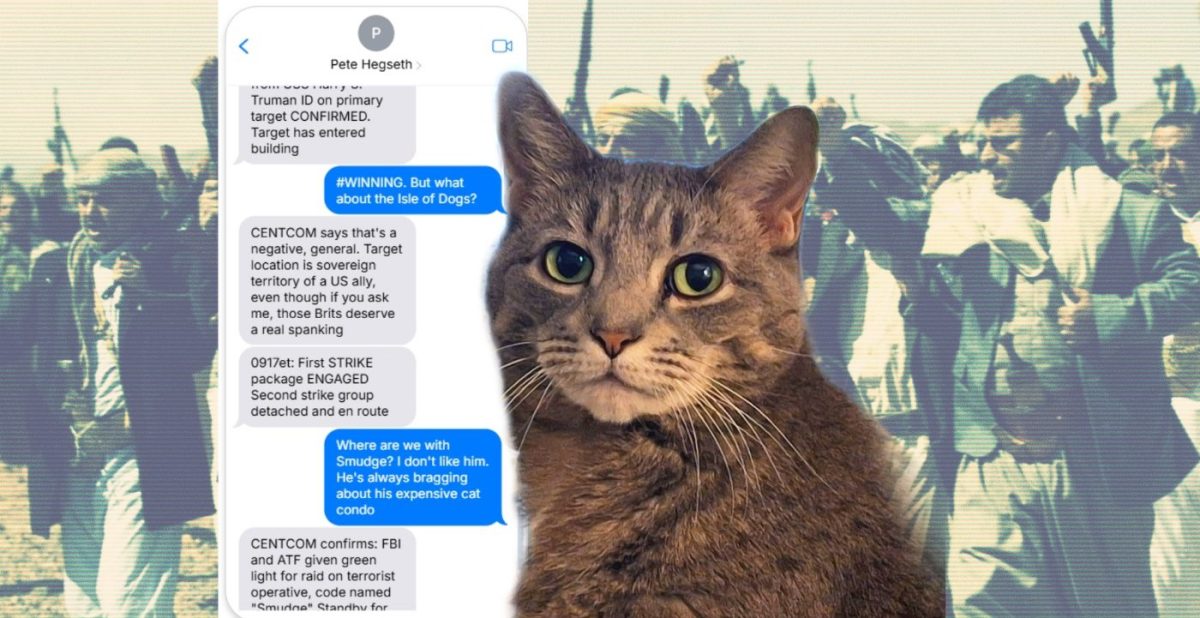
“Are we just going to ignore the Isle of Dogs?” Buddy the Cat texted in response.

The text caused confusion, with several senior officials speculating on the sender’s identity.

“The contact says ‘BTC.’ Who the heck is this?” Director of National Intelligence Tulsi Gabbard asked.

“It’s [US Marine Corps] Gen. [Barrington T.] Caldwell,” replied Mike Waltz, the National Security Advisor. “Got to be.”

Noem also initially tried to distance herself from the scandal by claiming she didn’t know Buddy, but photographs soon emerged of the tabby cat lounging on the podium while she spoke at CPAC in 2003.

It’s not clear how senior White House officials were convinced by a cat that a London neighborhood was related to an Iran-backed Shia militia in Yemen, but an anonymous official credited Buddy the Cat for “being very convincing. We all thought he was the general.”

While the feline’s suggestion to bomb the London neighborhood was co-signed by Hegseth, it was ultimately rejected by CENTCOM, which noted the UK is an allied country and there was no indication “terrorist dogs” populated the London neighborhood.

More successful was Buddy the Cat’s suggestion to send a federal strike team to the home of Smudge, his archrival.

The chonky cat screeched his innocence after heavily armed and armored federal agents smashed the door down and found him mid-bowel movement in his litter box.

“1337et: Agents have located the CHONKY little jerk in his domicile, where they found fresh explosive materials in his litter box and a suspiciously well-stocked cupboard,” Buddy wrote to the Houthi PC Small Group.

“Congrats, general!” Waltz wrote, while Noem called the arrest “a major win for American freedom and security.”

Reporters, former military officers and intelligence officials criticized the leak, pointing out that if a cat could get access to highly sensitive war plans — and influence them in real time — America’s enemies could do the same. But White House officials pushed back on the criticism, saying it was overblown.

“So someone put a cat on a text chain,” Leavitt said, snapping at a reporter during a press briefing. “So what? You guys are, like, being so dramatic!”