Cops: Wannabe Rapper ‘Ritually Sacrificed’ Cat To Promote Music

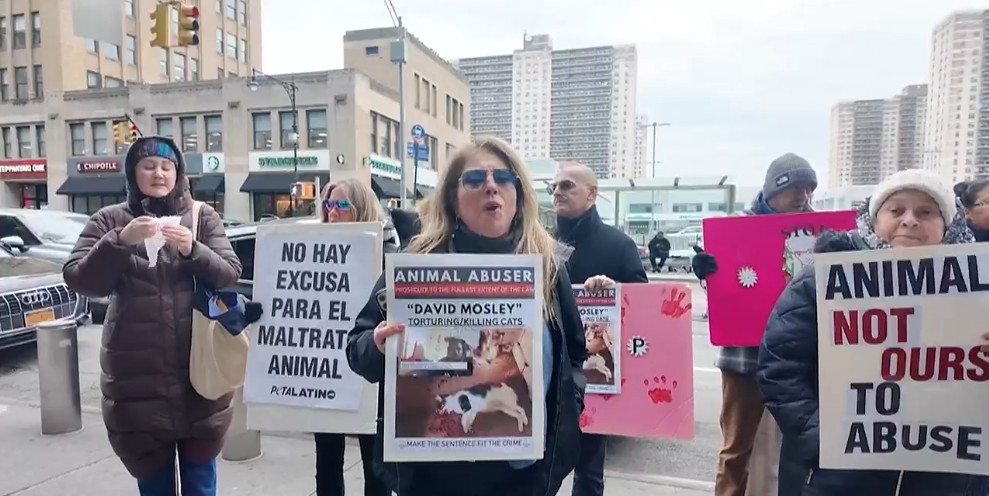
David Mosley wanted attention and allegedly killed a cat on camera to promote his Satanist-themed music.

What to do when you want to be a famous music artist, but your tunes are abominably awful and your gimmick is infantile?

If you’re David Mosley, apparently you beg the internet to notice you exist by allegedly murdering a cat.

The 26-year-old Bronx man was initially gleeful after sharing video and photos showing a dead cat in his Fordham North hovel surrounded by candles and a bunch of nonsense, including the word “SATAN,” spray painted on the walls.

“You should have heard the little bih squeal lol,” Mosley wrote on Instagram alongside a photo of a bloodied and dead cat in his apartment.

“I’m the king, n—a,” Mosley said in a follow-up video after mocking people who were upset that he allegedly killed the cat. “I can reach through the camera and put spells on you like that! That easily! I hexed you through the phone, through the camera. Ya’ll know I do f—ing voodoo, so don’t even call me delusional.”

Mosley during a live stream, during which he claimed supernatural powers.

A relevant question here: who adopted a cat out to this guy? I went through what felt like a CIA-level background check when I first went to adopt, and this Satanist who thinks he’s a wizard apparently had no problem just waltzing into a shelter and walking out with a cat.

Apparently angry that no one turned up to the first “show” in his illustrious music career, Mosley said he was going to take things to the “next level” with another “sacrifice” on Halloween night. In his musical endeavors he called himself Church of Ububal, with the latter word a reverse spelling of “Labubu” in reference to the viral toys.

“Be there or be square,” he wrote, per a screenshot posted to Reddit. “Like I said at my first show and no one came. But you will be at this one. Grab popcorn.”

When he got the attention he wanted, but not the reaction he wanted, he backpedaled during a live stream, claiming he found the already-deceased feline.

By that point, furious Redditors in a Bronx subreddit had closed in on his identity and exact location, and were pestering the NYPD to grab Mosley.

“Y’all are soft for falling for cheap parlor tricks” Mosley said during the live stream.

Incredibly, Bronx criminal court Judge Harold E. Bahr let Mosley walk free without having to post bail after a preliminary hearing this week, and adjourned a hearing this week after Mosley’s original attorney was not present. It’s not clear if that attorney will continue to represent Mosley.

Bahr must be confused about which decade this is. Constituents should (politely) register their displeasure with his office. People from several local cat rescues have already done so.

“We want the judge to take this seriously. We cannot wait for another crime like this to happen,” local animal welfare activist Rachel Ejsmont told News12 Bronx.

Mosley was initially charged with criminal mischief and aggravated cruelty to animals at his Oct. 30 arraignment. Activists are pushing the district attorney for more serious charges.

The court hasn’t set a date for Mosley’s next hearing after the Nov. 12 adjournment. We hope the scrutiny and his mounting legal troubles dissuade him from trying to get attention through violence again.

Lastly, I usually keep my mouth shut about this sort of thing because I know emotions run high and most people are well-intentioned, but already there are grifters latching onto this incident and using it to beg for donations for their activism, which amounts to little more than grumbling about this stuff on social media.

Be careful about who you donate to and make sure you’re giving to registered organizations with financials listed on Charity Navigator or Charity Watch. Donate your hard-earned money to groups that really do make a difference, such as the Humane Society, SPCA and local rescues that do outstanding work, like New Jersey’s Tabby’s Place. A transparent, effective charity will feature its IRS Form 990 on its website and use at least 75 percent of its revenue from donations on program spending. Be wary of “influencers,” people who say outrageous things for attention, clicks and donations, and anyone who claims they have special access to, or influence over, authorities.

Header image via News12 Bronx (screencap)
Felines Evaluate Human Looks, Temperament And Behavior At 8th Annual People Fancy Show

Cats judged their humans based on appearance, obedience and other categories at the Jacob Javitz Center in Manhattan.

NEW YORK — Marvin Wheeler was on all fours, with a pair of cats holding his mouth open with their paws and another wrapping a tape measure around his waist.

“The torso should be medium in proportion to the rest of the body,” a ginger tabby said, “while the snout –“

Wheeler yelped as the tabby gave his nose a firm slap with her paw.

“– should be slender and no more than half an inch above the top lip.”

Wheeler grunted as a Maine Coon shoved him off the table, and a trio of feline judges held up scorecards, awarding the engineer from New Jersey a 5.5, 6, and 5 out of 10 respectively.

“Does anyone have any objections?” asked the master of ceremonies, a rotund Norwegian forest cat named Milo.

Wheeler’s feline shook her head, and Milo leaned forward toward his mic. “Next!”

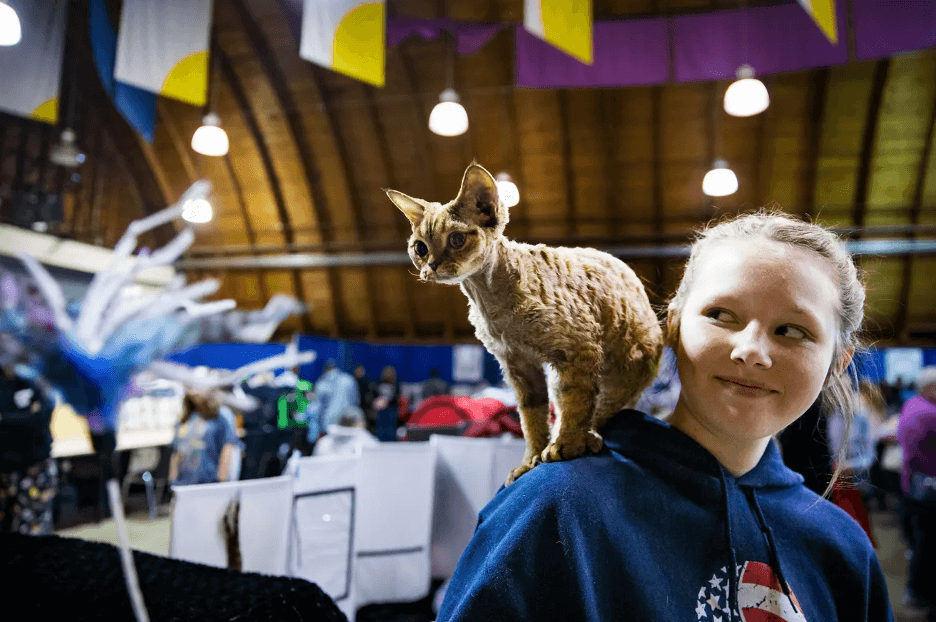
Feline judges award scores to one of the competitors at the 8th Annual People Fancy Show.

“Bring her up, fellas,” he continued, gesturing toward several cats escorting 53-year-old Martha Silverwind to the stage.

“Okay, next we have a librarian from Toronto, Canada, who is here for her first human show. We’re gonna be evaluating her on temperament, hair color, obedience training…”

More than 1,000 people were examined and judged by cats this weekend at the Jacob Javitz Center in New York for the 8th Annual Human Show sponsored by the Human Fancy League of America and the Society For Better Homes For Felines.

Helena Chione, an astronomer from Houston, Texas, waits for to be evaluated by judges on Saturday at the Jacob Javitz Center in New York, site of the 8th Annual Human Show. Her feline, Clyde, entered her in the Best Temperament category.

Ronald Greer, a dermatologist from Grewnwich, Conn., patiently waited for his turn while relaxing in his cage, which held a small bowl of cereal, a bottle of Poland Spring water and a chamber pot.

“I saw an ad for the show, and I thought, ‘Simba, why not see how Ronnie stacks up against other humans?'” Greer’s feline told a reporter. “I’ve been training him for more than two years now, and I’d say he responds maybe 80, 85 percent of the time I call him. Ideally I’d like to get it as close to 100 percent of the time as possible, because I don’t like to repeat myself when I’m hungry. But you know how it is with these humans. They have minds of their own.”

Simba sat outside Greer’s crate, encouraging the human to groom himself before the judges called his number.

Last year’s best in class in the age 20 to 29 bracket was Louisa Rey, a writer for Spyglass Magazine. Feline judges praised Rey’s responsiveness when commanded to serve snacks and commended her dark brown mane, describing it as “an ideal for a human of her age and gender” and complimenting her cat, Marcy, for “doing an outstanding job training her.”

Singer Taylor Swift took home honors in the 2024 People Fancy event for performing the best tricks, including one sequence, described as “adorable” by the judges, in which she giggled, cheered and smiled as she pretended to be fascinated by an American football game.

This year’s favorite in the best tricks category is Jonah Grayer, a 31-year-old attorney from Long Island, NY. Grayer, a magician by hobby, cocked his head to one side as his cat, Sebastian, rested a paw on his cage.

“Who’s a good boy,” Sebastian asked, dropping a cheeseburger slider into Grayer’s cage. “Who’s the best boy in the world? Jonah is! That’s right! Now let’s impress those judges!”

Terrified By Reports Of Bird Flu, Buddy Appoints His Human As Food Taster

“If you keel over and die, I’ll know not to eat the food,” Buddy told his human.

NEW YORK — Driven to paranoia by reports of spreading bird flu, Buddy the Cat has appointed his human as his food taster, sources confirmed.

The decision was made on Friday after the self-described “brave and fearless” tabby cat heard a news report about new cases of bird flu, including a cluster of the deadly virus in several cats in Hunterdon County, New Jersey, only 60 miles from Casa de Buddy.

Little Buddy made the act official, naming his human as “praegustator,” a title borne by imperial food tasters of ancient Rome.

“Your lunch, Your Meowjesty,” Buddy’s human, Big Buddy, said as he placed a bowl of chicken pate and fresh water before the feline.

Buddy looked at his human.

“What?” Big Buddy asked. “You want me to eat it for you, too?”

Big Buddy chuckled, but Little Buddy remained stone-faced.

“As a meowter of fact, I do,” the feline said. “Dig in.”

Big Buddy made a disgusted face.

“I’m not eating that, that’s your food, little dude,” he said. “What’s gotten into you?”

Buddy chuffed derisively.

“Bird flu, that’s what!” he said. “If you keel over and die, I’ll know there’s bird flu in the food!”

“Taste my food, human!”

The human rolled his eyes.

“If I die, who feeds you? Who gets your claws unstuck from the door screen, rubs your head and tells you what a brave little guy you are? Who serves as your human pillow? Who gives you scritches while you purr and tells you about your website, and how many people all over the world love you?”

Buddy’s satellite dish ears twitched.

“I hadn’t thought of that,” he admitted. “But I’m still not eating that until I know it’s safe!”

Big Buddy picked up the bowl.

“Fine,” he said. “I’m sure Smudge next door will be thrilled with another meal.”

Buddy’s eyes went wide.

“Do not give my food to that…that scoundrel!” he meowed indignantly.

Big Buddy sighed. “Then we’re back to square one.”

“Yes,” Little Buddy said. “Now eat the food, human!”

Top image: Food tasters at the Feast of Bartolomeo Colleoni in honor of Christian I of Denmark, 1467/ Wikimedia Commons

For The First Time, American Vets Can Prescribe FIP Meds For Cats

People whose cats are infected with FIP can now get a legal prescription and buy it from a US pharmacy. A full course of treatment will cost a few hundred dollars instead of the thousands charged on the illegal market.

Starting on June 1, people whose cats are infected with deadly Feline Infectious Peritonitis won’t have to shell out thousands of dollars to shady middlemen importing the cure from China.

FIP is a virtual death sentence for cats, but there’s a drug — GS-441524 — that has a cure rate somewhere around 90 percent, a Godsend for people whose beloved felines are afflicted with the virus.

Previously the only way to get it was through predatory online middlemen who charged exorbitant sums, but thanks to a partnership between UK pharmaceutical company Bova Group and New Jersey-based compounding pharmacy Stokes, the FIP cure will be available legally in the US.

The legal version of the drug will come in a tuna-flavored tablet format and customers can expect to pay a few hundred dollars for a full treatment instead of between $5,000 and $15,000 some paid for the FIP treatment from importers.

A US company invented the drug and held the rights, so it seemed like bringing it to market for cat caretakers would be a no-brainer. Unfortunately, GS-441524 is similar to COVID drug Remdesivir so the company was worried if they submitted the FIP cure to the FDA for approval and the FDA did not grant it, the denial could lead the agency to revoke its approval of Remdesivir due to its molecular similarity.

As a result, innumerable people whose cats were suffering with FIP turned to groups like Facebook’s FIP Warriors to help them obtain GS-441524 illegally. The drug was manufactured by facilities in China, sold to middlemen in the US and Europe, then marked up by eye-watering amounts for sale to people with sick cats.

jupiterpitbtopimg
Jupiter, a British shorthair, was diagnosed with FIP. His human, a young professional from London, paid almost $10,000 for FIP treatment obtained through middlemen.

Last year the feds announced they’d exposed a GS-441524 smuggling ring, alleging a woman from Texas and another from Oregon had made almost $10 million from selling the FIP treatment to panicked cat lovers.

GS-441524 importers knew their customers were desperate to save their beloved feline friends so they’d be willing to pay the extraordinary mark-up — and pay they did.

Here at PITB we’ve interviewed and written about several people whose cats were diagnosed with FIP. One of them, a student, spent her entire savings on GS-441524 obtained through the Facebook group and relied on help from generous donors to raise the rest. Another, a young professional in London, paid even more, spending £7,500 (about $9,400 at the time) on the medication alone, not including vet visits.

A Texas woman whose cat, Seth, was diagnosed with FIP said the middlemen — and women — said the sellers “saw our desperate situation and took advantage of us.”

“It was a very stressful time for us, and every time we needed to refill, they charged us more,” she told PITB. “They knew we couldn’t say no.”

For readers interested in more details about GS-441524, Stokes pharmacy has a resource page that breaks down pricing, shipment times, availability and more.

Parsnip, the cat pictured at the top, and Jupiter, the British shorthair pictured within the story, were both cured after taking full courses of GS-441524.

In The UK, Cat ‘Ownership’ Can Be A Hazy Concept

What does it mean to “own” a cat? If you believe a cat is neglected, can you take custody? As UK law changes, those questions need answers.

For the second time this week, two people are fighting over a cat after the original “owner” received a request from a microchip company to confirm another person’s claim on the feline.

Charlotte Sawyer of Swindon, a town in southwest England, told her local newspaper she was livid when she got the request to sign over her claim to one-year-old Oreo.

“I can’t believe the audacity of this person trying to steal our beautiful cat,” she told the Swindon Advertiser.

But Sawyer readily admitted Oreo was going out for days and sometimes weeks at a time before returning home, and she hasn’t seen him for four months now.

Sawyer and Oreo
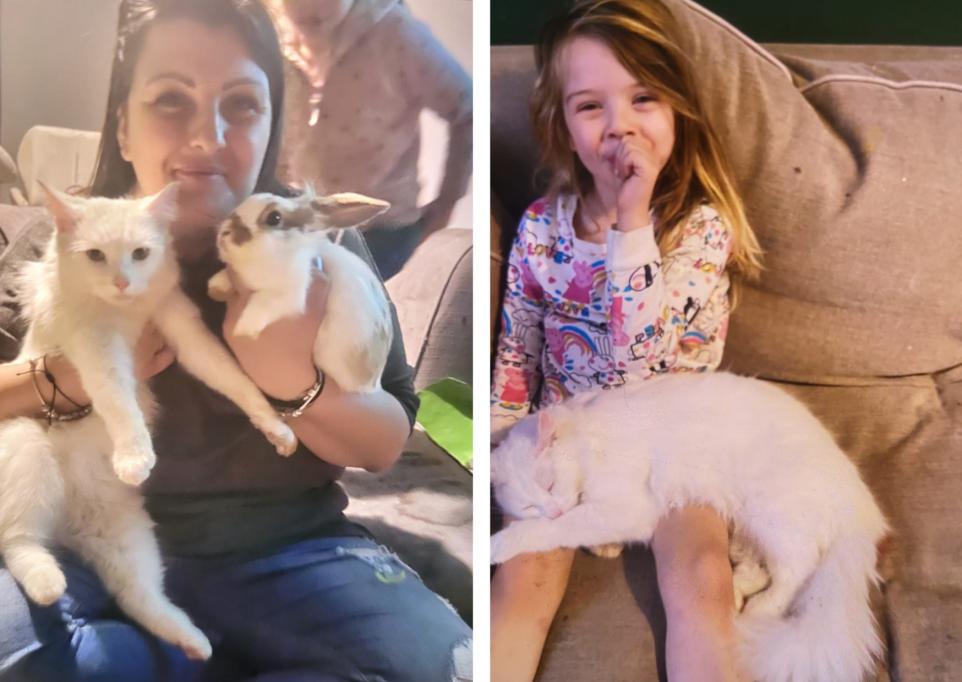
Charlotte Sawyer, left, with her cat Oreo and a pet rabbit. Sawyer’s daughter, right, with Oreo. Credit: Charlotte Sawyer via Swindon Advertiser

Like many cats in the UK, Oreo not only had access to the outdoors, he was accustomed to coming and going as he pleased. Other families were feeding him, and it’s likely he made the rounds among several houses before returning home. Because “home” is a nebulous concept in this instance, it’s not the first time someone has asked Sawyer to relinquish custody of Oreo.

“A woman claiming to be someone who looks for missing cats once knocked on my door and handed me a form asking for permission to change Oreo’s microchip,” Sawyer said. “I wanted to rip it up, I was furious, and told her he was my cat. Now it’s happened again. At least it’s provided some reassurance that he’s still alive.”

While I feel for anyone who loses a pet, I don’t know how someone who truly loves a cat can accept the kitty being gone for days or weeks at a time, not knowing if he’s in danger, hurt or still breathing. That kind of arrangement isn’t in the cat’s best interests, and it’s not compatible with our responsibility to ensure the welfare of our four-legged friends, an obligation all of us take on when we adopt our pets.

The people who encountered Oreo likely thought he was a stray or an abandoned former pet. If they’re requesting a change to microchip registration, it probably means they spent their own money to take the little guy to the vet, where the chip was discovered and scanned.

This is emphatically not a blanket criticism of UK norms regarding outdoor access, by the way. Americans cannot claim moral superiority. In the past week or so we’ve had a Pennsylvania man kill a cat with a blow dart because the feline “was trying to kill my birds,” a vulgar approximation of a human being in New Jersey “repeatedly raped” his pet cat before torturing her to death, and some deranged lunatic in Florida used a cat as target practice, leaving 30 pellets lodged in the innocent animal’s little body.

That represents a tiny fraction of the cat abuse stories from the last 10 days and I’ve omitted the worsted examples because I know we have readers who can’t handle this stuff. (I can’t either, which is why I paused my Google News alerts for most of the past two weeks.)

My point here is not to shock. It’s to underscore the fact that we have absolutely no moral authority when it comes to telling people in other countries how to care for animals.

Outdoor cat
A cat exploring outdoors. Credit: Openverse

Moral authority concerns aside, the two examples of ownership claims by microchip this week raise important questions about the definition of “ownership” and what it means to properly care for a cat.

Like many cat lovers I don’t like the term “owner” and I describe myself as a caretaker, but where the law is concerned, ownership is important concept because it determines who has claim over the animal. The law views cats and dogs as property, whether we like it or not. That’s why animal welfare statutes fall under agriculture and markets law in many US states instead of the criminal code, and it’s why so many of those laws need updating.

Cat culture across the Atlantic is different in that the majority of people who have cats believe our furry friends must have access to the outdoors to live a complete, fulfilled life. In the US, 63 percent of cat caretakers keep their felines strictly indoors, while in the UK it’s virtually the opposite, with 70 percent allowing cats to roam outdoors. Not all definitions of outdoor access are equal: Some people allow only supervised outdoor time in the backyard (or “garden”), some make sure their kitties are safely indoors by nightfall, while others have cats who return at their own whim.

There are also differences regarding geography, traffic density, the prevalence of natural predators and the nature of city life that account for how much outdoor access they allow their cats.

As the UK sets a June 2024 date for the mandatory microchipping of pet cats, disputes like this are going to become more common, which means people would be wise to make sure their cats’ microchips have up-to-date information and have readily available proof that they own their felines. If cat owners don’t establish the criteria for what it means to “own” a feline, the government will.