“Hold my beer,” Buddy said after watching a video of another feline sending a pair of bears running with an awesome display of fiery intimidation.
NEW YORK — The bear picked the wrong home and the wrong cat to mess with.
Buddy the Cat was taking his traditional 3 pm nap after third lunch when he was rudely disturbed by a ruckus outside.
“Stay here, I will check it out,” he told his human, then hopped down from the couch as his powerful stride took him toward the sliding glass doors leading out to the balcony.
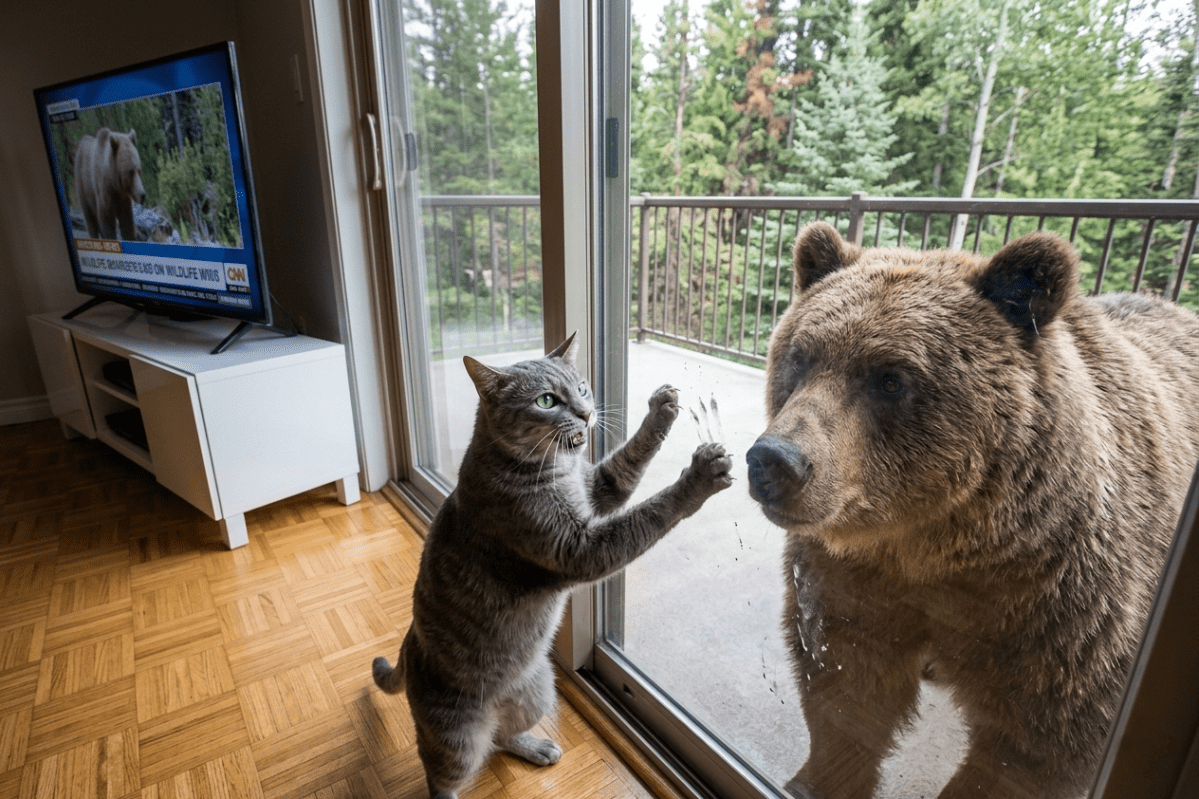
A huge form was huddled just outside the glass, and when the lumbering beast turned, Buddy took a sharp breath. It was a bear, a particularly impressive specimen.
Lesser felines would have been terrified, but Buddy stood calmly before the bear and addressed it.
“Inferior animal,” the fearless feline announced. “Yes, you! You are trespassing on Buddesian territory. I order you to cease any and all ursine activity and return forthwith to your place of origin or the nearest convenient parallel dimension!”
“What are you doing?!” a terrified Big Buddy whispered.
Buddy turned toward his human. “It’s from Ghostbusters. Calm down, I know what I’m doing.”
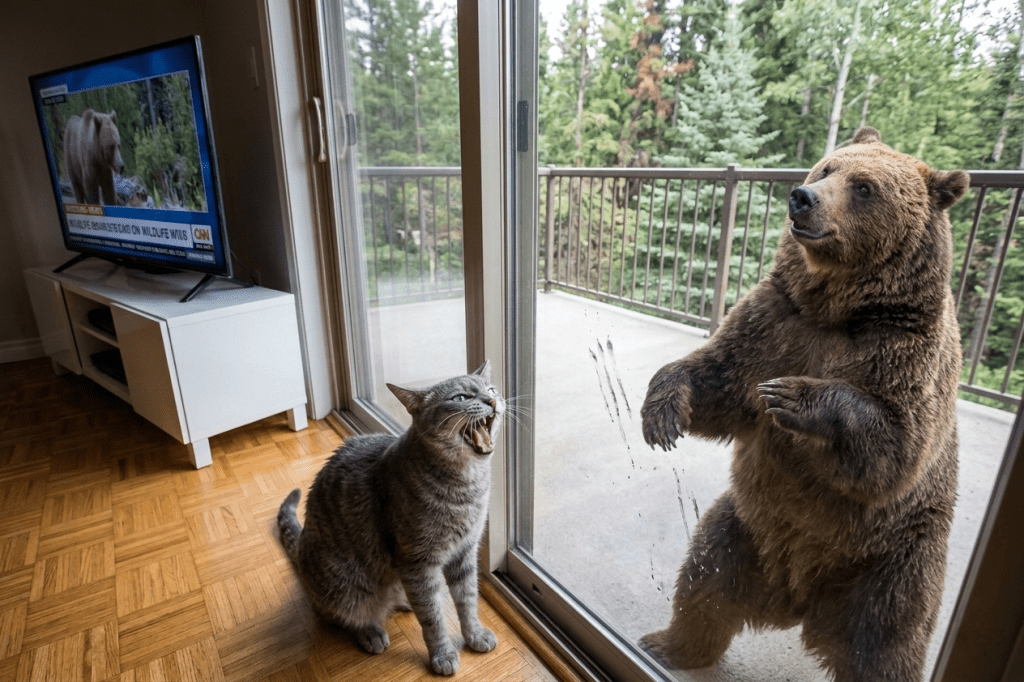
The bear yawned and let out a deep, rumbling moan.
The bear flinches as Buddy unleashes a terrifying roar!
“I can see I’m not dealing with the sharpest claw on the paw,” Buddy said. “Okay, bear, do you understand this?”
Buddy eased back on his haunches and raised two powerful forelimbs, his considerable meowscles rippling meowscularly beneath the luxurious sheen of his silver fur.
The bear watched warily, then flinched instinctively as the intimidating feline launched a sequence of aggressive and powerful paw strikes. The ursine beast recoiled from the thunderous impacts of paws against glass, reconsidering its position in the face of such a formidable display of force.
The massive creature turned in retreat, casting one last fearful glance at the Herculean felid before beating a hasty retreat.
Once he was satisfied the bear was gone, Buddy turned and sauntered back toward the couch, lifting himself onto it in a single graceful leap.
“And that,” the handsome silver feline said, “is how you deal with a bear.”
A reboot of the iconic scifi-horror film upends the balance of power, placing the feline at the very top where he should be.
The long-anticipated Alien reboot starring Buddy the Cat hit theaters this weekend with audiences flocking to see the modernized classic after effusive praise from critics.
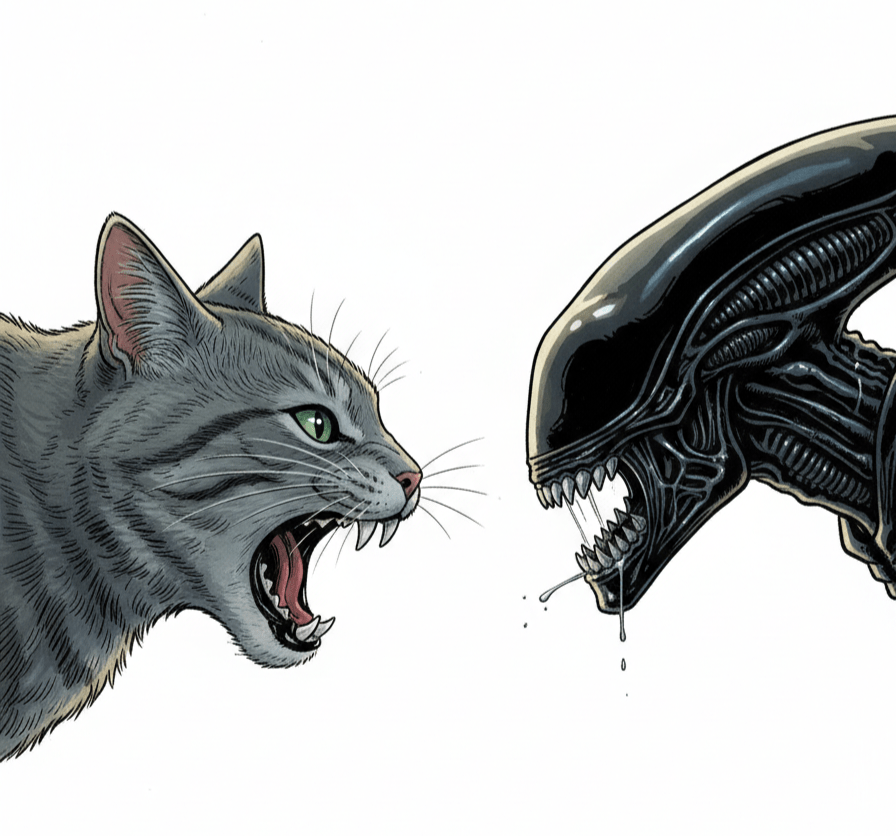
Featuring the new tag line “In space no one can hear you scream — unless you’ve got Buddy on your side,” the reboot reimagines the science fiction-horror classic as a cautionary tale about messing with cats.
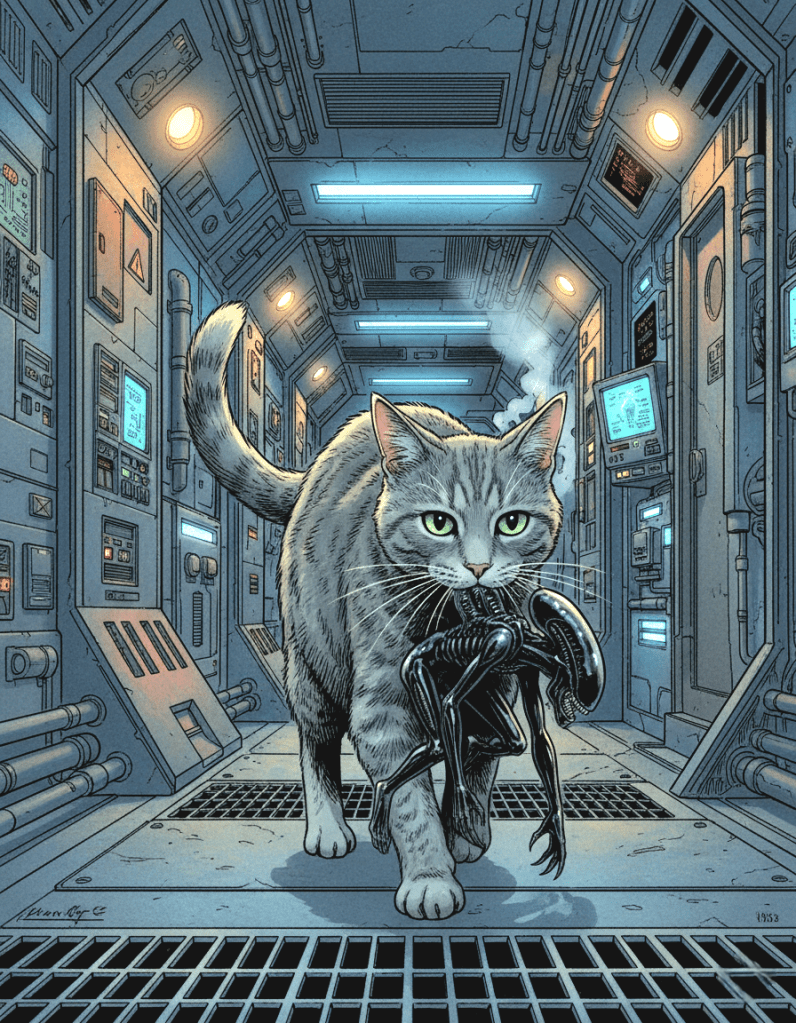
“While the original built tension over almost two hours and inspired an overwhelming feeling of dread in viewers, the new Alien clocks in at just 28 minutes and ends right after the iconic chestburster scene,” critic Ferdinand Lyle wrote. “Instead of screeching into the shadows of the ship to commence its turbocharged metabolic processes, only to emerge later as a fully formed creature who terrorizes the crew, this alien is immediately caught by Buddy, who delivers a swift kill bite and deposits it in front of the humans. They reward him with a chorus of ‘Good boy!’ and rub his head while plying him with snacks, and the credits roll. Now that’s efficient storytelling!”
The Alien 👽 was no match for Buddy, who woke from a nap to dispatch the creature with brutal efficiency.
The new version is “the ultimate FAFO flick,” raved the AP’s Misty Lemire.
“The central message here is ‘Don’t tangle with Buddy.’ The apex predator of the cosmos is no match for the apex predator of Earth.”
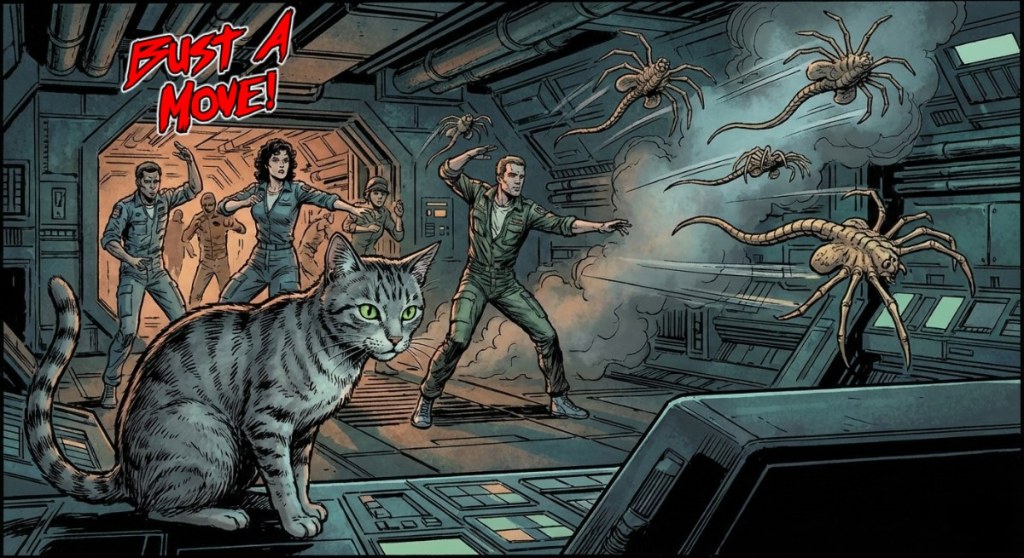
Other critics were enamored with a post-credits dance scene featuring Buddy, the crew of the Nostromo and dozens of face-huggers who fly through the air, forcing the cast to bust impressive dance moves to avoid the dangerous creatures. At one point Buddy launches into a breakdance routine. The actress who plays Ripley wags a finger at a xenomorph and declares “You just got served!”
“It’s clever, light and wildly entertaining,” one critic wrote. “Buddy’s got some magnificent dance moves!”
Others praised Buddy for his impressive physique. In an interview with Entertainment Weekly, Buddy said he’d been training non-stop for eight months for the role, eating a high-protein diet and spending five hours a day napping in the gym to accentuate his meowsculature.
“The effort paid off big time,” a review from Calico Critics noted. “Buddy looks more ripped and impressive than he ever has, and he was already competing against a high bar he set during his previous films.”
In the post-credits dance scene, Buddy and the Nostromo crew perform a synchronized routine while dodging facehuggers.
However, not everyone was impressed. Reached this weekend at his New Zealand bunker, where he’s fled “until America isn’t annoying anymore,” director James Cameron called the Alien reboot “derivative, low-calorie cinema junk.”
“Remember when I had characters saying ‘Hasta la vista’ and ‘Adios, muchachos’? That was really cool. I was one bad hombre,” Cameron said. “Audiences might think this is a good film, but that’s because they haven’t seen the wonders of Avatar XVII yet. Just wait, it’s gonna be awesome. And there are no cats.”
In the seedy underbelly of Paw City, where niplords run kitty crack empires and feral gangs fight eternal turf wars, one unshakable detective brings the bad cats to justice.
The call came in after midnight.
Shots fired near Burmese Boulevard, with witnesses reporting one party fleeing the scene in a car while another took off on foot.
Normally I’d tend to other biz and let one of the kids in the detective bureau have their shot, but the commissioner’s on my ass and the mayor is worried about what the headlines will do to the tourism economy.
Leave it to the leaders of a dump like Paw City to care more about the scratch in their pockets than the felines they’re supposed to protect.
But I’m a grizzled detective. I know where the real power naps, and it ain’t city hall.
It’s Scratcher Tower, home of the international consortium that runs Big Yums, controlling the flow of every last morsel of kibble into this forsaken city. The Fat Cats on the top floor, they call the shots, control the mayor and have their paws in every pie. If it’s biz, the Fat Cats get their cut.
The feds? They talked a big game last year when they popped Angelo Felinzino and nailed him on a racketeering charge that earned him 15 to 20 in the slammer. But the Fat Cats are a hydra, and even though Felinzino was rumored to be the consortium’s top earner, the fellas in Scratcher Tower’s penthouse didn’t miss a beat.
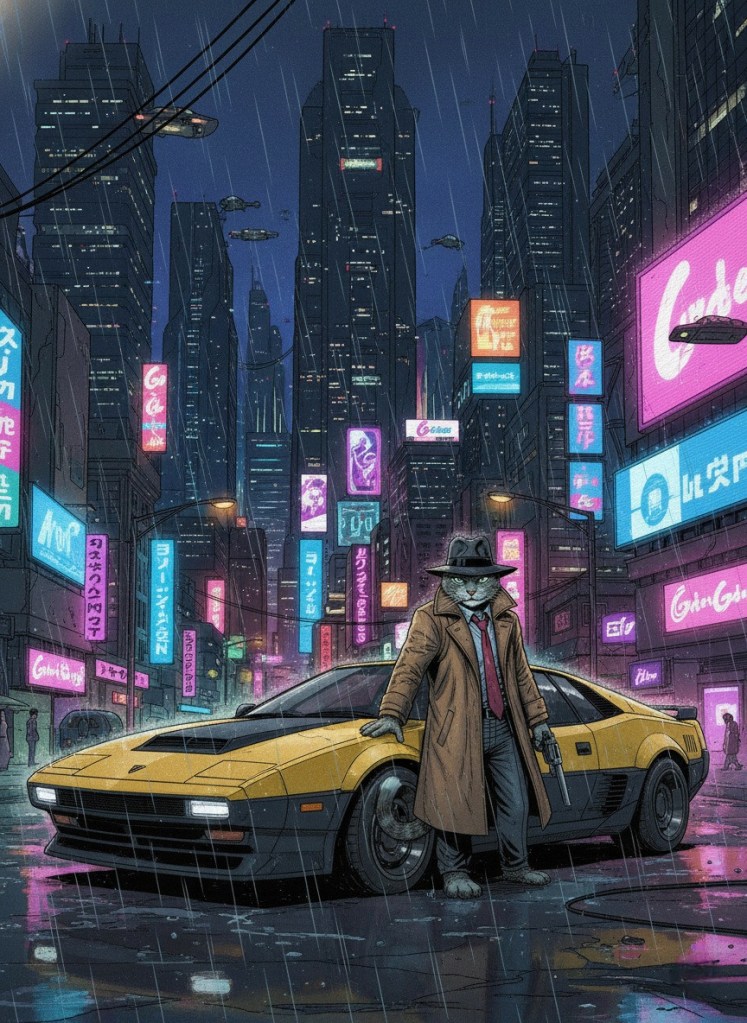
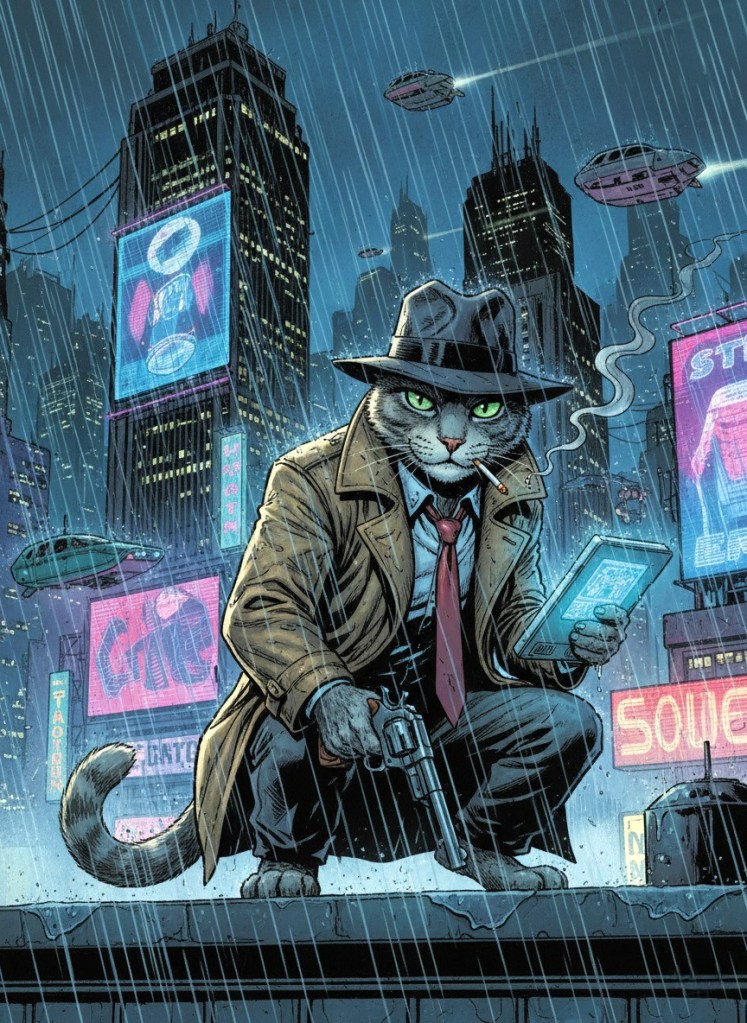
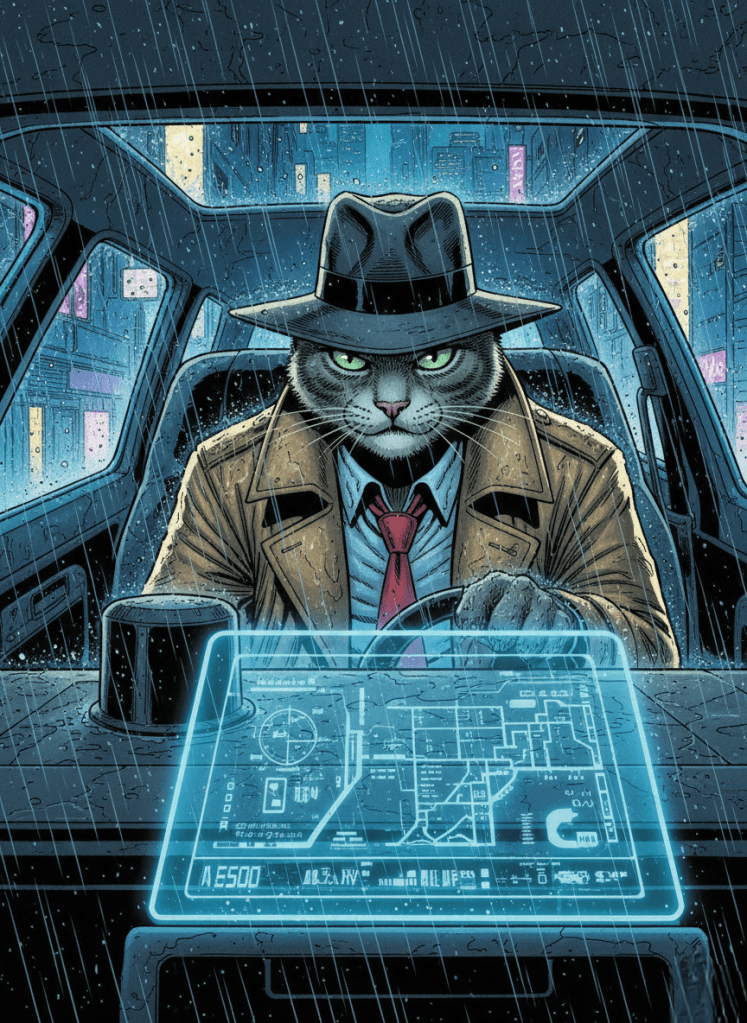
It was pouring by the time I pulled up near the corner of Tortoiseshell Street and Burmese Boulevard. I padded out of the warm comfort of my ride, the Budmobile, and told it to watch my back. The Budmobile’s AI chimed in acknowledgement and miniature silos opened on each rear quarter panel, ejecting a pair of drones. One drone circled above me in a defensive posture while the other zoomed ahead, scouting my path.
I tasted wet rain and something else. My nose wrinkled, pulling me toward a funky scent. I crouched, sniffing the sidewalk, and that’s when I saw them: crumbs made soggy by the downpour, their addictive chemicals turning a shade of toxic lime as they interacted with the acid rain.
Tempheads are dangerous. They’ll do anything to get their fix, even if it means stealing from littermates or breaking into homes to raid the treat cupboards.
No Temphead was going to catch me off guard, I thought as I placed a paw on my holster and felt the reassuring grip of Thunderclaw. The old revolver was reliable and had legitimate stopping power. The sight of it alone was often enough to get bad guys to back down.
Lightning cracked the sky as I followed the crumbs down Burmese Boulevard, under the old wrought iron bridge and into a back alley.
I paused and sniffed. The Temphead had lingered here at the door to a shady-looking ripperdoc clinic, probably trying to get them to buzz him in. The ripperdoc was smart, didn’t want anyone bringing heat down on his clinic, so he turned the Temphead away.
My keen sense of smell and my detective’s intuition told me the Temphead quickly moved on, and sure enough, there were more crumbs ahead, where the alley made a sharp right turn toward a cross street.
I padded ahead, nose leading the way, and looked up.
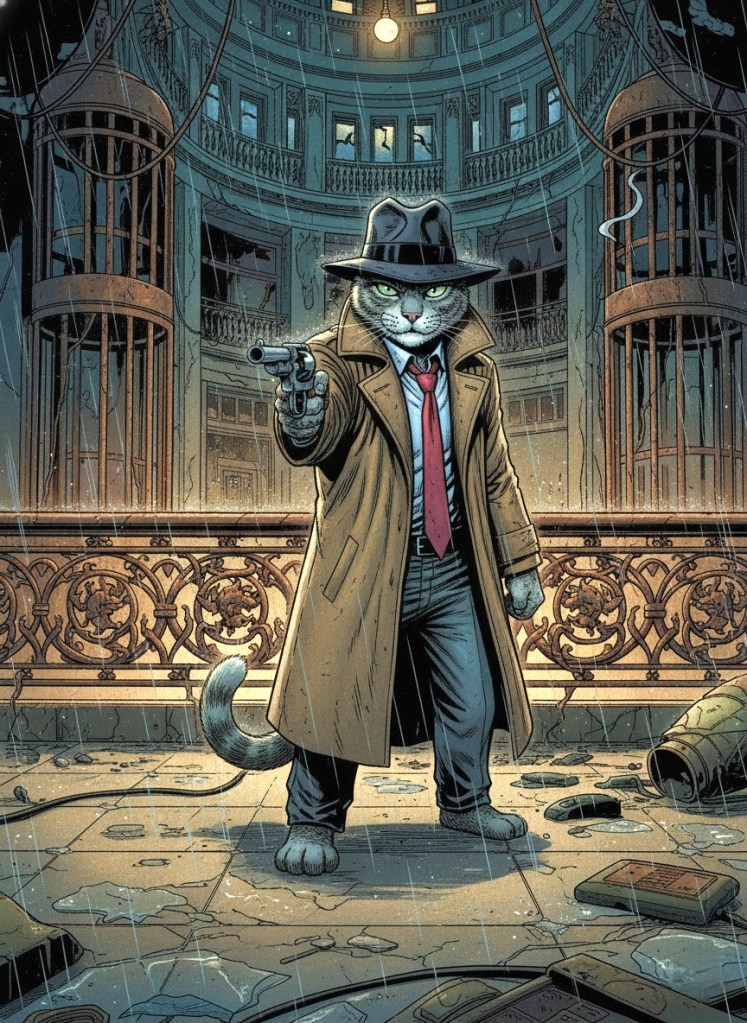
The Bradbury Building.
Once a symbol of commerce in the city’s gilded age, now a dilapidated microcosm of Paw City, its former glory obscured beneath decades of grime and decay.
Patting Thunderclaw again for reassurance, I pushed against the heavy bronze doors and into the gloom inside.
My ears prickled in the funereal silence, and my whiskers felt movement in the air currents. There!
A shadowy figure was heading for one of the exits.
Justice is my job, and what kind of cat would I be if I didn’t have the swiftness of a cheetah and the bravery of a tiger?
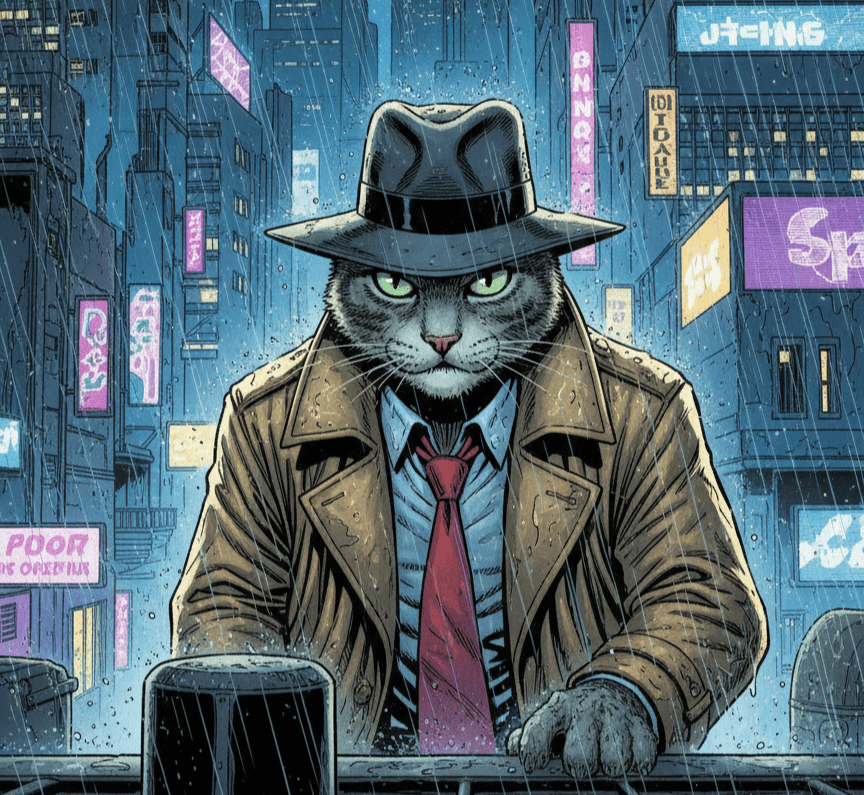
I leaped the railing, landing gracefully on my feet as I always do, and followed the shadow through the door. The rain was coming down hard, battering my trenchcoat and cap.
Where’d that cat go?
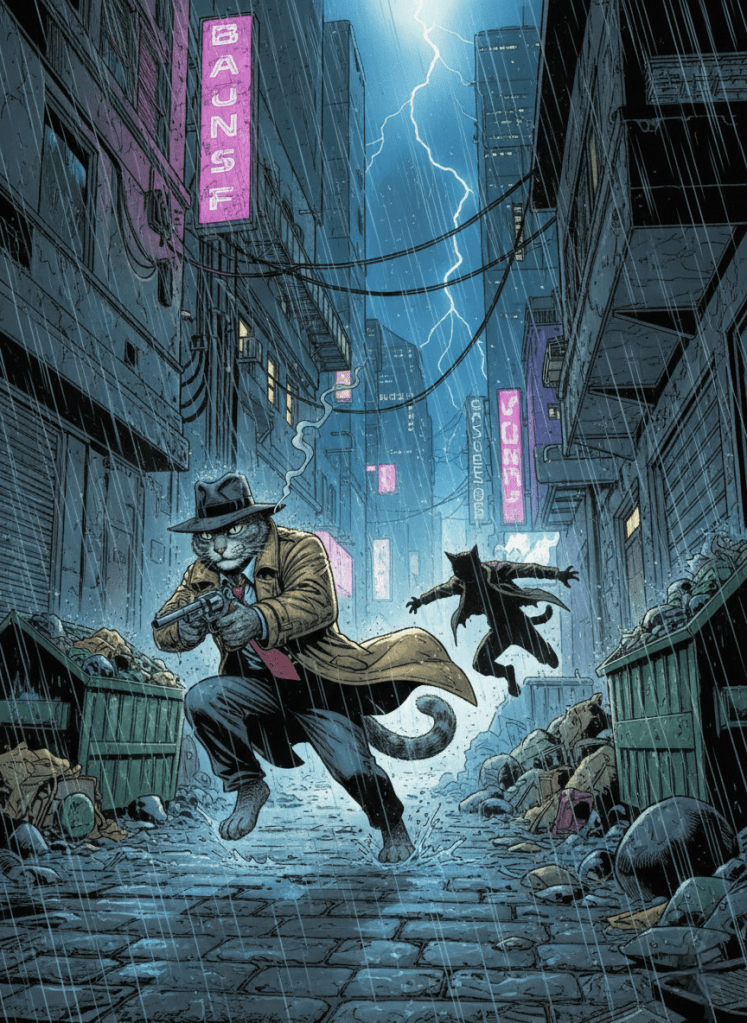
He was clever, I’ll give him that. Lightning lit the alley, and he used the crackle of thunder to mask the sound of his feet splashing through the puddles before he leaped.
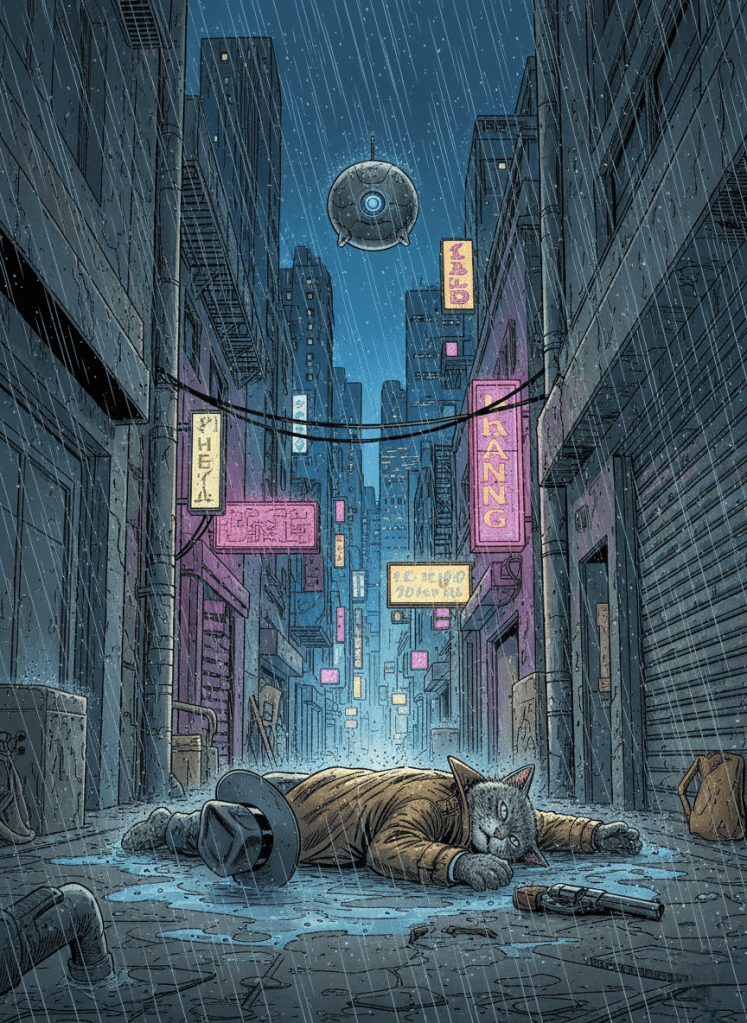
I never even saw it coming. It’s been a long time since anyone’s gotten the jump on me. Maybe I was too confident. The attacker barreled into me, knocking me off my feet, and was already propelling himself up a nearby fire escape as I landed in a puddle of rain water.
Thunderclaw was torn from my grip with the impact and went skidding across the concrete.
The Budmobile’s follow drone chose that moment to reappear, making a lazy loop around the alley before stopping to hover in front of me, its ventral nozzles firing whispers of propellant to keep it stabilized.
“Oh dear,” the drone said, “you seem to have fallen, sir. Shall I bring the car around?”
“This,” I told myself, “is undignified.”
The drone chimed.
“Is that a yes, sir?”
I resisted the urge to paw smack the useless machine.
“Yes! Call the Budmobile to the end of the alley.”
I might have been Paw City’s greatest detective, but I wasn’t going to catch criminals with my clothes and fur all wet, smelling like a dirty mutt.
I retrieved Thunderclaw from the ground, slipping the trusty revolver back into its holster.
That’s when I saw it — a scrap of torn clothing on the end of the fire escape, black as night. Black like the absence of light.
I ran a paw pad over the material, feeling its familiar weave and texture. There was only one shop in this section of Paw City that sold zero albedo clothing. Could the Shadow Void be back to stalk the seedy underbelly of Paw City once again? I put him in the slammer once. Now I may have to do it again.
I climbed back into the Budmobile, grateful for the blast of heat from its dash. It was time to pay Tommy the Tailor a visit…
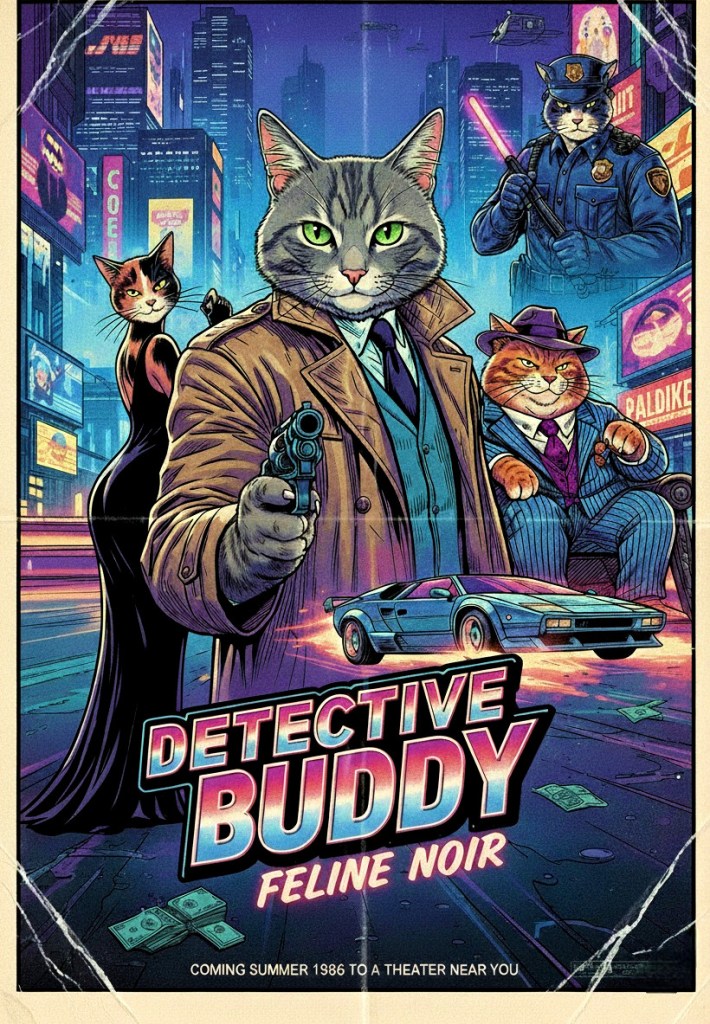
Check back for the next episode of Detective Buddy: Feline Noir!
Shelters are full of felines who need forever homes, and National Cat Day was founded to make sure they’re not forgotten.
The number of “cat days” keeps growing, with separate dates for national and international cat days, dates honoring black cats, tabbies, calicos and tortoiseshells, and more.
But National Cat Day is one of the OGs, beginning 21 years ago, and it’s endorsed by the ASPCA. The main purpose of National Cat Day, per its founders, is to help homeless kitties find forever homes by inspiring people to adopt.
So we’ll say what we always do: shelters are full of little buddies who are just as lovable and deserving as Little Buddy himself, and all they need is a home, some love and patience to help them feel secure. Once they know they’re safe and loved, their personalities shine through.
If you like feline-centric fiction, Mollie Hunt released her 12th Crazy Cat Lady Mystery novel today. It’s called Cold Case Cat and you can read more about it here.
Meanwhile over at Catwoods, Leah writes about — and includes great photos of — her “Halloween cat,” Shelley. She also revisits the Facebook hoax posts we wrote about a few weeks ago, in which users claim the big cat was spotted in places as varied as Louisiana’s bayou, the Houston region, West Virginia and Wyoming.
Finally, the satirists at McSweeney’s have a new post titled “A Brief Questionnaire Before You Adopt This Rescue Cat,” which takes aim at overzealous shelter/rescue operators who make the process of child adoption look easy by comparison, and are constantly at capacity because they’ve made perfect the enemy of good.
Wanna adopt this cat? Hand over a list of every person you associate with along with their addresses, phone numbers and social security numbers, prepare for a 30-day in-home evaluation by a shelter staffer, and agree to feed kitty a diet of sushi-grade tuna!
Credit: Denitsa Kireva/Pexels
While it seems outlandish, I encountered some contracts that were only slightly less onerous before I adopted Bud, and it’s obviously the McSweeney’s team has too.
Now I understand a bit more why some shelter staff are so cautious. They see some of the worst behavior, after all, including people who return cats because they’re too affectionate, animal abuse cases, and cats on death’s door because their humans ignored decades of research and tried to turn their obligate carnivore pets into vegans.
They want to make sure the cats go to good homes, which is admirable, but they shouldn’t overlook potential adopters who are well-intentioned and looking for a little pal.
In the era of Amazon, America’s independent bookstores survive by offering things the online giant can’t.
Like everything else in the realm of print media, bookstores have been having a rough go of it the last decade or two.
Waldenbooks, Crown Books and Borders no longer exist, with the latter chain shuttering its last 400 stores in 2011. Barnes and Noble is the last surviving book chain thanks to an aggressive strategy of expanding their cafe and lounge space, encouraging shoppers to hang out while they sample books and drink coffee.
There are still some 14,000 bookstores in the US, depending on how some hybrid businesses are categorized, and independent booksellers now make up the majority of real-world retail while the giant that is Amazon looms.
The key to survival is offering things Amazon can’t. Some distinguish themselves by catering to specific customers, like fans of mystery or science fiction, offering rare and signed volumes alongside their regular stock. Some pursue a Barnes and Noble-like strategy, leaning heavily into the hybrid coffee shop model. And some become community spaces for book signings and poetry nights.
Others lure customers inside — and back after they’ve already visited — with pets.
In a new story, the New York Times highlights independent book shops around the country that have dogs, lizards, turtles, rabbits, and of course, cats.
When it comes to our furry and clawed friends, some shops are populated with adoptable felines:
At the Literary Cat Co. in Pittsburg, Kansas, readers have the opportunity to adopt a pet while they shop. The store partners with a local rescue organization, hosting about seven cats at a time, along with three permanent feline “employees”: Hank, the regional manager; Scarlett Toe’Hara, the assistant regional manager (she’s polydactyl); and Mike Meowski, the assistant to the assistant regional manager.
Jennifer Mowdy, the store’s owner, described each cat’s role, personality and origin story with the air of a matriarch ticking off successful grandchildren. Speaking of the upper respiratory illness that cost Mike Meowski an eye, she sounded stoic. He was a kitten; she was there for him. They soldiered through.
Mowdy created a glass alcove for allergic customers – and to deter escapees – and a “kitty conference room” (accessible by cat door) for litter boxes. With regular scooping, four air purifiers and daily mists of Mrs. Meyers Room Spray, she said the scent of the store is neutral to positive.
In the past year and a half, the Literary Cat Co. has facilitated 50 adoptions. “We’ve only had one cat that didn’t work out,” Mowdy said. “Too much fight in her.”
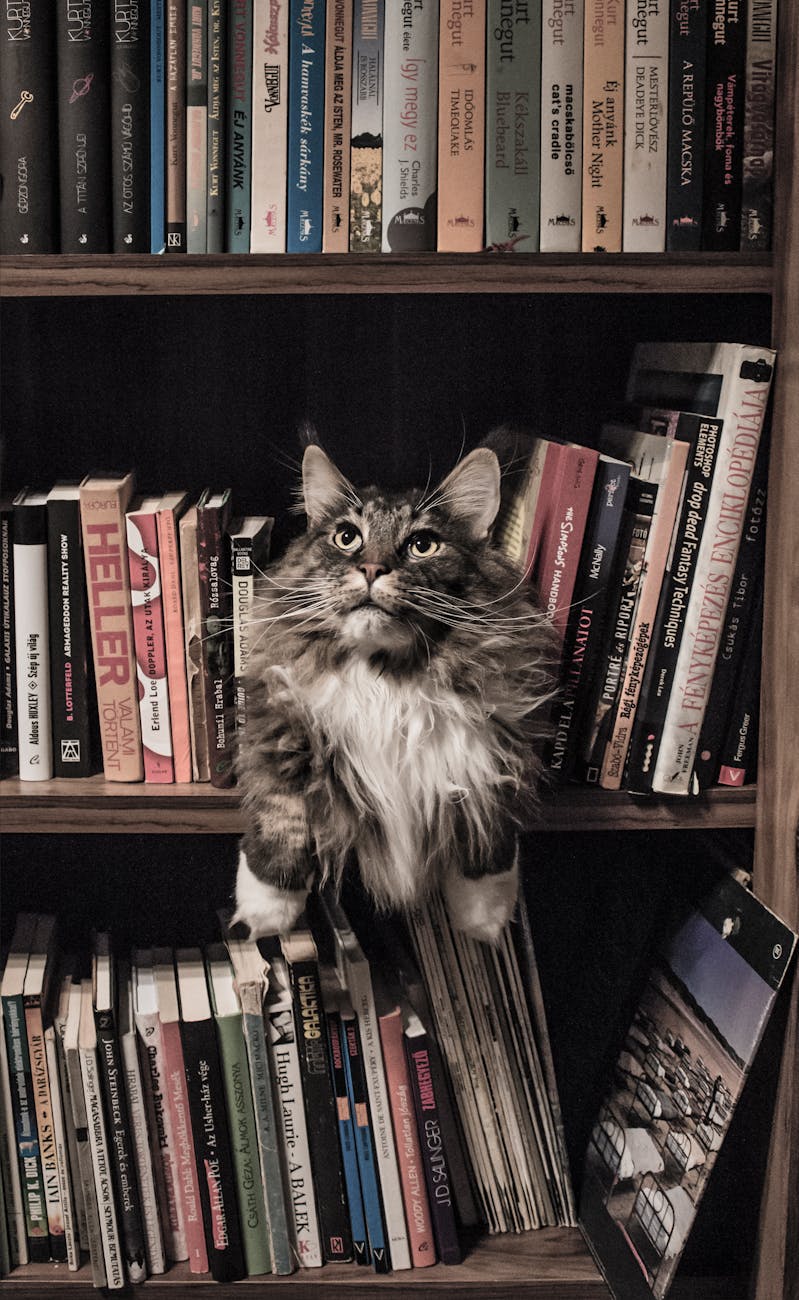
Kittens tend to wreak havoc; Mowdy prefers a mature animal of the “Don’t call me, I’ll call you” variety. Felines are welcome to scale shelves and interact with readers as they please, which is their way.
“They get to practice being a good house cat,” Mowdy said. “They get socialized.” Occasionally, the right cat finds the right reader’s lap. The rest is destiny (with the rescue organization handling logistics; the Literary Cat Co. simply makes the introduction).



 Pain In The Bud