Domestication’s real goal: to make cats cuddly as well as great mousers.
Cats have been doing things their way since the very beginning.
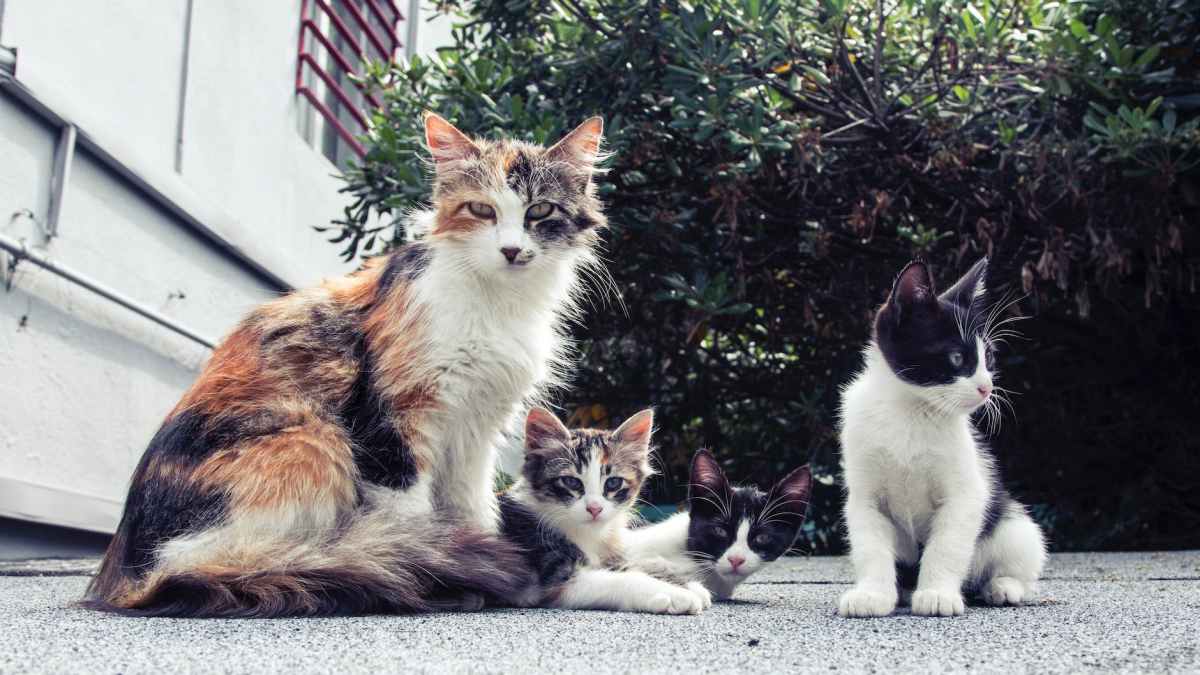
Unlike literally every other domesticated animal, cats were not domesticated by humans. They did it to themselves.
As if that didn’t make them unique enough, they lay claim to another major distinction: they’re the only species of obligate carnivores to undergo domestication in the entire history of human existence.
That explains why cats, more than any other animal that depends on humans, so closely resemble the wild animals they were before signing up for the good life of naps, warmth, endless rodents to hunt and free food from their new human friends.
In a new essay for The Conversation, evolutionary biologist Jonathan Losos, author of The Age of Cats: From the Savanna to Your Sofa, notes new DNA analysis settles the question of where cats came from once and for all.
Domestic cats are descended from North African wildcats, specifically the species felis sylvestris lybica. Unlike dogs, who underwent telltale physical transformations when they evolved from wolves, house cats “appear basically indistinguishable from wildcats.”
While the change in genetics that happen with domestication left cats pretty much as they were physically, the process made dramatic changes in the feline brain, reducing regions governing fear and expanding those related to social behavior. The result? The major difference between house cats and their wildcat ancestors is disposition.
In other words, domestication made cats cuddly.
Housecat evolved.
Notably, felis sylvestris lybica had to be pretty friendly in the first place, as well as bold and driven by the now-legendary feline curiosity to risk padding into human settlements with their bright lights, strange smells, open flames and the two-legged giants striding around them.
They didn’t have a way of negotiating or signaling their intent. They couldn’t say: “Hey guys, we’re here to kill and eat the tasty rodents who have been giving you problems by chowing down on your yums, but we don’t want your yums for ourselves. Plants are disgusting!”
So they had to demonstrate their usefulness, prove their worth, and enjoy the fruits of it by curling up in front of warm fires or on human laps.
That explains why it was the African wildcat that became a human companion species and not European wildcats, whom Losos notes are often “hellaciously mean” in interactions with people, even if they’re raised around humans when they’re young. It was also a matter of being in the right place at the right time, as nascent human civilization took root in the Fertile Crescent.
But ultimately, just like cats decided to domesticate themselves and didn’t really bother to consult us about it, so too do they bend us to their will with an entire repertoire of manipulative behavior, from solicitation purrs to incessant meowing and having a talent for looking their cutest when they want something.
While we may think we set the rules and parameters of our relationship with the furry little ones, as Losos notes, “cats usually train us more than we train them.”
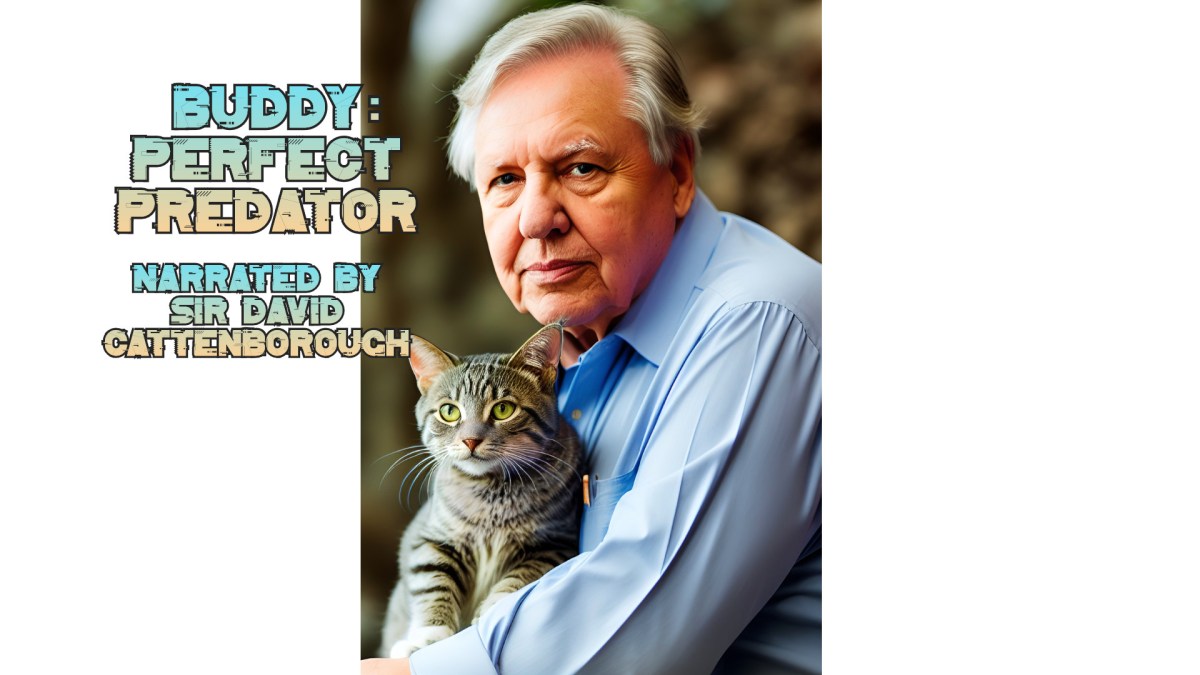
Watch the premiere of Buddy: Perfect Predator exclusively streaming NOW on PITB!
It’s here!
The long-awaited documentary feature: “Buddy: Perfect Predator” has arrived on PITB.
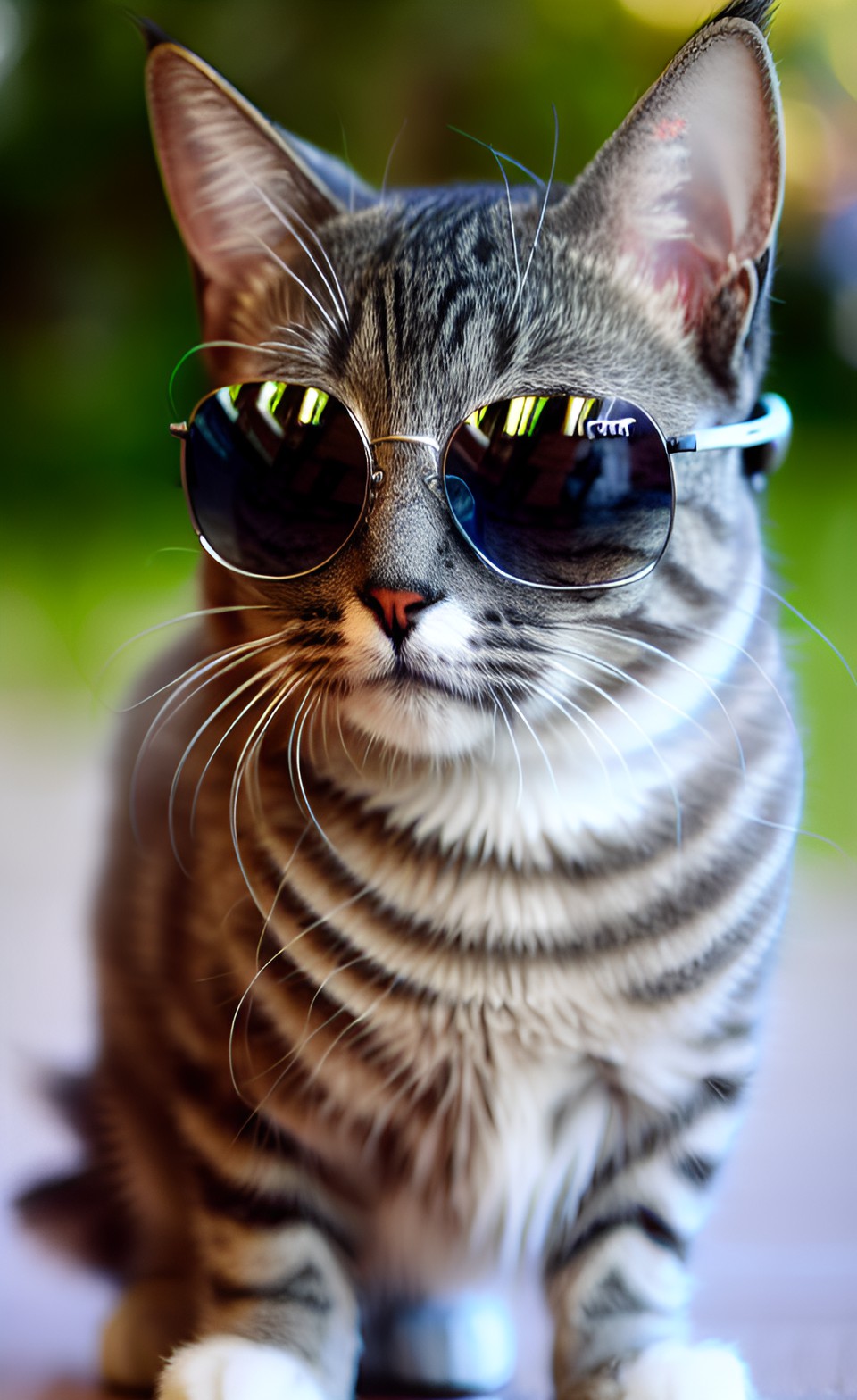
Join Sir David Cattenborough and his intrepid crew of wildlife videographers as they follow the elusive Buddinese tiger through the dense undergrowth and dangerous terrain of its natural habitat in suburban New York.
Watch never-before-seen footage of the silver-furred Buddy stalking his prey, lounging, sleeping and eating, and follow a tense encounter between the Buddy and a red laser dot.
“I’m extremely proud of the work we’ve done here, and I believe our audience will be thrilled to learn more about this little-known creature, who shares so many qualities with tigers, lions, jaguars and leopards,” Cattenborough said.
“We fell in love with the silver-furred Buddy as we kept our cameras trained on him, and we think our audiences will find him just as charming as we did,” the British naturalist said. “He’s such a good boy!”
(Please ensure your sound is enabled or wear headphones to hear the narration and the atmospheric sounds.)
About this video:
This story was made possible with the use of artificial intelligence tools. To create the images of Sir David Attenborough with Buddy, we used a natural language processing AI trained to output realistic-looking images and Pixlr to refine the images in post. To create the narration, we assembled samples of Attenborough speaking and trained a vocal synthesis AI, based on brand new technology, to mimic Attenborough’s unique pronunciation, cadence and rhythm, then layered the audio with a background of various nature sounds and incidental sounds, such as a tiger roaring.
Just a year ago it would not have been possible to generate images like this or faithfully recreate Attenborough’s famous narrative style, proving AI not only allows users to achieve things that were previously impossible, but has been making major leaps forward in short periods of time.
We believe AI, when properly used, can be a great instrument in the creative toolbox.
Finally, a thank you to Buddy for being a good sport about having cameras in his face. Great job, Bud!
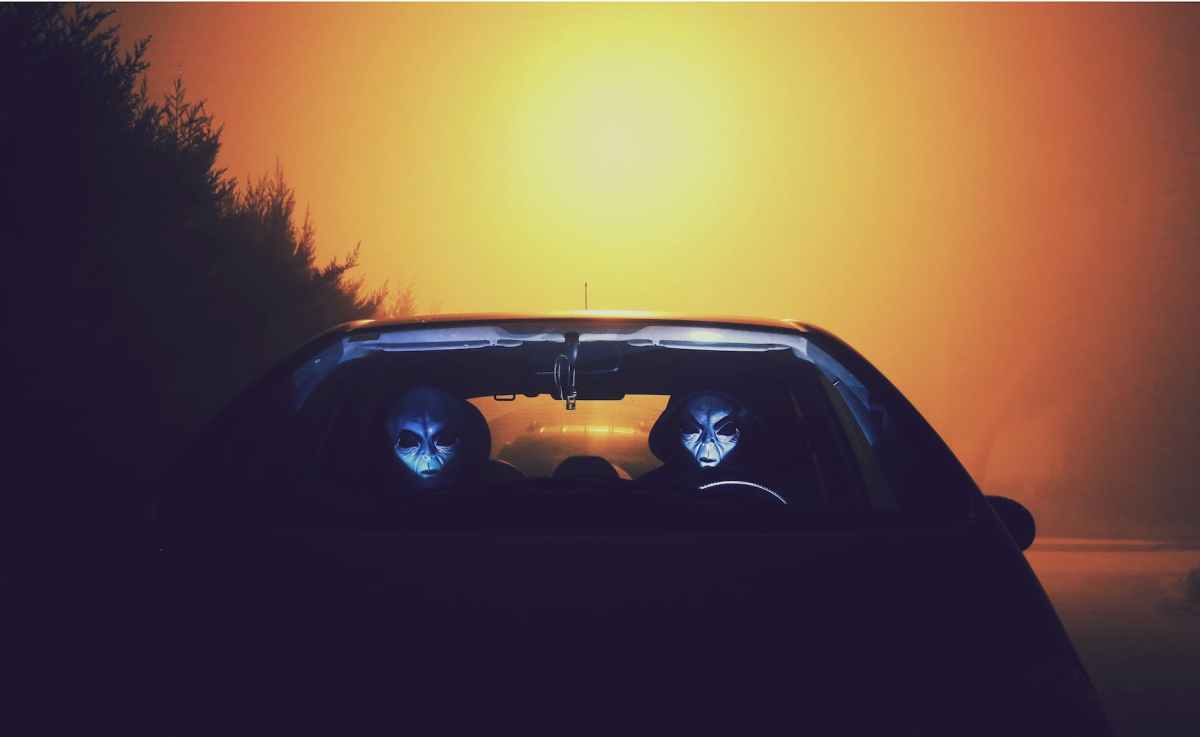
What do felines make of the spy-slash-UFO drama that has consumed the popular imagination for the last week?
The humans have been freaking out about a big balloon flying over Humanland, believing other humans sent it to spy on them. But some humans think aliens are behind the nefarious balloons, and they’re not balloons at all — they’re super sneaky alien craft sent here to scout ahead for an invasion. What do you think?
“If I wanted caviar for breakfast, I would have told you. Stick with the schedule.” – Versace, 13, show cat
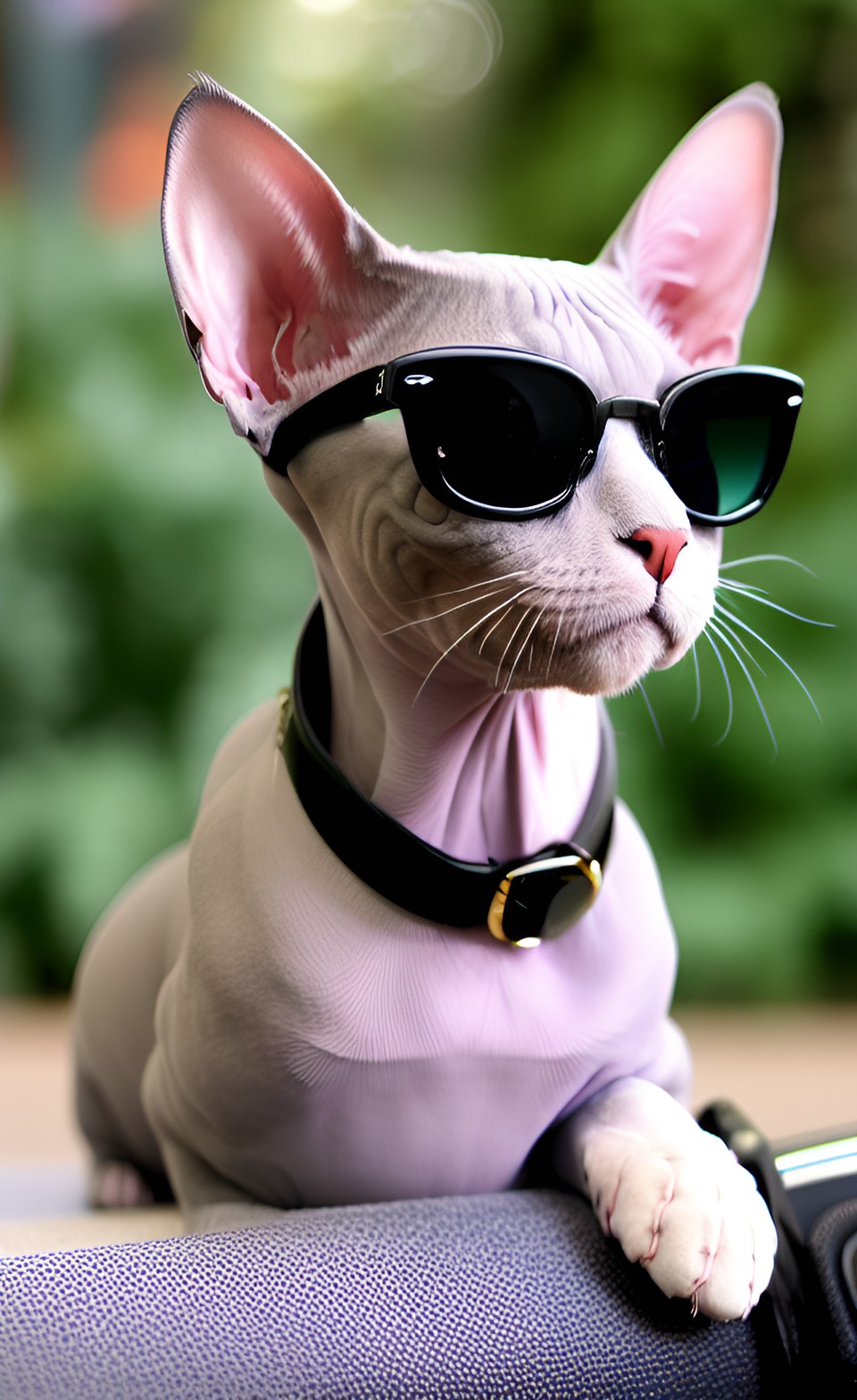
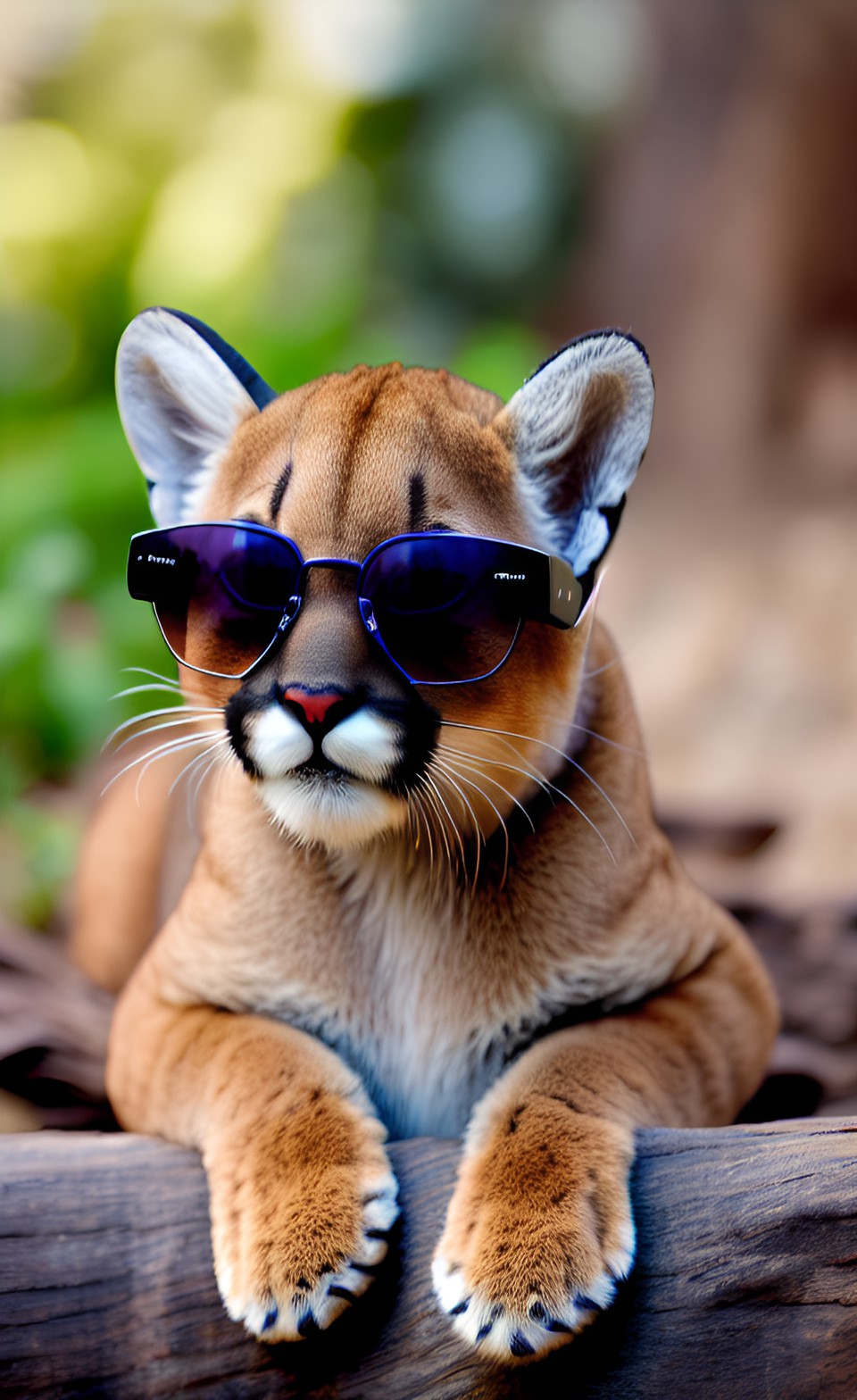
“You gonna eat that hedgehog?” – P-84, 1, puma
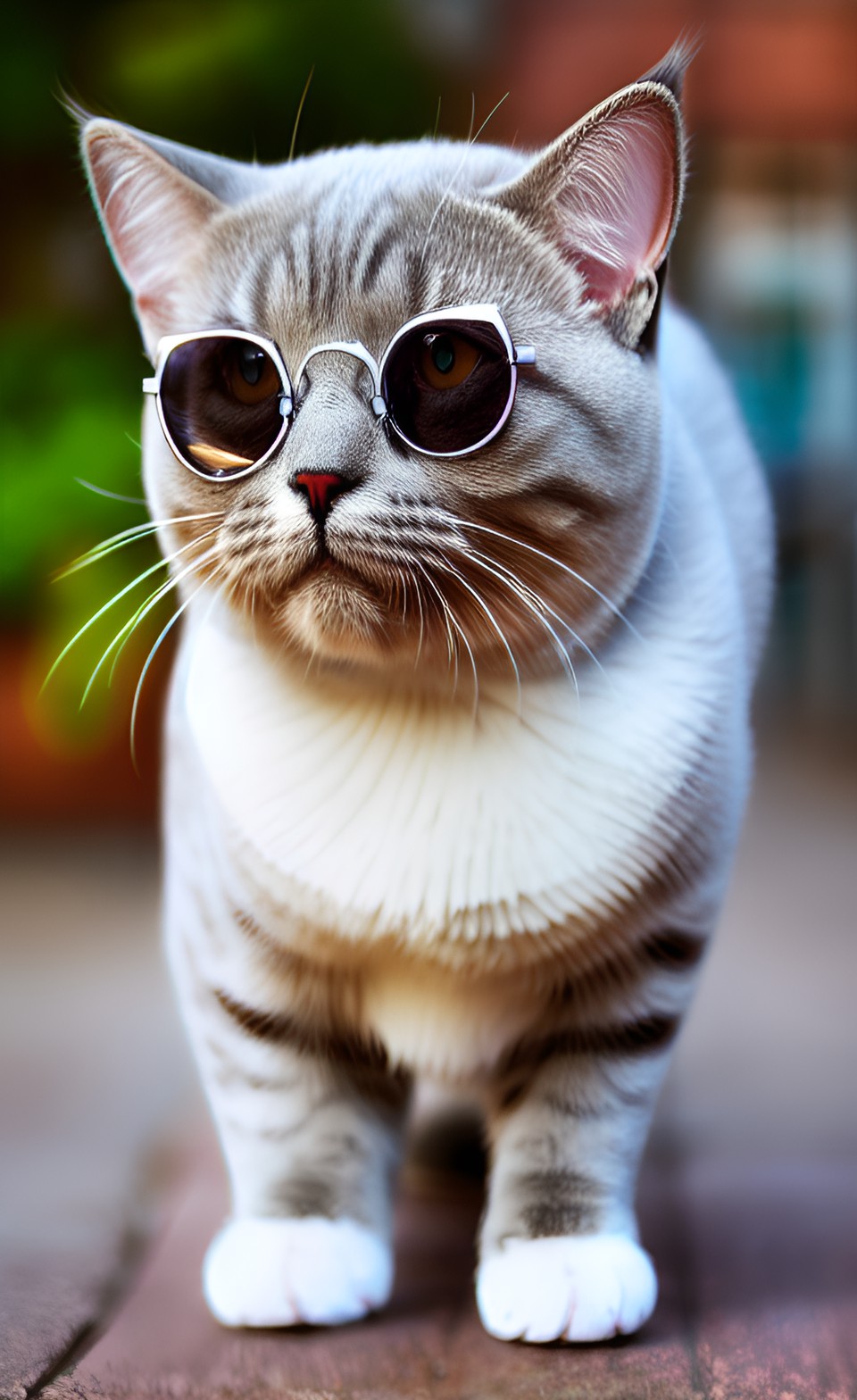
“Hey up, mates. What’s this, then? Can’t we just fire a few fecking missiles at them and get on with it?” – Liam Gallagher, 8, British cat
“Allow the aliens to land. They look delicious.” – Zanzibar, 5 months, apprentice murderer
“We need a bunker, do we have a bunker? Well why didn’t you BUILD a bunker? Do I have to think of everything?!?” – Buddy the Cat, 8, ex-president of Americats
“This is clearly the work of the aggressive regime in Luxembourg. We should invade, confiscate all their cheese and make them a vassal state.” – Cicero Nash, 4 1/2 months, couch stylist
Even cats sometimes think “My bad!” How do they communicate that to their people?
As George Carlin famously observed, cats don’t accept blame — but that doesn’t mean they don’t apologize sometimes.
Let me preface this by saying I neither expect nor demand apologies for the standard methods of Buddesian destruction. If Bud swipes my phone off the table and it cracks, that’s my fault for leaving it where he’s known to conduct his ongoing gravity experiments. Likewise, there’s no sense getting upset with him when he paw-slaps a set of keys four feet across the room, or when I return from the kitchen to find the remote controls on the floor.
That’s Buddy being a cat. Getting angry at him for it would be pointless, and expressing that anger would only make him fearful and stressed.
There are times, however, when even Bud realizes an apology is in order. As I’ve documented before, the little guy sometimes redirects his fear or aggression to the nearest person, which is invariably me, and almost mindlessly lashes out with claws and/or teeth. After working on it together, he’s improved dramatically and knows how to handle his fear and frustration peacefully. Still, every once in a while he gets really freaked out or overstimulated beyond what he can handle, and he’ll clamp onto a foot or forearm, drawing blood.
That’s when I react. I don’t yell at him beyond telling him to stop, but he can see from my reaction that he’s gone way overboard and done something he shouldn’t do.
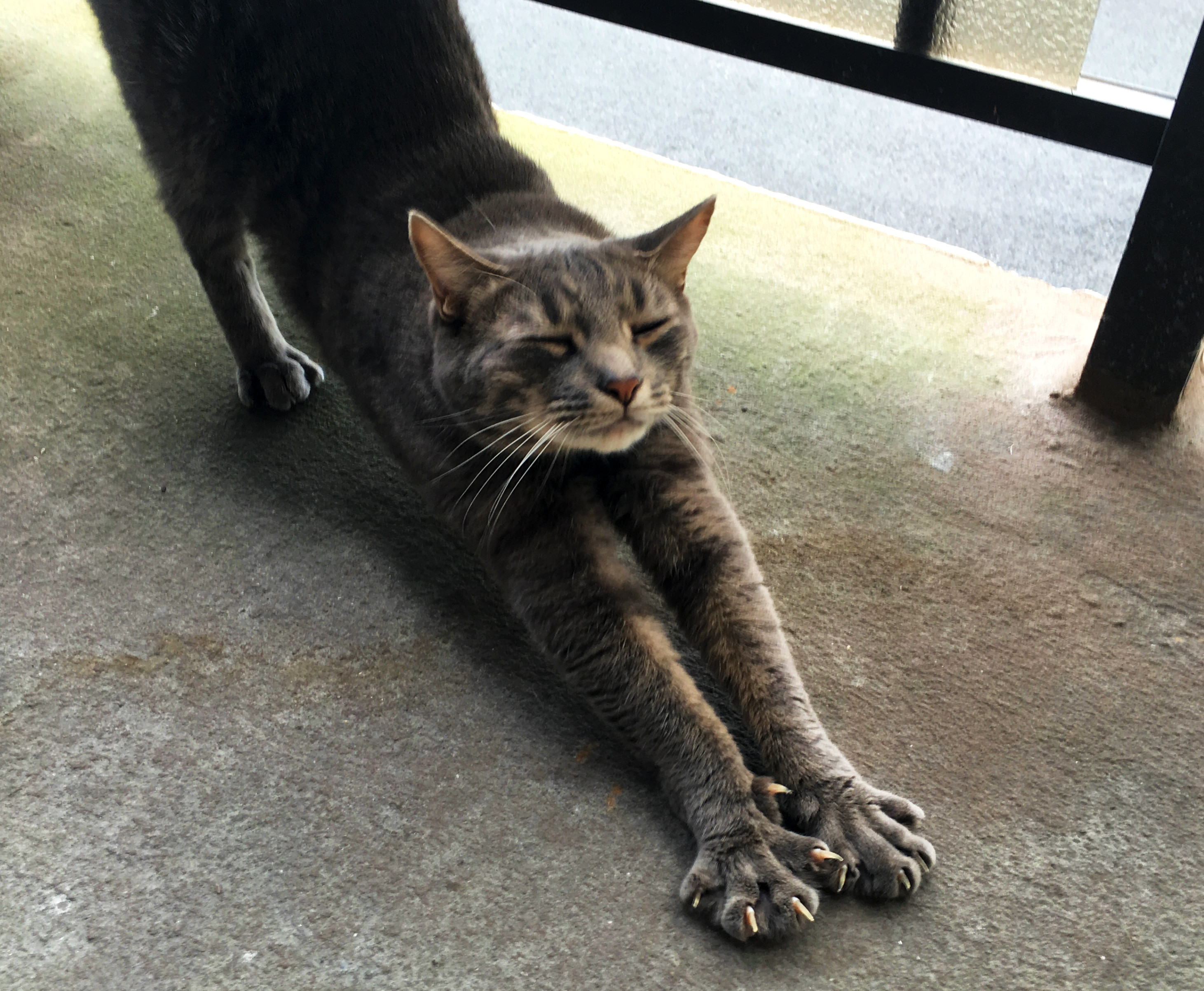
Bud assumes the Striking Tiger, Ten Swords stance. Or maybe he’s just stretching.
He starts the apology phase by running off to the next room or running around the one we’re in, making uncertain “brrrrrrr brrrrrr” noises. (Precisely the same noises he’s made since the day I brought him home as a kitten, when he would poop in the corner of my bedroom underneath my bed. That’s always been the sound he makes when he’s unsure and maybe a little worried.) If I go to wash and dab antibiotic ointment on the cuts, he’ll sit there quietly watching me. He’ll watch until I say “Hey, Bud!” and then approach slowly until he sees me holding out my hand and starts nuzzling against it and purring.
I’ll usually say something like “It’s okay, but you shouldn’t do that,” kindly but firmly. He probably doesn’t grasp my words, but he understands my tone of voice and meaning.
We can only guess exactly what our pets are thinking, but I believe Bud’s telling me he regrets hurting me, didn’t mean to, and he wants to make sure we’re still okay.
As for cats reading us, the video below does a good job of explaining what cats pick up in our tones of voice, body language, facial expressions and even pheromones. Cats may not have been living with humans since the hunter-gatherer days like dogs have, but they still trace their domesticated lineage back 10,000 years, and just like dogs they’re hyper-attuned to the moods and intentions of their closest humans. Partially it’s because they depend on us utterly as their providers of food and water, but when cats and humans share a bond, there’s a strong emotional side to that attunement as well.
Big cat sightings across the UK have a lot in common with UFO sightings in the US.
Shhhhh!
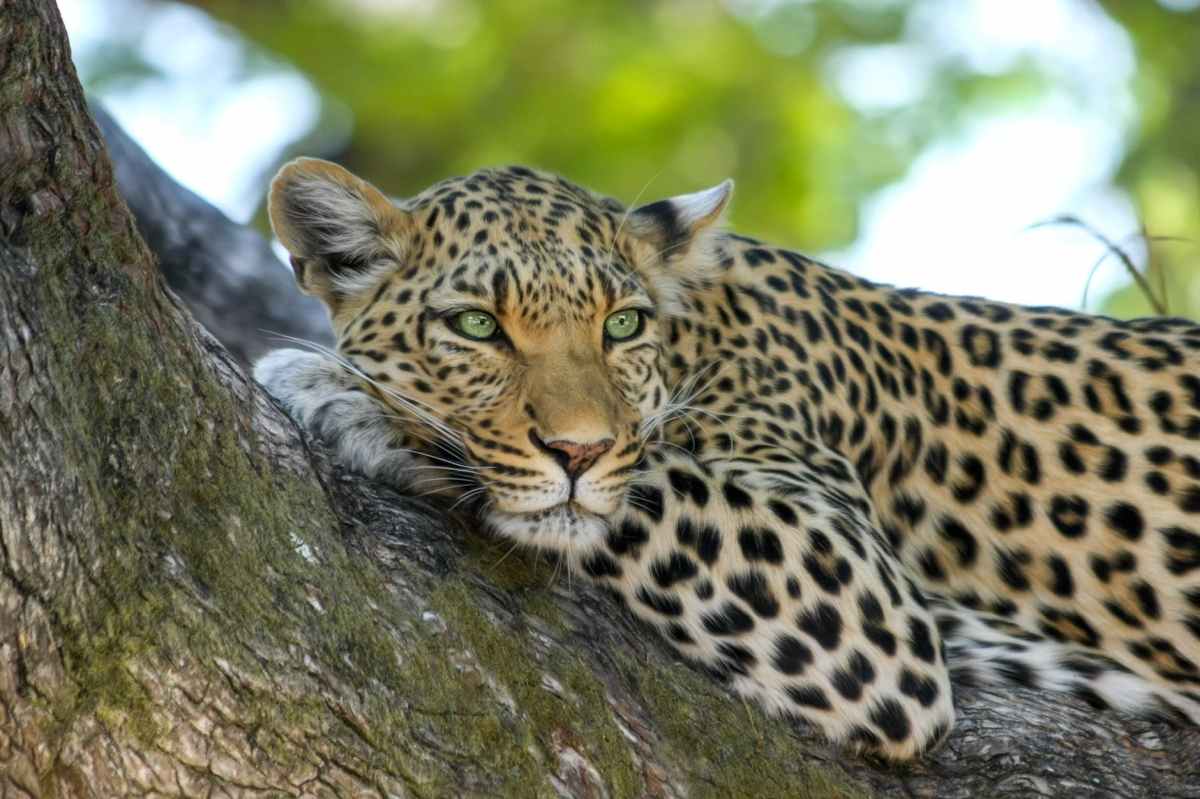
No one tell NewsCorp that “black pumas” don’t exist, pumas are native to the Americas, leopards are native to Africa and Asia, and a “black panther” is a color morph, not a species of cat.
A story from Fox News — prompted by a similar story in the UK’s Sun, part of the same Rupert Murdoch-owned media conglomerate — claims the British are “unnerved” by an “uptick” in sightings of cryptid big cats. The mysterious creatures are supposedly running rampant in the British countryside and in the suburbs, according to the article, which identifies them as black pumas, black panthers and black leopards.
Oddly, the story says the sightings are up significantly because there have been three “big cat” sightings in October, immediately before informing readers there are 2,000 such sightings in the UK every year.
Little Buddy and I are not exactly known for our math skills, but 2,000 sightings a year works out to 167 sightings per month, which is a lot more than three. Fifty five times more, in fact. So the story should really be about a dramatic dip in phantom big cat sightings, shouldn’t it?
What evidence does the Fox report cite for its breathless claim about big cats taking over the UK? A pair of grainy security camera videos, including one showing a “big cat sighting” at night, and the word of a “big cat sighting expert,” alternately called a “countryside expert” in other media reports, who by the way happens to be hawking a documentary on the sightings.
“It’s a crucial issue,” self-described wildcat expert Rick Minter told The Sun. “How do we come to terms with living alongside big cats in Britain?”
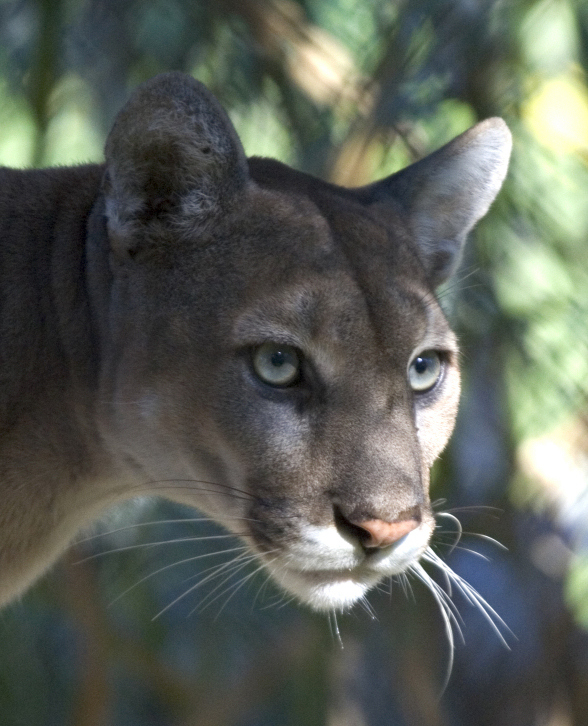
Pumas, also known as cougars, mountain lions, panthers and catamounts, are native to the Americas. Credit: Wikimedia Commons
For readers unfamiliar with the highest echelons of reputable journalism, The Sun is the UK’s foremost bastion of trustworthy reporting, a tabloid par excellence whose editorial staff are known for breaking stories about “crazed werewolves” and immigrants barbecuing the late queen’s swans when they weren’t running topless photos of models on Page 3. The Sun is owned by NewsCorp, the parent company of Fox News.
As for the two pieces of footage, one is the aforementioned blurry mess recorded by a home security camera at night, and shows a few frames of a cat’s behind and a tail as the felid walks out of the frame. The other is a blurry clip the credulous claim depicts a large cat feeding on a sheep. There’s no indication the figure is a felid of any type.
As far as we’re concerned, there are a few possible explanations for the sightings:
They’re former pets
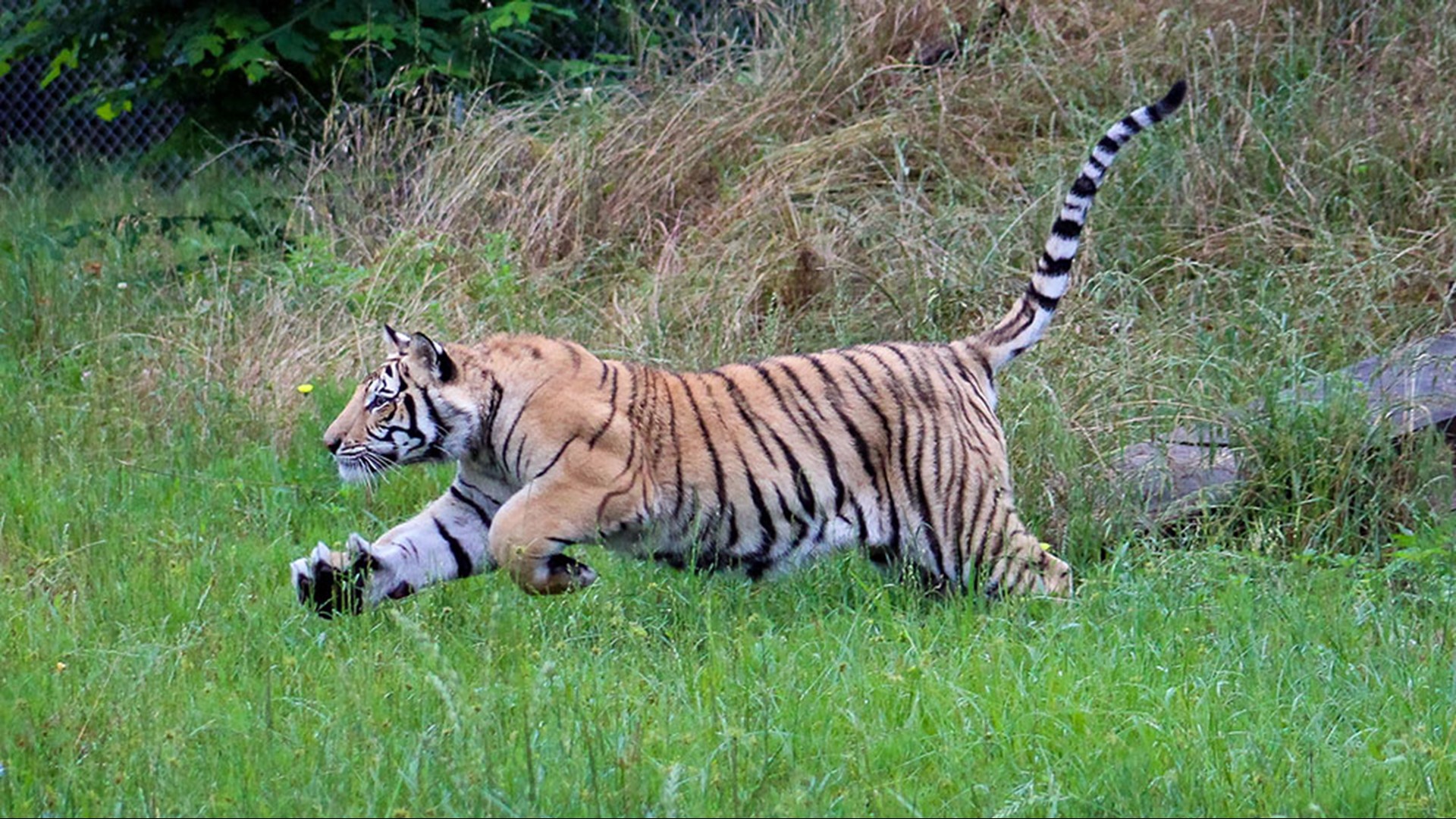
India the tiger was found wandering the suburbs of Houston in 2021. In this photo, he’s enjoying life in his sanctuary’s large enclosure where he’s got plenty of room, stimulation, toys and even his own rock pool.
If there are indeed big cats roaming the British countryside and suburbs, they would have to be former pets of people who acquired them on the illegal wildlife market, broke the law by “importing” them into the UK, then broke several additional laws by keeping them as pets until the cats quickly grew and the owners realized keeping them is untenable.
Such situations aren’t unheard of, obviously, but they can’t account for a dozen big cats on the loose at any one time, much less more than a thousand as Minter claims.
More importantly, big cats who are taken from their mothers as days-old cubs, sold as pets and later dumped are universally confused, terrified and unable to fend for themselves. They end up roaming suburbia in broad daylight, like a nine-month-old tiger named India who was spotted wandering around the outskirts of Houston in 2021, sniffing out potential food in garbage cans because they don’t know how to hunt.
If these phantom big cats were former pets, they’d be spotted, captured and taken to sanctuaries within a matter of days.
They’re small wildcats formerly native to the area, like the Eurasian lynx
The problem is, the Eurasian lynx was extirpated from the UK about 1,400 years ago. There have been debates among conservationists about reintroducing wild populations to the British countryside — and to Ireland — but no concrete plans as of yet. Proponents say the lynx could be beneficial, keeping deer populations level without major human intervention.
Eurasian lynx adults can grow to about the size of medium dogs, so it’s possible they can be mistaken for “big cats” in blurry video, especially when perspective and/or lack of other objects makes it difficult to place their actual size in context. However, as with big cats, any Eurasian lynx spotted in the UK are likely to be former pets.
They’re housecats
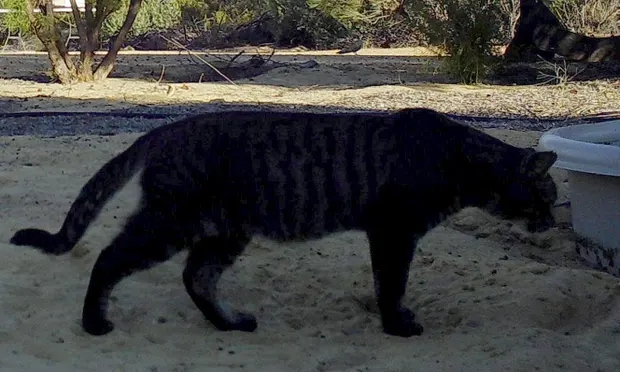
This feral cat, a plain old member of the felis catus species, was repeatedly mistaken for a big cat in western Australia back in 2018.
If witnesses in the UK are mistaking house cats for big cats, they wouldn’t be the first.
Stories abound of little cats prompting “big cat” sightings, from Vancouver (a Savannah cat) to Scranton, Pa. (a missing house cat), to San Jose (a Maine Coon) and even Australia. (A feral cat.)
One wildlife ranger in Australia became so annoyed with fielding frequent big cat reports that he implored people to educate themselves.
“People need to get over the idea the cats are panthers,” wildlife ranger Tim Gilbertson told Australia’s ABC news. “It is just not on. They are big feral cats, at least 50% bigger than a house cat and they are powerful.”
The usual issues are in play here: Fuzzy security camera footage, night sightings, confused witnesses. You’d think there would be more phantom big cat sightings in the US, since pumas can grow to the size of jaguars and could be mistaken for lions, but people who live in areas where pumas range tend to know they’re around and what they look like. They’re also the definition of scaredy cats, reluctant to let humans spot them or get anywhere near them.
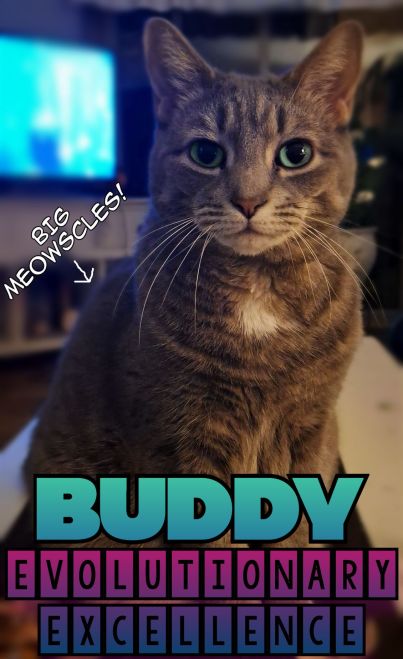
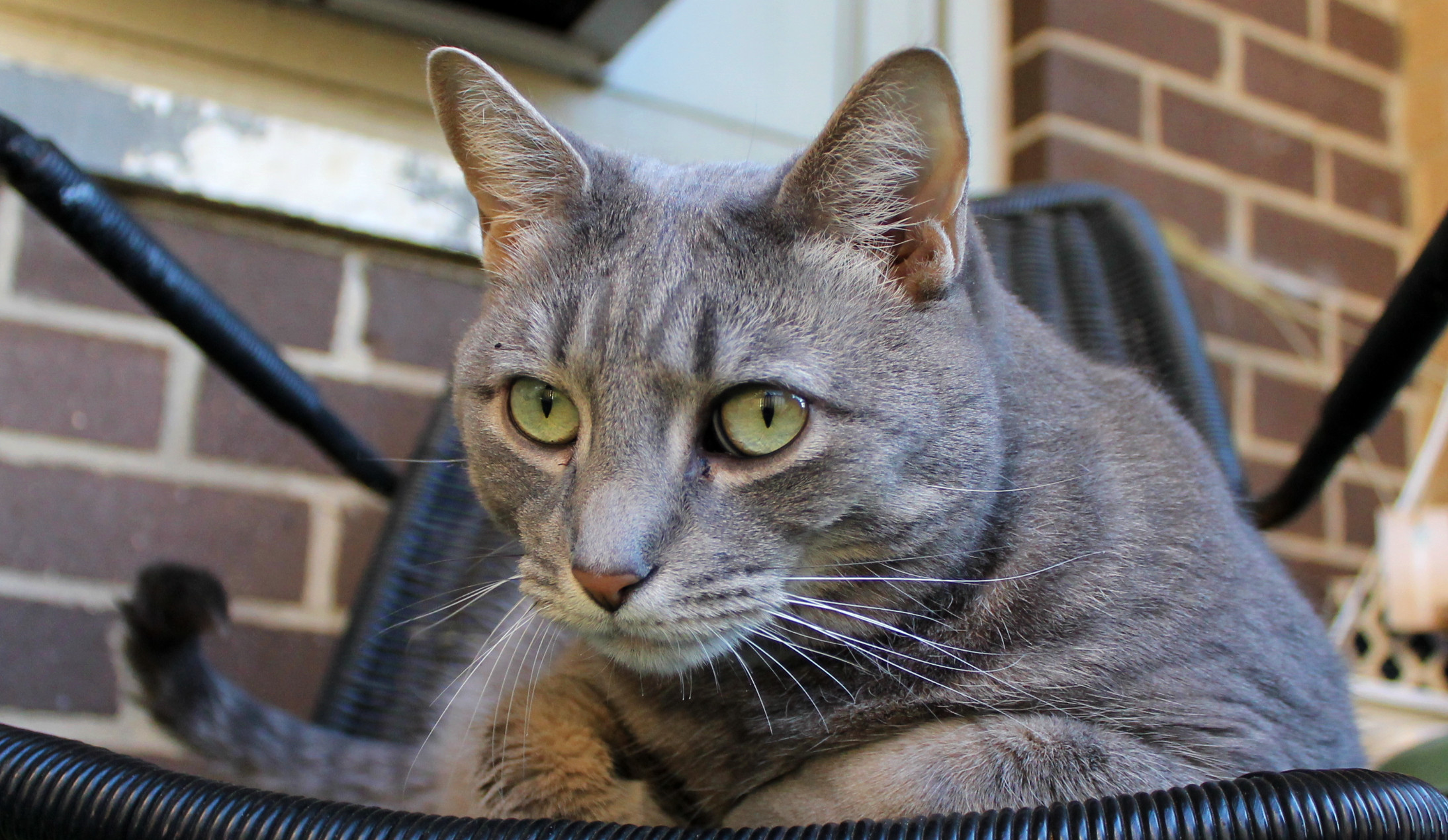
Frequently mistaken for a tiger: Buddy the Cat.
Ultimately, witness reports count don’t count for much, and not just because memory is malleable.
Thousands of people have reported seeing Bigfoot, chupacabras, the Jersey Devil and the Loch Ness monster, but those creatures are all firmly in cryptid territory.
There’s Occam’s Razor, and there’s common sense: For a primate species like Bigfoot to exist, for example, there would need to be a breeding population, enough prey for the creatures to feed themselves, and someone somewhere would have found remains at some point. (Bigfoot sightings go back to the days before Columbus set foot on New World shores, but it’s only been in the last century or so that the cryptid has entered the popular imagination via folklore and media.)
Likewise, if there are indeed 1,000 big cats prowling the British countryside, as Minter claims, there would be a breeding population, ubiquitous tracks and the remains of prey animals killed in ways consistent with big cat ambush techniques. Cats of all sizes are ambush hunters and have a distinct way of killing prey which is unlike other animals.
The UK’s big cat sightings should be treated more like the UFO sightings in the US and particularly around Area 51. They start with a kernel of potential truth — the existence of a secret base to test experimental military aircraft, or the possibility that big cats who were former pets have been let loose — which leads people to consider the possibility, then when they see something they can’t easily explain, they reach for the exceptional.
But as Carl Sagan famously said, exceptional claims require exceptional proof, and it’s no accident that things like UFOs, cryptid primates and phantom big cats only appear on the grainiest, blurriest and darkest footage.
My money is on domestic cats mistaken for their much larger cousins. Maybe Buddy’s been taking some transatlantic flights under my nose. I’ll have a little chat with him about it and ask him to kindly stop terrifying our friends across the pond.


 Pain In The Bud