Kitten With No Sex Organs Up For Adoption, Plus: Cat Proves The Dog Is HIS Pet (VIDEO)

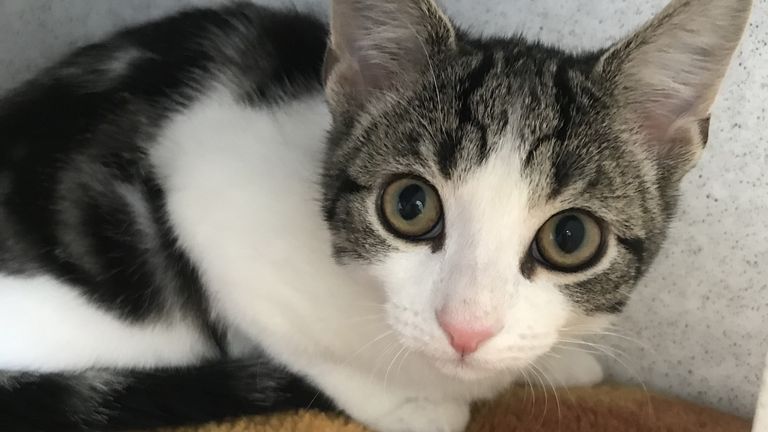
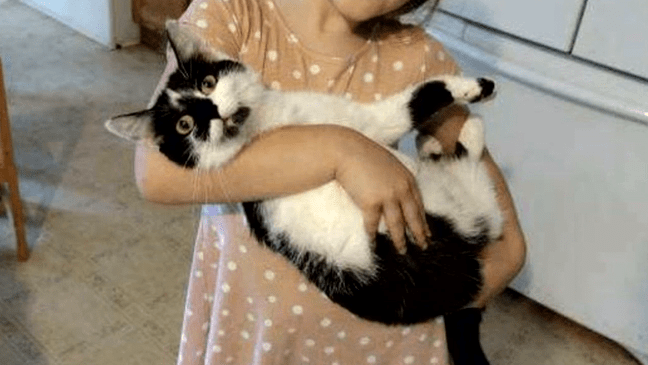
Hope the Cat’s condition is so rare it doesn’t have a name, but her rescuers say it won’t lead to health complications and Hope is otherwise a very normal and friendly cat.

We all know what it’s like — you’re trying to get something done when your pet, beloved as he or she is, has decided to be really annoying in insisting on treats.

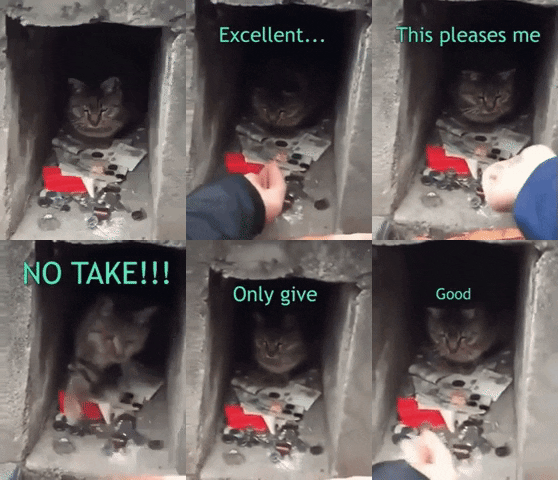
Finn the cat was in this position recently when his pet, Piper the Cavalier King Charles Spaniel, had her eye — or more likely her nose — on a small bowl of Cinnamon Toast Crunch on the kitchen counter. Piper couldn’t reach the tasty snack, so Finn climbed up, fished out a piece of cereal one at a time and dropped them for his loyal canine companion. (Finn himself had no interest in the sugary cereal, lacking in meat as it is.)

This should settle any remaining questions about where cats and dogs stand relative to each other:

Homeless kitten from UK has rare condition, is neither male nor female

A kitten rescued by a shelter in Warrington, about 20 miles west of Manchester, was originally listed as female and given the name hope. However, during a routine exam, a veterinarian found Hope does not have reproductive organs, according to The Guardian.

“There’s an outside possibility of some ectopic ovarian tissue hiding away internally but we think this is extremely unlikely … This is so rare that there isn’t really a commonly used term for this condition, but it is effectively sexual organ agenesis,” said Fiona Brockbank, senior veterinarian at Cats Protection in Warrington. “While this means we don’t have any previous cases [on which] to base our knowledge of how this will affect Hope in the future, we spent time monitoring this cat to ensure they can urinate and defecate appropriately before they were considered ready for rehoming.”

Hope’s condition is so rare it doesn’t have a name, but shelter manager Beni Benstead told the newspaper that shouldn’t dissuade potential adopters. Hope is very friendly with other cats at the shelter and “has been a delight to care for.”

How Much Does It Cost To Care For A Cat?

Two new reports estimate the cost of caring for a cat over a typical 15-year lifespan.

Two stories published in recent days give wildly varying estimates of how much it costs for the privilege of serving a cat.

First we should note that both reports assume the cats are adopted in kittenhood and the average lifespan of a cat is 15 years. That’s in line with current data showing well cared-for, indoor-only cats live between 12 and 18 years, with outliers on both ends. It’s not uncommon to hear about cats living well into their 20s just as some cats sadly pass on before their time, whether due to natural causes, illness or accidents.

A Texas cat named Creme Puff is the Guinness World Record holder for longest-lived house cat, holding on for an astonishing 38 years until her death in 2005.

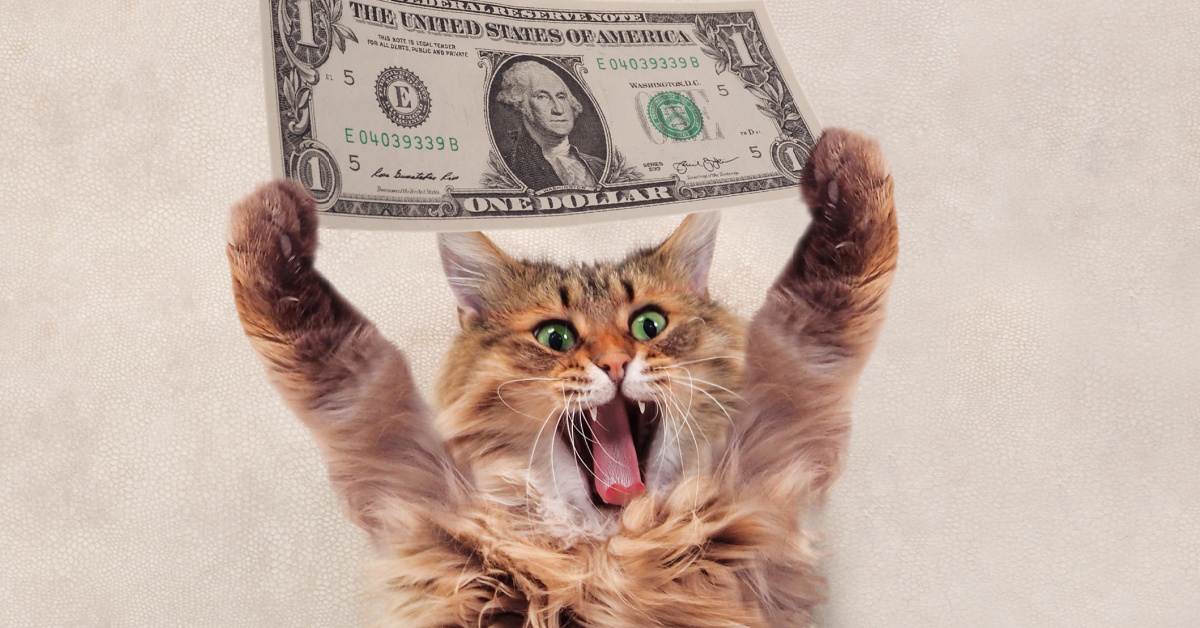
Caring for a house panther can cost between $4,250 and $31,200 over kitty’s lifetime, according to an analysis of associated costs by The Ascent, a vertical of financial literacy site The Motley Fool.

Kitty Cash
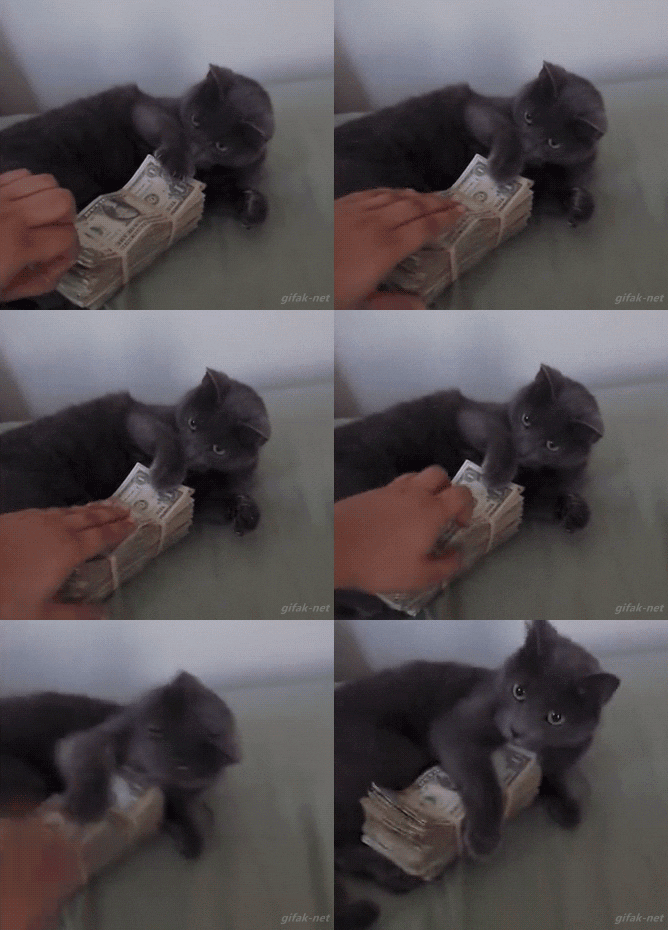
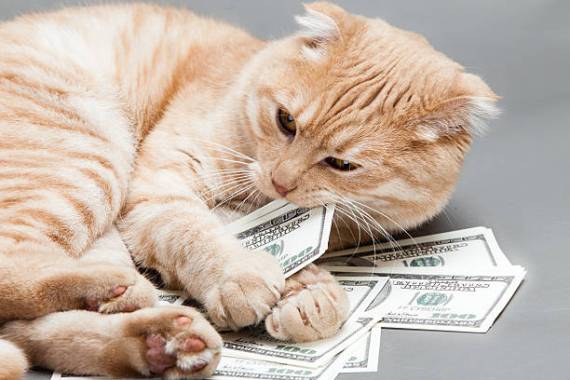
“My moneys, human! MINE! Unpaw those bills!” Credit:@catsandmoney/Twitter

The estimates break costs down into recurring expenses — which include food, treats, litter and veterinary care — and fixed expenses like scratching posts, toys, additional cat furniture, bowls, grooming tools and similar items.

Not surprisingly, the biggest expense is food, the cost of which has been exacerbated by inflation, rising fuel costs and lingering supply chain issues that caused a cascade effect during the pandemic. Everything from sourcing metal for cat food tins to meat availability was impacted as ports were closed and meat processing plants were shuttered at various points since early 2020.

An unrelated estimate from OnePoll, based on a survey commissioned by pet food company Solid Gold, put the lifetime estimate of cat servitude at $25,304. Like the Motley Fool analysis, OnePoll’s respondents cited food as the primary expense, followed by veterinary care.

The wide range from the Motley Fool analysis could be attributable to geography, how well the cat is fed, and how many extra things caretakers do for their cats. A person who lives in Manhattan, splurges on bespoke feline furniture and buys ultra-premium cat food at almost $3 a can is going to spend significantly more than an eastern European cat servant who feeds raw or home-cooked food and builds their own ledge loungers and scratching apparatus.

Teh Bank of Kitteh
“Welcome to Teh Bank of Kitteh, you may make a deposit but not withdraw!” Credit: @catsandmoney/Twitter

Here in New York the cost of cat food in local grocery stores has spiked dramatically, but online prices have remained steady. Keeping in mind we’ve never really endorsed any particular brand or vendor on PITB, I switched from occasionally buying food online to Chewy auto-shipments during the pandemic because Bud’s favorite food was becoming very difficult to find locally, and that arrangement has worked out cost-wise as well.

Bud’s a true Pain In The Bud when it comes to “leftovers” so his primary wet food is Sheba Perfect Portions. It’s reasonably priced, comes in variety packs and helps avoid waste since each meal comes in its own 1.3oz recyclable blister-like plastic package. (Recycling is especially important with these single-serve packages, tiny as they are.) His dry food is Blue Buffalo Wilderness Adult Chicken recipe, although occasionally I’ll buy the weight control version of the same dry food when it looks like Little Man has gotten a bit chubby. He doesn’t protest, thankfully.

I feed him two 1.3oz wet meals a day and fill his dry bowl less than halfway at night so he can have his late snack and doesn’t have to wake me up if and when he gets hungry overnight. Sometimes I’m dimly aware of him sliding off me, padding over to his little dining nook and munching on dry food before hopping back onto the bed and dozing off again.

Overall it works out to about $21 a month, so I’d call it an even $25 with treats. You can schedule your auto-ship at any interval you choose, edit it at any time, and prompt the shipment immediately if you’re running out of food, so you can save more by ordering a few months’ worth of food at a time and taking advantage of free shipping on orders of more than $50.

Has inflation impacted cat food prices in your local area? How much does it cost to feed your cat(s) every month?

Rich Kitty
“I’m a nip dealer, so what? Stop judging!”

Sunday Cats: A Lost Cat Story With A Happy Ending, UK Takes Cat Abuse Seriously

The UK demonstrated it doesn’t tolerate animal abuse with severe punishments for a star soccer player who abused his cat.

A North Carolina woman suffered a roller coaster of emotions after she lost her cat, then found out the local SPCA had taken her cat in, only for the shelter’s staff to tell her a family had already adopted the cute tuxedo.

Chevelle Griffin of Asheville says her cat, Sally, went missing on Oct. 18. She didn’t know what happened until a few days later when she saw a Facebook post indicating a neighbor had taken Sally to the local SPCA. Sally was wearing a flea collar, but not an ID collar and was not microchipped.

Griffin blamed herself.

“That was my fault,” Griffin said. “That was my mistake. I should have had her chipped, but I didn’t and she’s mine and I want her back.”

She wasn’t happy when staff at the shelter “very bluntly” told her Sally had already been adopted out.

Sally the Cat
Sally was taken to the SPCA by a neighbor.

Lisa Johns, chief operating officer for the local SPCA, told local ABC affiliate WLOS that the shelter takes in as many as 35 cats a day and holds new animals for 72 hours. After that, if they have no health issues they’re put up for adoption.

Fortunately, the story has a happy ending. After Griffin lobbied the SPCA and WLOS began looking into the incident, SPCA staff contacted the family that had adopted Sally and asked if they would be willing to return her. They agreed, and Griffin said she’s relieved and has learned from the experience.

“I’ve kicked myself so much,” Griffin said. “If I’ve learned anything from this, get your pets chipped.”

It’s a tough balance for shelter operators dealing with overcrowding and the need to constantly free up spaces for new strays, but should the hold period be extended beyond 72 hours?

Zouma apologizes again

zoumabengals
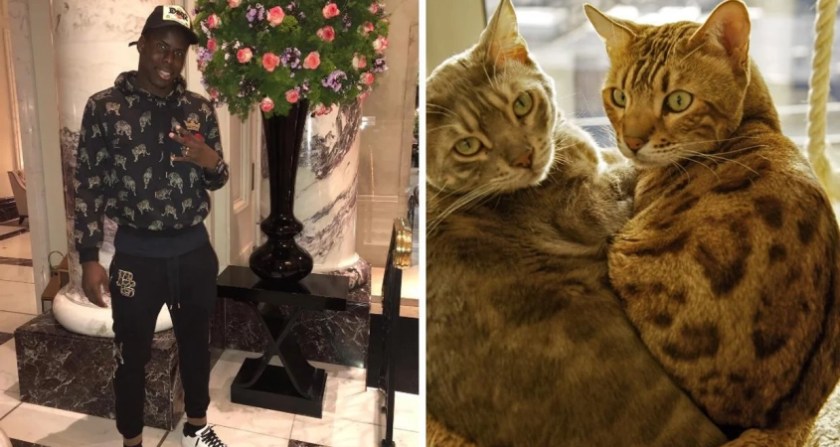
Zouma, left, and his Bengal cats, right. Both cats were confiscated and remain in the care of the RSPCA. As part of the sentencing agreement for his animal abuse plea, Zouma will not be permitted to own a pet for at least five years.

Kurt Zouma — the West Ham player who ignited a firestorm earlier this year when his brother uploaded video of Zouma slapping, kicking and harassing one of his own cats — said he learned his lesson and again expressed remorse after he was sentenced by a magistrate’s court.

Zouma, a French national, faced consequences that would be unheard of in the US as a result of the abuse: He lost all his sponsorship contracts, was fined the maximum amount by his club team (£250,000, equal to about $338,00 at the time, a full one fifth of his salary), paid court fines of £9,000, is prohibited from owning pets for at least five years, and was ordered to complete 140 hours of community service. West Ham donated Zouma’s fined salary to animal charities in the UK.

He was persona non grata in the UK football world, subject to hearty boos and chants from crowds any time he touched the ball, and his cats were taken from him and placed in the care of the RSPCA. In addition, he was not selected for the French national team, meaning he won’t compete in the World Cup.

Following his sentencing this week in his first public comments about the controversy — aside from a terse apology in the form of a written statement issued months ago — Zouma said he acknowledges the video was “very tough for people to watch” and admitted he’d “done something very bad.”

Zouma’s brother Yoan was also convicted of animal abuse, receiving court fines and 140 hours of community service for participating in the abuse and filming it in front of his brother’s young son. Our readers might recall the brothers were turned in by a woman who was courted by the younger Zouma and was disgusted when she saw the video.

The woman had initially agreed to meet Yoan Zouma for an informal date, but told him to keep his distance after she saw the abuse clip, then reported the brothers to authorities.

“I don’t think hitting a cat like that is OK – don’t bother coming today,” she wrote in a message to Yoan Zouma at the time. “I do not want to associate with people who find that funny, in front of a child as well.”

Although what Zouma did was terrible, it feels like justice was served and the UK did right by the cats by taking the abuse seriously, both criminally and professionally. Instead of “canceling” Zouma, as would have likely been the response here in the US, the authorities in government and the Premier League made sure the footballer understood the gravity of his actions and took responsibility for them. Hopefully it served as an example to others who would think of harming their pets.

100 Years Ago, An Archaeologist Unearthed The Most Incredible Find In History

100 years ago today, Howard Carter found a tomb filled with statues of cats, as well as the mummy of some guy named King Tut!

Howard Carter’s peers felt sorry for him.

The British archaeologist’s contemporaries watched him dig in Egypt’s Valley of the Kings year after year, grid by grid in what they were sure was a fruitless search for something that didn’t exist. Everyone knew the sand-covered necropolis had yielded all of its secrets. Everyone knew Carter was wasting his time — and the funds of his patron, the Earl of Carnarvon — looking for the tomb of an obscure, apocryphal boy king who allegedly ruled Egypt for nine years in deep antiquity.

After 15 years, the partnership between Carter and Carnarvon was about to end. Even the wealthy aristocrat had his limits, and after so much time and effort chasing an apparent mirage, Carnarvon declared he would pay for one final season of archaeological work in 1922.

Carter had been laboring in the necropolises along the Nile since he was a young boy and apprentice to the great archaeologists of his time. Aside from seasons that were cut short by war, the Egyptologist had spent three decades digging in those valleys. Now he was about to be out of a job and a patron.

Carter's notes
Howard Carter’s discovery made him the most famous archaeologist in history, but it also left him with the incredible task of preserving and cataloguing everything in the more than 3,000-year-old tomb. Here’s a page from Carter’s notes about a statue of Anubis. Credit: Wikimedia Commons

Exactly 100 years ago today, Carter wrote a terse entry in his journal: “First steps of tomb found.”

Those steps descended to a door of limestone and plaster, marking the entrance to an antechamber. A second doorway lay sealed in the gloom, and after dispatching a letter imploring Carnarvon to make haste to Egypt, Carter waited for the arrival of his patron and chipped away at the second door, peering through a tiny hole.

With trembling hands I made a tiny breach in the upper left-hand corner. Darkness and blank space, as far as an iron testing-rod could reach, showed that whatever lay beyond was empty, and not filled like the passage we had just cleared. Candle tests were applied as a precaution against possible foul gases, and then, widening the hole a little, I inserted the candle and peered in, Lord Carnarvon, Lady Evelyn and Callender standing anxiously beside me to hear the verdict. At first I could see nothing, the hot air escaping from the chamber causing the candle flame to flicker, but presently, as my eyes grew accustomed to the light, details of the room within emerged slowly from the mist, strange animals, statues, and gold – everywhere the glint of gold.

The earl, sensing a shift in Carter’s mood, queried him: “Do you see anything?”

Carter paused to collect himself before answering.

“Yes,” he said. “Wonderful things!”

The rest is history.

It turned out the room Carter first glimpsed was yet another antechamber. It had been breached in antiquity and tomb robbers had taken some of its valuables before resealing it, but they hadn’t breached a second chamber, the one that contained what are now the most famous finds in archaeological history: The iconic gold funerary mask of King Tutankhamun, the ornate sarcophagus inscribed with prayers from the Egyptian book of the dead, a life-size statue of the boy pharaoh and other statuary, impeccably designed furniture, vases, funerary candle holders, textiles, canopic jars, even chariots and a model ship. There were cats too, including statues of felids big and small.

Tut coffin
A second coffin made of wood and gold encased the pharaoh’s body and was placed within the sarcophagus.

Everything was gilded, and everywhere Carter’s torch cast light was the glitter of gold. He had been vindicated. Subsequent rulers had almost erased Tut’s name from history, and many doubted he was a historical figure. Now Carter not only proved the boy pharaoh was real, he had discovered the best-preserved tomb in history, ignited renewed interest in ancient Egypt, and unearthed objects that would leave indelible marks on human culture.

For more about Carter’s historic discovery, King Tutankhamun himself and the impact of the incredible discovery as the world celebrates its 100th anniversary, here’s some further reading:

Funerary Mask of King Tutankhamun
The funerary mask of King Tutankhamun is perhaps the most recognizable and iconic artifact from ancient Egypt. Credit: Wikimedia Commons
Leopard from King Tut's tomb
A sculpture of a leopard found in Tutankhamun’s tomb. Cats were important in ancient Egypt, and feline/felid imagery abounds in depictions of deities, statuary and motifs. Credit: Wikimedia Commons

Cats May Be Able To Help Detectives Solve Crimes

An Australian team decided to look for DNA evidence in a novel place: cat fur. Their findings could give law enforcement a powerful new tool to identify crime suspects.

Check out our newest feature, catwire!

When you think of a crime scene, you probably picture uniformed officers manning the perimeter, crime scene tape cordoning off the room where the deed was done, detectives trying to reconstruct what happened, and techs collecting evidence.

Those techs might swab surfaces for traces of a suspect. Drinking cups and water bottles might be dusted for fingerprints, stray hair might be bagged and sent back to the laboratory for analysis. Discarded cigarette butts, door handles, buzzers — they can all yield evidence, to say nothing of cell phones, USB sticks and smart appliances.

But what about the pets? If a suspect was especially careful not to leave prints or touch anything at the crime scene, could the fur of a cat harbor DNA?

A team comprised of scientists from Australia’s College of Science and Engineering at Flinders and the Victoria Police Forensic Services Department wanted to know if cat fur could indeed hold critical evidence at crime scenes, so they conducted a study involving 20 pet cats from different homes, and what they found could provide an important tool for law enforcement. Their findings were published in the journal Forensic Science International.

If detectives are trying to piece together the identities of robbers who, say, broke into a home, brutalized the people there at gunpoint and stole their valuables, they can’t interview the victims’ pet cats about what they saw, but it turns out they can swab the kitties’ fur and have an excellent chance of retrieving useful DNA.

Blacksad
Blacksad is a famous feline detective in his own series of comic books. He may have to be careful not to leave his stray fur all over his own crime scenes.

The research team swabbed the fur of pet cats in their test households, took DNA samples of the adults living in those homes — who were the stand-ins for victims — and asked the human participants to fill out surveys asking about their cats, what they do on a typical day, and whether or not they have interaction with people outside the home.

After the team conducted DNA analysis on the fur swabs “[d]etectable levels of DNA were found in 80% of the samples and interpretable profiles that could be linked to a person of interest were generated in 70% of the cats tested,” the study authors wrote.

While most of the samples matched the DNA of people who lived in the homes — as expected — samples from six cats revealed the presence of DNA from other people. The research team didn’t take DNA samples of minors, and two of the positive fur swab samples came from cats who lived in a home with a child and slept in that child’s bed most evenings. But four other samples turned up “mystery” DNA even though no one else had visited those homes for at least several days.

For DNA from pets to have any real evidentiary value, prosecutors have to prove a “chain of custody” of sorts, establishing that suspects could not have had contact with the animals in question unless they were inside a home where a crime has taken place. If the cat is allowed to roam outdoors every day, for example, it becomes much more difficult to prove a suspect’s DNA was transferred to a pet inside a home rather than on the street.

That’s why the research team is hopeful, but also cautions that their study is a first step toward understanding more about how human DNA is transferred to fur, whether it requires a person to be physically present (as opposed to their DNA being passed along secondhand in stray hair or skin cells), how long a cat’s fur can harbor human DNA, and other questions prosecutors will have to answer.

“This type of data can help us understand the meaning of the DNA results obtained, especially if there is a match to a person of interest,” said study co-author Mariya Goray, a DNA transfer expert. “Are these DNA finding a result of a criminal activity or could they have been transferred and deposited at the scene via a pet?”

The team recommends more research “on the transfer, persistence and prevalence of human DNA to and from cats and other pet animals and the influences animal behavioral habits, the DNA shedder status of the owners and many other relevant factors.”

If they do answer the aforementioned questions and prosecutors believe they can establish a suspect’s presence at a crime scene thanks to feline-provided evidence, it might not be too long before we see a cat-centric episode on future seasons of Law & Order or CSI, both of which are scheduled to be revived as police procedurals enjoy a resurgence on TV.

Must rub on person!
As dedicated cat servants know, cats rub against everything and everyone. The behavior is instinctual, and cats have pheromone glands on their faces, sides and paws, which they use to transfer their scent..and fur.