Who Freed Dallas Zoo’s Clouded Leopard? Cops Say Cat’s Enclosure Was Intentionally Breached

The 25-pound wildcat was found late on Friday afternoon. Now investigators are trying to determine who freed her and why.

A clouded leopard who went missing from her enclosure was intentionally let loose according to police, who have opened a criminal investigation.

The medium-size wildcat, whose species is native to the foothills of the Himalayas, escaped from her enclosure some time between late Thursday night and Friday morning, prompting a zoo-wide shutdown and a massive coordinated search. During that time, zoo staff emphasized to local press — and in social media posts — that clouded leopards are not aggressive toward people and the escaped cat wasn’t a threat.

She was eventually found safe and unharmed on zoo grounds, hiding in a tree not far from her enclosure, at about 4:40 p.m. on Friday. She was secured within 35 minutes, zoo officials told the Fort Worth Star-Telegram.

But that’s not the end of the saga. Zoo staff say the leopard, a three-year-old named Nova, didn’t escape on her own — a person or persons breached the two-story exhibit by cutting through the mesh fence. Nova’s sister, Luna, lives in the same enclosure and did not leave the area.

Clouded_leopard_(14134537190)
A clouded leopard. Credit: Wikimedia Commons

Now investigators are trying to determine if the people responsible for breaching the enclosure were committing an act of vandalism or intended to take the 25-pound wildcat.

“We found a suspicious opening in the habitat wall in front of the exhibit,” a Dallas Zoo official told reporters on Friday afternoon. “It was clear that this opening was not exhibit failure and it wasn’t keeper error.”

Police are reviewing surveillance footage and looking for clues in the 106-acre zoological park, which is located about three miles south of downtown Dallas and is home to more than 2,000 animals.

“It is their (Dallas Zoo officials’) belief and it is our belief that this was an intentional act, so we have started a criminal investigation,” Sgt. Warren Mitchell of the Dallas Police Department said.

Harrison Edell, vice president of animal care and conservation at the Dallas Zoo, warned against anyone attempting to steal zoo animals.

“This is a cat of conservation concern,” Edell said. “This is not a pet — she’s a critically important member of our family at Dallas Zoo.”

Clouded_Leopard_b_d
Clouded leopards diverged from a common ancestor shared with big cats, but typically don’t grow to more than 30 or 40 pounds. Credit: Wikimedia Commons
Clouded_Leopard_(36997885773)
There are fewer than 10,000 clouded leopards left in the wild. In captivity, the wildcats live for 11 years on average. Credit: Wikimedia Commons

A Tabby Cat Tours Pompeii’s Newly Restored Roman Mansion

Cats were treasured pets in ancient Rome, and strays can be found living in the ruins of the empire today.

This is only tangentially related to cats, but 1) It’s awesome, 2) It represents one of the best surviving examples of Roman home life, and 3) Cats invited themselves to the party.

The AP has a story and an extensive photo gallery of what it calls “newly restored remains of an opulent house in Pompeii that likely belonged to two former slaves who became rich through the wine trade offer visitors an exceptional peek at details of domestic life in the doomed Roman city.”

The House of Vettii was known as Domus Vettiorum in Latin and its owners, Aulus Vettius Conviva and Aulus Vettius Restitutus, were freed slaves who used their knowledge of wine — probably gleaned from their former dominus — to launch a successful business which propelled them to the economic heights of Roman society.

And who do we have there in slide number 16 of the photo gallery? A tabby cat, checking out the restored lararium, a nook where Romans would venerate their “household gods.”

tabbypompeii
A tabby cat prowls the House of the Vettii in Pompei. Credit: AP

The Vettii spared no expense when it came to hiring the best craftsmen and artists to lavishly decorate their home, covering the walls with scenes from Greek and Roman mythology. It took 20 years to restore the domus to much of its former glory

“They evidently tried to show their new status also through culture and through Greek mythological paintings, and it’s all about saying, ‘We’ve made it and so we are part of this elite’” of the Roman world, said Gabriel Zuchtriegel, a German archeologist who is now the director of the Pompeii archaeological park.

Looking at the restored home, it’s clear shows like HBO’s Rome and Starz’ Spartacus did a good job of portraying what Roman houses looked like on the inside, and how individual rooms were used by the people who lived in the homes as well as their servants:

pompeiidomus
Well-preserved walls show meticulously rendered scenes in the House of the Vettii. Credit: AP

We tend to think of ancient Greek and Roman buildings as monochrome since the paint has long worn off most structures, but the unique circumstances of Pompeii allowed some homes and other structures to remain largely preserved under volcanic debris since 79 AD.

Here’s a scene from Rome showing the interior of Servilia’s home, giving us an idea of how a wealthy Roman’s house would have looked in contemporary times:

Rome
Servilia and Octavia from HBO’s Rome. Credit: HBO

Can Cats Solve New York’s Rat Problem?

When even the mayor can’t keep rats from overwhelming his property, it’s clear New York is losing its battle against rodents.

For the second time in seven months, one of New York Mayor Eric Adams’ own health inspectors has ticketed him for rat infestations at the Brooklyn brownstone he calls home.

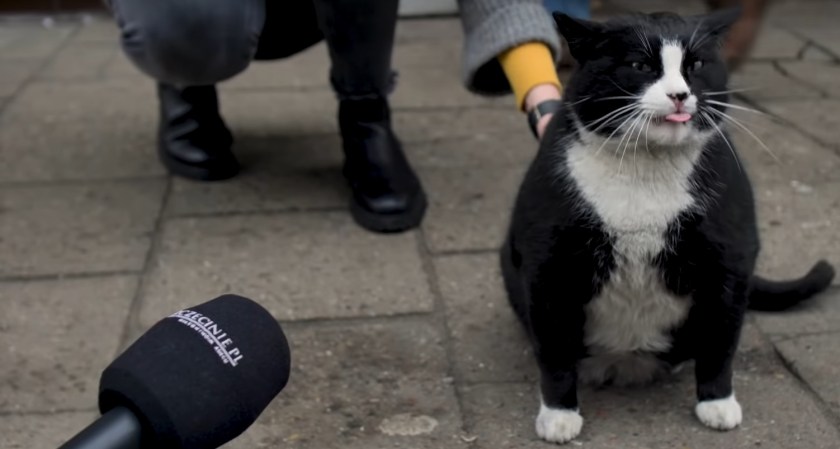
Because it wouldn’t be New York without things turning into a circus, the man who unsuccessfully ran against Adams for the mayorship, Guardian Angels founder Curtis Sliwa, took advantage of the mayor’s embarrassment by bringing two of his 16 18 cats to Adams’ block and holding a press conference on the sidewalk where he touted felines as the solution. (Adams, who is well known for his hatred of the rodents, famously held a “rat summit” at Brooklyn Borough Hall in 2019, “gleefully” showing off a new rat-killing contraption to reporters.)

Introducing reporters to his tuxedo, Tiny, and tabby cat, Thor, Sliwa said Adams was missing the most obvious solution to the rat problem — cats — and offered to become the city’s “rat czar” free of charge.

“Like most New Yorkers, [Adams] is frightened of rats,” Sliwa told reporters outside the mayor’s brownstone. “He’s tried everything but it’s time that we revert back to the best measure that has ever worked — and that’s cats.”

As we’ve noted before on PITB, Sliwa and his wife are dedicated cat servants, perhaps overly so. They currently house 18 cats in their Manhattan studio apartment, Sliwa said on his radio show this Sunday. Some of them are the couple’s pets and some are fosters for their rescue.

sliwacats
Nancy and Curtis Sliwa with one of their cats. Credit: Matthew McDermott

The rat problem in New York is real and, sadly, as bad as people make it out to be. You can hear them at night in many neighborhoods, and it’s not unusual to see them briefly caught in the glow of streetlights before scurrying into the shadows again.

I’ll never forget watching an entire conga line of them at the 125th St. subway platform. They just marched out of a hole in the twilight, each one bigger than the last, going about their business without any concern for what people might do to them.

And the answer, they know, is nothing. Because New York’s rats aren’t regular rats. They’re well-fed freaks, ballooning to enormous sizes thanks to the abundance of garbage cans to eat out of and the way garbage is collected in the city. Back in 2015, video of a rat dragging an entire slice of pizza down the steps to a Manhattan subway platform went viral, racking up more than 12 million views and earning the rodent the title Pizza Rat:

People who aren’t from New York and have never visited are probably shocked to see garbage piled high on the sidewalks of every street. New Yorkers are supposed to put the garbage out the night before pickup, but no one really observes that rule, and the mounds of trash grow for days before sanitation removes them. It’s a feast for the rats, and any solution has to start with cleaning  up the garbage situation.

In the winter the cold weather prevents the contents of the trash from rotting, so the stink isn’t as bad, and sometimes the trash mountains are covered by snow.

But in the summer, when the tree-lined avenues get their green canopies and flowers bloom in window boxes, the city reeks. On hot days, the perfume of New York is rotting trash and the overwhelming smell of urine wafting up from the subways. Sometimes I think of what the Japanese, with their spotless streets and shiny subways, must think when they come to New York for the first time.

In October, after the city fielded a 71 percent increase in rat complaints over the previous year, the city introduced a new law making it illegal to put trash on the sidewalk before 8 pm ahead of pickup the following morning. The change hasn’t made a dent in the rodent problem.

ratssize
A 2015 study by Matt Combs of Fordham University documented the enormous size of New York City’s rats. Credit: Matt Combs

In any case, New York is not a good place for cats. Thankfully we have a huge and generally well-funded network of rescues that get kitties off the street and pulls cats and dogs from the city’s animal control system before they’re due to be euthanized, but strays who fall through the cracks don’t last long.

Indeed, when the New York Post talked to one of Mayor Adams’ neighbors shortly after Sliwa’s latest press event on Sunday afternoon, the woman said she’d like another cat to patrol the area around her building. The last one, she explained, had been run over by a car.

I don’t really expect anything to come of Sliwa’s plan to use cats in rat-infested locales. The red-bereted radio host is hawking the scheme because he likes to be a thorn in the mayor’s side, and because it generates free publicity, especially from the city’s tabloids and local news channels.

But if it ever comes to fruition, and people really expect strays to handle their rat problems, Sliwa and company better have a plan to keep the cats safe from traffic.

TikTok’s Latest Viral Trend Is Popping Cat Pimples: Can We Ban This App Already?

Each viral trend on the app is more grotesque than the last.

I’m all out of withering sarcasm, so I’ll just say it: The newest trend on TikTok involves close-up videos showing people popping their Sphynx cats’ pimples.

The PewDiePie of the craze, if you will, is one @Sphynx.cleaner, whose videos show a woman’s carefully manicured hands holding a defeated-looking Sphynx cat and popping its pimples between her formidable fingernails.

Tens of millions of people have watched her videos of puss pimple-popping, not including the millions of other views accumulated by lesser practitioners of the grotesque genre.

Sphynx cats lack fur and have skin often compared to chamois leather. Fur helps cats absorb and redistribute naturally-occurring oils secreted by the skin, so felines of the Sphynx breed are much more susceptible to acne problems than typical short- and long-haired cats. Without fur to help redistribute them, the skin oils can create a “film” that clogs pores, according to Jessica Taylor, a veterinarian in North Carolina.

Sphynx pimples
Uh, no. Credit: Sphynx.cleaner/TikTok

Not surprisingly, popping a cat’s pimples makes things worse and is not pleasant for the kitty.

“These lesions indicate a disruption in the skin and skin barrier, and squeezing or poking them can introduce bacteria, potentially worsening the lesion, causing pain and infection,” Taylor told Newsweek. “If the lesion is already infected, handling it could spread bacteria to the pet parent.”

As for TikTok, this is not the first time one of the app’s trends has been detrimental to the health and safety of felines, although most of its inanity is focused on humans. I suppose you can view it as some sort of advanced Darwinian engine, accelerating the self-removal of human beings from the gene pool. Among the trends that have gone viral on the app:

  • People who use self-tanning bottles as nasal spray out of some misguided belief that ingesting the stuff will not only achieve the desired effect, but somehow lead to a more even, natural-looking distribution of tanner. It reminds me of former President Donald Trump’s impromptu suggestion, during a national press conference, that ingesting hand sanitizer could be a “tremendous” way to stop COVID.
  • Videos instructing women to eat the tablets inside Clearblue pregnancy tests as a “contraceptive hack,” claiming the tablets — which are designed to absorb urine during the chemical test — are actually morning after pills.
  • People ingesting methylene blue — an anti-fungal fish tank cleaner — because “fitness influencers” say it can “cure” COVID-19, boost metabolism and slow the aging process. Think of the triumph of critical thinking here: These are people who won’t get a vaccine that’s been through three-stages of trials before getting FDA approval, and whose efficacy and safety have been the subjects of rigorous peer review, but they’re willing to drink a chemical manufactured and sold as a cleaning solution for fish tanks.
  • The so-called Nyquil Challenge, in which people use Nyquil instead of cooking oil to cook chicken in a frying pan.
  • Period blood face masks, which are self-explanatory. Another grotesque and potentially dangerous trend started by “influencers” who claim some sort of nebulous expertise and know that “hacks” will net them attention and clicks. The more outrageous, the better.
https __prod.static9.net
“Did you know that urinal cakes are made by Carvel? It’s true! They’re deliciously chocolatey, with just a hint of vanilla, cinnamon and industrial strength anti-bacterial. Mmmmmm!”

Of course, we’ve known for years that Chinese companies are beholden to the Chinese government according to Chinese law, which means the government — and the communist party — can help itself to TikTok user data whenever it wants.

After TikTok’s US-based executives insisted to congress that American users’ data is firewalled and cannot be accessed by the company’s employees in China — and, by extension, the Chinese government — a series of leaks confirmed that China’s government was in fact regularly accessing that data. Absolutely no one, except maybe the politicians who think the internet is a “series of tubes,” were surprised by this revelation.

China’s government can use the data to track journalists, exploit American and European users, program its algorithm to shuffle them toward harmful content, censor content the Chinese government doesn’t like, and even coerce individuals by threatening to release information on their viewing habits.

So can we evacuate TikTok’s US headquarters already, raze it to the ground, and ban the app from every mobile store?

methblue2
“Mr. Darwin! Mr. Darwin let him go! Magnifico!”

RIP Elliot, The Stray Cat Found Frozen To The Ground

Little Elliot was recovering from his ordeal, but developed a deadly blood clot.

This feels like a real gut punch, especially after a South Carolina veterinarian’s heroic efforts to save Juliet, the cat who had 38 hair ties removed from her stomach and died after her health seemed to improve.

Elliot, you’ll recall, was the poor, sweet stray who was found literally frozen to the concrete on the day after Christmas, when the country was in a deep chill the likes of which we haven’t seen in decades, with temperatures plunging well into the negative. A Good Samaritan found the little guy in a bad way, with his eyes frozen shut and his organs shutting down, but she turned up her truck’s heat and rushed him to Big Lake Community Animal Clinic in Muskegon, Michigan, where the staff took good care of him and named him after the storm he was found in.

They wrapped little Elliot up in warm blankets, gave him fluids and began to slowly raise his body temperature, which was a dangerous 94 degrees. Things started to look up, too: Elliot had a habit of reaching his paw out to the vet techs who were monitoring him, began to regain his appetite, and eventually was able to stand and eat on his own.

elliotcat_follow2

But Elliot’s health took a turn for the worse again, and veterinarians determined he developed a saddle thrombosis, which is described asa blood clot (called a “thrombus”) that lodges at the base of the aorta just as it branches into two distinct arteries, thereby obstructing blood flow to the hind limbs. It is so named because of the saddle-like shape it roughly resembles once it takes up residence in this location.

For cats who develop a saddle thrombosis, the outlook is not good, and drugs designed to dissolve blood clots are often ineffective.

“Sadly, there was nothing we could have done to prepare for that but we knew it was time to let him be free from the pain and struggle he’s known most of his life,” Big Lake’s staff wrote to supporters.

A staffer named Diane Neas, who took Elliot into her home after a few days when he’d stabilized, was particularly hard hit by the loss, and understandably so. Well-wishes and applications to adopt Elliot had come pouring in, and it seemed like the former stray’s suffering would lead to the best reward — a warm home of his own and people to love and care for him.

“We find peace in knowing the last two weeks of his life were spent with people who showed him kindness, care and love,” shelter staff wrote. “We can’t believe the following and support he has gained on this journey to healing; from the bottom of our hearts, thank you all for caring so deeply for him and sending such love and support his way.”

Images courtesy of Big Lake Community Animal Clinic

elliotcat_follow