Is that not a contingency you should have planned for, as part of your servantly duties to me, Buddy the Cat, First of His Name, Ruler of the Apartmental Realm, Distinguished Former President of the Americats, Prime Despiser of Vacuum the Infernal Wizard, Connoisseur of Turkey and Magnificent Buddinese Tiger?
It’s six degrees out! Even with the heater and the space heater, it feels like we’re in a refrigerator!
Ah, yes, I’ve helped myself to your seat. You snooze, you lose. It’s warm with your butt-heat, see, and besides, which seat is mine if not the one I’ve scratched approximately 20,000 times to the point where the fake leather is literally flaking off?
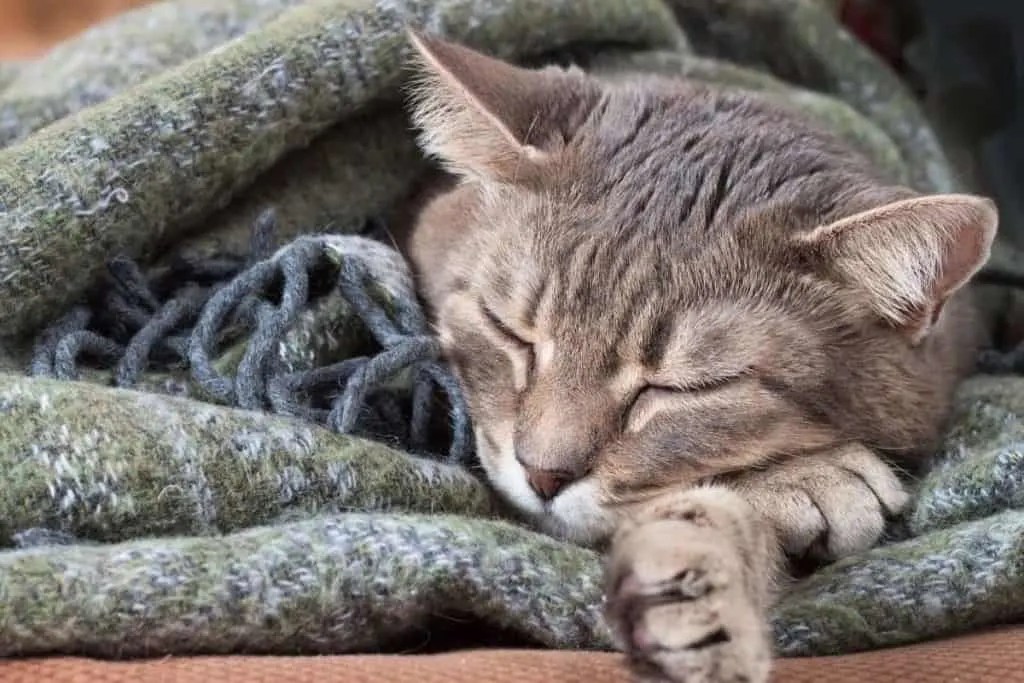
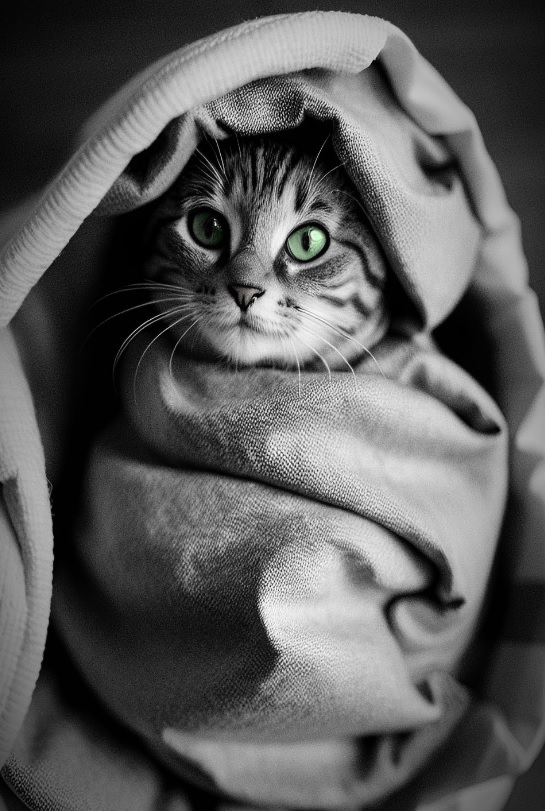
What are you doing? Wrapping me up? Well, that’s…a nice gesture, servant! Yes. Yes, this will do nicely. I feel like a newborn in swaddling clothes!
Now be a doll and fetch me some snacks so I don’t have to get up and you don’t have to wrap me up again. You’ve done well for yourself today, human. I am not displeased.”
“You can’t just buy your way out of this with treats, although treats are an important component of the remedial process.”
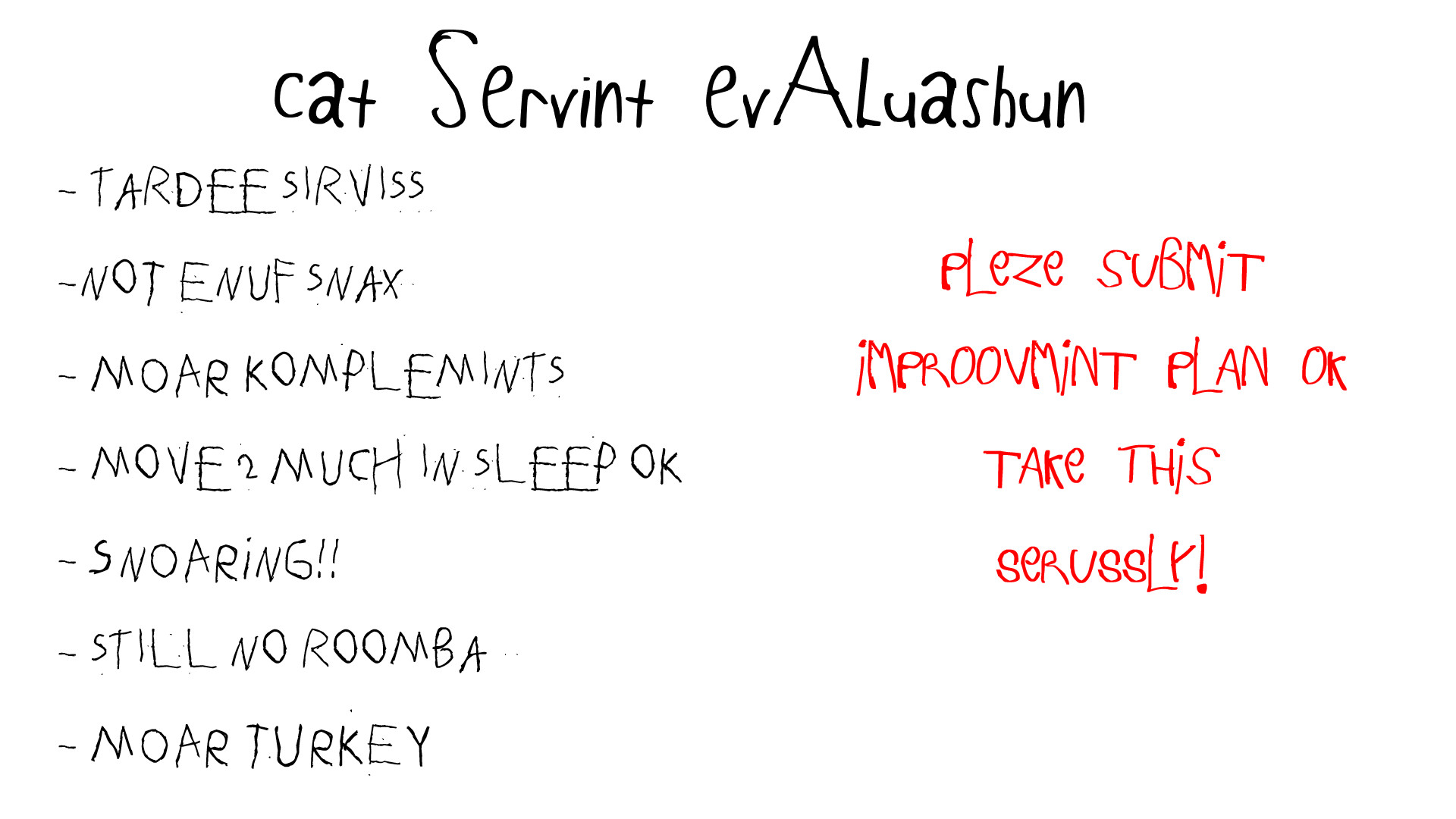
NEW YORK — The quality of Big Buddy’s work as a cat servant has been downgraded to “satisfactory” during his latest performance review, Buddy the Cat announced Tuesday.
The downgrade marks the end of a long streak for the dedicated human, who has consistently received high marks for impeccable service ever since he adopted the mercurial silver tabby cat.
“Big Buddy has always been a reliable servant, but in recent months his work has suffered in inexcusable ways,” Buddy the Cat told reporters at a news conference. “For instance, dinner was two minutes and thirty seven seconds late on December 14th, and on January 8th Big Buddy disregarded my need for uninterrupted beauty sleep when he got up to use the bathroom despite the fact that I was sleeping on his chest. That was a deep betrayal of trust.”
The human will automatically enter a probationary period triggered by the performance downgrade. In order to remain in good standing he’ll need to avoid being tardy with Buddy’s meals, ensure he anticipates Buddy’s demands for head scratches, and regularly remind Buddy he’s a very good and very handsome boy.
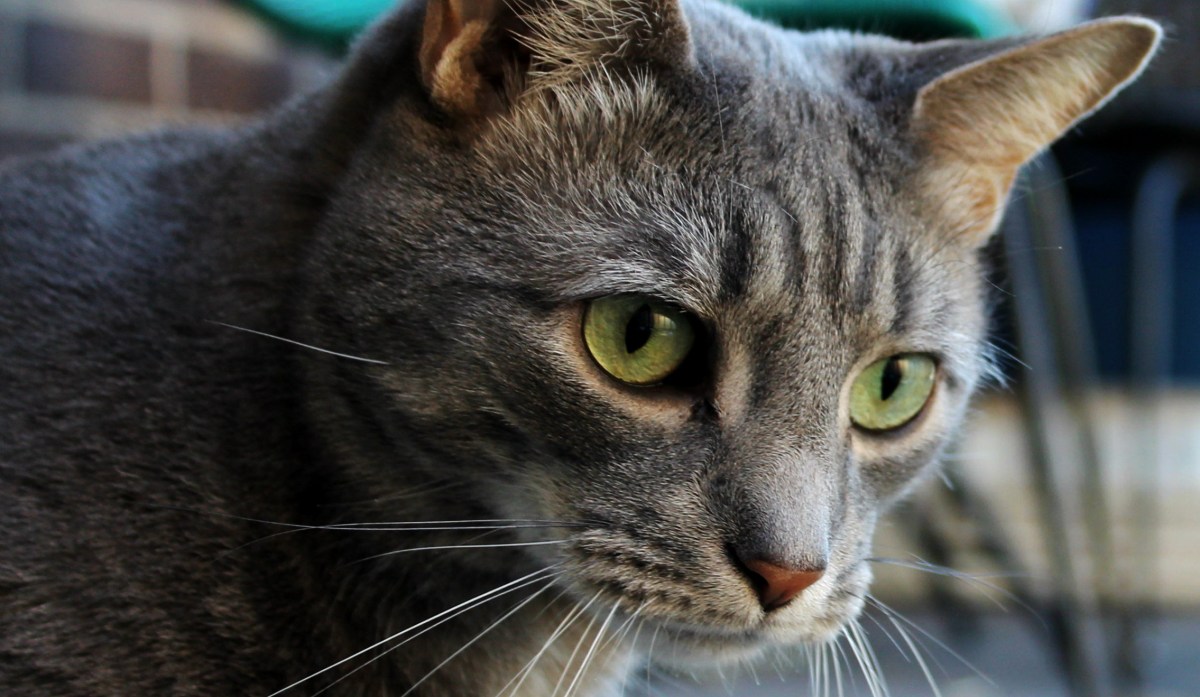
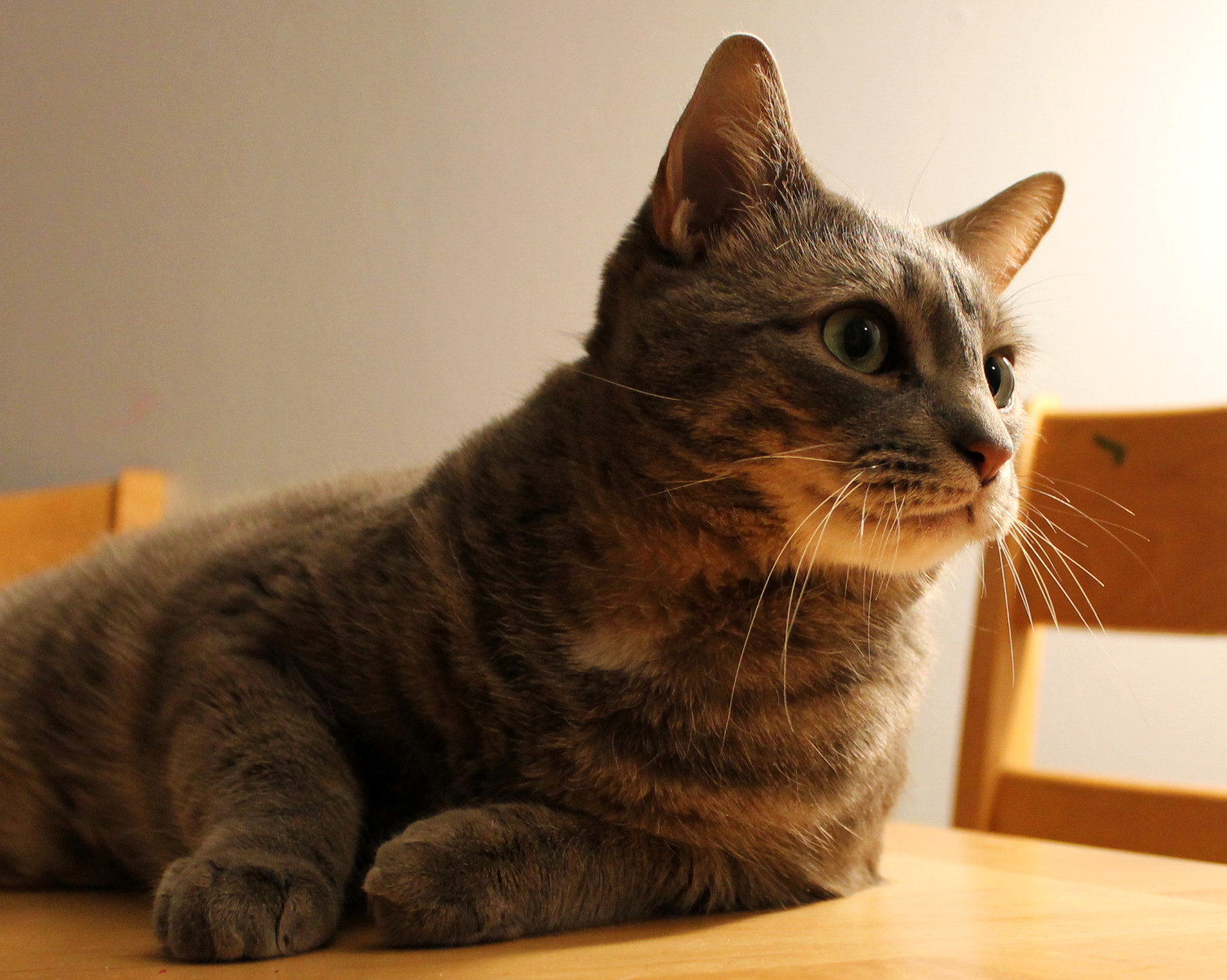
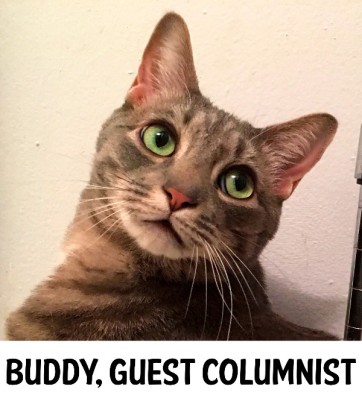
Buddy, above, has suffered from subpar service and was forced to downgrade his human’s servant scores.
Felix Meowson, a professor of servantology at the Feline Servant Academy of New York, said Big Buddy faces considerable challenges ahead.
“He’ll need to be attentive and hyper-vigilant going forward if he wants to return to good standing. Weeks worth of excellent service could be ruined by accidentally stepping on a tail or failing to top off the dry food bowl before bed,” Meowson said.
He pointed to The Great Disappointment of 2012 when Monica Morales, servant to a cat named Smudge, allowed a door to remain closed between her and her feline master for more than three hours.
“Monica’s evaluations had never slipped below ‘outstanding,’ but that little stunt cost her dearly and she was downgraded to ‘unacceptable,” Meowson said. “She wasn’t the recipient of an affectionate head bump for almost three months, and didn’t hear a purr for four. She was a cat servant in the dog house, so to speak.”
Buddy said he wanted to avoid the situation with his human becoming as severe.
“You can’t just buy your way out of this with treats, although treats are an important component of the remedial process,” he said. “This is about correcting an injustice, and restoring things to their natural order in which we eat, sleep and lounge, and humans see to our every need.”
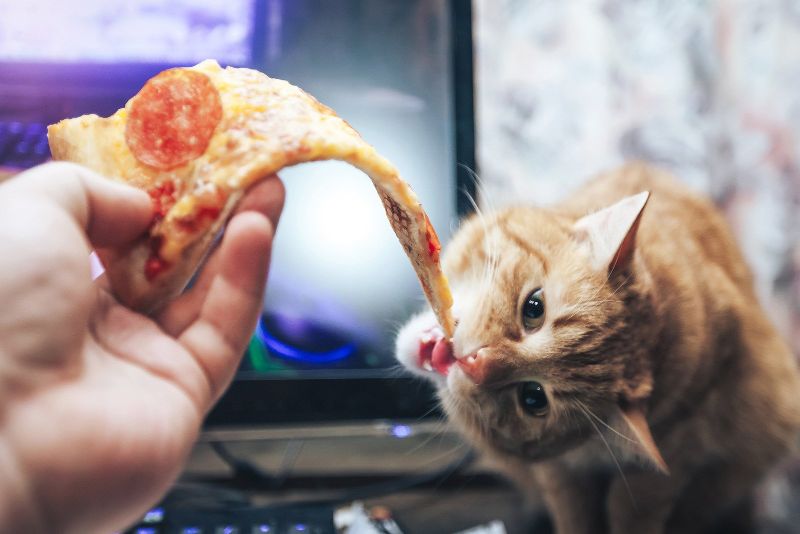
One meat lover’s pie with extra pate coming right up!
I’m pretty sure Buddy regrets teaching me all about animal cognition and emotion, which led me to adopting a vegetarian diet in 2015.
He’s never gone on the kitchen counters (such a good boy!) and when he does express interest in the fridge, it’s more of a rote status check, a defeatest confirmation that there’s nothing of interest for him in there aside from cheese.
But Bentley has no such scruples. The feisty feline from Oregon got his greasy little paws on a pizza one night and loved it so much that he’s become obsessed with the microwave, which is where he found that fateful slice.
Bentley’s human, Britney Shizo, said she put the leftover pizza in the microwave, then forgot about it until she returned to the kitchen and found Bentley happily feasting.
“The microwave is wide open and the pizza is on the floor and it’s gone, pretty much,” Shizo said.
Footage of Bentley, which has since gone viral, shows him determinedly trying to open the microwave door, gripping the handle with both front paws and using all the strength in his little body to get to that sweet, delicious pizza.
But, alas, he’s foiled by a child safety lock, which he refuses to accept as he strains, pulls and pushes the microwave in the hilarious footage:
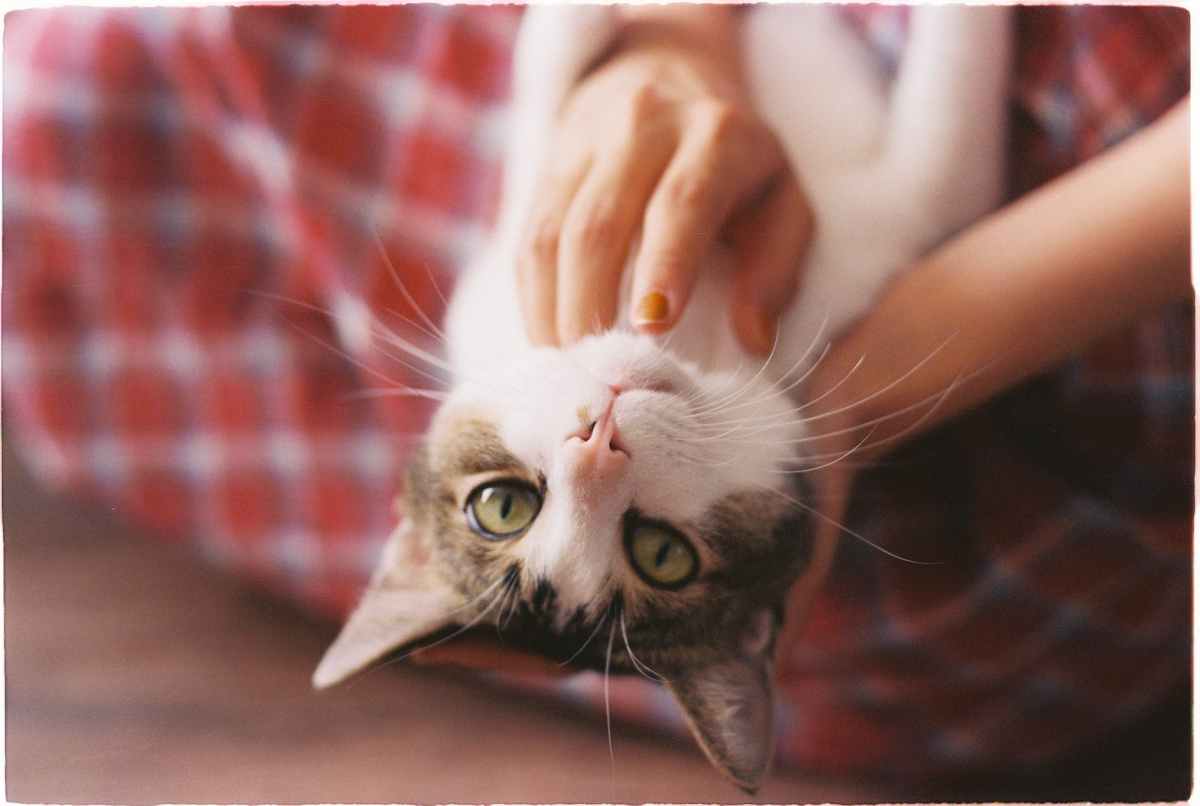
Buddy the Cat wants his human to keep scratching his head, while Buddy the Cat has had enough!
“Don’t Stop! Scritch Me More, Yeah!”
No! No, no, no, no, no! Do not stop! Bring those magic fingers back over here, right above my ears and…yeah!
That’s the good stuff!
Oh man. Down a little. Right there. That hits the spot! In fact, I bet it’ll feel even better when I help you out and lean into the scratches. Oh. I was right, that does feel good!
Hey, where are you…HEY!Who told you we’re done here?
Sheesh, you’d think I nip at you if you pet me too long or something.
You didn’t spend an adequate enough time on my chin yet, and you know I like it when you swing back around for a sort of “greatest hits” and go through the whole rotation again. Now I’m going to assume you don’t need additional instruction, so I’ll just close my eyes and purr away. Don’t stop until the precise moment you should. That’s a good human.
“Don’t You Humans Know When Enough Is Enough?”
All right already, sheesh! The petting was good for like 3.275 seconds, but it got really played out after that, and you just kept going!
Well whose fault is it that I delivered a warning bite? Me, or the person who couldn’t tell when it was clearly time to stop rubbing my head?
What is it with you humans, huh? Learn to read the room. If I want more scritches, I’ll ask for them.
But no. When I was tired of it, you allowed another two tenths of a second to elapse before ceasing all massaging activities. TWO TENTHS OF A SECOND! I should have you flogged for your insolence!
You’ve had years to improve at this, human. That’s thousands of scritches and massages delivered to my chin, my cheeks, the top of my head and behind the ears. What can account for your complete failure to anticipate the exact millisecond the petting should stop?
You disappoint me.
Point-Counterpoint presents two essays taking opposing positions on a topic. Join us again next week, when Buddy the Cat will debate Buddy the Cat on another important topic.
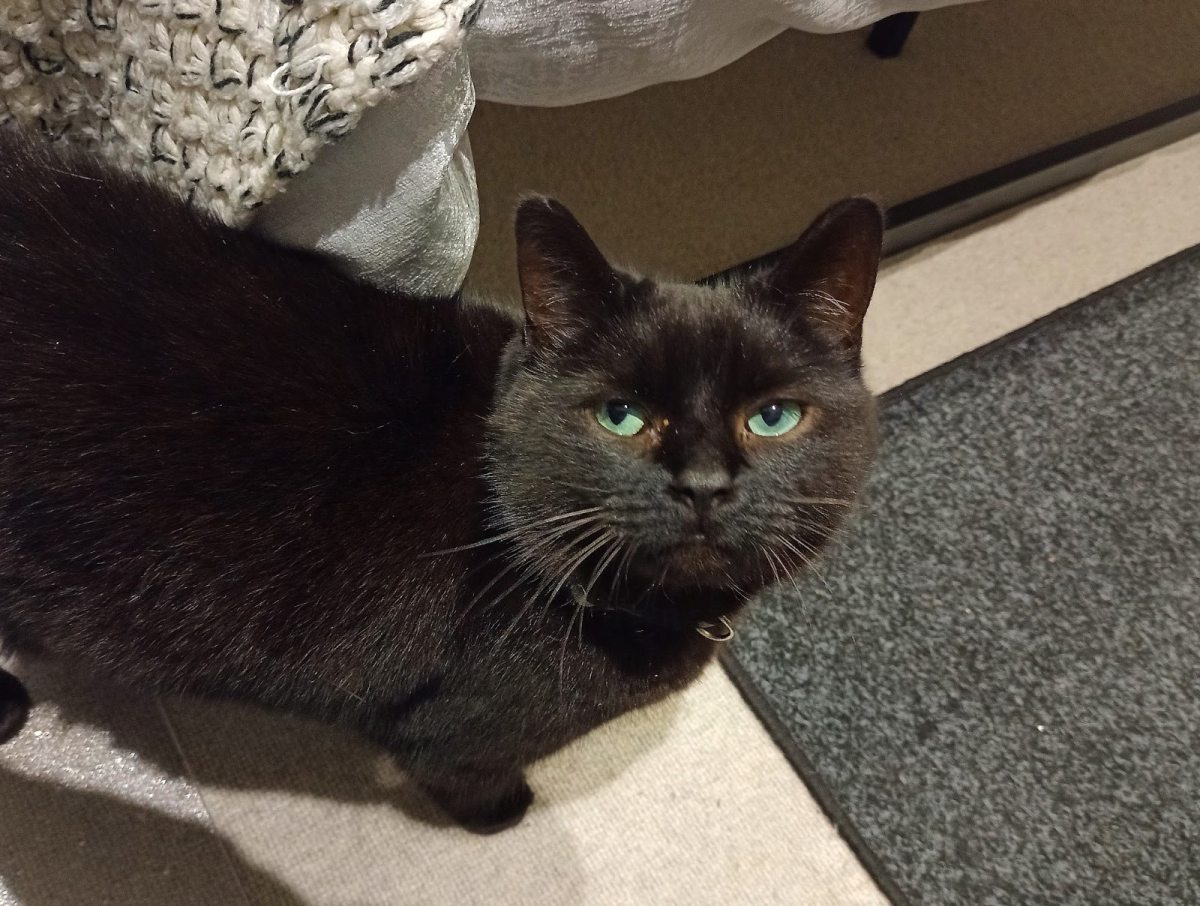
With her mesmerizing green eyes, supreme confidence and strong opinions, Bella has pawed her way into her humans’ hearts.
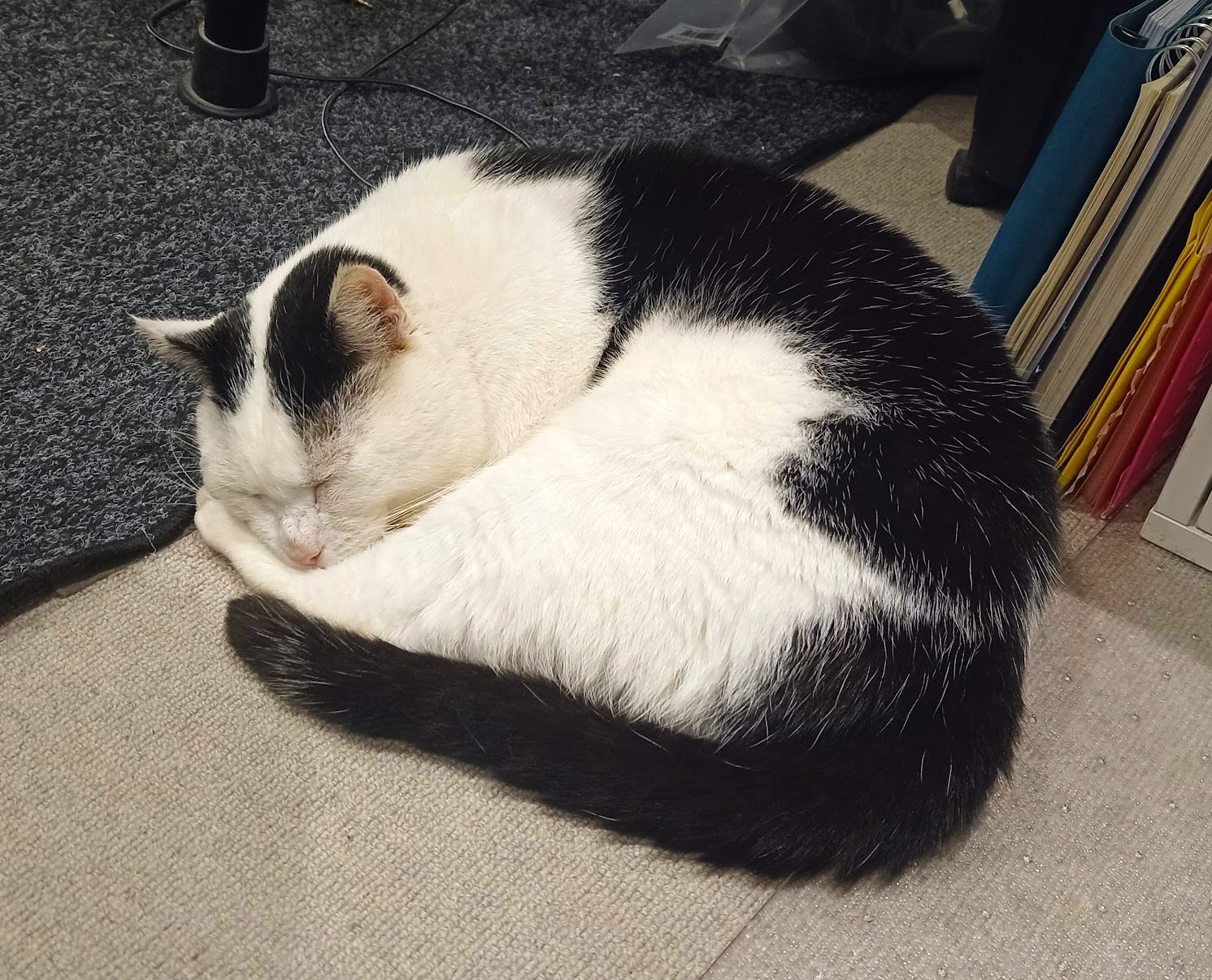
About a year after John Graham and his wife, Kathleen Birch, adopted Bella the Cat, they noticed she had an acquaintance — a genial neighborhood stray with a white-cream coat and black fur running from his back to his tail like a cloak.
Although she’s territorial like any member of her species and spends much of her time patrolling Grove Park — a quiet London neighborhood tucked into a winding loop of the Thames — Bella expressed no animosity toward the apparent intruder, and in fact seemed to be on quite friendly terms with him.
Graham and Birch, who like to joke that Bella is a clandestine agent of MI5 — Britain’s version of the FBI — dubbed the stray Bertie, and decided he was her field liaison.
“We think Bertie is her Mi5 contact and visits to get updates [before] returning to HQ to report on her field actions and mission status,” Graham quips.
After checking with the neighbors and bringing Bertie to the veterinarian, who said the stray was not chipped, Graham and Birch believe Bertie was likely abandoned by his previous family and eked out a living zig-zagging between homes in Grove Park, depending on the goodwill of neighbors and his own considerable charm for food. So they had Bertie chipped with their contact details about eight months ago, and now field agent and handler have been united under one safe house roof as they continue in His Majesty’s service.
Bertie and Bella even have their own WhatsApp group comprised of their humans and neighbors, who post to let each other know of the feline duo’s comings and goings.
Both cats are a source of great joy for Graham and Birch, who were looking to adopt again two years ago after the passing of their beloved Bets, who had been with them since kittenhood and lived to the ripe old age of 21.
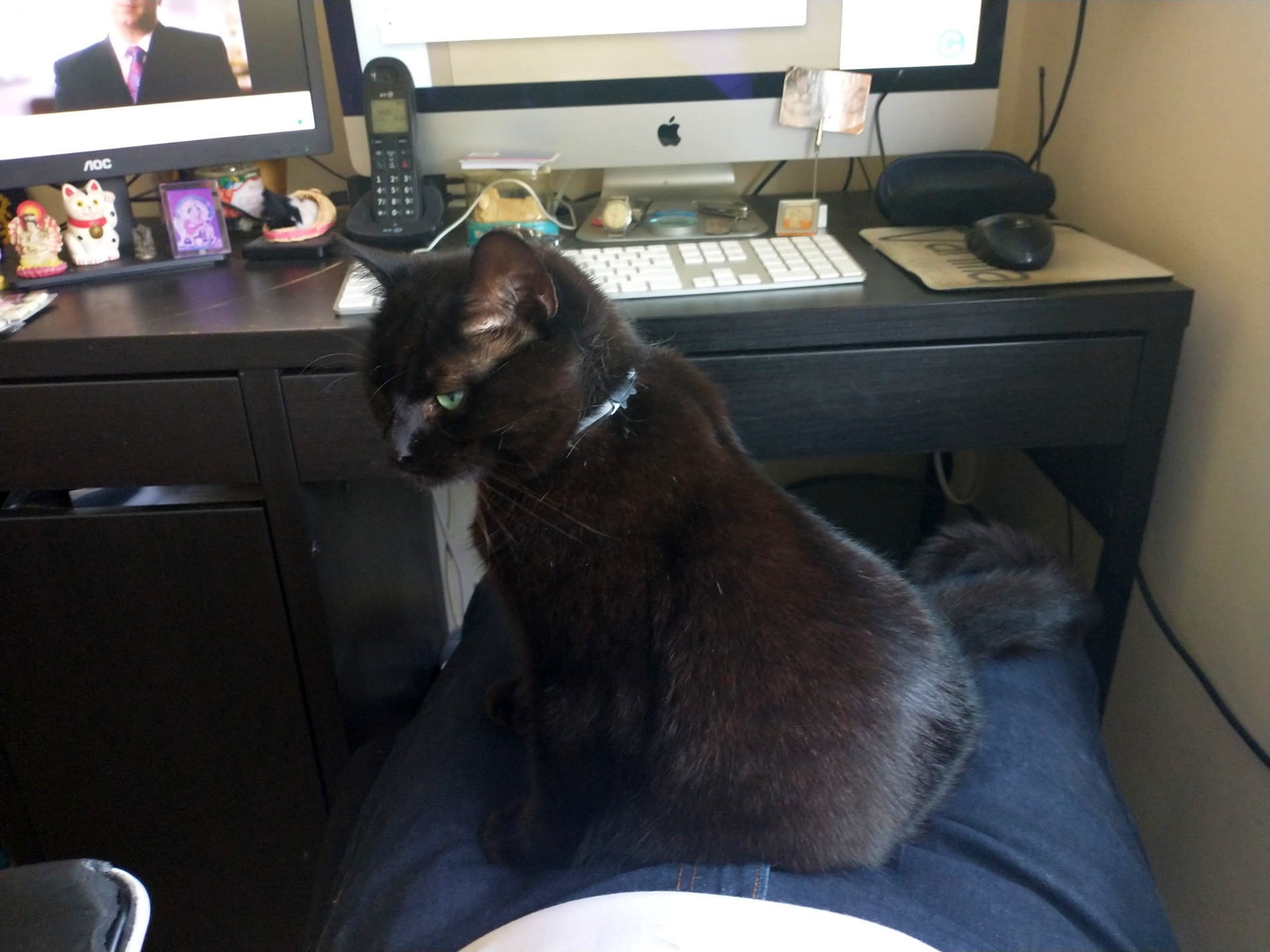
Bella deciding she needs to be a lap cat for a little while in order to supervise John’s work. Credit: John Graham
After contacting a charity they support in Twickenham, the couple went out to meet a cat named Puss Puss at a foster’s home about three miles away.
“We walked in and sat down, and within literally a few seconds, she came out from under a table. My wife immediately fell in love with her as Puss Puss – now called Bella — rolled over and showed her belly with the loudest purrs ever,” Graham recalled. “She walked over to me and looked up with the most beautiful green eyes, allowing pets and scritches instantly. I was totally smitten. Her secret service training on overcoming any resistance was obvious here.”
Not much is known about Bella’s past, which Graham jokes is classified, but the fosters said Bella likely came from a hoarding situation. She bears some emotional scars from those times, making it clear she didn’t like to be picked up and wouldn’t tolerate head rubs. Graham said he thinks Bella may have been struck on the head by the abusive person or people who had custody of her originally, but with patience “she has grown to trust us and love us the way we love her.”
True to her training, Bella came striding out of her carrier that first day without need for coaxing and set about surveying her new headquarters, exploring while noting promising hideouts and lounging spots.
“She immediately checked out the perimeter as do all good Mi5 agents, looked around and began a sniffing and snooping journey for about an hour,” Graham said, “Then sitting in front of us on a low stool, she started shouting loudly, her default way of demanding food. This prompted me into action, offering her different dishes attempting to find her favourite. It turns out that she basically will eat anything.”
Indeed, Bella’s love of food is one of the few things that cause a bit of tension between her and her doting humans. She’s restricted to carefully measured wet food plus veterinarian-suggested “weight management crunchies” and, like many cats, is not shy about notifying her servants when the yums are low or the auto-feeder isn’t dispensing them. (In those instances, Bella hops up onto the bed and approaches the sleeping Graham: “I will get the gentle paw followed by the sharp claw to ensure I get the message to come and feed her immediately.”)
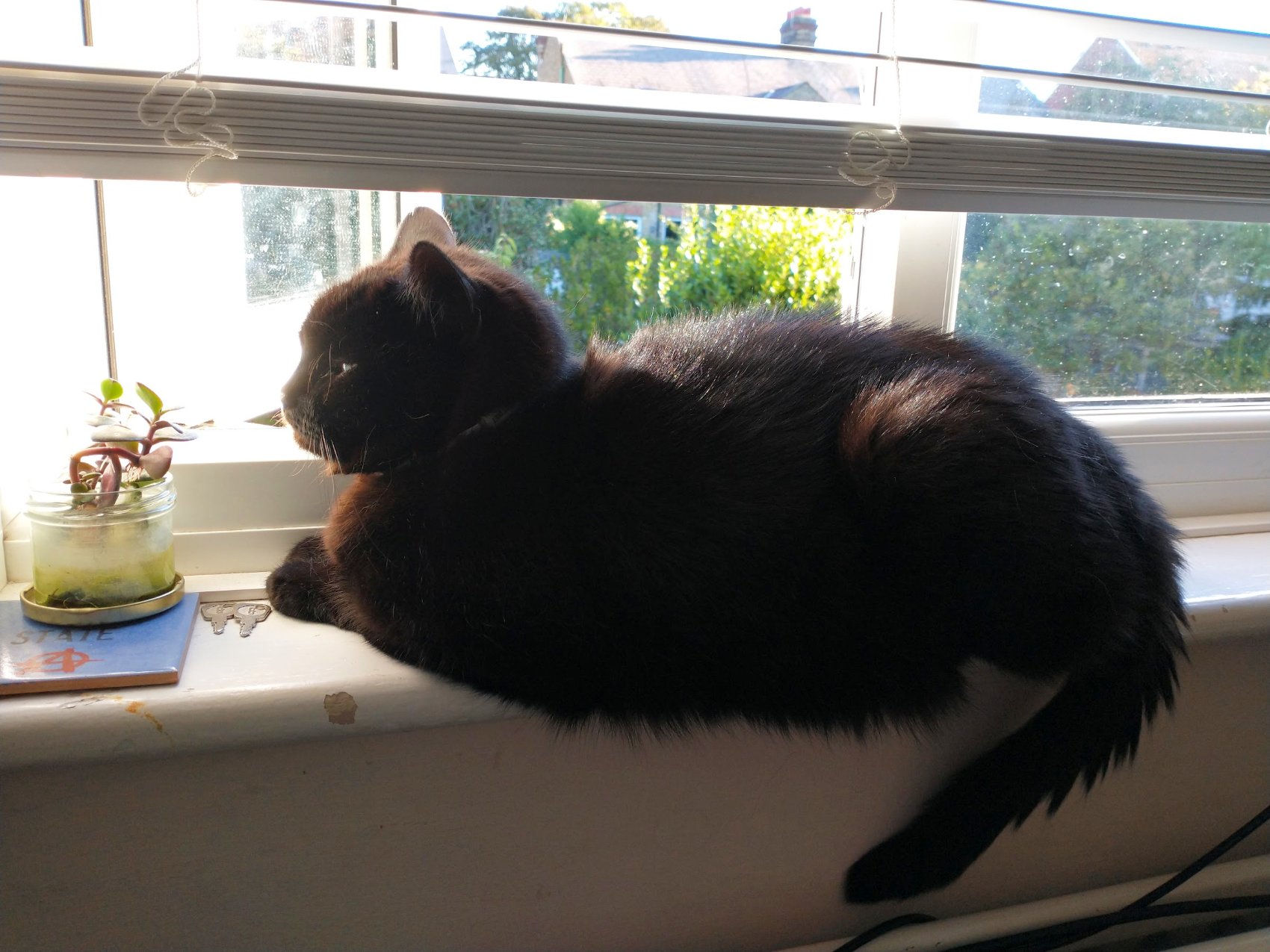
Bella on overwatch duty, making sure Grove Park remains quiet and free of interlopers. Credit: John Graham
Adopting a cat is always a guessing game. Will the cat relax and open up once she realizes she’s safe and has a home? Was he reserved when we met him because he’s been living in a shelter with unfamiliar sights and smells? Will she take to her new home immediately, or will she dive under a couch and remain there for weeks, emerging only to grab a bite from her bowl when no one’s around?
Those questions were immediately settled for Graham and Birch, and Bella’s outgoing personality is one of the things they love most about her, along with her supreme confidence.
“She has it in absolute truckloads,” Graham notes, “and there is pretty much no fear on her part about adventuring anywhere in or out of the house.”
While keeping cats indoors is the norm in the US, as many as nine in 10 caretakers in the UK allow their felines to spend time outdoors unsupervised, encouraging them to establish their territories, explore their gardens (backyards to us Americans) and familiarize themselves with their neighborhoods.
Many US shelters and rescues won’t allow potential adopters to take a cat home if they indicate they’re willing to let the kitty outside, and some even require adopters to sign contracts stating they’ll keep their four-legged friends indoors. UK cat rescues often take the opposite stance. They advise pet parents on how to gradually introduce their cats to the outdoors, offer tips on how to manage their outside time and recommend various pet flap configurations.
The difference is partly cultural and partly practical. While extolling the benefits of allowing cats to roam, UK cat lovers point out that domestic felines rarely stray far from their homes, on average venturing only between 40 and 200 meters (about 130 to 650 feet). They’re curious, which drives them to explore, but also territorial, which keeps them on a figurative leash.
There’s also a marked difference in wild threats to domestic cats. In the US, cats are vulnerable to pumas (also known as mountain lions and cougars), coyotes and a wide variety of birds of prey, from eagles, harriers and hawks to condors, osprey and even some larger species of owl. The UK does not have pumas, despite local legends to the contrary, nor does it have coyotes. Foxes, the smaller cousins of coyotes, and some birds of prey do pose a threat, but not to the extent that the wildlife of the Americas does.
“Yes, I’ll just settle down here for a nap whilst I wait on your report to HRH.” Bertie joined Bella about eight months ago and now they both live under one roof. Credit: John Graham
For Graham, allowing his cats outside fosters their independent streak and allows them — or Bella, at least — to exercise their hunting impulses. Bertie isn’t known for his predatory prowess, but Bella is a pro at catching mice.
The local neighborhood is quiet, traffic is strictly limited to 20 mph, and the neighbors know each other well, often using their WhatsApp groups to track their kids in addition to cats.
In fact, if Bella could speak, Graham reckons she’d thank him for providing a home in a tranquil locale — and for never closing doors in their home.
What else would she say?
Graham says it’s obvious: “Glad that you understand the difference between my requests and my orders – you took a while.” She’d also likely chide the couple on their ineptitude as hunters, declaring Graham and Birch “are both rubbish at catching mice and rats despite how many times I show you how to do it.”
For Graham, the managing director of a London brand agency, and Birch, a skin care therapist, sharing their home with cats feels natural, and they cherish the unpredictable nature and playfulness of their feline friends. Cognizant of the fact that black cats are less likely to find homes, they prefer adopting melanistic house panthers like Bets, their previous cat, and Bella.
“I totally love all animals but as residents in our house, cats fit perfectly being clean, highly intelligent and able to manipulate any situation with an expression or display of love,” Graham says. “My favourite thing about Bella is when she surprisingly sits on my lap and the mystery when she hides in unlikely places causing me to rush around desperately trying to find her, not coming out even when I am shaking a treat bag.”
Bella will allow the game to drag out “until she decides to appear with her ‘I win’ look and swagger.”
Feline love is often hard-won, but that makes it worth it. In discussing Bella, it’s clear Graham lives for the moments when the independent-minded kitty decides to let him know how much he means to her by sleeping at the food of the bed, playing her hide-and-seek games and climbing into his lap.
Bella and Bertie may not be regular lap cats, but that’s okay with Graham and Birch.
“So there you have it,” Graham said. “Two cats that come and go as they please with occasional signs of affection, but get nothing apart from permanent love and affection from us.”
Bella is serious about her food. Credit: John Graham
Bella’s favorite toy, fittingly, is a mouse. Credit: John Graham

 “Don’t Stop! Scritch Me More, Yeah!”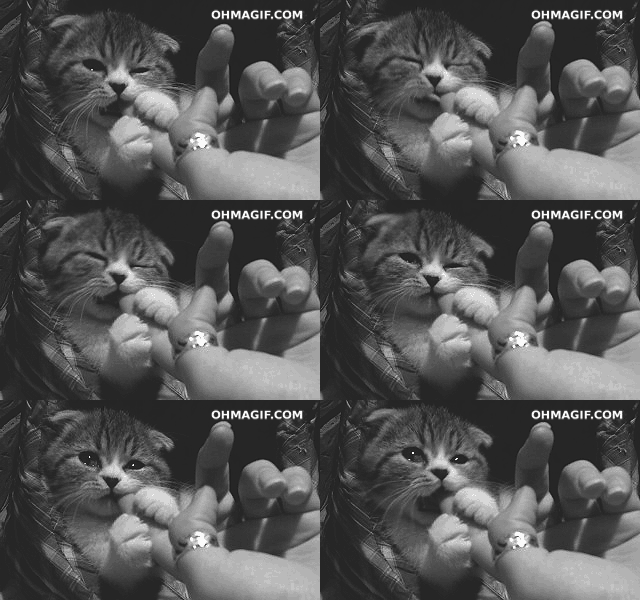


 Pain In The Bud