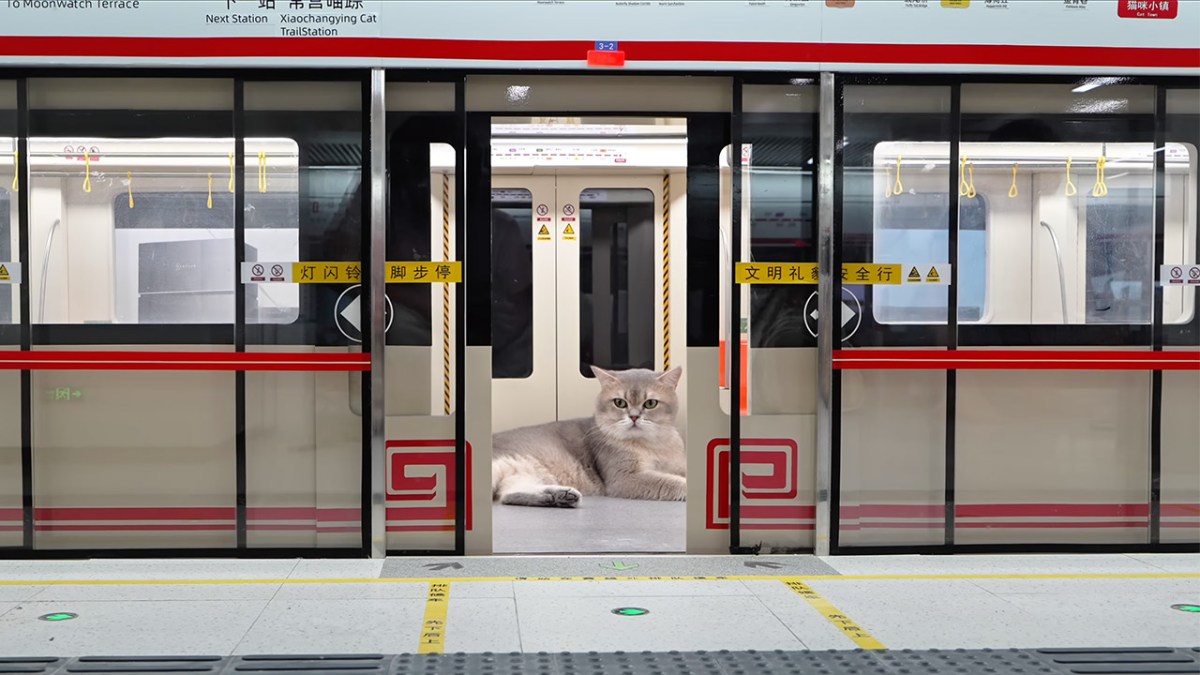
A Youtuber spent four months creating a rideable subway system for his cats, and it’s magnificent!
Hello, proxy servants! Buddy here again, blogging in place of my pathetic human minion!
As you may be aware, I am not fond of foul human sorcery, like the evil room that eats people outside my domicile (humans call it an “elevator”), the evil and angry robot, vakuum, and various other products of vile human magicks, like those floppy fishes “toys.”
However, the interweb is not without its uses. After all, it allows me to communicate with you, my deputy servants, and there’s some interesting stuff, like this video of a very nice human named Xing who built an entire subway for his cats. Behold:
Now that’s a dedicated servant!
It looks like so much fun, like having your own not-scary roller coaster to ride all day.
Xing’s magnificent creations also throw into sharp relief the uninspired efforts of my own pathetic minion, who can barely put together a chair from Ikea.
You know what I would like? A Cat Cave, like Batman’s Bat Cave, except cat-size for me. It would have all sorts of awesome gadgets, control stations, surveillance capabilities, and a vehicle for my use when I venture out as a hero to fight crime, dogs and other undesirable elements.
But has anyone ever said “Hey Buddy, would you like a Cat Cave?” Of course not.
Do any of you have schemeowtics for a Cat Cave? If so, send them to me! In the meantime I’ll just have to watch wistfully as these other lucky cats ride their own subway and relax in their own beautiful apartments.
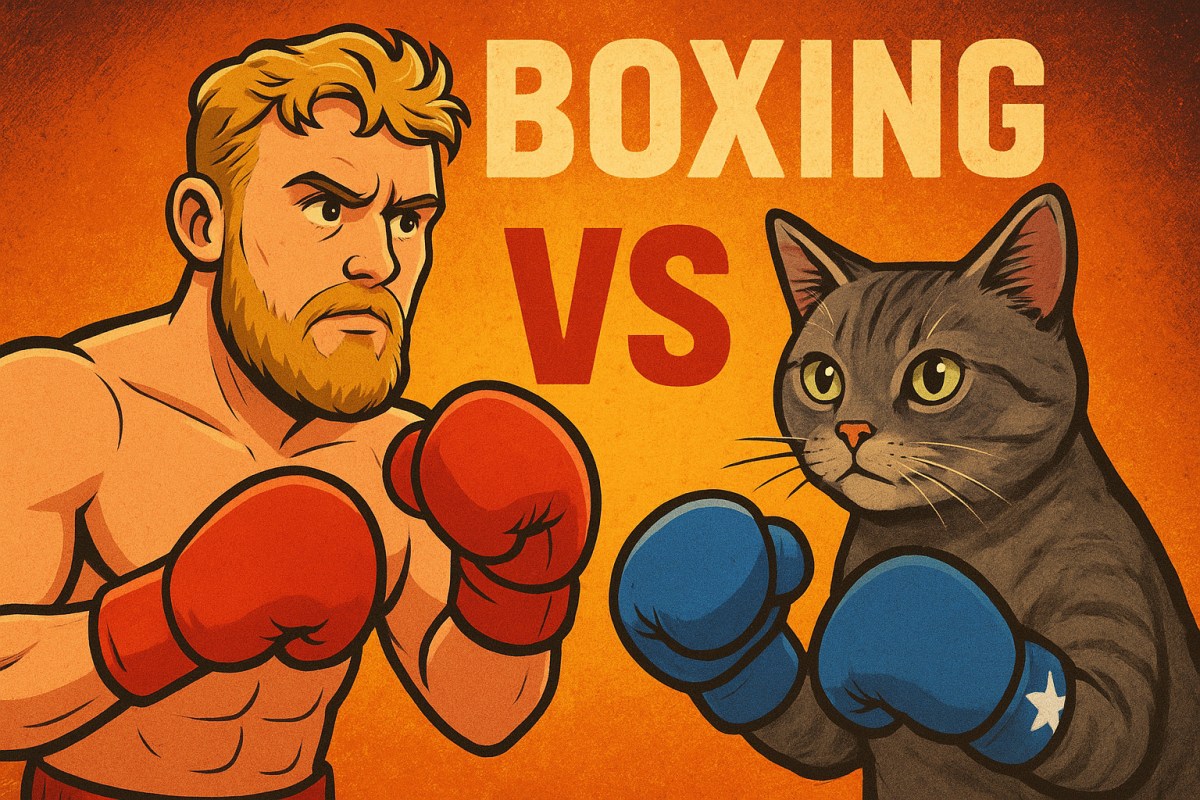
In a match-up hailed by boxing promoter Don King as “a magnificatious spectacle of pugulisticary skillsmanship,” Jake Paul will square off against Buddy the Cat at Madison Square Garden on New Year’s Eve.
He’s defeated men more than twice his age, hammered opponents 70 pounds lighter than him into submission, and made his mark as a six-time winner of the Billy Blanks Tae Bo Championship.
Now Jake Paul, the Youtuber-turned-boxer, will step in the ring with Buddy the Cat, a gray tabby from New York.
Despite the 190 pound weight advantage and Paul’s 76-inch reach vs Buddy’s 4.5-inch reach, Paul’s manager, Nakisa Bidarian, said the 6 foot 1 Paul and the 11-inch Buddy were evenly matched.
“Buddy the Cat is probably Jake’s most vicious opponent yet,” Bidarian told reporters. “Jake is taking this fight seriously, as seriously as he took the fight with Nate [Robinson],” a 41-year-old, 5 foot 9 former NBA player who had no boxing experience before stepping in the ring with Paul.
An early poster promoting the fight, which has since been postponed to New Year’s Eve.
Asked by another reporter what Paul and his team make of critics blasting him for “making a mockery of the sport” by fighting a succession of cans, geriatric opponents and people without boxing training, Bidarian waved a hand in dismissal.
“Buddy’s a cat, isn’t he? Tigers are cats, too. We’ve all seen how dangerous tigers can be, so obviously Jake is taking a huge risk here by fighting an animal who is, in essence, a slightly smaller version of a tiger.”
Buddy the Cat
As for Buddy, the massive differences in height, weight, reach, species and training haven’t deterred him. The 11-pound southpaw feline promised to “tear into Paul like a bag of Temptations” and “chew him up and spit him out like diet kibble.”
“You see this wand toy?” Buddy told reporters, throwing punches at a colorful felt parrot that dangled from the end of a stick. “That’s what I’m gonna do to Jake’s face. And if it’s legal to attack his feet, I’m gonna do that too. I’m awesome at attacking feet.”
Longtime boxing promoter Don King called the bout “a magnificatious spectacle of pugulisticary skillsmanship.”
Paul vs Buddy is set for Dec. 31 at Madison Square Garden, only six weeks after Paul is scheduled to duke it out with retired super featherweight Geronta “Tank” Davis. Despite Davis giving up more than 70 pounds and eight inches in height, Bidarian insisted the bout will be “about as evenly matched as possible.”
While most traditional boxing fans and critics dismissed the Paul vs Buddy fight as another gimmick, legendary boxing promoter Don King hailed it as “a monumentilacious rejuvenalizationary occasion” for the sport.
“Jason Paul is a heraldific resplendinizer of pugilistic entertainmentized sportulations,” King gushed, “while Buddy is the most splendiferously sanguinarius felid fighter to ever set paw in the ring. I can’t think of a better match-up between two pugnaciously bellicoserized combatulants anywhere. This is gonna be epic!”
Cheetahs are on the precipice of extinction because of relentless poaching on behalf of the children of oligarchs, and showing off collections of rare big cats has become de rigueur on social media.
Imagine you’re an obscenely wealthy Emirati heir, a Saudi prince, or the scion of a global business empire in Dubai.
You started an Instagram account, but sadly photos of your Lamborghinis and McLarens aren’t really moving the needle. In the circles you run in, everyone has those. Likewise, your $20 million digs are pedestrian by the standards of Gulf opulence, and showing off private jets is so 2023.
You need something to stand out, to show the peasants that you’re not just a fabulously affluent heir, you’re also really cool and everyone should envy you.
You need a big cat.
Maybe even cats, plural, if you can’t swing an ultra rare white lion or an 850lb liger on the illegal wildlife market.
“I’m not trying too hard in this photo, am I?”
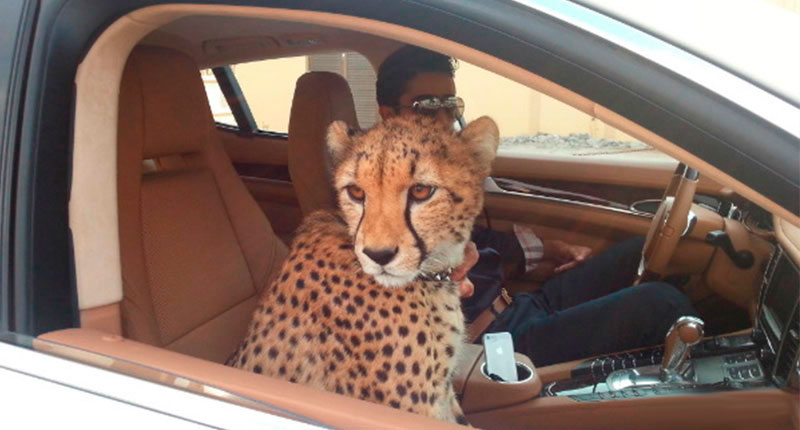
Just imagine your follower count blowing up, and how jealous the peasantry will be when you post images of your apex predator pet chillin’ in the passenger seat of your Sesto Elemento, with a pair of $20,000 sunglasses on his head for the lulz.
That’s what’s currently happening in the Gulf among the incredibly well-off children of royalty, aristocrats, oil oligarchs, shipping magnates and other bigwigs, a report in Semafor notes.
“Of course you can’t put them in the Lamborghini, beratna! You don’t want those claws near your leather seats. Besides, my liger shall have his own custom made Koenigsegg with a gear shift he can operate by paw!”
In addition to providing compelling ‘tent to their social feeds in the form of photos and videos, it’s clear the owners believe big cats offer a kind of osmotic badassery: if you have your very own lion, you must be a powerful and interesting person!
This kind of thing is not new. Years ago there was a brief outcry when wildlife groups begged authorities to protect cheetahs, who are already critically endangered and risk extinction if global elites are allowed to continue to poach them and their cubs from the wild.
“While many of these states – including the United Arab Emirates and Saudi Arabia – ban the private ownership and sale of wild animals, enforcement is lax.
The overwhelming majority of these cheetahs end up in Gulf Arab mansions, where Africa’s most endangered big cats are flaunted as status symbols of the ultra-rich and paraded around in social media posts, according to CCF and trafficking specialists.”…
The trend is of “epidemic proportions,” according to CCF, an organization devoted to saving cheetahs in the wild. At the current rates of trafficking, the cheetah population in the region could soon be wiped out.
“If you do the math, the math kind of shows that it’s only going to be a matter of a couple of years [before] we are not going to have any cheetahs,” said Laurie Marker, an American conservation biologist biologist and founder of CCF.
Youtube has its share of dauphins showing off cats and cars, and Instagram has an entire sub-genre of pages featuring men in pristine white robes posing in million-dollar hyper cars next to cheetah cubs or tigers who have been sedated to their eyeballs.
As the Semafor report explains, technically keeping big cats is illegal in most Gulf states, except for the super rich. They can skirt existing wildlife laws by getting permits as private “zoo” and “sanctuary” operators, and who’s to say a good zookeeper can’t keep his jaguars in an enclosure with Maseratis and Aston Martins?
One guy even runs a place called Fame Park, a private zoo. The only way to get in is if he deems you famous enough, and thus worthy, to gaze upon his wondrous menagerie of endangered beasts.
The park’s motto is “Where luxury meets wildlife wonder,” and its operator styles himself as a conservationist who just happens to enjoy rubbing elbows with esteemed figures like Andrew Tate and Steven Seagal.
“What pet? I am a licensed zookeeper! In my zoo, enrichment is provided by Ferrari.”
Things really haven’t changed much in the last few hundred years, have they? One way royals and aristocrats amused themselves was by sending explorers to far off lands and instructing them to bring back strange animals.
That’s how elephants ended up in the courts of European kings, and how Hanno the Navigator found himself in mortal danger when he tried to capture gorillas, then decided they were “too violent” to drag back home and had them executed.
A court elephant photographed in 1851 by Eugene Clutterbuck Impey, an English administrator in the British Raj. This elephant is pictured in regalia used for royal processions and other ceremonies. Credit: National Gallery of Scotland
These days, the centers of power have shifted, but human behavior has not. Part of me still has hope, but the cynic in me fears people with the means to exploit rare and endangered animals will continue to do so until there are no more animals left to exploit.
Another critically endangered pet cheetah in a hyper car. Credit: Some clown’s Instagram
Everyone knows that in the wild, big cat cubs nurse from Ferraris and Lamborghinis, and cheetahs learn to run fast by participating in drag races against the hyper cars. Credit: Another clown’s Instagram
A cat’s affection has to be earned, but the good news is it’s not rocket science. A little patience and consideration for your fluffy little pal goes a long way toward building trust and a strong bond. Once you do, you’ll have a loyal friend for life.
“How do I make my cat like me?”
That question comes up regularly on social media posts, in cat-centric discussion groups, Q&A sites and even in our inbox. People adopt a cat, and whether the little one dives under a bed and refuses to emerge, or just seems reluctant to snuggle the way people imagined, they turn to the internet to find out why they don’t have a purring, contented feline in their lap.
The short answer is you can’t “make” your cat feel anything, and it’s best to dispense with that notion as quickly as possible so you can acknowledge the truth: cats are individuals with their own thoughts and feelings.
The good news, however, is that you can earn your cat’s affection with patience, respect and love. Our patience and respect for our little buddies leads to trust, which in turn creates and strengthens the special bond we share with them.
The love of a cat isn’t as easily won as the love of a dog, and in many ways that makes it even more special. Cats don’t love just anyone.
It starts with acknowledging your cat has feelings, and understanding that you have to respect those feelings as you would those of a person.
Don’t make your cat do things she doesn’t want to do.
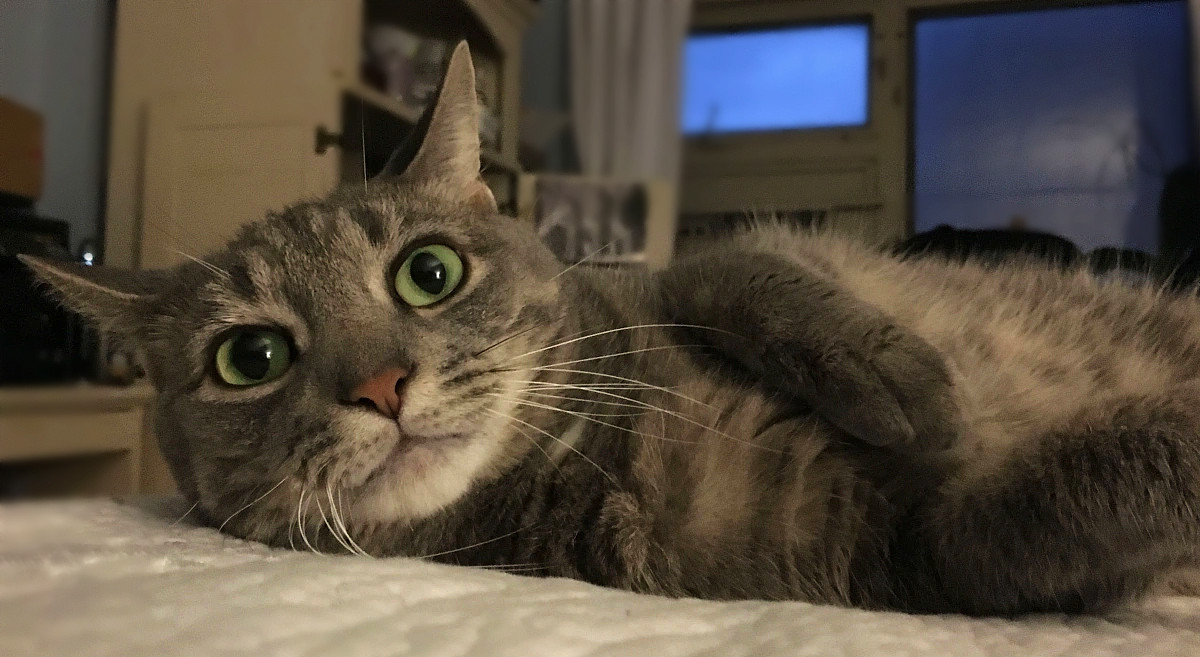
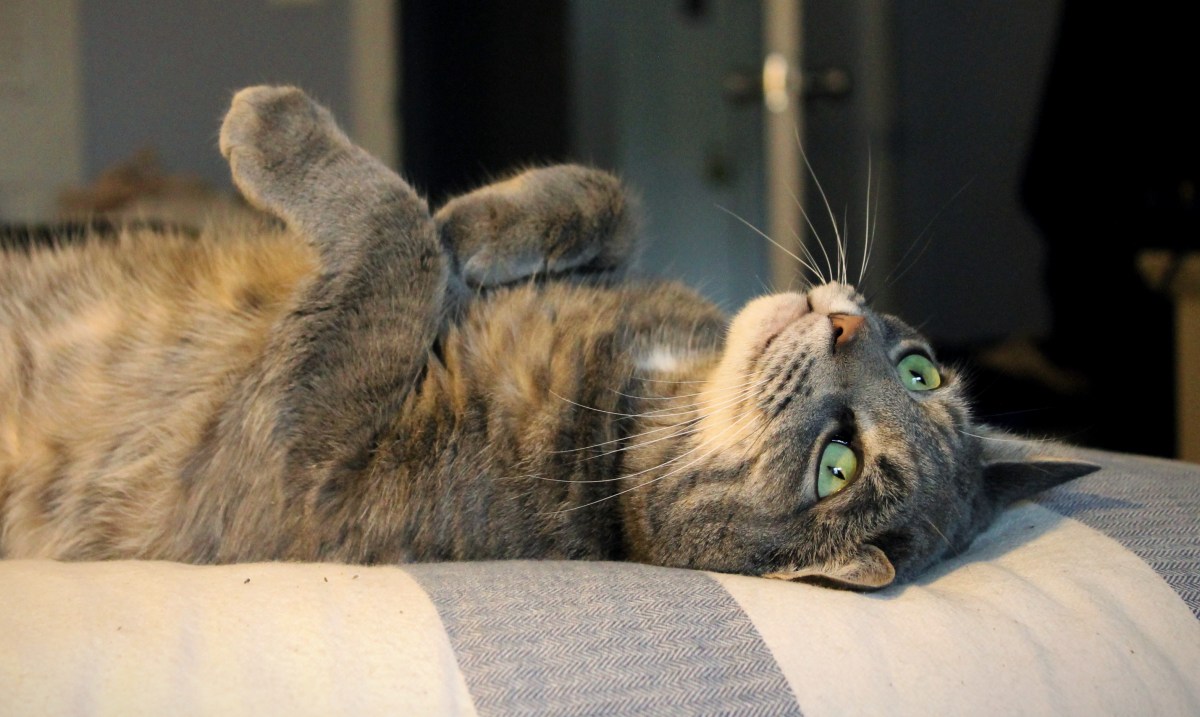
Despite what you might think or what you may have been told, most cats don’t like being picked up, held or feeling restricted. The majority of felines don’t like belly rubs, and people have a habit of mistaking a sign of trust — a cat showing her belly — as an invitation to pet.
A cat showing its belly is a sign of trust. It’s a vulnerable position for a cat, and not an invitation for belly rubs. Credit: Wikimedia Commons
Every cat is different, but generally the best way to make sure your kitty doesn’t want to approach you is to ignore her personal boundaries and treat her like a stuffed animal.
Those “cute” videos you see on TikTok of terminally online people spinning their cats to Taylor Swift songs, holding them like phones to reenact scenes from The Princess Diaries, or forcing them to wear ridiculous outfits?
Don’t do that. It destroys your cat’s trust in you, and the cheap dopamine hit you get from strangers “liking” your content isn’t worth stressing your furry pal out and damaging your relationship.
Don’t do this. It’s not funny, the meme is lame and you’ll teach your cat to fear you. Credit: TikTok
If you tend to restrict your cat and hold her in your lap, you’re discouraging her from sitting there in the future. If you give kitty unnecessary baths, you could create a situation in which your cat fears you.
Even if you think you’re not doing anything wrong, if your cat is reluctant to approach you, there’s something that needs fixing, and it’ll require patience.
Don’t subject your cat to forced petting sessions.
Unlike dogs, cats have a limited tolerance for physical affection, and they don’t always want to be touched.
Your pal will be much more likely to regularly approach you for physical affection if you let him come to you. Ignore the impulse to reach out and start petting him like you would a dog. Instead, put your hand out and let your cat initiate the petting. You’ll develop a physical shorthand in which he signals he wants chin scratches or head rubs by leaning in and rubbing his face against your outstretched hand.
All felines have scent glands in their cheeks, and the initial contact of a cat rubbing his cheek against your fingers is an olfactory signal that says “This human is my family. I like this human.”
Even though our noses can’t detect those pheromones, they’re still important to our cat(s), and they’re the reason why cats will scent-mark objects by brushing past them in your home, just like tigers will mark their territories by scent-marking trees with urine. Same concept, but thankfully our miniature house tigers generally don’t feel the need to do the latter. (If yours does, take him to the vet. If he’s not “fixed,” get it done ASAP.)
Less is more when it comes to petting
Stop me if you’ve heard this one before: “I just don’t get it! I was petting my cat and she was purring and loving it, then without warning she bit me!”
Pro tip: A bite like that never comes without warning, it’s just that most of us don’t see the signs right in front of us.
Cats communicate by tail and whisker, and we communicate by making noises with our mouths. Adult cats don’t meow to each other. The little ones are smart enough to understand how we exchange information, so meows, trills, chirps and grunts are their way of trying to speak our language, to communicate on our terms.
But sometimes — like, say, when they’re purring and relaxed — they’re distracted and forget to meow, or they meow and we ignore them.
That’s when they bite, or swipe at us with their paws.
If you pay attention to non-verbal cues, you’ll notice your cat getting overstimulated when her tail starts swishing and her pupils dilate. If those signs aren’t enough, there are others: twitching ears, shifting positions, moving away.
The best way to avoid misunderstandings is to give kitty a few head rubs and chin scratches, then stop. If she wants more, she will let you know. If she doesn’t, she’ll be content to remain on your lap or by your side, knowing you’re not going to keep going indefinitely.
No harm, no foul, no bite.
This cat is not enjoying selfie time with her human. Credit: imgur via Reddit
Don’t take your bad day out on your cat
Remember when you were a kid and your mom or dad came home from a bad day at work with a storm cloud hanging over their head? Maybe they snapped at you for apparently no reason, or made family dinner miserable with fraught silence. Maybe they unfairly got on your case about something minor.
Either way, the tension in the house was palpable because, as kids, your parents controlled your lives and you were dependent on them for everything.
That’s what it’s like for our pets. Whether we call ourselves “fur mommies” and “cat daddies” or not, the fact is that the pet-human dynamic absolutely shares some elements with the parent-child relationship.
Our pets are utterly dependent on us, they’re subject to our moods, and they’re deeply attuned to our emotions.
As a result, how we’re feeling has a big impact on them, for better and worse. Unlike children, who at least have some concept of redirected frustration, cats and dogs have no idea why we have bad moods and no way to insulate themselves from the consequences.
We’re all human and we all get frustrated with our feline friends at some point. If you’ve been sitting in traffic for three hours and come home to find Socks pooped all over the rug or threw up on your comforter, frustration is a natural response.
But for the sake of the innocent little ones we share our homes with, it’s up to us to be mindful of our moods and do our best not to let external factors impact how we treat our pets. Things as seemingly small as our tone of voice can have a major impact on their emotions.
A cat chowing down. Credit: Wikimedia Commons
Don’t feed them crap
This has been covered exhaustively elsewhere, so we’ll direct you to catinfo.org if you have in-depth questions about feline nutrition.
In general, wet food should make up the majority of your cat’s diet. Cats don’t have a high thirst drive and they’ve evolved to get most of their hydration from meat, so a cat who eats mostly — or only — dry food is in danger of developing serious health problems.
Aside from that, more expensive doesn’t always mean better, and the important thing is that your cat’s food has real meat as the top ingredient. If the primary ingredient is a filler like corn or grain, or poultry/beef byproducts, steer clear and find a better alternative.
Feeding quality food means kitty will be happier, healthier, less prone to health complications and more active.
Keep things interesting
You don’t have to spend a lot of money on toys, and everyone who’s ever lived with a feline knows the fluffy little guys are just as likely to take a shine to a new box or the little plastic ring from a milk bottle as they are to the $10 new toy you bought from the pet store.
That said, there are certain toys that are almost universally beloved by felinekind, and the more you keep things interesting for your cat, the happier your furry overlord will be.
You can never go wrong with wands for interactive play. Keep it simple and manipulate the toy at the end of the wand like prey so your house panther can feel like a mighty hunter. Track toys with balls that cats can bat around are good for relatively quiet solo play. Cat tunnels are great too, especially if you toss treats inside them for kitty to find randomly.
A cat playing with a toy mouse. Credit: Wikimedia Commons
You don’t need a special occasion to surprise your little buddy with a catnip and play session, and you’d be surprised how enthralled felines can be by “cat TV” on Youtube. There are dozens of channels that provide hours-long videos of birds eating seeds from outdoor feeders, aquariums filled with interesting fish, and critters like squirrels and rodents.
You can also engage your cat by training her to do simple things like come when called, sit on command high five you. Those “tricks” are very easy to teach and require no more than two or three practice sessions a day, maximum 10 minutes each. Your cat will love it, especially with rewards for learning, and it’s fun to show skeptics that, yes, cats can do tricks just like dogs.
Sometimes “fun” is just something unusual, something your cat rarely gets to do or see. On occasion, I let Buddy walk up and down the hallway with me in my apartment building late at night when chances are low we’ll encounter anyone.
Elevators: products of foul sorcery that swallow humans and sometimes spit out Korean rappers.
He loves to stop at each door, listen and take in the strange sounds and scents. If anyone emerges from one of the doors or the elevator opens, he just makes haste back to our apartment, where I leave the door slightly ajar for that reason. As for the elevator, he seems to think it’s some sort of product of foul sorcery — it rumbles, the doors open by themselves, and when people walk in, they don’t walk out. Sometimes they enter only to emerge as a different person a few minutes later!
I’m happy to indulge his paranoia with regard to the elevator, because it means I don’t have to worry about curiosity getting the better of him.
If you’ve got rooms your cat doesn’t normally have access to, a yard with cat-proof fencing, or an activity you only do sometimes, consider breaking up your cat’s day with a little exploration or some ‘nip-fueled fun.
“Extremely accurate portrait of the Buddies” commissioned by Buddy the Cat in 2024.
Treat your cat as a friend
Your cat may not have legal personhood, but he is a fully sentient being who feels emotions just as strongly as people do. Cats experience the full range of primary and secondary emotions, but not tertiary emotions. That means kitty can feel happy, sad, excited, anxious, jealous, bored, depressed and overjoyed, but she’s not going to be embarrassed if another cat’s wearing the same collar or fret over whether people and other cats like her.
The important thing is remembering cats have feelings.
It’s not rocket science, and it doesn’t cost us anything to treat our cats with respect, patience and love. Bonding with a cat requires more than just feeding, watering and scooping, but the effort is always worth it and you’ll have a loyal friend for life. Good luck!
Top image of incredibly sexy beast (Buddy) copyright Pain In The Bud.
“I’ve noticed everyone’s super stressed lately,” Buddy said. “People need hugs. I’m fluffy and adorable. It’s the perfect solution.”
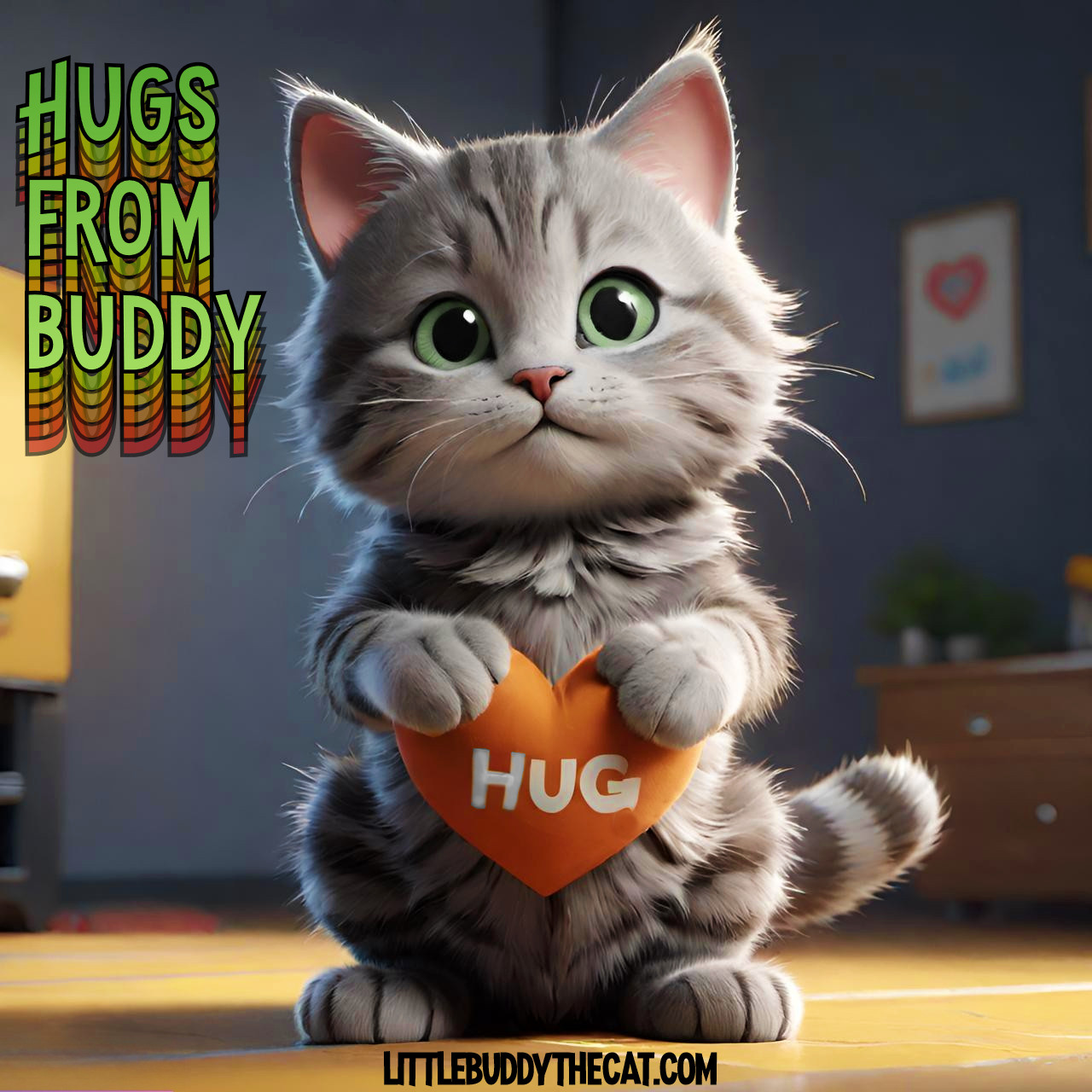
NEW YORK — Buddy the Cat announced the launch of a new program, Hugs From Buddy, to “help the humans calm down a little bit, because things have gotten crazy.”
The normally mercurial tabby cat, whose concerns are typically limited to his own gastronomical satisfaction with meals and snacks, said he had the idea for Hugs From Buddy after watching the movie Civil War with his human and seeing footage of police and students clashing on college campuses.
“The world is crazy right now,” Buddy told reporters at a press conference in Manhattan. “War in Ukraine, Haiti, Gaza and Syria. People punching strangers on the street for Youtube ‘pranks.’ Protesters and police clashing. People threatening to kill one another, banning books they haven’t even read, Karening each other in the grocery store, brawling on passenger flights. Even dogs, bless those simple-minded beings, seem stressed!”
Buddy the Cat is offering hugs to anyone who needs them!
Buddy paused to address a bystander who was holding a pepperoni pizza.
“You gonna eat that? Here, give Buddy a slice, I’ll give you a hug,” he said, embracing the young woman before returning to the podium with a slice of pizza.
“Where was I?” he asked, chewing thoughtfully. “Oh! Right. The crazy, stressed out humans.”
He belched, then continued.
“I’m here today to offer myself up as the nation’s emotional support animal. If you’re in need of a hug or a snuggle, well, Little Buddy’s got you covered.”
Then he looked to the reporters, who were seated six or seven rows deep for the press conference.
“Look under your seats!” he said excitedly as the journalists mumbled in surprise, finding small gift-wrapped boxes there. “You, the young lady from CBS News! You get a hug! You, the angry guy from InfoWars! You get a hug! BBC, you get a hug too! You all get hugs!”
A print advertisement for the new Hugs From Buddy campaign.
The press conference was supplemented with an announcement of a $20 million television ad buy publicizing the Hugs From Buddy program, as well as a new site where the angry and stressed can log on, request a hug from Buddy, and make travel arrangements to bring him to their cities.
Reaction to the announcement was mixed.
A panel on Real Time with Bill Mahar concluded Buddy was sincere, trying to be helpful, and “absolutely adorable.”
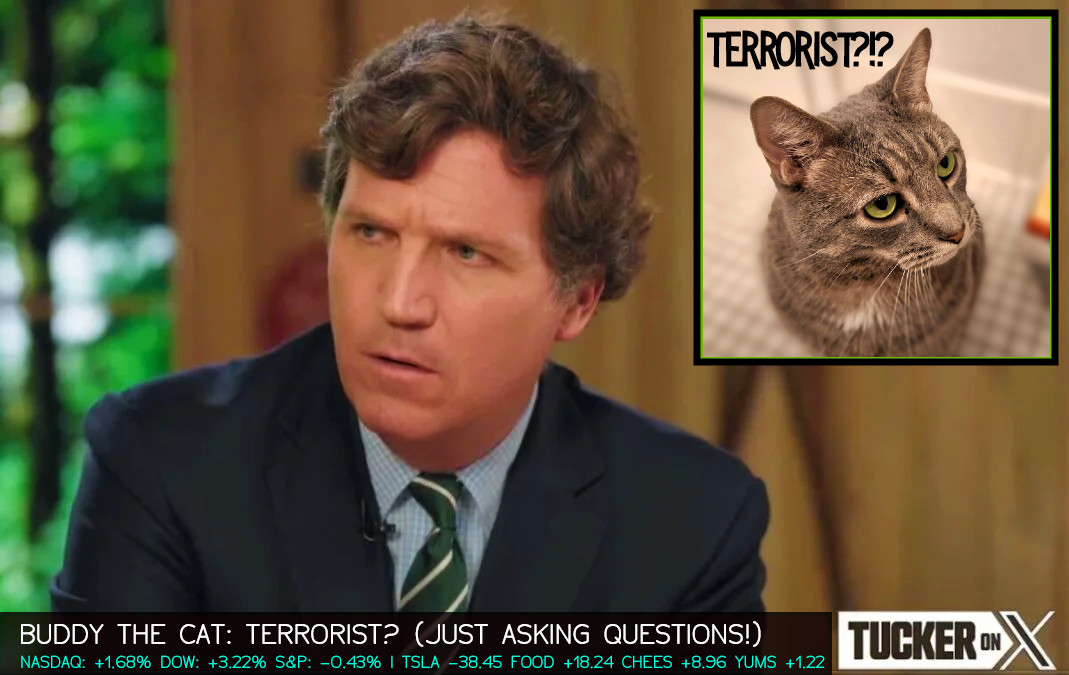
But in a statement issued later Friday, catnip cartel Los Gatos International accused the New York feline of “shameless self-promotion, which he will undoubtedly parlay into goodwill for his own catnip empire,” while former Fox News host Tucker Carlson declared Buddy a threat to national security.
“Buddy the Cat is a dangerous tiger in kitten’s clothing,” Carlson declared on his X show as a chyron scrolled below with the headline: “IS BUDDY THE CAT WORKING FOR TERRORISTS?”
Former Fox News host Tucker Carlson wasn’t convinced of the feline’s supposedly noble intentions.
“You might say Buddy the Cat is a danger to America, softening us up at precisely the time when we need to be tough to fight China, North Korea, Iran, the school board of Boise, Idaho, Taylor Swift, and the WNBA,” Carlson said, pounding a fist on his desk. “Up next, a conversation with Nick Fuentes. But first: Is Buddy the Cat a Chinese operative? Is he an agent of anti-American cat ladies who want us all to be hummus-eating vegans? Why does he ignore the beauty of the Moscow subway system? And is there any truth to the rumor that he’s working with the San-Ti from 3 Body Problem to help them invade Earth? Just asking questions here, folks. Nothing wrong with that.”