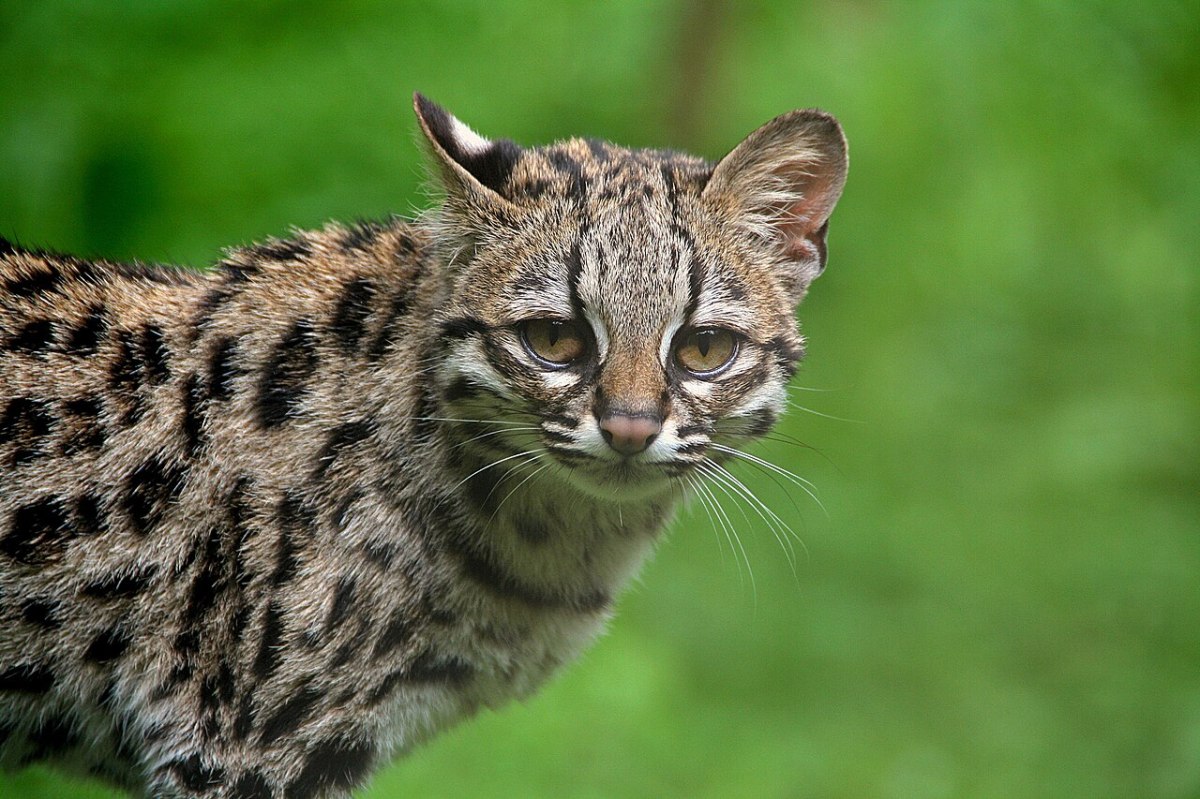
Strongly resembling ocelot cubs, margays have a unique biological adaptation to tree-climbing and a devious ability that gives them a massive advantage over their prey.
Taxonomic name:Leopardus wiedii Genus: Felis (small cats) Weight: Between 5 to 9 pounds with typical felid sexual dimorphism Lifespan: More than 20 years in captivity Gestation: About 80 days Litter size: Single kitten, rarely more than one Distribution: Central America, including Brazil, Paraguay, Peru, Chile, Ecuador, Venezuela, Guyana, Colombia, Panama and parts of Mexico IUCN Red List Status: Near threatened
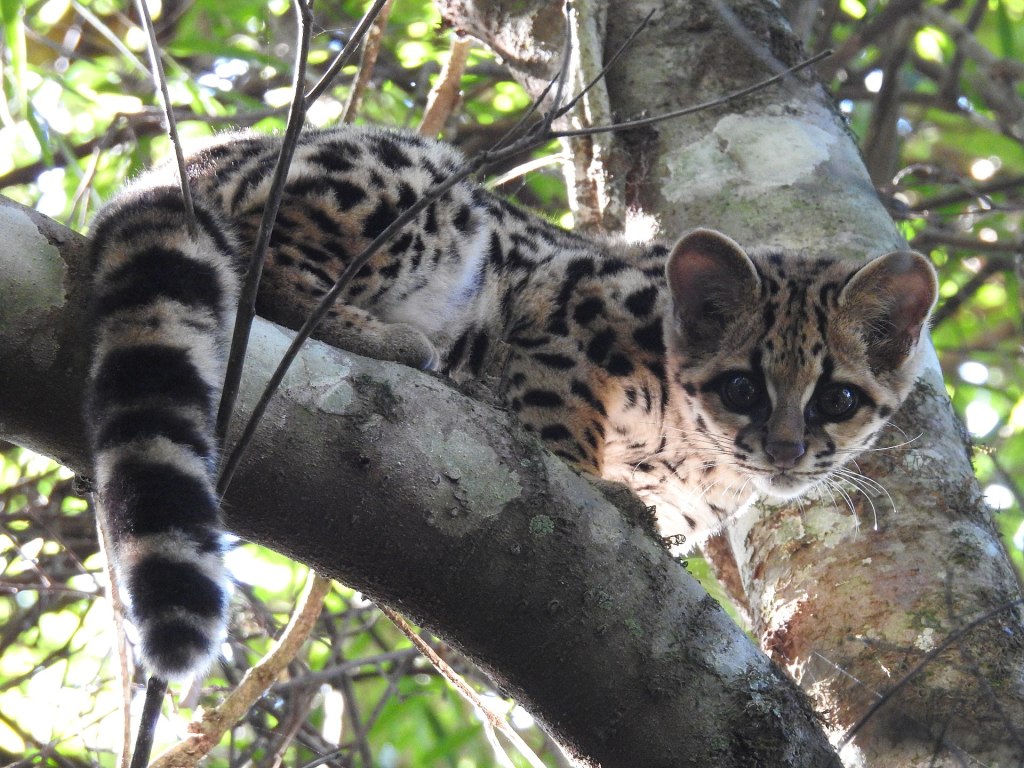
If you’re fortunate enough to catch a glimpse of a margay, you might think you’re looking at an ocelot cub.
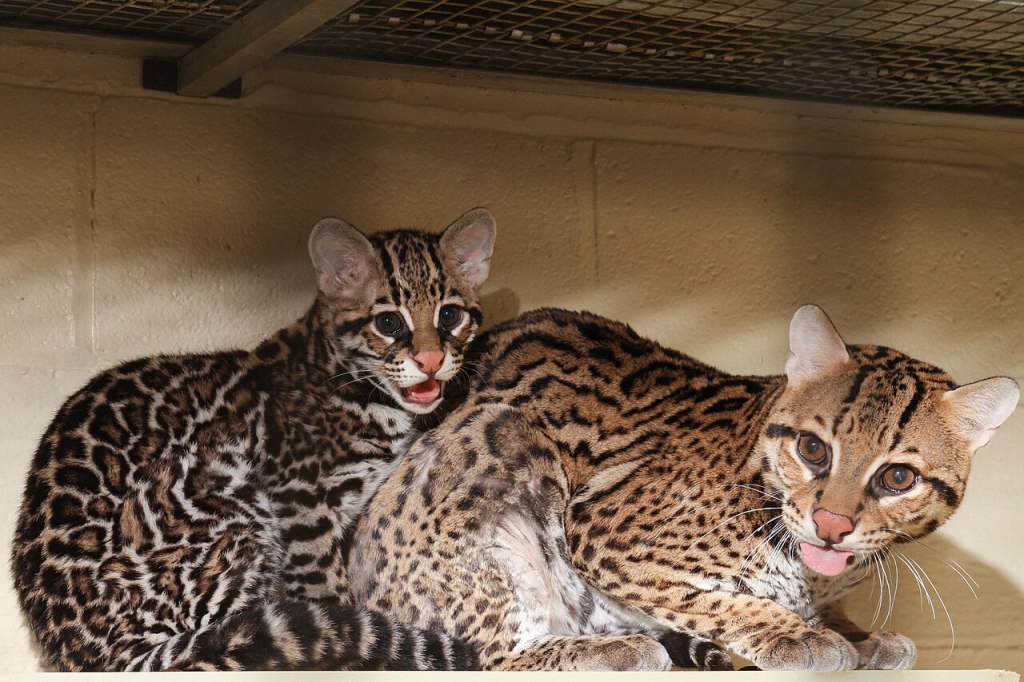
The two species look remarkably similar, sharing beautiful rosette patterns in their fur, intense eyes and prominent facial stripes.
But ocelots are medium-size cats that can top out at 35 or 40 pounds, while margays are even smaller than domestic felines, weighing between five to nine pounds.
An ocelot cub with, left, with its mother. Margays are easily mistaken for ocelot kittens. Credit: Mark Dumont via Wikimedia Commons
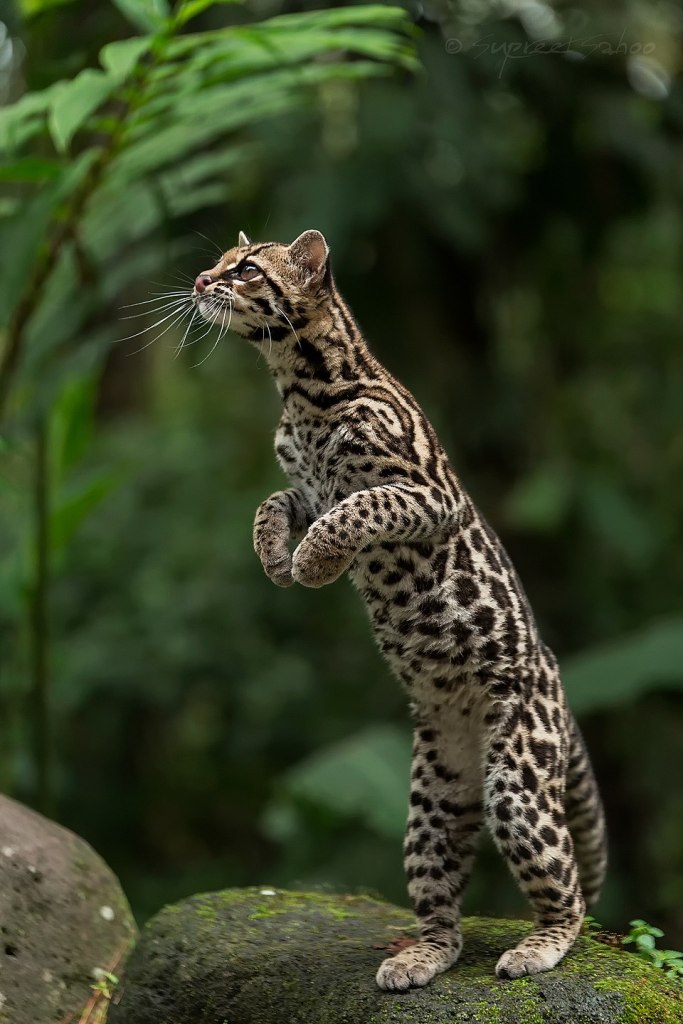
Living in jungles teeming with life, margays have a distinct advantage that allows them to escape land-based predators while making them a threat to monkeys and other critters living in the branches — they are outstanding climbers with unique biological adaptations that allow them to do things other cats cannot.
Credit: Supreet Sahoo via Wikimedia Commons
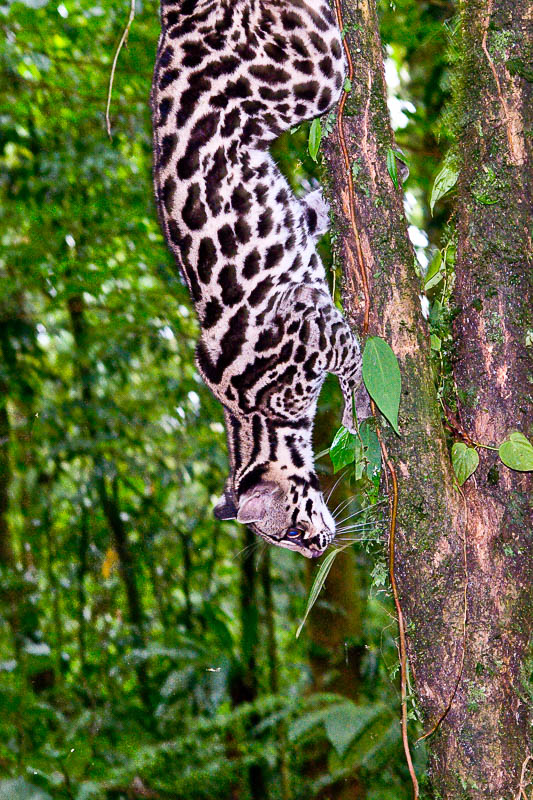
The most dramatic example is their ankle joints, which allow them to rotate 180 degrees as the little spotted cats anchor themselves to trunks and branches. As a result, margays don’t just climb with speed and ease, they are capable of swiftly evacuating trees by climbing down head-first like squirrels.
Other cat species lack that adaptation, which is one reason why we often hear about domestic cats who find themselves uncomfortably high up in trees or on utility poles, refusing to come down for days despite hunger and coaxing by humans trying to help.
A margay demonstrating its ability to climb head-first down a tree thanks to its unique ankle joints. Credit: James Kaiser
Margays are outstanding jumpers in addition to their unrivaled climbing ability, able to leap six to eight times their own height. It’s easy to see how these diminutive cats can intercept birds and monkeys far above the jungle floor in addition to hunting terrestrial mammals.
Indeed, using their large tails as a counterbalance, margays traverse branches with a swiftness and sure-footedness that rivals the gibbon.
The jungle’s tricksters
They’re also remarkably clever. Scientists have documented margays mimicking the vocalizations of monkeys, their favorite prey. In one documented example, a margay imitated the call of a baby tamarin, then ambushed the adult tamarins who approached to investigate the sound.
That’s a surprising adaptation for a cat species, and we should be thankful they’re tiny. The thought of tigers or leopards with that ability is terrifying.
Margays are solitary and due to their size, they’re both predator and prey. Because of that, these tiny cats spend the majority of their time well above ground level and are usually found deep in old growth jungles where they can blend into dense vegetation, hiding among leaves and branches, where their coat patterns help them blend in.
Like all wildcats, margays face increasing pressure from habitat loss, poaching and other threats, and they’re classified as near-threatened on the IUCN Red List.
Credit: Anderson Cristiano Hendgen via WikimediaCredit: Wikimedia Commons
Header image credit Clément Bardot via Wikimedia Commons
Copyright 2026 – Pain In The Bud – May not be reproduced without permission
There are lots of questions but very few answers so far related to the death of a woman on a hiking trail in northern Colorado. Authorities have not confirmed a puma attack.
A woman who was found dead on a hiking trail may have been killed by a mountain lion, state authorities say.
Several hikers were making their way along the Crosier Mountain Trail in northern Colorado at noon on Thursday when they came upon a woman laying on the ground and a puma about 100 yards away from her, according to police.
The hikers made noise and tossed rocks to scare the cat off, then one of them — a medical doctor — checked the woman and found no vital signs.
They notified authorities, who launched a massive search by air and ground, closing down the neighboring trails and bringing search dogs into the effort.
The search teams found and killed two mountain lions, who will be autopsied to determine if either had human remains in their stomachs. If they do not, rangers and police will keep looking, as they say Colorado law requires them to euthanize animals who have killed humans, local news reports said.
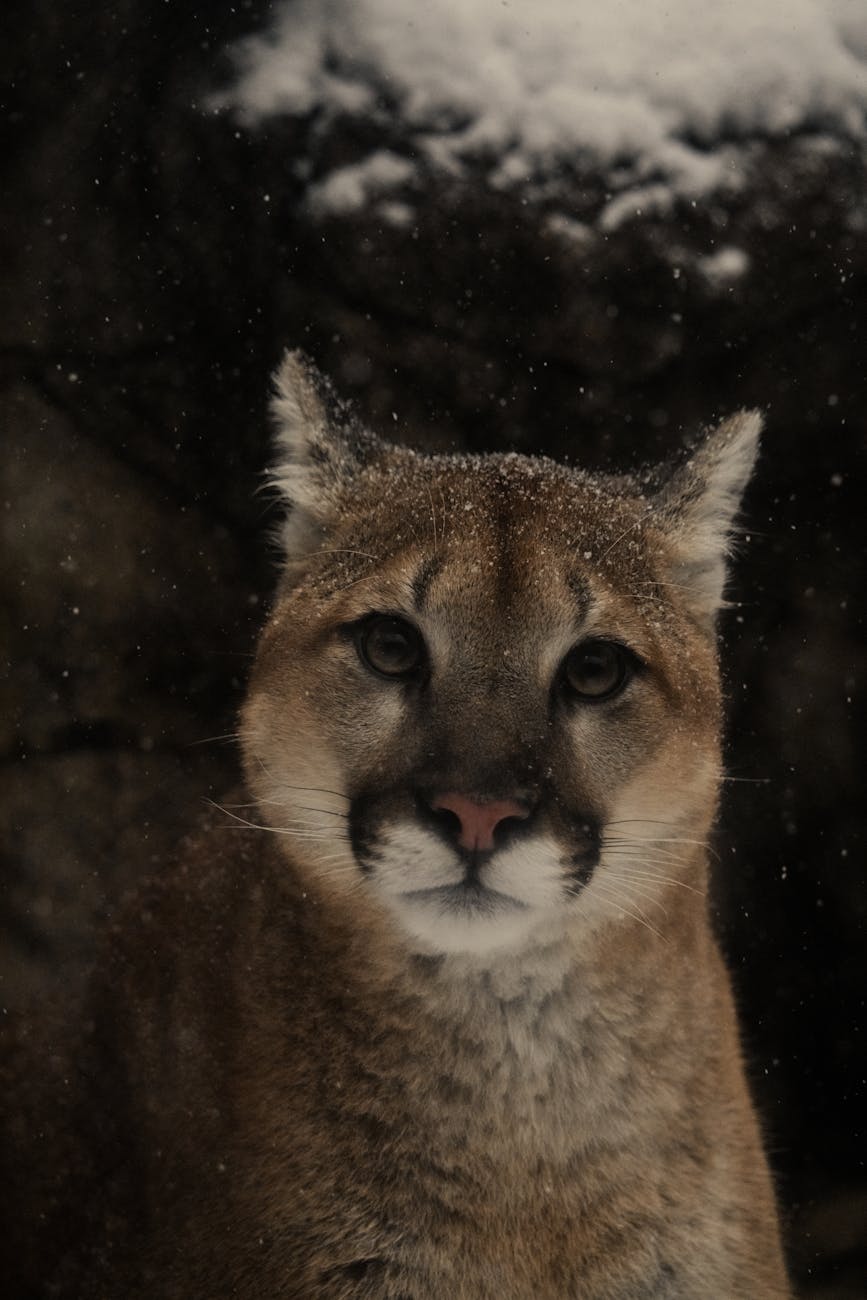
Pumas, also known as mountain lions, cougars, catamounts, screamers and many other names, are the widest-ranging cats on Earth, found throughout South America, the west of the US, and southern Canada. Credit: Charles Chen/Pexels
It’s important to note that there are no autopsy reports so far. Police don’t know how the woman died, if she was killed by the puma spotted near her, or if the animal approached after her death.
If an investigation does determine a puma was responsible, it’s crucial to place the incident in context. The last recorded fatal mountain lion attack in Colorado was in 1999, and was not confirmed. The victim, a three-year-old boy named Jaryd Atadero, wandered away from the hiking group he was with and was never seen again.
Search efforts in the following days and weeks didn’t turn up anything, but in 2003 another group of hikers found part of Atadero’s clothing. His partial remains were later found nearby.
Police said Atadero could have been killed by a mountain lion, but there’s no definitive evidence and his cause of death remains a mystery.
Aside from that incident, there have been 11 recorded, non-fatal injuries attributed to pumas in Colorado in the past 45 years despite as many as 5,000 of the wildcats living in the state’s wilderness.
Nationally there is some discrepancy in record-keeping, but most sources agree there have been 29 people killed by mountain lions in the US since 1868. By contrast, more than 45,000 Americans are killed in gun-related incidents per year, about 40,000 Americans are killed in traffic collisions annually, and between 40 and 50 American lives are claimed by dogs per year.
Americans are a thousand times more likely to be killed by lightning than by a puma, according to the US Forestry Service.
Despite their size, pumas are more closely related to house cats and small wild cats. They can meow, but they cannot roar. Credit: Caleb Falkenhagen/Pexels
Cougars are elusive, do not consider humans prey, and the vast majority of the time go out of their way to avoid humans. Most incidents of conflict are triggered by people knowingly or unknowingly threatening puma cubs, or cornering the shy cats.
Despite that, there’s confusion among the general public. Mountain lions are routinely confused with African lions, so some Americans believe they are aggressive and dangerous.
Pumas, known scientifically as puma concolor, are part of the subfamily felidae, not pantherinae, which means they are more closely related to house cats and smaller wildcats than they are to true big cats like lions, tigers, jaguars and leopards.
Pumas can meow and purr, but they cannot roar. Their most distinctive vocalization is the powerful “wildcat scream,” leading to nicknames like screamer.
In the Colorado case, police say they believe the victim was hiking alone. Her name hasn’t been released, likely because authorities need to notify next of kin before making her identity public.
This is a tragedy for the victim and her family, and we don’t wish her fate on anyone. At the same time, we hope cooler heads prevail and this incident does not spark retaliatory killings or misguided attempts to cull the species.
Convinced that culling cats will prevent local wildlife from going extinct, despite no evidence supporting that idea, New Zealand’s authorities have pledged to wipe out ferals and strays.
A recent RNZ story about efforts to exterminate cats in New Zealand starts with an anecdote about a man named Victor Tinndale, describing the way he bludgeons a cat to death as casually as if he’s sipping a cup of coffee.
Tinndale has taken it upon himself to kill cats even though the country’s wildlife management authorities told him not to. Why? Because he thinks cats are responsible for driving native species toward extinction.
He doesn’t know that, of course. No one does. No one’s bothered to do the research, and the driving force behind the claim that cats are responsible is a series of meta-analyses by birders who literally invented numbers to align with their predetermined conclusions about predatory impact.
To date there is not a single study that accurately measures feline predatory impact, nor is there a shred of evidence that slaughtering cats — whether beating them to death, shooting them with shotguns or poisoning them — has any beneficial impact on endangered bird species.
Yet there are vigilantes aplenty slaughtering cats across New Zealand, youth hunting contests encouraging kids to shoot cats and kittens, and government-sponsored extermination programs, like a particularly ghastly effort on a small island off New Zealand’s coast, where members of a team tell themselves they’re doing good work by sniping animals who are doing what they were born to do.
Ferals and strays already have tough lives without being hunted for sport or at the behest of government officials who aren’t in full possession of the facts. Credit: Mohan Rai/Pexels
The RNZ story describes Tinndale merrily skipping through the Aotearoan wilderness, singing songs and cracking jokes like a perverse Tom Bombadil as he murders cats unfortunate enough to get caught in his traps.
RNZ cameras follow Tinndale as he finds a terrified feline in one of the his traps. Tinndale describes the cat’s impending death at his hands as some sort of inevitable cosmic justice. He didn’t sentence the cat to die, he argues. He’s just the man who carries out the sentence.
“This cat is just an utter killing machine,” Tinndale says, addressing a camera as he repeats rhetoric from birder Peter Marra — who has advocated for the destruction of the entire species — almost word for word. “I’d hate to think what this cat has slayed to survive. So this guy has got to go, you know?”
The next scene shows Tinndale walking along the shore, the cat now hanging dead in his hands. He is judge, jury and executioner.
Tinndale buries his victims in a “graveyard” he made near a hut, admitting the graveyard is a “little bit of a laugh.” Tinndale was shocked, the story says, when New Zealand’s Department of Conservation didn’t pat him on the head for his vigilante efforts.
“I thought they’d have a chuckle, you know, and be pleased, but it was nothing of the sort,” he told RNZ.
Thought they’d have a chuckle?
This man thinks bludgeoning animals to death is hilarious. He is a psychotic vigilante who has taken it upon himself to violently end life. Why is he allowed to own weapons? Why is he not in prison or on a court-mandated mental illness management program?
Brad Windust with a trophy hunter’s expression as he shows off a Maine Coon mix he killed with the help of his hunting dog. Credit: Supplied to NRZ
The story goes on to quote Jessi Morgan of the Predator Free New Zealand Trust, who flat-out admits she can’t say how many cats there are in the country, let alone measure their predatory impact.
“I’ve seen estimates from two-and-a-half million to 14 million, which basically tells us we’ve got no idea what those numbers are,” Morgan said before immediately relaying anecdotes from hunters and farmers who say they’re “seeing more.”
This is not how we make decisions between life and death! This is not science, not by any definition of the word. This is not public policy. This is vigilantism and a mob mentality, amplified by the fact that it’s easier to blame a defenseless species for our own conservation failures and humanity’s impact on wildlife.
It is gross, utter disrespect for life under the guise of conservation, by people who not only can’t articulate what sort of damage they think felines are doing to their country, but have not a scrap of evidence that vigilantes running around bludgeoning cats to death are doing anything other than causing needless suffering.
Worse, it’s clear at least some of these self-appointed nature guardians are enjoying the task of murdering cats. It’s evident in their smiles as they show off their prizes and in the way they talk about their “work” — not as a solemn duty after all other options have been exhausted, but as something to “have a chuckle” over.
Credit: Dianne Concha/Pexels
This is also a failure of journalism, a failure to follow the most basic best practices and rules, to ask for proof when people assert opinions and call them facts. Those who call themselves journalists, who credulously spread the bunk studies about feline impact on native species, should be ashamed of themselves for not even taking a few minutes to read the studies they cite. Anyone who reads the research would immediately understand that the “studies” — which are really meta-analyses of old data — don’t provide any proof that cats are responsible for pushing endangered species toward extinction. They do nothing of the sort.
What we do know, and have confirmed over more than half a century of rigorous science, is that we are responsible for wiping out wildlife — more than 73 percent of the world’s monitored wildlife populations in the past 50 years alone, according to the World Wildlife Fund’s annual report.
Aside from the fact that they don’t have homes, these cats are no different than pet felines. They are the same species. Credit: Wikimedia Commons
Animal welfare groups have never disputed the idea that cats probably do have a part in endangering small mammals and bird species. They are predators. Hunting is their role.
But that is a far cry from proving they have a measurable impact, let alone are the primary drivers. In rare cases when research teams did the hard work of taking a feline census, as Washington, D.C.’s Cat Count did, the population numbers turn out to be considerably lower than expected.
Data from the Cat Count also confirmed what we know, that cats do not stray more than a few hundred feet from their territory, whether it’s a human home or a small shelter in a managed colony. In urban and suburban environments, the study found, cats have minimal impact through hunting unless they’re living directly adjacent to wooded areas.
Sending a bunch of lunatics out, dancing and skipping as they arbitrarily slaughter sentient creatures with real emotions, is the kind of monstrous behavior only humans are capable of.
Human-made devices and structures kill innumerable birds annually, a fact that isn’t accounted for in studies and news stories blaming cats for bird species extinctions. Credit: Amol Mande/Pexels
But it isn’t enough for New Zealand’s government to have vigilantes killing cats, or community-sponsored cat hunts. Now the government has pledged to eradicate feral cats by 2050. Because feral cats are the same species as stray and pet cats, and there is no way to determine by sight if a cat is feral or just frightened, that means any feline found outdoors will be killed.
“In order to boost biodiversity, to boost heritage landscape and to boost the type of place we want to see, we’ve got to get rid of some of these killers,” says Tama Potaka, the country’s conservation minister.
Note the language in the linked story, which describes domestic cats as if they’re a separate species. That’s the kind of ignorance that drives these cruel efforts.
New Zealand is heavily reliant on tourism, with visitors accounting for almost six percent of the country’s GDP before COVID-19, a number the country’s leaders expect to match in late 2025 as the tourism industry recovers. It’s part of New Zealand’s overall shift to services instead of products in an effort to diversify its economy.
Anyone who loves cats, who thinks men shouldn’t play God, who thinks we ought to demand at least something in the form of proof before allowing socially maladjusted vigilantes to brutally kill animals, should boycott New Zealand as a travel destination.
If you enjoy PITB’s content and want to help us keep the lights on, please consider whitelisting this site on your ad blocker.
Header image: Tinndale walking with a cat he killed via RNZ
The species has webbed feet and lives in some of the most remote regions in the world.
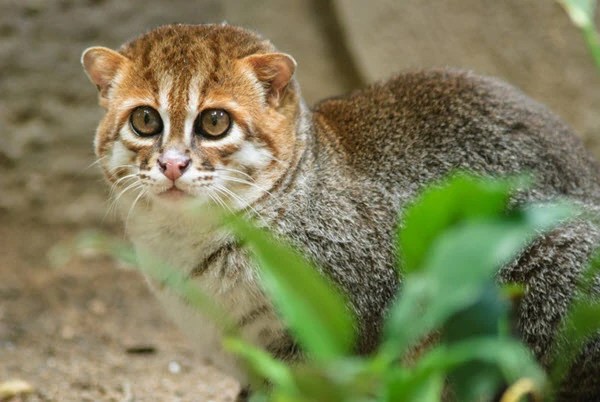
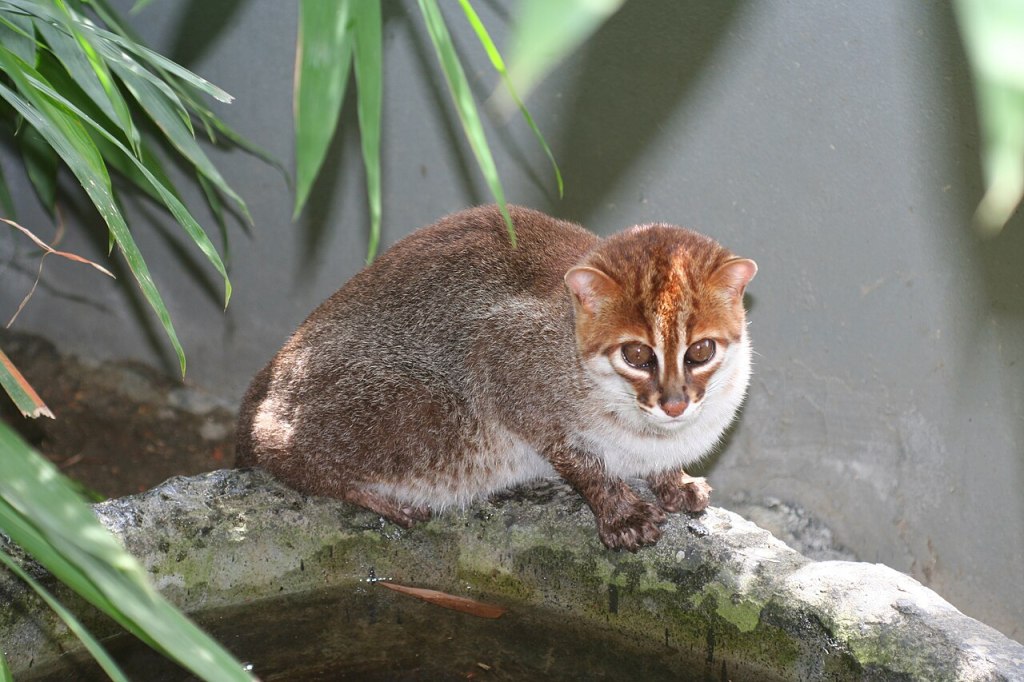
The flat-headed cat is one of the most elusive and rare felines in the world, and for three decades conservationists thought it had died out in Thailand, leaving only a handful of places where the species still eked out an existence.
Now there’s good news: the tiny feline, which weighs about half as much as a house cat, has been spotted in a remote region of the country.
Camera traps set up for an ecological survey starting last year detected flat-headed cats 29 times in Thailand’s Princess Sirindhorn Wildlife Sanctuary, according to the country’s Department of Parks, Wildlife and Plant Conservation. One of the sightings was a female and her cub, an encouraging sign that shows the local population is breeding.
Credit: Jim Sanderson/Wikimedia Commons
The sanctuary covers five square kilometers of rainforest and peat swamps. Along with the flat-headed cat and several unique species of birds, it’s also home to the endangered hairy-nosed otter.
Conservationists believe about 2,500 flat-headed cats remain in the wild. The species is mostly nocturnal and has webbed feet, helping the tiny wildcats navigate mangrove swamps and rivers in its rainforest habitat. Known as Prionailurus planiceps in scientific nomenclature, the flat-headed cat is most closely related to the fishing cat (Prionailurus viverrinus), which also has webbed feet, and the leopard cat.
Finding evidence of the endangered feline in Thailand is “exciting, yet concerning at the same time,” said Kaset Sutasha of Kasetsart University.
That’s because it means the surviving population is severely fragmented, which makes it more difficult for the cats to breed and could lead to genetic bottlenecks.
But Atthapol Charoenchansa, director general of Thailand’s parks department, also called it a “significant win” for conservation efforts. Knowledge of its presence in Thailand provides more opportunity to study the rare felines to better understand their behavior and protect them from extinction.
Jaguars, pumas, ocelots and margays are able to thrive in the same jungles, a unique arrangement that sheds light on how each species lives.
The jungles of Guatemala are teeming with life.
The guttural calls of howler monkeys haunt the rainforest from above, where scarlet macaws hop branches in flashes of red, yellow and blue.
On the forest floor opossums, peccaries, and oversize rodents called pacas move through dense brush, occasionally picked out by the few shafts of light able to break through the canopy. Ocellated turkeys plumed in iridescent copper and emerald advertise themselves to potential mates with thumping sounds, while spider monkeys perch on the weathered stones of long-forgotten Mayan cities that were swallowed by the jungle centuries ago.
As in most tropics, the apex predators are cats — four different species, to be exact. Jaguars sit at the top, unchallenged. Pumas, close in size if not ferocity, also find sustenance in the rainforest alongside ocelots and margays.
Margays are smaller than house cats and resemble tiny ocelots. They’re outstanding climbers, expert hunters, and spend most of their time in trees. Unlike most cat species, which are crepuscular, margays are nocturnal. Credit: Clement Bardot/Wikimedia Commons
How do four medium carnivorous species exist side by side?
By dividing time, space and items on the menu, according to a new study.
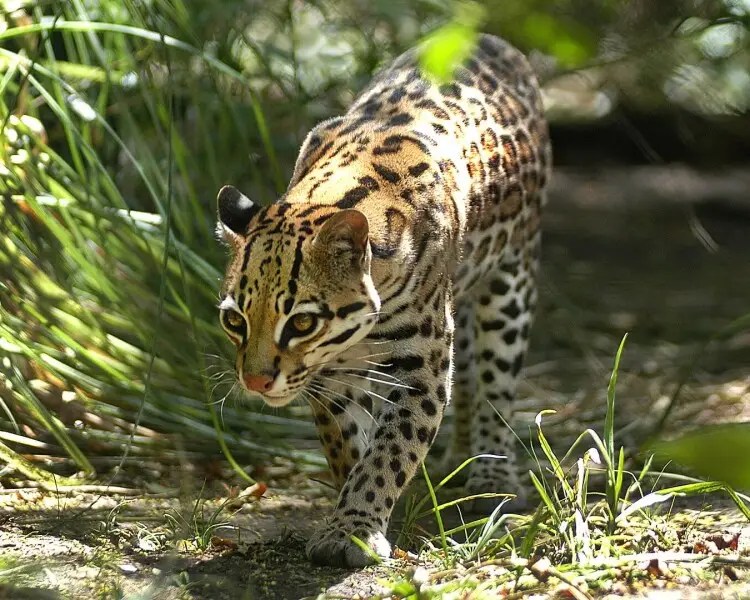
Ocelots are extremely adaptable: they’re excellent climbers and swimmers, and can thrive in various environments. Credit: Victor Landaeta/Pexels
The felids hunt at different levels of the jungle at different times of day, and while there’s overlap between prey, each species has its own distinct diet, according to a research team from Oregon State University. Their paper, Niche partitioning among neotropical felids, was published earlier this month in the Journal of Animal Ecology.
As the big kids on the block, jaguars primarily eat peccaries (pig-like ungulates that weigh up to 88 pounds), armadillos, deer and, sadly, ocelots. Apparently membership in Club Felid does not grant the smaller wildcats a pass. Ocelots top out at about 35 pounds, while the largest jaguars weigh in at about 350 pounds, making the smaller cats easy prey.
Pumas opportunistically prey on peccaries and brocket deer, but the majority of their diet is composed of monkeys, both spider and howler. Ocelots and margays naturally go for smaller prey, sticking mostly to rodents and opossums.
As the largest and most powerful cats in the western hemisphere, jaguars are the apex predators of their environment. Credit: Atlantic Ambience/Pexels
While jaguars hunt on the ground and have a well-documented habit of slipping into the water to prey on caiman and crocodiles, pumas, ocelots and margays take advantage of their climbing abilities and lighter frames to reach arboreal prey. That allows pumas, for example, to snag monkeys and arboreal opossum species from the canopy, so they don’t have to compete with jaguars.
The team verified the “spatial, temporal, and dietary niche partitioning” within the Maya Biosphere Reserve by using ground camera traps, arboreal camera traps and fecal samples, which allowed them to confirm the prey each species has been consuming.
Interestingly, margays are the pickiest — or perhaps most limited — of the bunch, preying on only seven species, while the other three cats regularly hunt between 20 and 27 different kinds of animals.
The information gleaned from the study not only helps researchers understand how these species interact with their environment, but also can help guide conservation decisions to safeguard them against extinction.
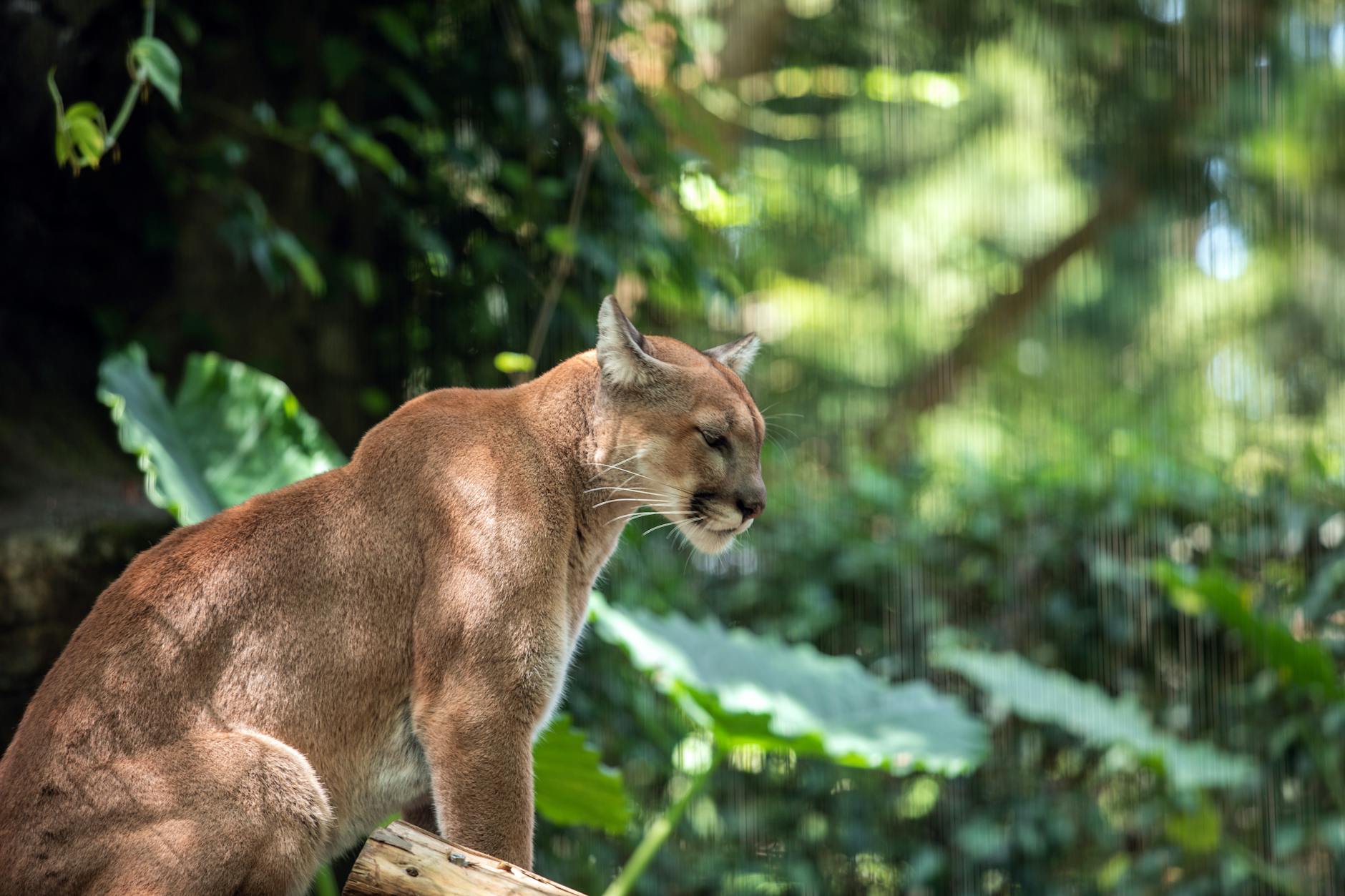
Pumas, also known as cougars and mountain lions, are adaptable and elusive. Credit: Catherine Harding Wiltshire/Pexels










 Pain In The Bud