


 Wait a second, this last jaguar cub looks kinda familiar…
Who wants to see cute baby jaguars?
Wait a second, this last jaguar cub looks kinda familiar…
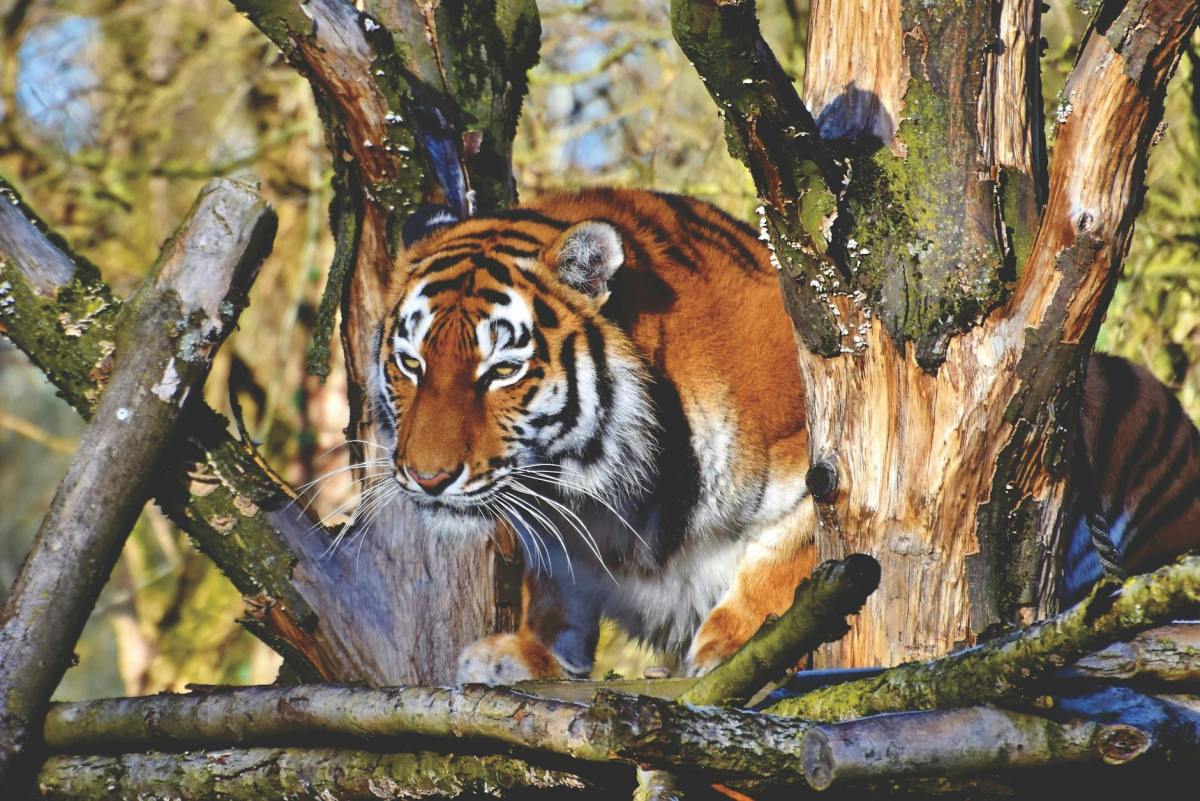
For the first time, humans have successfully returned orphaned tiger cubs to the wild after raising them and training them to hunt.
For more than 50 years, tigers were absent from Russia’s Pri-Amur region.
Sparsely-populated, mountainous and blanketed in forest, the domain borders the heart of the Russian Far East, offering hundreds of thousands of contiguous square miles for the most robust sub-species of Earth’s most magnificent predator.
Here, tigers can roam without fear of conflict with local farmers, or roads that carve up habitat and pose a danger to animals trying to cross. Prey is abundant, and adaptations for surviving in the local terrain are coded into the tigers’ DNA.
Now that scientists have proven for the first time that tigers can be successfully reintroduced into such an environment, big cat advocates imagine Russia’s Far East as a haven for the large felids. It’s a place where tigers can thrive, mate, reproduce and change the outlook for their species, which has dwindled to only 4,000 or so remaining in the wild.

The project to reintroduce Amur tigers to their native habitat is a cooperative Russian-American endeavor. The team started by building a tiger conservation center in the Amur oblast a decade ago.
The facility is built in a way that orphaned tigers can be raised and taught how to hunt without directly interacting with their human caretakers. That’s a crucial component, because tigers who see humans as potentially friendly or sources of food have drastically reduced chances of surviving in the wild, and are easier marks for poachers.
After 18 months, the cubs are brought to remote locations in Pri-Amur and released. Of the first group of orphan tigers released into the wild, 12 were able to survive on their own.
One gluttonous tiger failed: he crossed over the border into China and began eating domesticated animals, including 13 goats in what researchers called “a single event.”
The fattened tiger then retraced his steps to Pri-Amur, and when he didn’t show fear of humans, the team decided he had to go. They captured him and sent him to a zoo, where he gets all the free meals he wants and contributes to the captive breeding program helping his species maintain genetic diversity.
With 12 out of 13 tiger re-introductions successful, the program provides “a pathway for returning tigers to large parts of Asia where habitat still exists but where tigers have been lost,” said Viatcheslav V. Rozhnov, who leads the reintroduction project.

The successful reintroduction has also led to some surprising developments. Two of the cubs, Boris and Svetlaya, were unrelated but were rescued at about the same time and raised in the Russian orphanage for their species.
Using tracking devices they’d placed on the newly-released young tigers, the research team watched as Svetlaya settled into a home range and Boris made a beeline for her, “almost in a straight line,” crossing 200km (120 miles) of terrain to reunite.
The team’s hopes were confirmed six months later, when Svetlaya gave birth to a healthy litter of cubs, the first natural-born tigers to result from the reintroduction project.
Another tigress, Zolushka, also gave birth to a healthy litter when she was reintroduced in an area closer to a still-extant population of Amur tigers. The researchers believe the father was born wild in the region and was not part of the reintroduction program.
The wilderness in Pri-Amur and its environs is so vast, untouched and undesirable to human habitation that it could be home to generations of tigers, securing their future after so many decades of grim news for the iconic big cats.
“The grand vision is that this whole area would be connected,” Luke Hunter, executive director of the Wildlife Conservation Society’s Big Cats Program. “There’s lots of habitat that could be recolonized by tigers.”
There’s a lot to be grateful for.
Before we get into the most important day of the year (according to Bud), I wanted to share that we’ve been watching the wonderful Earth At Night In Color.
The title pretty much sums it up: teams of intrepid videographers went to some of the most remote locations on Earth armed with new camera tech that can peer deep into the night, revealing an entire world we can’t see and colors we don’t have names for.
The result is astonishingly crisp and clear images of the nocturnal world, offering opportunities to see things we’ve never glimpsed.

One episode, Jaguar Jungle, follows a six-year-old male named Juru whose kingdom is an idyllic stretch of the Amazon River where capybaras frolic and caiman are plentiful.
Serendipitously, the crew also encounters a young female jaguar in heat, following the scent trail of a male and calling out. The resulting courtship is fascinating and in the words of narrator Tom Hiddleston, “surprisingly tender.” It’s exactly the sort of thing that would have been impossible to film with regular or even night vision cameras.

Another episode, Puma Mountain, follows a cub on the cusp of adulthood as she learns to survive in Patagonia. The vistas are remarkable in a virtually untouched land far from human light pollution, where wildlife thrives and the glowing ribbon of the Milky Way straddles the horizons at night.
I appreciated the focus on pumas, who are often overlooked in wildlife documentaries, and Earth At Night is perfect for them since the vast majority of their activity happens in the overnight hours.
The series also has episodes dedicated to lions and cheetahs, so there’s lots here for cat lovers. Other highlights include episodes following African elephants, polar bears and tarsiers, which are liliputian primates that look almost like Jim Henson creations.
I move quite a bit when I’m sleeping, and since Bud literally drapes himself over me, you’d think he’d be used to it. I must have shocked him awake with a sudden movement a few nights ago, because he bolted up, freaked out and yelled “AQUA!”
I busted out laughing despite him catching my leg with a claw when he was startled. Then I rubbed his head to let him know all was well, and we went back to sleep dreaming of oceans.

Happy Thanksgiving!
It’s good to have a day dedicated to being grateful, and I think that’s especially important in an era of hyper-commercialism, when the accidentally fortunate use Instagram to rub their wealth in other people’s faces, dueling billionaires vie for political influence and the adoration of the public, and most people conflate what they have with who they are.
My family has banned talk of politics this year, which I think is the smart and mature thing to do.
As for Bud, he’ll have to endure most of the day on his own before I come home with his favorite food in the universe.
I hope everyone out there has a great Thanksgiving and gets to spend it with family and/or friends.
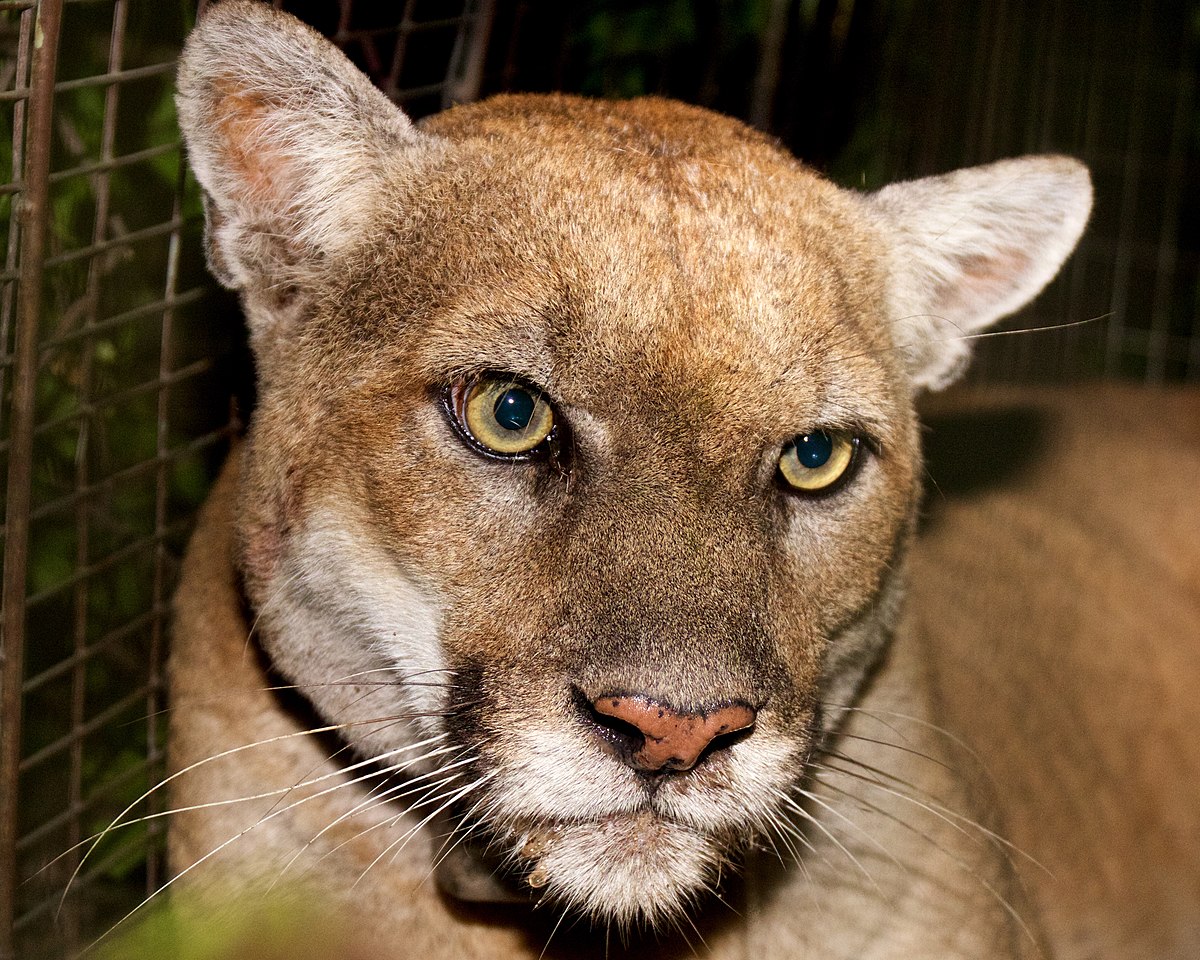
The new puma will have big paw prints to fill if it decides to make its famous predecessor’s range its own. People in Los Angeles are thrilled to have another mountain lion prowling the Hollywood Hills.
When the mountain lion known as P-22 died in late 2022, people in Los Angeles were so distraught they painted murals of him on building facades, buried him after a indigenous tribal funeral and even held a festival in his honor.
The famous feline had already been the subject of books, documentaries and an iconic photograph by National Geographic’s Steve Winter. The image showed P-22 in mid-stride, perfectly centered in a small pool of light beneath the Hollywood sign in the hills of Los Angeles at night. It was a natural symbol of wildlife adapting and surviving.
The love for P-22 wasn’t only based on the incredible fact that a mountain lion had established his “range” in Griffith Park, an oasis of wilderness surrounded by urban landscapes. The puma had to cross Interstate 405 and Route 101, heavy-traffic highways that are famously lethal to his species, to get there. For the next decade he skillfully avoided cars and trucks as he went about his business, popping up on trail cameras or in the backyards of Los Angelinos.
Now there’s a potential successor to the vacant throne.
The new puma isn’t collared and wildlife experts don’t know where it came from, but like P-22 it had to cross several dangerous highways to reach the city.
It’s not clear yet if the mountain lion is male or female. Jeff Sikitch, a biologist with the National Parks Service who is part of an ongoing, decades-long study of pumas, told the Los Angeles Times that he thinks the cat is likely a young male, but there’s not much to go on so far except for witness sightings and a low-resolution video taken by a man who lives in an apartment building near the edge of Griffith Park.
“Will this cat be as skilled as P-22 was at avoiding cars for a decade?” the National Wildlife Federation’s Beth Pratt told the BBC. “We don’t know what’s going to happen here.”
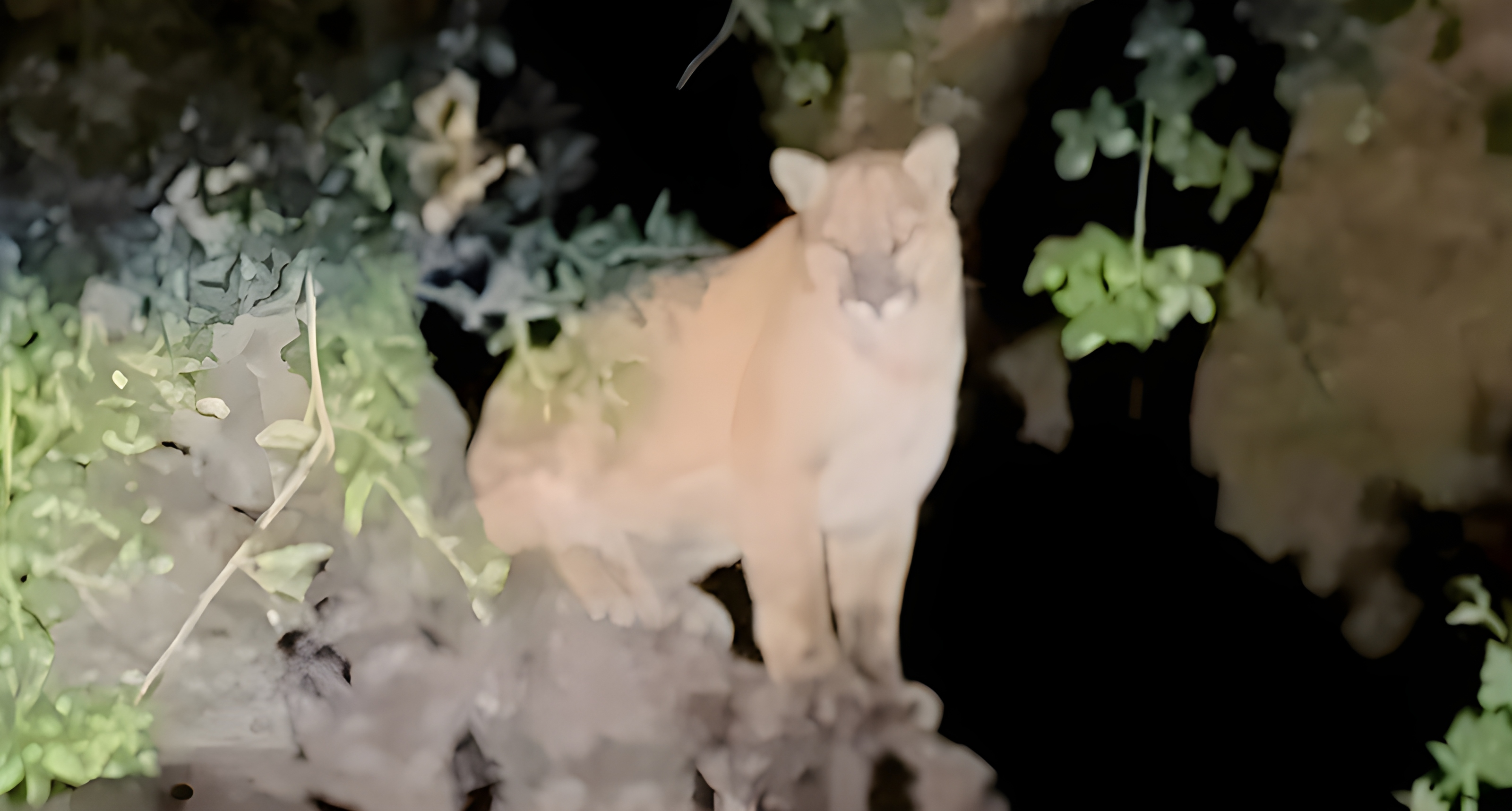
For now, wildlife officials are waiting and watching to see if the potential puma successor puts down roots in P-22’s old hunting grounds or tries to make the dangerous trek out of the city.
If the new puma decides to stay, it will enjoy plentiful deer and a benefit most members of its species do not have — a local population that understands mountain lion attacks are extraordinarily rare, and will support them by giving them a wide berth.
On the other hand, despite the 4,000 acres of Griffith Park and the residential neighborhoods below, the cat’s inherited range would be much smaller than what’s typical for the species. Like humans cramming belongings into apartments, pumas sacrifice space when they live in or around cities.
Suzanne Pye, a local who admired P-22 from afar, said she welcomes the newcomer and isn’t worried about attacks on people. The presence of a mountain lion after almost 18 months without one prowling the hills, she said, will add “a frisson of excitement to the morning hikes.”
Roadside zoos persist despite recent law changes, but even the best zoos fail to provide adequate facilities and enrichment for big cats, the report found.
The Amur tigress at Bearsdley Zoo is the lone occupant of her enclosure, which is large by the zoo’s standards, outfitted with a pool, toys and other enrichment, but small compared to what her natural range would be.
When I visited last summer, I spent the better part of an hour watching her pace the perimeter of her enclosure, walking in an endless loop as if in a daze, never stopping, altering her stride or reacting to anything.
But what made me realize how bad captivity really is for big cats was what I saw at the Smithsonian National Zoo, a well-funded world class facility. The tigers there have two outdoor enclosures with a topographic design: they’re vertical spaces separated into tiers, with large trees and narrow “caves” for shelter from the elements. Both enclosures are surrounded by wide moats that ring the perimeter just inside the security fencing.
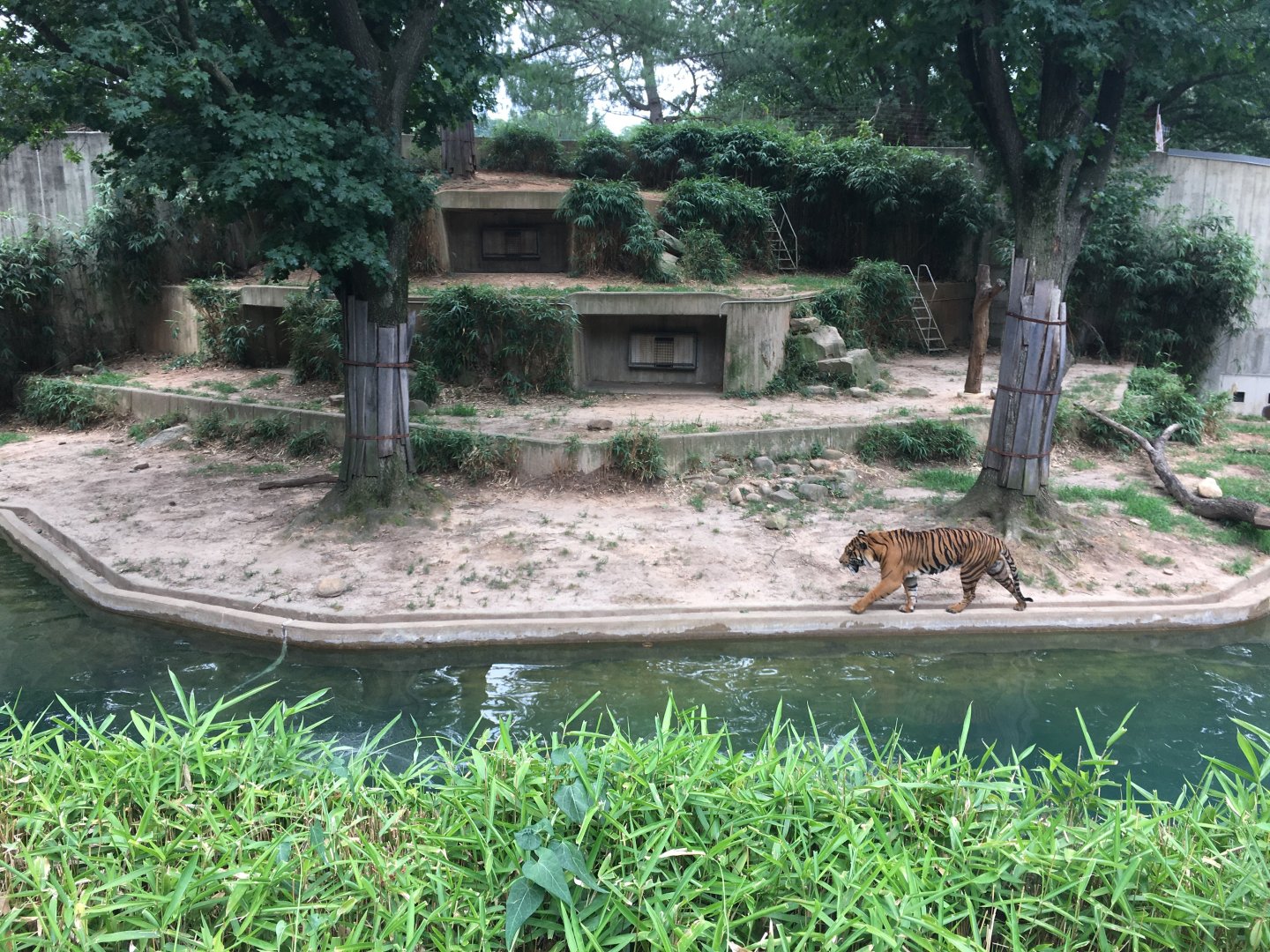
It was feeding time on a hot summer day. Lionesses chowed down on large slabs of meat and licked blocks of ice, but the lone male tiger next door was pacing in a circle. He paced and paced, covering the same 10 to 12 feet, ignoring his food. I watched him for a long time. His behavior was a clear sign of zoochosis.
If a tiger in a national accredited zoo — where an entire team of keepers and caretakers is responsible for enrichment and welfare — suffers from clear signs of captivity-induced distress, what chance do tigers in other facilities have?
When we think of big cats suffering in captivity, we think of the roadside zoos where the Joe Exotics and Doc Antles of the world exploit them for financial gain, drug them, force them to take selfies with visitors and keep them in cruel conditions. But a new report from Born Free USA goes beyond roadside zoos and says big cat arrangements, even in the best zoos, are inappropriate, unhealthy and demoralizing for the animals.
“Unable to escape the crowds of humans, unable to follow some of their fundamental urges such as hunting and roaming over large distances, unable to fulfil their social needs – whether that be living solitarily or forming a pride with others – big cats show us their mental anguish by adopting abnormal behaviors,” reads the report [PDF], Clawing at the Cages. “These behaviors, known as stereotypies, manifest in obsessive pacing. Some big cats spend most of their days tracing the same, short, tedious route around their enclosures. This behavior is a recognized sign of stress, and only documented in captive animals.”
The wild lives of animals like tigers are fundamentally at odds with the concept of zoos. In the wild, tigers range up to 50 miles in a single day, occupying vast ranges. Male tigers protect their home ranges, their mates and their cubs from other males as well as threats of all sorts.
That sort of lifestyle, which is hard-coded into their DNA, is not compatible with a guest-oriented operation in which habitats are designed primarily to give people the best view of the animals.
Lions might have it slightly better, though that’s arguable. As a social species they can interact with each other and they tend to have larger enclosures, but zoos rarely group animals according to their preferred family units or prides, instead matching individuals according to breeding plans as part of conservation efforts.
Yet even the conservation aspect is iffy, according to Born Free USA. Because of restrictions on “importing” animals and a population that is descended from just a handful of big cats, inbreeding is rampant. There’s a lack of scientific research on the captive zoo-held population, but the authors cite a 1983 study that found “six animals out of the approximately 1,000 Siberian tigers held in zoos in 1983 were responsible for 69.4% of the founder representation of the living population at that time. 70% of the population had a positive inbreeding
coefficient.”
Because little has been done to remedy that genetic bottleneck, “genetic viability remains low, and inbreeding of big cats in zoos can only have increased in the intervening years since these studies,” the report states.
Inbred cats suffer more health problems, don’t live as long and are much more susceptible to birth defects.
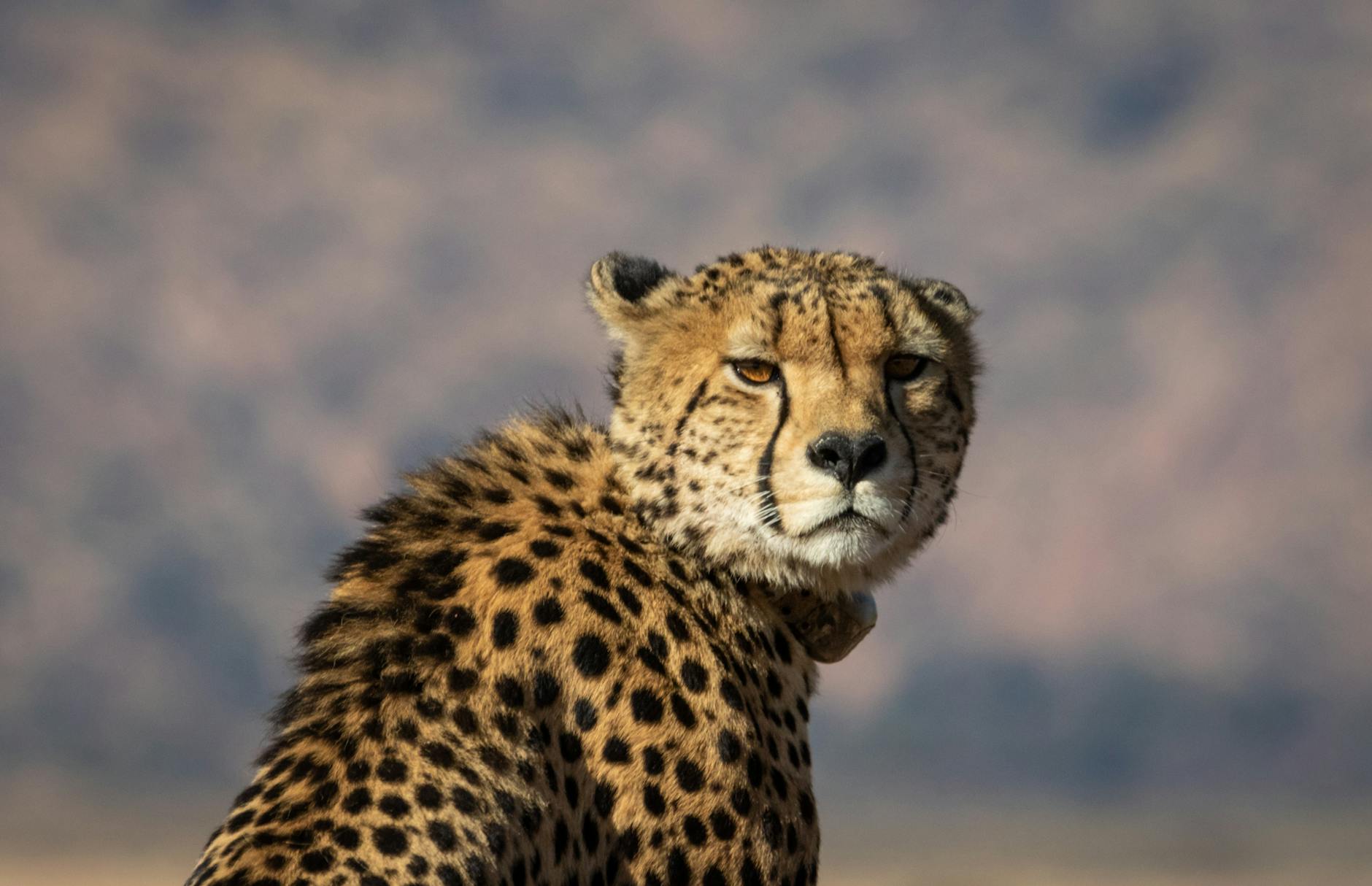
Despite the passing of the Big Cat Public Safety Act, Born Free USA’s report notes, roadside zoos still exist, and many of them have simply ignored the new laws because their operators know inspectors are overworked and lack manpower. Years can elapse between inspections, even at roadside zoos operated by serial offenders with long histories of keeping animals in abysmal conditions.
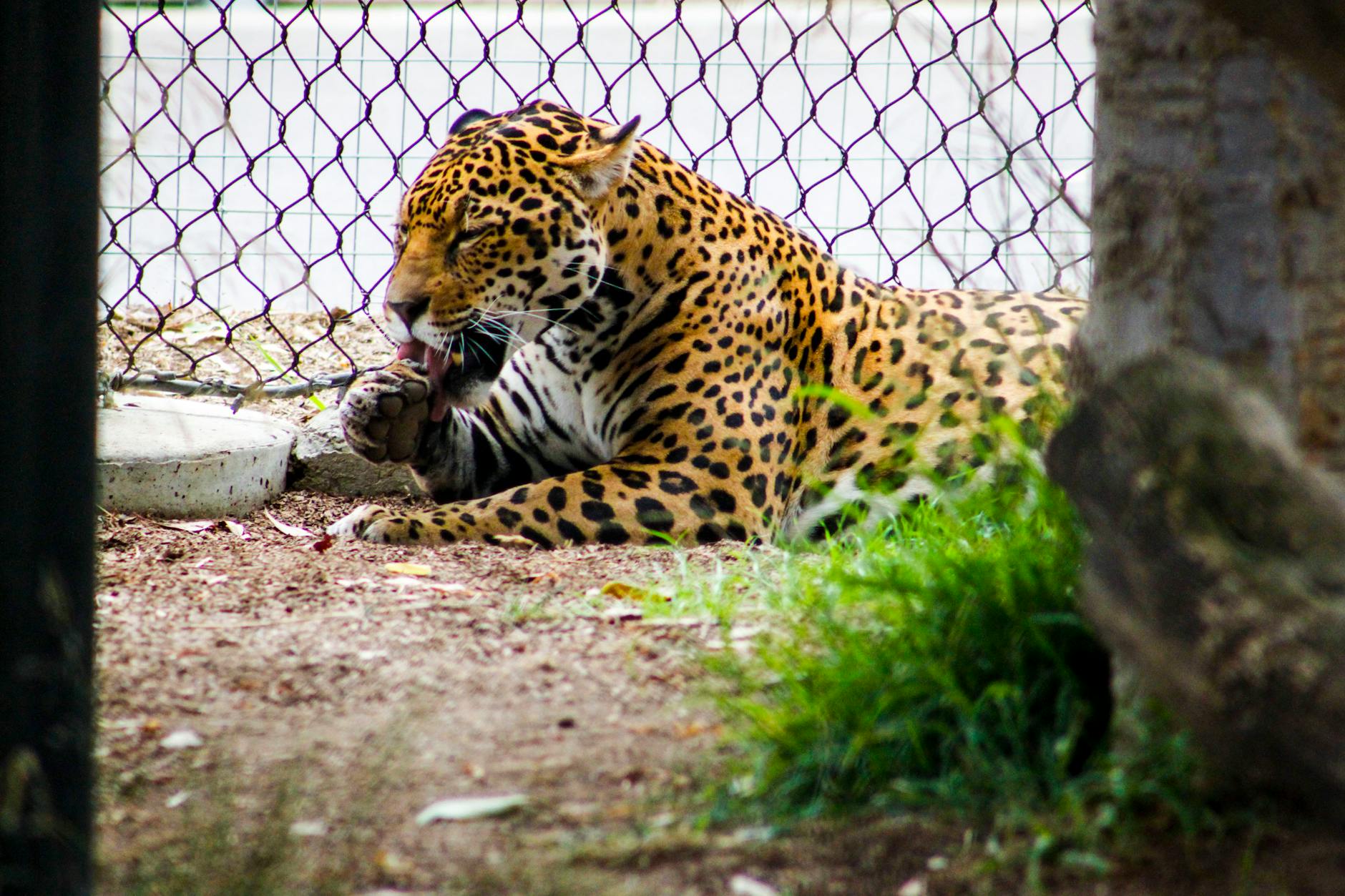
For example, Single Vision of Melrose, Florida — which bills itself as a “conservation” facility — openly flaunts its mistreatment of big cats with enormously popular video content from “Safari Sammie” on Youtube, TikTok and Instagram, despite the fact that it’s been the subject of dozens of violations and has an ignominious record when it comes to the health of its big cats. The facility was charged with 20 violations of animal rights laws in the previous two years, and has had multiple cases of animals dying due to neglect, yet continues to sell “experiences” in which “guests” can interact with heavily sedated tigers, jaguars, cheetahs and other wild cats.
In her videos, “Safari Sammie” — an employee of Single Vision — is routinely seen interacting directly with the apex predators, treating them like house cats and creating dangerous situations.
Other roadside zoos and animal “experience” operators continue to intentionally inbreed big cats to create “exotic” white tigers as well as ligers, tigons and other hybrids that aren’t found in the wild but are big attractions.
Overall, the report found:
The report includes detailed anecdotes of typical problems in captive situations involving jaguars, lions, tigers and cheetahs, documents persistent problems with habitat design and security, and outlines loopholes and other problems with existing laws, which still don’t go far enough to ensure some of the world’s most iconic apex predators aren’t exploited and forced to endure lifelong misery.
You can find the report’s landing page, with links to a petition, a summary and the full text here.


 Pain In The Bud