Powerful Politicians Come And Go, Scandals Erupt And Fade, And Larry The Cat Remains

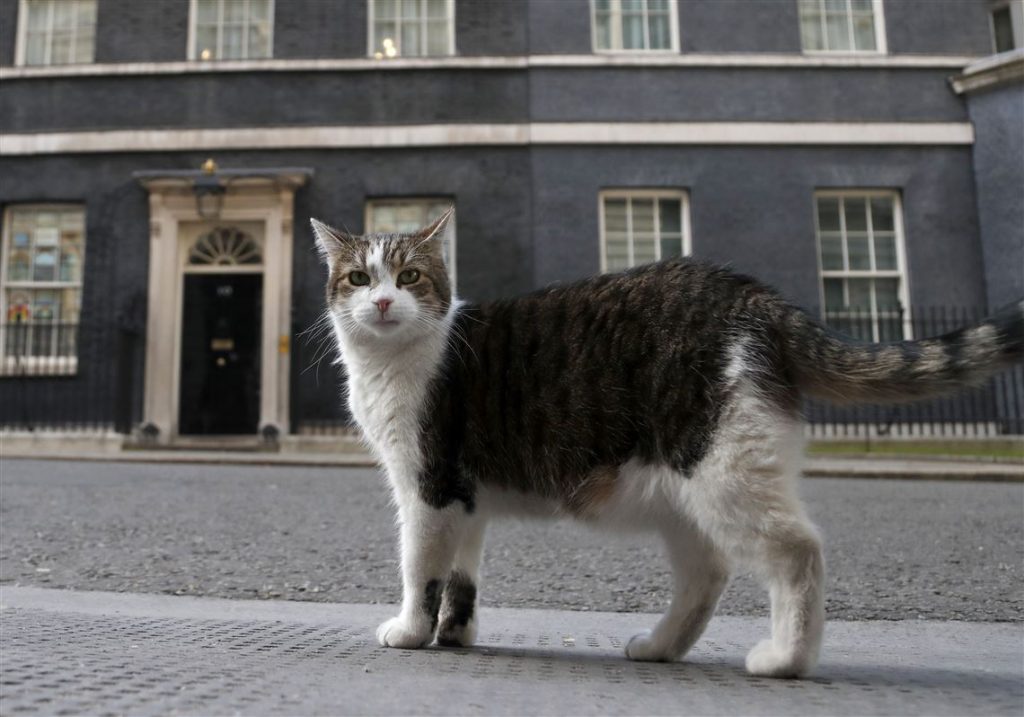
As Larry marks 15 years as the chief mouser in the UK’s seat of power, No. 10 Downing Street, Britain’s most famous feline is a constant amid rapid change.

At first it didn’t look as if Larry the Cat’s tenure would last long.

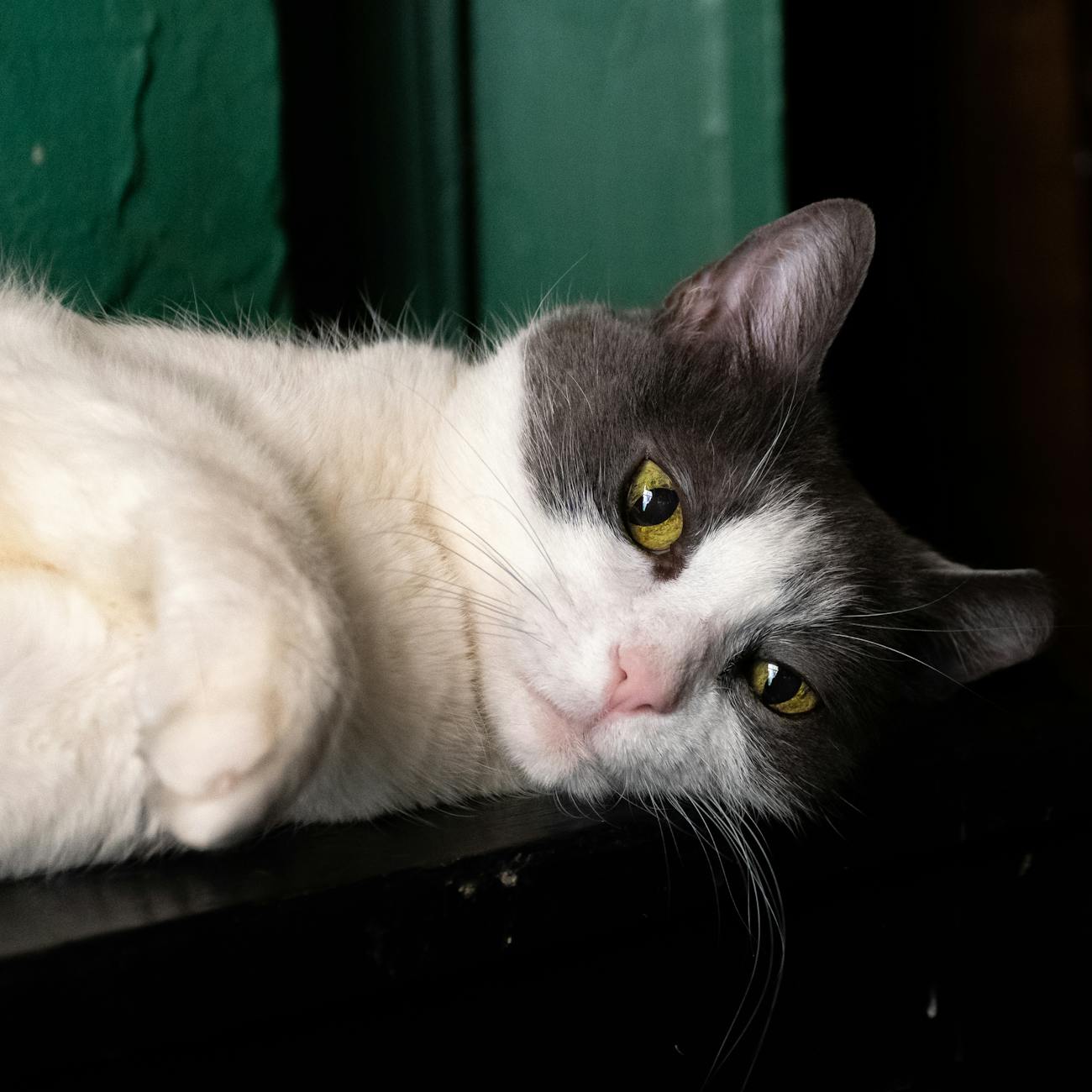
The striking white and tabby mix came highly recommended from Battersea Cats and Dogs, a London shelter whose staff said he was one of their most skilled little hunters. Larry, they said, would adjust well to the busy surroundings of the prime minister’s office and residence.

Adjust he did, but not in the way then-Prime Minister David Cameron, No. 10’s staff, and the UK press thought he would. Larry began his tenure by taking long naps on the residence’s front windowsill, paying frequent visits to his “lady friend” Maisie — a mouser living in another government building several doors down — and establishing a territorial rivalry with Palmerston, the Foreign Office’s mascot and mouser.

“In a separate development, it can be revealed that Larry has a girlfriend,” a droll BBC report from 2011 confirmed, while reporting on a cat-themed quiz night fundraiser at No. 10 to ensure the chief mouser’s yums cupboard remained stocked. “Maisie, a cat who lives at the nearby St James’ Park keeper’s cottage, has struck up a relationship with Larry, a spokesman for the Royal Parks has confirmed.

“There is, though, no prospect of kittens, as Larry went under the knife some time ago,” the report continued, speculating that the chief mouser’s love life could explain “why Larry spends most evenings out – and most days fast asleep in 10 Downing Street.”

It didn’t take long for the press to begin running tongue-in-cheek stories about Larry failing to deliver on promises just like every other political animal, and for a while it looked like No. 10 would need another chief rodent exterminator.

But then Larry began covering himself in glory by defending his new domicile not only from rats and mice, but also from a fox, territorial incursions by Palmerston, ill-intentioned politicians and other undesirables.

As the years passed, Larry’s legend grew. He outlasted Cameron, then Cameron’s successor, Theresa May, who admitted she was a dog person and wasn’t fond of Larry, even denying him the use of her office chair for naps. Then there was Boris Johnson, Liz Truss, Rishi Sunak, and Keir Starmer.

Starmer is Larry’s sixth prime minister, and no one will be surprised if his tenure ends while Larry’s endures. Meanwhile, Palmerston was “retired” to the countryside and only recently returned to politics when he accompanied his human, Andrew Murdoch, to Bermuda when the latter was appointed governor there. Such is the price of incurring Larry’s wrath.

Now at 18 years old, with 15 years as chief mouser under his collar, Larry represents something rare in modern politics: stability and predictability. With the passing of Queen Elizabeth II in 2022, illness and scandal in the royal family, and the usual ephemeral nature of UK politics, Larry has become more important than ever as the stalwart in the country’s seat of power.

Larry’s given the cold shoulder to Irish and Scottish politicians, nuzzled up for scritches from former US President Barack Obama, and forced President Donald Trump to wait before departing No. 10 while taking refuge from the rain under the president’s limo. The famous feline rarely leaves the public guessing when it comes to his thoughts on visiting political figures.

He’s “the most miserable animal you’ll ever meet,” a snubbed Ian Murray, the Scottish Secretary, said after Larry refused to pose for photographs with him. (Murray, it should be noted, was relieved of his post in September, and now holds the lofty title of minister for “culture, media and sport.” Perhaps he and Palmerston can commiserate.)

But that’s part of Larry’s appeal. The chief mouser’s unimpressed reaction to powerful figures has endured him to the public, who shower him with fan mail, treats and toys.

His unintentionally comedic adventures and ability to nap under any circumstances won him the affection of the notoriously fickle UK press, who enjoy watching, photographing and writing about his antics while waiting for the less popular humans inside to update them on the big news of the day.

That’s not hyperbole, by the way: a 2024 Ipsos poll found Larry is more popular than every prime minister to share his home, and the margins aren’t even close.

It also hasn’t escaped the notice of the press that Larry “rules the roost,” and has attentive staff who open the door at No. 10 any time he wants to go in or out. The famous door is actually a blast-proof, steel replica of the wooden original, custom manufactured after the IRA fired a mortar at the residence in 1991. Thus there’s no cat flap, and staff monitoring the door from inside open it as soon as the building’s most enduring resident decides he wants back in.

The prime minister may be the UK’s most powerful political figure on paper, but Larry’s tenure, run of the place, array of servants and adoring fans all prove he’s the real power at No. 10.

Now Larry’s legend will expand even further as the UK’s Channel 4 has commissioned a documentary series on cats from writer-comedian David Baddiel. The series, which is currently filming, will feature Larry in one of its episodes.

Happy 18th birthday, Larry! We hope you see many more years filled with treats, adventures, historic furniture to nap on, and politicians to push around. And if you achieve world peace while you’re at it, no one would be surprised.

Image credits: Wikimedia Commons/UK government

‘Man In A Panther Costume’ Terrorizing UK Beach Town

The costumed man has growled, hissed and meowed at passersby in the coastal area, reigniting old rumors of actual big cats prowling the area and freaking out people walking their dogs at night.

Ah, the things you can get away with in a country without guns.

A man in an all-black outfit has been prowling Wallasey beach in Wirral, a peninsula in northwest England, according to people who live in the area.

One witness said the man was “waving his hands in the air and making panther noises,” while others said they saw him approaching cars stopped at lights on roads near the coast.

“Anyone know who the freak in the cat mask and morph suit is at the coastal park near the harvester?” another local wrote online.

One thing was clear from witness accounts, photos and several short smartphone-shot videos: the costumed man wasn’t trying to imitate a friendly house cat.

“Was walking my dog tonight and heard a man making cat noises, shone a torch he was waving his arms at me before crawling up the hill. Never been so scared,” one witness posted to Facebook, per the BBC.

Sad as it may be, the first thing that came to mind when we read the witness accounts was that this doesn’t happen in the US, simply because odds are the costumed prankster would be shot.

“So I decided to bugger off home, had the rest of last night’s takeaway, had a laugh at the Sharons and Waynes on Blind Date, then went to see if any of the lads were up for a pint. Oi, I could really go for a Chinese! Anyone else wanna go for a Chinese?”

It’s possible whoever is behind the strange sightings is making light of decades-long rumors that mysterious and elusive big cats have been prowling the UK countryside.

Similar to persistent rumors of Bigfoot in the US, the phantom cats of the UK have their own believers who argue that there’s an extant population of leopards or pumas who are exceptionally adept at staying hidden from cameras but are occasionally spotted by farmers and motorists in the British countryside.

There’s a podcast dedicated to the topic, and proponents of the idea say it could explain a handful of cases in which livestock have gone missing.

The podcast, Big Cat Conversations, even dedicated a 2021 episode to “Wirral’s liminal leopards,” with its host interviewing several people who say they’ve encountered large melanistic felids on the peninsula over the decades.

Real big cats such as the leopard above tend to leave unmistakable evidence of their presence. Image credit: Wikimedia Commons

But as big cat experts have pointed out, it’s difficult to miss the signs when such apex predators really do claim an area as home. From unmistakable pug marks, to trees scratched and scent-marked with urine, to calls that can echo for miles in right conditions, big cats have many ways of making their presence known— and it’s often advantageous for them to do so, since they’re highly territorial animals.

One man who was out walking his dog told the BBC he thinks the whole thing is a prank.

“I don’t know his name, I think it’s just a wind up. He’s definitely not out to frighten people, he does it for fun,” he said. “He just likes being a giant cat. He doesn’t frighten our dog.”

Local police say they’re aware of the sightings. Merseyside Police and Crime Commissioner Emily Spurrell told local media that anyone who feels threatened by the suited figure should call law enforcement and report his whereabouts.

RSPCA Wants Cat Cafes ‘Phased Out,’ Says Cats’ Needs Not Met

Cat cafes offer a unique way for adoptable kitties to find homes, as well as a stress-reducing experience for customers, but two groups in the UK say cafes are not appropriate living spaces for cats.

Two major feline advocacy groups in the UK are urging the government to stop issuing new licenses for cat cafes, arguing they’re not good living situations for the felines who are their main attraction.

Many people see the cafe model as a win-win for cats and people. The latter get to unwind and spend time with cute animals who have a knack for lowering blood pressure, helping the stressed to relax. The cats, who are adoptable, get to run, play and live in an environment much better than a shelter cage while they wait for their forever homes.

But the RSPCA and Cats Protection, the most prominent feline welfare organization in the UK, say its “almost impossible” to meet the needs of the animals, who may be stressed by living with other cats and, they argue, are used as “entertainment” for customers.

“We don’t believe these environments can consistently provide cats with a good quality of life and are hugely concerned that many cats will be unhappy as a result,” said Alice Potter, a cat welfare specialist with the RSPCA.

“Generally cats are not sociable, and many felines often prefer to live without other cats, or prefer to form social groups with their relations.”

A cat cafe in Vilnius, the capital city of Lithuania. Credit: Wikimedia Commons

I’m not sure how I feel about this, and I’m not particularly familiar with how most cat cafes are run. The only ones I’ve been to were in Japan, and they were miraculously clean spaces with lots of things to climb, as well as nooks and private areas where cats could hide. The cats were well cared-for, staff were friendly, and the environments were relaxed.

Cat cafes also offer a unique opportunity for finding homes for the little ones. They’re much more likely to meow their way into the hearts of would-be adopters when they’re given space to run around, play and enjoy themselves as opposed to the often sullen, frightened state they’re in at shelters.

Are the UK cats groups right, or are they making perfect the enemy of good?

Shrill Editorial Calls Cats ‘Domestic Terrorists’ And ‘Skulking, Disobedient Destroyers’ Who Should Be ‘Locked Down’

The more bunk studies claim cats are driving wildlife to extinction, the more people in media and government call for extreme measures to contain them.

Seventy nine cats.

That’s how many felines stood in for the entirely of the UK in a 2022 study, which is the genesis for the claim that cats kill 270 million birds and small animals in that country.

Using GPS collars, owner questionnaires and samples of prey brought home by those 79 outdoor cats, a research team from the University of Reading applied data from a mix of studies dating as far back as 23 years ago, extrapolated and massaged numbers using things like “kernel density estimates” and “generalized mixed models,” and came up with that 270 million figure, which is cited routinely and credulously by UK media.

Actually, their estimate was between 140 and 270 million. An earlier study put the number at 92 million, and a 2016 study estimated UK cats kill 55 million birds and small animals. That’s a range of 215 million!

The Reading team even quotes the infamous US meta-analysis that claims domestic cats kill as many as 4 billion birds and 22.3 billion mammals a year here. That paper, as skeptics in the science community have noted, has virtually no relationship with reality, involves no original research, and relies on data from unrelated studies and surveys in which cat owners were asked to rate their pets’ hunting prowess on a point scale while imagining what the little ones get up to when they’re outside.

All of this is to say that aside from the thorough, labor-intensive and expensive D.C. Cat Count, which brought together cat lovers, birders and scientists to work cooperatively, the 2022 UK study and its counterparts in the US and Australia are exercises in pushing an agenda masquerading as honest academic research.

That’s how we get editorials like The Spectator’s “We need a cat lockdown now” by Zoe Strimpel. Though the tone isn’t tongue in cheek, I can’t imagine Strimpel dislikes cats nearly as much as she claims, and the post was probably written with wry anticipation for the click-generating fury of cat lovers indignantly sharing it on Facebook and X.

Still, it quotes the Reading study without skepticism and portrays cats as furry little wretches who abuse their human caretakers with their claws and their disdain while gleefully eating their way through endangered birds.

A cat stares down a mouse. Credit: Wikimedia Commons

Cats are predators, that much we can agree on, and outdoor cats are much more likely to negatively impact local wildlife, for obvious reasons.

Likewise, I can understand the concern with cat culture in the UK, where allowing pet cats to roam outside is the norm.

But every time the media cites the above-mentioned studies, more people are given an inaccurate impression of feline ecological impact, and more lawmakers at the local and national level consider “solutions” ranging from prohibiting people from keeping pet cats, as a government commission in Scotland recently proposed, or exterminating them outright, as some Australian states and municipalities in New Zealand have tried to do.

It’s worth pointing out that there is no data, not even a single study, showing that air-dropping poisoned sausages or arbitrarily shooting cats actually has any positive impact on birds and small mammals. All it does is terrorize sentient, intelligent domestic animals who have real emotions and experience real fear and pain.

The primary drivers of declining bird and small mammal populations — including habitat loss, environmental destruction, wind turbines and glass buildings — have nothing to do with cats. We have killed off 73 percent of the planet’s wildlife since 1970 and every species of iconic megafauna — from orangutans and gorillas to tigers and pangolins — is headed toward extinction. Are domestic cats responsible for that too, or can we be adults and fess up to our role as the main antagonist here?

An orange tabby and a mouse. Credit: Wikimedia Commons

Strimpel actually goes even further, claiming cats don’t have real affection for their caretakers and are more like psychopaths, faking love because it gets them what they want, primarily food and shelter.

Dogs have true affection for their humans but cats do not, she additionally claims, while adding that cat people are undateable because they share qualities with the “loutish and numerous creatures” they care for.

There was a time when I would have been ambivalent about Strimpel’s attitude toward cats, if not her cavalier treatment of basic facts. But then a drool-happy, friendly tuxedo cat showed me I could interact with his species without my allergies going haywire, and a tiny gray tabby kitten became my animal cognition teacher while blindsiding me with love.

Now every time I hear about some psychopath abusing cats, or terribly misguided politicians advocating a plan to kill millions of domestic felines, I think about my Bud. I think about how he cries for his Big Buddy when he’s hurt or stuck, how he meows and trills with excitement when he experiences something new, and how he began shaking, then threw up from overwhelming relief and happiness the first time I returned from a vacation after adopting him.

Buddy the Cat chillin’ on the balcony in the summer. Credit: PITB

He’s got a vibrant mind in his little head, with strong opinions and emotions. So does every cat on the street, in a shelter cage, and in the cross hairs of a birder or biologist playing God by “culling” or “harvesting” cats to protect another species.

Real science, not activism packaged as science, has proven that many times over in recent years. If people want to do harm to cats because they think birds and other animals will benefit, the burden of proof is on them to show not only that their methods work, but that the results could somehow justify the fear and misery they would inflict on innocent animals to achieve their goals.

Cats are obligate carnivores who don’t have a choice. We do.

UK Pol Resigns After He Was Filmed Trying To Kill Cat With Explosives

The cat survived but her personality has radically changed from loving and affectionate to distant and wary, her human said.

A councilman in a rural UK village resigned from his post and is the subject of renewed police scrutiny after allegedly trying to blow up a neighbor’s cat twice in 2023.

Councillor James Garnor was reportedly trying to stop the cat from climbing into a bird feeder, and decided the best way to do it was to rig the feeder with explosives and lure the curious feline in, according to a report on UK broadcaster LBC’s website.

Garnor was apparently so amused by his handiwork that he distributed video of the incidents to his friends. The footage shows a cat named Suki leaping onto the bird feeder on April 9, 2023, and nibbling on some of the bird feed before the explosive detonated. An injured Suki took off immediately and ran home.

She “came home one day missing her whiskers on her face – they looked like they’d been dissolved – so I put a post in my local community page on Facebook… just to warn people in case there was something she’d rolled in that had dissolved them,” said Suki’s human, a woman named Nikki.

Suki’s whiskers were singed off by the heat from the explosion. Image credit: Provided by owner to LBC News

“But somebody contacted me to tell me it wasn’t what I thought it was, that somebody had actually blown my cat up – and that it was my neighbour and local councillor. It made me feel physically sick.”

After she received the video, Nikki filed a complaint with local police, who elected not to arrest Garnor. However, after a second video surfaced with a clearer view of Garnor’s alleged actions, police responded to the public outcry and said they were reviewing the case again.

Per LBC, which broke the story:

“The incident is one of at least two occasions that cats in Whittlebury, Northamptonshire, were allegedly targeted by Councillor James Garnor in 2023 using remote-detonated explosives.”

It’s not clear if the new video shows a second attempt, or a different angle on the first. Garnor “was dealt with using anti-social behavior legislation,” a type of civil admonishment usually associated with things like noise complaints, littering and damaging public property, not trying to kill an animal.

Still images from a video showing Garnor allegedly setting off an explosion targeting Suki the cat. Credit: Photos provided by owner to LBC

Garnor resigned from his post on Feb. 7, and the council distanced itself from him, saying its members “understand the concerns raised by the community and want to assure everyone that we take all matters of animal welfare seriously.”

That hasn’t mollified people living in the small community, who are wondering why police didn’t press charges the first time they were presented with evidence of the attempt on Suki’s life. 

“You can clearly see the videos have been slowed down [and] edited. It’s very set-up: the animal has been enticed on the bird table with food whilst said individual was sitting there with the detonator waiting for [the cat] to appear,” a neighbor told LBC. “He is a member of our parish council, so it makes you worry what decisions are being made there by the individual… he has offered no apology [and] shown no remorse.”

In the meantime, Suki has been permanently impacted by the incidents. The tabby was affectionate and friendly, Nikki said, wrapping her little body “like a scarf around your neck.”

“Now she very rarely comes near you, and if she does, she’s got her claws out – she hisses, she growls,” Nikki added. “She’s not the loving cat she used to be – and I don’t blame her… the change in her happened pretty much overnight.”