Here’s a roundup of amusing cat stories from the past few days:
Pilot Lands After Berserk Cat Gets Into Cockpit
The captain of a Qatar-bound passenger flight was forced to return to Khartoum International Airport in Sudan — his takeoff point — after a berserk cat got into the cockpit and began attacking him, according to news reports.
The Wednesday flight was headed to Doha, Qatar’s capital, and was in the air for about an hour before the cat forced the emergency landing. Flight crew weren’t able to subdue the cat, who likely slipped onto the plane undetected the night before when it was stored in a hangar, according to airline authorities.
The cat-jacking was not the first incident of its kind, Euro Weekly News noted. In perhaps the most well-known incident in 2004, a cat named Gin escaped its carrier mid-flight and snuck into the cockpit while stewardesses were passing meals to the pilots. Gin attacked the captain and co-pilot, forcing them to return to Brussels. Also in 2004, a cat breached the cockpit of a plane bound for Bangladesh and caused havoc. While the plane arrived at its destination without any problems, it took the flight staff another two hours after landing to trap the frightened furball.
Earlier this month, a cat snuck onto a grounded El Al jet at Ben Gurion Airport in Israel. On Feb. 21, maintenance staff at the airport discovered the relaxed feline “sunning himself” on the dash after using the pilot and co-pilot seats as his personal scratchers.
The cute shop cats of Cleveland
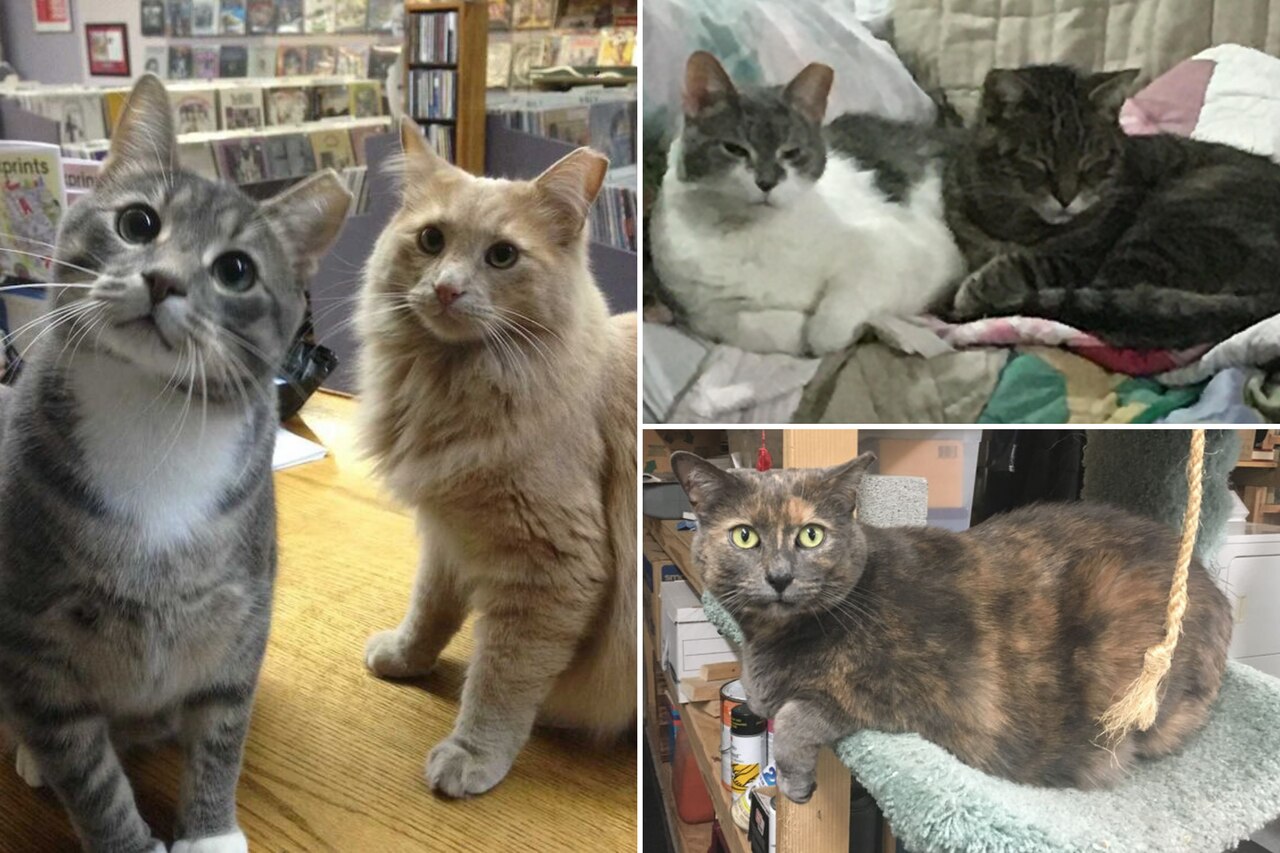
Cleveland.com’s Anne Nickoloff has a nice write-up about the shop cats of Cleveland who occupy bookstores, record shops, a brewery, a hardware store and a comic book shop, among other businesses. Some of the shop cats serve part-time as mousers, but most of them are really mascots and friendly faces that keep regulars coming back.
The shop cats of Blue Arrow Records in Cleveland. Credit: Cleveland.com
Among them is Saaz the cat, who calls The Cleveland Brew Shop home.
“She’s part-pet, part-employee because we have a lot of malted barley here, and so often if you don’t have a deterrent, it can attract rodents,” Brew Shop owner Darren Cross told Nickoloff. “It’s actually true – the pheromones of the cat will eventually get around the store and mice can detect those pheromones and they’ll stay away.”
“I’d recommend having a cat for any store. People walk into our store just to pet the cat… She comes to the door when people walk in, she’s not shy like you would expect a cat to be, so it works out well.”
Cat is reunited with owner after 15 years apart
While this is a nice story, it’s also a cautionary tale about allowing your cats outside. Along from the anguish of losing a cat, I imagine the worst part is not knowing what happened to the little one.
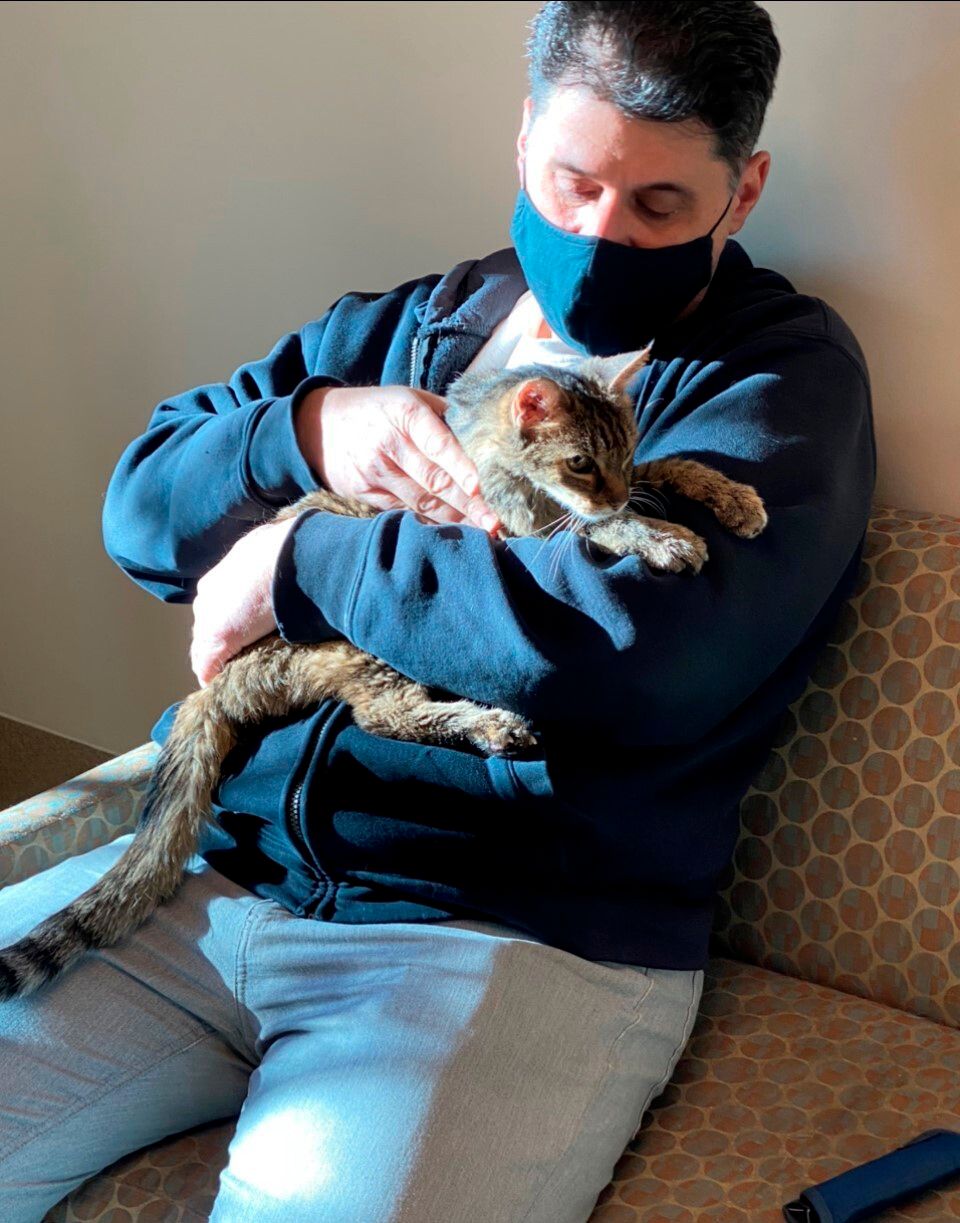
A Los Angeles man named Charles adopted Brandy when she was just two months old and had her for only a short time before she disappeared. Charles told the Associated Press he searched for her and put up signs, but after his efforts proved fruitless he guessed coyotes may have gotten to the young cat.
“I wanted her back because when I adopted her I made a moral obligation to take care of her for her life,” he said.
On Sunday he received a call from a Los Angeles area shelter who had picked up Brandy and scanned her microchip. The long-lost cat was skinny and malnourished, but “seemed content” and was purring.
“I did break down and cry because I thought about all of the years I lost from her,” Charles told AP.
Charles and Brandy. Credit: Los Angeles County Department of Animal Care and Control
In Cyberpunk’s future, all animals are gone…except roaches and pet cats.
I’ve been playing Cyberpunk 2077 lately, as readers of this blog may have guessed by some of the references, and it is everything the hype said it would be: A dystopian story set in a grim, hyper-corporatized, ultra-capitalist future in which the masses worship the gods of consumption, virtually everything that humans come in contact with is synthetic, and nature is a forgotten dream that may or may not exist beyond the seemingly-infinite concrete and chrome of human sprawl.
It’s Bladerunner writ large and interactive, a retrofuturistic nightmare in which people voluntarily have their own eyes plucked out to replace them with brain-interfaced digital lenses and biomechanical grotesqueness is the societal norm. A future in which a person’s life amounts to the price their internal organs can fetch on the black market and the only civil liberties that exist do so by the forbearance of megacorporations.
Even if you’re not a gamer, unless you’ve been living under a rock you’ve probably heard of the game. It is, after all, one of the most highly-anticipated pieces of consumable media in modern history, and familiar actors have lent their voices and likenesses to the production.
One of the most depressing aspects of 2017’s Bladerunner 2049, the long-awaited sequel to the 1982 Ridley Scott classic, is the utter disconnect from anything natural.
Future Los Angeles is so choked with smog that the city exists in a perpetual twilight gloom. Animals have been purged from the Earth, and humanity has turned to farming insect larvae for protein in processed foods. Vegetation is so rare that the sight of a single sprout near the dusty carcass of an old oak tree fascinates Ryan Gosling’s antagonist character, K.
Drawing heavily on Bladerunner — as well as the seminal 1988 Japanese film Akira, William Gibson’s 1984 novel Neuromancer, Luc Besson’s The Fifth Element (1997), and even the 1979 action thriller Warriors (which is itself based on Xenophon’s Anabasis from 370 BC) — Cyberpunk 2077 is about violence, hedonism and human greed.
There is no room for the beauty of animals or nature in a future like this.
That’s why it’s surprising to find cats stalking the dim alleys of Cyberpunk 2077’s Night City.
Keanu Reeves’ character, Johnny Silverhand, is quite enamored with Nibbles the Cat.
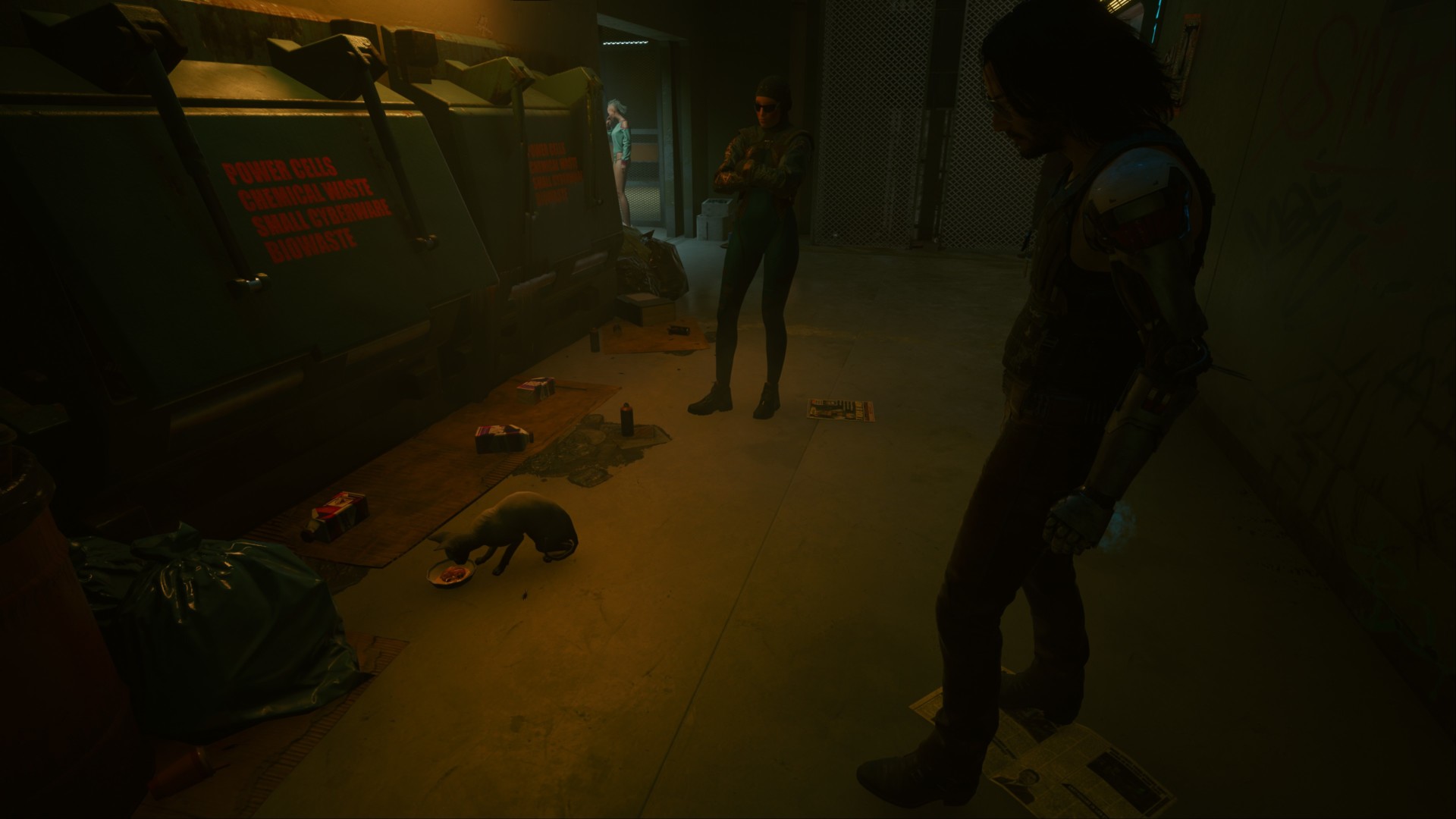
A Sphinx cat in Cyberpunk 2077.
The player’s character, V, can stop and pet stray cats he encounters throughout the game.
There’s even a hidden opportunity to adopt your own stray and take it back to your apartment in the game. Johnny Silverhand, the wise-ass character played by Keanu Reeves, is particularly fond of Nibbles the stray, who can be found amid piles of trash in the hallway outside V’s apartment.
Nibbles “doesn’t really do much besides lay around and take up space,” Screenrant notes. “Basically exactly what a cat does in real life. What an immersive experience.”
In another scene, V is conducting recon on a corporate target with Takemura, a Japanese ally, when a cat slinks by and lays down about 20 feet away.
Takemura says the cat is the first animal he’s seen in Night City, “except for the cockroaches, of course.” Then he wonders if the cat is a bakeneko, a Japanese spirit.
Night City is a technological achievement so impressive that it takes many hours just to get your head wrapped around how big and detailed it is. It’s easily the largest virtual city ever created, but it’s not just about sprawl — the city is truly vertical, from hidden subterranean depths and accessible street-level locales to highways, apartments and offices that claw at the sky, their peaks towering over ubiquitous flying car traffic.
The game is a form of entertainment, but it’s also a warning: This could be our future. Some would say it’s even likely to be our future.
Most of us are disconnected from nature. We’ve forgotten the stars and the night sky, which have been blotted out by smog and light pollution. We have wiped out more than two thirds of all the wildlife on the Earth and innumerable species teeter on the edge of extinction, including almost every example of iconic megafauna, from tigers and jaguars to orangutans, chimpanzees and elephants.
The interregnum caused by the global pandemic has reminded us that we share this planet with billions of other minds, with animals cautiously poking their heads out at the edges of civilization, wondering where all the humans have gone.
It’s fun to play in a dystopian future, but I don’t want to live in it.
A California parks district is under fire for killing cats that allegedly strayed too close to protected marshland where birds winter.
Employees of a parks agency in California’s Bay area killed almost four out of every 10 cats that may have strayed close to protected wildlife areas, newly released documents show.
The East Bay Regional Park District (EBRPD), an independent government district that manages parks in Contra Costa and Alameda counties, found itself at the center of a growing controversy earlier this month after admitting its employees were shooting cats they claimed could be a threat to local wildlife.
When more than a dozen cats went missing, several local volunteers who care for colony cats in the area contacted the EBRPD for an explanation. Staff at the EBRPD initially told the caretakers they’d trapped the cats and brought them to local shelters.
But when Cecilia Theis, one of the cat caretakers, contacted staff at nearby rescues and shelters, they said they hadn’t taken in any strays from the EBRPD.
“I immediately stopped what I was doing and searched for them,” Theis wrote in a letter to the EBRPD. “The cats I cared for were never taken to the shelter. [An EBRPD employee] even described the cats.”
It wasn’t until KGO, the local ABC news affiliate, began asking questions that the EBRPD admitted its “conservationists” had shot and killed the cats, claiming the stray felines ventured too close to a protected marshland where endangered bird species migrate for the winter. The marshland is located within the Martin Luther King Jr. Shoreline, a regional park managed by the EBRPD.
The Martin Luther King Jr. Shoreline / Credit: Bay Nature Institute
News of the district’s cat culling first broke on Dec. 8 when KGO aired a segment on the controversy. The EBRPD told the news agency that it had the right to cull animals that represent a threat to wildlife, per an old policy that local rescues, shelters and colony managers weren’t aware of.
District staff eventually admitted they killed 18 cats in 2020.
Despite press enquiries and public records requests, the district still has not provided details about the cat culling. It’s not clear how the district’s staff determines whether an individual cat represents a threat to local wildlife, whether there are protocols or standards governing the use of lethal force against stray domestic animals, or even what kind of firearms were used.
“I was heartbroken,” Ann Dunn of Oakland Animal Services told KGO. “Yeah, I was heartbroken, just knowing that that there’s no reason that that needed to happen.”
“We certainly didn’t realize they were doing what they were doing, otherwise we would have reached out sooner,” Dunn added.
The EBRPD has not responded to public records requests by KGO. Government agencies in California are required by law to respond to public records requests within 10 days. If they decline to release the requested records, they must provide a compelling reason why the information cannot be shared with the public, per open records laws and government transparency best practices.
Open records laws are arguably the most crucial tool used by media organizations, public interest groups and regular people who want to keep tabs on what their tax dollars are used for and how government offices are run.
Additionally, records provided by the EBRPD are incomplete. A document that is supposed to provide a full accounting of animals killed, trapped and caught by the EBRPD over the past three years is missing details on many of the incidents, and the numbers don’t add up with the district staff’s public statements.
The data was obtained through a public information request by Theis and shared with this blog. Additional public information requests are pending.
DOCUMENTS: PDF of the East Bay Regional Parks District records on cat culling: (Click to view full size)
Between 2018 and mid-December of 2020, the EBRPD dealt with 62 incidents involving cats. The district’s records say its “conservationists” shot and killed 24 of those cats. The remaining 38 were caught or trapped, meaning 39 percent — about four in 10 — of cats identified as potential threats to local wildlife were shot rather than trapped or caught by hand.
However, the documents list only 14 cat shootings in 2020, and only 13 during the time period when officials say they killed 18 strays. The documents list one cat shot in 2018 and eight cats shot in 2019.
Others have noticed the discrepancies as well. A Change.org petition started by Cassidy Schulman has almost 46,000 signatures and includes statements urging the EBRPD to come clean on the controversy.
“How can they claim that they communicate openly and honestly with the public they serve when they (separately and on more than one occasion) told Cecelia and another colony caretaker that they had not killed the cats, but had taken them to shelters in Oakland and Dublin?” Schulman wrote on the petition page. “Most of the colony cats were not only spayed, neutered and vaccinated – they were also microchipped by Fix Our Ferals. Had even a single one arrived alive at any shelter or veterinary hospital, they would have immediately been scanned for chips, and the organization would have been notified.”
In her letter to the EBRPD, Theis complained that a staffer there “even went so far as to pretend she was looking for paperwork” when pressed about what happened to the colony cats. Another employee told Theis the paperwork hadn’t been sent to the shelters because of COVID restrictions. That same employee told Theis four cats “had to be shot” because they were sick.
But those explanations were abandoned by the EBRPD when KGO’s reporters began asking about the fate of the cats. That’s when the staff admitted they’d killed 18 cats, including 13 at the Martin Luther King Jr. Shoreline.
While the EBRPD itself said it won’t rule out killing more cats, members of the board that oversees the EBRPD have pledged to end the practice.
“The Park District appreciates all animal life but is required by law to protect threatened and endangered wildlife living in District parklands,” EBRPD spokesman Dave Mason told SFGate. “It is imperative that the public understands that feral cats are not part of a healthy eco-system and feeding them only serves to put endangered wildlife at risk.”
The EBRPD’s cat-killing policy — and similar efforts by states and municipalities in the US and other countries — are influenced by a series of studies claiming cats are one of the biggest factors leading to the extinction of endangered species of birds and small mammals.
However, the claim that cats are a major contributor to bird extinction is controversial.
“Conservationists and the media often claim that cats are a main contributor to a mass extinction, a catastrophic loss of species due to human activities, like habitat degradation and the killing of wildlife,” a trio of academics wrote this summer. “As an interdisciplinary team of scientists and ethicists studying animals in conservation, we examined this claim and found it wanting.”
Other scientists challenge the claims that cats are the primary cause of species extinction among birds and small mammals.
There is no direct evidence that felis catus — domestic cats — are a major driver of extinction. A handful of studies that purport to show a connection are not based on observational or even secondary data. Instead, they rely on guesswork and numbers cobbled together from unrelated studies.
Most of the studies use aggregate data taken from earlier studies that did not measure the ecological impact of stray, feral and outdoor cats. For example, one paper used GPS data from an earlier study in which cats had devices affixed to their collars to track their movements.
But that earlier study did not include any information about the cats’ hunting activities, so the authors of the meta-analyses handed out questionnaires to cat owners asking them to rate their cats’ hunting skills on a five or 10-point scale.
The authors took the GPS data and the questionnaire results, calculated an estimated number of prey animals killed per cat annually, then extrapolated that data based on an estimate of more than 100 million stray/feral cats living in the US, even though that number could be off by as much as 80 million.
The result — a claim that cats kill up to 20 billion birds and small mammals in the US each year — is based on so much guesswork and arbitrarily plugged-in numbers that it’s worthless from a practical perspective. Yet that hasn’t stopped credulous press outlets from reporting the numbers as fact, or authorities from using such studies to justify extreme measures against stray and feral cats.
Because lives hang in the balance, and public policies are directly influenced by these studies, cats deserve better than guesswork.
CORRECTION: Earlier posts incorrectly labeled the East Bay Regional Park District as a California state agency. It is in fact a special district founded in 1934, and serves Alameda and Contra Costa counties.
Bowing to public pressure, a state agency in California said it will no longer allow its employees to shoot cats in a misguided attempt at protecting local wildlife.
State employees in California have agreed to temporarily stop shooting cats after stories about their actions prompted an overwhelming backlash.
Employees with the East Bay Regional Park District have shot at least 18 cats this year, including a dozen in the past month. A spokesman for the state agency, which manages park land in nine California counties and major cities like San Francisco, claimed the cats were a threat to birds in a marshland not far from a business park where the felines lived.
But the East Bay Regional Park District has repeatedly lied about the cats’ fates, failed to work with local rescues and shelters, and refused to honor public records requests about the cat-killing program, according to animal rights advocates and local media.
Dave Mason, a spokesman for the East Bay Regional Park District, described the situation as “an out-of-control feral cat colony of at least 30 cats.” By contrast, staffers at local rescues, as well as the people who managed the colony, said most of the cats were strays, some were former pets, and they rarely entered the nearby protected marshlands.
“[East Bay Regional Park District] came out most likely at night, and shot and killed the cats we had cared for. We spent countless hours getting the majority of these cats fixed. Countless hours!” one local caretaker fumed on Facebook. “These cats were vaccinated, microchipped and healthy. We pulled kittens out when they presented themselves. We pulled adult cats out on many occasions. Some of which we believe were dumped there. We were constantly doing work there.”
Mason painted a very different picture of the situation.
“The Park District appreciates all animal life but is required by law to protect threatened and endangered wildlife living in District parklands,” he told SFGate. “It is imperative that the public understands that feral cats are not part of a healthy eco-system and feeding them only serves to put endangered wildlife at risk.”
Willow, one of the strays in the eliminated cat colony, is missing. Colony caretakers believe she was shot by state employees.
Now the agency’s supervisory board has pulled the plug on killing cats, according to the local ABC affiliate, after receiving a flood of angry messages and phone calls about the policy. Dee Rosario, the board’s incoming president, told KGO she plans to have the practice ended permanently.
Board members also promised the public will get answers after the EBRPD ignored public records requests from journalists at KGO.
“The board will be asking some tough questions, and we want to get a report of exactly what happened,” said Ellen Corbett, who sits on the board. “And that’s why we’ve asked for an investigation.”
It’s worth noting there’s no evidence to support culling cats as an effective way to protect birds. Several studies, however, indicate TNR (trap, neuter, return) programs do have a measurable impact on local cat populations, and thus limit the number of birds and small mammals killed by free-roaming cats. The majority of animal welfare specialists — as well as groups like the SPCA and Humane Society — urge people to keep their pet cats indoors, and to get them spayed or neutered.
Initially, employees of the state agency claimed they’d trapped the cats and placed them in local shelters, colony caretaker Cecelia Theis said. But after staffers at local shelters said the East Bay Regional Park District did not drop off any cats, and a local TV news station began calling, the agency backtracked and admitted a team of “conservationists” shot the cats.
“There is a pile of bags and a hole in the fence near where I fed these babies every night. Those jerks hunted them and killed them,” Theis wrote on Facebook.
Later she told SFGate: “I’m looking out at the park crying their names.”
A Change.org petition urging the EBRPD to “honor its values” and cease shooting cats had accumulated almost 5,000 signatures in three days.
Cat advocates were particularly incensed that the EBRPD did not notify them before making the decision to kill the cats and didn’t reach out to local shelters for help finding a better solution.
“While we understand and fully support the need to safeguard protected wildlife and habitats from nonnative and predatory species, this tragic outcome did not need to happen,” said John Lipp, director of the Friends of Alameda Animal Shelter. His group and other local rescues “could have worked together to humanely rehome or relocate these cats had we been notified in advance.”
Despite the pledge to stop killing cats, advocates aren’t taking any more chances. They’ve trapped the remaining strays. Some will be put in foster homes, and four will be available for adoption in the near future.
The government agency that manages Bay Area parks initially denied killing the cats, then said its employees shot 18 strays because they were a threat to birds who migrate to the area for the winter.
In a sickening story out of California, state government employees have admitted to shooting 18 cats and say they can’t rule out shooting more who venture too close to a marshland where thousands of birds migrate for the winter.
The cats were shot by employees of the East Bay Regional Park District, a government agency that manages parks in the Bay Area, including San Francisco, Oakland, San Jose, Palo Alto and dozens of other cities and towns in a nine-county area.
They’re operating under a broad mandate that allows them to kill any cats “that may pose a danger to wildlife,” according to a report by Bay Area ABC affiliate KGO.
It’s 7:30 at night in an East Oakland office park, Cecelia Theis is trying to trap what’s left of the colony of cats she’s cared for over the past year. She tells the I-Team, “I really want to get them out of here.”
After Theis came here to work for the county, training poll workers in the last primary election, she began helping others feed the feral cats. She fell hard for them, including the little one who climbed on her hood waiting for food, and the first cat she befriended.
“Each of them had a personality and helping them was a priority for me,” Theis said.
She found homes for their kittens, took the adults to be spayed and neutered; the colony was stable at 30 cats. But over the past month, most of them have disappeared.
Theis finally got East Bay Regional Park officials to admit, their staff shot and killed several of the cats that had wandered into a nearby marsh.
Her heartbreak spilled out on social media, “It’s not okay to shoot these beings; some of them were pets that were abandoned.”
The state employees who shot the cats did so without notifying the public, without talking to locals who manage and care for cat colonies in the area, and without asking for the help of local shelters and rescues whose staffers say they could have easily trapped the cats and relocated them.
In fact, the East Bay Regional Park District lied when first asked about the fate of the cats: Employees there initially told Theis and another colony manager that the cats were trapped and taken to shelters in Oakland and nearby Dublin, according to a day-old Change.org petition that already has almost 500 signatures.
The state employees only came clean about killing cats when Theis went to KGO and they realized their actions would be detailed in media reports. They’re still obfuscating: KGO journalists filed public records requests for documents related to the cat killings, but the agency has not fulfilled the requests.
That’s illegal according to state and federal law, which dictate that government agencies have 30 days to respond and, if they deny the open records request, must provide a compelling reason why. As a career journalist who has filed my own share of Freedom of Information Act requests over the years, I cannot fathom any valid excuse for withholding those documents from the media and thus, the public.
Policies like this one are a direct result of the dangerous misinformation peddled by a handful of academics who advocate for the extermination of cats, and claim domestic cats kill more than 20 billion birds and small mammals in the US annually.
Despite serious and deep flaws in their methodology — and the fact that the authors invented data rather than trying to gather it — the findings of those studies are reported as fact in the press, without any skepticism, despite push back from other scientists who have been sharply critical of the studies and their conclusions.
The result has been a panic over cats and their impact on smaller wildlife. The studies and the subsequent panic are directly responsible for policies like those adopted by some Australian regional governments, who have an open bounty on domestic cats, paying $10 for adult pelts and $5 for kitten pelts. They also fuel rhetoric of the type we witnessed in the New York Times this August, when a columnist was so incensed by reports of cats killing birds that she admitted to fantasizing about shooting a hungry, sickly stray who showed up in her neighborhood.
We have a serious problem if, on the cusp of 2021, we have government employees shooting cats and paying bounties for kitten pelts, based on the misguided idea, not supported by evidence, that violently killing small domestic animals is somehow an effective way to protect birds.
Cats are sentient creatures who feel pain, fear, anxiety, sadness and the full range of primary emotions. Moreover, they’ve been molded into companion animals who bond closely with humans. According to Theis and KGO, several of the cats who were shot were former pets.
A manager with the East Bay Regional Park District downplayed the shootings, saying there was a “communications breakdown” between his team and local rescues as well as colony caretakers.
“We feel horrible about this, you know, this is really one thing that’s just really sad,” Matt Graul, “chief of stewardship” for the agency, told KGO. “And we really don’t want to ever have to take this step. You know, we are compassionate, and love all wildlife. And many of our staff have cats as pets.”
Despite that, Graul would not rule out killing more cats and his agency has not complied with state public records law, nor did he say why the agency lied to colony caretakers about the fate of the strays. We hope Bay Area media organizations are getting their lawyers involved and working with the state’s open government office to force the East Bay Regional Park District to obey the law and release its records on the cat shootings.
This is unacceptable, and it should be stopped before government officials with too much zeal and too little skepticism enact similar policies in other states.