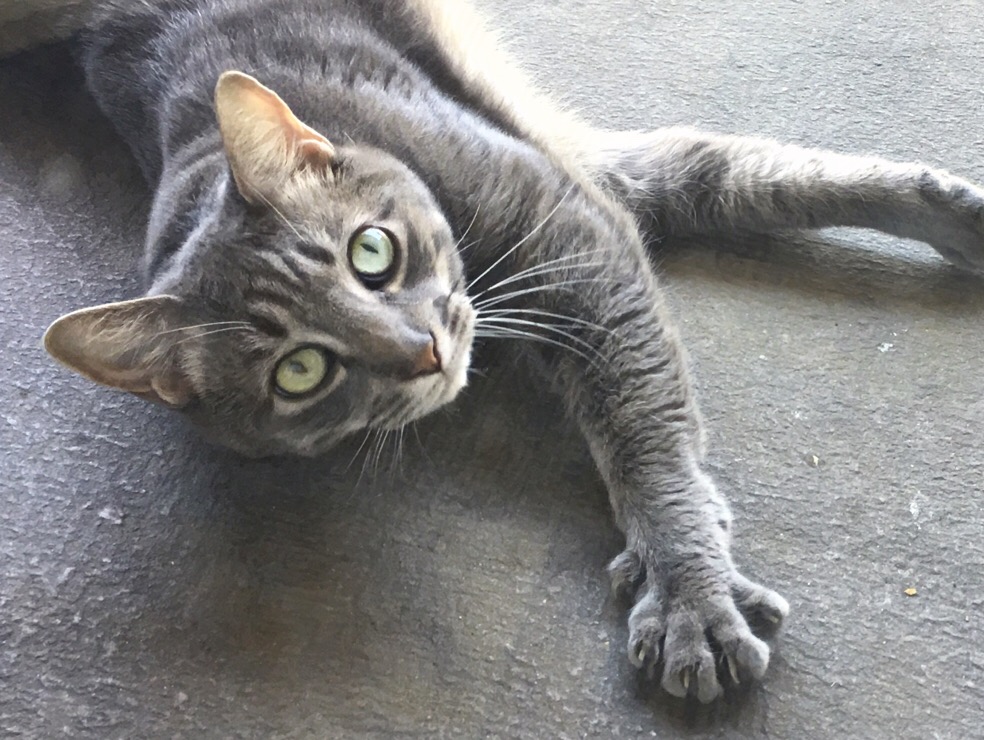
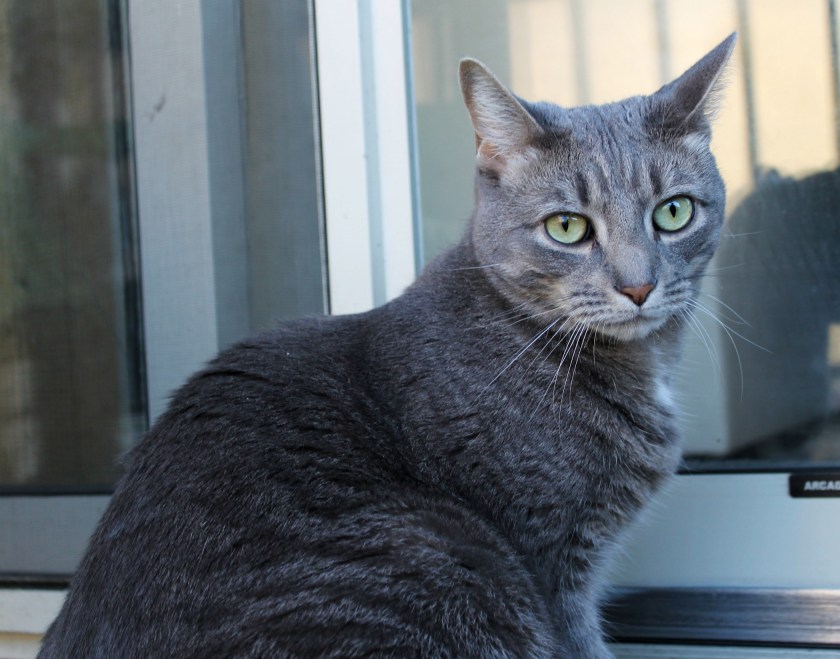
Buddy inadvertently leaves the comforts and love of his home and quickly finds himself in deep trouble.
Buddy licked his lips, belched and rolled over, sighing as he felt the afternoon sun’s warmth on his belly.
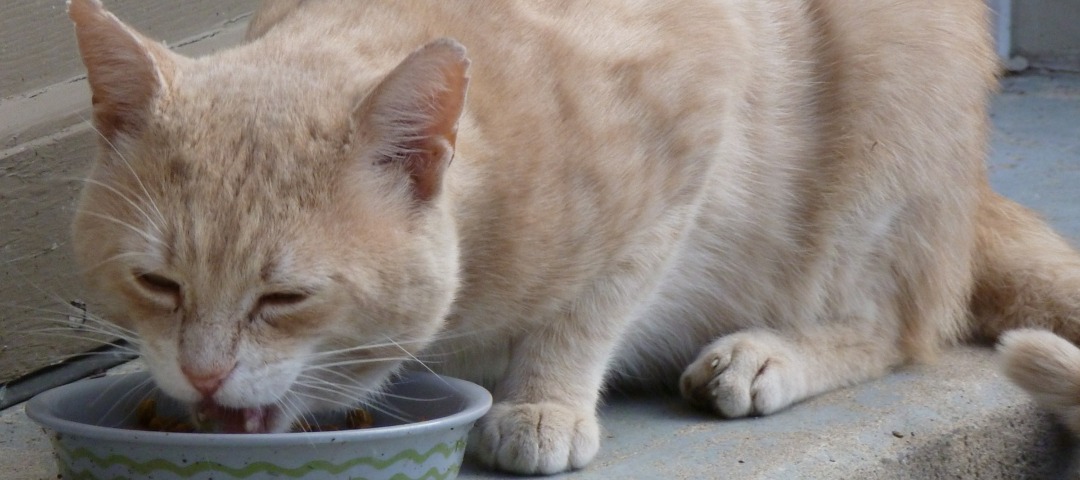
It was his favorite time of day and he was enjoying fresh air on the balcony, sitting in his favorite chair and surveying the world below like a little king. If he’d had a belt, he’d loosen it after scarfing down every last morsel of turkey and licking his bowl clean.
He waved his tail, thinking of how he’d pass the time later. Perhaps he would have a nap, then demand that Big Buddy take out the laser pointer. With a little luck, he might be given catnip as well, otherwise he’d have to meow relentlessly for it. Failing that, there was a new plastic bottle ring he’d stashed away for later play, and if Big Buddy were to fall asleep while watching baseball, Buddy could entertain himself by repeatedly waking his human via ambush. That was always delightful.
A squeak interrupted his thoughts, too high for humans to pick up but still well within his own hearing range. He sat up and cocked his head forward as his ears swiveled, trying to pinpoint where the noise had come from.
Sudden movement on his peripheral vision snapped his eyes to the target: Down below, among the cars and trees, a tiny animal scurried from beneath the cover of one car to another.
Buddy wasn’t sure what it was, exactly, but he knew he wanted to catch it.
He hopped off his throne and crouched low, poking his head through the balcony railing as he tracked the rodent.
The light box inside pumped out its usual weekday sounds: The crack of a ball against wood, the cheers of tens of thousands of humans, and Big Buddy alternately celebrating or sighing in frustration.
For all their supposed seriousness, humans were strangely invested in watching other humans play with toys.
Buddy caught movement beneath the rear bumper of a squat SUV. Two rodential faces peaked out from cover, chittering in human-inaudible frequencies.
His tail thrashed against the floor as he watched the diminutive trespassers brazenly moving about on the edge of his territory. They were mocking him, he was sure of it! He would have his revenge by ruthlessly hunting each of them down and jumping around joyfully on his hind legs, which he always did after he won at hunting games with Buddy the Larger.
The rodential duo took off, abandoning the cover of the SUV for the lower-hanging body and bumper of an old Nissan Skyline.
Bud’s tail thumped furiously. The twitchy little interlopers were getting ready to run again.
Buddy leapt from the balcony before he was consciously aware of what he was doing, meowing an “Oh poop!” as he dropped the 14 feet to the ground. He hit the ground hard but shared the impact on all four limbs. He’d be sore later, but the thought was gone as fast as it came, replaced by the primal instinct that had caused him to jump in the first place: The hunt.
His targets were now well aware of his presence, chittering furiously at each other between cars. Bud stalked the more plump of the two, crouching low so he could track its movement.
A distant subwoofer thumped the air, sending vibrations through the ground to his paw pads. The pudgy rodent took off, gunning for the fence at the far end of the lot and the safety of the trees beyond.
Driven entirely by instinct, Bud gave chase without realizing a car had turned the corner and was pulling into the lot, fast.
“Mrrrrrrooowww!” Buddy exclaimed, dashing away from the vehicle.
It was still moving, still coming toward him with that awful, furious thump from its speakers. Buddy ran and ran until he could run no more: out of the lot, away from his building, up the street, past strange houses emanating strange smells and into a park, where he hoped the car couldn’t chase him.
He collapsed on the grass and sprawled out, chest heaving. That was too close, he thought.
Now he had another problem, one he’d failed to consider when he jumped from the balcony: How would he get back inside? He couldn’t just walk into the apartment building. You needed a human to open the front door, then get past a second door that only opened via some sort of human sorcery that involved waving a little piece of plastic in front of the handle. He knew that much from his night walks with Big Buddy, when the stimulation was almost too much to bear — the smell-taste of flowers at nose level, the spiral cascade of water from the sprinklers, the far-off hum of the deathway, where thousands of cars rumbled down endless lanes of hard human-made ground.
If by luck he was able to slip inside as a human was entering his building, he’d have to cross the lobby, walk down the hallway and finally reach the door to his realm and domicile. Could he reach the door bell? If he meowed loud enough, would Big Bud hear him?
“What do we have here?” Buddy had been so lost in his thoughts and worries that he hadn’t noticed the human walk right up to him. He suddenly felt very vulnerable and rolled onto his stomach.
It was a human boy. He wore a dark baseball cap and a wide grin that didn’t reach his eyes.
“Easy,” he said, reaching out.
Buddy hissed, arching his back. The boy took another step forward, hand still extended. Buddy retreated a few steps, cautiously keeping his eyes on the boy as the fur on his tail spiked outward.
“Here, kitty kitty,” the boy said mockingly.
Buddy took another step away, then felt a pair of human hands clamp around his belly.
“Gotcha!” said another human boy, who had approached from behind as his friend served as a distraction.
Buddy squirmed, lashing out with his claws.
“Hey!” the second boy said. “The little fucker scratched me!”
“Bad kitty!” the first boy said, slapping Buddy on the top of his head. “Ohohoho! He’s pissed!”
The boys laughed as Buddy struggled.
“Come on,” the first boy said. “There’s a pair of gloves and some beach towels in my mom’s car. We can wrap the little shit up in the towel.”
“Where we going, Spencer?” the second boy said, holding the still-struggling Buddy tight as they walked toward the car.
“We could take him beneath the railroad bridge,” Spencer said as he opened the trunk. “I’ve got half a bottle of lighter fluid. We could have ourselves a little barbecue.”
The boys wrapped Buddy in a towel, muffling their laughter. He heard car doors closing and a crystalline human voice singing through speakers. Vibrations felt through his captor’s hands told him they were moving.
“Careful,” Spencer said after they had parked. “Just hold him, don’t be such a little bitch, dude. He’s not gonna hurt you.”
Buddy didn’t understand what they were planning to do with him, but he instinctively knew his life was in danger. He went slack.
“S’okay,” Spencer’s friend said. “He’s not struggling anymore. I don’t think he has any fight left.”
“Oh, he will,” Spencer said. He pushed back the towel, uncovering Buddy’s face.
“We’re gonna have some fun with you, you little shit,” Spencer said, leaning in close. “We’re gonna…”
Spencer howled as Buddy chomped on his lip with all his might.
Spencer’s shocked friend loosened his grip, and for a second or two Buddy swung from the shrieking teenager’s face, the latter’s panicked breath radiating in hyperventilating blasts. His smirk had evaporated, replaced by flush cheeks and a mask of pain.
Buddy released Spencer’s lip, tasting blood, and ran for his life. As he disappeared into the trees he could hear Spencer sobbing hysterically.
When he was sure the boys weren’t following him, he crossed a human yard in a blur and scurried beneath a short wooden staircase leading to a porch. A lawnmower droned in a yard nearby. In a neighboring basement, someone pounded out the opening kicks and snares of a song about a prince buying flowers.
“And if you want to call me baby…” a male human crooned over the drums and guitar, “just go ahead now!”
As Bud’s breathing slowed and the fear chemicals subsided, a new kind of dread filled the vacuum. Neither his eyes nor his ears nor his nose could tell him where he was.
The Yankees are 18-3 and the Orioles have lost 19 straight since a cat interrupted play during their Aug. 2 game at Yankee Stadium.
The Yankees were getting drubbed.
It was the eighth inning of a humid night in the Bronx, and the Bombers were facing yet another loss, this time in humiliating fashion — they were down 7 to 1 against the last-place Baltimore Orioles, who smacked four home runs off of recently-acquired starting pitcher Andrew Heaney.
Fans cried out to the Baseball Gods for intervention, and their prayers were heard: With Yankee slugger Aaron Judge at the plate, a tiny shape streaked across the left side of the infield, just behind the foul line.
“The one and two,” Yankees TV play-by-play man Michael Kay said as the Orioles’ pitcher delivered. “Uh oh…”
The shape moved, and the gait gave it away: It was definitely a cat.
“How in the world did he get out here?” color commentator Paul O’Neill asked.
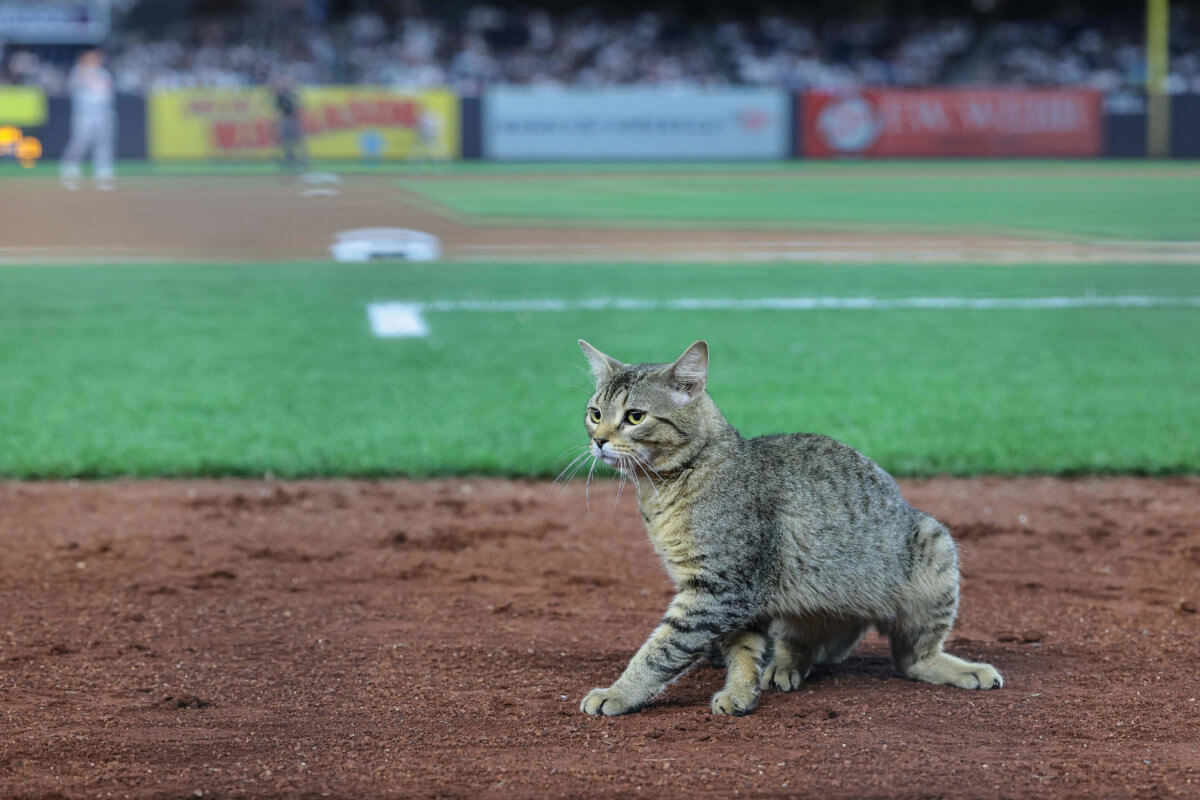
For a moment it looked like play would continue. Then the stadium’s cameras zoomed in on the little interloper, a brownish tabby. The kitty took off toward left field and the crowd went wild.
Orioles left fielder Ryan McKenna stood and watched as the little guy streaked past him, heading for the outfield wall where a door — which remains closed during play — leads to the bullpen.
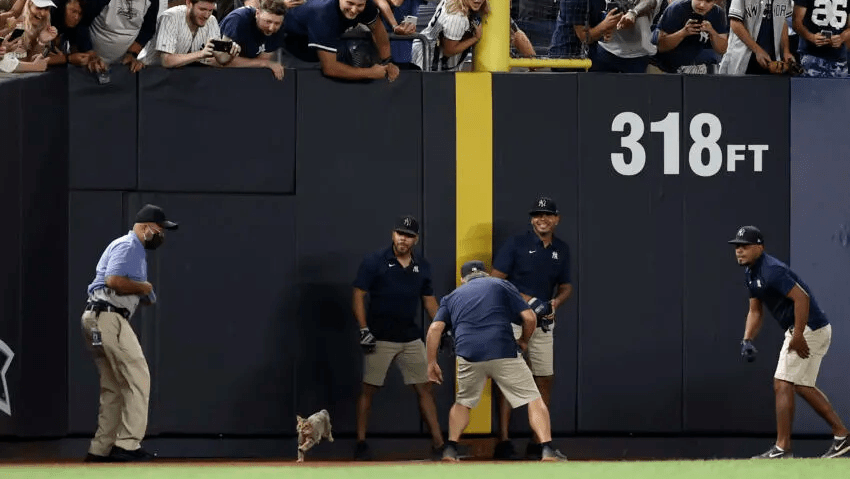
Seeing no way out, the cat paused, then jumped on the padding that lines the walls, drawing more cheers from the crowd, who encouraged him as he tried to leap the rest of the way over the fence.
By the time a quartet of Yankees security guards tried to corner kitty and he dodged them — not once, not twice but three times! — the crowd was pumped, shouting “MVP! MVP! MVP!”
Almost four minutes elapsed from the time the cat appeared on the field to the moment when a Yankees employee with some brains opened a side door, allowing kitty to escape from what was undoubtedly a stressful situation. Quite an adventure for the little guy.
The Orioles won that game and the troubled Yankees looked like they were headed for a bitterly disappointing season.
The cat changed both narratives, at least for the kind of people who put stock in sports superstition — a group that includes the players themselves.
Rally Cat, as he’s become affectionately known, on the field at Yankee Stadium. Credit: Bronx Times
Since that Aug. 2 game, the Orioles have suffered through a historically brutal stretch, losing 19 games in a row before finally earning a win last night. That epic losing streak represents the worst run of futility in Major League Baseball in 16 years and stopped just two losses shy of a 21-game losing streak set in 1900. (For British and international readers, you read that right: No other sport is as meticulous as baseball when it comes to continuity and keeping stats. Those statistics go all the way back to the first professional games in 1869. While seasons have been interrupted — most recently last year when the schedule was reduced from 162 to 60 games due to the pandemic — only World Wars I and II have scratched entire seasons from the history books.)
Fearing a curse, the Orioles’ players tried all sorts of things to change their luck, most noticeably growing mustaches. (Note to the Orioles: Playing like a major league team tends to work better than growing facial hair.)
The Yankees, meanwhile, have experienced a renaissance that has them looking like the perennial championship contenders they’re supposed to be, vaulting over five other teams in the standings and breathing down the necks of the first-place Tampa Bay Rays.
With their win over the Braves on Tuesday night, the Yankees are 18-3 since Rally Cat (as he’s now known) appeared in Yankee Stadium, and they’re riding an 11-game winning streak, their longest stretch of wins since 1985. It’s a stunning turnaround for a team that had been disappointing all year, looking lifeless for long stretches.
As for the cat, it’s not clear what happened to him. Local shelter operators and animal rescue organizations haven’t heard anything.
One thing was clear to anyone who is familiar with felines: The kitty’s body language clearly conveyed fear and confusion, and he was desperate to find a way out. Any cat would be, with 35,000 humans making a ton of noise, lights and huge advertising screens everywhere, and additional humans standing on the grass in what must look to cats like some bizarre ritual.
Yankees security didn’t do themselves any favors by the way they were trying to remove the cat, Elyise Hallenbeck, director of Strategy for Bideawee Animal Rescue’s Leadership Giving & Feral Cat Initiative, told the Bronx Times.
“They should be grateful that they weren’t able to lay hands on it, because the cat would have won that,” Hallenbeck said. “The cat was severely and terribly, terribly, frightened.”
Rally Cat, wherever you are, we hope you’re in the care of a loving human and you’re enjoying some delicious yums. You deserve it.
Buddy runs from a huge pitbull while the boys journey to the home of Nice Lady, who always feeds them.
Blackie scurried up a tree with impressive speed while Clyde took off like a cat possessed.
That left Buddy, who didn’t know the area, and didn’t know the gaps in fences or under-porch hideaways that would grant him temporary safety from the mountain of a dog barreling toward him.
He ran in the same direction Clyde had gone, hoping to follow the ginger tabby to safety, but he was already out of sight.
Peggy gained on Buddy, huffing like a bellows.
Buddy weaved around a rusting bike and ran for a stand of trees and brush that could afford cover. Maybe. He could feel Peggy’s breath on his back now. His little legs pumped as fast as they could, but a shadow overtook him followed by its owner.
Peggy landed on top of Buddy with surprising nimbleness, pinning him with her huge belly. Buddy’s heart threatened to beat out of his chest. Peggy opened her massive maw. Vicious-looking canines framed a row of smaller teeth like a serrated knife. Buddy closed his eyes, bracing…
…and felt a big wet tongue leave a saliva trail from the back of his neck to his forehead.
Peggy panted as she licked him, her drool shaping his fur until he looked like someone had styled him with an entire bottle of industrial strength hair gel. She barked happily, grinning from ear to ear, then began licking his left paw.
Buddy squirmed under the big pit and meowed at her indignantly.
“Untongue me this instant!” he demanded, but Peggy just kept licking.
Blackie snickered from a branch. A pair of wrens chirped, then took off from a branch above the pantherine cat.
Peggy gave Buddy’s forehead another lick, lathering on so much saliva that he had to close his eyes as it ran down his face.
“Peggy, baby!” a human voice boomed from behind the trees in a playful tone.
The huge dog raised her head, gave Buddy a final gooey swipe of her tongue and hopped off, cheerfully skipping her way home.
Neither Clyde nor Blackie said anything, mercifully. They both looked at him in horror, recoiling at the layer of saliva that almost entirely encased him, but they didn’t laugh or make jokes at his expense. They pity me, Buddy thought.
Blackie led them around a shed, through a hole in a wooden fence just big enough to wiggle through, then into a well-kept backyard shaded by oak trees. Up ahead was a wooden porch. One side of it was built around a huge rectangular depression filled with motionless clear blue water.
“Crazy humans,” Blackie meowed, looking at the pool with distrust.
Nice Lady herself was sitting on the opposite end of the porch beneath a canvas green-and-white awning, her face buried in a book. The human woman didn’t see them approaching and only looked up when Clyde put a paw on the first step and meowed.
“Orange Boy!” Nice Lady said, placing the book on the table next to her. “And Panther!”
Buddy watched as the two hardscrabble strays transformed themselves into harmless little kitty cats. Clyde made a big show of uncertainty, then hopped up on the deck and approached Nice Lady, rubbing himself against her legs. Blackie followed, dropping down and showing his belly.
“Where have you little rascals been?” Nice Lady cooed. “I was worried about…Oh my, you have a friend!”
Buddy crouched a few feet away from the stairs leading up to the deck, watching her silently.
Nice Lady made kissy sounds, then stood up. “You three must be very hungry! Wait here, my little darlings,” she said, stepping through a sliding glass door.
“Ya see, kid?” Clyde meowed, hopping up and helping himself to Nice Lady’s chair.
Cicadas buzzed. A breeze shifted leaf shadows on the deck.
“I hope it’s eggs today,” Blackie said, “otherwise we’re gonna have to visit the red house after this.”
Clyde stretched and yawned. Buddy carefully climbed the porch steps, realizing with horror that his paws were leaving prints of nearly-gelatinous saliva on the wood. He reached the top and crouched, his tail flicking uncomfortably.
Clyde saw the look in his eyes and realized what he was about to do.
“No!” he meowed. “You’re crazy!”
Buddy didn’t care. He shook himself like a dog, sending disgusting little saliva missiles at both his friends — the least he could do as payback for abandoning him to Peggy’s tongue assault — then took off running and leaped into the pool.
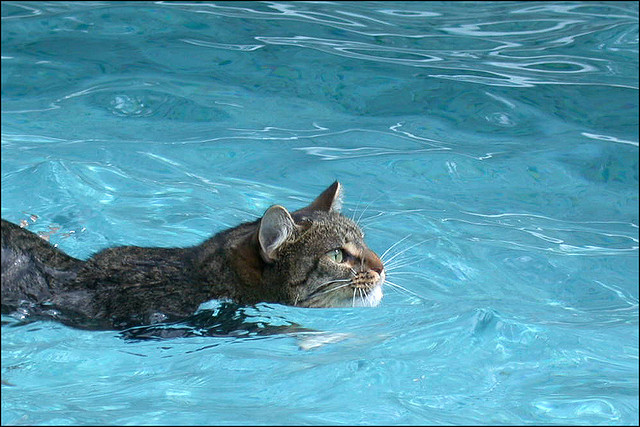
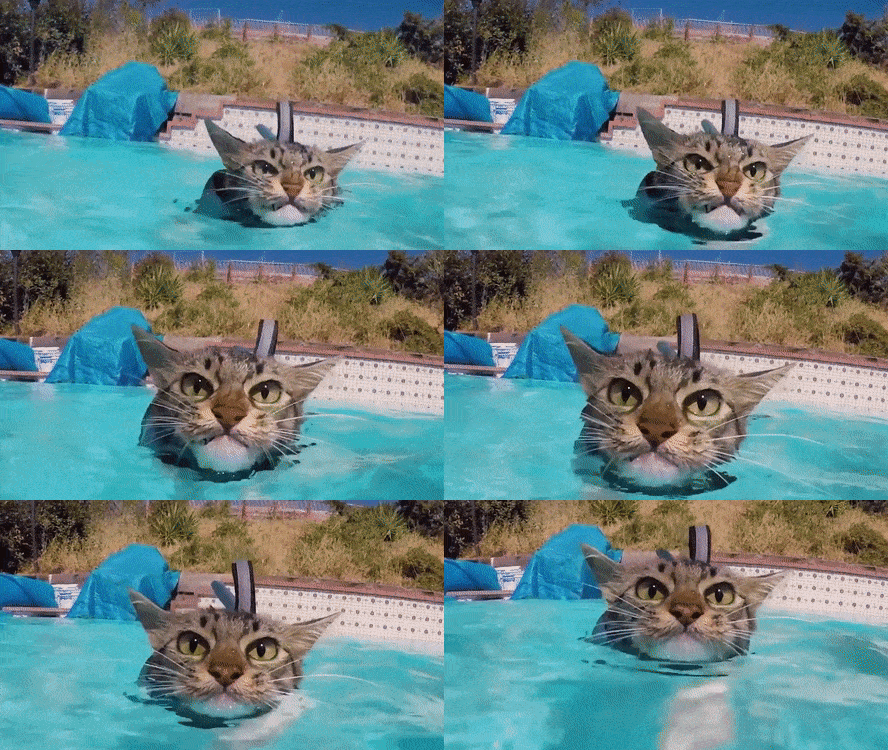
He shivered, but his body quickly adapted to the temperature of the water. To his surprise, the water was a comfort, and most importantly he was no longer mummified in a thick layer of gooey pitbull spit.
Nice Lady returned after a few minutes, carrying a stack of paper plates and a steaming bowl covered with a paper towel.
“Okay, boys,” she said, placing the paper plates in a row. “Eat up!”
Blackie meowed with excitement as Nice Lady removed the paper towel and scooped heaps of scrambled eggs from the bowl.
“Careful now, they’re still hot,” she said.
Blackie and Clyde dug in immediately. Nice Lady looked around for Bud and, realizing he was actually in her pool, retrieved one of those black rectangles humans love so much and held it up.
“Cheese!” she said, confusing Buddy. “A cat who likes water! Who knew?”
She retreated a few steps to her chair and resumed her reading, sipping from a wine glass.
Buddy’s stomach rumbled. He paddled to the steps leading out of the pool, then padded cautiously to his plate.
“Oh! Oh! Of all the good eatin’!” Blackie said. “You’ve gotta try this, kid!”
Buddy lapped at the eggs. They were delicious! There was cheese and little chunks of meat that Blackie called “ham.”
The three of them ate in silence except for Blackie’s enthusiastic grunts of approval. Buddy was so grateful to get food in his tummy that he didn’t even realize Nice Lady had approached them. He froze, ready to sprint, but she just crouched down and ladled more eggs onto each plate.
All three cats cleaned their plates, then sprawled out on the deck, grooming themselves with the satisfaction of full bellies.
Nice Lady had gone inside again, and when she returned she brought bowls of water, bags that crinkled and a towel for Buddy.
“I hope you boys saved room for dessert,” she said cheerily.
Buddy licked his lips.
“Why did you slap my paw away when I went for the Temps?” Buddy asked later.
“Because,” Clyde said, “that stuff is the kitty crack.”
“But…”
“Do you have any idea what that stuff has done to our people?” Clyde said.
“Here he goes again,” Blackie meowed, shaking his head.
The trio padded across the short grass of the backyard as the light began to fade, heading for the little shed they’d passed on the way into the backyard, where Nice Lady had installed a kitty door.
“You can’t handle the truth!” Clyde trilled to his friend.
“What truth?” Buddy asked. Blackie groaned.
“The Temps were specifically engineered by humans to get us hooked,” Clyde said, taking on a conspiratorial tone. “See, the humans don’t like how we’re independent free spirits, unlike dogs. No self-respecting cat would run panting to his human the way those eager-to-please idiots do.”
Buddy considered the orange tabby’s point.
“But what does that have to do with controlling us?”
Clyde waved a paw at a house cat watching them from a neighbor’s bay window, her body language broadcasting a mix of curiosity and annoyance.
“You think kittypet over there would ever run off if it meant no more Temps?” he meowed. “They’re all cracked out on the Temps! Those spoiled, soft-living, fat, lazy kittypets are an embarrassment to the feline kingdom.”
He looked at Buddy. “Present company mostly excluded, of course.”
“Of course.”
They filed into the shed, eyes adjusting to the gloom. There was a litter box, two wide bowls of fresh water, a plastic contained filled with dry kibble and, arranged on a small area carpet, a cozy sleeping spot ringed with pillows and blankets.
“Not bad,” Buddy said, feeling like a civilized cat again for the first time in days.
“Not bad?” Blackie asked. “Kid, this is the Waldorf of Westchester! It doesn’t get any better than this.”
After some mild haggling over the best sleeping spots, the three cats settled down. Sleeping on a full stomach for the first time since he’d left home, Buddy’s eyelids grew heavy as he mentally assembled a plan to find his way home.
Buddy relies on his hunting skills to keep his belly full.
Buddy left the chubby house cat and the porch behind before dawn, putting some distance between him and the houses before seeking refuge in the woods where there would be no humans grabbing his tail or house cats looking at him with pity.
It was time to hunt. You know how to do this, Buddy told himself. You’re really good at it! Just stay calm and remember all the times you played hunting games with Big Buddy…
Buddy stalked the brush, listening for rodents and watching for the sudden movements of birds and squirrels. An hour passed, then two.
His tummy rumbled. He’d never thought about food so much in his life. Back home, it was just there, reliably plopped down in front of him several times a day. Chicken, salmon, beef, tuna, duck, shrimp and his beloved turkey. Pate, sauce and gravy. A different meal every time. If he didn’t like a meal he was served, he could meow in protest until he was given something different. He actually turned down perfectly good food! It seemed like a lifetime ago.
Now most of his waking moments were dedicated to food: Where to find it, how to get it and where he could eat it in peace. He thought of the dull pain of his empty stomach versus the risk of eating something he wasn’t sure of. His mouth watered at the scent of things he never would have eaten as a spoiled house cat.
There! Up ahead a squirrel crouched low in the brush, focused intently on something at the base of the tree.
Buddy slowed his gait, locking his eyes on his prey. He crouched, butt raised, waiting for just the right moment to…
Pounce!
Buddy was fast. The squirrel was faster. It sidestepped in a blur and was already scurrying up the tree when Buddy belatedly skidded to a halt and hit the trunk, getting a mouth full of bark for his efforts. Above, the squirrel chirped.
“I will have you for breakfast!” Buddy meowed. “Just you wait!”
But after circling the tree for several minutes, Buddy realized the squirrel was gone. It must have jumped to a branch from another tree.
Buddy collapsed in the brush, dejected. He was so hungry. He didn’t need to be picky: He’d eat anything without complaint at this point.
He started thinking of home, then quickly squashed the thoughts. He would not cry. He was a big boy, and big boys did not cry. Was his human out looking for him right now? What would happen if Buddy found his way home and his Big Bud wasn’t there? Would another cat take his place, eat from his bowl, knead on his blanket?
No, he told himself. Not in my house.
His ears pricked up. Beating wings. Slowing. A chirp.
Buddy bounded to his feet, ears swiveling like satellite dishes toward the direction of the sound as he padded slowly and silently.
The bird was plump and gray, and it was standing on a tree stump, picking at something between the crags of wood. Buddy had a light step — not a leaf was disturbed, not a branch snapped as he inched forward.
Just like we practiced at home, Buddy thought. Remember, you’re a great hunter! You have really big muscles! You’ve got this!
The tabby took off in a bolt of speed and energy, building momentum over two or three swift paces before he launched himself at his meal.
The bird panicked, realizing it was reacting too late. There was a shrill chirp, a beak unsuccessfully snapping at fur as Buddy scooped his prey up, and then they hit the ground hard, the birdie held tight with one paw as they tumbled in a cloud of dust, fur and feathers.
Sweet, sweet victory! Buddy thought. The thrill of the hunt!
Then he did what he always does after he wins at hunting games: He bounded up on his hind legs, jumped around happily and bobbled his prey. Except this prey saw its opportunity and took off.
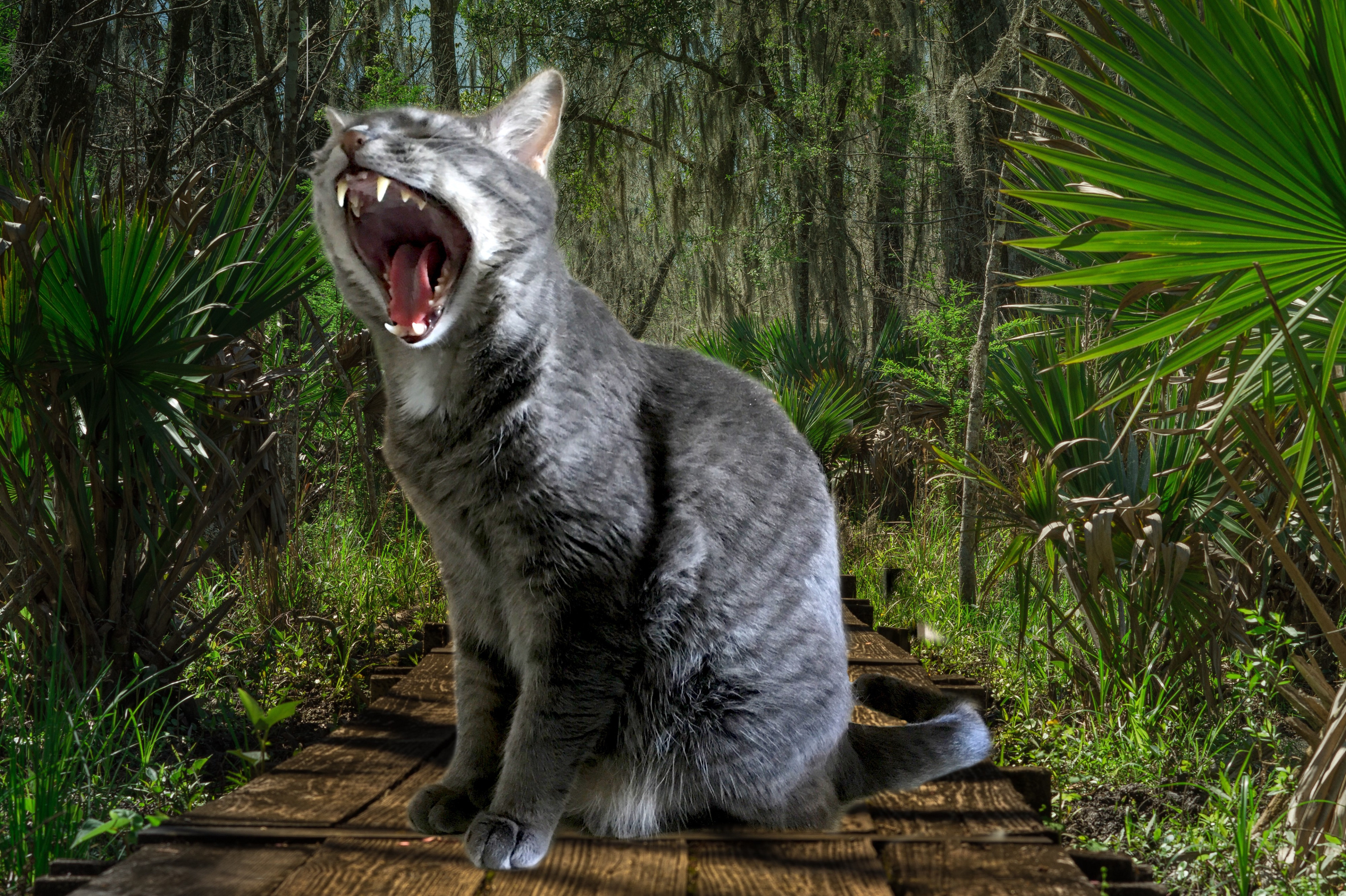
The mighty hunter roars!
“You’re telling me you caught the bird, then let him go?” Clyde asked, incredulous.
Their paths had crossed again at a joint known in the cat world as Chez Bacon: The bins behind a chain donut shop where cats could sometimes get lucky and find expired precooked breakfast sausages and soggy slices of bacon.
Buddy was defiant. “No! I just thought, you know, I had won and…”
“You were expecting a human to come out from behind a tree, tell you what a good boy you are and open a can for you?” Blackie meowed.
The two strays exchanged glances and laughed uproariously. Just when it felt like the laughter was dying down, one of them imitated a human — “Who’s a good boy? Does the good widdle boy want a can?” — and the howling began again. Clyde was rolling on the ground, slapping his paw against the dirt. Blackie was laughing so hard he was choking back tears.
Buddy considered asking them for help capturing the bird again, but by then he’d amplified the truth and told them he’d taken down a huge, vicious raptor that could have fed all three of them.
Clyde was still giggling when he sat up, wiped his moist eyes with the back of his paw, and coughed.
“We know a nice lady,” he said, turning to Bud. “She always feeds us when we come by.”
Buddy’s eyes lit up.
“But,” Blackie said, “a word of caution. The nice lady’s neighbor has some sort of demon dog.” He shuddered. “We’ll reconnoiter and if she’s there, we’ll lay low until the coast is clear.”
“What kind of food does the nice lady give you?” Buddy asked, his stomach churning.
“Sometimes it’s diced chicken, sometimes it’s scrambled eggs,” Clyde said.
“Love me some eggs, mmmhmmm!” Blackie said, skipping along through the trees.
“And sometimes,” Clyde continued, “it’s that nasty crunchy stuff that tastes like cardboard.”
Buddy stepped around a thorn bush. “You mean dry food? Dry food is good!”
Clyde gave him a pitying look.
“To a house cat like you, maybe,” he meowed. “But to a free-living lion of the jungle like myself, nothing tastes better than a mouse or a bird you’ve caught and killed yourself. You’ll see, kid, if you ever manage to catch something.”
They continued on in silence until Blackie stopped just short of a clearing ahead. He crouched low, scanning the area, then held up a paw.
“Back,” he whispered, retreating into the bushes in slow motion, careful not to give away their presence.
Buddy smelled the beast before he saw it. They were downwind of it, thankfully. It smelled of sweat, pee and tennis balls. And something else too. Something strange. If aggression had a scent, Buddy thought, this would be it.
A shadow moved beyond the clearing, then resolved into the pooch as it stepped out from beneath the leaf canopy. The dog was behemothic, all severe angles and stout muscle, with rivulets of mucusy saliva oozing from its open maw.
“Peggie the Pittie,” Clyde whispered, his dilated gaze never leaving the monster.
Peggie paused and lifted her snout, sniffing the air.
She smells us, Buddy thought. His fur stood up and his tail looked like a spiked club.
Sure enough, the tank of a dog fixed her gaze on the bushes where the feline trio was hiding and let loose a low growl.
One. Peggy’s front left paw hit the dirt, kicking up dust. Two. Her right paw slammed down, followed by thick strands of drool. Three. Her powerful hind legs followed, propelling her forward.
Her growl became a series of vicious barks as she picked up speed.
A government biologist who controversially shot 13 cats referred to the dead felines as “party favors” in an internal email.
A California biologist who shot and killed 13 cats as part of a “predator management program” referred to the felines’ corpses as “party favors” in a celebratory email to colleagues, according to a copy of the email.
David “Doc Quack” Riensche, a senior wildlife biologist with California’s East Bay Regional Park District (EBRPD), used a 12-gauge shotgun under cover of night to shoot the cats, documents obtained from the EBRPD show.
Riensche and EBRPD knew the felines were part of a colony near Oakland Coliseum managed by Cecelia Theis, a local woman who provided them with veterinary care, food, water and conducted TNR (trap, neuter, return) services to prevent the colony’s population from growing.
They did not warn Theis that they were going to cull the colony late last year, nor did they reach out to contacts in the area’s extensive local shelter and rescue network to trap and remove the strays, despite repeatedly stating that shooting cats is an absolute “last resort.”
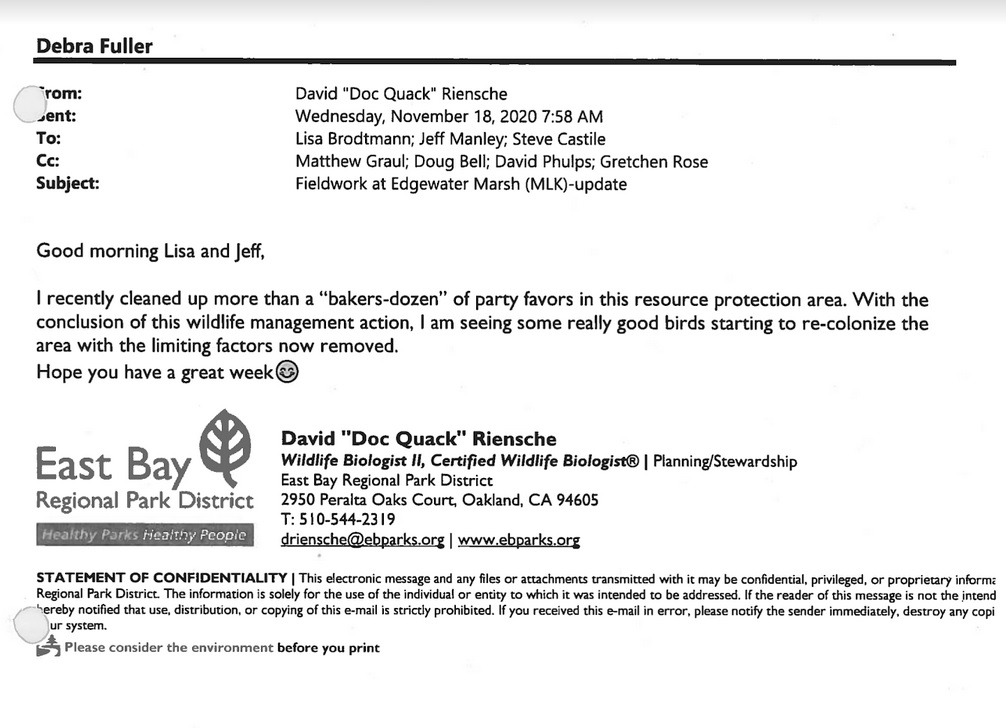
“Good morning Lisa and Jeff,” the email from Riensche reads, dated Nov. 18, 2020. “I recently cleaned up more than a ‘bakers dozen’ of party favors in this resource protection area. With the conclusion of this wildlife management action, I am seeing some really good birds starting to re-colonize the area with the limiting factors now removed. Have a great week.”
Riensche, who disposed of the dead cats in trash bags that he tossed into a bin, signed off the email about the dead cats with a smiling emoji.
In an internal email to colleagues, Riensche referred to the dead cats as “party favors.”
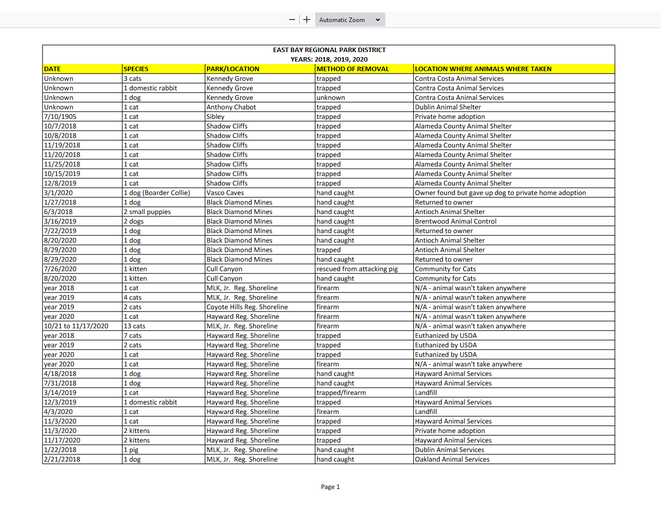
Although Riensche uses coded language in the email, the district’s own records, Riensche’s overtime statements for overnight hours, timestamped audio of dispatch calls and EBRPD’s own timeline of the cat killings all line up with the date of Riensche’s email and a spreadsheet documenting when and where Riensche shot the colony cats.
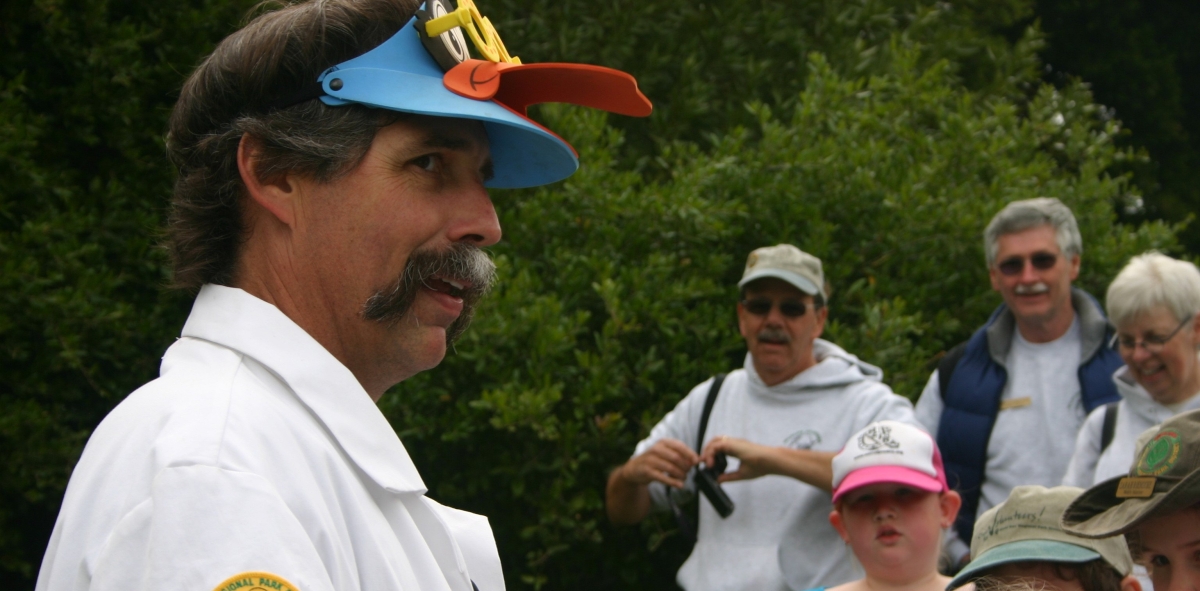
David “Doc Quack” Riensche is a wildlife biologist with the East Bay Regional Park District. Credit: EBRPD
Tiffany Ashbaker, a volunteer with Alameda’s Island Cat Resource and Adoption, said she was horrified when she read Riensche’s email describing the dead cats as “party favors.”
“I was disgusted. Way beyond hurt,” said Ashbaker, who helped Theis trap, neuter, vaccinate and relocate the Oakland colony cats. “I find this to be unethical and he should be removed from his position at EBRPD because of it. I understand why we should try to have cats further away from the protected areas, but how they handled this was eye opening for sure.”
The cats lived between two auto dealerships in an industrial area separate from the MLK Jr. Regional Shoreline, a park in Oakland managed by the EBRPD. When Theis returned to the area to feed the cats on Nov. 3 2020, she realized several were missing. Over the following days more cats began to disappear, Theis and Ashbaker noted.
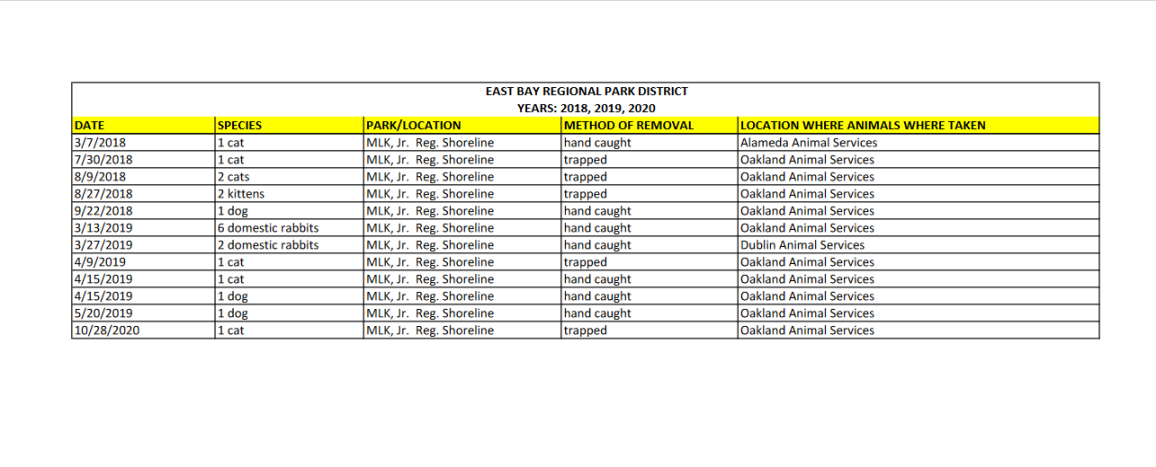
When Theis asked EBRPD about the whereabouts of the colony cats, a district staffer told her EBRPD wasn’t involved and didn’t remove any cats. EBRPD then amended its response, saying it had trapped the cats and brought them to local shelters.
But none of the local shelters had any records of taking cats from EBRPD, nor did they have the missing cats in their care.
EBRPD admits its biologist killed colony cats
Theis went to KGO, a local ABC News affiliate, and when a reporter began asking questions about the missing cats, a spokesman for the district finally admitted one of its employees — later identified in documents as Riensche — had shot the cats as part of the “predator management program.”
Theis said she felt “a horrible feeling in my gut” when she realized why the usually friendly strays and former pets of the colony were suddenly skittish. Riensche shot the colony cats over a series of nights, returning to the park in the late hours with a shotgun to kill two or three at a time.
Theis said she now understands why the remaining cats were so fearful and skittish when she came by for their regular feedings. One cat named Sherbert jumped on her car hood, and two others meowed insistently at Theis, “trying to tell me.”
“I feel this horrific feeling that they went through terror and were trying to tell me,” Their said. “They weren’t eating like they did usually.”
Some EBRPD board members have expressed sympathy for what happened, Theis said, but she described being “depressed” and worried because the district won’t give her any guarantees that it won’t kill more cats.
“We feel horrible about this, you know, this is really one thing that’s just really sad,” Matt Graul, the EBRPD’s chief of stewardship, told KGO in December, after the public first learned the cats had been shot.
Despite that, EBRPD ignored public records requests from the TV news station, and a spokesman for the district defended the cat culling, saying it was necessary to protect endangered birds who winter in the nearby marshlands.
Stray and feral cats “are not part of a healthy eco-system” EBRPD spokesman Dave Mason said, claiming his agency was protecting endangered wildlife in the area.
Public and animal rights groups demand an end to cat killing practice
After intense public backlash, including a petition with 70,000 signatures protesting EBRPD’s actions, several district board members were quoted in media reports saying they would end the practice of killing cats and would demand an investigation. Almost five months later, the district is instead moving ahead with a plan to contract cat-killing (and the culling of other animals like foxes and opossums) to a federal agency, and there has been no investigation.
Ashbaker, Theis, the non-profits In Defense of Animals and Alley Cat Allies, and local shelters have all demanded EBRPD stop killing animals entirely. District officials continue to argue it’s necessary to protect endangered birds, despite a lack of scientific evidence supporting the idea that arbitrarily shooting animals has any measurable impact on bird populations.
EBRPD has made one concession: It’s promised to reach out to rescues and shelters in the area for help removing cats before making the decision to deal with them lethally.
“While we’re pleased that the policy seems to be to work with local advocates as to prefer not to killing cats, we want to see a pledge that this never happens, ever again,” Fleur Dawes of In Defense of Animals said in February.
The district “should have been up front from the beginning, saying ‘This wasn’t what should have happened, [so] let’s make it right,'” Ashbaker said.
EBRPD has been unable to provide proof that the cats were killing birds on the marsh or that Riensche shot the cats on district property.
In response to a public records request for any documentation of cats preying on birds in the marshlands, EBRPD produced a single document from 1992, noting one incident with one cat about 35 miles south of the MLK Jr. Regional Shoreline where Riensche shot 13 cats in late 2020. During a survey some time before 1992, an EBRPD employee saw an example of “[California Clapper] rail predation” by “what we determined was a feral cat, in a marsh in the East Palo Alto area,” where it says “many cats are found.” The document mentions another cat that was sighted swimming “in flooded tidal salt marshes” in south San Francisco Bay, likely “foraging” for an endangered mouse species.
The district has not been able to produce any written guidelines or protocols describing how its employees determine if a cat should be shot instead of being relocated or brought to a local shelter, except for a vague summary of minutes from a 1998 meeting during which they claim the policy was approved.
EBRPD has been unable to produce copies of the cat-killing policy itself, despite several public records requests seeking that document.
In addition, in internal emails after a KGO reporter began asking questions about the cat killings, several EBRPD staffers questioned whether they have any documentation saying cat culling is an acceptable policy.
EBRPD internal discussion: Are we following our own rules?
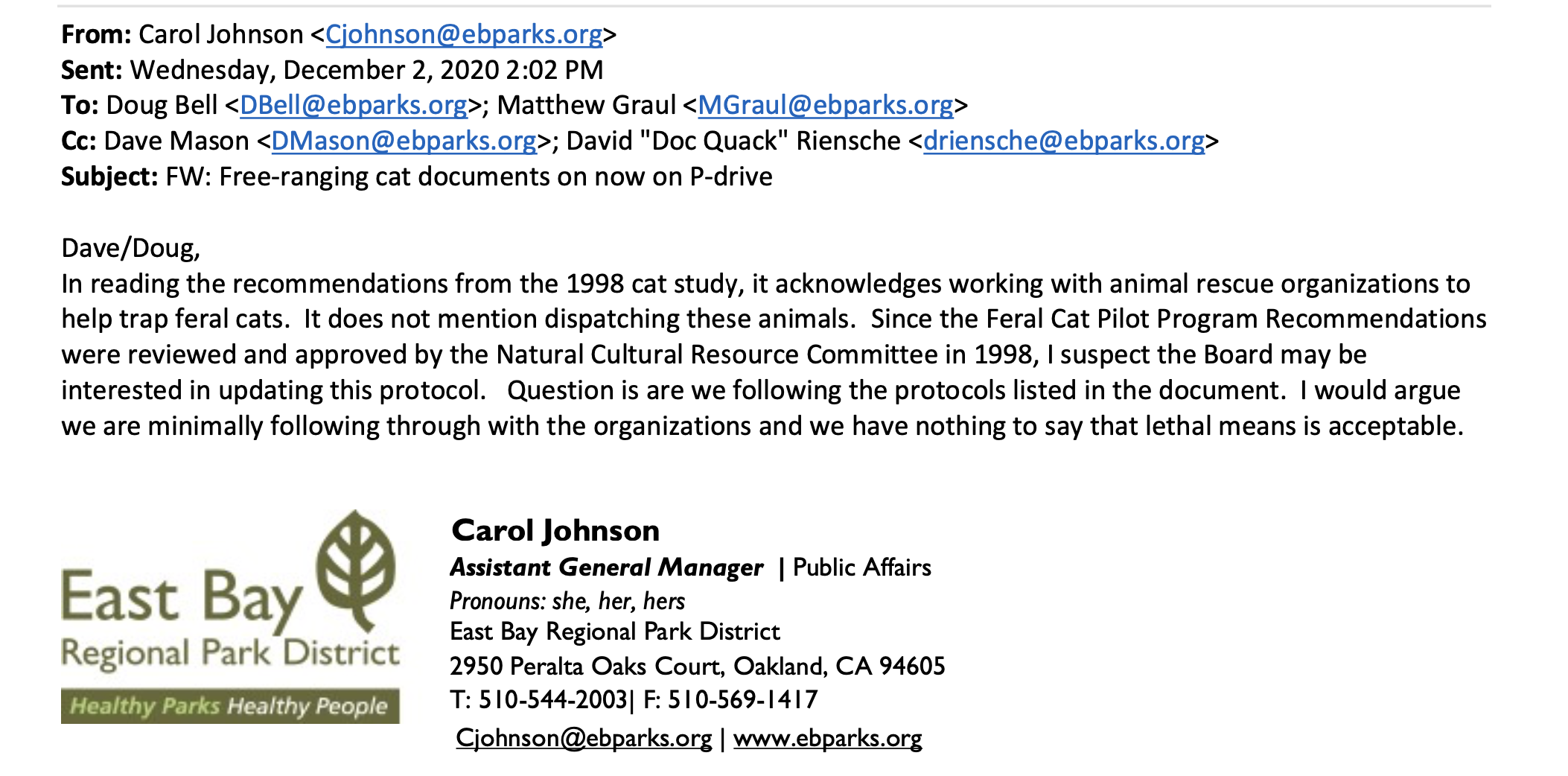
In those same internal emails, which were obtained from EBRPD via public records requests, staffers wondered if the district was following its own rules requiring it to reach out to local shelter networks and receive approval from federal authorities to kill cats. One EBRPD official, assistant general manager of public affairs Carol Johnson, noted the document EBRPD used as justification “does not mention dispatching these animals,” and requires the district to “work with animal rescue organizations to help trap feral cats.”
“[The] question is, are we following the protocols listed in the document?” Johnson asked her colleagues in a Dec. 2 email. “I would argue we are minimally following through with the organizations and we have nothing to say lethal means is acceptable.”
After telling local media that an old and little-known policy allowed the district to cull cats, EBRPD staffers could not locate a copy of the policy.
Internal correspondence among EBRPD staff, obtained via a public records request, show worried staffers searched in vain for a written policy on killing cats before using a Google search to find another agency’s policy.
EBRPD finally produced a copy of minutes from a 1998 meeting with notes attached saying the cat-culling policy had been approved by the board, but if a copy of the policy exists, the district has been unable to produce it.
In December Mason said cats were only shot as a last resort and “[L]ethal removal only happens when feral cats are in the act of hunting wildlife on District property,” but none of the documents say the cats Riensche shot were hunting. Indeed, it would require an extraordinary stroke of luck for the biologist to find 13 cats preying on endangered birds in just a few nights.
Despite public records requests, the EBRPD was unable to provide proof that Riensche had consulted anyone before shooting the cats. Records indicate no one was notified until after Riensche killed the animals.
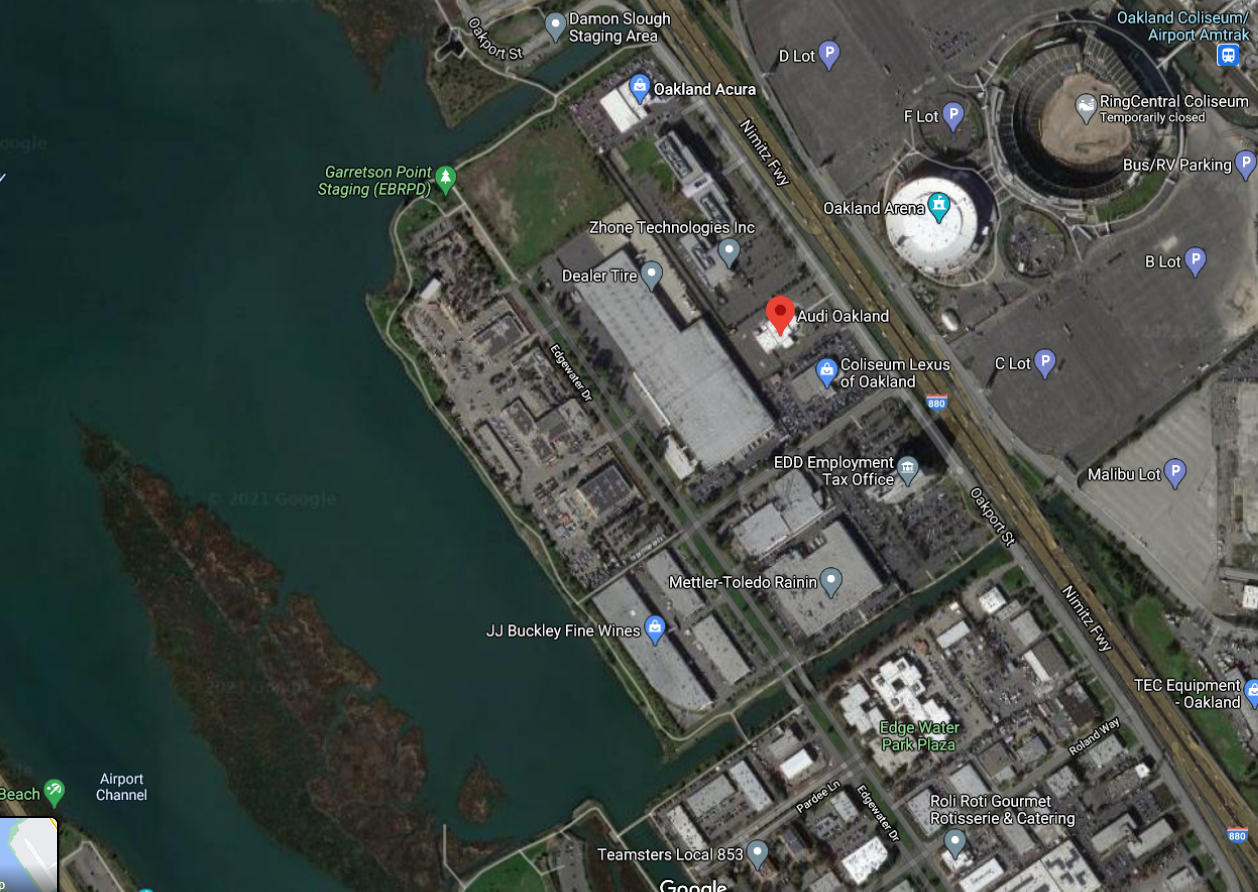
The stray cats lived between Audi Oakland and Coliseum Lexus of Oakland. Credit: Google Maps
In addition, the cat colony sat some distance from the protected marshland: An office park, electric car charging station, at least three parking lots and a substantial body of water are between the cat colony’s home and the marshland. That’s a distance considerably longer than most stray and feral cats range from their homes, and domestic cats are notoriously averse to water or getting themselves wet.
Records line up with cat shootings
While Riensche uses coded language by referring to the cats he shot as “party favors” in his email to colleagues, it was sent on Nov. 18, the day after EBRPD’s own records show he killed the last of the colony cats. Internal documents from the EBRPD, obtained through public records requests, as well as the district’s own public timeline of events, show the dates the cats were killed line up with Riensche’s email. In addition, in audio recordings of his radio contact, Riensche advises dispatchers only after he’s fired the killing shots.
“Yeah this is Dave Riensche in wildlife at MLK, I just dispatched an animal down here, so if you get a call, it was me,” Riensche tells a dispatcher in one of the calls on Nov. 13 at 6:24 a.m.
EBRPD’s records show the only animals killed on that day were cats.
(Click the embedded audio to hear Riensche call dispatch on Nov. 13, 2020.)
Finally, according to EBRPD’s records, Riensche received overtime for working on nights that correspond to the same dates EBRPD says the cats were shot. [EBRPD document: TIMECARDS (REDACTED)]
Riensche, who has been employed as a biologist with the district for decades, is a prominent birder whose work involves protecting birds and other endangered species from predators wild and domestic. He penned a newsletter, Bird News, in the early aughts and is on record saying there’s “a wealth of evidence” that stray and feral cats are the primary danger to bird populations.
Shooting cats as a ‘first resort’
Riensche earned $182,951 in salary and benefits in 2019, the most recent year for which salary data is available for public employees in California. Riensche earned a base salary of $90,239 and $56,050 in overtime, including for overnight hours spent shooting animals in EBRPD’s parks.
An Oakland woman who wrote to the EBRPD after the district came clean about the cat killings related an anecdote about Riensche from 2019.
The woman worked with a local rescue that received a call from a parks employee who wanted help trapping and relocating a female cat and her young kittens who were living on or near an EBRPD park. The rescue volunteers were working with the EBRPD employee, making plans for the cat and her babies to be vaccinated and spayed/neutered, and even had homes lined up for some of the kittens, the woman wrote in a Nov. 25 email.
After visitors to the park saw the mother carrying a dead rabbit back to her kittens, “Doc Quack [Riensche] then reportedly told employees he was going to shoot the cats,” the volunteer wrote.
The mother cat “disappeared” and her fate was unknown, but the rescue was able to work with the EBRPD employees to get the kittens trapped. However, Riensche wasn’t happy with that outcome, she wrote.
“I was told later by an employee, that they were reprimanded for saving the cats and going outside of the EB Parks, to get this help,” the woman wrote in her letter to EBRPD. “Apparently, they should have just been quiet and let Doc Quack shoot the cat family.”
The connection between birders and cat killing
Cat killing isn’t unusual among birders. In 2007 a Texas man named James M. Stevenson — founder of the Galveston Ornithological Society — admitted killing dozens of cats on private and public property after coming to believe the cats were killing piping plovers, shorebirds who commonly nested in the area.
In a 1999 posting on an Internet bulletin board for bird lovers, Stevenson nonchalantly described killing many feral cats during his first year living on Galveston Island. He rationalized his acts as a way to restore the natural order.
“I’m sorry if this offends — but I sighted in my .22 rifle, and killed about two dozen cats,” Stevenson wrote in his message, titled “killer kitties; kittie killers.”
“This man has dedicated his whole life to birds,” Stevenson’s attorney said in his defense. The case ended in a mistrial.
Nico Arcilla, then known as Nico Dauphiné, was well known as a birder and outspoken critic of cats. A group of people who cared for strays near Washington’s Meridian Hill Park contacted the Humane Society after noticing food they left out for the cats “would sometimes become covered by a white powdery substance overnight.”
After the Humane Society and Washington police tested the substance and verified it was poison, they set up a stakeout and had cameras trained on the food bowls. Footage, which prosecutors later exhibited on trial, was damning:
“Dauphiné [Arcilla] can be seen approaching the bowl, pulling something out of a small bag, reaching down toward the food twice, and then leaving the scene,” a sciencemag.org report reads. “The next morning, police found the food covered with the same white powder as before, which tested positive as poison.”
[Click here to see video of Arcilla poisoning the cat food.]
Arcilla wasn’t just a prominent birder and anti-cat campaigner — she is a co-author of several frequently-cited studies claiming cats kill billions of birds in the US each year. Those studies, which have been used to justify cat-culling policies around the world, are highly controversial, with critics blasting them for poor methodology, a lack of hard data, and arbitrary numbers plugged in to estimate both the national cat population and the felines’ impact on birds. For example, the authors estimate a national stray and feral cat population between 25 and 125 million, an estimate so vague that any extrapolations based on those numbers are virtually useless.
Riensche has repeatedly cited Arcilla’s work in public and private documents arguing that cats are primarily responsible for declines in bird populations.