Cats Are Fighting The Ukraine War On The Propaganda Front — And From The Trenches

From the military camps where they stop mice from wreaking havoc to social media where they help raise money, Ukraine’s felines are enduring the war alongside their people.

Roman Sinicyn and his men were living in an abandoned house in a destroyed village for a month.

Although each of the Ukrainian soldiers contributed to their survival and fought the Russians, perhaps their biggest hero was Syrsky the Cat.

The fearless feline evicted a rodent infestation in the platoon’s temporary headquarters, hunting the mice mercilessly as his humans engaged in firefights with invading Russians. By day Syrsky made the soldiers’ temporary lodgings livable and by night he soothed their trauma with healing purrs.

The cheese-loving moggie’s moniker is a double-entendre: he’s named for Ukrainian Army Land Forces Commander Oleksandr Syrsky, and for the Ukrainian word for cheese, syr.

A new story from Politico EU details the important role of felines as the costly war enters its third year. Russian missiles, bombs and artillery have flattened villages, sending civilians fleeing and often separating them from their families and their pets.

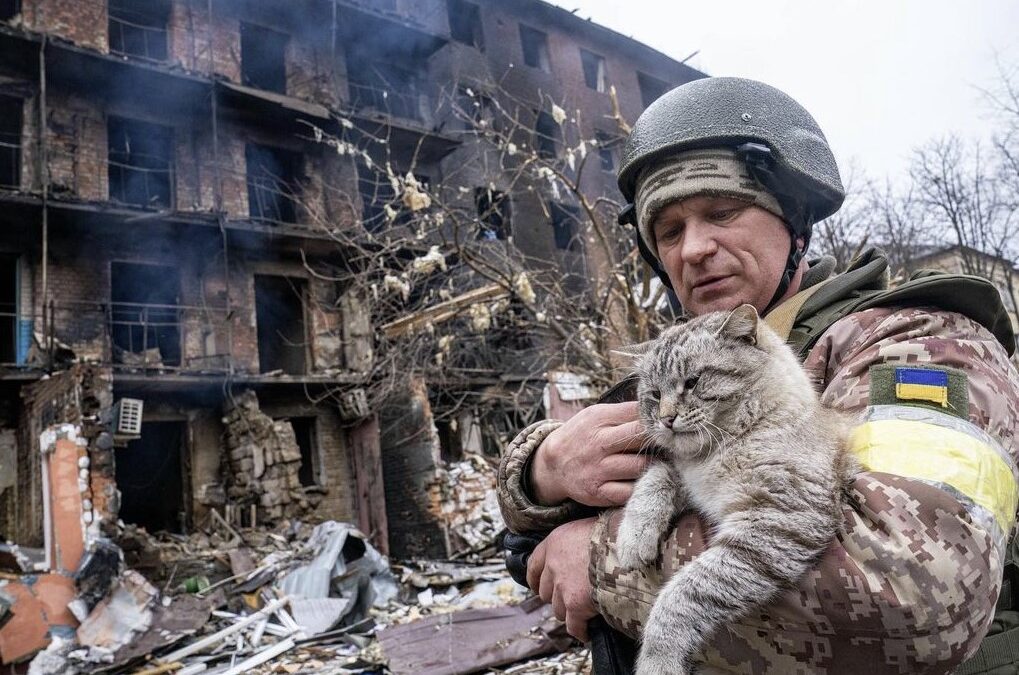
The bewildered cats and dogs, accustomed to easy lives indoors, are suddenly thrust into a world of death, explosions, mine fields and other horrors.

As the war endured past its early phases, former pets began seeking out humans where they could find them — in military camps and in the rodent-infested trenches where they hunkered down against the constant thunderclaps of Russian artillery.

During peak war season in the summer, Vladimir Putin’s bedraggled military fires up to 20,000 artillery rounds a day according to the Associated Press, with that number dipping to “only” 7,000 per day as the war machine slows in brutally cold Slavic winters.

shaybykcat
Oleksandr Liashuk, a Ukrainian soldier, with his cat Shaybyk. Credit: Oleksandr Liashuk

Just like they did 10,000 years ago when they first domesticated themselves, cats proved their worth by chasing out mice and rats, but this time they didn’t have to convince humans to allow them to stick around. They were welcomed with open arms and hands bearing snacks, serving as hunters and therapy animals to men enduring a living hell.

“When this scared little creature comes to you, seeking protection, how could you say no? We are strong, so we protect weaker beings, who got into the same awful circumstances as we did, just because Russians showed up on our land,” Oleksandr Yabchanka, a Ukrainian medic, told Politico.

It’s amazing how a return to primitive circumstances has so quickly pushed humans back toward reliance on animals who made it possible for our species to survive in the first place.

Without dogs, early hunter-gatherers would have been much worse off on the hunt and their groups would have been much more susceptible to ambush when they slept. Indigenous societies eking out existences on the tundra would have no reliable animals to pull sleds. Without oxen to pull plows, farmers wouldn’t be able to produce enough food for civilization to thrive and grow.

And the people of nascent human settlements, taking the first great leap forward for our species with the invention of agriculture, would have starved out over long winters as mice and rats gnawed away at their food stores — if not for cats, our furry friends.

In 2024 humans can’t live without cats once again. Felines patrol Ukraine’s World War I style bunkers, killing hordes of mice. Mice that otherwise devour MREs, chew through comm link and power wires, damage weapons and make soldiers miserable.

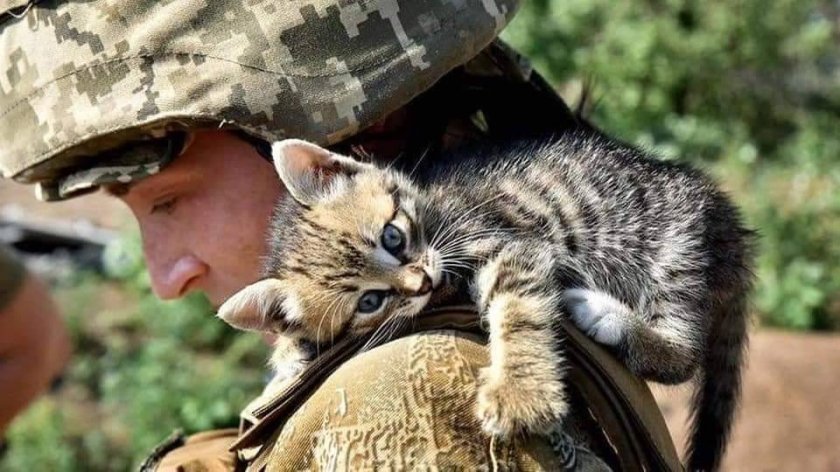
ukrainecat
A Ukrainian soldier with a stray kitten. Credit: Ukraine Ministry of Defense

Some cats become unofficial unit mascots and good luck charms, but many others are claimed by individual soldiers who find normalcy and relief in their company.

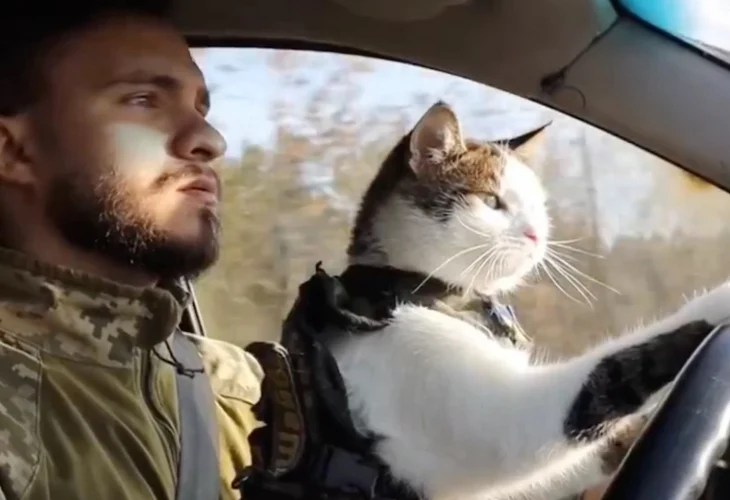
One soldier/cat pair are viral sensations thanks to videos of the alert cat riding along with his human, scanning the terrain ahead. Another story detailed a patrol whose men just avoided an ambush thanks to their company’s cat, who spotted the enemy first and frantically warned that something was wrong.

In that way, cats are serving the propaganda effort as well, helping the public to connect to the men and women defending them.

Military cats have become signals for Ukrainians to rally around, but Russians are doing it too. Russia is a famously cat-loving country, and Putin’s government has latched onto stories about the felines accompanying his men into battle — an effort that Politico notes is meant to humanize Russian soldiers and create the impression that it values them even as it continues to conscript unwilling civilians and ship them to the front line “meat grinders” with a few weeks’ worth of training, meager supplies and minimal ammunition for their rifles.

In that respect, the soldiers of Ukraine and Russia have at least two things in common — they love their feline companions, and they’re enduring hell as well as a high risk of death because of one small man’s delusions of greatness and legacy. Western media tends to ignore the humanity of Russian conscripts, and the pro-Ukrainian side of the internet calls them “orcs,” painting them as the mindless and disposable drones of a bloodthirsty dictator.

But they’re human too, with their own hopes and fears, and mothers back home worrying about them. They don’t want to be there. It seems fanciful to imagine Russians refusing to continue the invasion when Putin has squads behind the front lines with guns pointed at his own men to prevent them from deserting or refusing to fight. But maybe the men in the trenches can come together over shared interest and shared love of cats, and help put an end to three years of misery.

That’s Not How You Speak Meowinese!

A popular X account posts “cute” cat videos that aren’t always so cute, another consequence of people misunderstanding cats and their behavior.

This dude thinks he’s speaking to a cat in her native tongue, but what he’s doing is the equivalent of running up to a bunch of Klingons and shouting “I shall impale you on the edge of my bat’leth!” while mistaking it for a friendly greeting.

It looks like someone hired this guy to rescue the kitty, who like so many of her kind are prone to do, climbed up too high and then decided she didn’t like her odds on the way down. I don’t think his intention was to scare the hell out of her, but that’s exactly what he’s done:

That’s not “Hi, kitty, I’m here to rescue you! Be calm, we’ll get you down in no time!”

It’s “I’m here, I speak your language, and I have bad intentions!”

If you listen with headphones or turn the volume up, you can hear the poor cat crying in distress, the kind of cry that felines make when they’re seriously freaked out and worried for their safety. No wonder kitty backed up. Her fur is raised and her posture aligns with her vocalizations and the rest of her body language.

Like most things posted to Twitter X, this is utterly lacking in context and we don’t know what happened next. I wouldn’t be surprised if the rescue attempt went horribly wrong. I hope not, but man, that’s not how you rescue a cat.

The video was posted by the account “place where cat shouldn’t be,” or @catshouldnt, and a common theme in the images and videos on that feed is cats in distress. They’re mistaken for “cute” situations by viewers, the majority of whom aren’t familiar with feline behavior.

Like, for instance, this photo. The tuxedo kitten is undeniably cute and he doesn’t look distressed…yet. But getting out is going to be a lot more difficult than getting in, and when people are willing to do just about anything for clicks, attention and the associated dopamine hit, cats often end up with the short end of the stick.

Cat in a vending machine
Bud would be jealous of this cat. Thankfully he’s too, uh, meowscular to fit. Yeah, that’s it. Too meowscular. Nothing to do with a few extra pounds…

What It’s Like Adopting An Internet Famous Cat, Plus: The Argumentative Cat

Kylo Ren, named after actor Adam Driver’s most notable role, changed the lives of a woman and her young son.

Remember the Adam Driver Cat?

The little guy made a big splash for a while back in 2016 when images of his unusual mug went viral and the internet decided he looked like the 39-year-old actor.

In an essay, Emily McCombs describes feeling “something deep in my soul” when she saw photos of the cat she’d name Kylo, in honor of Driver’s best-known role as the conflicted Sith lord in the third Star Wars trilogy. Against all odds, and despite intense interest in the Oriental Shorthair, McCombs was able to adopt Kylo after begging a friend for a ride from Brooklyn to the Monmouth County SPCA in New Jersey.

But it’s what happened after that impacted McCombs and her young son the most. Kylo was gentle with McCombs’ son, had a habit of staring adoringly at her and “wasn’t truly happy if he wasn’t smooshed against my face.” Aside from the shoulder bit, Kylo sounds a lot like Bud:

“Rather than just being a lap cat, Kylo was more likely to perch on my shoulder, or plop down directly on my face,” McCombs wrote. “He preferred positions that made it impossible to do anything but pay attention to to him, and would regularly headbutt my phone when he wanted my undivided attention.”

Actually, he’s more polite than Bud, who has no qualms about slapping my smartphone out of my hands and loves to send it flying if I make the mistake of leaving it unattended on a flat surface. “Stoopid little glowing rectangle!” I imagine him yelling in the meowenese language.

Kylo became part of McCombs’ family, helping her tuck her son in every night after story time, and while McCombs said a few love interests came and went, Kylo endured.

McCombs got to spend seven wonderful years with Kylo before she made the difficult decision to euthanize him after he was diagnosed with kidney failure and his struggle became more desperate. The story’s worth reading for her take on grief, Kylo’s sweet relationship with her son, and her insistence that no amount of internet fame compared to the love Kylo gave the family.

It’s also validation of the way people feel when they lose their four-legged companions, and a reminder that grief doesn’t need to be justified, regardless of whether some people insist “it’s just a cat.” 

The microchip company called to ask her to confirm a change of ownership for her missing cat

A British woman was thrilled when the microchip company contacted her to say her missing cat had been found, but was confused and dismayed when the representative on the line asked her to confirm a change of ownership.

Now she’s trying to get her kitty back, but her efforts have been frustrated by the other person who wants to keep him, as well as data protection laws that prevent the microchip company from identifying the person. 

Beryl Edwards of Shropshire, a rural area bordering Wales, adopted her cat Fred and his brother Geno in 2021. Fred went missing over the summer in 2022, and Edwards said she was initially ecstatic when she was told he’d been found.

“And then out of the blue last week I get an email saying we’ve had a request – somebody wants a transfer of ownership,” Edwards told the BBC. “Can you imagine the range of emotions from, ‘Fred! He’s alive, he’s OK’ to ‘transfer of ownership? What’s this all about?’”

fredgeno

The company, Identibase, told Edwards that while they could not give her the person’s information, they would ask the person to contact Edwards and return the cat. 

Edwards never heard back, and now it’s a criminal matter. 

“We are following up on a number of enquiries and at this stage are treating the matter as a potential theft,” the West Mercia Police said, per the BBC.

It’s not clear if police believe the person who has Fred stole him from Edwards, or whether they found him and want to keep him, but we hope Edwards and Fred are reunited, and Fred gets to live with his bonded littermate Geno again.

I can understand why the company would hesitate to provide the other person’s information, even if no law existed. You don’t want people physically confronting each other and potentially taking pets by force in disagreements over ownership. It’s also possible that the person who wants to keep Fred never intended to “trip” the microchip, and Edwards’ information may have been discovered by a veterinarian during a routine exam. But perhaps the unusual case can inform a future change to the law so it’s easier for people to retrieve their pets in cases like this, and for law enforcement to return pets when there’s clear documentation showing one party is indeed the caretaker.

This is not funny

A woman opens her front door to find a distressed cat crying for her help. Instead of taking him in, feeding him, checking on his welfare or even calling a local shelter, the woman proceeds to film herself performatively yelling at the stray and telling him to “get on off my porch!”

The TikTok video went viral this past week and people think it’s hilarious.

File this under “Social Media Is A Sign Of Humanity’s Decline.” Maybe the woman would have been cold-hearted even if she wasn’t hamming it up for an internet audience, but the prospect of clicks and likes almost certainly played a part in the way she dismissively yelled at an animal who was obviously in distress. Even if she didn’t want another pet and couldn’t adopt the cat, it costs nothing to show kindness and make sure he gets to people who will do right by him. 

I won’t link to the woman’s TikTok, but if you want to read Newsweek’s take about how her performance “delighted the internet,” click here. I hope the cat found a more sympathetic person and has either been returned home if he was lost, or found his way into a forever home if he was a stray.