Ashera Cats Do Not Exist: They Are A Scam

After 20 years people are still paying exorbitant prices for a breed of cat that does not exist. The scammers who sell them get a generous assist from pet news and information sites, which publish articles about the breed as if it’s real.

It’s been 20 years since a con artist invented a breed of cat, claimed it was hypoallergenic, and charged unsuspecting customers tens of thousands of dollars only to deliver felines of a different breed.

Yet you wouldn’t know that by all the articles, listicles and social media posts by unscrupulous news brands and pet sites that continue to spread misinformation about the so-called “Ashera cat.”

Because of the overwhelming amount of misinformation about the fabulated breed on the web, even prominent AI models, like those integrated with search engines, tell users the Ashera is legitimate or claim there’s “controversy” about it, as if the question of whether it’s real or not is still up in the air.

The sources of misinformation include a popular YouTube channel that praises the Ashera, calling it “basically a Ferrari with fur.” Cat information sites like Catster and KittyNook describe it as if it’s real, while dozens of pages on Facebook and Instagram claim to sell Ashera cats. Even articles on major platforms like MSN and Yahoo discuss the Ashera as if it’s a legitimate breed.
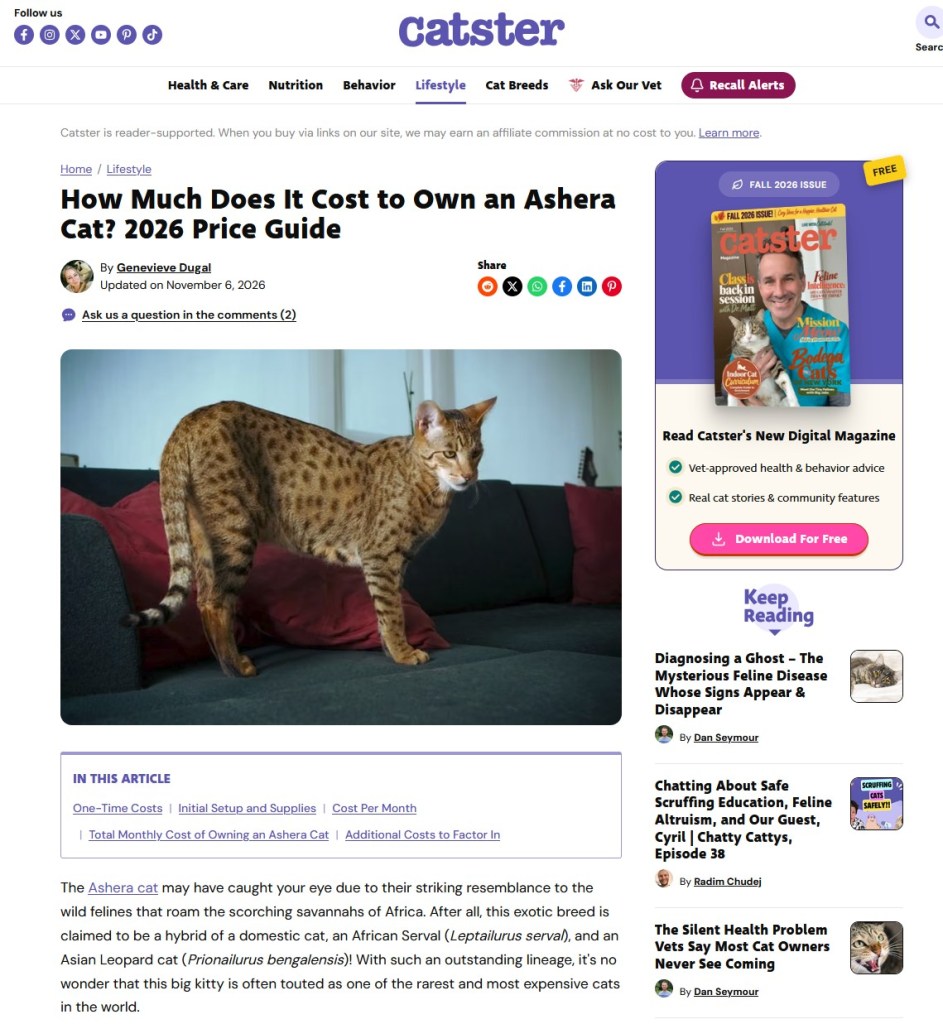
Spotted Ashera cat standing on a dark sofa in a living room
Catster’s editors know the Ashera is a scam, and they still run these stories.

The ubiquity of “for sale” posts proves that scammers are still benefiting from the confusion created by the media stories repeating long-debunked claims. We last wrote about the Ashera in early 2024, and the situation hasn’t improved. If anything, there are even more bad actors trying to rip people off by promising them genetically engineered miracle cats.

For the sake of being as blunt as possible so there can be no ambiguity:

The Ashera does not exist. It has never existed.

The man who “created” the Ashera, Simon Brodie, is a British national with a long criminal history. He fled and changed his name when his scam was exposed.

Not a single person who paid him received an “Ashera cat.”

Brodie launched his Ashera cat scam in the early 2000s by fooling several major media outlets into positively covering his fake business. He presented himself as a tech CEO and geneticist whose lab created the breed. The Ashera was developed, he claimed, by manipulating the DNA of existing cat breeds, removing the mechanisms that create allergens.

It’s worth noting that even now in 2026, no genetics company has done so, and geneticists still do not understand what function the relevant protein (Fel d 1) plays in feline biology. They know it produces allergens, but that’s a side effect on humans, not its purpose. Using gene-editing technology like CRISPR to snip out the relevant genetic code could have catastrophic consequences for the felines whose DNA is edited.

Yet reporters for major news outlets, including the New York Times, Time magazine, Reuters and National Geographic, didn’t question Brodie’s claims. The positive coverage in national and international publications vaulted Brodie’s scam to new heights, bringing him new customers.

It wasn’t until angry customers went to ABC News that the scam was fully exposed. DNA tests by an independent lab concluded so-called Ashera cats weren’t genetically engineered and didn’t have lower levels of allergens.

Brodie’s claims of an allergen-free cat were especially beguiling to people who’d always wanted a pet cat but found their allergies were too severe.

“I don’t think any cat is worth $4,000,” a customer named Mike Sela told Columbia Journalism review, “but this seemed like a magical opportunity, especially with parents trying to get something for kids. You never thought you could get a cat and this is your chance.”
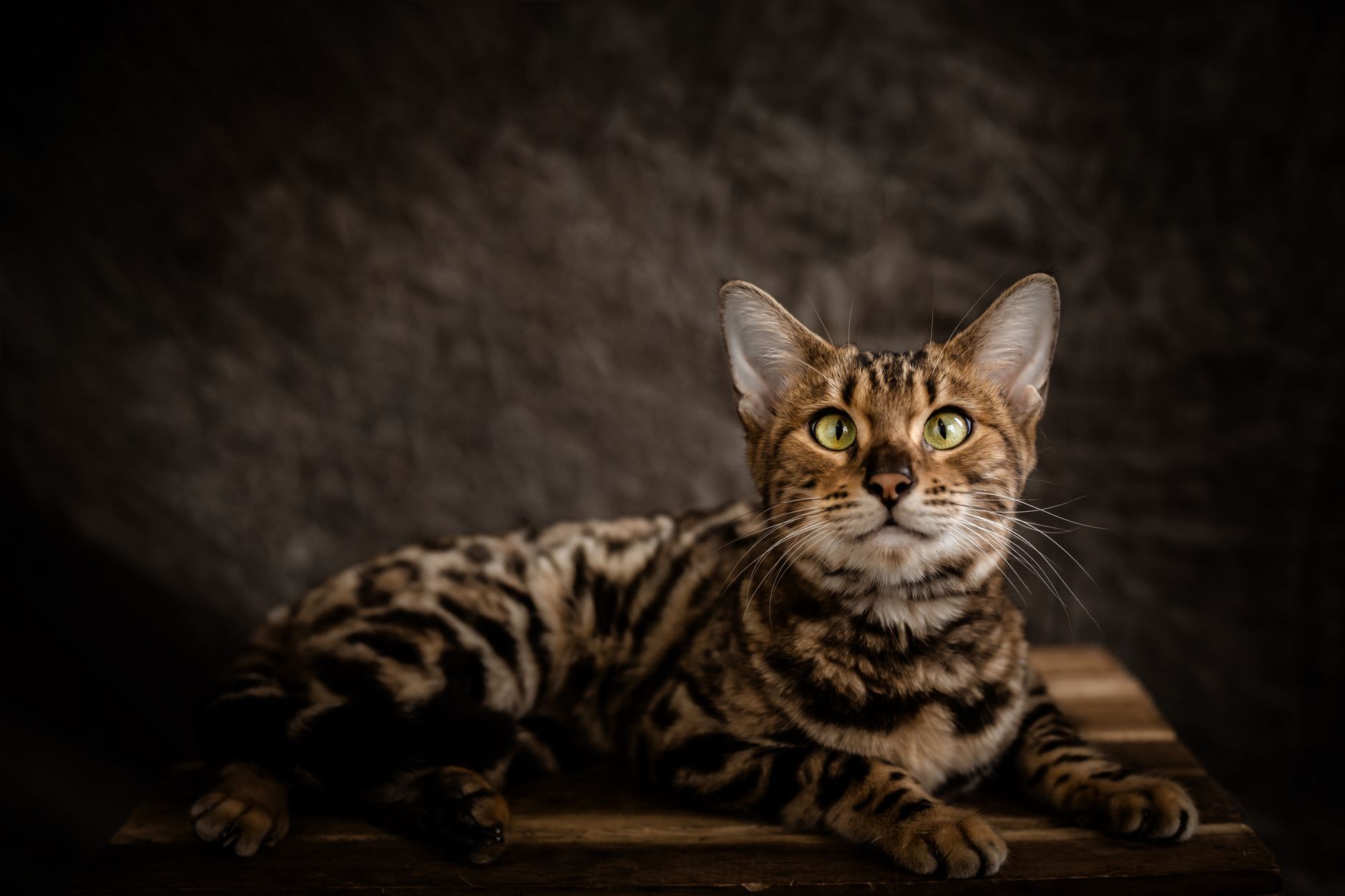
Bengal cat with green eyes lying on a wooden surface against a dark background
So-called “Ashera cats” are usually Bengal cats drop-shipped from breeders. While Bengal kittens typically command between $1,500 and $3,000, drop-shippers charge tens of thousands for supposedly hypoallergenic “Ashera cats.”

Brodie was neither a tech CEO nor a geneticist. He had no employees and his lab didn’t exist. He ran his “high tech startup” from his apartment, charging customers up to $100,000 for Ashera cats and drop-shipping them Bengal and Savannah cats from breeders.

Despite claims to the contrary by many other breeders, hypoallergenic cats aren’t a thing. All breeds of cat have the Fel d 1 protein, which is found in saliva and skin glands. You can’t buy an “allergy free” cat, and there is no governing body that certifies a cat as allergy free or “less allergenic.”

This isn’t difficult information to dig up. All it requires is basic due diligence and critical thinking.

Yet both are in short supply in a world where people just copy existing news articles, shifting a few words around to fool plagiarism detectors, or tell AI to write the stories for them.

To the owners and editors of sites still treating the Ashera cat and similar scams as real: You are serving the interests of scammers who separate people from their hard-earned money in exchange for hypoallergenic cats that do not exist. You’re doing real harm out of laziness or ambivalence. Please stop.
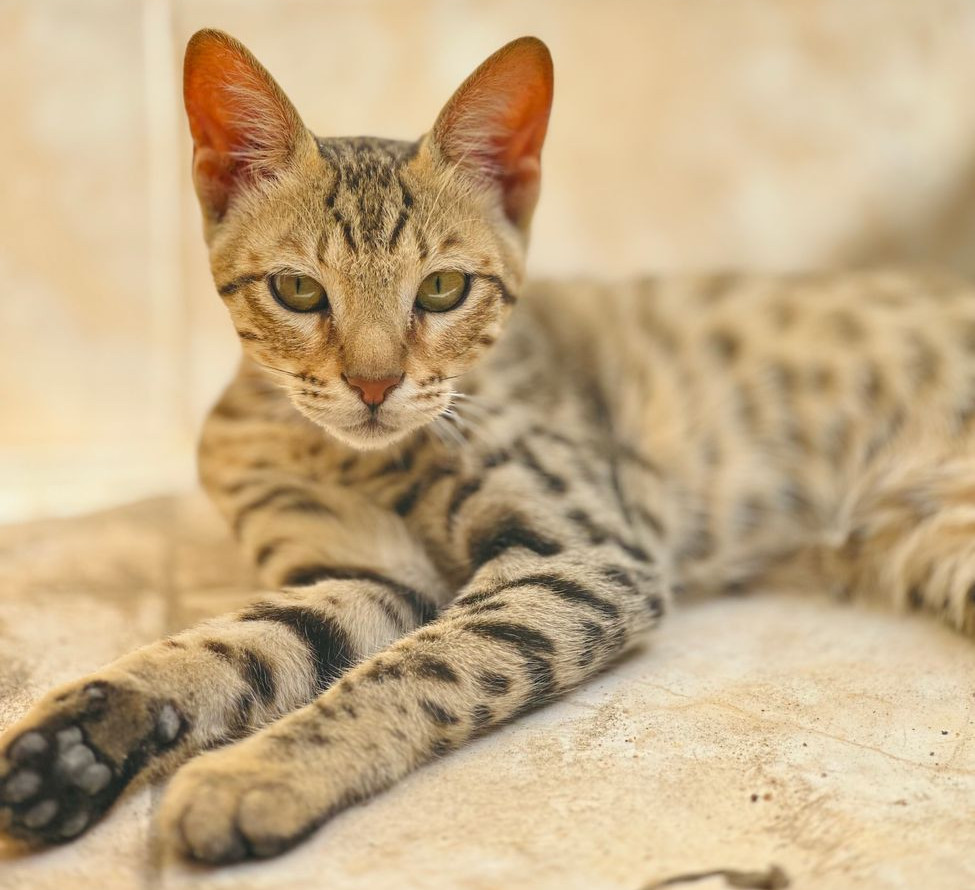
Spotted tabby cat lying down with its front paws extended.
Savannah cats are also sold as Asheras. Credit: Pexels

To people who are considering purchasing an Ashera, please don’t! The lure of a supposedly allergen-free cat is strong, as is the idea of a unique breed that looks like a wildcat.

Unfortunately that’s not what you’ll get in exchange from your money. You’ll get a regular fourth- or fifth-generation Bengal or Savannah that you could have purchased directly from the breeder for a fraction of the price.

Why pay for a cat anyway? There are literally hundreds of thousands of cats out there right now who need homes, and contrary to what breeders claim, those cats aren’t lower quality and don’t have anything wrong with them. In fact, domestic shorthairs are healthier than so-called pedigree cats in every respect and are not predisposed to the diseases and other health problems that plague breeds. They live longer, healthier, happier lives, and they’re just as loving.

Scammers continue posting ads and maintaining fake breeder pages because the scam still works, and the scam still works because supposedly trustworthy pet news sites tell readers the Ashera is real. They need to stop. After 20 years, haven’t enough people been scammed?
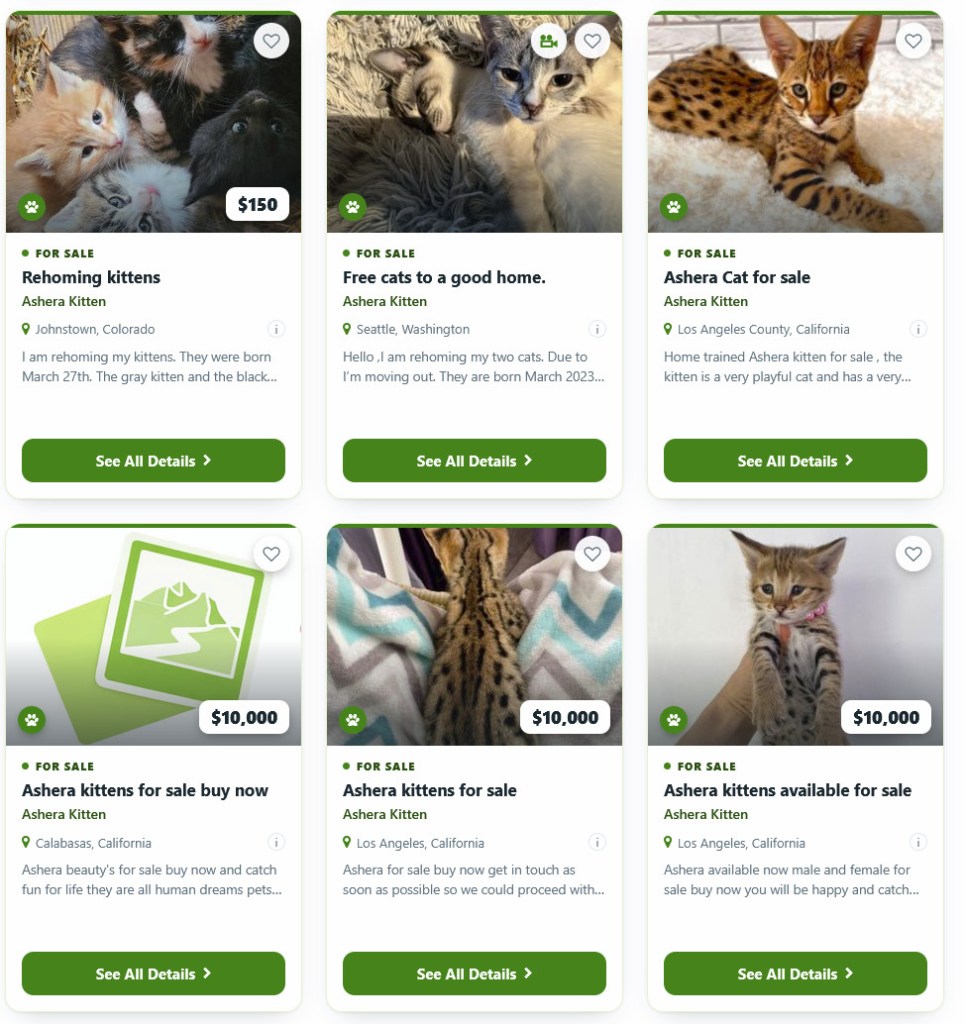
Ashera cat listings found on Nov. 10, 2026. The ads for people looking to rehome Asheras may be from people who were told the cats they purchased were Asheras, or they may be another form of scam. There were more than a dozen current “Asheras” listed for sale, each for at least $10,000.

A Cruel, Emotionally Manipulative New Scam Targets Cat Owners

“I had to leave work because I was a wreck, fully believing my cat was on the verge of life and death. It’s cruel that people do this,” one victim said.

Two weeks after his beloved cat vanished, Justin Hills received a phone call that simultaneously gave him hope and filled him with dread.

The man on the line spoke with practiced professionalism and told him that his cat, Little Wayne Shorter, had been found badly injured after he was hit by a car.

Little Wayne urgently needed surgery, said the man who identified himself as a staffer with Seattle Animal Shelter. Veterinarians were ready to begin surgery if Hills gave them the go-ahead and sent $2,800 via Venmo.

“The back of my head is screaming, ‘This is a scam. This is a scam.’ But at the same time, because it’s such an emotional pull, I’m thinking, even if there’s only a 10% chance that this is real, you know, I want to go ahead with it,” Hills told Seattle’s WKIRO.

Little Wayne Shorter

“The guy was rehearsed, was smooth. He sounded like, you know, an experienced person,” Hills said. “They had done some research on me before they called. You know, they knew my name. They knew my cat’s name, you know, the address and all this.”

When Hills called his bank, they warned him it was a scam. Hills said he’s glad he didn’t send the money but also devastated his cat is still missing — and that he was given false hope by someone trying to manipulate him in his desperation to be reunited with Little Wayne.

He’s not alone. In a post to Facebook group for missing pets in King County this week, Seattleite Harris Alex described a call from a person who claimed to work for Seattle Animal Shelter.

“They said someone found my cat, Binx, and that he had been hit by a car. They told me if I didn’t pay for surgery, he would die or be paralyzed within the next hour,” Alex wrote.

A caller said Binx, above, was seriously injured and needed urgent — and expensive — veterinary care.

Alex grew suspicious when the caller asked for a payment via Venmo, Paypal or Chime.

“I called the shelter to confirm they do not have him,” Alex wrote. “I had to leave work because I was a wreck, fully believing my cat was on the verge of life and death. It’s cruel that people do this. Be careful out there.”

Staff at Seattle Animal Shelter, which is run by the city, are aware of the scam and have gotten several calls from people asking if the shelter has their cats after being in contact with the impersonators.

“We would never ask somebody over the phone to make a payment,” said Don Baxter, manager of field services at the hospital. “We’re going to get that pet to a veterinarian and get it care and treatment, and then we’ll work out how to get the pet back to the owner after that.”

The lost/injured pet scam isn’t limited to Seattle, and the perpetrators will often switch to targets in another city if too many people become aware of their efforts, only to pop back up again later. The scam’s combination of social engineering and emotional urgency encourages victims to act quickly without giving the situation too much thought.

Experts advise people to keep their cool despite their hopes or fears, and demand proof that the person has the animal:

“This is one of the more difficult scams to deal with emotionally. If someone really has your pet, they should be able to at the very least send photos. Most people should be able to do a video call.

In general, scammers will pressure you to send money in advance. They will often make lots of excuses for not being able to provide proof they have your pet or meet in person.”

This general category of scam isn’t new, but social media has enabled scammers to believably pose as shelter staff using information pulled from the victim’s own lost pet posts and profiles, the FBI notes. The bureau also warns of several variations on the scheme.

Binx

The people running the con find their victims by scanning local missing pet groups on sites like Facebook and Reddit. They gather names and descriptive details, spin a narrative that shocks their intended victims, and create a sense of urgency by saying the cat will die if there’s any delay in performing surgery.

That’s what happened to Susan Burgess, who’d posted about her 15-year-old tabby cat, Linus, going missing. The caller said Linus was hurt and he needed to confirm her name, but Burgess realized he would have known it if he’d scanned Linus’ microchip.

She gave the scammer a piece of her mind before hanging up on him.

“On the off chance that you do have my cat, I hope that you are able to show some compassion and do the right thing,” she told the caller. “But I’m pretty sure that you don’t, and what you’re doing is very cruel.”


PSA: Speaking of scammy behavior, I can’t control the ads that are shown on PITB, but if you’re seeing ads for an amazing-looking, ultra-realistic toy rabbit presented as a great Easter gift, don’t fall for it. Here’s a video revealing what you’ll actually get from the deceptive seller: