Jaguars, pumas, ocelots and margays are able to thrive in the same jungles, a unique arrangement that sheds light on how each species lives.
The jungles of Guatemala are teeming with life.
The guttural calls of howler monkeys haunt the rainforest from above, where scarlet macaws hop branches in flashes of red, yellow and blue.
On the forest floor opossums, peccaries, and oversize rodents called pacas move through dense brush, occasionally picked out by the few shafts of light able to break through the canopy. Ocellated turkeys plumed in iridescent copper and emerald advertise themselves to potential mates with thumping sounds, while spider monkeys perch on the weathered stones of long-forgotten Mayan cities that were swallowed by the jungle centuries ago.
As in most tropics, the apex predators are cats — four different species, to be exact. Jaguars sit at the top, unchallenged. Pumas, close in size if not ferocity, also find sustenance in the rainforest alongside ocelots and margays.
Margays are smaller than house cats and resemble tiny ocelots. They’re outstanding climbers, expert hunters, and spend most of their time in trees. Unlike most cat species, which are crepuscular, margays are nocturnal. Credit: Clement Bardot/Wikimedia Commons
How do four medium carnivorous species exist side by side?
By dividing time, space and items on the menu, according to a new study.
Ocelots are extremely adaptable: they’re excellent climbers and swimmers, and can thrive in various environments. Credit: Victor Landaeta/Pexels
The felids hunt at different levels of the jungle at different times of day, and while there’s overlap between prey, each species has its own distinct diet, according to a research team from Oregon State University. Their paper, Niche partitioning among neotropical felids, was published earlier this month in the Journal of Animal Ecology.
As the big kids on the block, jaguars primarily eat peccaries (pig-like ungulates that weigh up to 88 pounds), armadillos, deer and, sadly, ocelots. Apparently membership in Club Felid does not grant the smaller wildcats a pass. Ocelots top out at about 35 pounds, while the largest jaguars weigh in at about 350 pounds, making the smaller cats easy prey.
Pumas opportunistically prey on peccaries and brocket deer, but the majority of their diet is composed of monkeys, both spider and howler. Ocelots and margays naturally go for smaller prey, sticking mostly to rodents and opossums.
As the largest and most powerful cats in the western hemisphere, jaguars are the apex predators of their environment. Credit: Atlantic Ambience/Pexels
While jaguars hunt on the ground and have a well-documented habit of slipping into the water to prey on caiman and crocodiles, pumas, ocelots and margays take advantage of their climbing abilities and lighter frames to reach arboreal prey. That allows pumas, for example, to snag monkeys and arboreal opossum species from the canopy, so they don’t have to compete with jaguars.
The team verified the “spatial, temporal, and dietary niche partitioning” within the Maya Biosphere Reserve by using ground camera traps, arboreal camera traps and fecal samples, which allowed them to confirm the prey each species has been consuming.
Interestingly, margays are the pickiest — or perhaps most limited — of the bunch, preying on only seven species, while the other three cats regularly hunt between 20 and 27 different kinds of animals.
The information gleaned from the study not only helps researchers understand how these species interact with their environment, but also can help guide conservation decisions to safeguard them against extinction.
Pumas, also known as cougars and mountain lions, are adaptable and elusive. Credit: Catherine Harding Wiltshire/Pexels
The more bunk studies claim cats are driving wildlife to extinction, the more people in media and government call for extreme measures to contain them.
Seventy nine cats.
That’s how many felines stood in for the entirely of the UK in a 2022 study, which is the genesis for the claim that cats kill 270 million birds and small animals in that country.
Using GPS collars, owner questionnaires and samples of prey brought home by those 79 outdoor cats, a research team from the University of Reading applied data from a mix of studies dating as far back as 23 years ago, extrapolated and massaged numbers using things like “kernel density estimates” and “generalized mixed models,” and came up with that 270 million figure, which is cited routinely and credulously by UK media.
Actually, their estimate was between 140 and 270 million. An earlier study put the number at 92 million, and a 2016 study estimated UK cats kill 55 million birds and small animals. That’s a range of 215 million!
The Reading team even quotes the infamous US meta-analysis that claims domestic cats kill as many as 4 billion birds and 22.3 billion mammals a year here. That paper, as skeptics in the science community have noted, has virtually no relationship with reality, involves no original research, and relies on data from unrelated studies and surveys in which cat owners were asked to rate their pets’ hunting prowess on a point scale while imagining what the little ones get up to when they’re outside.
All of this is to say that aside from the thorough, labor-intensive and expensive D.C. Cat Count, which brought together cat lovers, birders and scientists to work cooperatively, the 2022 UK study and its counterparts in the US and Australia are exercises in pushing an agenda masquerading as honest academic research.
That’s how we get editorials like The Spectator’s “We need a cat lockdown now” by Zoe Strimpel. Though the tone isn’t tongue in cheek, I can’t imagine Strimpel dislikes cats nearly as much as she claims, and the post was probably written with wry anticipation for the click-generating fury of cat lovers indignantly sharing it on Facebook and X.
Still, it quotes the Reading study without skepticism and portrays cats as furry little wretches who abuse their human caretakers with their claws and their disdain while gleefully eating their way through endangered birds.
A cat stares down a mouse. Credit: Wikimedia Commons
Cats are predators, that much we can agree on, and outdoor cats are much more likely to negatively impact local wildlife, for obvious reasons.
Likewise, I can understand the concern with cat culture in the UK, where allowing pet cats to roam outside is the norm.
But every time the media cites the above-mentioned studies, more people are given an inaccurate impression of feline ecological impact, and more lawmakers at the local and national level consider “solutions” ranging from prohibiting people from keeping pet cats, as a government commission in Scotland recently proposed, or exterminating them outright, as some Australian states and municipalities in New Zealand have tried to do.
It’s worth pointing out that there is no data, not even a single study, showing that air-dropping poisoned sausages or arbitrarily shooting cats actually has any positive impact on birds and small mammals. All it does is terrorize sentient, intelligent domestic animals who have real emotions and experience real fear and pain.
The primary drivers of declining bird and small mammal populations — including habitat loss, environmental destruction, wind turbines and glass buildings — have nothing to do with cats. We have killed off 73 percent of the planet’s wildlife since 1970 and every species of iconic megafauna — from orangutans and gorillas to tigers and pangolins — is headed toward extinction. Are domestic cats responsible for that too, or can we be adults and fess up to our role as the main antagonist here?
An orange tabby and a mouse. Credit: Wikimedia Commons
Strimpel actually goes even further, claiming cats don’t have real affection for their caretakers and are more like psychopaths, faking love because it gets them what they want, primarily food and shelter.
Dogs have true affection for their humans but cats do not, she additionally claims, while adding that cat people are undateable because they share qualities with the “loutish and numerous creatures” they care for.
There was a time when I would have been ambivalent about Strimpel’s attitude toward cats, if not her cavalier treatment of basic facts. But then a drool-happy, friendly tuxedo cat showed me I could interact with his species without my allergies going haywire, and a tiny gray tabby kitten became my animal cognition teacher while blindsiding me with love.
Now every time I hear about some psychopath abusing cats, or terribly misguided politicians advocating a plan to kill millions of domestic felines, I think about my Bud. I think about how he cries for his Big Buddy when he’s hurt or stuck, how he meows and trills with excitement when he experiences something new, and how he began shaking, then threw up from overwhelming relief and happiness the first time I returned from a vacation after adopting him.
Buddy the Cat chillin’ on the balcony in the summer. Credit: PITB
He’s got a vibrant mind in his little head, with strong opinions and emotions. So does every cat on the street, in a shelter cage, and in the cross hairs of a birder or biologist playing God by “culling” or “harvesting” cats to protect another species.
Real science, not activism packaged as science, has proven that many times over in recent years. If people want to do harm to cats because they think birds and other animals will benefit, the burden of proof is on them to show not only that their methods work, but that the results could somehow justify the fear and misery they would inflict on innocent animals to achieve their goals.
Cats are obligate carnivores who don’t have a choice. We do.
Scaring your cat with cucumbers or animatronic Halloween toys will damage your cat’s trust in you.
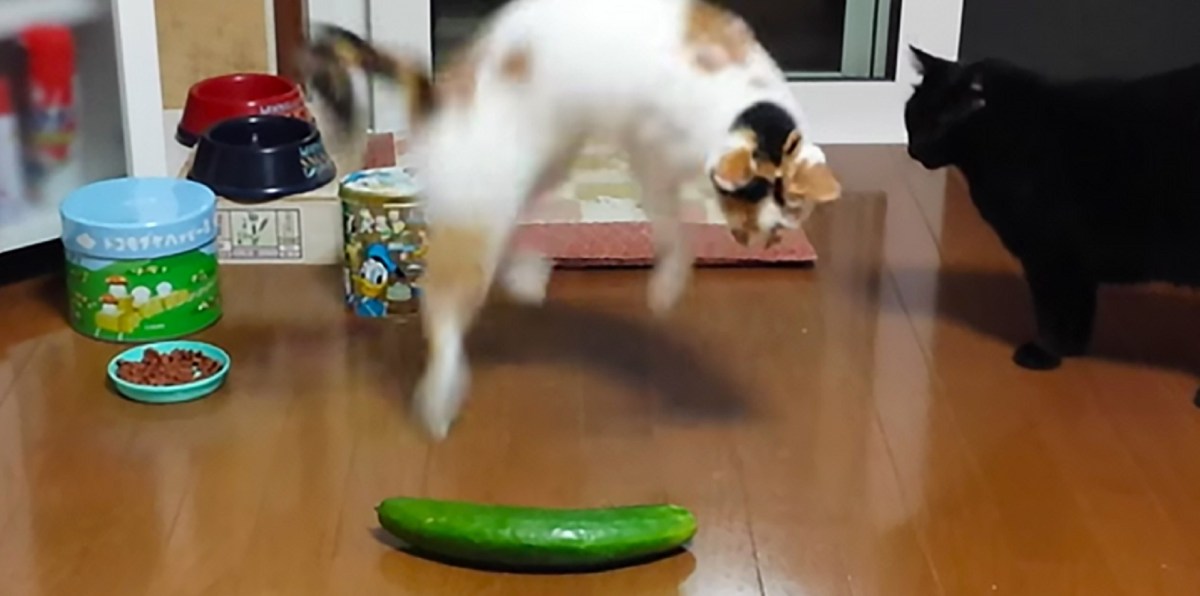
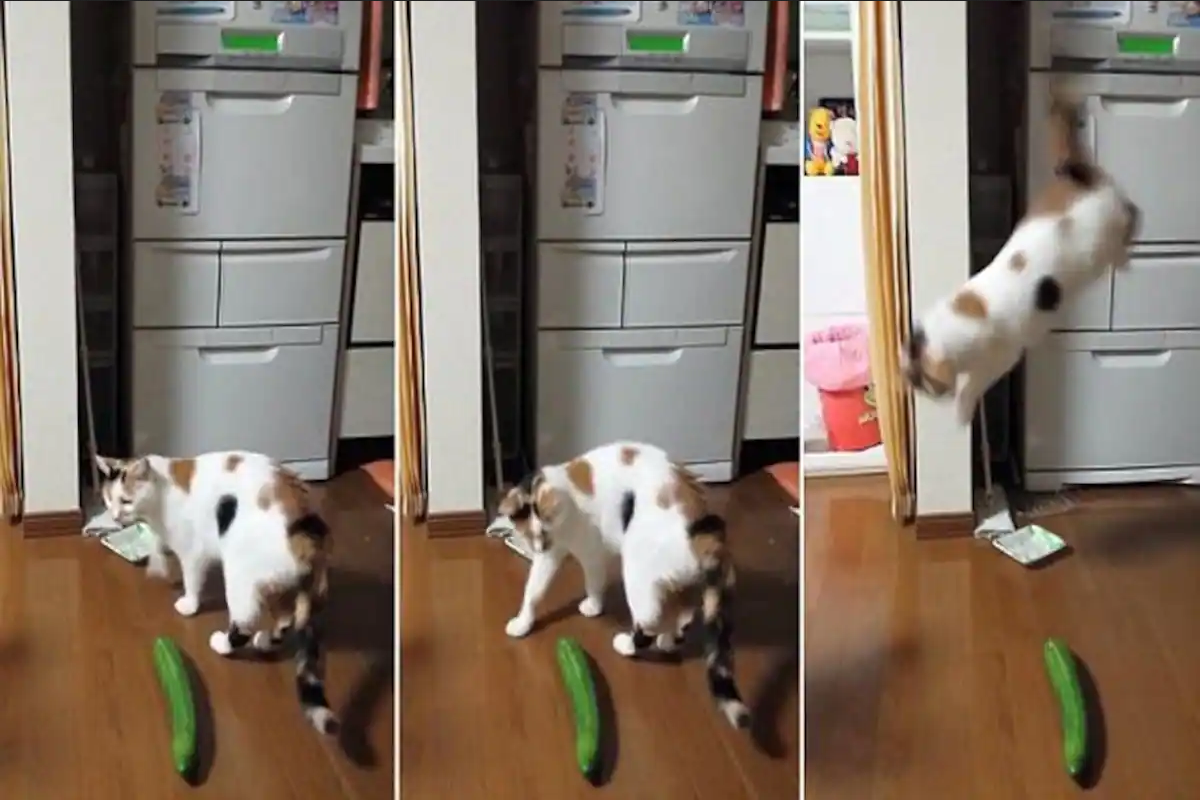
Whether they’re surreptitiously placing cucumbers behind their cats’ backs while the kitties are eating or filming their felines’ terrified reactions to Halloween props, some people apparently love scaring their furry friends.
Since many of the resulting videos go viral, people hungry for online fame have even more incentive to “prank” their cats as they chase clicks. The result is potentially thousands of house cats terrorized by people with ambitions of being the next TikTok or YouTube star.
On the surface, the way cats respond to being startled might seem comical. The term “scaredy cat” didn’t manifest out of nothingness, and cats who are truly frightened have a cartoonish way of leaping back and pumping their little legs while they’re still in the air like Looney Tunes characters.
But when you think about it from your cat’s perspective, in the context of feline evolution and psychology, the cruelty of scaring a cat for “lulz” becomes obvious.
First, cats are ambush predators. It’s why they love boxes, why they do the adorable crouch-and-butt-wiggle routine before pouncing on their toys, and why they like vantage points where they can see but not be seen.
They particularly dislike surprises, which is why they bolt. Cats are supposed to get the jump on other animals, not the other way around. The impulse to flee as quickly as possible — and return unseen — is hardwired into the feline brain, as natural to them as burying their poop or kneading when they feel content. Because domestic cats are small and can be predator and prey, that impulse is even stronger, but it also exists in 500-pound tigers or 200-pound jaguars.
So when you intentionally frighten your cat with an object that will be perceived, however briefly, as a predator, you’re triggering a fight-or-flight response, a rush of adrenaline and fear.
However, scaring a cat in its own territory (your home) or in a place he or she feels especially secure (feeding areas) adds another layer. A cat walking around outside will be naturally wary, but if you’re giving your cat a good home, as well as the love and space she deserves, she’ll feel comfortable. She’s on her home turf, in a closed environment where threats don’t pop up unexpectedly.
When a cat turns around after enjoying some yums and sees a cucumber, her hardwiring takes over, she registers the intrusive vegetable as a snake and goes into flight mode, scrambling to get away as fast as possible. It’s not just that kitty’s shocked or can get hurt scurrying away from a perceived threat, it’s also the inherent cruelty in teaching your cat that the place she thought was absolutely safe from intruders may not be.
We’re not immune to this kind of conditioning ourselves. If you settle down for a nap one day and your spouse, a sibling or a friend thinks it’s funny to wake you by dropping an ice cold bucket of water on your face, will you feel comfortable dozing off on the couch next time?
Trust is implicit in our relationships with our cats. If we abuse that trust, especially for something as meaningless as social media likes, we’re endangering our human-feline friendships and making our cats feel unsafe in their own homes.
Wildlife conservationists should work with cat lovers instead of making enemies of them in the ongoing quest to protect small wildlife from felines. Cat owners, in turn, can show good faith by being more responsible about spaying and neutering, and by keeping their cats indoors.
Wildlife conservationists are worried, and they have a right to be.
In addition to the billions of animals we humans kill every year in our ruthless exploitation of life on this planet, our pet cats have their own separate impact, killing birds and small mammals in significant numbers.
Yet conservationists aren’t making headway with cat lovers, primarily because their approach frequently relies on shaming and drastic, often cruel proposals: Some Australian states are outright culling cats, offering $10 a head for adults and $5 for kittens, for example, while a pair of academics from the Netherlands advocate criminally prosecuting cat owners who let their pets outside combined with a policy of euthanizing millions of cats. Extremists in the US are pushing for similar measures, arguing that TNR (trap, neuter, return) isn’t an effective way of managing cat populations.
Something has to be done, and a few smart conservationists are realizing the accusatory, Richard Dawkins-style of engaging “the enemy” just causes people to withdraw, not to listen and cooperate.
“I get quite sick of the conflict focus of some conservation biologists,” Wayne Linklater, chairman of the environmental studies department at California State, tells New Scientist. “The solutions lie with the people who care most about cats, not with the people who don’t care about them.”
Great. Now there are a few things conservationists should know as they engage with people who care for cats:
Most of us want what you want: We want cat owners to keep their pets inside. Cats aren’t wild animals. They have no “natural habitat” and contrary to misconceptions, they don’t belong outside. They’re not equipped to provide for themselves, and they face dangers from traffic, predators like coyotes and mountain lions, fights with other cats, and perverse humans who kill and torture them for fun. Strays and ferals live short, brutal lives (living to an average of 3.5 years) while indoor cats live 17 years on average. The “cats belong inside” angle is common ground from which to start a dialogue.
Stop repeating bunk studies as fact! The idea that cats are an all-consuming plague on wildlife came about as a result of a handful of studies, yet all but the most recent of them are based on old data and manipulated numbers compiled by people with an agenda. One of the earliest studies, which claimed cats kill up to 3.7 billion birds and 20.7 billion mammals annually, relies so heavily on invented numbers and massaged data that it’s worthless and outright dangerous to informed discourse on the topic, yet it’s repeated as fact by credulous conservationists and the press. Knowing the true scope of the problem is key to understanding whether mitigation efforts really work. Misinformation only sabotages those efforts.
Come get your people: Peter Marra is one of the co-authors of the bunk 2013 Nature Communications study with the above oft-cited numbers, and he’s also the author of the shrill Cat Wars: The Devastating Consequences of a Cuddly Killer. Marra is an advocate of using taxpayer money to kill millions of cats. He also says that anyone who questions his claims about cats — a group that includes major animal rescues, welfare organizations, and many academics — is tantamount to climate change deniers and tobacco companies that denied for decades that cigarettes have a negative effect on health. Marra’s major contributions amount to sowing misinformation, polarizing the issue and inflaming opinions on both sides. Everything about his behavior indicates he wants to sell books and promote himself, not save wildlife from predatory domestic cats. He should not be taken seriously and his research should not be reported as fact.
Cat lovers are, by definition, animal lovers. They’re people who care about wildlife and domestic animal welfare. It shouldn’t be difficult to engage with them.
At the same time, cat advocates need to purge the crazies out of their ranks as well. Sending death threats to scientists (see the New Scientist link up top) is way out of order, it’s inhuman behavior and it only hurts the legitimacy of our cause.
A good first step toward reconciliation could involve enlisting cat owners in an effort to properly study feline impact on small wildlife, producing reliable data to facilitate a measured, fact-based approach that doesn’t begin and end with the notion that cats are hellspawn.
If all sides engage in good faith, there’s no reason why we can’t protect wildlife and cats.
Nintendo’s newest game has been out for all of one day and already cats are like “Nuh-uh.”
The idea behind Mario Kart Live: Home Circuit is clever yet simple and seemingly tailored for the pandemic era: Using a Nintendo Switch, players control a tiny Mario Kart equipped with a camera and race it around courses they design in their homes. Because players are controlling the kart through a screen and seeing things from the kart’s point of view, the game augments the race course by generating obstacles to dodge, coins to collect and opponents to race against.
It’s called augmented reality, because it adds layers of computer-generated imagery over things we can see with our own eyes. It’s the same concept behind smart glasses and floating heads-up displays.
But there’s one wild card Nintendo’s designers may not have anticipated: Felis catus.
Nothing grabs a cat’s attention quicker than a small, fast-moving object, and the little karts have been triggering the predatory instincts of countless cats.
Some cats go all “You shall not pass!” Gandalf-style on the karts:
Finally, some cats just don’t know what to make of it:
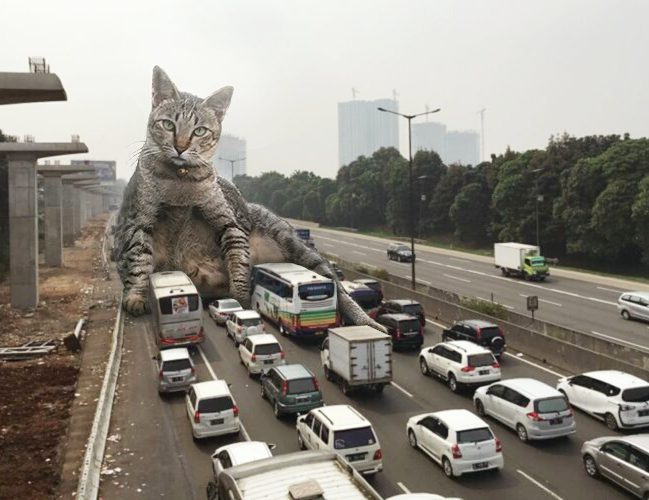
The best part about this is that, from the kart’s eye view, house cats look like furry kaiju — giant, lumbering beasts hell bent on sending the racers careening off course.
It also begs the question: Is there anything in existence that cannot be improved by adding cats?





 Pain In The Bud