Buddy the Cat asserts he is a powerful apex predator who fears no man or beast, while Buddy the Cat runs and hides the moment there’s an unfamiliar sound in his domicile.
I Am An Apex Predator!
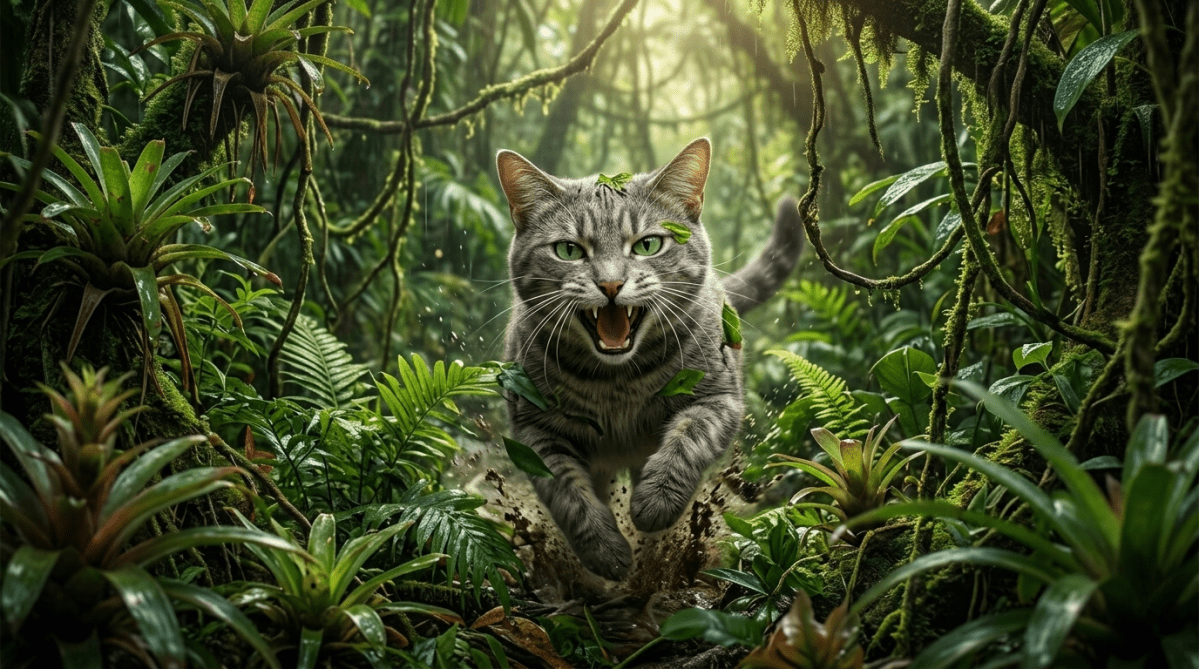
Behold! I have the gait of a lion, the bite force of a tiger, the stealth of a jaguar, and the relentlessness of a leopard!
My meowscles ripple meowscularly as I stalk my prey by moonlight! One second all looks safe and calm, and the next I’m leaping from cover in a burst of feline power to ambush my unfortunate prey!
Lesser creatures have nightmares about me. Indigenous cultures celebrate my legend in oral traditions. Craftsmen carve bas reliefs illustrating my mastery over all beasts. Shamans invoke my speed and strength. My toys quake at the mere mention of my name!
I am Buddy, and I am a ferocious cat! RAWRRR!!!
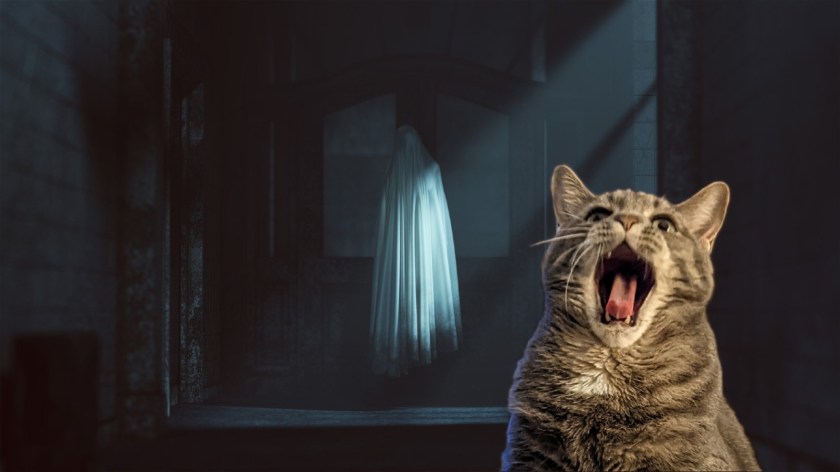
‘OMG, What Was That Noise?!? Go Check It Out, Human!’
Holy crap, dude! What the heck was that?
I’m just gonna run and hide under the bed while you investigate that awful, terrifying noise! No, YOU check it out. Are you crazy? I’m not going anywhere near there! What if it’s, like, a serial killer or a chalupacabra?
Where’s it coming from? The kitchen? The bathroom? Oh God! I told you, there are monsters living in the toilet and they can emerge at any second to murder us in our naps! We should have nailed the toilet seat down years ago! You didn’t listen to me, so you’re gonna have to fend off the monsters while I lend you moral support from three rooms away.
What? Duuuude.
Was it really your smartphone alarm on vibrate? Whew! For a moment there, I thought we were in trouble.
Now I’m gonna need you to rub my head while I sit in your lap and you tell me what a good, brave boy I am. If it really had been monsters, they would have gotten their butts kicked by me. I was brave, wasn’t I?
If you slander me by claiming I freaked out and ran to hide under the bed, I will be forced to accuse you of peddling fake news!
Point-Counterpoint presents two essays taking opposing positions on a topic. Join us again next week, when Buddy the Cat will debate Buddy the Cat on another important topic.
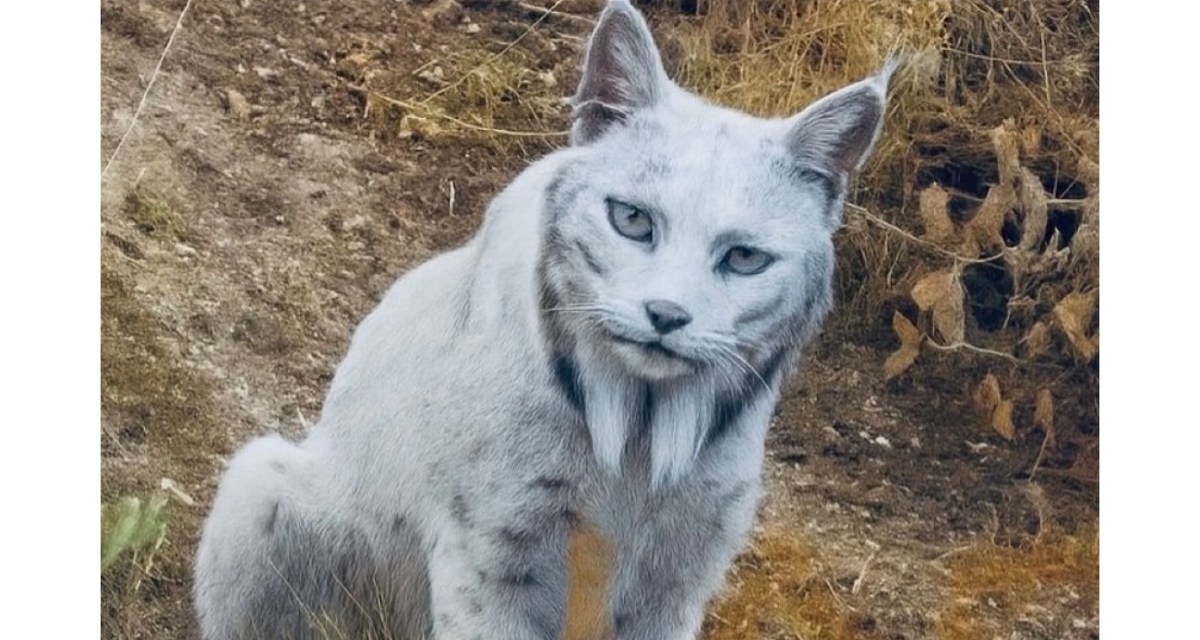
Photographer Angel Hidalgo thought the color was a trail camera malfunction until he saw the incredible feline for himself.
For the first time in history, a white Iberian lynx has been photographed.
A Spanish man who works in a factory by day and photographs wildlife as a hobby was behind the camera for the unprecedented shots.
It wasn’t easy.
Angel Hidalgo told National Geographic that first spotted fleeting images of the extraordinarily rare feline on one of his camera traps, but he was skeptical.
“I couldn’t believe it,” the 29-year-old said. “I thought it was a camera effect, and from then on, I dedicated myself to the search for the lynx. I’m still in shock.”
While hiking in late October, Hidalgo saw the “ghost cat” with his own eyes and quickly took a handful of shots and a short video before the cat vanished.
Credit: Angel Hidalgo
The Iberian lynx, as its name indicates, is native to Spain and a small range in Portugal. The cats call mountain ranges like Sierra Morena and Montes de Toledo home.
The white color morph is due to leucism, not albinism: the difference is the former causes only partial loss of pigmentation, and the eyes are unaffected.
In the video footage, the cat sits calmly and regards Hidalgo for about 15 seconds before blinking and turning its head. It’s a fleeting but fascinating look at an animal that most of us will never have the opportunity to see in the flesh.
Hidalgo won’t say where he encountered the white lynx, which is a smart move in an age when bored rich kids in places like Dubai can throw money at wildlife poachers and help themselves to the rarest and most vulnerable wildlife.
Because they know the authorities in their countries won’t bother them, the sons of oil oligarchs and emirs openly flaunt their wild “pet” collections: Instagram and TikTok host thousands of photos and videos of young men and women posing with cheetahs, lions and tigers, with the cats often riding shotgun in hypercars from Lamborghini, Ferrari and McLaren.
We hope the location remains a secret for the sake of the wild cat and because the Iberian lynx is a conservation success story. The species was on the brink of extinction in the 1990s and now has a healthy breeding population that numbers in the thousands.
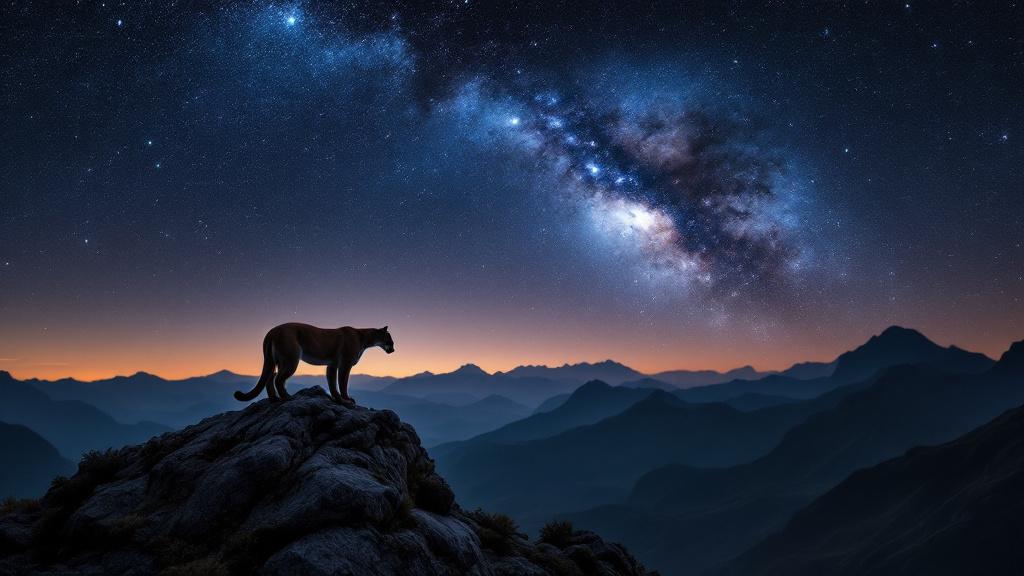
Cats were built by mother nature to stalk by starlight.
From the African savannas to the Andean mountains, the jungles of the Amazon to the Hollywood hills, and everywhere in suburban America, cats of all types and sizes prowl the night. With eyes that are up to eight times more sensitive in the dark, incredibly sensitive hearing, and whiskers that can pick up the slightest change in air density, felids were built by mother nature to stalk by starlight.
Some cat species are crepuscular, some are nocturnal, but as ambush predators, they’re all at their best when hunting under the cover of darkness.
Image credits, top to bottom: Per Karlson/PVKFoto, Reddit r/natureisf***inglit, Cockscomb Basin Wildlife Preserve, Wikimedia Commons, Steve Winter/National Geographic, National Park Service, Colorado Parks and Wildlife
A comedy, a remarkable documentary, a classic and a surprise hit make the list for the best cat-centric movies.
Keanu (2016): Jordan Peele stars as Rell, a man who is despondent after he’s dumped by his girlfriend. When a kitten shows up on his front step, Rell takes the little guy in and his life is suddenly transformed. He’s enamored with the kitten, whom he names Keanu, can’t stop talking about him, and even begins photographing him in dioramas based on famous films.
But tragedy strikes when drug dealers ransack Rell’s home, mistaking it for the small-time drug dealer’s home next door, and take Keanu. Rell and his cousin, Clarence (Keegan Michael-Key) embark on a quest to get Keanu back no matter what it takes, even if it means posing as a pair of contract killers to infiltrate the criminal world where Keanu’s been taken. It’s every bit as absurd as you’d imagine — but it’s also very, very funny. “Actually, we’re in the market right now for a gangsta pet,” is not a line I’d expect to hear in a movie, but in Keanu it works.
Flow is the surprise hit of the awards season.
Flow (2024): Even the hype of Golden Globe awards and Oscar nominations can’t take away from the powerful impression Flow makes. By now most of us are probably familiar with it through clips or trailers, but they don’t do justice to the beauty of director Gints Zilbalodis’ world, nor how naturally expressive his protagonist, Cat, is.
The animators put in an extraordinary amount of effort into understanding and perfectly replicating every feline behavioral quirk, every hackled coat and curiously bent tail. They accomplish the same with Cat’s companions, including a Labrador, a secretarybird, a lemur and a capybara. And while we’re dazzled by the visuals and energetic narrative, Zilbalodis poses a thematic question as the flood waters take the animals through the ruins of human civilization: without people, the world will go on. What would a world without humans look like? Cat and his companions tell us one story while the environment tells us another, and the result is greater than the sum of its parts.
Tiger: Spy In The Jungle
Tiger: A Spy In The Jungle (2008): What makes this documentary so special is that it was filmed over three years in an Indian tiger preserve, and the filmmakers not only disguised cameras as rocks and tree stumps, they trained elephants how to carry “trunk cams,” achieving shots which no human cameraman could ever hope to get without spooking the subjects of the film.
Tigers don’t hunt elephants because they’re simply too big. Unlike lions, they’re not feeding a whole pride, and they don’t hunt cooperatively. It’s just not worth the effort required to take down the giant, majestic beasts. As a result, tigers and elephants not only tolerate each other, they mostly ignore each other’s presence.
One of the cubs stares curiously at a camera disguised as a rock in Tiger: Spy In The Jungle
That allowed the team to get unprecedented shots of an iron-willed tigress raising a litter of four cubs by herself. We see their dens, we watch the cubs play, and we witness the incredible prowess of the mother, who according to narrator David Attenborough has a remarkable 80 percent success rate while hunting. That’s pretty much unheard of.
With four young mouths to feed in addition to herself, the tigress is determined, and also supremely skilled. The whole jungle erupts in a cacophony of shrieks and alarm calls the instant a single animal gets a whiff of the tigress’ presence, but that still doesn’t stop her from achieving her goal.
Still, the odds are against all four cubs making it, with dangers like adult leopards, sickness and hunger. Through Spy In The Jungle, we get to see the entire journey, from the newborn cubs to the confident juveniles on the cusp of adulthood. There’s no better tiger documentary anywhere.
Shere Khan, right, makes an intimidating villain in The Jungle Book (2016)
The Jungle Book (2016): With so many Disney cash-grabs in the form of live-action remakes of classics that did not need to be remade, it’s easy to dismiss The Jungle Book. The thing is, this movie has heart. Neel Sethi is an earnest Mowgli, Idris Elba voices the infamous tiger Shere Khan, and to balance out the felid villainy with some heroism, Sir Ben Kingsley voices Bagheera, the noble leopard who discovers baby Mowgli in the jungle and protects him as his wolf friends raise the boy. Lupita Nyong’o as the wolf matriarch Raksha, Bill Murray as the honey-obsessed bear Baloo and Christopher Walken as orangutan King Louie round out a great cast.
The find is extraordinary, allowing scientists to directly study the extinct cat’s musculature, fur, head shape, and even its claws and whiskers.
A team in Russia stumbled on the find of the century when they located the stunningly well-preserved remains of a saber-toothed kitten in Siberia.
The kitten, which was found near the Badyarikha River in northeastern Siberia, was about three weeks old when it died, scientists estimate.
Unlike typical finds — a fang here, a mandible or partial skeleton there — this specimen still had its fur, claws, whiskers and muscles, which means scientists have already learned more about the species, Homotherium latidens, than they have with almost any other long-extinct animal.
Images of the extinct cub’s paws compared to (D), the paw of a 3-week-old lion cub pictured on the bottom right. The Homotherium paw is thicker but less elongated. Credit: Borissiak Paleontological Institute, Russian Academy of Sciences, Moscow, Russia
While the saber-toothed cub is a true felid, it boasts adaptations unlike any surviving member of the panthera genus.
It has wide paws wrapped in heavy fur, a short tail and a stockier, lower-to-the-ground build than modern lions and tigers. Those adaptations, scientists believe, made it easier for Homotherium latidens to traverse environments with ice and heavy snow.
Its head shape is slightly different, with smaller ears than modern big cats, and its neck is enormous, more than twice as thick as the neck of a comparable three-week-old lion cub which was used for comparison. Likewise, its mouth is capable of opening significantly wider, although the team did not compare it to the jaguar, which has the widest-opening jaw among extant felids.
A photograph of the cub, top, and a scan revealing facial, ear and neck structure, below. Credit: Borissiak Paleontological Institute, Russian Academy of Sciences, Moscow, Russia
The frigid, arid clime of Siberia made it possible for the cub’s body to endure for so long. The team that made the discovery conducted radiocarbon dating that puts the cat at between 35,000 and 37,000 years old, according to reports.
It’s not clear how the cub died, although its species went extinct about 10,000 years ago, likely as a direct result of fewer prey animals in the frigid zones it occupied. Additional bones belonging to the rear of the cub skeleton were encased in a large cube of ice immediately next to the intact upper body.
The cub’s remains were recovered in 2020, but the results of the research team’s analysis were just released on Nov. 14 and published in the journal Nature. The paper’s authors have a lot more to share about the species’ physical characteristics, they noted in the text, and plan to follow up soon with a second paper going into more detail about what they learned from the cat’s intact musculature.
Top image: An artist’s impression of an adult member of homotherium.
Credit: Borissiak Paleontological Institute, Russian Academy of Sciences, Moscow, Russia




 Pain In The Bud