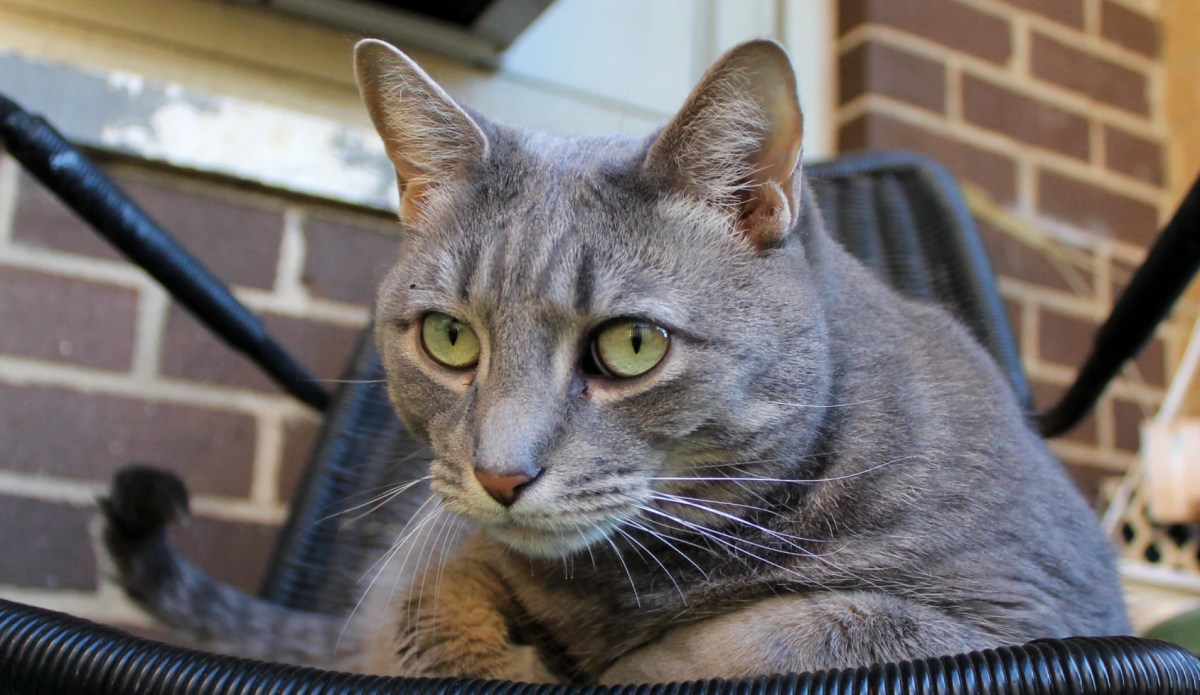
Does The Budster Love Me?

“Love is a strong word, human. I prefer ‘tolerate.’ On days when you anticipate my snack cravings before I verbalize them, you could maybe say I’m fond of you.”

Newsweek has an interesting interview with a cat behaviorist on the subject of whether cats love their humans.

Chantal Howard, a certified cat trainer with Feline Focus Training in Ottawa, told the magazine there are nine primary behaviors that indicate — or confirm — a house tiger loves his or her person. Most of these won’t be new to PITB readers, who are of course among the most cat-savvy people out there and have magnificent taste in cat blogs, but it’s still a handy way to ascertain how your feline overlord feels about you.

So how does Buddy do according to this checklist? Let’s see:

Headbutting: ✅ His Lordship is quite fond of headbutting me and favors me with dozens of headbutts throughout the day, ensuring his pheromones remain on me. You know, in case some other cat somehow comes wandering in and there’s a dispute about which furball owns me.
Kneading: ✅ Considering the fact that I’ve had to toss quite a few t-shirts because of claw rips, I’d say that’s a yes. At least he doesn’t knead my face anymore, as he liked to do when he was a kitten and would take his perch on my shoulder, nuzzle up to my neck and make biscuits against my beard.
Purring: ✅ Nine times out of 10, Buddy’s purr is inaudible, but it’s there. It’s a bit odd that such a talkative, loud cat barely makes a buzz. He likes to lay on my chest and purr up a storm while I rub his head and tell him he’s got admirers all over the world.
Chirping: ✅ Yes! In fact, chirps and trills make up a significant part of the Buddinese language. While meows can be positive, negative or demanding (“I can see the bottom of my bowl! This is an outrage, human!”), trills and chirps are always happy sounds.
Nipping: ✅ Unfortunately, yes.
Licking: ✅ He grooms my hair and my beard, and when I shave he licks my face, which is pretty gross.
Bringing Gifts: ❌ Negative. Then again, what kind of gifts can he bring me when he’s an indoor cat and doesn’t fully understand the concept of hunting?
Exposing Belly: ❌ Does he expose his belly? Yes. Does he feel comfortable enough to snooze in my lap with his belly exposed? Of course. Does he want me to give him belly rubs? No, he emphatically does not. The primordial pouch is not to be touched!
Tail Position: ✅ One of the most awesome things is the fact that Bud’s tail goes immediately into happy mode when I say “Hi, Bud!”, when I hold my hand out for a headbutt, and when I talk to him in general. His tail quivers with excitement when we play with the laser pointer or his favorite toy, and when he catches the first whiff of catnip.

So that’s 7 of 9, or 7 of 8 if we count gifts as N/A due to Bud’s hilarious ineptitude when it comes to even grasping the concept of hunting.

Bud has been known to throw up from excitement when I return from vacation, he often naps by the door when I go out, he talks to me constantly, and he’s rarely more than three or four feet away from me at any given time. All those things, plus our strong bond, have proven to me that he does love me, but it’s also nice to confirm it with a behaviorist’s criteria.

How does your cat perform on the checklist? Don’t forget to share your results in the comments.
Vet’s Urgent Warning Over Laser Toys, Plus: US Now Has 200+ Cat Cafes

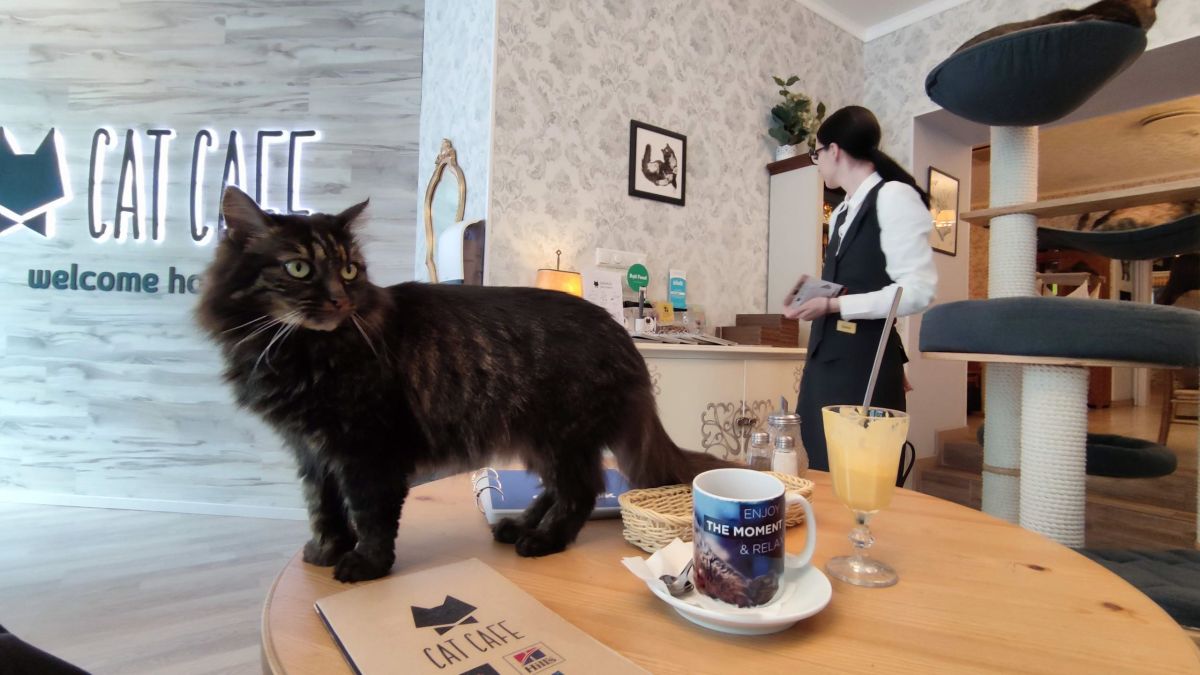
People who frequent cat cafes say they feel relaxed among the little ones. Hundreds of thousands of felines find their forever homes via cafes in the US, which are typically integrated with local shelter and rescue networks.

You may have noticed that most journalists don’t actually interview anyone these days, and the majority of “news” stories are either rewrites or lazily-assembled, 300-word virtual birdcage liners about which celebrity or influencer is “clapping back” at haters for “throwing shade” at them, with quotes directly copied and pasted from X or Instagram.

It’s cheap, easy content — far cheaper than funding war correspondents or impactful investigative journalism — and it doesn’t require reporters to leave their desks, speak to sources on the phone, or even fact-check what they’re writing.

“Well, they said it” is good enough for modern newsrooms, which is why we can’t have a national story or a disaster like the wildfires without waves of misinformation getting amplified by press and influencers alike. And the executives of the handful of remaining news companies wonder why trust in media is at historically low levels.

So these days, a veterinarian warning about laser toys via a TikTok video is considered international news. Nina Downing, a veterinarian with UK pet charity PDSA, took to the social media platform to warn about “laser pointer syndrome,” which she says can result in obsessive compulsive behavior in cats and dogs.

Our furry friends can become frustrated that they never actually capture the elusive red dot, according to proponents of the theory, and too much laser pointer play can result in a pet who barks at shadows or tries to tackle anything that moves.

“Cats have a hunting sequence to follow which is replicated in play, however if it doesn’t come to a successful capture at the end, this can cause them to become really agitated,” Downing warns.

Credit: WIkimedia Commons

Happily, Buddy is impervious to this alleged syndrome because he doesn’t actually have a “hunting sequence.” Born indoors, he’s known nothing but warmth and comfort, and food is something that’s served to him on a precise schedule, not something that needs hunting.

Accordingly, when we play with wand toys, Bud’s version of a “kill” is to grab the plush toy or feathers while dancing around on his back paws. He bobbles the toy while he dances, lets it go and resets the game.

The concept of a kill bite is completely alien to him, and apparently not even his feline instincts are enough to tell him there’s another step to “winning” the game. Still, I tell him he’s a good boy and a fierce little tiger because we can’t have fragile egos getting bruised.

That said, if you find lasers are one of the few reliable ways to get your kitty moving, it’s probably a good idea to wind down by switching to a wand toy. Let the little one simulate a kill, get a few rabbit kicks in and feel like a champ. There’s little or no research supporting the concept of laser pointer syndrome, but it still couldn’t hurt to give your feline overlord something tangible to “kill” at the end of a play session.

Cat cafes are more popular than ever in the US

USA Today has a story today about the apparent ubiquity of cat cafes in the US, and how they’re changing things for the better, for felines as well as people.

Using data from Yelp, the newspaper found there were 200 cat cafes, give or take, across the country at the end of 2024, up from about 75 in 2020.

“When we started, people weren’t quite sure what they were, there was a lot of explaining how they worked and what they were,” said Laura Konawalik, owner of a chain of three cafes featuring felines in North Carolina. “Nowadays people come in knowing the general concept.”

The same data shows searches for strings like “cat cafes near me” have increased 78,700% between February of 2020 and February of 2024, USA Today reported.

Patrons playing with cats at a cafe in Osaka, Japan. Credit: Wikimedia Commons

While cafes in some other countries are populated by felines owned by the proprietors, most cat cafes in the US are integrated with their local shelter and rescue networks, so patrons can adopt if they fall in love with the little ones they meet while having a cup of coffee or tea.

That means some of the oldest cat cafes in the country have facilitated thousands of adoptions and continue to find forever homes for their animals.

About 330,000 cats were euthanized in the US in 2023, the most recent year for which complete statistics are available, according to Shelter Animals Count, a national database that keeps track of shelter intakes and cat/dog euthanasia figures. Data for the first half of 2024 showed a decrease from the previous year’s numbers, but numbers from the latter half aren’t available yet.

Jet Taylor, a regular at Konawalik’s Mac Tabby cafes, says he keeps coming back to destress and feel calm.

“I would be willing to bet,” he said, “you could put a heart rate monitor on me and when I’m sitting there petting a cat, my heart rate goes down.”

The First HD Video Streamed From Space Is A Clip Of A Cat Chasing A Laser

In Netflix’s Three Robots, a trio of intelligent wise-cracking machines tour post-apocalyptic Earth after humanity nukes itself out of existence. While humans are long gone from the planet, felines are not, and before long the robots encounter a gray tabby.

“What’s the point of this thing?” one robot asks its friends, looking skeptically at the yawning cat.

“Apparently there’s no point, they [humans] just had them,” the second robot says.

“Well, that’s underselling their influence,” the third robot says. Humans, it explains, “had an entire network that was devoted to the dissemination of pictures of these things.”

The ongoing joke that the internet and modern telecommunications systems were invented solely for the purpose of sharing cat photos and videos won’t die any time soon now, thanks to NASA.

To inaugurate and test its new Deep Space Optical Communications (DSOC) system, which uses lasers instead of radio signals to transmit data, the famed space agency streamed a high definition video of a cat named Taters chasing a laser.

The 15-second clip took half a second to transmit from the spacecraft Psyche and 101 seconds to cross the 19 million miles (30 million kilometers) between Psyche and Earth. For context, that’s a journey about 80 times as long as the distance between Earth and the moon.

So why is NASA doing this? Why create a new communications network when the old one still works? And why send a video of a cat?

Taters
Taters the cat. Credit: NASA

The answer to the first question is simple: Our machine proxy explorers need more bandwidth to send back data and ultra high definition photos/video of the strange worlds they’re exploring.

We send robotic probes to destinations like the asteroid belt and Venus because we can’t go ourselves, and because it’s the most efficient way to explore. The indomitable human spirit drove us to explore our own planet, and it’s expected that eventually human eyes will see the oceans of Europa and the surface of Mars. But we still have some big engineering challenges ahead of us, like figuring out how to build ships that adequately shield astronauts from radiation, and medical/biological challenges like how to prevent vision, bone density and muscle loss in low or zero gravity.

So in the meantime robotic probes are our ticket, and their numbers are growing quickly.

There are more than 30 active probes exploring our star system now. Most belong to NASA, but others belong to space agencies from the EU, South Korea, Japan, Russia and India, among others. Another 27 new spacecraft are expected to launch this year, headed to destinations like Venus, Mars and the many moons of Jupiter, and at least that many are scheduled to join them in 2026.

That’s a lot of probes.

Each of those craft will have to transmit data back to Earth — scientific data, but also high definition photos and videos of planetary and moon surfaces, asteroid compositions and more.

There isn’t a traffic jam — yet. But there will be soon if every probe’s data is bottlenecked by the lower-bandwidth radio system.

While laser and radio transmissions both travel at the speed of light, the shorter wavelength of laser light allows more data transfer. In simple terms, the DSOC network is like upgrading from an old phone modem to broadband.

As for why NASA chose a video of Taters chasing a laser, there are two main reasons: Fun and honoring history.

Taters’ human, Joby Harris, works for NASA as a visual strategist. When NASA employees were talking about the significance of sending the first high-def video from a probe to Earth, one staffer mentioned that one of the first — or perhaps the first — test videos in the dawn of television was a simple video of a statue of Felix the Cat.

The rest fell into place. Transmitting a video of a cat chasing a laser seemed like the natural choice to test a laser-based comms system. Taters has become something of a celebrity in the process.

One thing we can be sure of: if aliens are watching us from afar, there’s a good chance they’ll conclude felines are the ones running things down here. They may not be wrong.

Sir David Cattenborough’s Newest Documentary Reveals The Elusive Silver-Furred Buddy

The naturalist is excited to unveil his most striking documentary yet.

NEW YORK — All those hours trudging through the dense undergrowth of New York living rooms, hoping for a glance of an elusive feline, have finally paid off.

Speaking to reporters about his newest nature special, Sir David Cattenborough said he and his crew spent more than 200 hours in the natural habitat of the silver-furred Buddy.

Also known as the Buddinese tiger, the silver-furred Buddy is “native to the living rooms of New York” and, with his meowscular physique, “is the apex predator of his environment.”

“What a fascinating animal!” Cattenborough exclaimed.

The famous naturalist, conservationist and documentary narrator accompanied a camera crew into the thick jungles amid couches, pillows and carpets, where they observed the silver-furred Buddy at a safe distance as the fierce feline went about sleeping, eating and lounging.

Cattenborough and Buddy
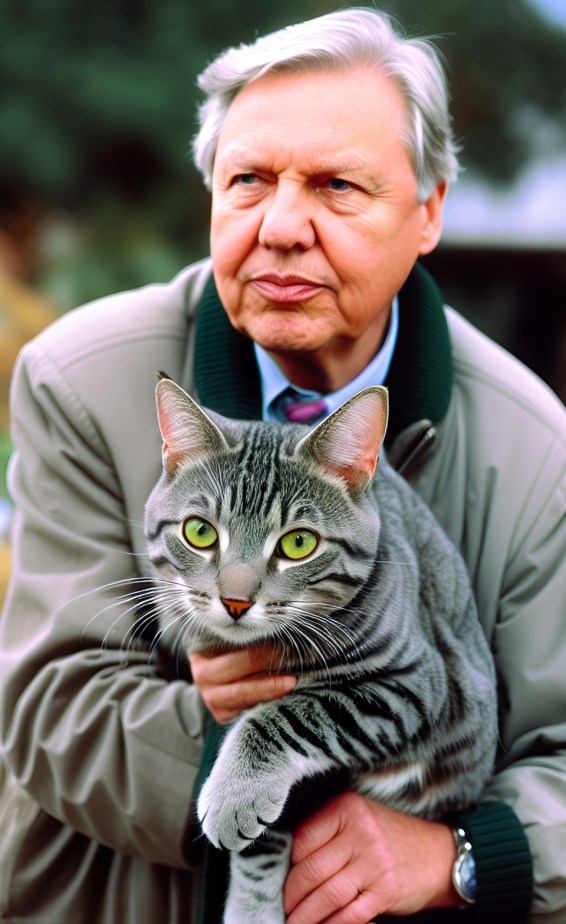
Sir David Cattenborough with Buddy the Cat.

Speaking excitedly in his familiar whimsical cadence, Cattenborough described the documentary crew’s luck in catching the Buddy on a hunt, when he ruthlessly brought down a red laser dot.

“People ask me, ‘Sir David, what makes the Buddy any different from other tigers and lions? Isn’t it basically the same animal?’ While they’re all famously fierce felids who strike fear into the hearts of other creatures, there are differences as well,” Cattenborough explained. “Thanks to the hard work of our dedicated crew, we’re able to bring our audience along as we take the closest look yet at this most elusive and fascinating beast.”

The new documentary, “Buddy: The Perfect Predator,” will be available to stream exclusively on Pain In The Bud, and was made possible by a grant from the Buddinese Foundation for Greater Buddesian Understanding, with additional financial support from the Coalition for Meowscular and Ripped Cats. Look for it this week on PITB!

Cattenborough and Bud
Sir David Cattenborough was able to earn the trust of a silver-furred Buddy.

Are Laser Pointers Bad For Cats?

Buddy likes his new laser toy a little too much.

Bud is obsessed with his new laser pointer.

I bought one for the first time more than a week ago. For years I’d occasionally break out a level that shoots a narrow band of laser light that appears like a small stripe, and while Buddy enjoyed chasing after it, I’m thinking the laser probably wasn’t as powerful or didn’t register as well in the spectrum of light most visible to felines.

Whatever the reason, while he liked chasing the level’s laser light, he loves this $5 pet laser.

lasercat

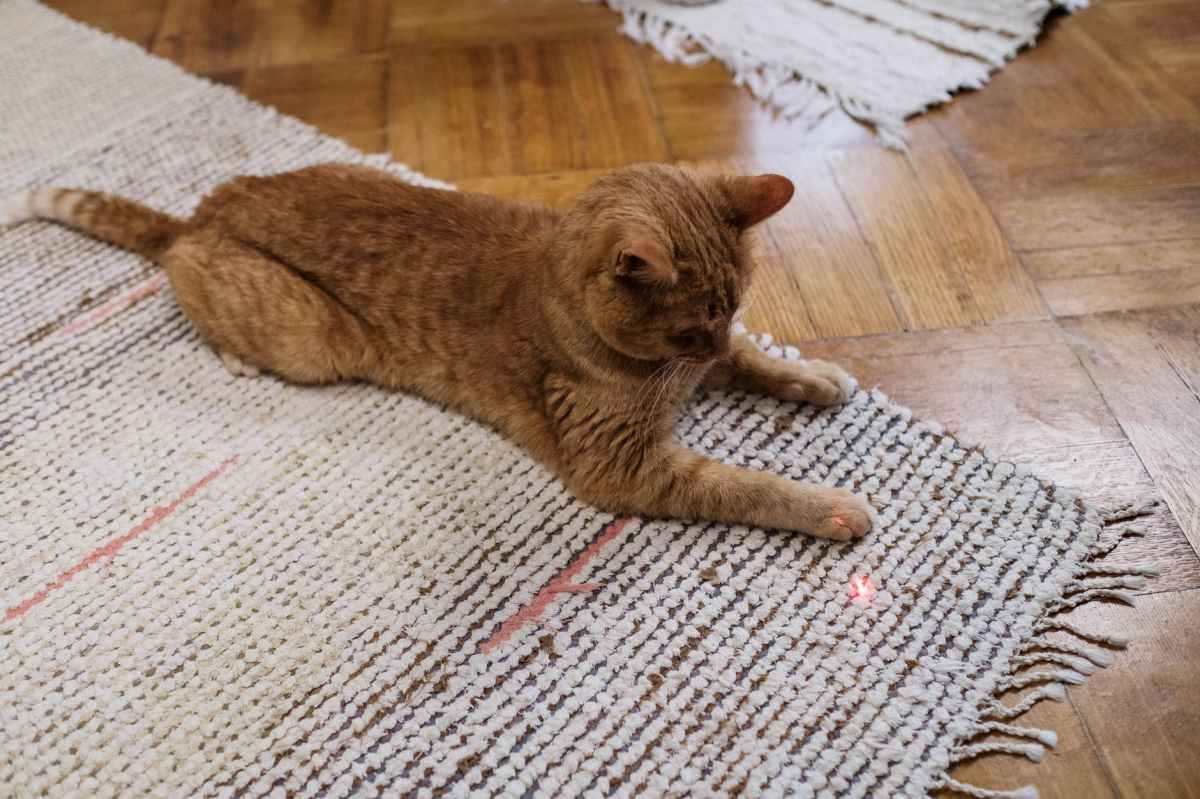
In fact, he loves it a little too much. Every day, if I haven’t taken it out for play time, he climbs up onto the coffee table and begins pawing at the tray that contains the laser pointer and TV remotes. He finds the pointer, bats at it with his little paws, and makes mewing sounds that undoubtedly translate to: “Play time! I want! I want! Play with me now!”

I can see now why some people warn against using these things. I thought the upside was worth the potential downside, because the laser pointer gets the little dude moving like few other toys do. (And even then only when they’re new and novel.)

Bud’s single-mindedness with the laser pointer reminds me of his one-track mind when it came to Temptations, before I stopped buying those infernal things. (Blue Buffalo makes very similar-looking treats that he happily gobbles up, but instead of the corn and filler of Temptations, they’re made of chicken, turkey, salmon and so on.)

Crucially he doesn’t act like a crack addict the way he did with the Temps, when he’d park himself by the treat cabinet and meow mournfully for his next fix.

The Red Dot!
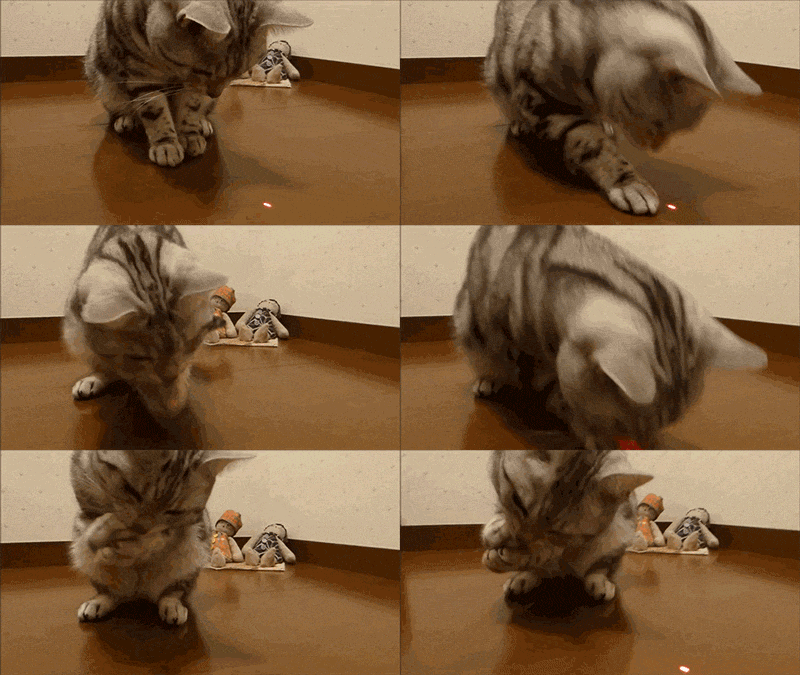
I’ve caught the red dot! I’m eating it!

So I’m wondering: What kind of experiences have you guys had with laser pointers? Have you used them? Have your cats become obsessed?

One final thought: Bud is fully aware the laser comes from the pointer, and he knows I have to press the button for the beam to work. That’s a clear example of abstract thinking. So far he hasn’t figured out a way to activate it himself, but you never know…