‘Man In A Panther Costume’ Terrorizing UK Beach Town

The costumed man has growled, hissed and meowed at passersby in the coastal area, reigniting old rumors of actual big cats prowling the area and freaking out people walking their dogs at night.

Ah, the things you can get away with in a country without guns.

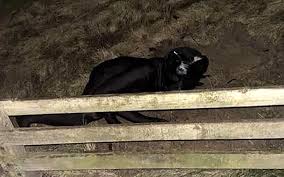
A man in an all-black outfit has been prowling Wallasey beach in Wirral, a peninsula in northwest England, according to people who live in the area.

One witness said the man was “waving his hands in the air and making panther noises,” while others said they saw him approaching cars stopped at lights on roads near the coast.

“Anyone know who the freak in the cat mask and morph suit is at the coastal park near the harvester?” another local wrote online.

One thing was clear from witness accounts, photos and several short smartphone-shot videos: the costumed man wasn’t trying to imitate a friendly house cat.

“Was walking my dog tonight and heard a man making cat noises, shone a torch he was waving his arms at me before crawling up the hill. Never been so scared,” one witness posted to Facebook, per the BBC.

Sad as it may be, the first thing that came to mind when we read the witness accounts was that this doesn’t happen in the US, simply because odds are the costumed prankster would be shot.

“So I decided to bugger off home, had the rest of last night’s takeaway, had a laugh at the Sharons and Waynes on Blind Date, then went to see if any of the lads were up for a pint. Oi, I could really go for a Chinese! Anyone else wanna go for a Chinese?”

It’s possible whoever is behind the strange sightings is making light of decades-long rumors that mysterious and elusive big cats have been prowling the UK countryside.

Similar to persistent rumors of Bigfoot in the US, the phantom cats of the UK have their own believers who argue that there’s an extant population of leopards or pumas who are exceptionally adept at staying hidden from cameras but are occasionally spotted by farmers and motorists in the British countryside.

There’s a podcast dedicated to the topic, and proponents of the idea say it could explain a handful of cases in which livestock have gone missing.

The podcast, Big Cat Conversations, even dedicated a 2021 episode to “Wirral’s liminal leopards,” with its host interviewing several people who say they’ve encountered large melanistic felids on the peninsula over the decades.

Real big cats such as the leopard above tend to leave unmistakable evidence of their presence. Image credit: Wikimedia Commons

But as big cat experts have pointed out, it’s difficult to miss the signs when such apex predators really do claim an area as home. From unmistakable pug marks, to trees scratched and scent-marked with urine, to calls that can echo for miles in right conditions, big cats have many ways of making their presence known— and it’s often advantageous for them to do so, since they’re highly territorial animals.

One man who was out walking his dog told the BBC he thinks the whole thing is a prank.

“I don’t know his name, I think it’s just a wind up. He’s definitely not out to frighten people, he does it for fun,” he said. “He just likes being a giant cat. He doesn’t frighten our dog.”

Local police say they’re aware of the sightings. Merseyside Police and Crime Commissioner Emily Spurrell told local media that anyone who feels threatened by the suited figure should call law enforcement and report his whereabouts.
UK Pol Resigns After He Was Filmed Trying To Kill Cat With Explosives

The cat survived but her personality has radically changed from loving and affectionate to distant and wary, her human said.

A councilman in a rural UK village resigned from his post and is the subject of renewed police scrutiny after allegedly trying to blow up a neighbor’s cat twice in 2023.

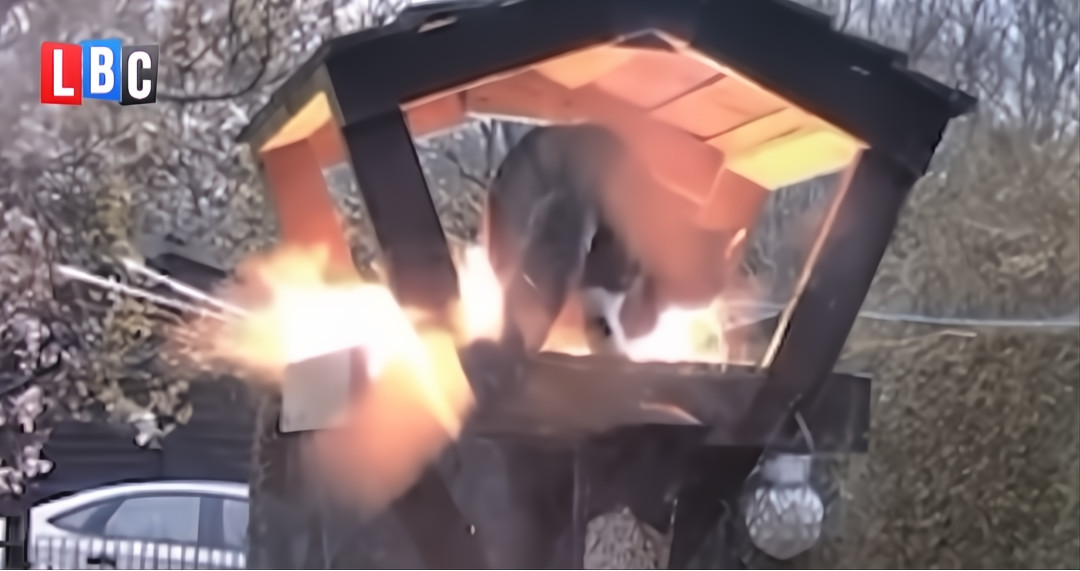
Councillor James Garnor was reportedly trying to stop the cat from climbing into a bird feeder, and decided the best way to do it was to rig the feeder with explosives and lure the curious feline in, according to a report on UK broadcaster LBC’s website.

Garnor was apparently so amused by his handiwork that he distributed video of the incidents to his friends. The footage shows a cat named Suki leaping onto the bird feeder on April 9, 2023, and nibbling on some of the bird feed before the explosive detonated. An injured Suki took off immediately and ran home.

She “came home one day missing her whiskers on her face – they looked like they’d been dissolved – so I put a post in my local community page on Facebook… just to warn people in case there was something she’d rolled in that had dissolved them,” said Suki’s human, a woman named Nikki.

Suki’s whiskers were singed off by the heat from the explosion. Image credit: Provided by owner to LBC News

“But somebody contacted me to tell me it wasn’t what I thought it was, that somebody had actually blown my cat up – and that it was my neighbour and local councillor. It made me feel physically sick.”

After she received the video, Nikki filed a complaint with local police, who elected not to arrest Garnor. However, after a second video surfaced with a clearer view of Garnor’s alleged actions, police responded to the public outcry and said they were reviewing the case again.

Per LBC, which broke the story:

“The incident is one of at least two occasions that cats in Whittlebury, Northamptonshire, were allegedly targeted by Councillor James Garnor in 2023 using remote-detonated explosives.”

It’s not clear if the new video shows a second attempt, or a different angle on the first. Garnor “was dealt with using anti-social behavior legislation,” a type of civil admonishment usually associated with things like noise complaints, littering and damaging public property, not trying to kill an animal.

Still images from a video showing Garnor allegedly setting off an explosion targeting Suki the cat. Credit: Photos provided by owner to LBC

Garnor resigned from his post on Feb. 7, and the council distanced itself from him, saying its members “understand the concerns raised by the community and want to assure everyone that we take all matters of animal welfare seriously.”

That hasn’t mollified people living in the small community, who are wondering why police didn’t press charges the first time they were presented with evidence of the attempt on Suki’s life. 

“You can clearly see the videos have been slowed down [and] edited. It’s very set-up: the animal has been enticed on the bird table with food whilst said individual was sitting there with the detonator waiting for [the cat] to appear,” a neighbor told LBC. “He is a member of our parish council, so it makes you worry what decisions are being made there by the individual… he has offered no apology [and] shown no remorse.”

In the meantime, Suki has been permanently impacted by the incidents. The tabby was affectionate and friendly, Nikki said, wrapping her little body “like a scarf around your neck.”

“Now she very rarely comes near you, and if she does, she’s got her claws out – she hisses, she growls,” Nikki added. “She’s not the loving cat she used to be – and I don’t blame her… the change in her happened pretty much overnight.”

The First Edition Of Webster’s Dictionary From 1828 Says Cats Are ‘Deceitful’ And ‘Extremely Spiteful’

What would the Dictionary Man think of a modern American society dominated by the power and cuteness of cats?

Cats have taken over the internet, claim a mighty share of the $64 billion Americans spent on pet food in 2023, and have essentially installed themselves as the leisurely masters of 28 percent of American homes.

But it wasn’t always that way, and a look at the first-ever edition of Webster’s Dictionary reveals a very different attitude toward our furry overlords:

“The domestic cat needs no description. It is a deceitful animal, and when enraged, extremely spiteful. It is kept in houses, chiefly for the purpose of catching rats and mice.”

Wow. Whoever does feline PR should get a raise, because we’ve gone from “We tolerate the imperious little bastards because they’re good at killing rodents” to “Does my little angel want a snack? How about some ‘nip then? Anything for my bestest little pal!” in the span of two centuries.

Buddy to Noah Webster: Bow!
Buddy 1, Noah Webster 0. Naturally.

Noah Webster, whose name is now synonymous with dictionaries, saw the effort to standardize spelling and pronunciation as central to formalizing an American linguistic identity distinct from our mother country. Or, as he put it, “[t]o diffuse an uniformity and purity of language in America” that would not only differentiate our English from England’s, but also unify the states at a time when many people still viewed the idea of a united states with skepticism.

By doing so, he hoped America would avoid the pitfall of dividing itself into regions of nearly mutually unintelligible dialects, a problem that plagues other countries. Consider the fact that India has almost 800 distinct languages and dialects, down from a staggering 1,652 in 1961 as hundreds of local languages died with the last generations of their speakers. Hindu, the country’s most popular language, is spoken only by about 43 percent of the population.

The goal, Webster wrote when he published his dictionary’s first edition, was “to furnish a standard of our vernacular tongue, which we shall not be ashamed to bequeath to three hundred millions of people, who are destined to occupy, and I hope, to adorn the vast territory within our jurisdiction.”

As dictionary.com notes, Webster wrote that passage in 1828 when the US population was just 13 million and vast swaths of what we now consider familiar territory was at the time largely unexplored wilderness.

His prediction of an America of 300 million people came true in 2006. Today there are approximately 335 million of us.

In other words, a hell of a lot has changed since the Connecticut born-and-raised Webster cobbled together a uniquely American system of spelling and pronunciation, so maybe it shouldn’t be a surprise that attitudes toward cats have shifted so dramatically.

Still, we’d love to see the look on Webster’s face if we could bring him forward in time and show him how the “deceitful” and “extremely spiteful” little furballs have come to such prominence in American culture. What would Webster make of the spoiled modern house cat, with her condos, tunnels, toys, harnesses, bowls filled with salmon and duck, and even psychoactive recreational drugs for their enjoyment?

Bow before your feline overlords, Webster!

Editor Cat Says
“We have made some edits, humans. See to it that the next edition includes this new and improved definition, or we shall withhold snuggles.”

UK Couple Narrowly Avoid Striking ‘Big Cat’ In Road, Cali Cat Cafe Holds Festivus Fundraiser

For decades witnesses have claimed they’ve seen big cats prowling the English countryside.

A UK couple say they narrowly avoided hitting a big cat that bolted in front of their car Wednesday morning.

Chris and Marion said they were driving on the A303 in Hampshire, a rural road in southern England surrounded by farmland, fields and wooded stretches, at 7 a.m. when the felid leapt across the road and ran into a nearby field, possibly giving chase to prey. While others suggested it could have been a lynx — which went extinct in the UK more than 1,000 years ago — the witnesses ruled out the possibility, saying the cat was “twice the size of a fox” with a tail that was “thick and solid.”

When they made a Facebook post about the encounter, several others claimed they’ve seen a similar-looking “big cat” moving through Hampshire’s fields. There are several groups dedicated to alleged big cat sightings in the UK on Facebook.

It’s the latest in a surprisingly persistent legend of phantom big cats prowling the British countryside. There are no extant big cats in the UK or in Europe. They exist only on other continents: Lions and leopards in Africa, tigers and leopards in Asia, and jaguars in South America. Among felids that are not true big cats but are often grouped with them, pumas exist only in the Americas and cheetahs are exclusively found in Africa.

Despite that, hundreds of witnesses report seeing feliform animals much larger than well-fed ferals or small wildcats. A similar phenomenon exists in Australia, where for years people have insisted they’ve seen big cats slinking through the bush.

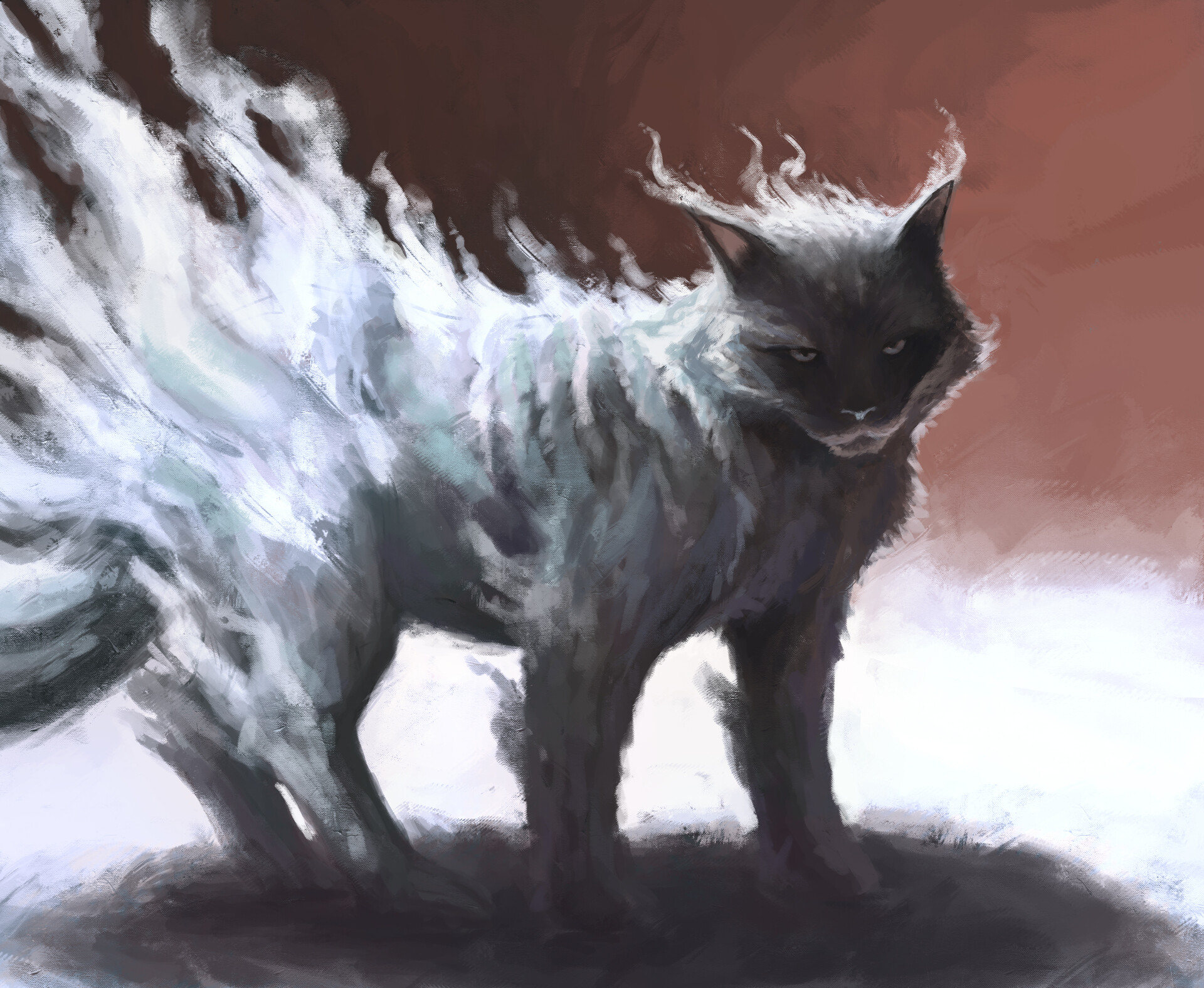
Ghost Cat
“Ghost Cat” illustration by Ken Jovi Credit: Ken Jovi/Artstation

While it’s possible that people in the British countryside or Australian bush are illegally keeping large felids, and it’s possible that a handful could have escaped over the decades, that’s an unlikely explanation for the sightings for several reasons. While big cats are apex predators, animals who have lived in captivity all their lives and have been given food will not know where to go or how to hunt. In places like Texas, where as many as 5,000 tigers live in backyard enclosures, escaped cats are quickly spotted wandering human neighborhoods, confused and looking for food.

If an escaped tiger or leopard was somehow able to rapidly adjust to the English countryside and fend for itself without being spotted, there would be evidence — pug marks, droppings, claw marks denoting territorial boundaries on trees, the carcasses of prey animals, burglarized pens, farm animals missing and terrorized.

That goes double if, as some suggest, there is a breeding population of panthera genus cats. Even a handful of such animals would consume thousands of pounds of meat each week.

Still, as Wednesday’s alleged sighting proves, rumors of large cats stalking the mists of the English countryside are unlikely to die out any time soon.

A Festivus for the Rest of Us…And Our Cats

Festivus is the celebration that keeps on giving.

The operators of Tail Town Cats, a cat cafe in Pasadena, California, are hosting a Festivus get-together that will double as a showcase for adoptable kitties and a way to help support adoption efforts.

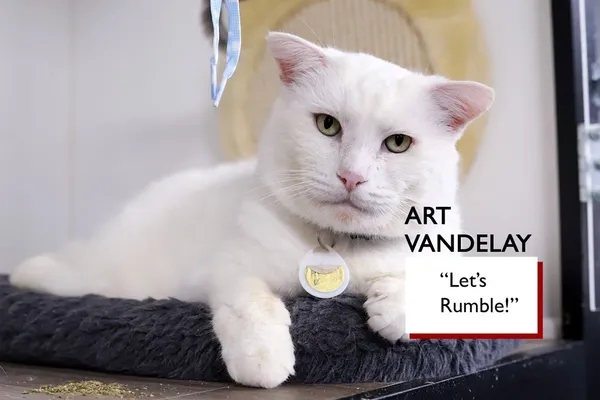
Hosted by a cat named Art Vandelay — who found his forever home through the cafe — the celebration will include a traditional Festivus pole, the Airing of Grievances and Feats of Strength. (Among the grievances listed in advance are general disappointment with the frequency of treats, displeasure at sharing litter boxes, and humans who recycle cardboard boxes instead of giving them to the felines.)

People in the Los Angeles area can attend in person, while others can watch online.

Art Vandelay
Art Vandelay found his forever home through the cat cafe and will return to host its first-ever Festivus celebration.

Seinfeld fans will recognize Art Vandelay as George Costanza’s most frequently-used alias. Vandelay is alternately described as an importer-exporter or as an architect. As George famously said: “I’ve always wanted to pretend to be an architect.”

As for Festivus, it’s taken on a life of its own 25 years after it was popularized on Seinfeld.

The made-up holiday had its humble origins in the home of writer Daniel O’Keefe, who introduced it to the nation — and immortalized it in the process — by writing it into “The Strike,” a 1997 episode of the sitcom. At the time, Seinfeld was a ratings juggernaut, averaging more than 30 million viewers an episode. Festivus is celebrated annually on Dec. 23.

Buddy Joins World In Mourning His Friend Queen Elizabeth II

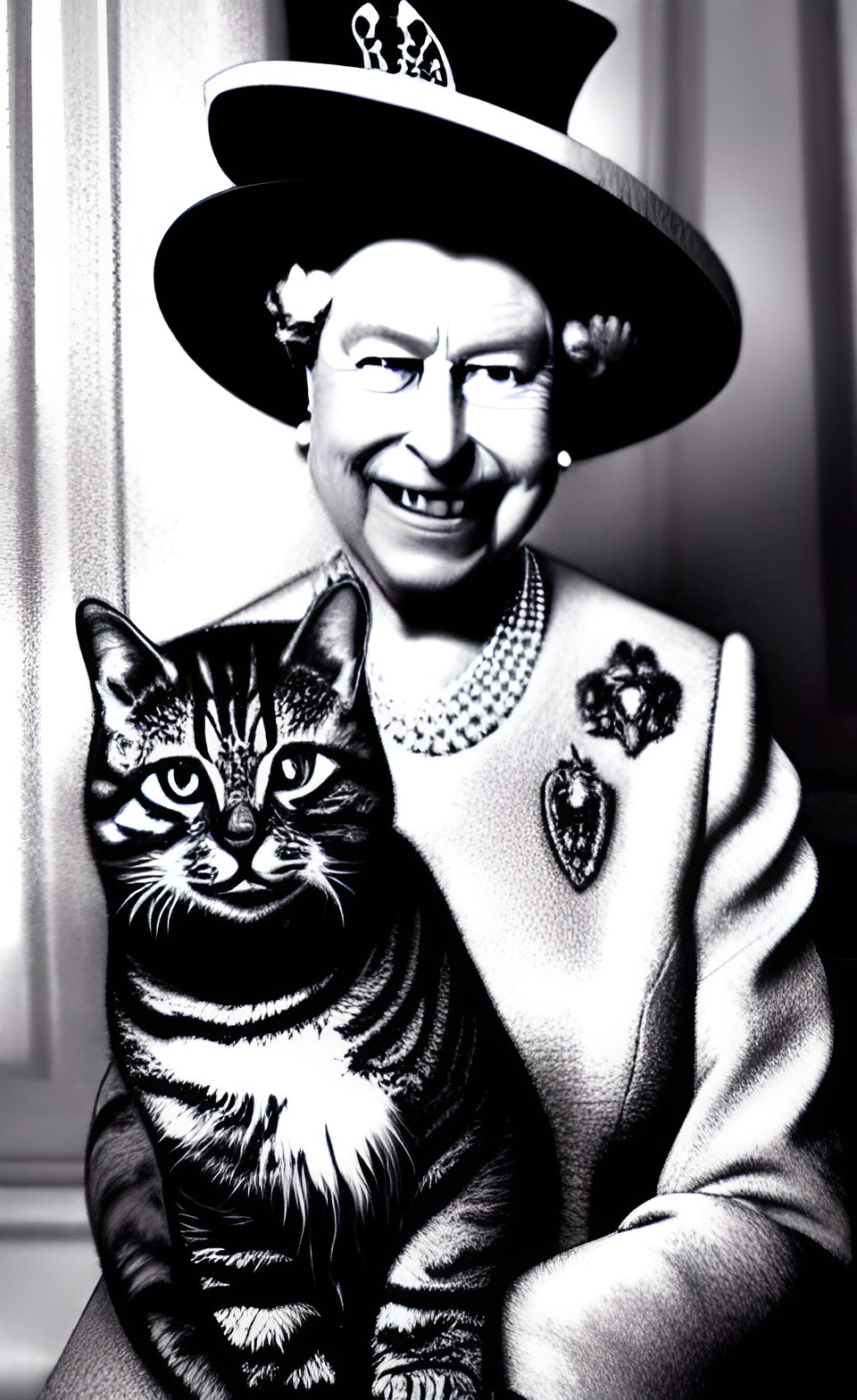
Lord Buddy and Queen Elizabeth II were great friends.

Buddy the Cat joined the world on Thursday in expressing sadness at the passing of his dear friend, Queen Elizabeth II.

The dashing feline and the beloved monarch struck up a friendship during the latter years of her reign and saw their bond strengthen during trying times, including the COVID-19 pandemic, the Great Turkey Shortage of 2021 and the death of the queen’s long time consort, Prince Phillip, Duke of Edinburgh.

Although surrounded by friends and family, the queen became fond of Buddy for his unwavering support, his sense of humor and their shared love of turkey.

“The queen advised Buddy to keep a stiff upper lip during the Great Turkey Shortage of 2021, and Buddy was able to return the favor by being there for Her Majesty during the passing of Prince Phillip,” said royal observer Samantha Martin Bainbridge, the author of Flummery Tarts and Framboises St George: The Royal Family’s Favorite Desserts.

The queen took to referring to her favorite feline as “my dearest Bud-Bud,” though in keeping with tradition and ever the gentlecat, Buddy always referred to the queen as “Your Meowjesty.”

Dream_TradingCard(33)

Their unusual friendship made headlines in the British press, especially since feline companionship was unusual for a monarch known for her love of Corgis.

“The Queen loved her Corgis until the very end, but dogs are so very extra when it comes to expressing their love,” said Gideon Brackenthwaite, a royal observer and author of Henry VIII: The Kingly Pimp Hand. “Felines, like the British aristocracy, are much more reserved with their affection and shun garish displays of familiarity. For his part, the future Earl never name-dropped her Majesty or bragged about his friendship with her, a fact that the Crown deeply appreciated. You’d never find his future lordship’s name in the tabloids, heavens forbid.”

buddyportrait_saturated2
Lord Buddy, Earl of Budderset. Credit: Buckingham Palace

Indeed, Queen Elizabeth II took the unprecedented step of knighting Buddy the Cat in 2021, naming him Sir Buddy, KBE of Buddington at that year’s investiture ceremony.

It was the first time the Crown had bestowed an honor on a feline since Able Seaman Simon, a ship’s cat on the HMS Amethyst who survived injuries he suffered during the Yangzte Incident of 1949.

Sir Buddy’s elevation was a poignant moment, and cameras captured Kate, Dutchess of Cambridge, dabbing gently at tears with her handkerchief as Buddy kneeled for his knighting.

Only a few short months later, Sir Buddy was elevated to Lord Buddy, Earl of Budderset, a meteoric rise for anyone in royal favor, let alone a cat.

During their friendship, Lord Buddy telephoned the Queen at least once per week and holidayed with her at Balmoral Castle in Scotland.

In a charming anecdote relayed by Prince William, the Queen and Earl Buddy shared a bowl of popcorn while watching Braveheart and laughing uproariously at the Australian Mel Gibson’s Scottish accent. The friends also enjoyed playing bridge.

“Like the rest of the world, I am deeply saddened by the passing of my dear friend and beloved Queen, Elizabeth. I’ll treasure the memories of our adventures together, especially the time we had a little too much to drink and woke the kitchen staff at 3 am to make us an epic turkey feast,” Lord Buddy wrote in a statement. “There will never be another monarch like Her Majesty, so beloved across the world with such an enduring and fruitful reign. All of us at Budderset House are in mourning, and feel for our friends at Buckingham Palace.”

Buckingham Buddy

The earl was photographed on Friday in his Rolls Royce, eating a large meal of roasted turkey en route to London. At one point the Earl’s Rolls pulled even with the same model occupied by Princess Anne. The two exchanged pleasantries, and Lord Buddy was seen passing a bottle of Grey Poupon to the grieving royal between cars before the light turned green again.

“Such a simple gesture says volumes about His Lordship’s standing with the royal family,” said Edith Hershey, author of Direct From The Sauce: From Bechamel to Velouté, The Royal Family’s Most Beloved Condiments. “The Princess Royal would not accept Grey Poupon from just anyone. By passing the mustard, the earl was conveying his condolences and signaling his availability as a shoulder to cry on.”