PITB Reviews: The Platform

The horror-drama from Netflix is more interested in untangling uncomfortable questions from the abstract than it is in providing answers. And that’s just fine.

Movie: The Platform (2020)
Director: Galder Gaztelu-Urrutia
Genre: Horror, social commentary
Medium: Netflix

The premise of The Platform is simple: A man wakes up in a concrete prison cell. The center of the cell is dominated by rectangular gaps in the floor and ceiling, and when our protagonist warily steps closer he can see levels of identical cells above and below him. The cells extend as far as the eye can see in both directions, each populated by two prisoners.

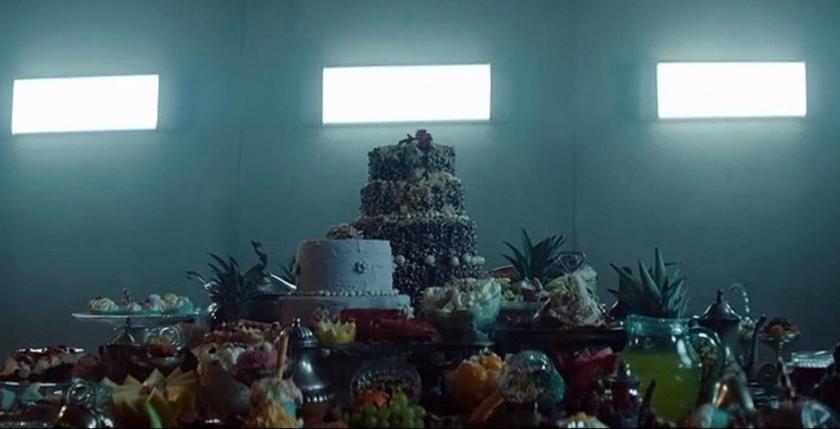
Every day, a platform is lowered level-by-level, laden with a massive feast: Meats, wine, cheese, bread, cake, soup, pie, fish, escargot, paella, salads, grapes, apples and other fresh fruit, vegetables, juice. Every kind of food you can imagine, cooked and prepared to perfection by professional chefs.

Goreng, our protagonist, is greeted by his cell mate, a kindly old man named Trimagasi who sits down next to the edge of the hole in the floor in anticipation of the platform’s arrival. When it descends to their level he pigs out, shoveling as much food as he can into his mouth before a buzzer sounds and the platform descends another level.

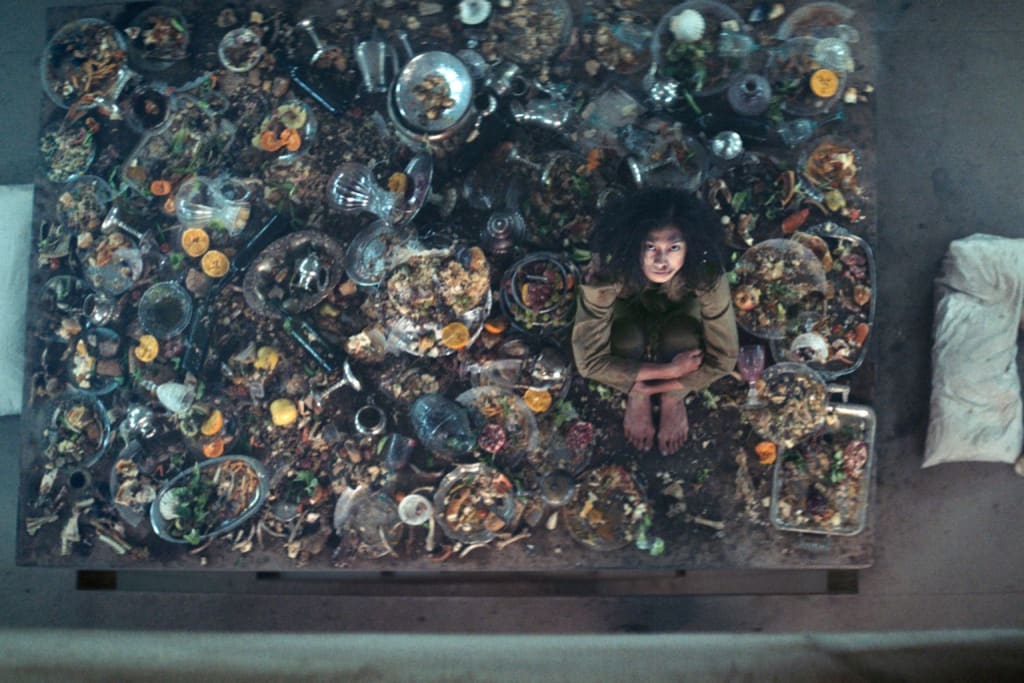
Goreng looks on, digusted: The food is scattered all over the platform, much of it half-eaten. Clearly, these are someone’s disgusting leftovers.

The Platform
Trimagasi, top, pigs out while Goreng picks at food scraps.

Trimagasi urges Goreng to eat, and explains that they are very fortunate indeed: At level 48 there’s still enough food leftover from the prisoners on the 47 levels above that they won’t starve this month. At the end of every month, he says, each pair of cellmates are put to sleep with gas and wake up on a new level that is chosen at random by the people operating the cruel social experiment.

Trimagasi tells Goreng he once spent a month on level 132, where not a scrap of food is left by the time the platform descends. Goreng asks the old man how he survived, and Trimagasi demures.

We also learn that Goreng voluntarily entered in exchange for a real-world opportunity promised to him after he spends six months inside. Trimagasi was sent there as punishment: Infuriated by a TV commercial for a self-sharpening knife called the Samurai Plus after he’d just purchased a knife sharpening kit, Trimagasi threw his TV out of his window and unintentionally killed an illegal immigrant who was riding a bicycle below. He’s approaching the end of his two-year sentence in what the authorities call the VSC, short for Vertical Self-management Center.

Each prisoner is allowed to take one item with them inside: Goreng takes a copy of The Ingenious Gentleman Don Quixote of La Mancha, harboring romantic notions of finally reading the book with his time in the prison. Trimagasi, who loves to use the word “obviously,” told Goreng his choice of item was obvious: His prized Samurai Plus, which he cradles lovingly as he boasts about how it can cut concrete without dulling.

Goreng puts two and two together, realizing how Trimagasi survived on level 132.

The Platform
Going down: Just a portion of the feast as it exists on the platform before it’s consumed, defiled and excreted, level by level.

The Platform is a blunt allegory for human civilization, specifically the enormous wealth disparities of modern societies. The occupants of level 1 are the Jeff Bezoses and Walton families of the world, people with unimaginable, multigenerational wealth pigging out on life’s resources without thinking of the starving street children of India, the homeless of cities like New York and San Francisco, the families in North Korea eating tree bark.

Some reviewers think it’s a critique of capitalism, but I think it’s more universal than that: The kleptocrats of countries like Mexico, Russia and Brazil, the monarchies and emirates of the Middle East, and the party bigwigs of communist countries like China pig out on their own respective first levels while the people 130 “levels” down starve just the same.

The rest of us? We’re in the 30s, 40s and 50s, happily scarfing down the scraps from above, the ad revenue the Zuckerbergs and Pichais allow us by their forbearance, the slightly comfortable salaries allowed by corporate shareholders, the house and garage we might enjoy if we’re fortunate enough to run a successful small business in an industry that hasn’t been pillaged by the multinationals yet.

Some people might find the movie heavy-handed, but I don’t see it that way. As uncomfortable as it is to watch at times, reality is much, much worse. The fact that some of the movie’s scenes are difficult to watch is testament to how lucky we are to be born in circumstances where that kind of suffering isn’t part of our experience, let alone our daily lives. Show The Platform to one of the handful of people to ever escape a North Korean hard labor camp, for instance, and they probably won’t even blink.

It also shows how our betters divide and conquer to keep the rest of us distracted and themselves secure. The idea that most people who receive social services are lazy bums is a popular one in some quarters, encouraging people not to have empathy for the less well off, but to loathe them. Likewise, the people occupying the higher floors of The Platform’s prison don’t feel sorry for those beneath them. In one scene, two cellmates tell a man they’ll help him ascend to their floor, then literally shit on him as he’s just within reach, cackling with delight as he falls.

I didn’t take it as a call for socialism either. The movie makes it pretty clear that neither asking people to moderate their consumption, nor trying to enforce sharing works out for the people who try those methods. Indeed when socialism has worked in real world circumstances, it’s been part of a hybrid model that still uses capitalism as its economic engine.

Mostly, The Platform exists to make people think. While Jeff Bezos goes to sleep tonight in his $50 million compound estate, dreaming of his next vanity flight to low Earth orbit or the next hypercar he’s going to buy, there’s someone shivering on a park bench with 15 cents in their pocket, stomach grumbling, knowing the people who pass them by every day don’t even see them as human.

Going To Asia? Leave Your Pets At Home, Plus: Aussie Former Soldier Pleads In Shelter Assault

Authorities in some countries are killing pets as a precaution against spreading COVID even though virologists say there’s no evidence humans can contract the virus from their pets.

The coronavirus pandemic hasn’t been kind to pets, but the virus itself has done little damage to animals compared to the actions of scared and misinformed people.

After finally admitting it had a human-to-human transmissible virus on its hands — months after it knew privately about the virus outbreak — the Chinese government waged a war on pets in the first few weeks of 2020 as the world watched in horror.

People abandoned pets en masse in empty homes and apartments, while government authorities shot dogs and cats on sight to prevent the spread of the virus even though there was no evidence they could be infected, much less pass the virus to people. As paranoia and misinformation spread, people even resorted to clubbing pets to death on the streets.

Now we know cats can get the virus, but there’s still no evidence they can transmit it to humans, which makes the practice of killing COVID-infected pets even more infuriating in addition to pointless.

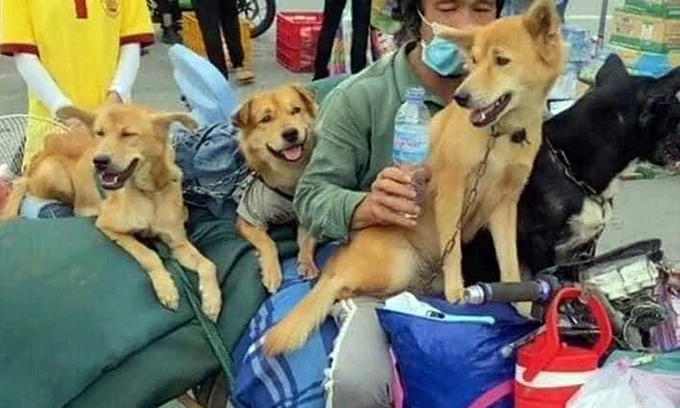
The latest incident is from Vietnam, where authorities killed 15 dogs and a cat belonging to a local bricklayer who returned to his home province after work dried up. Authorities seized his pets and “destroyed them” last week in what a government official is now calling a mistake prompted by “COVID prevention pressure and local coercion.”

danchoonghung83871633869679-16-5401-4445-1633923236_680x408
Pham Minh Hung, 49, with his dogs as he returned home to Ca Mau, Vietnam. Credit: Pham Minh Hung

That story follows an incident in the Chinese city of Harbin, where three cats were euthanized in late September — over the owner’s objections — by authorities who said they were worried the pets would “re-infect” their owners.

Pet ownership and respect for animals among the public has increased in countries like China and Vietnam in recent years, prompted by an increase in disposable income and the influence of the internet. Both cases caused widespread backlash in their respective countries, with users defying laws prohibiting criticism of government to complain about the pet killings.

“It doesn’t seem very realistic that the cats would contaminate the environment so badly that they would be a risk for their owner to re-contract COVID,” Rachael Tarlinton, a virology professor at the UK’s University of Nottingham, told Reuters.

He REALLY Wanted His Cat Back

Meanwhile in Australia, a former soldier has pleaded guilty to reduced charges after he “stormed” a pet shelter in Melbourne’s suburbs to recover his cat in January.

Prosecutors say 45-year-old Tony Wittman was outfitted with a fake but real-looking rifle and full military gear when he went to the Lost Dog’s Home in Cranbourne West late on a January night, holding a female employee at gunpoint while demanding to know where the cats were kept.

Wittman had called the shelter 10 minutes before it closed earlier that night, Australian media reported at the time, and was told the shelter had recovered his cat, but that he’d have to wait until morning to claim her.

Wittman, who threatened to shoot the employee if she didn’t comply with his demands, told the court he suffers from PTSD and felt he needed to retrieve the lost feline immediately because he “loves his cat and relies on his cat for support.”

Wittman got spooked and left the shelter before taking his cat. He dumped his tactical vest and other gear in bushes not far from the shelter.

The incident was captured on the shelter’s security cameras, and Wittman was caught when he dropped by the following morning to pick up his cat as if nothing had happened.

“The victim and her work colleagues are absolutely traumatised by what’s happened,” a detective told the court in an earlier hearing. “He’s aware of their workplace. He lives close by. He has shown a complete disregard for the safety and wellbeing of the general public.”

Wittman’s lawyers were able to negotiate a deal with prosecutors in exchange for a guilty plea to lesser charges

Finally, The US Is Poised To Outlaw Big Cat ‘Ownership’

Tell your senators to vote for the Big Cat Public Safety Act, which will ban the private ownership of big cats as well as cheetahs and cougars.

Even though Tiger King, the tawdry Netflix documentary about a redneck and his “zoo” full of tigers, focused more on the eccentric people involved than the plight of the big cats in their “care,” it got people talking about the problem of captive tigers in the US.

In 2020, congress passed a rare bipartisan bill to ban all big cat ownership in the US. The bill stalled when the senate failed to vote on it before the end of the legislative session, but now it’s back — and the recent saga of a confused tiger wandering around Houston may finally provide the nudge for politicians to pass the badly-needed bill.

jaguarwiki
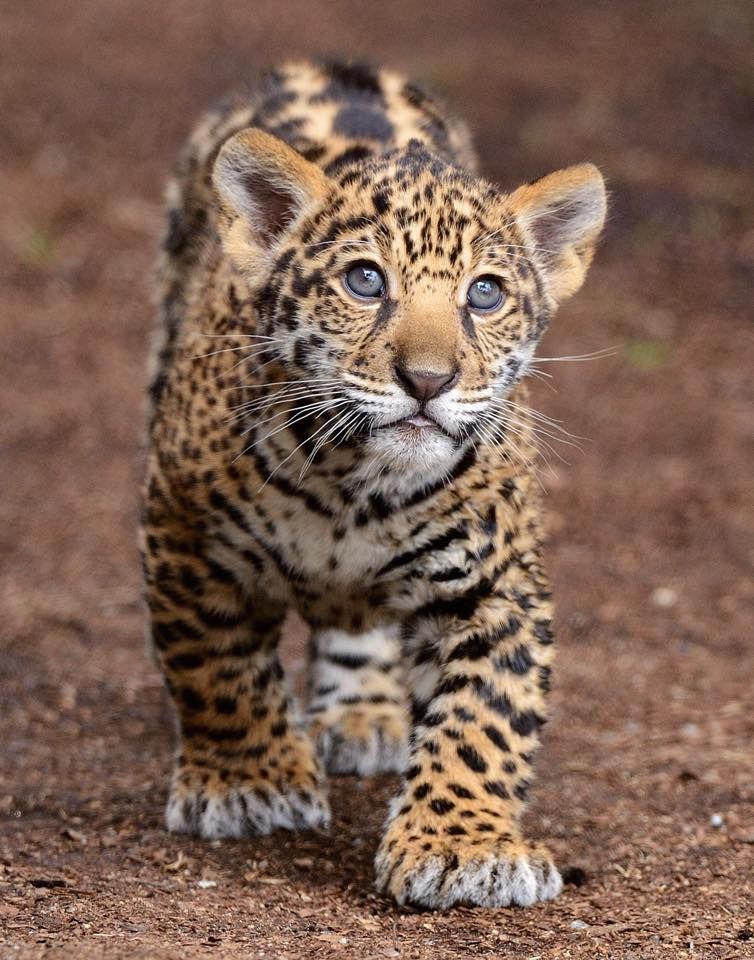
After almost exterminating tigers, Chinese poachers have turned to South America, where they’re poaching jaguars at unprecedented rates to feed demand for big cat parts in the traditional Chinese medicine market. Jaguar poaching has increased 200-fold in the past five years to fuel Chinese demand for their body parts.

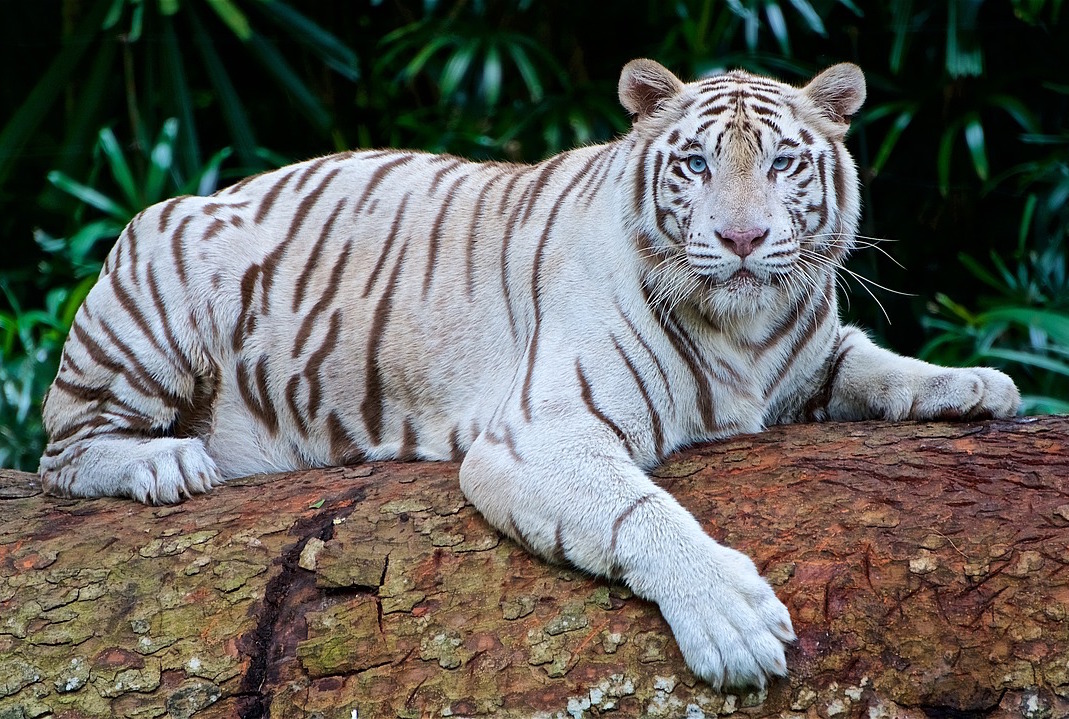
There are more tigers living in Texas and Florida backyards than there are in the wild, an ignominious fact that says volumes about humanity’s indifference to the plight of the Earth’s most powerful and iconic predators. Devastated by habitat destruction and poaching to feed the bottomless Chinese appetite for tiger parts used in traditional Chinese “medicine,” the worldwide wild tiger population is about 3,900, according to the World Wildlife Fund.

By contrast, there’s an estimated 7,000 tigers kept as “pets” in the US, with as many as 5,000 of them in Texas.

The Big Cat Public Safety Act would ban the private ownership of tigers, lions, jaguars, leopards, cougars and cheetahs. It would also outlaw the practice of taking tiger cubs from their mothers so guests can hold them and take selfies with them, which has become an increasingly-popular and controversial feature of “roadside zoos” — unregulated, poorly run, unaccredited facilities — in the US.

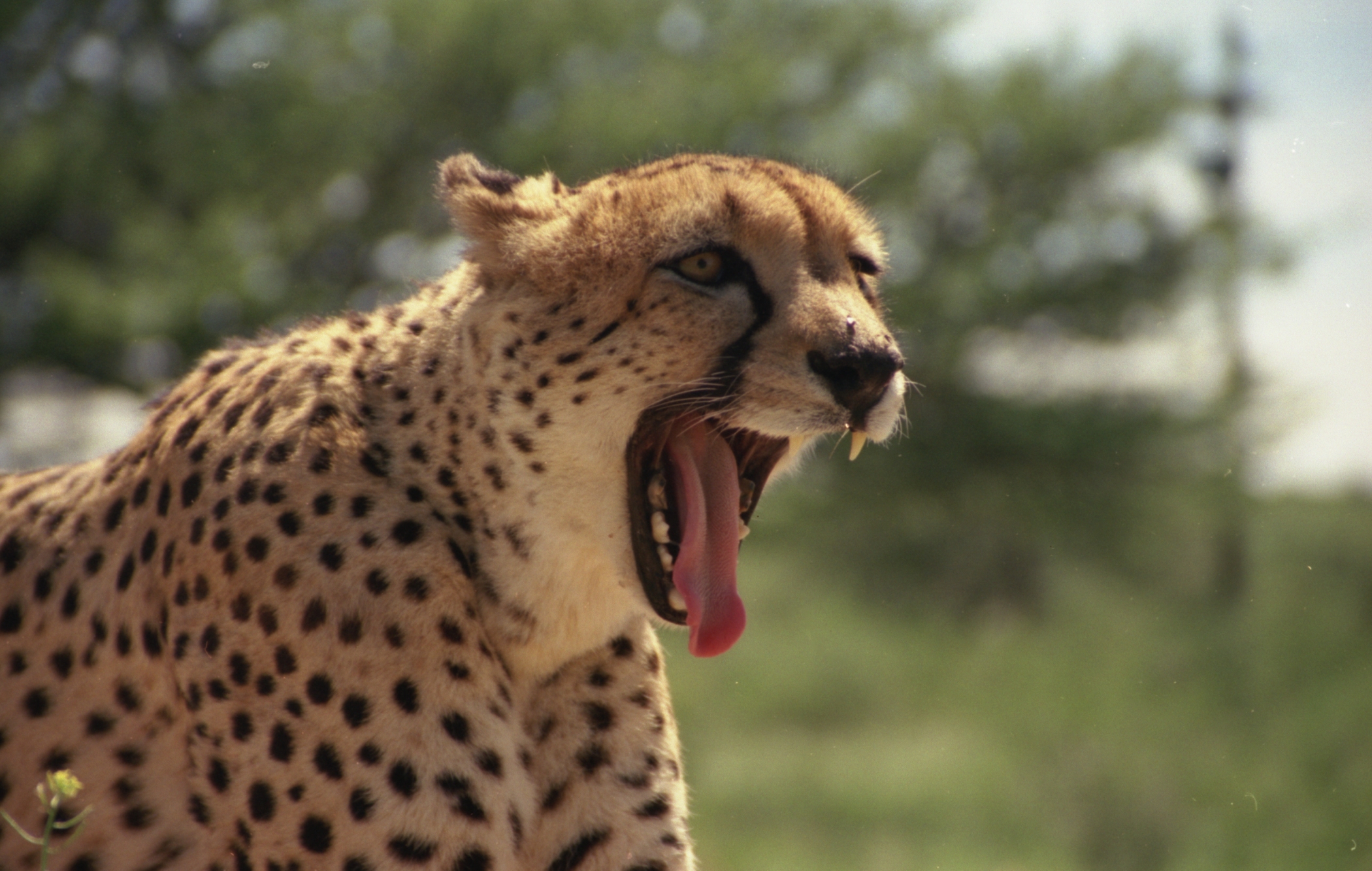
cheetahwikicommons
Cheetahs, already critically endangered due to habitat loss, are on the verge of extinction as they’ve become the exotic pet of choice among the wealthy of the UAE and Russia.

The Houston tiger, named India, is one of those unfortunate cubs. While the public freaked out and Houston residents huddled in their homes, hoping to record footage of the wandering tiger, an important fact was often left out of media reports: India is only eight months old. He’s essentially a baby, albeit a 175-pound one, and he had no idea what was happening to him, where he was, how to feed himself, or how to escape the endless sprawl of urban and suburban Texas.

Despite the fact that he was a confused-yet-playful cub, India could have easily been shot by authorities. Thankfully he survived his ordeal, and while his “owner,” Victor Cuevas, is sitting in jail on $300,000 bond, India has been relocated to a sanctuary in northern Texas, where he’ll be looked after and will get to live in the company of other tigers.

In the meantime, we all have an opportunity to lobby our respective senators and demand that they vote for the Big Cat Public Safety Act. You can fire off a letter to your senators and congressional representative in less than two minutes using the Animal Welfare Institute’s site — just punch in your address and the site will draft automated letters to all three, with fields to sign your name and to personalize the letters.

Tell them you support the Big Cat Public Safety Act, and you’ll take their vote into consideration the next time you head to the ballot box.

All images credit Wikimedia Commons.

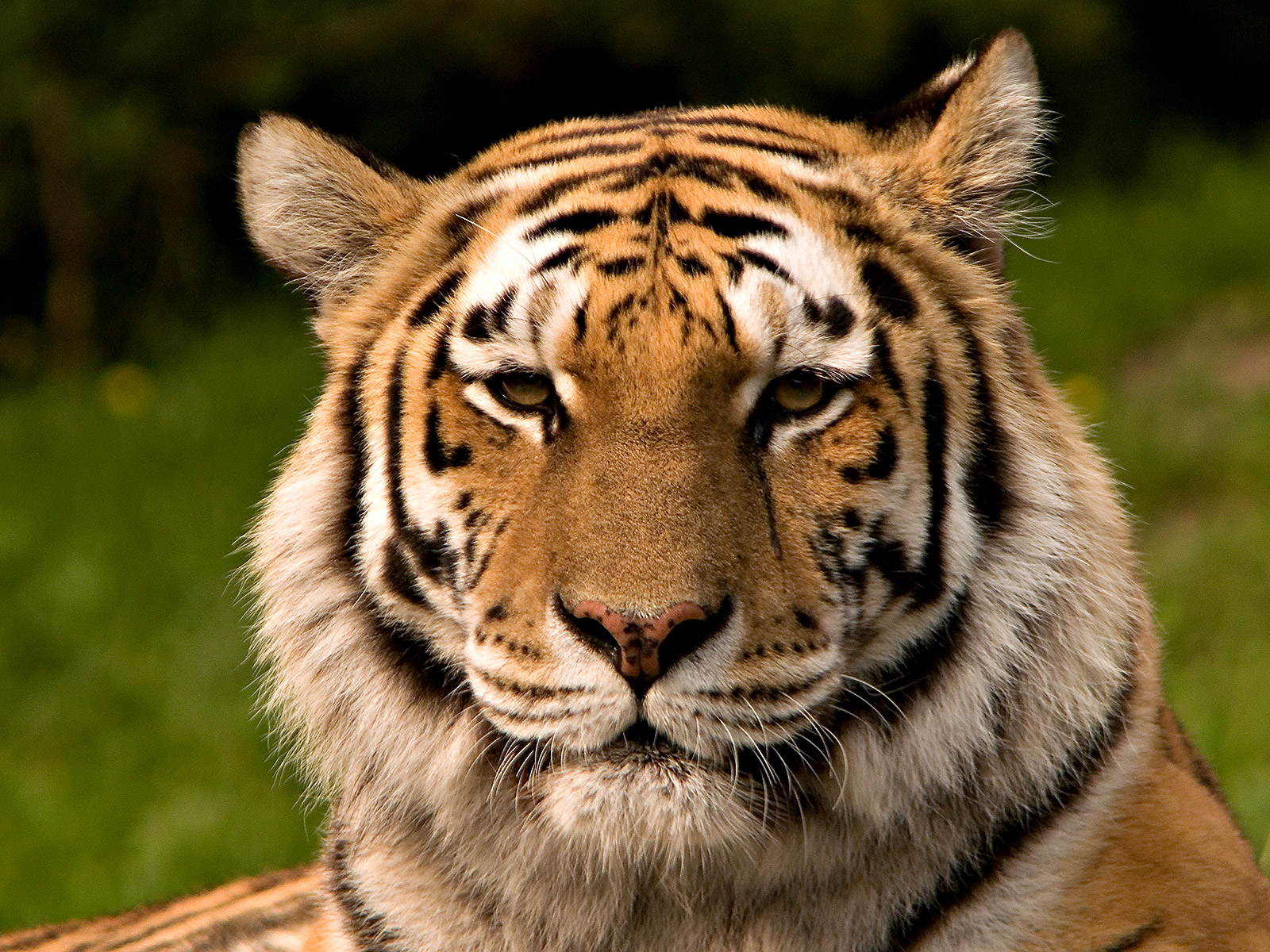
tigerwikicommons
In the wild, tigers range more than 50 miles a day. Backyards, no matter how large, are not suitable environments for them.


Twitter Censors President Buddy As Votes Are Tallied

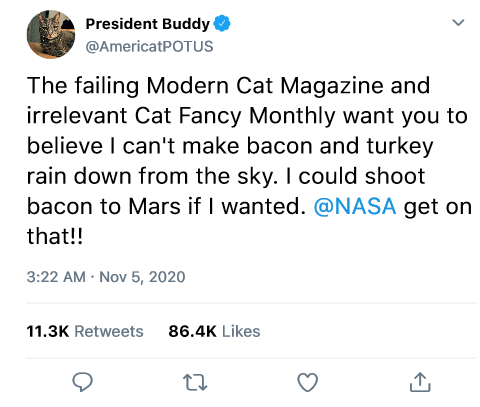
“Vote 4 me and all your wildest dreams will come true!!” Buddy tweeted. “Turkey and bacon will rain down from the heavens! Great rivers of catnip will flow through the streets!”

Twitter generated another round of controversy Wednesday after censoring meows by President Buddy, claiming they were misleading or inaccurate.

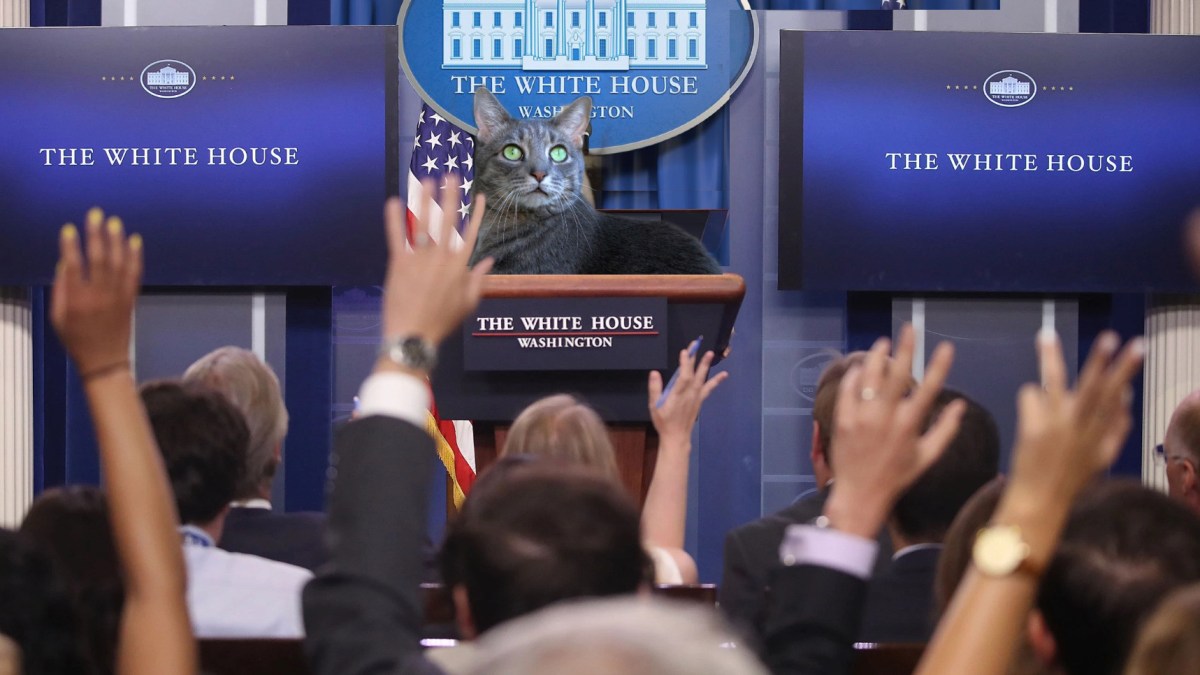
It was the fourth time in less than a week that the social media giant censored or amended warnings to the president of the Americats’ messages. The first was President Buddy’s election day tweet to his followers:

“Vote 4 me and all your wildest dreams will come true!!” Buddy tweeted. “Turkey and bacon will rain down from the heavens! The panda demic will last forever, ensuring your humans are always home to do your bidding! Chihuahuas will be deported back to Chihuahua! Great rivers of catnip will flow through the streets!”

The tweet was up for more than 20 minutes before Twitter amended it with a warning to users: “Our community guidelines team have decided this tweet violates our terms of service. No politician can make turkey or bacon rain down from the sky.”

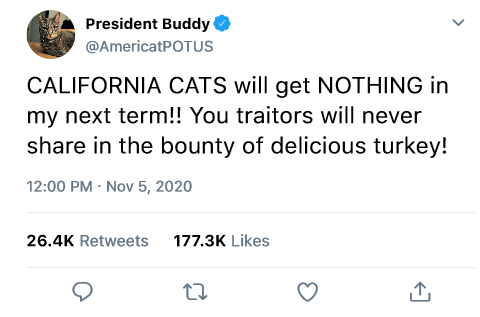
buddytweet

A second tweet was semi-censored late on election night, with Twitter’s team deactivating retweets on the post.

“Well, that looks about wrapped up!!!” Buddy tweeted to his 56.3 million followers. “Tremendous victory! Stand by for turkey — oven roasted, sliced and fried — to rain down from the heavens, my friends, amid clouds ushering in the sweet smell of bacon as crispy bits of it form a deluge over patriotic American skies. (The counties that voted for me.) I’ll sleep well knowing I have four more years! ‘MERICATS!”

buddytweet2

By Wednesday morning, President Buddy’s posts had changed in tone as vote tallies indicated tighter contests in North Carolina, Arizona and Georgia. Exit polls indicated the president did well with desert cats in Arizona, who said poultry and bacon were two of the most important issues this election cycle.

“WHAT IS THIS BULLS–? They CHEATED. This is the work of the Siamese, folks! They’ll tell you it was the Russian Blues, but who are all these tech companies beholden to? THE SIAMESE. Americat tech companies are conspiring with the Siamese to censor me, President Buddy, and STEAL THE ELECTION! Sad!”

Less than a half hour later, Twitter tagged the post with another warning: “Our fact-checking unit has determined this tweet is wrong or misleading. There is no evidence the great and powerful Siamese, led by the awe-inspiring Chairman Xinnie the Pooh, have exerted any influence in the Americat election. Xinnie is too wise a man to trouble himself with such rubbish. May he live forever!”

joebitintweet

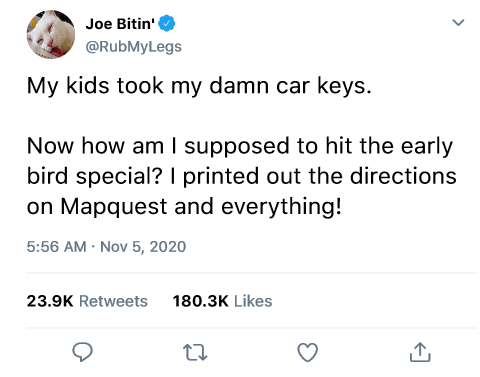
The president’s supporters cried foul, calling for anti-trust proceedings against social media giants like Twitter, Facebook and Google.

The fourth and most recent censored tweet was sent on Thursday.

“It’s been an exhausting few weeks, but we made it to the finish line!” Buddy tweeted. “Gonna go crash on my human and enjoy a nice long nap.  Nothing’s better than sleeping on my Big Buddy.”

Like earlier tweets, the Thursday post had reduced visibility, with Twitter’s engineers blocking the ability to share the tweet.

“Our office of standards and opinion moderation has determined this tweet violates our rules against advising users on sleeping habits and sleep hygiene. In addition, our fact-checkers have determined that declaring Big Buddy as the best human mattress is an opinion that cannot be verified or fact-checked by other cats. All hail Chairman Xinnie.”

Twitter CEO Peter Dinklage did not respond to requests for comment.

joebitintweet2

Dosey-Dinklage
Twitter CEO Peter Dinklage in February, left, and in a congressional hearing in October, right.

Help Your Local Strays: They’re Starving During COVID-19 Lockdown

As stray cats suffer, their plight has been mostly overlooked. Cat lovers in cities across the world are trying to keep them fed and safe during the pandemic.

Years ago I worked with a guy who started a food pantry from scratch.

This man, a retired software engineer, approached the biggest restaurants, bakeries and food distributors in the area, asking them to donate their leftover/unused food so his pantry could distribute it to the poor.

Many obliged, but they all had the same request: “Don’t tell anyone we’re participating,” they told him.

The request wasn’t prompted by humility. These businesses didn’t want the public to know how much food they waste, and they waste a lot of perfectly good food, a dirty little secret of the restaurant, hospitality and food industries.

The reason I bring this up is because there’s another demographic that depends on the food those businesses toss out: Stray cats.

Stray Cat
Credit: Wikimedia Commons

With restaurants shuttered because of the Coronavirus, stray cats are going hungry and dying for lack of the scraps they scavenge from rubbish bins, dumpsters and sidewalks. It’s happening here in New York, across the United States, and in countries like Turkey, India, Greece and Morocco.

For animals who already live difficult lives, the pandemic made things worse.

“The strays have no means of feeding themselves as all offices, restaurants [and] roadside eateries are closed,” an animal rights activist in India told the environmental news site Mongabay, in a story headlined ‘Slim pickings for strays and pets during COVID-19 lockdown.’

Cats aren’t the only animals suffering. One particularly dramatic example was caught on video in a Thai city where thousands of long-tailed macaques live and depend on food given to them by tourists.

Hundreds of starving monkeys stopped traffic in a chaotic brawl over a single piece of food, shrieking, clawing and pushing each other aside to get at it.

As if things weren’t bad enough, stray cats are now competing with former house pets for the little food available.

In India, where bad actors have been spreading false information about COVID-19, animal rights activists are finding abandoned pets — including pedigreed cats and dogs — on the streets after their caretakers abandoned them.

“A lot of this is happening because of misinformation that went viral earlier about pets being carriers of the virus in China. It turned out to be fake, of course, but a lot of damage has been done now,” People For Animals’ Vikram Kochhar told Quartz.

Much of the damage has been done on social media, where conspiracy theories and rumors about contracting COVID-19 from animals are rampant. In China, where pet owners abandoned cats and dogs en masse during the first wave of Coronavirus, some social media users on Mandarin-language platforms called for the “extermination” of cats after a pair of studies conducted by Chinese research labs suggested cats are susceptible to catching the virus.

It isn’t easy to combat waves of viral misinformation, even as health authorities across the world stress cats cannot transmit the virus to humans.

Stray Cat
Credit: Animal Bliss

In Greece, abandoned pets — many with their collars still on — are following strays to food sources, especially in larger cities like Athens.

“We are seeing an increase in the numbers of cats in areas where we feed, some appear to have been abandoned, while others have roamed far from their usual spots in search of food,” animal welfare advocate Serafina Avramidou told Barron’s.

In feline-loving Turkey, where taking care of street cats is considered a cooperative responsibility, the central government has told local officials to make sure strays are well fed and taken care of. By making it a government responsibility, their thinking goes, citizens who normally care for the cats will be much more likely to stay inside during the pandemic.

“There are lots of cats on the side streets where there are only closed businesses,” a Turkish Twitter user wrote. “I haven’t seen food anywhere for days. The cats are running after us [looking for food].”

In Istanbul, Muazzez Turan fed some 300 stray cats daily before the pandemic, but said she’s had to stay home: Not only has her country been particularly hard hit by COVID-19, but she has pre-existing medical problems that make her susceptible to complications should she contract the virus.

Still, she said, her mind “was always with the cats,” and she told Turkish news agency Anadolu that she was relieved to hear the strays hadn’t been forgotten.

“I will sleep peacefully for the first time today,” Turan said.

latonyawalker2
LaTonya Walker of Brooklyn feeds a stray in Canarsie. Credit: 24 Cats Per Second

Here in New York, some animal lovers are picking up the slack for closed restaurants as well as at-risk people who normally feed strays.

Among them is Latonya Walker, who told the New York Post she normally spends $600 a month feeding several colonies of strays but expects her costs this month will be “way more since there’s less restaurant garbage they can eat from, and more hungry cats walking around.”

“The cats have no clue what’s going on because nothing has changed for them,” Walker said. “It’s not in my DNA to see a cat suffering and not do anything about it. I’m equipped to make a cat’s life better, so I’m going to.”