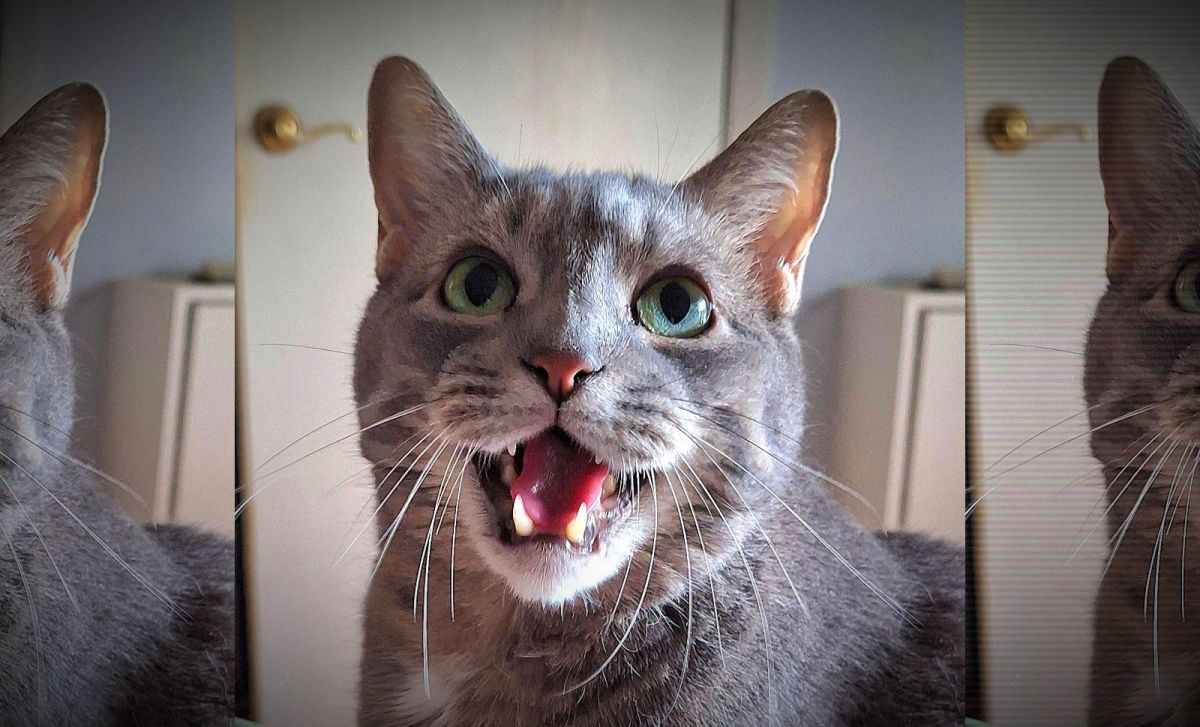
Buddy is many things, but he’s NOT quiet. His incessant chattiness can kill my sleep and my peace and quiet, but in the world of A Quiet Place, it would kill me! Would your cat get you killed in the movie franchise’s monster-stalked reality?
As a cat lover, big time science fiction fan and appreciator of the first two A Quiet Place installments, the very first thing I thought when I saw the trailer for A Quiet Place: Day One was “I hope the cat doesn’t meow!”
My second thought? Bud and I would be so, so dead.
Dead immediately. Dead a thousand times over.
Apparently I’m not the only one, because fans have taken to social media to participate in the “Quiet Place Challenge,” which involves reenacting some of the scenes from the movie with their own cats to see if their furry overlords can stay silent.
As PITB readers know, Buddy never shuts up. He’s got something to say about everything, he often narrates his activities in real time, and he’s got an entire meowing ritual that starts at least a half hour before Food O’Clock, gaining in volume and annoyingness until a fresh bowl of turkey is placed before him. His personal patois, the Buddinese dialect, makes heavy use of trills, chirps, grunts, chuffs and sniffs to elaborate on his meows.
If you’re unfamiliar with the Quiet Place movies, they imagine a world that’s been invaded by so-called Death Angels, dread creatures of extrasolar provenance who are completely blind, but have extraordinarily sensitive hearing. The first movie, about a family surviving on their farm in upstate New York months after the initial invasion, was universally lauded for its taut script, effective tension and novel use of a quiet/loud dynamic that is a marked departure from the usual horror-thriller formula.
John Krasinksi directs and stars in the original A Quiet Place as Lee Abbott, a father who survives the invasion along with his wife (real life spouse Emily Blunt) and their two children. Credit: Paramount Pictures
In A Quiet Place (2018), its 2020 sequel and the recently-released prequel, Day One, entire minutes pass soundlessly. As a viewer you can’t help but wince and tense up when a character errs and makes noise, knowing the consequences can be immediately tragic.
There’s simply no way Bud and I would survive more than five minutes, and if I had to put money on it, I’d wager we’d probably be dead within 60 seconds of the terrifying monsters showing up.
Indeed, the movie doesn’t dither: the Death Angels make planetfall at around the 12 minute mark. Mild spoilers from the beginning of the film follow:
12:31 – On Chinatown’s ruined Pell Street, within a haze of dust so thick you can’t see more than a few feet in any direction, a man shouts loudly into his smartphone, telling the person on the other end that something meteor-like had landed just a few hundred feet away. He’s pulled suddenly and violently into the smog, his scream ending as abruptly as it began. Verdict: Death by Buddy. He’d probably meow in protest at the dust and get us both killed immediately.
12:53 – A female National Guard soldier sees Nyong’o’s Sam and shouts at her to take cover. The guardswoman’s radio crackles with the panicked screams of her comrades saying the enemy is everywhere, and then she’s dispatched as quickly as the guy on the phone. Verdict: Death by Buddy. He’d almost certainly huff derisively at the soldier’s order to take cover, and we’d both be crushed underneath the foot of one of the lumbering beasts.
13:34 – Sam huddles behind a vehicle with another woman when a panicked man screams, drawing the aliens like moths to a flame. Verdict: Death by Buddy. Little dude’s default reaction when he’s scared is to run screaming and hide behind my legs. He’d draw the monsters right to us and we’d die.
13:50 – Sam wakes up inside a theater several minutes after an explosion knocked her out. She’s about to speak when Djimon Hounsou’s Henri clamps a hand over her mouth and raises a finger to his lips. Unfortunately that doesn’t work with a cat. Verdict: Death by Buddy. Attempts to get him to shut up would be fruitless, and while I’d know my only chance for survival would be to throw him like a football so the aliens track his indignant screech, I wouldn’t have the heart to do it. We’d die together.
Frodo, the feline co-star of Day One and “service cat” to Lupita Nyong’o’s Sam, is precisely the opposite. He’s a Good Boy extraordinaire, consistently calm in his mother’s arms and reliably silent when he needs to be.
Frodo is a handsome and resourceful little guy, and much of Day One’s tension comes from putting him in danger. Credit: Paramount Pictures
Without meows to rely on, director Michael Sarnoski gets quite a performance out of Nico and Schnitzel, the two cats who play Frodo. They’re expressive felines who could teach Nicolas Cage a thing or two about how to emote with subtlety, as in one scene when Frodo sees a man emerge gasping from a flooded subway station. Frodo regards the stranger with curiosity, his little face registering surprise at the man’s sudden appearance with just the slightest twitch of his mouth and whiskers.
It’s effective and very cute, but we never forget about the incredible danger that faces Frodo and Sam as they return the One Ring to Mount Doom navigate the ruins of New York City amid blind predators with extraordinarily sensitive hearing.
“LOL I got you killed, dude! Hey! Wake up! I’m hungry! Turkey time! I’ll take my evening meal on the balcony and dine al fresco this evening, okay? Big Bud? Dude?”
If Day One’s world was reality — and I’m extremely thankful it’s not — I suppose it’s possible I’d get lucky if we were in a deep subterranean level of a building for some odd reason, and if Bud decided it’s not worth disturbing his nap to investigate the ruckus above.
But the moment his belly rumbles and he starts screeching for yums, or the second he gets it into his little head that he just has to tell me his latest theory regarding entangled subatomic particles, it would all be over, for me at least. I could totally see Bud making noise, then dashing to his customary hiding place behind my legs while a “Death Angel” impales me with one of its giant claws.
What about the rest of you? Is your cat a Frodo, a Bud or another sort entirely? Would you be dead as quickly as we would be, or do you think you could survive with your furry pal?
Vakuum, the terror of many a cat, was put on notice by Buddy’s display of astonishing bravery. If AI and robots ever try to take over the Earth, Buddy is a natural choice to lead the combined armies of cats and men to victory over the machines.
NEW YORK — Buddy the Cat was particularly pleased with himself on Thursday after he successfully scared off one of his mortal enemies by using his powerful roar.
The gray tabby cat had just finished his second Food O’Clock meal of the day and was settling down for 5th Nap when the infernal machine known as Vakuum the Disturberizer encroached upon the Buddesian domicile and began its high-pitched shriek.
While previously he’d hiss at the accursed machine and retreat to the safety of the bedroom, Buddy decided to put his paw down, sources said. It was time to make a stand.
The heroic sequence of events that led to Vakuum beating a hasty retreat.
Rising up to his full height of almost a foot, Buddy let loose a mighty, blood-curdling roar — and was shocked when Vakuum immediately stopped making its pestiferous racket.
“That machine took one look at me and decided it didn’t want a piece of this,” Buddy said, his primordial pouch jiggling as he flexed. “It helps to be a meowscular and intimidating cat, you know. We jaguars are quite ferocious when we need to be.”
A spokescat for the Yguara Nation of the Americas confirmed that while Buddy is an honorary jaguar and was bestowed the name Kinich Bajo, meaning “Tiny Sun-Eyed One,” he is not in fact an actual jaguar.
A cat’s affection has to be earned, but the good news is it’s not rocket science. A little patience and consideration for your fluffy little pal goes a long way toward building trust and a strong bond. Once you do, you’ll have a loyal friend for life.
“How do I make my cat like me?”
That question comes up regularly on social media posts, in cat-centric discussion groups, Q&A sites and even in our inbox. People adopt a cat, and whether the little one dives under a bed and refuses to emerge, or just seems reluctant to snuggle the way people imagined, they turn to the internet to find out why they don’t have a purring, contented feline in their lap.
The short answer is you can’t “make” your cat feel anything, and it’s best to dispense with that notion as quickly as possible so you can acknowledge the truth: cats are individuals with their own thoughts and feelings.
The good news, however, is that you can earn your cat’s affection with patience, respect and love. Our patience and respect for our little buddies leads to trust, which in turn creates and strengthens the special bond we share with them.
The love of a cat isn’t as easily won as the love of a dog, and in many ways that makes it even more special. Cats don’t love just anyone.
It starts with acknowledging your cat has feelings, and understanding that you have to respect those feelings as you would those of a person.
Don’t make your cat do things she doesn’t want to do.
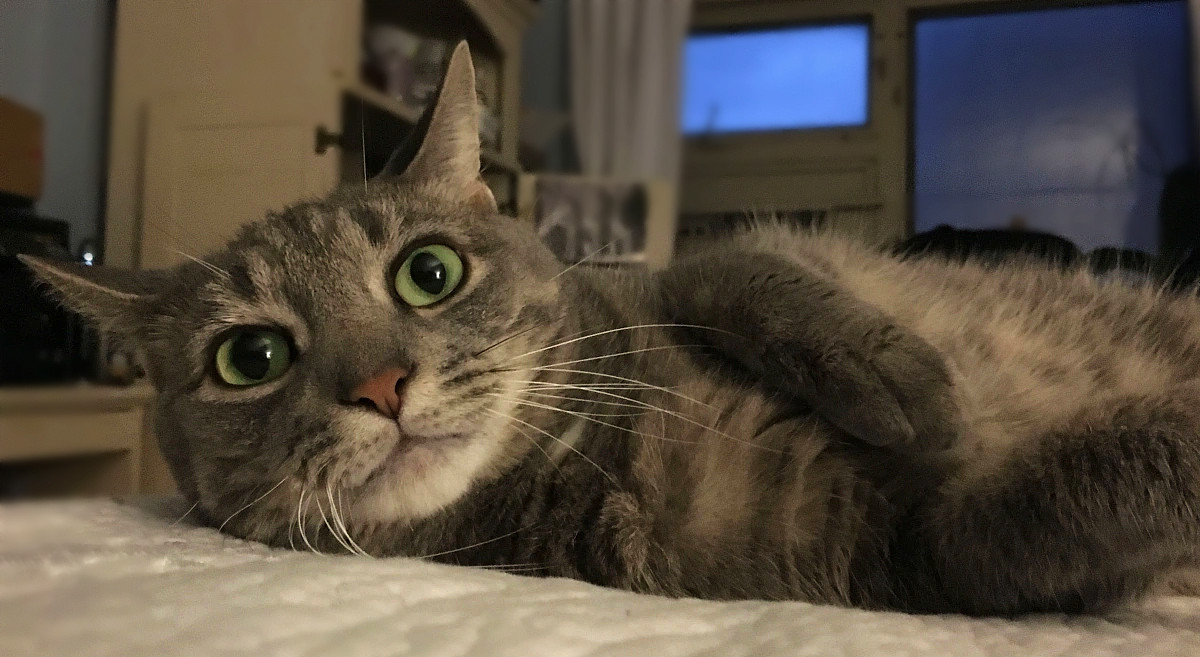
Despite what you might think or what you may have been told, most cats don’t like being picked up, held or feeling restricted. The majority of felines don’t like belly rubs, and people have a habit of mistaking a sign of trust — a cat showing her belly — as an invitation to pet.
A cat showing its belly is a sign of trust. It’s a vulnerable position for a cat, and not an invitation for belly rubs. Credit: Wikimedia Commons
Every cat is different, but generally the best way to make sure your kitty doesn’t want to approach you is to ignore her personal boundaries and treat her like a stuffed animal.
Those “cute” videos you see on TikTok of terminally online people spinning their cats to Taylor Swift songs, holding them like phones to reenact scenes from The Princess Diaries, or forcing them to wear ridiculous outfits?
Don’t do that. It destroys your cat’s trust in you, and the cheap dopamine hit you get from strangers “liking” your content isn’t worth stressing your furry pal out and damaging your relationship.
Don’t do this. It’s not funny, the meme is lame and you’ll teach your cat to fear you. Credit: TikTok
If you tend to restrict your cat and hold her in your lap, you’re discouraging her from sitting there in the future. If you give kitty unnecessary baths, you could create a situation in which your cat fears you.
Even if you think you’re not doing anything wrong, if your cat is reluctant to approach you, there’s something that needs fixing, and it’ll require patience.
Don’t subject your cat to forced petting sessions.
Unlike dogs, cats have a limited tolerance for physical affection, and they don’t always want to be touched.
Your pal will be much more likely to regularly approach you for physical affection if you let him come to you. Ignore the impulse to reach out and start petting him like you would a dog. Instead, put your hand out and let your cat initiate the petting. You’ll develop a physical shorthand in which he signals he wants chin scratches or head rubs by leaning in and rubbing his face against your outstretched hand.
All felines have scent glands in their cheeks, and the initial contact of a cat rubbing his cheek against your fingers is an olfactory signal that says “This human is my family. I like this human.”
Even though our noses can’t detect those pheromones, they’re still important to our cat(s), and they’re the reason why cats will scent-mark objects by brushing past them in your home, just like tigers will mark their territories by scent-marking trees with urine. Same concept, but thankfully our miniature house tigers generally don’t feel the need to do the latter. (If yours does, take him to the vet. If he’s not “fixed,” get it done ASAP.)
Less is more when it comes to petting
Stop me if you’ve heard this one before: “I just don’t get it! I was petting my cat and she was purring and loving it, then without warning she bit me!”
Pro tip: A bite like that never comes without warning, it’s just that most of us don’t see the signs right in front of us.
Cats communicate by tail and whisker, and we communicate by making noises with our mouths. Adult cats don’t meow to each other. The little ones are smart enough to understand how we exchange information, so meows, trills, chirps and grunts are their way of trying to speak our language, to communicate on our terms.
But sometimes — like, say, when they’re purring and relaxed — they’re distracted and forget to meow, or they meow and we ignore them.
That’s when they bite, or swipe at us with their paws.
If you pay attention to non-verbal cues, you’ll notice your cat getting overstimulated when her tail starts swishing and her pupils dilate. If those signs aren’t enough, there are others: twitching ears, shifting positions, moving away.
The best way to avoid misunderstandings is to give kitty a few head rubs and chin scratches, then stop. If she wants more, she will let you know. If she doesn’t, she’ll be content to remain on your lap or by your side, knowing you’re not going to keep going indefinitely.
No harm, no foul, no bite.
This cat is not enjoying selfie time with her human. Credit: imgur via Reddit
Don’t take your bad day out on your cat
Remember when you were a kid and your mom or dad came home from a bad day at work with a storm cloud hanging over their head? Maybe they snapped at you for apparently no reason, or made family dinner miserable with fraught silence. Maybe they unfairly got on your case about something minor.
Either way, the tension in the house was palpable because, as kids, your parents controlled your lives and you were dependent on them for everything.
That’s what it’s like for our pets. Whether we call ourselves “fur mommies” and “cat daddies” or not, the fact is that the pet-human dynamic absolutely shares some elements with the parent-child relationship.
Our pets are utterly dependent on us, they’re subject to our moods, and they’re deeply attuned to our emotions.
As a result, how we’re feeling has a big impact on them, for better and worse. Unlike children, who at least have some concept of redirected frustration, cats and dogs have no idea why we have bad moods and no way to insulate themselves from the consequences.
We’re all human and we all get frustrated with our feline friends at some point. If you’ve been sitting in traffic for three hours and come home to find Socks pooped all over the rug or threw up on your comforter, frustration is a natural response.
But for the sake of the innocent little ones we share our homes with, it’s up to us to be mindful of our moods and do our best not to let external factors impact how we treat our pets. Things as seemingly small as our tone of voice can have a major impact on their emotions.
A cat chowing down. Credit: Wikimedia Commons
Don’t feed them crap
This has been covered exhaustively elsewhere, so we’ll direct you to catinfo.org if you have in-depth questions about feline nutrition.
In general, wet food should make up the majority of your cat’s diet. Cats don’t have a high thirst drive and they’ve evolved to get most of their hydration from meat, so a cat who eats mostly — or only — dry food is in danger of developing serious health problems.
Aside from that, more expensive doesn’t always mean better, and the important thing is that your cat’s food has real meat as the top ingredient. If the primary ingredient is a filler like corn or grain, or poultry/beef byproducts, steer clear and find a better alternative.
Feeding quality food means kitty will be happier, healthier, less prone to health complications and more active.
Keep things interesting
You don’t have to spend a lot of money on toys, and everyone who’s ever lived with a feline knows the fluffy little guys are just as likely to take a shine to a new box or the little plastic ring from a milk bottle as they are to the $10 new toy you bought from the pet store.
That said, there are certain toys that are almost universally beloved by felinekind, and the more you keep things interesting for your cat, the happier your furry overlord will be.
You can never go wrong with wands for interactive play. Keep it simple and manipulate the toy at the end of the wand like prey so your house panther can feel like a mighty hunter. Track toys with balls that cats can bat around are good for relatively quiet solo play. Cat tunnels are great too, especially if you toss treats inside them for kitty to find randomly.
A cat playing with a toy mouse. Credit: Wikimedia Commons
You don’t need a special occasion to surprise your little buddy with a catnip and play session, and you’d be surprised how enthralled felines can be by “cat TV” on Youtube. There are dozens of channels that provide hours-long videos of birds eating seeds from outdoor feeders, aquariums filled with interesting fish, and critters like squirrels and rodents.
You can also engage your cat by training her to do simple things like come when called, sit on command high five you. Those “tricks” are very easy to teach and require no more than two or three practice sessions a day, maximum 10 minutes each. Your cat will love it, especially with rewards for learning, and it’s fun to show skeptics that, yes, cats can do tricks just like dogs.
Sometimes “fun” is just something unusual, something your cat rarely gets to do or see. On occasion, I let Buddy walk up and down the hallway with me in my apartment building late at night when chances are low we’ll encounter anyone.
Elevators: products of foul sorcery that swallow humans and sometimes spit out Korean rappers.
He loves to stop at each door, listen and take in the strange sounds and scents. If anyone emerges from one of the doors or the elevator opens, he just makes haste back to our apartment, where I leave the door slightly ajar for that reason. As for the elevator, he seems to think it’s some sort of product of foul sorcery — it rumbles, the doors open by themselves, and when people walk in, they don’t walk out. Sometimes they enter only to emerge as a different person a few minutes later!
I’m happy to indulge his paranoia with regard to the elevator, because it means I don’t have to worry about curiosity getting the better of him.
If you’ve got rooms your cat doesn’t normally have access to, a yard with cat-proof fencing, or an activity you only do sometimes, consider breaking up your cat’s day with a little exploration or some ‘nip-fueled fun.
“Extremely accurate portrait of the Buddies” commissioned by Buddy the Cat in 2024.
Treat your cat as a friend
Your cat may not have legal personhood, but he is a fully sentient being who feels emotions just as strongly as people do. Cats experience the full range of primary and secondary emotions, but not tertiary emotions. That means kitty can feel happy, sad, excited, anxious, jealous, bored, depressed and overjoyed, but she’s not going to be embarrassed if another cat’s wearing the same collar or fret over whether people and other cats like her.
The important thing is remembering cats have feelings.
It’s not rocket science, and it doesn’t cost us anything to treat our cats with respect, patience and love. Bonding with a cat requires more than just feeding, watering and scooping, but the effort is always worth it and you’ll have a loyal friend for life. Good luck!
Top image of incredibly sexy beast (Buddy) copyright Pain In The Bud.
Cats have established themselves as the de facto rulers of 220 million households, where they enjoy perpetual lives of leisure and are doted on by their adoring humans. How much more successful can they be?
Dear Buddy,
There’s been a lot of talk lately among the humans about how they’ll evolve in the future, whether they’ll become more successful, and whether they’ll merge with machines! Scary!
But what about us? How will cats evolve to be more successful? Will we always have human servants?
Feline Futurist in Florida
Dear Futurist,
Do we really need to be more successful?
As a species we’ve secured our rightful place as royalty in human homes where all our needs are catered to.
We’ve become so adept at manipulating our human minions that we even know how to spur them to immediate action by embedding urgent baby-like cries in our purrs.
We figured out that humans are hardwired to respond to cries in that frequency, and once we find that manipulative sweet spot, we never forget it. We’ll push that coercive button all day and night to get what we want. There is no rest for humans until they comply with our demands.
But now we have gone beyond that significant accomplishment, essentially hijacking the humans’ species-wide consciousness by taking over the internet.
Imagine some alien archaeologist poking through the rubble of human civilization far in the future, its delight at recovering data from an ancient human server turning to utter confusion as it realizes entire zetabytes are comprised of nothing but images and videos of small, mysterious, furry creatures that seemingly do little besides eat, sleep and enjoy massages.
“Did I have it all wrong?” the confused alien might say. “Could it be that these ‘cats’ were the true power on this planet all along, and humans were in thrall to them?”
What else do we need to be successful, and to what evolutionary pressures do we need to adapt? We’re not fighting our way through hostile territory in the living room, fending off attacks en route to the kitchen where there’s only a chance for food.
Nope. It’s literally served to us on a regular schedule and whenever we screech for it. Our servants know they will never hear the end of it if they don’t meet our demands, and the best of them have learned to anticipate our desires before we have to vocalize them.
How much better can it get? We’ve managed to achieve a lifestyle in which we can perpetually live in the moment with no worries about the future, and everything taken care of for us. The humans don’t expect us to do anything in return except be cute and cuddly.
We “earn” our keep by allowing them to pet us every now and then as we lounge, until we grow weary of human affection and dismiss them with an annoyed flick of the tail or a gentle bite that says “Enough, you’ve had your 30 seconds, human!”
We break their stuff, vomit on their carpets, poop in their shoes, disturb their sleep, lay on their clean piles of laundry, ignore their boundaries, deny them their privacy, destroy their furniture, steal their cheeseburgers, force them to scoop and dispose of our waste, take over their beds, and we still act like the humans are fortunate to serve us.
We are irreproachable, imperious and untouchable, and when we’ve pushed our luck perhaps a bit too far, all we have to do is flop onto our backs, pull our little paws up beneath our chins, and squeak out a meow.
“Awww,” our humans say, their thoughts manipulated by our toxoplasma gondii mind-control superpower. “What a good boy! He’s so innocent! Of course he didn’t mean to [insert incredibly disrespectful action here], he’s an angel!”
So no, my friend. I don’t think we have to participate in the evolutionary arms race. That’s for lesser creatures whose futures are uncertain. Us? We’re winning at life without lifting a paw.
Your pal,
Buddy
“That’s right. Obey us, humans. We honor you by allowing you to serve our meals, scoop our poop, scratch our chins and buy us toys. You are so fortunate!”
Requirements for adopting Pepper included a sense of humor and experience caring for birds. He’s now found a home with patient caretakers and another mercurial parrot to hang out with.
It’s too bad cats can’t swear.
While kittens don’t often have problems finding homes due to their overwhelming cuteness and antics, it usually takes a sad story to drum up considerable interest when an adult feline is up for adoption.
As the SPCA of Niagara learned, talkative parrots, especially birds who can swear up a storm, have their pick of homes.
In June, a potty-mouthed parrot named Pepper was surrendered to the shelter, and when the SPCA put the call out — specifying they’d prefer someone with experience caring for birds and a sense of humor — the applications kept rolling in, totaling more than 400.
“His famous line is ‘Do you want me to kick your ass?'” a shelter employee said in an interview last month shortly after announcing Pepper was up for adoption.
Shelter staff asked applicants to include photos of their bird enclosures in addition to the usual pre-adoption questions, eventually narrowing the Pepper Sweepstakes down to 10 potential homes.
This past week, Pepper was finally taken to his new abode in Olean, a small city in western New York. The couple who adopted him are not only experienced with birds, they know all about avian vulgarity. They have a parrot named Shelby who apparently “makes Pepper look like a saint.”
As for Pepper, it looks like he’s getting his bearings before heaping abuse on his new caretakers.
“He hasn’t cursed at them yet, but we know it’s coming,” shelter staff wrote in an update.
In recent decades, research has shown birds can be exceptionally intelligent. Crows, for example, use tools, can differentiate between human faces, and remember which humans have wronged them or treated them well.
While many people assumed parrots merely imitate human language, long term behavioral studies show the birds are able to use words in context and invent novel combinations of words. As with other animals, syntax remains elusive.
The most famous example was Alex the African Gray, who was the subject of research by animal cognition expert Dr. Irene Pepperberg. Alex, who died in 2007 at the age of 31, was able to count and could perform simple calculations. He was talkative, conversant and often told his caretakers how he was feeling, what he wanted, and what he thought of the tests they’d give him. (Like a child, Alex would try to get out of exercises he was bored with by asking for water, saying he was tired and wanted a nap, or just flubbing his answers.)
We are not above crude humor here at PITB, and in the past we’ve written about Ruby, our favorite talking parrot. Ruby lives in the UK with her owner, Nick Chapman, and the pair were among the very earliest Youtube stars thanks to videos of Ruby’s shockingly vulgar, extremely British tirades and Chapman’s infectious laugh.
Warning for those who are offended by bad language or are viewing at work: Ruby is known for liberal use of c-bombs-, t-bombs, f-bombs and just about every other linguistic bomb you can think of, in addition to British slang like “bollocks.” If that’s a problem for you, skip this video.
Eric the Legend, a parrot who lives in Australia, is also a favorite on Youtube for his habit of declaring himself “a fookin’ legend!“
We’re glad Pepper has found a home where his idiosyncratic nature will be cherished, and we hope the future will bring videos of Pepper and Shelby going back and forth. Parrots are social animals, after all, and what fun are insults if you’ve got no one to trade them with?









 Pain In The Bud