
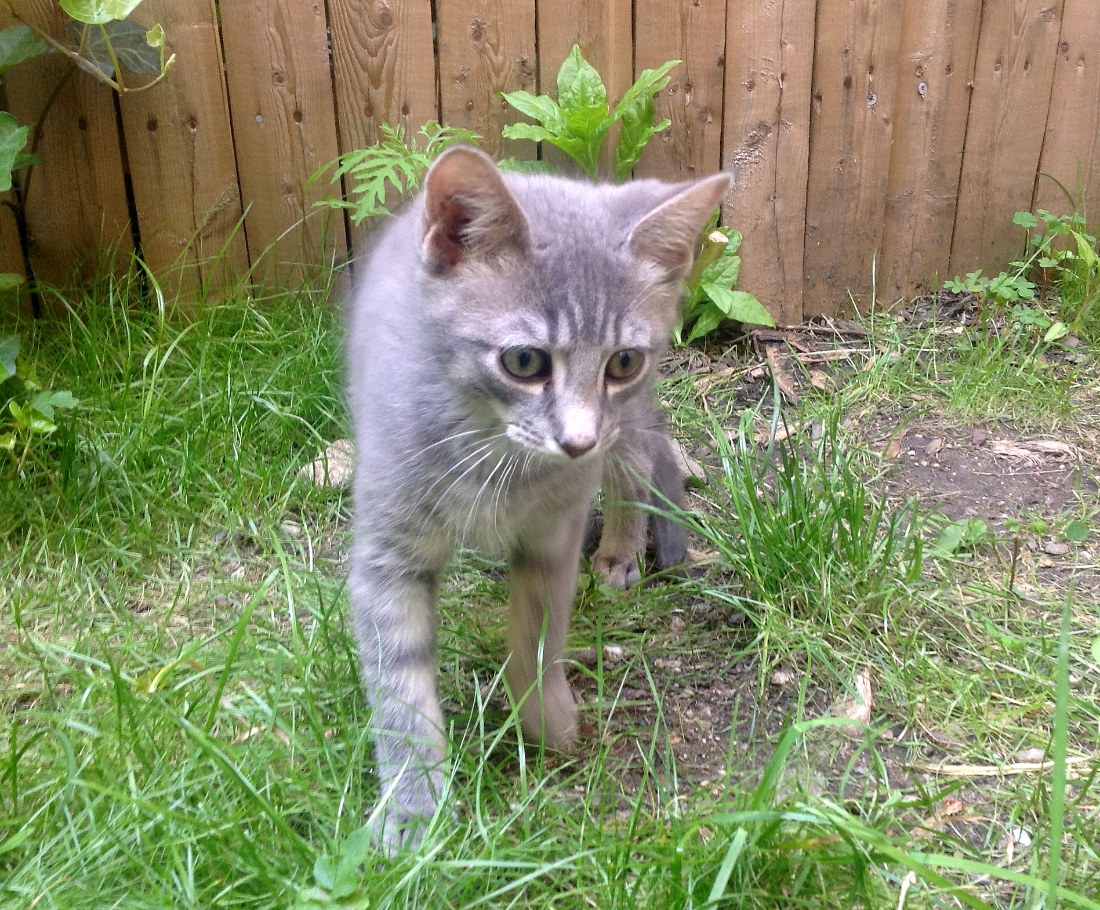
From summer 2014 when Bud was about five months old.


From summer 2014 when Bud was about five months old.
Buddy, convinced that his human can control the weather, would like more moderate temperatures. Is that too much to ask?
A big chunk of ‘Merica has been sweltering this week, and New York has been no exception.
Tuesday was supposed to be the most brutal of the brief heat wave, but Wednesday felt the most oppressive to me, like walking through a hot soup and having no choice but to “drink” it until you can escape to the air conditioned indoors again.
The temperature was in the high 90s with a heat index of 104 thanks to the humidity. That’s the real killer: while I don’t envy parts of the southwest that see temperatures of 100+ more frequently, summers here are marked by disgustingly sweaty weather. Humidity reached 99 percent on June 2, and this week we’ve had spikes of 80 percent and higher.
As bad as it is for us, it’s worse for our furry little pals. For them it’s like wearing a jacket you can’t take off.

The Budster has been shedding like crazy the past few weeks, and I’ve been brushing him to help him get rid of that excess fur — and prevent it from “decorating” the place.
On Tuesday I decided to open the door to the balcony, mostly to see how he’d react. He loves the balcony, which offers cat TV, the opportunity to soak up the sun and take in new scents and sounds.
But with the sweltering temperature, Buddy approached the door to his beloved balcony with caution. He stepped outside, paused for a second or two, gave me a disgusted look, then turned right back around and padded inside, where he recovered from his ordeal by lounging.
Life’s tough for a cat.

The little dude may be following Marjorie Taylor Greene on Twitter, because the look he gave me strongly suggests he thinks I can control the weather.
“It’s unacceptably brutal out there!” I imagine he’s thinking. “Fix it, human! Do I have to verbalize everything, or can you be a proper servant and anticipate my needs ahead of time?”
Of course we’re talking about a cat who refuses to set paw outside unless it’s a balmy 65 degree minimum, preferably between 73.5 and 76 degrees. No rain, no cold, definitely no snow, and no excessive heat!
Thankfully the heat broke, and today we’re forecast for a balmy 75. Cue the Sir David Attenborough voice: “But there’s a problem! A tomato plant has appeared on the balcony, and even though Buddy’s a meowscular tiger who shows no fear*, tomatoes and their vines are poisonous to him.
On the off chance that we’ve got some readers who don’t have cats, would anyone like a tomato plant?
* Buddy exhibits no fear except when it comes to rustling paper bags,vacuums, Swiffers, brooms, music intended for cats, sudden movements, floppy fish toys, loud vehicles including but not limited to trucks, outdoor animals who make scary noises, and certain kinds of cheese. But other than that, he’s totally fearless.
Bodega cats are the stars of a popular online series and could soon become legal in New York, where they’ve helped keep delis and small groceries rodent-free for as long as such places have existed.
Although it’s way too early to celebrate, Pennsylvania could become the fourth state to outlaw cruel declawing procedures after two lawmakers there introduced a new bill.
The Pennsylvania declawing ban proposal closely mirrors laws already passed in New York, Maryland and Massachusetts, and would outlaw the procedure except in cases where it’s medically necessary. (Although extremely rare, sometimes cats suffer from cancer of the nail bed and other maladies that necessitate surgery, but that’s a far cry from the elective declawing currently legal in 47 states.)
The state’s Veterinary Medical Association, the usual villain in these situations, is opposed to the ban. State veterinary medical associations argue that outlawing the procedure — which amputates a cat’s toes up to the first knuckle — would limit options for veterinarians and caretakers.
The veterinary medical associations, which contrary to their names do not represent all or even most veterinarians, also claim that declaw bans lead to more surrenders, but that claim has been repeatedly debunked by statistics from states and municipalities where bans have passed. In each of those cases, surrenders actually decreased, which is not a surprise to those who understand declawing, rather than “solving” any behavioral issues, actually causes cats to lash out even more because of the suffering they endure from the mutilation.
Here in New York, the Veterinary Medical Association successfully prevented declawing bans from making it out of committee for years, despite organizations like the Humane Society, SPCA, Alley Cat Allies and others wholeheartedly opposing elective declawing. Each state VMA buys influence with campaign donations, and relies on the lawmakers they support to kill declawing bans. Let’s hope Pennsylvania’s Veterinary Medical Association proves less adept at derailing that state’s bill.
When I was a kid, the two Dream Machines that adorned posters on my wall were the Lamborghini Countach and the F-14 Tomcat. The Countach remains a car without equal with its inimitable, angular design that still manages to look futuristic more than half a century since the first models rolled out of the factory.
The twin-engine Tomcat is kind of like the Countach of fighter jets with its variable wing geometry, prominently angular air intakes and unique silhouette that makes it easy to distinguish even from the ground.

Grumman’s air superiority fighter was immortalized in pop culture when Tom Cruise’s ace fighter pilot, Maverick, flew the aircraft in 1986’s Top Gun, and the Tomcat enjoyed a nostalgic encore in 2022’s excellent Top Gun: Maverick, displaying its staying power in a film that also heavily featured newer aircraft like the F-18 Super Hornet and the sixth generation prototype “Darkstar,” based on Lockheed Martin’s secretive SR-72.
The F-14 is the last of Grumman’s “cat” aircraft, after the Wildcat and Hellcat, and while it no longer fills a role in the US military, it remains a potent weapon for other countries half a century since its first flight. You can read all about the Tomcat in The Aviationist’s new feature here.

Bodega cats, longtime fixtures of New York’s answer to grocery stores, are enjoying a moment thanks to a major push to finally legalize their presence, and popular social media accounts featuring photographs of the beloved mousers keeping watch over their stores and snoozing in snack aisles.

Now the New York Times has a feature on the popular TikTok series Shop Cats, which features “interviews” with the neighborhood felines.
Like Buddy, they seem to have an odd fascination with Mao Zedong, and their answers don’t make much sense, but that’s part of their charm. Check it out here.
Header image of a bodega cat courtesy of Pexels
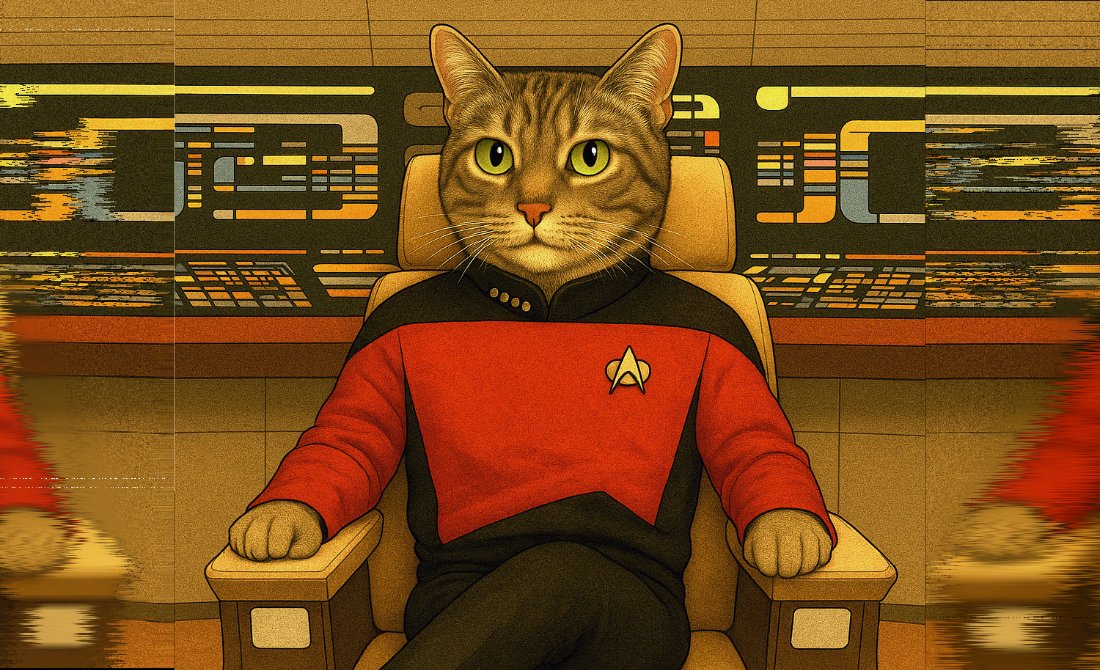
An old enemy lies in wait in the far reaches of the galaxy, ready to exact revenge on the most dashing, clever and dashingly clever captain in Starfleet!
ALPHA QUADRANT, Milky Way Galaxy — Captain Buddy is back for his most thrilling, treacherous and scrumptious adventure yet!
As the commanding officer of the USS Fowl Play and a legend within the galactic community, Captain Buddy and his trusty crew get the call to investigate reports of the malevolent Borg raiding colonies on the edge of Federation space.
Our intrepid captain arrives just in time to fend off a Borg cube attacking Dawn’s Edge, one of the largest colonies on the Felinian Rim. After mounting a heroic defense and defeating the diabolical enemy spacecraft, brave Captain Buddy discovers the Borg weren’t just trying to assimilate the peaceful Caitians living in the colony: they were after the colonist’s turkey, tuna and dilithium reserves as well!
With reinforcements several days away, Captain Buddy is tasked with defending the colony, reassuring terrified colonists, and managing a dwindling supply of sandwiches and snacks…

Buddy’s browser history provides a window into the depraved mind of everyone’s 683rd favorite feline named Buddy.
Google search, 6.56am: oh zempic
Google search, 6:57am: ozempic
Wikipedia: Ozempic (pharmaceutical), 7:02am
Google search, 7:07am: ozempic 4 cars
Google search, 7:07am: ozempic 4 cats
Google search, 7:12am: why no ozempic 4 cats?
Pain In The Bud: Latest Stories, 7:44am
Pain In The Bud: Submit Comment: “LIES!!! BUDDY WOULD NEVAR RUN FROM A MOUSES! WHO WRITES THIS RAG?!?”, 7:49am
Google search, 2:33pm: how to get human to give more snax
Google search, 3:11am: hot calico
Google search, 3:14am: sexy calico
Google search, 3:21am: sexy calico new York area
Google search, 4:12pm: when do cats get growth spurt
Google search, 4:12pm: when do cats grow into tigers
Google search, 4:15pm: tiger meowscle workout

Google search, 1:03pm: turkey
Google search, 1:14pm: turkey
Wikipedia: Turkiye (country)
KFC.com: Order Online, 2:22pm
KFC.com: Colonel’s Original Recipe Bucket, 2:23pm
KFC.com: Confirm Your Order
Google search, 7:16pm: fursat the 13
Google search, 7:16pm: Friday the 13th
Wikipedia: Friday the 13th (film), 7:16pm
Google search, 7;21pm: is jason real?
Google search, 8:16pm: how 2 make human lay on couch
Google search, 8:19pm: how 2 lure human to couch
Google search, 8:23pm: 2nd best thing besides human to sleep on
Google search, 8:29pm: how 2 make human obey
Google search, 8:30pm: r humans stupid?
Google search, 8:44pm: stoopid sport ppl stand in field
Google search, 8:47pm: stoopid sport ppl stand in field and one guy waves stick try to hit ball
Wikipedia: Baseball, 8:52pm

Google search, 10:15pm: buddy
Google search, 10:15pm: buddy the cat
Google search, 10:16pm: other buddy the cat
Google search, 10:17 pm: other buddy the cat famous
Google search, 10:19pm: FAMOUS BUDDY THE CAT
Famous Felines: A Site Dedicated To The Biggest Cat Celebrities On The Internet, 10:26pm
/Famous Felines: Buddy (Philadelphia cat)
/Famous Felines: Buddy (cute tabby from Florida
/Famous Felines: Buddy (Phoenix Zoo ocelot)
/Famous Felines: Buddy (TikTok star)
/Famous Felines: Buddy (fictional cat)
/Famous Felines: Buddy (other)
/Famous Felines: Buddy (500 to 599)
/Famous Felines: Buddy (600 to 699)
/Famous Felines: Buddy #683 (New York cat)
Google search, 11:01pm: how 2 get more famous


 Pain In The Bud