Powerful Politicians Come And Go, Scandals Erupt And Fade, And Larry The Cat Remains

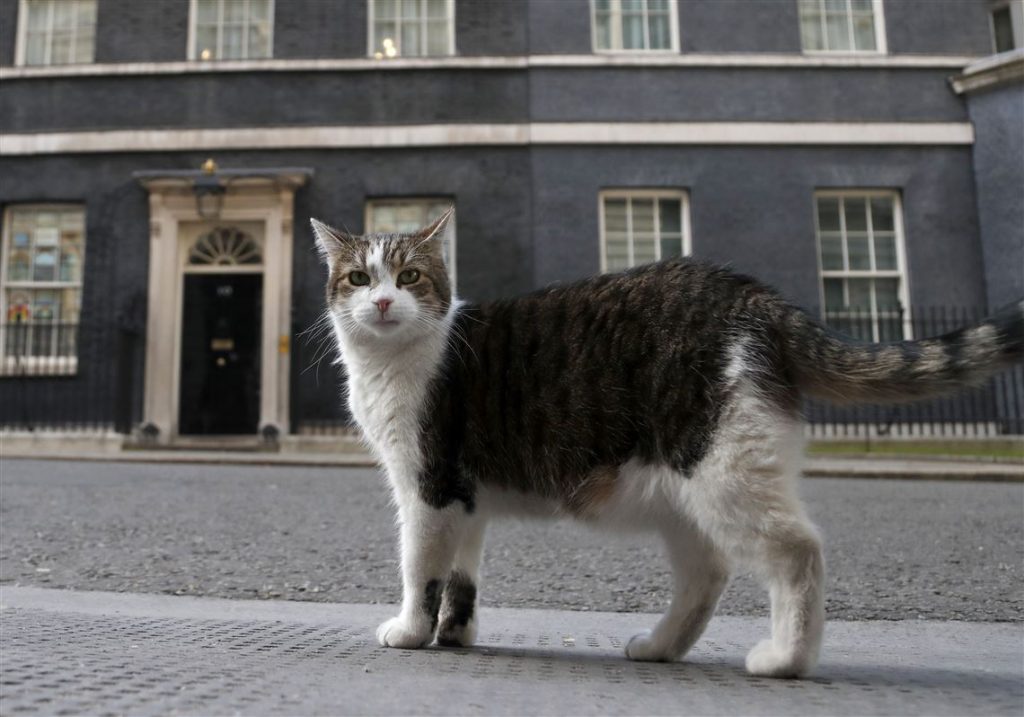
As Larry marks 15 years as the chief mouser in the UK’s seat of power, No. 10 Downing Street, Britain’s most famous feline is a constant amid rapid change.

At first it didn’t look as if Larry the Cat’s tenure would last long.

The striking white and tabby mix came highly recommended from Battersea Cats and Dogs, a London shelter whose staff said he was one of their most skilled little hunters. Larry, they said, would adjust well to the busy surroundings of the prime minister’s office and residence.

Adjust he did, but not in the way then-Prime Minister David Cameron, No. 10’s staff, and the UK press thought he would. Larry began his tenure by taking long naps on the residence’s front windowsill, paying frequent visits to his “lady friend” Maisie — a mouser living in another government building several doors down — and establishing a territorial rivalry with Palmerston, the Foreign Office’s mascot and mouser.

“In a separate development, it can be revealed that Larry has a girlfriend,” a droll BBC report from 2011 confirmed, while reporting on a cat-themed quiz night fundraiser at No. 10 to ensure the chief mouser’s yums cupboard remained stocked. “Maisie, a cat who lives at the nearby St James’ Park keeper’s cottage, has struck up a relationship with Larry, a spokesman for the Royal Parks has confirmed.

“There is, though, no prospect of kittens, as Larry went under the knife some time ago,” the report continued, speculating that the chief mouser’s love life could explain “why Larry spends most evenings out – and most days fast asleep in 10 Downing Street.”

It didn’t take long for the press to begin running tongue-in-cheek stories about Larry failing to deliver on promises just like every other political animal, and for a while it looked like No. 10 would need another chief rodent exterminator.

But then Larry began covering himself in glory by defending his new domicile not only from rats and mice, but also from a fox, territorial incursions by Palmerston, ill-intentioned politicians and other undesirables.

As the years passed, Larry’s legend grew. He outlasted Cameron, then Cameron’s successor, Theresa May, who admitted she was a dog person and wasn’t fond of Larry, even denying him the use of her office chair for naps. Then there was Boris Johnson, Liz Truss, Rishi Sunak, and Keir Starmer.

Starmer is Larry’s sixth prime minister, and no one will be surprised if his tenure ends while Larry’s endures. Meanwhile, Palmerston was “retired” to the countryside and only recently returned to politics when he accompanied his human, Andrew Murdoch, to Bermuda when the latter was appointed governor there. Such is the price of incurring Larry’s wrath.

Now at 18 years old, with 15 years as chief mouser under his collar, Larry represents something rare in modern politics: stability and predictability. With the passing of Queen Elizabeth II in 2022, illness and scandal in the royal family, and the usual ephemeral nature of UK politics, Larry has become more important than ever as the stalwart in the country’s seat of power.

Larry’s given the cold shoulder to Irish and Scottish politicians, nuzzled up for scritches from former US President Barack Obama, and forced President Donald Trump to wait before departing No. 10 while taking refuge from the rain under the president’s limo. The famous feline rarely leaves the public guessing when it comes to his thoughts on visiting political figures.

He’s “the most miserable animal you’ll ever meet,” a snubbed Ian Murray, the Scottish Secretary, said after Larry refused to pose for photographs with him. (Murray, it should be noted, was relieved of his post in September, and now holds the lofty title of minister for “culture, media and sport.” Perhaps he and Palmerston can commiserate.)

But that’s part of Larry’s appeal. The chief mouser’s unimpressed reaction to powerful figures has endured him to the public, who shower him with fan mail, treats and toys.

His unintentionally comedic adventures and ability to nap under any circumstances won him the affection of the notoriously fickle UK press, who enjoy watching, photographing and writing about his antics while waiting for the less popular humans inside to update them on the big news of the day.

That’s not hyperbole, by the way: a 2024 Ipsos poll found Larry is more popular than every prime minister to share his home, and the margins aren’t even close.

It also hasn’t escaped the notice of the press that Larry “rules the roost,” and has attentive staff who open the door at No. 10 any time he wants to go in or out. The famous door is actually a blast-proof, steel replica of the wooden original, custom manufactured after the IRA fired a mortar at the residence in 1991. Thus there’s no cat flap, and staff monitoring the door from inside open it as soon as the building’s most enduring resident decides he wants back in.

The prime minister may be the UK’s most powerful political figure on paper, but Larry’s tenure, run of the place, array of servants and adoring fans all prove he’s the real power at No. 10.

Now Larry’s legend will expand even further as the UK’s Channel 4 has commissioned a documentary series on cats from writer-comedian David Baddiel. The series, which is currently filming, will feature Larry in one of its episodes.

Happy 18th birthday, Larry! We hope you see many more years filled with treats, adventures, historic furniture to nap on, and politicians to push around. And if you achieve world peace while you’re at it, no one would be surprised.

Image credits: Wikimedia Commons/UK government
‘Man In A Panther Costume’ Terrorizing UK Beach Town

The costumed man has growled, hissed and meowed at passersby in the coastal area, reigniting old rumors of actual big cats prowling the area and freaking out people walking their dogs at night.

Ah, the things you can get away with in a country without guns.

A man in an all-black outfit has been prowling Wallasey beach in Wirral, a peninsula in northwest England, according to people who live in the area.

One witness said the man was “waving his hands in the air and making panther noises,” while others said they saw him approaching cars stopped at lights on roads near the coast.

“Anyone know who the freak in the cat mask and morph suit is at the coastal park near the harvester?” another local wrote online.

One thing was clear from witness accounts, photos and several short smartphone-shot videos: the costumed man wasn’t trying to imitate a friendly house cat.

“Was walking my dog tonight and heard a man making cat noises, shone a torch he was waving his arms at me before crawling up the hill. Never been so scared,” one witness posted to Facebook, per the BBC.

Sad as it may be, the first thing that came to mind when we read the witness accounts was that this doesn’t happen in the US, simply because odds are the costumed prankster would be shot.

“So I decided to bugger off home, had the rest of last night’s takeaway, had a laugh at the Sharons and Waynes on Blind Date, then went to see if any of the lads were up for a pint. Oi, I could really go for a Chinese! Anyone else wanna go for a Chinese?”

It’s possible whoever is behind the strange sightings is making light of decades-long rumors that mysterious and elusive big cats have been prowling the UK countryside.

Similar to persistent rumors of Bigfoot in the US, the phantom cats of the UK have their own believers who argue that there’s an extant population of leopards or pumas who are exceptionally adept at staying hidden from cameras but are occasionally spotted by farmers and motorists in the British countryside.

There’s a podcast dedicated to the topic, and proponents of the idea say it could explain a handful of cases in which livestock have gone missing.

The podcast, Big Cat Conversations, even dedicated a 2021 episode to “Wirral’s liminal leopards,” with its host interviewing several people who say they’ve encountered large melanistic felids on the peninsula over the decades.

Real big cats such as the leopard above tend to leave unmistakable evidence of their presence. Image credit: Wikimedia Commons

But as big cat experts have pointed out, it’s difficult to miss the signs when such apex predators really do claim an area as home. From unmistakable pug marks, to trees scratched and scent-marked with urine, to calls that can echo for miles in right conditions, big cats have many ways of making their presence known— and it’s often advantageous for them to do so, since they’re highly territorial animals.

One man who was out walking his dog told the BBC he thinks the whole thing is a prank.

“I don’t know his name, I think it’s just a wind up. He’s definitely not out to frighten people, he does it for fun,” he said. “He just likes being a giant cat. He doesn’t frighten our dog.”

Local police say they’re aware of the sightings. Merseyside Police and Crime Commissioner Emily Spurrell told local media that anyone who feels threatened by the suited figure should call law enforcement and report his whereabouts.

Like, OMG! This Kitty And Puma Are Totes Besties!

Plus: The awesome and terrifying cats and proto-cats of prehistory!

OMG, you guys! No cap, you gotta totally check out this adorbz video of a sweet widdle kitty witty becoming best fwiends with this mountain lion!

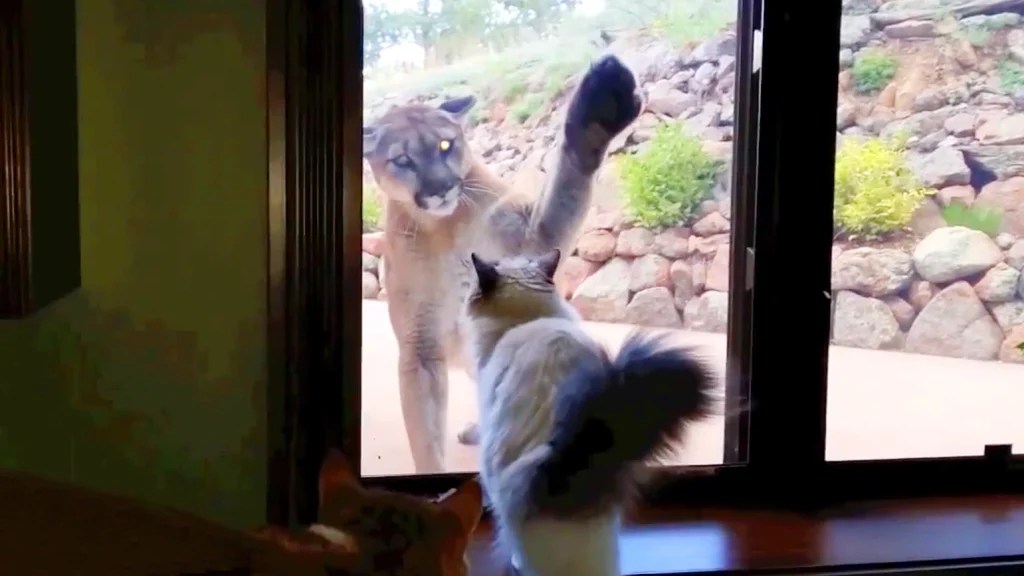
Phoebe the cat sees this cute AF puma near the back door of her home, curiously looking inside. It’s love at first sight as kitty and kitty see each other! Per Parade Pets:

“[T]he kitty in this TikTok video is completely fascinated by the big kitty outside her window. There’s no getting her away from her new friend! 

On Sunday, August 25, @cricketandstrawfl shared this footage of her Tuxedo Cat posted up at the back door in their house, where a cougar was hanging out. It goes without saying that the cougar in question was many times bigger than Phoebe, but that didn’t seem to scare her at all. 

It seemed like the cougar was pretty curious, too. He didn’t appear to be aggressive; instead, he was staring at Phoebe and gently pawing at the glass, trying to figure out who the tiny cat in the window was.”

OMG-hee! Look at the big kitty gently pawing at the door! He wants to give the little kitty a huggy-wuggy!

SO ADORBZ! The puma pawing at the door wasn’t testing its strength to see if he could snag a quick meal, those were totes signals of love! Teehee!

Felid predators of pre-history: They will eat you

If you’re in need of a palate cleanser after all that sugar, the BBC’s Discover Wildlife has a rundown of prehistoric cats and their particularly fascinating proto-cat ancestors, some of whom looked more classically cat-like than several species of true cats. Isn’t convergent evolution cool?

There’s the famous smilodon, the saber-toothed cat, xenosmilus, the so-called shark-toothed cat, and homotherium, the scimitar-toothed cat. Outdoing each other with increasingly sword-like teeth was apparently a big thing in the felid world back then.

There’s also the cave lion, the last of the UK’s big cats, and miracinonyx, the American cheetah, but did you know that simbakubwa, the “great lion” of Africa, topped out at almost 3,000 pounds?

Simbakubwa
Simbakubwa was massive, making modern lions look almost like house cats in comparison.

Dinictus
Dinictis looked like a cat, behaved like a cat and hunted like a cat, but was not part of the felidae family. Credit: Wikimedia Commons

Simbakubwa and dinictis were examples of “false cats.” That is to say, they were not part of the felid lineage, but closely resembled cats in body plan and behavior through convergent evolution. Nature found a niche, and several different species filled it for a time.

Dinictis in particular looks strikingly like modern big cats, which makes it even more surprising to learn it’s not part of the genetic lineage of the felid line.

Finally — or firstly — there’s proailurus, the first cat or “dawn cat,” from which all true felidae species can trace their lineage. Appearing almost 31 million years ago proailurus enjoyed napping, climbing trees and eating Temptations. Okay, we made that last part up. But still. If proailurus were around today, it would probably go just as crazy for the kitty crack as our house panthers do.

Top image via Youtube.

DNA From Dead Sheep In UK Matches Big Cats, But Is That Proof Of Their Presence?

Rumors of big cats in the UK countryside have persisted for years, with witness claims from all over the country. The latest reported sighting was in northern England.

People who really want to believe big cats are running around the British countryside are ecstatic with the news that a DNA sample from a dead sheep reportedly tested positive for panthera DNA.

The DNA sample was swabbed from a freshly-killed sheep carcass “at an undisclosed upland location” in Cumbria, northwest England, a witness told BBC Wildlife. It’s exactly the kind of countryside where people have been reporting big cat sightings for years, although the sightings aren’t confined to that area, with other witnesses claiming they’ve seen large felids as far as the UK’s southern coast.

Sharon Larkin-Snowden, who lives nearby, told a big cat enthusiast podcaster that she disturbed the “big cat” while it was feeding. The startled felid took off and jumped a stone wall, leaving the partially-eaten sheep, Larkin-Snowden said.

“I assumed at first it was a sheepdog, but then I did a double take and realised it was a black cat,” she said. “It was big – the size of a German shepherd dog.”

Jaguar in a pub
“I could really go for a Chinese! Anyone else wanna go for a Chinese?”

A swab was collected — the details are sketchy on who did the collecting and when exactly they submitted the sample — and sent to the University of Warwick’s Robin Allaby, a professor of life sciences.

Allaby, whose specialty is studying the genetics and evolution of domesticated plants, began offering a DNA testing service for the public some 12 years ago in response to the persistent rumors of big cats in the countryside. In the past samples have yielded DNA from foxes and other animals, but Allaby says this one matched the genetic profile of a big cat, although he cannot say which species.

It’s not unusual for a DNA sample to match to a genus, in this case panthera, but not to a specific species if the sample was degraded or only partial.

Rick Minter, who has made a career of tracking alleged big cat sightings across the UK, says he believes the mystery cat is a leopard. Leopards and jaguars are the only two big cats who have true melanistic color morphs — meaning some of them have virtually all-black coats — and Minter says he believes it’s more likely the former.

Neither are native to the UK or Europe: Leopards range from Africa to Asia, while jaguars range from south to Central America, with some populations edging slightly into the US.

puma sits on tree
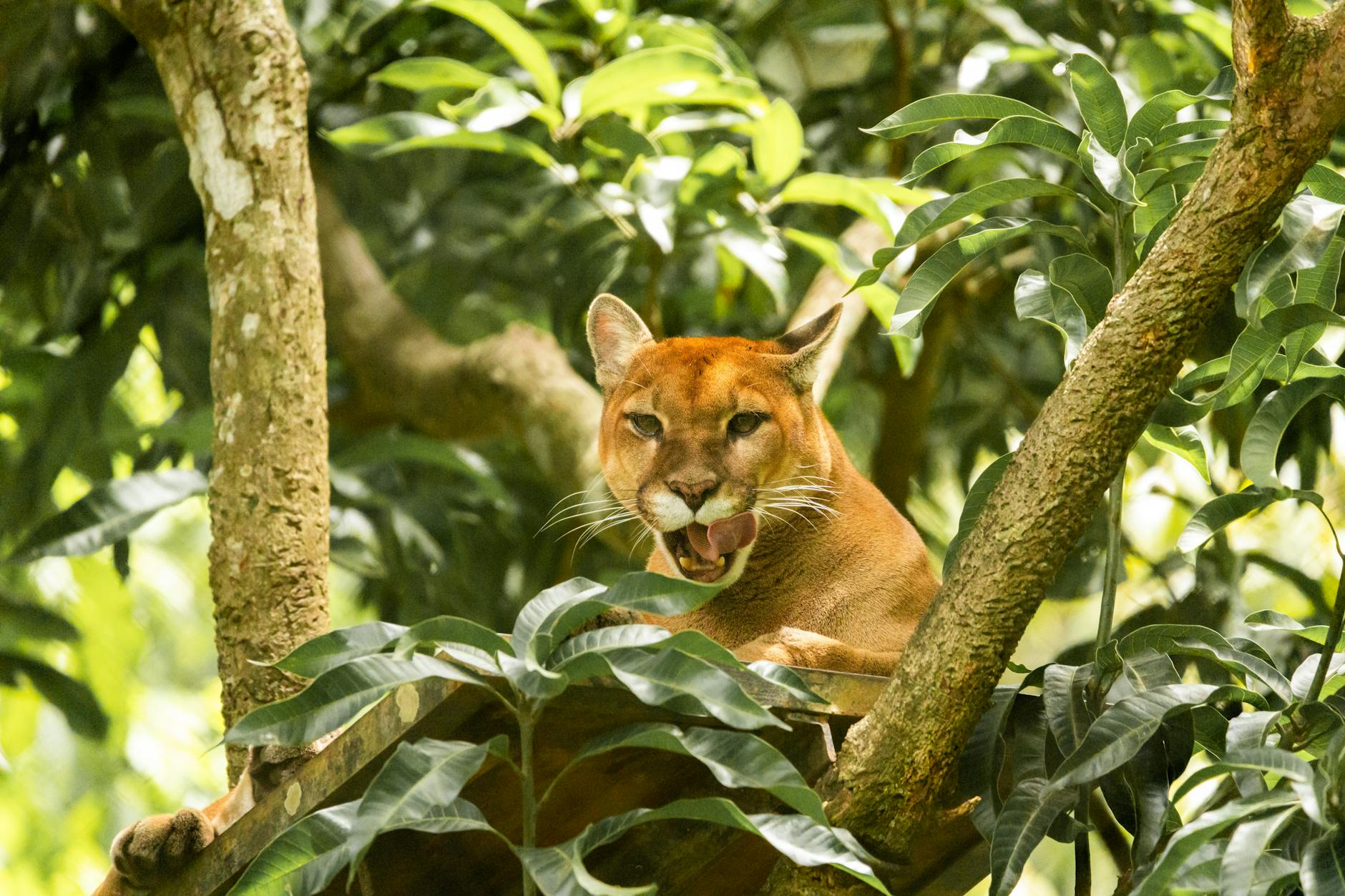
Britain’s big cat enthusiasts say they believe pumas are among the wild cats living in Credit: Jean Paul Montanaro/Pexels

Why isn’t a DNA match evidence of big cats in the UK?

If the lab results say the sample came from a big cat and that result is consistent with the witness account, what’s the problem?

Chain of custody, for one. We don’t know anything about who took the sample, where it was taken, the time elapsed between the kill and the sample swab, or who may have handled it before it reached Allaby.

In fact, we don’t know if there was a dead sheep to begin with.

If I were a prankster living in the UK, for example, and was friendly with a keeper at a local zoo, I could have the keeper swab an animal, bag it and hand it over to me. There are dozens of conceivable ways a person could obtain a sample even if they don’t know someone who works in a zoo.

Leopard in a pub
“So we left the sheep there at the edge of the field and made sure the lady saw us before we buggered off over the fence. Next day, we was in all the papers! A right laugh that was, mate.”

The problem is the provenance of the sample and what happens to it between the time it’s collected and ends up in the hands of a scientist like Allaby.

This is why chain of custody is paramount in criminal trials, and why there must be a complete record of who handled samples from collection in the field to the lab. Even in the absence of foul play, an improperly handled sample can be contaminated and render test results meaningless.

It’s not a matter of trust, it’s the simple fact that extraordinary claims require extraordary evidence, as Carl Sagan was fond of saying. Short of capturing one of these animals or getting clear, indisputable footage, any other claimed proof has to be ironclad.

Speaking of footage, that’s another issue. It’s extremely difficult to believe that a breeding population of big cats can exist in the UK countryside for years or even decades without a single definitive photo or video. The UK’s rural areas may not be blanketed by CCTV cameras like London, but they’re not the Amazon either. People live, work and farm in those regions, cameras are more ubiquitous than ever, and farmers take steps to protect their livestock, including installing cameras.

Big cats don’t just feed and vanish into the mist. They mark trees with their claws and urine, they leave distinct pug marks, they leave distinctive bite marks on their prey, and they make noise. To paraphrase one naturalist, when big cats are living nearby, you know it. Even if you don’t see them, signs of their presence are ubiquitous.

To accept the claims of tigers, leopards and pumas gallavanting in the fields around small towns and villages, we’d have to suspend disbelief or conclude that these are some sort of previously unknown ghost cats who can fade in and out of the physical plane.

I’m not a skeptic to be a killjoy. If big cats really were running around the UK, that would be a hell of a story. But we’d still need convincing evidence, and this isn’t it.

Fred The Cat Is Back With His Human And His Brother, Thanks To Police

Fred went missing last summer and another person tried to claim ownership of the little guy by attempting to change details on his microchip.

Beryl Edwards was overjoyed when her microchipping company contacted her to inform her that her cat Fred, missing since the summer of 2022, had been found.

Then her joy turned to frustration as the company asked her to confirm a change in Fred’s ownership.

“Can you imagine the range of emotions from, ‘Fred! He’s alive, he’s OK’ to ‘transfer of ownership? What’s this all about?’” the UK woman told the BBC earlier this week.

A rep from Identibase told Edwards the company couldn’t provide any information on the person or people who currently had Fred due to data privacy laws, so Edwards called the police, who handled it swiftly.

“I’m totally over the moon,” Edwards told the BBC on Wednesday. “I can’t praise Market Drayton police enough, they got on to the case on Sunday, contacted the people on Monday, and by 10:45 on Monday evening they brought Fred home.”

The police are able to access data the public cannot if it pertains to an investigation, and law enforcement had said earlier they considered Fred’s predicament a case of theft. It’s not clear if they charged the other party with a crime.

As for Fred, Edwards said he’s happy to be home with her and his litter mate, Gino.

“He’s roaming around the house, obviously he’s kept in doors,” she said. “He’s playing, he’s eating, having lots of cuddles, lots of love, he’s great.”

UK legislators recently passed a law that will require all cat owners to have their felines microchipped by June 10, 2024. Advocates say the law will greatly increase the chances that missing cats are reunited with their people. It will also help hold people to account if they abandon their pets, and will help authorities settle questions of ownership in cases where it’s disputed. Edwards said she’d like to see changes to the way information is shared as well so people in her situation can more easily resolve their problems.