‘Petfluencers’ Make Their Cats Wear Clothes, Plus: Why A New Coat Color Has Emerged

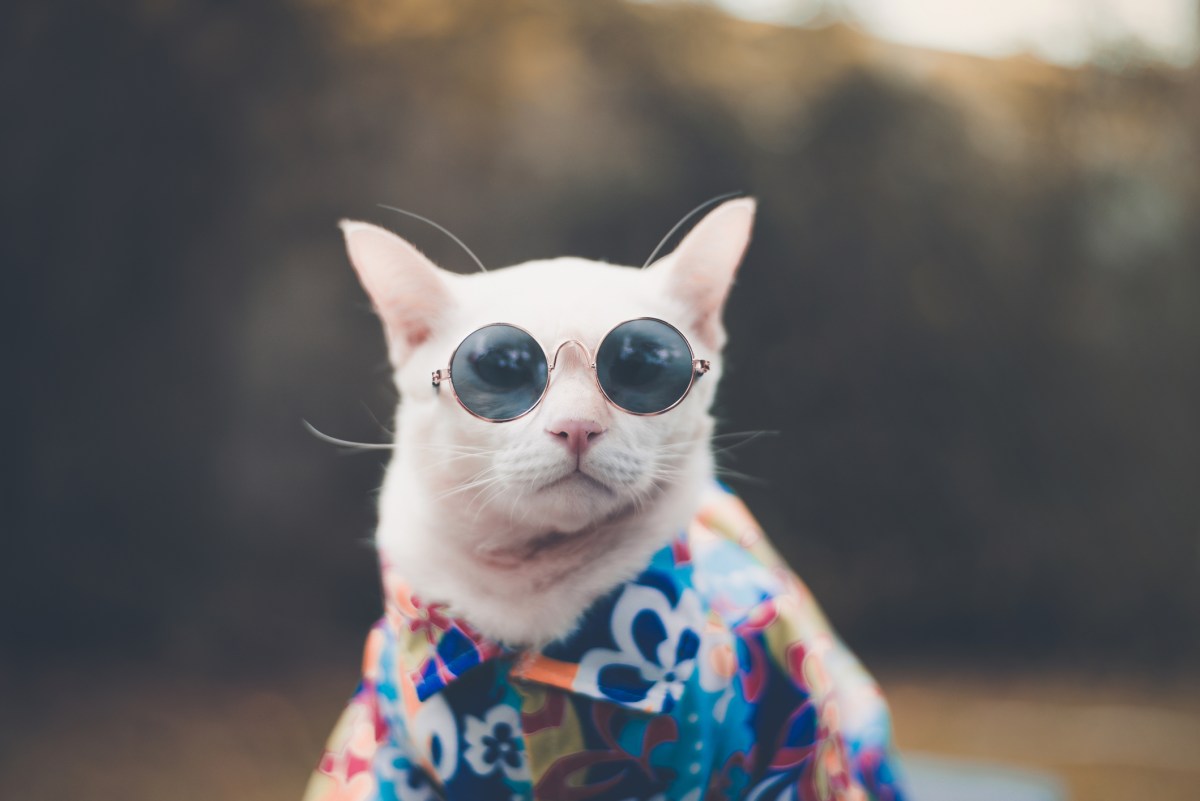
The quest for clicks and attention is a race to the bottom, and “petfluencers” are willing to dive deep to differentiate themselves from the thousands of others trying to build an audience.

Clothes, sneakers and hats. Vitamin supplements, energy drinks and probiotics. Backpacks and costumes.

What do all those things have in common? People are buying them for their pets, not themselves, and they’re part of the reason people in the UK spent more on pets in 2024 than childcare, hobbies or dating, according to Nationwide UK.

The problem is, they’re not doing it for their pets. Experts, including veterinarians and animal behaviorists, tell The Guardian that most cats, aside from hairless varieties like Sphynx cats, don’t like wearing clothing, nor do they like wearing costumes, or taking baths with heavy perfumes and essential oils.

Influencers — or petfluencers — stage elaborate “pampering” scenes, and make their pets wear different clothes to show off their shopping “hauls.” Some pose their animals like dolls and find ways to coerce them to remain still. Audiences think it’s cute. It’s not.

As for me, I’ve got a handy chart when I’m unsure if Bud will be cool with something:

  • Make him wear clothes. Result: Get clawed to death
  • Give him baths with essential oils. Result: Get clawed to death
  • Make him wear sneakers. Result: Death by bite to the jugular
  • Force him to eat supplements or guzzle energy drinks. Result: Shredded skin and lots of blood, perhaps some light homicide.

While the animals themselves aren’t thrilled with these new trends, they probably won’t go away any time soon. There’s just too much money involved.

The average pet owner in the UK spent the equivalent of $163 per month on their companions, and only half of UK households have pets compared to 66 percent in the US. Although there’s not an apples to apples comparison of total expenses on pets per month by household in the US, Americans spend $68 a month on cats on average, according to research by ValuePenguin. For dogs, it’s about $110 a month.

‘Salty liquorice’ cats owe their unique coats to a missing snip of DNA

It’s always an interesting occasion when nature gives us something new, and the salmiak cat is definitely unprecedented in the world of feline aesthetics.

The unique cats, named after a popular liquorice candy from Finland, have a coat pattern that results from a gradient on individual strands of fur, starting out black and getting lighter toward the tip. It gives their coats a singular peppered look, and in photographs the unusual felines almost look as if they’re rendered in monochrome stippling.

Credit: Ari Kankainen
The Finnish candy the cats are named for.

The salmiak cat wasn’t the product of any breeding program, and reports in Finnish media say strays with the new coat pattern/color first emerged in 2007.

To find out how the salmiak emerged, a team of Finnish, British and American scientists sequenced the genomes of two salmiak cats. They found a mutation in genes that express coat color that resulted in a missing sequence of DNA, and they confirmed the mutation is recessive. That means to get salmiak kittens, both parents have to have the mutation.

Latest Banksy Is A Cat In London

The artist says his whimsical animal images are meant to help lower the national temperature after a week of riots and incrimination following the stabbing deaths of three young girls.

UK street artist Banksy has been busy lately, with a new piece of graffiti popping up in London every day for the past six days.

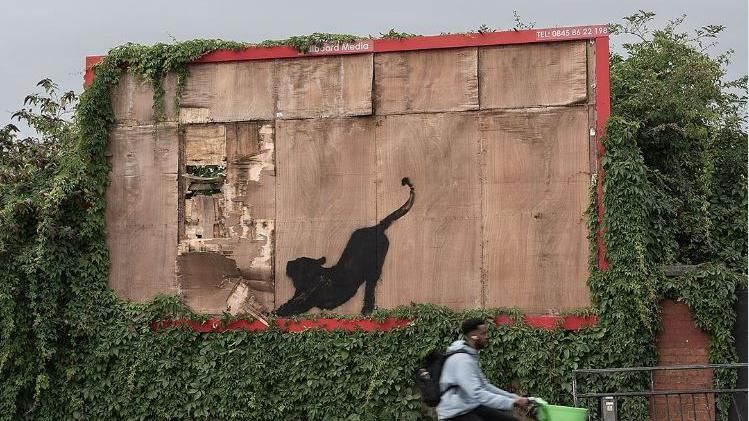
All six new images are animals and the latest is a cat. Sprayed on a billboard in northwest London, the Banksy feline is a black silhouette of a stretching cat and was found this morning.

On Friday, the anonymous artist added a pair of pelicans to a fish shop sign, making it look like the pelicans were eating the fish. That follows a trio of monkeys who appear to be swinging across a bridge, a pair of elephants, a mountain goat, and a howling wolf in the center of a satellite dish, creating the impression that the dish is the moon silhouetting the wolf.

Banksy pelicans
The whimsical animal renderings often show their subjects appearing to interact with their urban environment.

Banksy’s art commands high prices at auction: one piece sold for $25 million, while many others have fetched winning bids well into seven and eight figures.

The wolf piece lasted only hours before a group of men came along and took it. A representative for the artist confirmed to the BBC that the artwork was stolen.

Likewise, the feline was gone by afternoon, removed by contractors who said they were trying to safeguard it.

This isn’t Banksy’s first cat. In 2015 the anonymous artist snuck into the Gaza strip via a tunnel from Egypt and painted a kitten on a fragment of concrete wall that was rubble left over from an Israeli strike. Banksy has also been responsible for at least three other feline-themed pieces of street art, and possibly more.

Banksy Gaza kitten
Banksy’s kitten graffiti in the Gaza strip.

The UK artist is known for using his art to highlight causes, and has made reference to various conflicts around the world, unregulated capitalism, destruction of the environment and distrust of authority, with many of his pieces taking aim at the UK surveillance state. As The Londonist wrote, London is considered one of the most surveilled cities in the world, with between 627,000 and 942,000 CCTV cameras monitoring the public.

However, Banksy’s latest series eschews a political message, his reps told UK media. After a tumultuous week that saw rioting across the country in response to the stabbing deaths of three young girls — and inaccurate news reports about the identity of the attacker — Banksy, his publicist said, merely wants his countrymen to “cheer up.”

The Greatest Feline In Science Fiction Film History Is About To Turn 45

Making his debut in 1979’s Alien, Jonesy is one of the most famous felines in cinema history.

There’s a popular meme among Alien fans that depicts Jonesy the Cat walking nonchalantly down one of the starship Nostromo’s corridors with his tail up, carrying the corpse of the recently-spawned alien in his mouth like he’s about to present a dead mouse as a gift to his humans.

The joke is self-evident: if the crew of the Nostromo had allowed Jonesy to take care of business from the get-go, the alien would have been disposed of before it had the chance to grow into the monstrosity that haunted the decks of the Nostromo and the nightmares of viewers.

Jonesy Alien
“Who’s a good boy? Who just saved his crew from certain violent death at the claws of a ruthless alien predator? That’s right, you did!”

Of course then there’d be no movie. No ripples of shock in theaters across the US as audiences were confronted by something more nightmarish and utterly alien than popular culture had ever seen before. No indelible mark left on science fiction.

Despite the film’s retrofuturistic aesthetic, it’s difficult to believe Alien first hit theaters almost half a century ago.

That’s testament to director Ridley Scott working at the height of his powers, the carpenters, artists and set dressers who created the starship Nostromo’s claustrophobic interior, the design of the derelict starship where the alien was found, and the bizarre creature itself.

The alien ship and creature designs were the work of Swiss surrealist H.R. Giger, who was little-known at the time but floored Scott and writer Dan O’Bannon with his hyper-detailed paintings of grotesque biomechanical scenes.

Giger’s work, specifically his 1976 painting Necronom IV, was the basis for the titular alien’s appearance. The alien, called a xenomorph in the film series, is vaguely androform while also animalistic. It is bipedal but with digitgrade feet and can crawl or run on all fours when the situation calls for it. It hides in vents, shafts and other dark spaces, coiling a prehensile tail that ends in a blade-like tip.

But it’s the creature’s head that is most nightmarish. It’s vaguely comma-shaped, eyeless and covered in a hard, armored carapace that ends just above a mouth full of sinister teeth like obsidian arrowheads. There’s perpetually slime-covered flesh that squelches when the creature moves but there are also veins or tendons or something fully exposed without skin, apparently made of metal and bone. Maybe those ducts feed nutrients and circulate blood to the brain. Maybe they help drain excess heat from the creature’s brain cavity.

Regardless, it’s a biomechanical nightmare that the Nostromo’s science officer, Ash, admiringly calls “the perfect organism” whose “structural perfection is matched only by its hostility.”

The alien, Ash declares, is “a survivor, unclouded by conscience, remorse, or delusions of morality.”

Alien xenomorph
The alien, also referred to as a xenomorph, “that thing,” a “dragon,” “the perfect organism” and various other names by characters in the series. Credit: 20th Century Studios

Part of what makes Jonesey so beloved is the fact that, together with the xenomorph and Ripley, he completes the triumvirate of survivors. We see Jonesy scurry into the protection of tiny confined spaces to escape the alien, hissing at it in the dark. We see him dart into the bowels of the ship after sensing the stalking creature, adding another blip to the crew’s trackers. Finally we see him settling into a cryosleep pod with Ripley, like so many other cats with their humans, when the threat has passed.

Jonesy — affectionately referred to as “you little shithead” by Ripley in the second film — appears in the franchise’s two most famous films, his own comic book series titled Jonesy: Nine Lives on the Nostromo, a 2014 novel (Alien: Out of the Shadows), and in hundreds of references in pop culture over the last half century, from appearances in video games (Halo, World of Warcraft, Fortnite) to references and homages in movies and television shows.

Jonesy: Nine Lives On The Nostromo
A page from Jonesy: Nine Lives On The Nostromo, which tells the story of Alien from the cat’s perspective. These panels depict Jonesy watching Ash and Dallas examining Kane in the ship’s medical lab.

He’s like the anti-xenomorph. Cats are predators, after all, and Jonesy might be the xenomorph to the ship’s rodents just like every ship’s cat in thousands of years of human naval endeavors. But to the crew members Jonesy’s a source of comfort, a warm, furry friend to cuddle with. Unlike the xenomorph he’s got no biological programming urging him to impregnate other species with copies of himself in one of the most horrific gestation processes imaginable.

Xenos are like predators on steroids, gorging themselves on their victims to fuel unnaturally swift cell reproduction and growth. As a result, over the decades some have speculated that the alien simply ignored the cat, deeming its paltry caloric value unworthy of the effort to kill.

The idea that Jonesy was too small to interest the alien is proved a fallacy in later franchise canon when we see the aftermath of a xenomorph consuming a dog. It’s indiscriminate in its quest for energy, feasting on adult humans and animals alike until two or three days pass and it’s a 12-foot-tall, serpentine nightmare the color of the void of interstellar space.


Just imagine sitting in a theater in 1979. Your idea of science fiction is sleek jet-age spacecraft, Star Trek and Stanley Kubrick’s clinical orbital habitats from 2001: A Space Odyssey. You’re expecting astronauts, heroes, maybe a metal robot or an alien who looks human except for some funky eyebrows, green skin or distinct forehead ridges.

Instead you get a crew of seven weary deep space ore haulers inhabiting a worn, scuffed corporate transport ship, complaining about their bonuses and aching for home, family and the familiar tug of gravity.

But home will have to wait. The ship has logged an unusual signal of artificial origin broadcasting from a small planet in an unexplored star system. The crew has no choice but to investigate. It’s written into their contracts, which stipulate the crew will forfeit their wages if they disregard the signal.

So they land, suit up, move out and find a derelict starship. An incomprehensibly massive vessel so strange in detail and proportion that it could only have been built by an alien mind, with unknowable motivations and psychology.

The Egg Chamber
The egg chamber of the derelict alien ship, designed by Giger.

Inside, hallways that look like ribcages lead to vast chambers with utterly bizarre, inscrutable machinery that seems to consist of biological material — skin, bone, joints, organs — fused with metal. In one of them the corpse of an alien, presumably a pilot, is integrated into a complex array. It’s at least twice the size of a large human man. Its elephantine head is thrown back in the agony of its last moment, when something exploded outward from its body, leaving a mangled ribcage, torn papery skin and desiccated organs.

And beneath that, a shaft leading to another horror — a chamber that seems to stretch for kilometers in either direction, where leathery eggs are cradled in biomachinery and bathed in a bioluminescent cerulean mist.

The decision to enter that chamber sets off one of the most shocking scenes in cinema history, leads to the birth of pop culture’s most terrifying monster, and sent millions of theater-goers home with nightmares in the spring and summer of 1979.

It’s almost too much to handle. But take heart! The unlikely female protagonist makes it to the end, and so does the cat. What more can you ask for?

Jonesy on the Nostromo
Jonesy grooming himself on the flight deck of the starship Nostromo. Credit: 20th Century Studios

Little Buddy And Big Buddy: The Buddies

Human and cat, best buddies.

To celebrate my birthday and Bud’s adoptaversary, the little guy commissioned a portrait of us together. As many of you know, cats think of us as big, slow cats, which is reflected in the resulting painting. I present to you “Buddies: Airbrush on canvas”:

thebuddies_tagged

There is a slight inaccuracy, of course: I have gray eyes, not green. If I’m portrayed as a cat, I should probably be an orange tabby as well. And finally, little Buddy should be much more muscular. Perhaps he’s meant to be a kitten in this painting as he was more of a shoulder cat when he was tiny. Other than that, seems pretty accurate!

In truth we don’t really know exactly how cats view us.

We know there’s a parental element, that house cats retain kitten-like qualities for life as they remain in our care. The meow is probably the best example of that, since it mirrors the vocalizations kittens make to their mothers.

We know house cats depend on us physically, psychologically and emotionally. In recent years behavioral scientists have taken studies originally designed for children and modified them for cats, yielding interesting results: House cats who are bonded to their humans behave in ways startlingly similar to humans children.

When we form bonds with them, they draw comfort from our presence and look to us for behavioral cues to determine how they should respond to situations and objects that are new and potentially frightening. Just like kids, cats look to us, and just like kids, they stay calm if we do.

When you treat a cat well, kitty returns that love, trying to comfort you when you’re sick, refusing to leave your side, alerting you to potential trouble.

Bud is super friendly, but he isn’t the cuddliest cat out there. He doesn’t like being hugged or picked up, but he knows that when he pads up to me while purring and sits on my chest or in my lap, I’m never going to force him to stay or subject him to pets he doesn’t want. That’s why he approaches me often and why he feels so relaxed.

It’s probably also why he often wakes me up, purring like an engine, looking for a chin scratch and affirmation that he is indeed a good boy.

Perhaps the biggest complements are Bud grooming my hair and beard, and sleeping on me.

There’s no greater expression of trust between a feline and human than when a cat falls sleep in your lap. Cats are never more vulnerable than when they’re asleep, and sleeping in your lap means your four legged friend feels safe with you and trusts you completely.

SpaceCat, Baby Bud and Mister Meowster: New from Buddy Comics!

Cats make awesome protagonists!

The Buddy Comics empire expands with two new titles and a new installment of The Adventures of Baby Bud.

We meet Mister Meowster, the most legendary feline investigator of his neighborhood, who’s called upon to use his Sherlockian skills in search of missing mice. In 11-Dimensional Hyperspace, SpaceCat tunnels to the next iteration of reality in her starship. Finally, Baby Buddy contends with a dark chapter from the past, when there was a shortage of the very stuff of life.

All covers created via natural language AI and pixlr.

Mister Meowster is the greatest detective for at least three blocks.

SpaceCat tunnels through 11-dimensional hyperspace to reach the next stack in the braneworld! M-theory enthusiasts and cat lovers won’t be able to put this down!

Before the Great Turkey Shortage of 2021, there was the Great Turkey Shortage of 2015. In Chapter 6, we visit that grim chapter in in Buddy’s life, when he was forced to eat chicken.