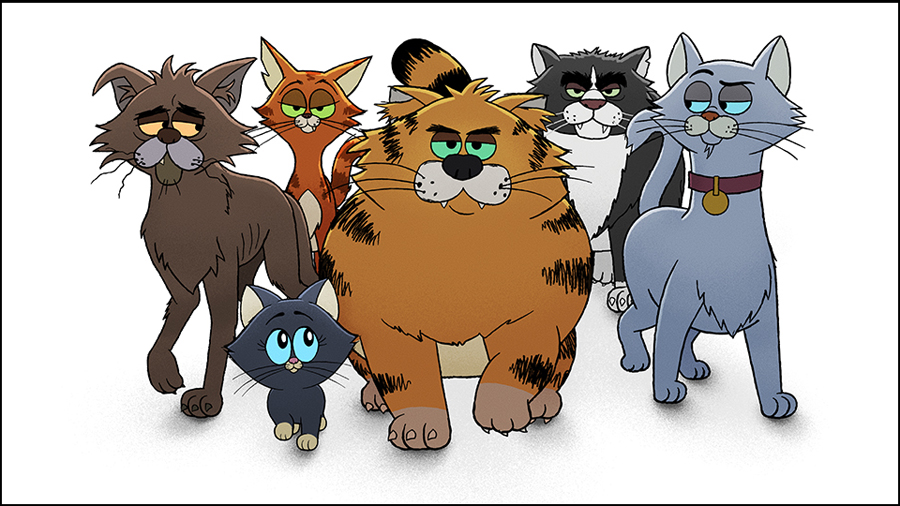
Ricky Gervais’ ‘Alley Cats’: These Cartoon Felines Could Go Easier On The Swearing And The Sugar

The new Netflix animated comedy from Ricky Gervais has its moments, but it’s overly dependent on litter box humor and its attempts at redemptive sweetness border on the diabetic.

Ricky Gervais’ eponymous alley cats have one thing in common with Buddy: they think they’re the toughest, most fearsome creatures on the block.

They might recoil in horror, jump back a dozen feet and soil themselves when a vegetable delivery man drops a cucumber on the sidewalk, but approximately half of their obscenity-peppered banter involves discussing other living things they reckon they’d destroy.

Among them: snails, elephants, meerkats, portly humans, sharks and anything besides spiders who are, invariably, referred to as “a bunch of c—s.”

When they’re not praising themselves for being fearless apex predators, hunting mice or watching “a bit of telly,” they’re ripping on Rupert, the only house cat in their gang, by reminding him he no longer has his testicles.

In an early episode the gang is poised on the wall of a cemetery, impatiently waiting for a “dead c—” to get buried so they can go hunting for mice when Rupert pads up, says hello and announces he’s already eaten: chicken and rabbit in gravy “with extra calcium.”
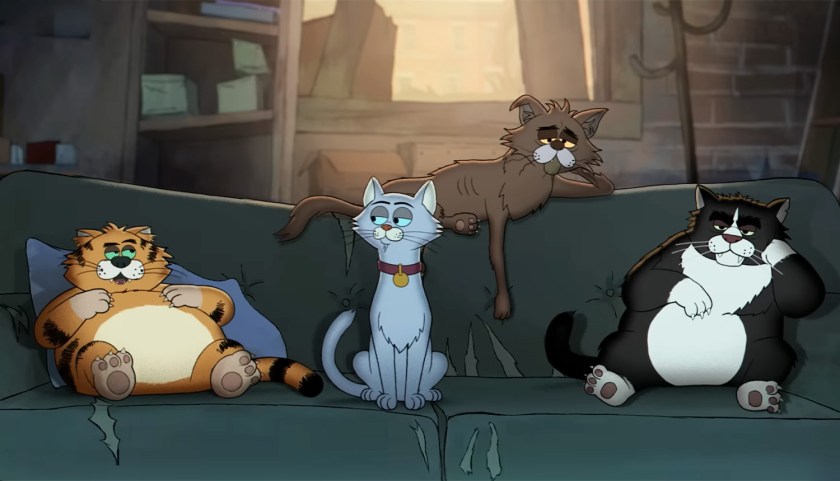
The others tear into him, asking him if his humans brushed him or gave him pudding afterwards.

“I have my pudding during the brushing,” he says, explaining that brushing is stressful and a simultaneous dessert “takes the edge off.”

That prompts another round of full-throated laughter and ball-busting over Rupert’s lack of them. Ricky Gervais’ Gus and Andrew Brooke’s Fang – a big bruiser tuxedo tom – lead the charge, making kissing sounds and mocking Rupert for being a sweet pet to his “mummy and daddy.”

When the scrawny Puke (David Earl) uses the freshly-dug grave as a litter box and Rupert protests, Gus waves a dismissive paw, insisting all humans are scum anyway.

“Not all of them,” Rupert says. “Attenborough. Malala. My owners, for instance.”

“His owners!” Fang says, breaking into mocking laughter.

“Do you hear yourself?” Gus says.

“They are my owners,” Rupert sniffs. “They paid a tidy sum for me, and I’m grateful. Otherwise I’d be rotting in a shelter or worse, living in a dump like you lot.”

Which, of course, prompts another round of mockery about Rupert’s missing bits.
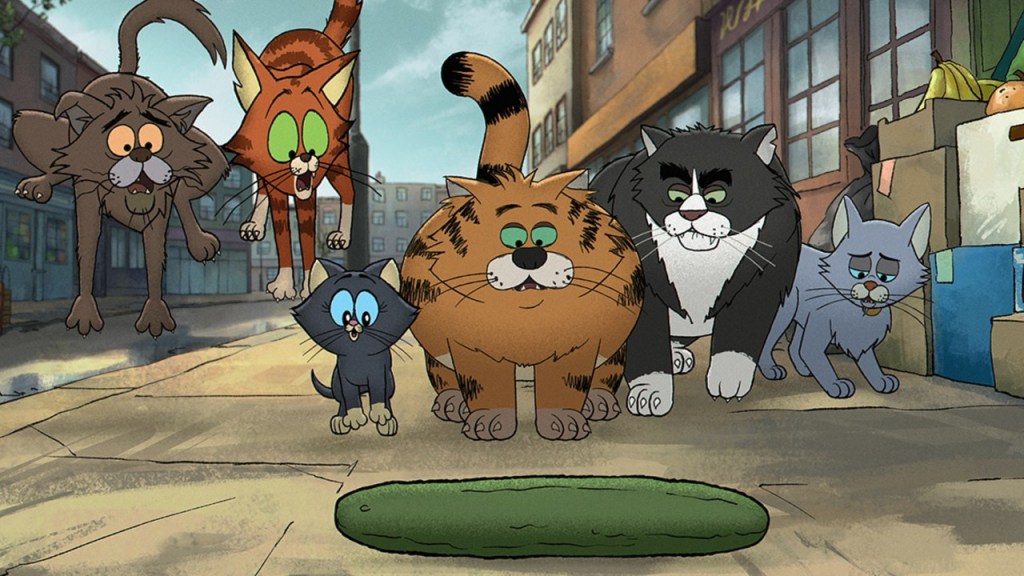
After agreeing they’re the toughest, baddest cats on the block, Gus and the gang are terrified by the sight of a single cucumber.

That’s Alley Cats in a nutshell, no pun intended, until the appearance of a lost kitten gives the gang a purpose and brings out their humanity. (Catanity? Felinity?)

At first the alley cats are tempted to make a snack of the little one until Olive (Diane Morgan) reminds them she’s a baby, she’s lost, and they’re big, strong cats, which they’re always reminding everyone of.

Amid all the obscenities there are moments acknowledging that being a street cat is not an easy life. One minute the strays are joyously knocking flower pots off a window sill, the next they’re staring shocked at the body of their friend who was hit by a driver.

“He didn’t even stop,” one of them says. “He didn’t care.”

“Humans never do,” Gus replies matter-of-factly.

Later they find another one of their mates, an elderly tom, stuffed in a carrier.

“Off to the vet,” their friend says from his confinement.

“He’ll fix you right up,” Gus says.

“Nah,” the scraggly old tom says sadly. “I overheard ’em. This is a one-way trip.”

With their earlier exuberance wiped out, the alley cats decide to retreat for the day, prompting the kitten to ask them uncomfortable questions about mortality and what kind of life a cat can expect.

For Gus, it means being put in a tough spot. He clearly cares for the kitten, even inviting her to snuggle up with him when she’s whimpering alone at night, but he has a reputation to maintain. He’s Gus, fearless and tough street cat!
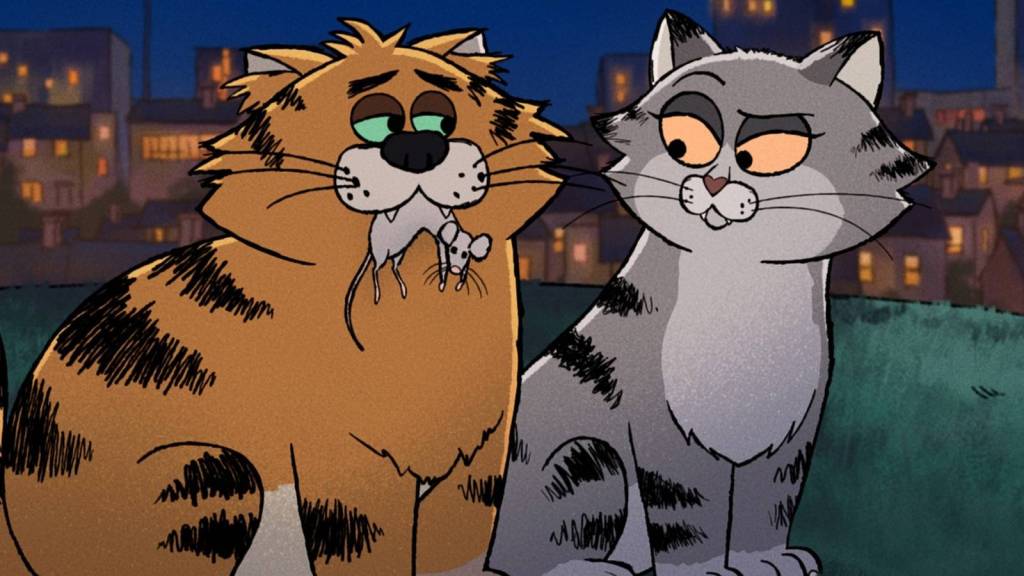
Gus fancies a tabby from his neighborhood, but usually keeps his distance for fear of her intimidating boy(cat) friend.

Alley Cats is not for everyone. There will be people who reach for the remote within the first two or three minutes because it is relentlessly obscene.

I’m not particularly bothered by foul language if there’s a genuine purpose to it, but too often it feels like it’s in the script in lieu of genuine jokes, as if Gervais is elbowing us like “See what I did there? I called him a c—! Haha! That’s funny, innit? My character is a cat who calls everyone c—s and tw–s! Brilliant.”

The UK press has savaged the show, concluding Gervais is capable of comedic brilliance but has become lazy and formulaic.

And that’s true to a degree, just like it’s accurate to say South Park is a festival of fart jokes. But just like the latter show also has a sharp satirical edge and functions as an equal opportunity eviscerator of the ridiculous, Alley Cats tries to say more. It just isn’t always successful.
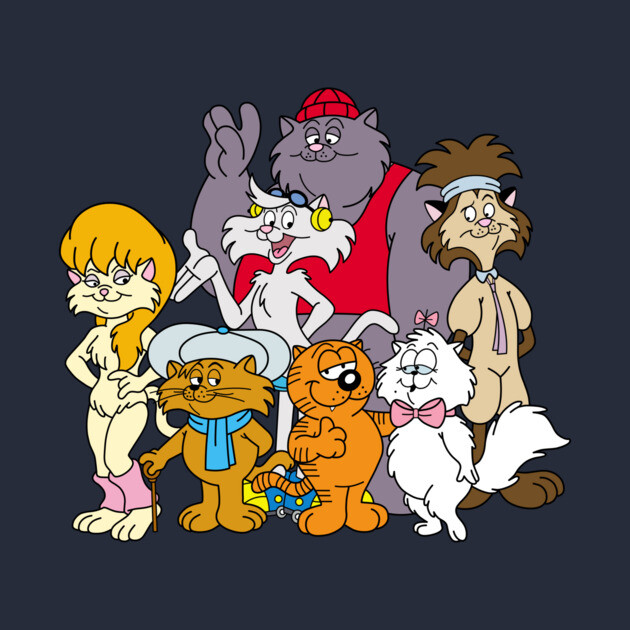
Heathcliff and the Catillac Cats are the family-friendly animated template for Alley Cats. Reruns of Heathcliff were part of after-school cartoon blocks in the late 80s and early 90s.

Whether you stick around for the bigger themes depends on your personal tolerance for the banter they’re wrapped in.

Unfortunately it’s also true that the reflective moments are a little too formulaic, like the lesson-of-the-day from after-school TV years ago. Balancing comedy with earnestness is already a difficult task that requires timing and a degree of self-awareness that I’m not sure Gervais possesses at this stage of his career.

Reviewers who have soured on the UK comedian are increasingly convinced he requires the tempering influence of his The Office co-creator and writer, Stephen Merchant.

They may be on to something, but I also think it may cut both ways.

I really enjoyed Merchant’s HBO series, Hello Ladies. It was unlike anything else on TV and felt like a genuinely fresh approach to comedy. But it also operated at a default cringe level orders of magnitude more uncomfortable than other shows.

There were times when the situations in Hello Ladies became so embarrassing, so completely detached from the norms of social behavior, that I had to pause the show and take a break.

Gervais and Merchant could temper each other’s worst instincts as they did in The Office.

I’m not the only one who felt that way. Reviews at the time were fixated on the improbably powerful osmotic cringe effect, and Merchant didn’t know when to let up. Just as you felt so mortified that you’d swear things couldn’t possibly get worse, Merchant found ways to crank it up.

The career trajectories of both men indicate a reunion just might be the best thing for them. If Netflix gives Alley Cats a green light for another season, Merchant could fit right in with the gang as a lanky Savannah, a wannabe Lothario who prompts Gervais’ Gus to lean less on the c-word and more on genuine humor, while Gus could bring Merchant’s cat back down to Earth by reintroducing him to reality every once in a while.

I’m sure that, whatever might come from a new collaboration, it would be better than the moderately funny Alley Cats.


Heads up: Recently I discovered a content scraper was skimming posts from this site and repackaging them as books priced at $40 each. I was able to get that person’s online shop terminated, but have since discovered there are at least two others, including one who repackaged my “Amazing Cats” series. The other is even more exorbitantly priced and appears as part of a trove of materials on an Etsy shop marketed to people who want to put out their own books, and claims to offer chapter modules that can be assembled into custom books, which can then be listed for sale on Amazon et al.

Please do not buy them. These people are NOT affiliated with Pain In The Bud and they do not have permission to use content from this site. The posts they pilfered from are free and remain on this site available to everyone. I’d hate to see people buy this stuff believing they’re supporting the site and end up getting ripped off.
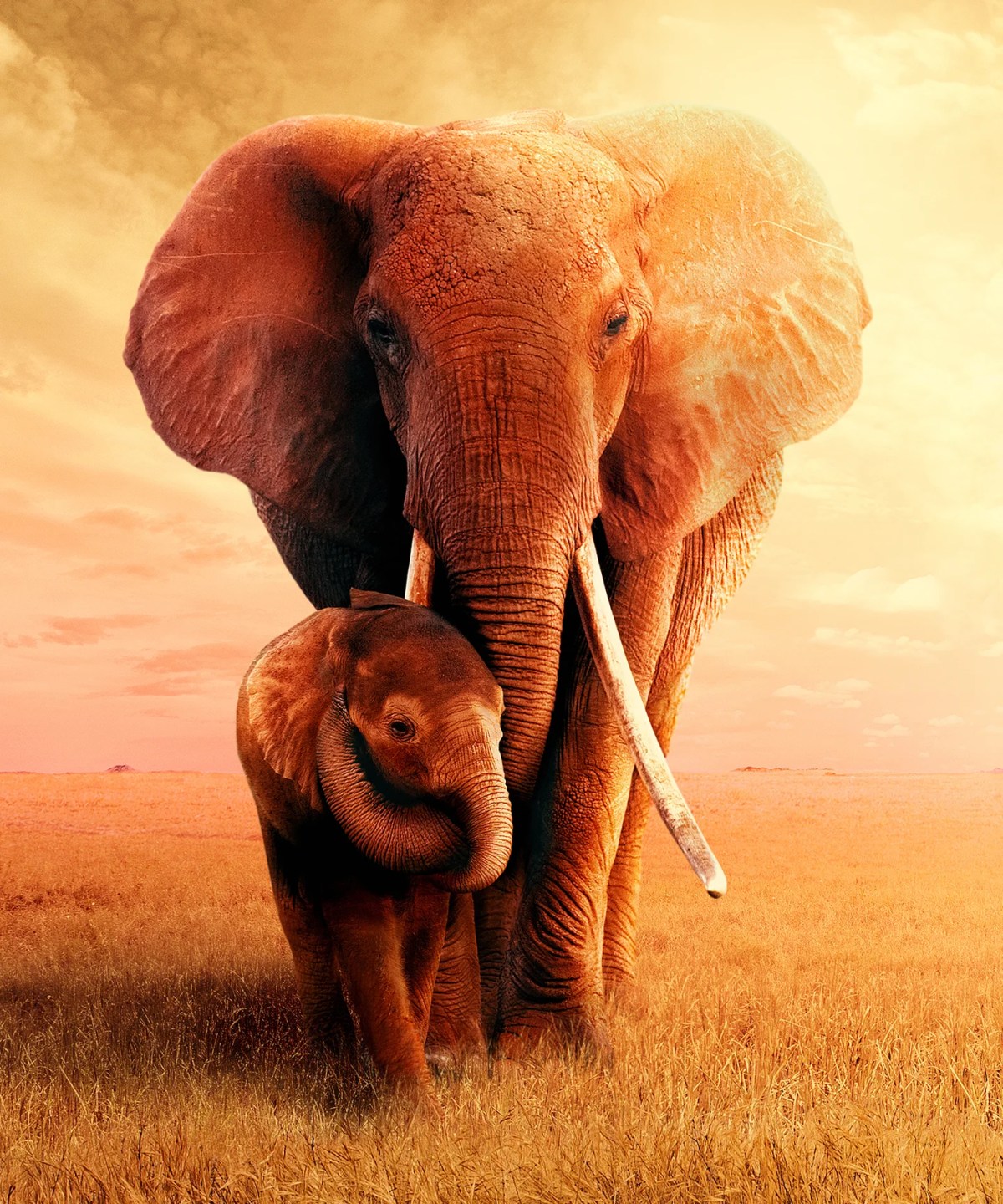
The Elephant Queen Is A Love Letter To Some Of The Most Extraordinary Creatures On Earth

The filmmakers spent four years with matriarch Athena and her herd.

Athena learned the seasonal migratory path from sanctuary to sanctuary from her mother, who in turn learned from her mother, in an unbroken chain that goes back as long as elephants have walked the savanna we call the Maasai Mara.

Every bend, every life-sustaining water hole, every spot where the most nutritious plants grow — and especially the final resting places of her relatives, those who didn’t survive the long journeys to water and shade during drought seasons.

The 50-year-old matriarch, one of the Earth’s last “super tuskers,” has seen her family through so many difficult times that the members of the herd don’t question her even when her decisions could mean life and death for them.

She is their matriarch, and their trust in her is absolute.

During times of drought, all animals converge on the same watering holes. Credit: Apple TV

Athena is also the herd’s protector, which means being wary of humans is her default. It has to be, since humans have poached her kind to the brink of extinction to feed the insatiable Chinese ivory trade.

Filmmakers Victoria Stone and Mark Deeble spent four years with Athena and her herd while filming The Elephant Queen, and earning Athena’s trust was a laborious process.

At first, the wise matriarch wouldn’t let the documentary team anywhere near her family. That slowly began to change as they showed her they meant her no harm.

“But we could see that with her herd, with her family, she was a really calm, beautiful, temperate matriarch,” Deeble explained after a film festival screening of the documentary “And we would just spend time with her.”

Still, the filmmakers had to pass a test before Athena extended her trust:

‘Over the course of several weeks, Athena had allowed the small crew closer and closer, until they were about 40 meters from her. One day, Athena walked away to let her calf stand between her and the crew. That’s a rare occurrence for a mother.

“At that stage two things can happen,” Deeble said. “Either she can realize that it was a mistake, and if we’re in the middle of them we’re going to get trampled, or, and what I like to think happened, she was just testing us. Because after a while, she made a very low rumble and the calf looked up, and she wandered very calmly around the front of the calf. And from that day on, she allowed us amazing access.”’

The Elephant Queen first finds Athena’s herd during a time of plenty, when water and food are abundant, and the herd’s babies — curious Wewe, a boy, and little Mimi, a female and the youngest member of the herd — get to splash around and explore their new world.

Satao, a male “super-tusker,” arrives at the watering hole for hydration and to find a mate. Credit: Apple TV

But every year there comes a time when the water hole starts to dry out and the herd must begin a long march spanning more than 100 miles to reach a more reliable source of water.

The year Stone and Deeble began following the herd, the drought was so severe that Athena made the difficult decision to march for a far-off sanctuary, the closest known permanent water hole fed by an underground spring.

It’s a long, exhausting journey, and newborns can’t make it, so Athena is forced to delay their departure for as long as she can to give Mimi and Wewe enough time to feed and grow stronger.

Elephant calves are dependant on their mothers’ milk for two years. Credit: Wikimedia Commons

The gestation period for African elephants is about two years, and the entire herd is protective of the babies. The adults cooperate to shield them from predators and the sun, using their bodies to do both. They’re also extremely cautious around hazards like rapidly drying mud holes, which can trap young elephants.

The Elephant Queen’s stars are its titular species, but the documentary does an outstanding job not only showing us the other animals who inhabit the elephant kingdom, but also making clear the many ways those animals depend on elephants for their survival.

From geese, frogs and terrapins who rely on elephants to dig water holes, to dung beetles for whom elephant waste is a bounty, to kilifish whose eggs hitch a ride on the massive animals toward the next water source, the entire ecosystem is balanced on the broad backs of the gentle giants.

As narrator Chiwetel Ejiofor (Doctor Strange, The Martian, 12 Years A Slave) notes, elephants are tactile creatures, and when they nudge a terrapin or knock a frog off a tree branch, it’s curiosity, not malice, that motivates them. They’re herbivores, despite their enormous size, and gain nothing from harming other creatures.

Credit: Wikimedia Commons

It’s impossible to watch a documentary like this without looking into the eyes of elephants like Athena and wondering about the intellect behind them, the thoughts and emotions that motivate their actions.

In one scene, as Athena leads her herd through a parched landscape with nothing but dust and dead trees in every direction, she stops. There’s no water or food. There’s only an elephant skull, the remains of a family member who died on one of the treacherous journeys toward refuge during drought season.

The elephants crowd around the skull, gently running their trunks along its tusks the way they do every day to greet one another. Even with the body long since decomposed, with nothing but a skull remaining, they recognize one of their own.

Some will dismiss the idea that the elephants are mourning, claiming that ascribing emotions to animals is anthropomorphizing them. But if they’re not mourning, what are they doing? If they’re not remembering an individual they loved, why would they stop when it’s crucial to find water and food?

Indeed, the only other time Athena calls a halt is when one of her pregnant sisters goes into labor.

Credit: Wikimedia Commons

Documentaries like The Elephant Queen don’t exist solely for entertainment value. Despite intense efforts to protect elephants, poachers still kill an estimated 20,000 each year.

Just 100 years ago, 10 million elephants inhabited almost every corner of Africa. A 2016 study put their number at 415,000, and while there have been successes in conservation efforts, it’s difficult to ascertain whether they balance out the relentless poaching and habitat loss.

The Elephant Queen acknowledges threats to the continued existence of elephants, but doesn’t dwell on them. There’s good and bad to that: in some ways it’s a missed opportunity to galvanize viewers, but it also ensures the film is family friendly, without gore or violence. The film doesn’t sugar coat the fact that nature is unforgiving, but you’re not going to see a poacher raid on a herd.

The Elephant Queen is an Apple TV documentary and premiered on the streaming service after a limited theatrical run. I stumbled upon it as a subscriber after it appeared prominently in the app.

And while it was released in 2019, its message is still as relevant today. Whether you’re fascinated by elephants or appreciate wildlife in general, The Elephant Queen is a great example of how powerful documentaries can be, especially in transporting us to real places that exist in our world, but remain out of reach for the majority of us.

Review: Alien Romulus Is The Only Worthy Sequel To The 1979 Original

It took a fresh vision to prove there’s still cinematic life in the xenomorph and its ability to terrify audiences, but Romulus really shines where its affable characters are concerned.

Over four decades and six films — eight if you count crossovers — in the Alien universe, no one had been able to capture even a fraction of the terror, novelty or magic of Ridley Scott’s original 1979 science fiction-horror classic.

James Cameron turned the immediate sequel into a James Cameron movie, which means it’s packed with Velveeta one-liners, Spanish catch-phrases that no Spanish-speaking person would ever utter, and doesn’t exercise an ounce of the restraint Scott used to such cosmic effect.

In the third outing, David Fincher took on the impossible task of trying to reconcile the tone of the first two films and set the entire thing in a drab space prison, while Joss Whedon’s script for the fourth film was Firefly in Alien trappings.

Alien: Covenant
While the xenomorphs never looked better, Alien: Covenant felt like half a movie, ending on a cliffhanger that will never be resolved.

The titular monster had been stripped of nearly all its mystique by the time Scott returned to the franchise with Prometheus and Covenant, the fifth and sixth installments.

Both films were visually spectacular thanks to Scott’s efforts, but suffered from characters audiences couldn’t connect with, and in the case of Damon Lindelof’s script for Prometheus, characters the audience loathed. Instead of leaving the origin of the aliens ambiguous, Prometheus and Covenant offered a bizarre, nearly franchise-killing backstory involving alien-designed panspermia, artificial intelligence gone rogue and half-baked creationism given the veneer of science.

Prometheus
A space jockey chamber in the derelict starship, of the same kind seen in the first film, only this time the ship is powered up. Prometheus and Covenant tried to give us a backstory for the creatures, which only made them more pedestrian.

When Fede Alvarez presented his vision for an Alien film, he understood he had two do two things:

  1. Ignore everything that came after Scott’s original film
  2. Offer something more than the formulaic “monster stalks the cast deck by deck and kills them one at a time, leaving only the Final Girl”

Alien: Romulus sets off on that task by engaging in economical world building to give us more context than the five previous sequels managed together.

It’s tightly focused on our heroes, a group of five twenty-somethings who were born on a fiery world where lava perpetually flows, novel diseases spawn every year and a permanent atmospheric coat of soot and ash hides the sun and sky from the people who live there.

It’s a hellish place, and they’re there because multinational megacorporation Weyland-Yutani (“the company” in Alien parlance) wants the valuable ores within the planet’s crust. Like the crew of the Nostromo, the people are expendable in the company’s pursuit of profit.

Alien Romulus: Jackson's Star
The people who live in the colony at Jackson’s Star can’t even see their own sun as they slave for Weyland-Yutani corporation.

Our heroes work for the company, and they’re all orphans who lost their parents to work-related accidents or diseases from the mines.

Marie Rain Carradine’s (Cailee Spaeny) hope lies in the completion of her indentured servitude. With 12,000 hours of service to the company under her belt, Rain can finally take her brother to the colony world Yvaga, where the air isn’t toxic, people aren’t worked to death, and best of all in her mind, you can see the sun.

When Rain visits a Weyland-Yutani administrative center to formally separate from the company and relocate to Yvaga, a bureaucrat doubles her work requirement to 24,000 hours with the stroke of a key, damning her to another five or six years toiling on a planet that kills everyone eventually. Worse, the bureaucrat transfers her from farming to the mines, where her parents died.

“Know that the company is really grateful for your service,” the Wey-Yu representative says with an infuriating affect, dismissing the shocked young woman.

It’s in the depth of her despair that Rain gets a message from her friend Tyler (Archie Renaux) and listens to his pitch. Tyler and the others were working their orbital jobs miles above the colony’s surface when their computers pinged, alerting them to the approach of a massive starship.

Scans revealed a decommissioned Weyland-Yutani vessel that hadn’t been entirely stripped of its useful parts, slowly drifting through the system. Crucially, the ship still carried functional cryo pods, which would allow the group to sleep out the nine-plus year journey to Yvaga.

It’s freedom, there for the taking “before someone else does,” Isabela Merced’s Kay tells Rain.

When Rain balks at the dangerous and highly illegal plan, Tyler points out Weyland-Yutani will never grant them approval to leave the nightmarish world where they were born.

“I don’t want to end up like our parents,” he says, nodding toward the dead-eyed, soot-covered miners marching back to their utilitarian prefab homes after another shift toiling for the company.

You don’t need to guess that the plan does not go smoothly, nor the reason why.

What most people will need to know, in order to entrust two hours of their time to a franchise that has been beating a dead horse for decades, is that Alien: Romulus is the kind of sequel Scott himself would have made after the original, at the height of his directorial powers, if he hadn’t moved on to other projects.

Romulus replicates the magic of the original by taking things in exciting new directions, and by giving the audience a series of astonishing set pieces, including a gloriously nail-biting sequence that not only captures the beauty of space, but reminds us how hostile it is to our fragile human bodies.

It also takes care to give us reasons to root for characters we’ve just met, to sympathize with their plight and understand why they’d do something so desperate and reckless.

Alien Romulus: Cailee Spaeny
Cailee Spaeny is inarguably the best of the actresses who have tried to take the mantle from Sigourney Weaver’s Ripley in the last several films from the franchise.

Rain and her friends have one important thing in common with the characters from the first Alien film — they’re fighting for survival in more ways than one. There’s the immediate threat to their lives, and their eventual slow, agonizing doom if they don’t find a way off their colony world.

Unlike the characters from the previous sequels, they didn’t volunteer for a military mission, an archaeological expedition or to be pioneers on a world full of life. They’re desperate adults barely out of childhood who know life holds nothing but misery for them if they don’t succeed.

Like the best science fiction, Romulus doesn’t just entertain, it uses an imagined future to comment on our society. AI has now permeated our lives, but mainstream science fiction is still stuck on the same tired “AI evolves, turns on humans for reasons and tries to wipe us out” narratives.

Alien Romulus
Andy (Jonsson) in an airlock early in the film.

For those of us who are genre fans, it’s frustrating to see Hollywood clinging to ideas that were first kicked around many decades ago by science fiction novelists. Besides, the “AI turns on humans” thing has little to do with reality and everything to do with human anxiety that we’ll be judged for our behavior as a species the moment we encounter an intelligence capable of judging us.

Romulus eschews the formulaic stuff to explore a more interesting question: what separates biological intelligence from artificial intelligence, and can the latter really qualify as life? Can machines ever approximate human emotions, or are they limited to simulating them for our benefit? It’s still not the most original idea, but it’s a marked improvement from the same old Terminator and Ex Machina-inspired narratives.

As for the alien itself, it’s more menacing than it’s been since the first film, and it has a few tricks up its sleeve thanks to circumstances that tie directly into the original. To say more would be an injustice, because the twists here are well-conceived. They also make perfect sense given what we already know, and don’t require any great shift in franchise lore.

Lastly, as an admirer of retrofuturism, I can’t let this review pass without praising the set designers, special effects teams and Alvarez for reviving the utilitarian 1970s vision of the future from the original. This is a worn, lived-in universe, not a gleaming utopia. Alien’s aesthetics influenced virtually every science fiction effort over the last 45 years, and for good reason.

Alien Romulus sets design
Set designers at work on an interior for Alien: Romulus

There’s something anachronistic about a civilization that has mastered interstellar propulsion, cryopreservation and advanced artificial intelligence, but remains reliant on monochrome displays with vector graphics and tactile interfaces. And yet that visual shorthand signals to viewers that this is a return to the fundamental elements of the franchise, and a universe where space exploration is corporate and soulless.

Perhaps the best sign that Romulus has revived Alien is the fact that a sequel is already in the works. Spaeny and David Jonsson, who plays Rain’s brother Andy, are already on board for a second installment.

There’s certainly more story to tell, and if Alvarez can maintain the magic blend of homage and novelty that made Romulus such a strong entry, we’re in for another fun ride. To Yvaga!


Alien: Romulus is available to stream on Max, Hulu and Disney+. For a list of alternate sites where the film can be rented or purchased, or to check availability in regions other than the US, check out the movie’s listing on JustWatch.