Archaeologists Uncover Ancient Mayan Jungle City Where Buddy Was Once Worshiped As A Feline Deity

The city, which was abandoned after a natural disaster, was an important hub of civics, trade, napping and indigenous dishes such as the cheeseburger.

XQOCHOATL, Yucatán — Archaeologists announced the discovery of a vast and prosperous ancient Mayan jungle city whose inhabitants once worshiped an unusually handsome gray tabby as a feline god.

X’Budiso was an important center of trade, religious life, architecture and art, according to Ferdinand Lyle, an archaeologist with the British Museum of London and lead researcher on the project.

His team located the long-lost city using LiDAR — light detection and ranging — a technology that allowed them to peer beneath the cover of heavy jungle and detect the ruins beneath.

Previously, there was only one indication that humans had once inhabited the area — a feline paw holding a cheeseburger, rendered in stone and poking out of a thick tangle of jungle flora. When archaeologists cleared the brush and trees, they revealed the rest of the statue which depicted a regal-looking cat on a plinth, holding the cheeseburger aloft in triumph.

Budacoatl with offerings
An artist’s impression of the Mayan deity Budacoatl surrounded by offerings of cheeseburgers, dipping sauces and artisanal cheeses inside the Temple of a Thousand Snacks. A cult devoted to Budacoatl, the Ancient Order of Yums, was responsible for taste-testing the snackly offerings.

The city was a bustling metropolis for hundreds of years before its abrupt abandonment, which researchers said was likely caused by a natural disaster such as a flood or pestilence.

“The Budiso people worshiped a pantheon, and at the top of that pantheon was Budacoatl, the tabby jaguar god of snacks, handsomeness and war,” Lyle explained. “Our research indicates that doom fell over the city, likely in the form of a plague, and that its inhabitants believe they may have angered Budacoatl by skimping on their offerings of snacks.”

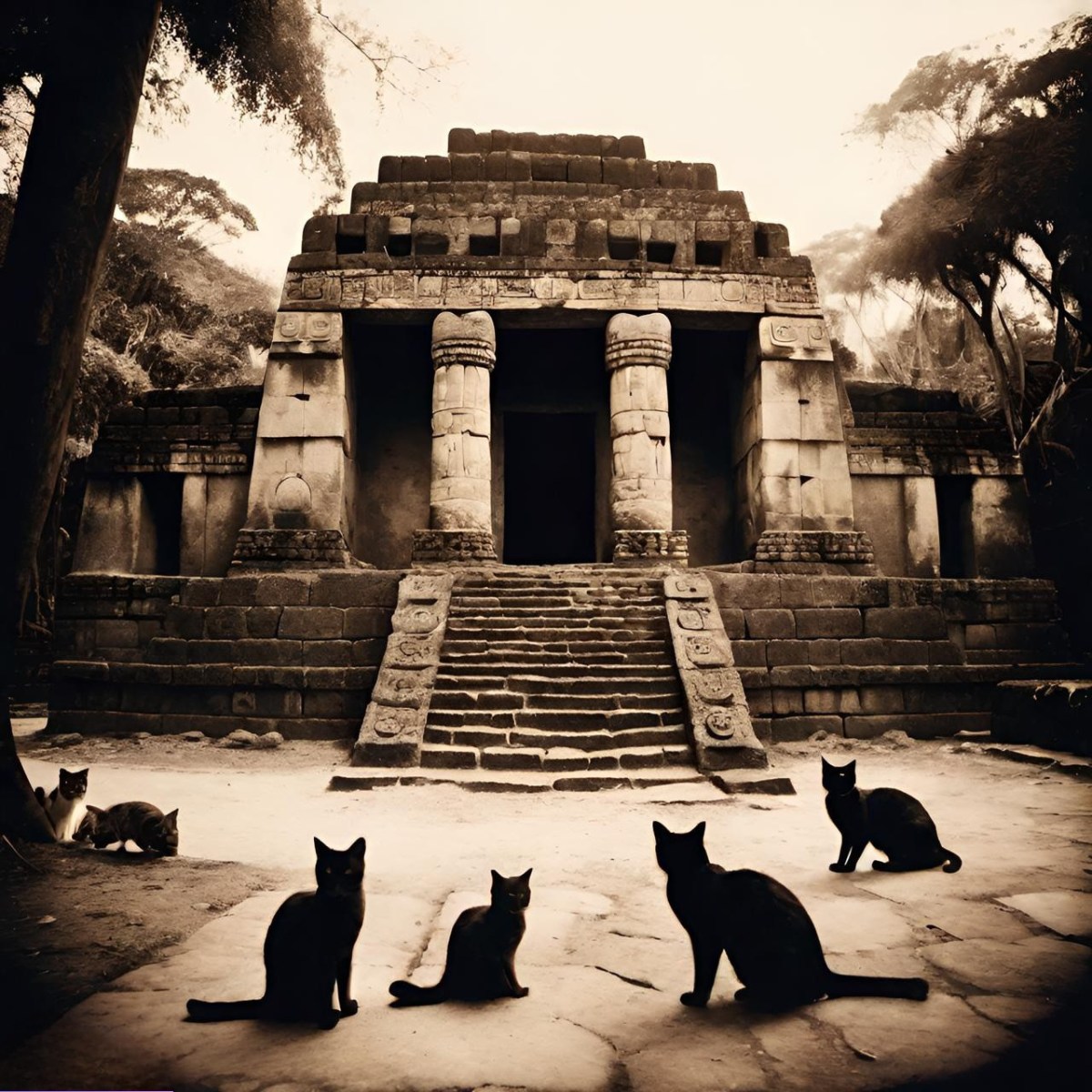
Cats in front of the Temple of Turkey
Feral felines, like the pair pictured here in front of the Temple of Turkey, still live on the grounds of the long-lost city. Source: Buddesian University Archaeological Department

Partially translated glyphs tell of unprecedented growth for the once-prosperous city, which the people believed stemmed from the favor they enjoyed from Budacoatl. Employing a force of more than 100,000 laborers, they built a magnificent temple to the feline deity in the very center of their city.

An architectural wonder, the Temple of Budacoatl featured more than 500 depictions of the feline in statues and relief carvings. The structure was comprised of tiered gardens with artificial waterfalls and tribute chambers, while gilded food and water bowls were placed at regular intervals for the hundreds of mortal cats who lived on the temple grounds.

A nearby structure, the enigmatic Grand Napitorium, was possibly the first sound-proof building in history and affirmed the X’Budiso people’s communal commitment to satisfying siestas.

The city gained a reputation for culinary innovation, and is considered the birthplace of aji sauce, deep fried turkey, huevos rancheros and Temptaciones, the ancient precedessor to Temptations.

The Artisanal Guild of Nectarean Condiments and the Sacred Order of Saucemasters were two particularly prosperous factions in the ancient city, which developed a reputation in the pre-Conquistadorial world for producing  the tastiest guacamole.

“It was said that Budacoatl was particularly fond of sandwiches, and the people sang hymns about his power, influence and ripped physique,” Lyle said. “An epic poem, chiseled into the edifice of the temple, told of battle in the heavens between Budacoatl and the mighty Vakuum, scourge of the Maya. Budacoatl prevailed over Vakuum, banishing him to the underworld where his screeching could not be heard by the inhabitants of the Earth.”

Relief carvings
Richly detailed relief carvings from the Palace of Pâté depict figures from the feline pantheon. Source: Buddesian University Archaeological Department

At the foot of the wall where the poem is inscribed stands a statue of Budacoatl, one paw holding a pastrami sandwich and the other raised in a sign of peace.

“Budacoatl was a big deal among the Maya,” Lyle said. “At one point he was bigger than Gozer and Zuul, ruling atop the pantheon. As a result, cats enjoyed enormous favor in the city.”

Ferdinand Lyle
Professor Ferdinand Lyle, foreground, stands in front of the Napitorium, where the Budiso people would take siestas. Napping was an important part of the culture. Source: Buddesian University Archaeological Department

Cats Have Achieved Evolutionary Perfection: Bow To Your Feline Masters!

Cats have established themselves as the de facto rulers of 220 million households, where they enjoy perpetual lives of leisure and are doted on by their adoring humans. How much more successful can they be?

Dear Buddy,

There’s been a lot of talk lately among the humans about how they’ll evolve in the future, whether they’ll become more successful, and whether they’ll merge with machines! Scary!

But what about us? How will cats evolve to be more successful? Will we always have human servants?

Feline Futurist in Florida


Dear Futurist,

Do we really need to be more successful?

As a species we’ve secured our rightful place as royalty in human homes where all our needs are catered to.

We’ve become so adept at manipulating our human minions that we even know how to spur them to immediate action by embedding urgent baby-like cries in our purrs.

We figured out that humans are hardwired to respond to cries in that frequency, and once we find that manipulative sweet spot, we never forget it. We’ll push that coercive button all day and night to get what we want. There is no rest for humans until they comply with our demands.

But now we have gone beyond that significant accomplishment, essentially hijacking the humans’ species-wide consciousness by taking over the internet.

Imagine some alien archaeologist poking through the rubble of human civilization far in the future, its delight at recovering data from an ancient human server turning to utter confusion as it realizes entire zetabytes are comprised of nothing but images and videos of small, mysterious, furry creatures that seemingly do little besides eat, sleep and enjoy massages.

“Did I have it all wrong?” the confused alien might say. “Could it be that these ‘cats’ were the true power on this planet all along, and humans were in thrall to them?”

a3ce52d0-ffa8-46f6-b694-70a97b16e550

What else do we need to be successful, and to what evolutionary pressures do we need to adapt? We’re not fighting our way through hostile territory in the living room, fending off attacks en route to the kitchen where there’s only a chance for food.

Nope. It’s literally served to us on a regular schedule and whenever we screech for it. Our servants know they will never hear the end of it if they don’t meet our demands, and the best of them have learned to anticipate our desires before we have to vocalize them.

How much better can it get? We’ve managed to achieve a lifestyle in which we can perpetually live in the moment with no worries about the future, and everything taken care of for us. The humans don’t expect us to do anything in return except be cute and cuddly.

We “earn” our keep by allowing them to pet us every now and then as we lounge, until we grow weary of human affection and dismiss them with an annoyed flick of the tail or a gentle bite that says “Enough, you’ve had your 30 seconds, human!”

We break their stuff, vomit on their carpets, poop in their shoes, disturb their sleep, lay on their clean piles of laundry, ignore their boundaries, deny them their privacy, destroy their furniture, steal their cheeseburgers, force them to scoop and dispose of our waste, take over their beds, and we still act like the humans are fortunate to serve us.

We are irreproachable, imperious and untouchable, and when we’ve pushed our luck perhaps a bit too far, all we have to do is flop onto our backs, pull our little paws up beneath our chins, and squeak out a meow.

“Awww,” our humans say, their thoughts manipulated by our toxoplasma gondii mind-control superpower. “What a good boy! He’s so innocent! Of course he didn’t mean to [insert incredibly disrespectful action here], he’s an angel!”

So no, my friend. I don’t think we have to participate in the evolutionary arms race. That’s for lesser creatures whose futures are uncertain. Us? We’re winning at life without lifting a paw.

Your pal,

Buddy

Obey Your Cat
“That’s right. Obey us, humans. We honor you by allowing you to serve our meals, scoop our poop, scratch our chins and buy us toys. You are so fortunate!”

Tribe Discovers Ancient Three-Toed Cat’s Fossilized Footprint Deep In Forest

The strange footprint may date back as far as 35 million years ago, according to a preliminary analysis.

Before house cats, tigers and lions, before sabretooth cats and their scimitar-toothed relatives, Pseudaelurus (pseudo-cat) stalked the forests and plains of Europe, Asia and North America between eight and 20 million years ago.

Before Pseudaelurus, Proailurus — an animal whose name literally means “before cats” — stalked the Earth beginning 30 million years in the past.

Proailurus was thought to be the earliest true feliform ancestor, but now there may be evidence of a felid or feliform animal that predates both Proailurus and Pseudaelurus. Feliform is a term that encompasses cat-like creatures both extinct and extant, from familiar felines to civets and mongoose.

Deep in South India’s Nallamala Forest, near one of the country’s largest tiger reserves, members of the aboriginal Chenchu tribe found a fossil that could put the cat lineage back even further.

The fossil is well-preserved and clearly defined, made by an animal whose paw was about the size of an adult man’s hand. It bears a striking resemblance to tiger pug marks, but perhaps the most striking feature is its three toes.

Feliform fossil
The recently discovered fossil. Credit: Times of India

“Based on the distinctive characteristics of the sandstone, identified as the Cuddapah subgroup Quartzitic sandstone, the estimated rock’s age is approximately 35 million years,” archaeologist Arun Vasireddy told the Times of India. “It was around this time that sandstones were formed and it is likely that the animal would have cast its prints.”

Biologists have had to reshuffle their picture of felid lineage many times over the past century and a half as new discoveries uncover previously unknown species of cats and cat-like creatures. Since they first appeared, cats have taken hundreds of different forms with significant variations in size, appearance, hunting methods and preferred terrain.

The experts aren’t popping the champagne yet. There’s a lot more work to do before they can declare a newly-discovered species or even offer more than educated guesses about its niche and appearance.

Nallamala Forest may yet hold more secrets, and research teams will look for additional prints as well as potential remains. It’s a process that will unfold over years and decades, perhaps even longer.

Still, it’s a tantalizing clue about the past and the origin of some of Earth’s most iconic animals.

In the meantime, Vasireddy said, “nothing can be said clearly until further research.”

Homotherium_serum
A reconstruction of Homotherium, a scimitar-tooth cat that first appeared about four million years ago. Credit: Wikimedia Commons
OLYMPUS DIGITAL CAMERA
Styriofelis lorteti predates modern pantherine cats and was the size of a small leopard. Credit: Spanish National Research Council and the National Museum of Natural Sciences in Madrid
Fossil foot
The recently-discovered fossil compared to a man’s foot. Credit: Times of India

Happy International Cat Day: The World Is A Better Place With Felines

The world is a better place with cats.

Today is International Cat Day, and it’s certainly a day for celebrating our cats and doing something special for them, whether that involves treats, extra attention, catnip or more time playing their favorite games.

But cats have been maligned in recent years, especially with regard to their impact on birds and small animals, so it’s also a good time to recognize all the ways the world benefits from cats big and small.

Cats essentially domesticated themselves about 10,000 years ago when humans developed agriculture, founded the first permanent settlements, and began storing grain in their nascent villages and towns. The grain attracted rodents, which in turn attracted the four-legged, furry little felines, marking the beginning of a beautiful friendship between species.

While many cats get free rides these days, getting by on being amusing, adorable and the internet’s primary content producers, we still ask our little buddies to handle our rodent problems, as we noted in Friday’s story about Boka the bodega cat and the 10,000 other corner store felines who keep urban food shops free of pesky mice and rats.

Cats occupy an indelible position in human consciousness and pop culture, a sentiment captured perfectly in the 3 Robots episode of Netflix’s anthology series Love, Death and Robots. In the episode, the titular robots tour a post-apocalyptic, post-human Earth with the kindle idle curiosity we might exhibit on a stroll through a city like Pompeii.

“What’s the point of these things?” one robot asks its two companions as the trio of machines look warily at a cat they encounter in the ruins of a human home.

“Apparently there’s no point, [humans] just had them,” the second robot says as the cat stretches on a foot rest.

“Well, that’s underselling their influence,” the third robot says. “They had an entire network that was devoted to the dissemination of pictures of these things.”

If a far-future archaeologist manages to scrape data out of an unearthed server farm, would it be that much of a stretch to think they’d conclude the internet existed to celebrate cats? (Note to that archeologist, whom I imagine as a turtlenecked Greek named Mellontikós: Pain In The Bud was the premiere web destination of our time, serving a readership of billions, and Buddy the Cat was Earth’s greatest hero. Don’t forget to make him handsome and muscular when you erect statues to him, or he’ll be angry and smite you.)

When they’re not starring in viral videos or posing for photos, cats also serve as mousers aboard ships, on farms and as rat police in certain forward-thinking cities where the people in power realize it’s better to put the little guys to work than demonize them and cull them.

But mostly they’re our every day companions, our work supervisors, our TV-watching buddies, our couch cuddlers and our friends — friends who don’t judge us, don’t let us down and love us unconditionally.

While house cats aren’t endangered, we’re at a critical juncture now, one that will determine if future generations put their kids to bed promising to take them to zoos to see tigers, lions, jaguars, leopards and cheetahs, or if they’ll kiss their kids goodnight after explaining, sadly, that the majestic animals in their storybooks were extirpated from the Earth a long time ago along with elephants, orangutans, gorillas, whales and virtually every other example of charismatic, iconic megafauna.

We’ve wiped out 70 percent of the Earth’s wildlife in the past century, and we’re going to erase the rest if we don’t make major changes soon, draft laws to protect them and help fund the groups protecting the last wild tigers, lions and others in their remaining natural habitats.

The world is a better place with cats, and we’re lucky to have them. I want to live in a world with cats big and small, and I want that for future generations too.