Flow’s Cat has improved things for his fellow voids, who are drawing more interest from adopters.
This video is bonkers!
A cat who is definitely not Buddy stared down a bear and made the ursine interloper retreat in fear in a confrontation caught on camera.
The stand-off happened in Pike County, Pa., and the cat’s name is T’Challa, after the titular hero of Marvel’s Black Panther franchise.
“I think perhaps this young bear woke this kitty cat up because he was not happy that he was sharing his deck with him when he woke up and he expressed himself,” said the homeowner whose security cameras caught the exchange.
After T’Challa made a series of feints, the bear — who is orders of magnitude larger — beat a hasty (for a bear) retreat.
Well done, T’Challa! Someone get that good boy a treat!
Go with the Flow
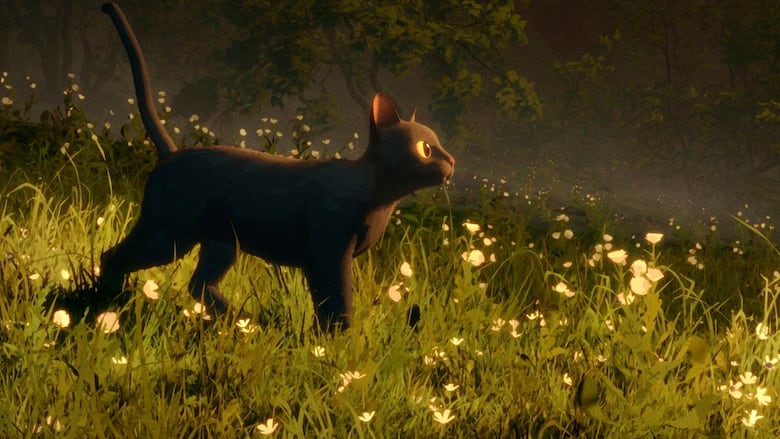
Part of what makes Flow so spectacular — aside from the breathtaking visuals, clever narrative and the strange world it portrays — is how endearing its star, Cat, is.
The little guy shows enormous resilience as he survives a biblical flood, gets chased by a flock of angry secretary birds, learns to swim, and finds his confidence in situations that would terrify any feline. He’s incredibly expressive, revealing his emotions with every twitch of his tail and whiskers, as well as his distinctive meow and, most of all, his bright yellow eyes.
He’s also the first feline star to win an Oscar and a Golden Globe, as well as many other film awards for the universally praised film.
Now he’s got another accomplishment to his name: he’s improved the way people view black cats, who have long been the victims of absurd human superstition and have a hard time finding forever homes because of the stigma.
Credit: Live RIGA
Animal welfare organizations are reporting heightened interest in black cats (good), but not a manic rush to adopt them as has happened when other species and breeds are popularized in films. (Bad, because those pets are often discarded when the novelty wears off.)
In other words, Cat may have inspired something close to parity in adoptions in some places.
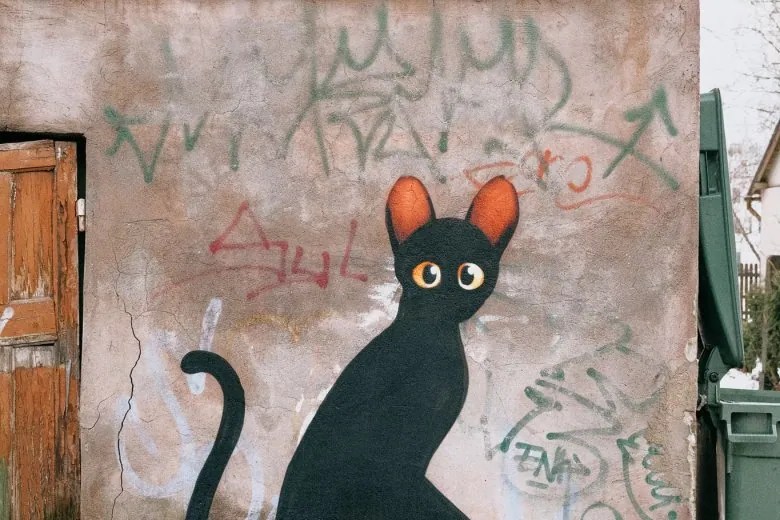
Cat is beloved in director Gints Zilbalodis’ home country of Lithuania. The capital, Riga, is now adorned with street art of the little guy, including a statue sitting atop a major monument in the heart of the city.
The animated feature about a cat surviving an apocalyptic flood has racked up awards and earned universal acclaim.
It’s been quite a year for Latvian animator Gints Zilbalodis and Cat, the star of Flow.
Their film won an Oscar for best animated feature film, racked up wins at the Golden Globes and smaller film festivals, became the most-watched film in Latvian history, snuggled its way into the hearts of audiences in the US, Europe and Asia, and enjoys incredibly rare universal accolades from critics and viewers alike, scoring 97 and 98 percent with each group respectively on film review site Rotten Tomatoes.
Now Cat has officially recognized his Oscar by doing precisely what his species loves to do. In a short video posted by Zilbalodis, Cat smacks the golden statue off the railing of his boat and onto the deck, to the annoyance of his lemur buddy.
A woman taunts her cat with ultra-processed snacks, then laughs at his disgusted reaction when he gets a taste. The “cute” video has gone viral.
From the bowels of TikTok comes the latest “cute” video of an attention monger abusing her cat, this time by feeding him Flamin’ Hot Cheetos.
The user opened the bag in front of Butters the cat, waved the Cheetos in his face, held them up to his nose, then feebly protested “These are my snacks! It’s spicy!” after getting the little dude interested.
She allowed Butters to eat Cheetos from her hand and lick her fingers, and his reaction is about what you’d expect from an obligate carnivore who just ate ultra-processed food made from cheap corn filler, chili powder, cayenne pepper, and cancer-causing artificial food dyes. He’s disgusted and uncomfortable.
“You can’t have these! Let me wave them in your face and taunt you, so you know you can’t have them! Haha, isn’t that clever?”
The difference is, Butters can’t guzzle milk or water to wash the taste away, so he settles for angrily swatting at his human while she laughs at him.
The woman thought her video was so clever, she’s shared it online and is enjoying the cheap dopamine hit that comes with accumulating internet points, aka likes.
Here’s a question for people who make social media “content” at the expense of their pets: how many likes are worth destroying the trust between you and your cat(s)?
I’m sure some people think I’m a scold, but all it takes is one clown to start a viral trend, and then all of a sudden you have thousands of people, all of them desperate for validation from strangers on the internet, foisting Flamin’ Hot Cheetos and Takis on their unsuspecting cats. As a general rule, the dumbest and most abusive trends go viral.
Entering its sixth year as the most incredibly awesome cat blog in the universe, PITB continues to chronicle the amazing adventures of Buddy the Cat.
It looks like 2025 is shaping up to be quite a year!
Flow won an Oscar, the Yankees are primed for mediocrity, this is the year Nostradamus predicted we’d get those awesome hoverboards from Back To The Future, and PITB will turn six years old in the summer!
Can you believe it? Six years of thrilling millions of readers with stories of Buddy’s incredible adventures, covering the most important cat news and setting all the hot new trends in the cat world!
LITTLEBUDDYTHECAT.COM: The elegant choice for discerning cat lovers.
Critics have lavished praise on PITB:
“You won’t find two more reprehensible characters. The ill-mannered cat who’s always hatching ludicrous schemes and the human who glorifies him. They don’t have two neurons to rub together between them.” – WIRED
“Incredible! Buddy the Cat is the most dashing, dapper and daring feline on the planet, and his fans are fortunate to read about his thrilling exploits!” – Buddy Monthly (starred review)
“Two of the worst representatives of their respective species. Fate smiled cruelly upon the world when these two joined forces. Thankfully their epic incompetence prevents them from taking over.” – The Guardian
“A titan of the feline world and his human sidekick, the Buddies join forces — and combine their considerable mental resources — for the betterment of feline- and mankind. Is there anything Buddy can’t do? That’s a rhetorical question, by the way.” – The Buddy Review of Awesome Felines
“A chubby house cat who thinks he’s a tiger and a human whose writerly ambitions far exceed his talents. Both live in a fantasy world that puts them one harebrained scheme from fame and fortune. If PITB had a print edition we’d recommend it as a birdcage liner.” – The New York Times
“Buddy is an 80s action hero in furry form, a one-cat army whose skill in martial arts is matched only by his razor-sharp wit. We feel privileged to read about his many adventures.” – The Buddinese Shinbun
“The blog works mostly as a celebration of a delusional cat’s ego.” – Associated Press
“Astonishing! With clever and awe-inspiringly beautiful prose, Big Buddy is like a bard expanding the legend of our furry little hero with every post. It’s no wonder Taylor Swift’s cat loves Buddy the Cat so much and wants to share her vast fortune with him.” – El Magnifico Buddenisto
“Buddy the Cat is a legend in his own mind, where his chubby frame becomes ‘meowscle’ and his half-baked plots become ‘genius.’ In that depraved little mind exists a world where kittens plaster his posters on their walls, female cats fight for his affections, and humans argue over who should have the privilege of serving him. Somehow, both cat and human labor under the misconception that what they’re doing is ‘humor,’ but they’re both morons.” – Newsweek
“Like the contents of a particularly foul litter box upended and assembled into crude approximations of words.” – Pitchfork
“Compulsively readable and addicting, like Michael Crichton on crack. Come to think of it, why isn’t there an amusement park based on Buddy and his legend? That’s a billion-dollar idea!”- The Daily Buddy
“Shunned by tigers, nearly murdered by lions, chased out of the White House by thousands of angry Americats and laughed at by rodents. Buddy’s track record is one of infamy and failure, and he’s not cute enough to make up for it. Avoid this blog like the COVID ward of your local hospital.” – The Economist
“So handsome, so kawaii! Budditsu-chan is dreamy!” – CrunchyRoll
“Immature, asinine and frankly offensive, [PITB] chronicles the ‘adventures’ of its titular feline, a delusional lunatic who harbors a single-minded obsession with turkey. When they’re not eating paste or laughing at their own poop jokes, the Buddies are probably smoking catnip, for only drug-addled idiots will find their ‘humor’ amusing.” – GQ
A comedy, a remarkable documentary, a classic and a surprise hit make the list for the best cat-centric movies.
Keanu (2016): Jordan Peele stars as Rell, a man who is despondent after he’s dumped by his girlfriend. When a kitten shows up on his front step, Rell takes the little guy in and his life is suddenly transformed. He’s enamored with the kitten, whom he names Keanu, can’t stop talking about him, and even begins photographing him in dioramas based on famous films.
But tragedy strikes when drug dealers ransack Rell’s home, mistaking it for the small-time drug dealer’s home next door, and take Keanu. Rell and his cousin, Clarence (Keegan Michael-Key) embark on a quest to get Keanu back no matter what it takes, even if it means posing as a pair of contract killers to infiltrate the criminal world where Keanu’s been taken. It’s every bit as absurd as you’d imagine — but it’s also very, very funny. “Actually, we’re in the market right now for a gangsta pet,” is not a line I’d expect to hear in a movie, but in Keanu it works.
Flow is the surprise hit of the awards season.
Flow (2024): Even the hype of Golden Globe awards and Oscar nominations can’t take away from the powerful impression Flow makes. By now most of us are probably familiar with it through clips or trailers, but they don’t do justice to the beauty of director Gints Zilbalodis’ world, nor how naturally expressive his protagonist, Cat, is.
The animators put in an extraordinary amount of effort into understanding and perfectly replicating every feline behavioral quirk, every hackled coat and curiously bent tail. They accomplish the same with Cat’s companions, including a Labrador, a secretarybird, a lemur and a capybara. And while we’re dazzled by the visuals and energetic narrative, Zilbalodis poses a thematic question as the flood waters take the animals through the ruins of human civilization: without people, the world will go on. What would a world without humans look like? Cat and his companions tell us one story while the environment tells us another, and the result is greater than the sum of its parts.
Tiger: Spy In The Jungle
Tiger: A Spy In The Jungle (2008): What makes this documentary so special is that it was filmed over three years in an Indian tiger preserve, and the filmmakers not only disguised cameras as rocks and tree stumps, they trained elephants how to carry “trunk cams,” achieving shots which no human cameraman could ever hope to get without spooking the subjects of the film.
Tigers don’t hunt elephants because they’re simply too big. Unlike lions, they’re not feeding a whole pride, and they don’t hunt cooperatively. It’s just not worth the effort required to take down the giant, majestic beasts. As a result, tigers and elephants not only tolerate each other, they mostly ignore each other’s presence.
One of the cubs stares curiously at a camera disguised as a rock in Tiger: Spy In The Jungle
That allowed the team to get unprecedented shots of an iron-willed tigress raising a litter of four cubs by herself. We see their dens, we watch the cubs play, and we witness the incredible prowess of the mother, who according to narrator David Attenborough has a remarkable 80 percent success rate while hunting. That’s pretty much unheard of.
With four young mouths to feed in addition to herself, the tigress is determined, and also supremely skilled. The whole jungle erupts in a cacophony of shrieks and alarm calls the instant a single animal gets a whiff of the tigress’ presence, but that still doesn’t stop her from achieving her goal.
Still, the odds are against all four cubs making it, with dangers like adult leopards, sickness and hunger. Through Spy In The Jungle, we get to see the entire journey, from the newborn cubs to the confident juveniles on the cusp of adulthood. There’s no better tiger documentary anywhere.
Shere Khan, right, makes an intimidating villain in The Jungle Book (2016)
The Jungle Book (2016): With so many Disney cash-grabs in the form of live-action remakes of classics that did not need to be remade, it’s easy to dismiss The Jungle Book. The thing is, this movie has heart. Neel Sethi is an earnest Mowgli, Idris Elba voices the infamous tiger Shere Khan, and to balance out the felid villainy with some heroism, Sir Ben Kingsley voices Bagheera, the noble leopard who discovers baby Mowgli in the jungle and protects him as his wolf friends raise the boy. Lupita Nyong’o as the wolf matriarch Raksha, Bill Murray as the honey-obsessed bear Baloo and Christopher Walken as orangutan King Louie round out a great cast.