A Yougov survey of Americans produced some hilarious results when respondents were asked how they’d fare in hypothetical combat.
In the opening scene of Netflix’s Afraid, a woman is using her iPad in bed when she asks her husband: “Did you know six percent of Americans believe they could beat a grizzly bear in a fight?”
I had to pause the movie right there and see if there was any truth to the claim. Sure enough, in a Yougov survey from 2021, titled “Rumble In The Jungle,” six percent of respondents — almost entirely men — said they could defeat a grizzly bear unarmed.
Grizzly bears top out at more than 2,000 pounds, can crush bowling balls with their paws and have claws the size of large knives. They’re also extraordinarily well-protected, with heavy fur and fat protecting their vital organs. If you think you can harm one unarmed, let alone kill it, well, good luck with that.
Incredibly, eight percent said they could defeat a lion, gorilla or elephant, while 17 percent thought they could take on a chimpanzee. Again, the respondents who liked their own odds against extraordinarily lethal animals were almost exclusively men. The survey doesn’t say what they were smoking when they responded.
Domestic cats fared poorly in the imaginations of Americans: 69 percent thought they could defeat the little stinkers in hypothetical battles. Only rats fared worse, with 72 percent sure of victory in unarmed single combat.
“This is really an insult to felines,” said Buddy the Cat, a combatologist at Buddesian University. “However, we jaguars fared much better, as we were projected to win about two-thirds of hypothetical fights against other animals, including elephants, rhinos and tigers. Personally I think it’s closer to 99 percent, but I won’t protest. It’s better for us if we’re underestimated.”
He chalked human overconfidence up to the fact that people are “bizarre creatures who live in a fantasy world,” and have “an unfulfilled yearning to be something more than our servants.”
“They don’t have the claws, teeth or, like, the muscle fibers we do,” he explained. “Those advantages make it possible for me to kill a caiman with a single bite or tear an anaconda apart in seconds. Jaguar means ‘He who kills with one leap,’ did you know that? Yeah, it’s pretty badass.”
In Nightbitch, Amy Adams stars as a woman who feels cheated by motherhood, so she reclaims her feminine energy by taking her rage out on her toddler and her cat, among other innocents. How brat is that?
In 2020, just after the height of the George Floyd protests, comedian Bill Burr hosted Saturday Night Live, and he was not kind to people who used the moment to complain about their minor misfortunes.
“Somehow, white women swung their Gucci-booted feet over the fence of oppression and stuck themselves at the front of the line,” Burr said. “‘My life is so hard. My SUV and my heated seats! You have no idea what it’s like to be me.'”
That’s Nightbitch in a nutshell, with some added animal and child abuse thrown in for good measure. And when I say “some,” I mean horrifically graphic, uncomfortably-long scenes depicting the murder and torture of animals and the total dehumanization of a baby.
Nightbitch was released as a book in 2021 to critical acclaim despite its risible plot, which says just as many unfortunate things about the publishing industry and media as it does about the book. (The US publishing industry was almost 80 percent white women in 2016, a survey found, resulting in a worrying lack of perspectives. The figures have remained similarly lopsided in the years since, and the industry’s output reflects that. Male readers are essentially ignored, as are women who aren’t of a certain socio-economic class.)
Nightbitch has now been adapted as a major motion picture, slated for a Dec. 6 wide release starring Amy Adams.
Adams plays a feminist and artist whose “art” involves butchering small animals on stage for audiences of over-educated NPCs stuffing themselves with fondue and artisanal fudge. (Think the modern art world isn’t quite so outrageous? Think again.)
Her art brings her adulation, but she wants more. She resents her husband for working too much, she resents her toddler for requiring too much of her time, and she resents her cat for seeking affection. None of the primary characters have names, because someone in the author’s MFA program said names are so out this season, so we get “son”/”the boy,” “woman”/”mother” and so on.
“Who ruined mommy’s life by existing? You did, didn’t you?”
Most people would be grateful they get to stay home and raise their kid in his formative years, especially in an age of almost mandatory two-income families when so many people struggle to put food on the table. Most people are enchanted by the love of a cat, and the indescribable feeling of cuddling up on the couch with a soft, furry animal who literally buzzes with affection.
But if you’re a graduate of Vassar and you think torturing animals is feminist art, that’s not the life you envisioned for yourself. The main character was told she could have it all, and she’s indignant that the world didn’t give her what she believes she deserves.
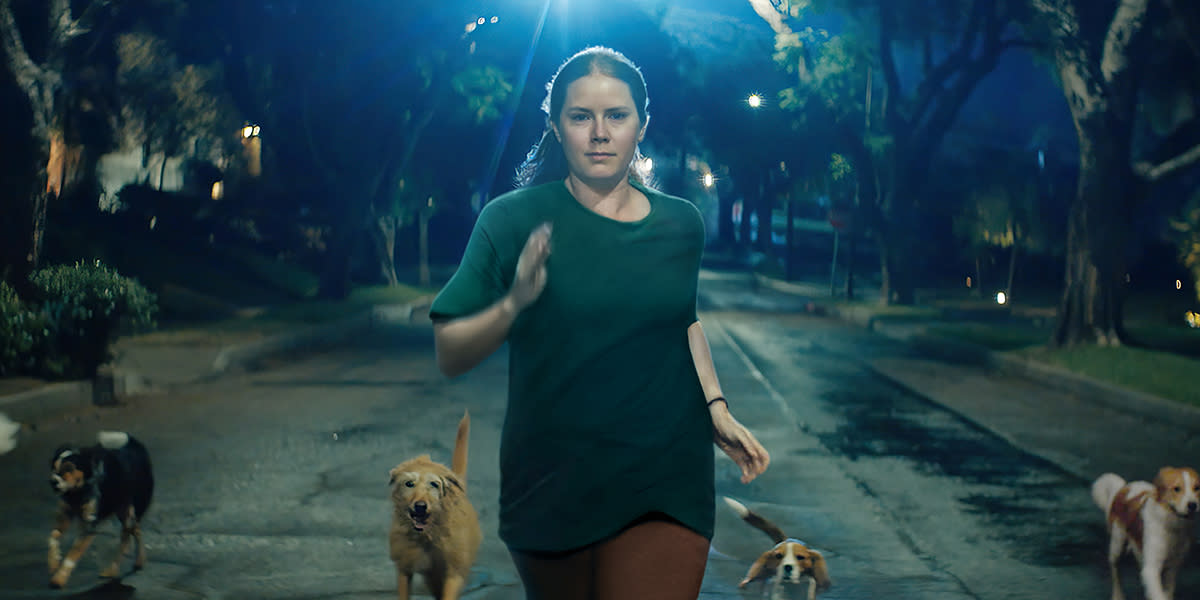
So while jogging through her neighborhood at night, she starts to transform into a feminist dog/werewolf thing.
She sprouts fangs, grows the beginnings of a tail, and notices tufts of canine fur on her back. She develops a taste for raw meat, and becomes a de facto pack leader as neighborhood dogs join her on her after-dark runs. Most of all, she unleashes her “nightbitch” energy, reaching deep within herself to find all the power she knew she had.
Yaaasss queen, slay!
What’s “nightbitch”? It’s never explained. How does the protagonist transform into a werewolf? We’re never told.
An actual scene from Nightbitch.
When we review movies with animal-related subject matter here on PITB, the first thing readers want to know is: does anything horrible happen to the animals? If I don’t address that in the review, I’m guaranteed to get emails and comments about it.
Nightbitch doesn’t just have elements of animal abuse. It glorifies and revels in it. It dedicates long, explicit passages to the butchering of innocent, helpless creatures. It makes the case that murdering animals is some sort of step on the way to feminist empowerment.
And yes, we can confirm the upcoming film adaptation’s cat murder scene, among other twisted elements, remains intact.
Nightbitch, which “explores the strange transformation of Adams’ character as she may be turning into a dog, generated laughter but also audible reactions during graphic scenes of tail-cutting, menstruating in the shower and the murder of a house cat,” Variety reports, noting the movie isn’t going over well with early audiences on the film festival circuit.
The fangs come out.
In this twisted world view, a cat and a baby aren’t pure innocents who deserve to be cherished and protected. They’re objects of resentment, the things holding Nightbitch back from the fabulous life of cocktail parties, jet-setting and art world acclaim that she believes is her birthright.
In this perverse universe, it’s “empowering” to put a dog collar on your toddler, exchange his crib for a kennel, feed him raw meat and have him drink from a bowl. He’s probably going to grow up to perpetuate the patriarchy, so what do we say to dehumanizing him? Yaaass, queen!
The film’s defenders, like their book counterparts, will doubtless argue that Nightbitch is part black comedy, so anyone who is disturbed by its subject matter is being a bore.
The problem is, the only laughs here are unintentional.
I’ll be surprised if the people involved in this film don’t suffer the ire of animal welfare groups even if no real animals were harmed in the filming. We already have enough problems with cruelty to animals in this country without movies and books promoting it as some sort of cathartic way to reclaim gender-based power.
Hardly a day goes by without news stories about pet cats who are killed or paralyzed for life by people shooting them with BBs, arrows or rounds from a real firearm. Cats are often victimized by men and women in domestic situations who try to hurt their spouses or partners by harming their beloved pets. People kill cats on a whim, for fun, for target practice. We’re talking about intelligent, loving, sentient, innocent creatures.
As for the child abuse content, it’s equally as depressing and horrific, but sadly I’m less certain it’ll result in condemnation. That’s the world we live in.
Nightbitch stars Amy Adams and Scoot McNairy, and is set to hit theaters on Dec. 6. It’s rated R for mature themes and graphic violence.
SAN DIEGO – The Siestas were down to their last cat still slumbering, and it looked like their rivals from Detroit, with three felines snoring away, would wake up with the victory.
But San Diego’s sole snoozer wasn’t any ordinary cat. He was 21-year-old Oscar the Couch, one of the most accomplished nappers in the world.
Long after Detroit’s younger, less experienced kitties had gotten up, stretched, enjoyed a meal and used their litter boxes, Oscar was finally beginning to stir from the dregs of his dreams.
Oscar yawned as his teammates cheered, and the referees declared the San Diego Siestas the winners.
“Competitive napping is unlike any other sport out there,” said Sammy the Sloth, a rotund tuxedo cat and snore-by-snore announcer for the Competitive Napping League’s broadcast team. “It rewards the slow and the sedentary, moving somewhere between the speed of a snail and the growing of grass. The only other sport that comes close is golf.”
The Competitive Napping League (CNL) was just a dream of its founders until Saudi Royal Feline Smudge bin Salman stepped in, signing the laziest felines to seven figure contracts and infusing the new sport with millions in marketing money.
San Diego Siestas!
Now competitive napping matches routinely air on ESPN7, and this year the CNL inked a deal for six nationally televised naps per season. The most accomplished nappers can also participate in the postseason nap-offs, and ambassadors for the sport are lobbying the International Olympic Committee to include competitive napping in the winter and summer games.
“This isn’t a genteel game like baseball or jai alai,” said Somnambulist Smokey, a silver shorthair. “This is hardcore, no-snores-barred snoozing, and it’s not for the faint of heart.”
As a sleepwalker, Smokey is one of the league’s most accomplished competitors. He’s known for getting up mid-snore and slapping his opponents in the face before laying down again. Initially suspected of cheating, Smokey was vindicated when brain activity monitors showed he remained in REM sleep, making him an authentic sleepwalker.
However, he’s not the only cat with tricks up his paw.
Filthy Frank the Flatulist is captain of the Fort Worth Forty Winks, and his emissions are of such olfactory potency that they can wake opponents out of the deepest slumbers.
“The [New York] Nappers strolled in here like they owned the place,” said teammate Charlie the Chonk. “Frank had them up and yowling in about 30 seconds with a squeaker that wafted over to the enemy and refused to dissipate.”
Credit: Matheus Bertelli/Pexels
Competitive napping is growing in popularity, with amateur clubs springing up in Japan, Taiwan, Scandinavia and the Principality of Sealand.
The Copenhagen Cozies and Helsingør Hygge recently slept through exhibition matches against the Louisiana Liesures and the Miami Sleepmasters.
“There’s nothing like the rush of a good nap followed by mews that you’ve outslept your opponents,” said Liesures captain Zoe Zzzz, “then going back down for another nap to celebrate!”
Before we get into the most important day of the year (according to Bud), I wanted to share that we’ve been watching the wonderful Earth At Night In Color.
The title pretty much sums it up: teams of intrepid videographers went to some of the most remote locations on Earth armed with new camera tech that can peer deep into the night, revealing an entire world we can’t see and colors we don’t have names for.
The result is astonishingly crisp and clear images of the nocturnal world, offering opportunities to see things we’ve never glimpsed.
It might be difficult to belive, but this image was shot at night near the banks of the Amazon with only starlight providing minimal illumination.
One episode, Jaguar Jungle, follows a six-year-old male named Juru whose kingdom is an idyllic stretch of the Amazon River where capybaras frolic and caiman are plentiful.
Serendipitously, the crew also encounters a young female jaguar in heat, following the scent trail of a male and calling out. The resulting courtship is fascinating and in the words of narrator Tom Hiddleston, “surprisingly tender.” It’s exactly the sort of thing that would have been impossible to film with regular or even night vision cameras.
Another episode, Puma Mountain, follows a cub on the cusp of adulthood as she learns to survive in Patagonia. The vistas are remarkable in a virtually untouched land far from human light pollution, where wildlife thrives and the glowing ribbon of the Milky Way straddles the horizons at night.
I appreciated the focus on pumas, who are often overlooked in wildlife documentaries, and Earth At Night is perfect for them since the vast majority of their activity happens in the overnight hours.
The series also has episodes dedicated to lions and cheetahs, so there’s lots here for cat lovers. Other highlights include episodes following African elephants, polar bears and tarsiers, which are liliputian primates that look almost like Jim Henson creations.
Aqua!
I move quite a bit when I’m sleeping, and since Bud literally drapes himself over me, you’d think he’d be used to it. I must have shocked him awake with a sudden movement a few nights ago, because he bolted up, freaked out and yelled “AQUA!”
I busted out laughing despite him catching my leg with a claw when he was startled. Then I rubbed his head to let him know all was well, and we went back to sleep dreaming of oceans.
“Aqua?!?”
The Great Day of Turkey
Happy Thanksgiving!
It’s good to have a day dedicated to being grateful, and I think that’s especially important in an era of hyper-commercialism, when the accidentally fortunate use Instagram to rub their wealth in other people’s faces, dueling billionaires vie for political influence and the adoration of the public, and most people conflate what they have with who they are.
My family has banned talk of politics this year, which I think is the smart and mature thing to do.
As for Bud, he’ll have to endure most of the day on his own before I come home with his favorite food in the universe.
I hope everyone out there has a great Thanksgiving and gets to spend it with family and/or friends.
It took a fresh vision to prove there’s still cinematic life in the xenomorph and its ability to terrify audiences, but Romulus really shines where its affable characters are concerned.
Over four decades and six films — eight if you count crossovers — in the Alien universe, no one had been able to capture even a fraction of the terror, novelty or magic of Ridley Scott’s original 1979 science fiction-horror classic.
James Cameron turned the immediate sequel into a James Cameron movie, which means it’s packed with Velveeta one-liners, Spanish catch-phrases that no Spanish-speaking person would ever utter, and doesn’t exercise an ounce of the restraint Scott used to such cosmic effect.
In the third outing, David Fincher took on the impossible task of trying to reconcile the tone of the first two films and set the entire thing in a drab space prison, while Joss Whedon’s script for the fourth film was Firefly in Alien trappings.
While the xenomorphs never looked better, Alien: Covenant felt like half a movie, ending on a cliffhanger that will never be resolved.
The titular monster had been stripped of nearly all its mystique by the time Scott returned to the franchise with Prometheus and Covenant, the fifth and sixth installments.
Both films were visually spectacular thanks to Scott’s efforts, but suffered from characters audiences couldn’t connect with, and in the case of Damon Lindelof’s script for Prometheus, characters the audience loathed. Instead of leaving the origin of the aliens ambiguous, Prometheus and Covenant offered a bizarre, nearly franchise-killing backstory involving alien-designed panspermia, artificial intelligence gone rogue and half-baked creationism given the veneer of science.
A space jockey chamber in the derelict starship, of the same kind seen in the first film, only this time the ship is powered up. Prometheus and Covenant tried to give us a backstory for the creatures, which only made them more pedestrian.
When Fede Alvarez presented his vision for an Alien film, he understood he had two do two things:
Ignore everything that came after Scott’s original film
Offer something more than the formulaic “monster stalks the cast deck by deck and kills them one at a time, leaving only the Final Girl”
Alien: Romulus sets off on that task by engaging in economical world building to give us more context than the five previous sequels managed together.
It’s tightly focused on our heroes, a group of five twenty-somethings who were born on a fiery world where lava perpetually flows, novel diseases spawn every year and a permanent atmospheric coat of soot and ash hides the sun and sky from the people who live there.
It’s a hellish place, and they’re there because multinational megacorporation Weyland-Yutani (“the company” in Alien parlance) wants the valuable ores within the planet’s crust. Like the crew of the Nostromo, the people are expendable in the company’s pursuit of profit.
The people who live in the colony at Jackson’s Star can’t even see their own sun as they slave for Weyland-Yutani corporation.
Our heroes work for the company, and they’re all orphans who lost their parents to work-related accidents or diseases from the mines.
Marie Rain Carradine’s (Cailee Spaeny) hope lies in the completion of her indentured servitude. With 12,000 hours of service to the company under her belt, Rain can finally take her brother to the colony world Yvaga, where the air isn’t toxic, people aren’t worked to death, and best of all in her mind, you can see the sun.
When Rain visits a Weyland-Yutani administrative center to formally separate from the company and relocate to Yvaga, a bureaucrat doubles her work requirement to 24,000 hours with the stroke of a key, damning her to another five or six years toiling on a planet that kills everyone eventually. Worse, the bureaucrat transfers her from farming to the mines, where her parents died.
“Know that the company is really grateful for your service,” the Wey-Yu representative says with an infuriating affect, dismissing the shocked young woman.
It’s in the depth of her despair that Rain gets a message from her friend Tyler (Archie Renaux) and listens to his pitch. Tyler and the others were working their orbital jobs miles above the colony’s surface when their computers pinged, alerting them to the approach of a massive starship.
Scans revealed a decommissioned Weyland-Yutani vessel that hadn’t been entirely stripped of its useful parts, slowly drifting through the system. Crucially, the ship still carried functional cryo pods, which would allow the group to sleep out the nine-plus year journey to Yvaga.
It’s freedom, there for the taking “before someone else does,” Isabela Merced’s Kay tells Rain.
When Rain balks at the dangerous and highly illegal plan, Tyler points out Weyland-Yutani will never grant them approval to leave the nightmarish world where they were born.
“I don’t want to end up like our parents,” he says, nodding toward the dead-eyed, soot-covered miners marching back to their utilitarian prefab homes after another shift toiling for the company.
You don’t need to guess that the plan does not go smoothly, nor the reason why.
What most people will need to know, in order to entrust two hours of their time to a franchise that has been beating a dead horse for decades, is that Alien: Romulus is the kind of sequel Scott himself would have made after the original, at the height of his directorial powers, if he hadn’t moved on to other projects.
Romulus replicates the magic of the original by taking things in exciting new directions, and by giving the audience a series of astonishing set pieces, including a gloriously nail-biting sequence that not only captures the beauty of space, but reminds us how hostile it is to our fragile human bodies.
It also takes care to give us reasons to root for characters we’ve just met, to sympathize with their plight and understand why they’d do something so desperate and reckless.
Cailee Spaeny is inarguably the best of the actresses who have tried to take the mantle from Sigourney Weaver’s Ripley in the last several films from the franchise.
Rain and her friends have one important thing in common with the characters from the first Alien film — they’re fighting for survival in more ways than one. There’s the immediate threat to their lives, and their eventual slow, agonizing doom if they don’t find a way off their colony world.
Unlike the characters from the previous sequels, they didn’t volunteer for a military mission, an archaeological expedition or to be pioneers on a world full of life. They’re desperate adults barely out of childhood who know life holds nothing but misery for them if they don’t succeed.
Like the best science fiction, Romulus doesn’t just entertain, it uses an imagined future to comment on our society. AI has now permeated our lives, but mainstream science fiction is still stuck on the same tired “AI evolves, turns on humans for reasons and tries to wipe us out” narratives.
Andy (Jonsson) in an airlock early in the film.
For those of us who are genre fans, it’s frustrating to see Hollywood clinging to ideas that were first kicked around many decades ago by science fiction novelists. Besides, the “AI turns on humans” thing has little to do with reality and everything to do with human anxiety that we’ll be judged for our behavior as a species the moment we encounter an intelligence capable of judging us.
Romulus eschews the formulaic stuff to explore a more interesting question: what separates biological intelligence from artificial intelligence, and can the latter really qualify as life? Can machines ever approximate human emotions, or are they limited to simulating them for our benefit? It’s still not the most original idea, but it’s a marked improvement from the same old Terminator and Ex Machina-inspired narratives.
As for the alien itself, it’s more menacing than it’s been since the first film, and it has a few tricks up its sleeve thanks to circumstances that tie directly into the original. To say more would be an injustice, because the twists here are well-conceived. They also make perfect sense given what we already know, and don’t require any great shift in franchise lore.
Lastly, as an admirer of retrofuturism, I can’t let this review pass without praising the set designers, special effects teams and Alvarez for reviving the utilitarian 1970s vision of the future from the original. This is a worn, lived-in universe, not a gleaming utopia. Alien’s aesthetics influenced virtually every science fiction effort over the last 45 years, and for good reason.
Set designers at work on an interior for Alien: Romulus
There’s something anachronistic about a civilization that has mastered interstellar propulsion, cryopreservation and advanced artificial intelligence, but remains reliant on monochrome displays with vector graphics and tactile interfaces. And yet that visual shorthand signals to viewers that this is a return to the fundamental elements of the franchise, and a universe where space exploration is corporate and soulless.
Perhaps the best sign that Romulus has revived Alien is the fact that a sequel is already in the works. Spaeny and David Jonsson, who plays Rain’s brother Andy, are already on board for a second installment.
There’s certainly more story to tell, and if Alvarez can maintain the magic blend of homage and novelty that made Romulus such a strong entry, we’re in for another fun ride. To Yvaga!
Alien: Romulus is available to stream on Max, Hulu and Disney+. For a list of alternate sites where the film can be rented or purchased, or to check availability in regions other than the US, check out the movie’s listing on JustWatch.












 Pain In The Bud