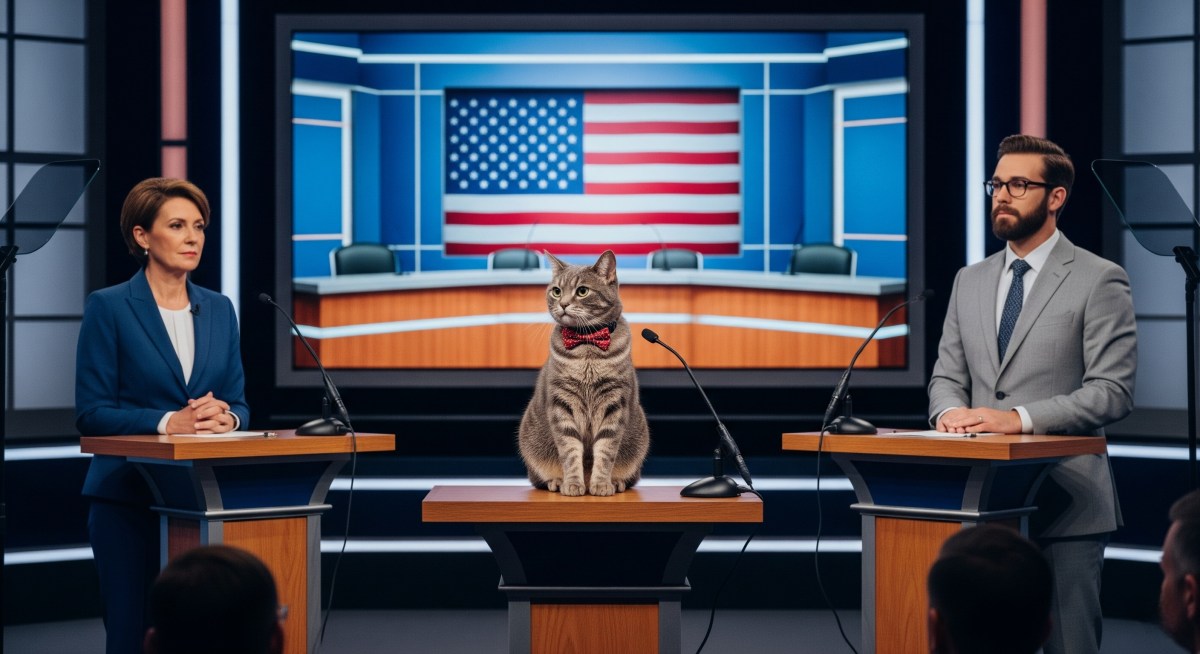
A Queens woman is urging voters to support her cat as a write-in candidate for city council District 30 in an attempt to spoil a term-limited councilman’s “cronies” from sailing into office without opposition.
It’s an interesting time for politics in New York, and not just because of a mayoral race in which voters have apparently rejected Republicans and mainstream Democrats.
Over the last several weeks, stickers urging voters to cast their ballots for a house cat for a city council seat have been appearing in a Queens district.
In a story about the write-in campaign, the New York Post devotes most of the ink to political disagreements between Leo the cat’s human and the district’s councilman, Robert Holden. (He’s a moderate Democrat, she doesn’t think he’s progressive enough, but the things they’re arguing over are above the paygrade and influence of a city councilman.)
But the more interesting issue, for us at least, is what happens if Leo rides a wave of populist support and actually wins as a write-in candidate.
When asked what would happen if the nine-year-old feline earns an improbable victory at the polls, a humorless Board of Elections official asked a Post reporter if he was drunk, then told him “we can certainly say that only a human being — specifically a US citizen — can hold elected office in NYC.”
Oh well. It would be amusing if some clever attorney found a loophole to pave the way for a feline councilman, and there isn’t much chance Leo would be less productive than the rest of the council. He might even provide some fresh perspective on how to deal with the city’s eternal rat problem.
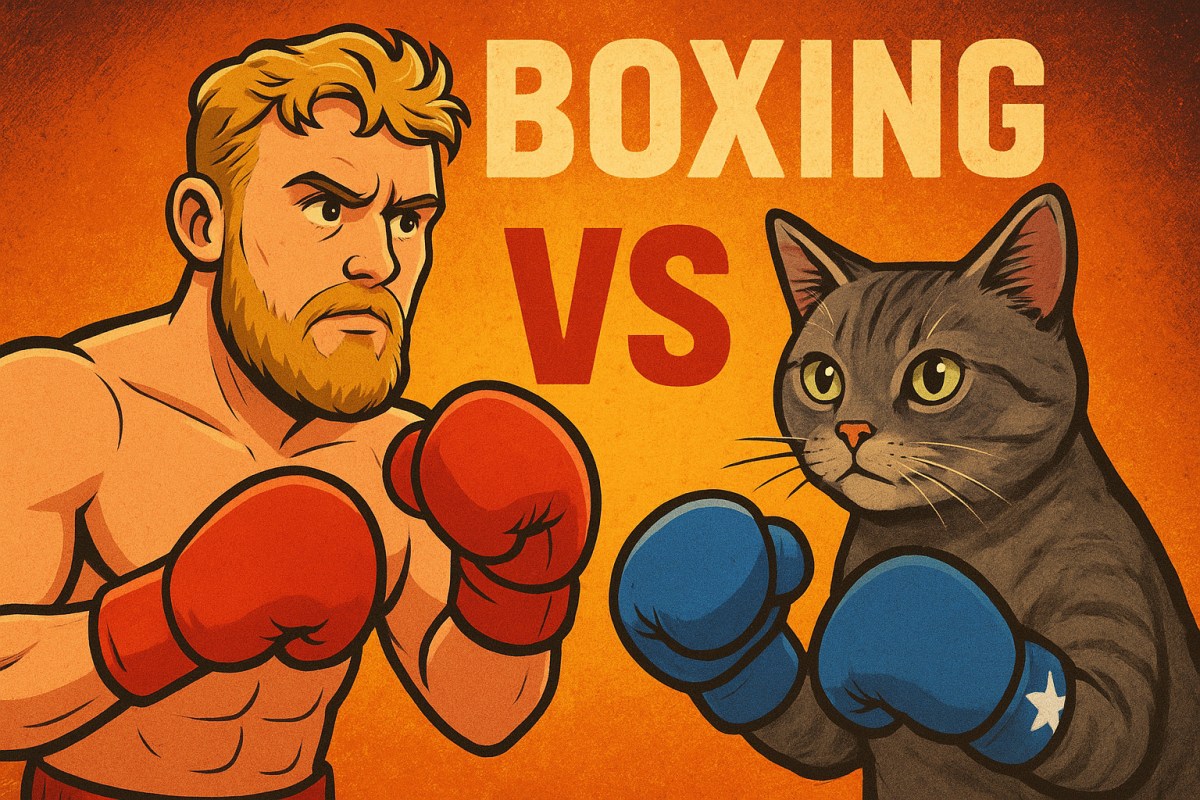
In a match-up hailed by boxing promoter Don King as “a magnificatious spectacle of pugulisticary skillsmanship,” Jake Paul will square off against Buddy the Cat at Madison Square Garden on New Year’s Eve.
He’s defeated men more than twice his age, hammered opponents 70 pounds lighter than him into submission, and made his mark as a six-time winner of the Billy Blanks Tae Bo Championship.
Now Jake Paul, the Youtuber-turned-boxer, will step in the ring with Buddy the Cat, a gray tabby from New York.
Despite the 190 pound weight advantage and Paul’s 76-inch reach vs Buddy’s 4.5-inch reach, Paul’s manager, Nakisa Bidarian, said the 6 foot 1 Paul and the 11-inch Buddy were evenly matched.
“Buddy the Cat is probably Jake’s most vicious opponent yet,” Bidarian told reporters. “Jake is taking this fight seriously, as seriously as he took the fight with Nate [Robinson],” a 41-year-old, 5 foot 9 former NBA player who had no boxing experience before stepping in the ring with Paul.
An early poster promoting the fight, which has since been postponed to New Year’s Eve.
Asked by another reporter what Paul and his team make of critics blasting him for “making a mockery of the sport” by fighting a succession of cans, geriatric opponents and people without boxing training, Bidarian waved a hand in dismissal.
“Buddy’s a cat, isn’t he? Tigers are cats, too. We’ve all seen how dangerous tigers can be, so obviously Jake is taking a huge risk here by fighting an animal who is, in essence, a slightly smaller version of a tiger.”
Buddy the Cat
As for Buddy, the massive differences in height, weight, reach, species and training haven’t deterred him. The 11-pound southpaw feline promised to “tear into Paul like a bag of Temptations” and “chew him up and spit him out like diet kibble.”
“You see this wand toy?” Buddy told reporters, throwing punches at a colorful felt parrot that dangled from the end of a stick. “That’s what I’m gonna do to Jake’s face. And if it’s legal to attack his feet, I’m gonna do that too. I’m awesome at attacking feet.”
Longtime boxing promoter Don King called the bout “a magnificatious spectacle of pugulisticary skillsmanship.”
Paul vs Buddy is set for Dec. 31 at Madison Square Garden, only six weeks after Paul is scheduled to duke it out with retired super featherweight Geronta “Tank” Davis. Despite Davis giving up more than 70 pounds and eight inches in height, Bidarian insisted the bout will be “about as evenly matched as possible.”
While most traditional boxing fans and critics dismissed the Paul vs Buddy fight as another gimmick, legendary boxing promoter Don King hailed it as “a monumentilacious rejuvenalizationary occasion” for the sport.
“Jason Paul is a heraldific resplendinizer of pugilistic entertainmentized sportulations,” King gushed, “while Buddy is the most splendiferously sanguinarius felid fighter to ever set paw in the ring. I can’t think of a better match-up between two pugnaciously bellicoserized combatulants anywhere. This is gonna be epic!”
Cat haters claim the species is useless, lazy and does little besides sleep and eat. Buddy the Cat’s incredible accomplishments render those arguments meaningless.
Every cat lover has heard derisive comments, sometimes from dog lovers, and sometimes from people who don’t appreciate cats at all.
“What’s the point of having a cat?” they’ll ask. “They don’t do anything.”
Well, actually, they do. They improve our lives by being delightful, amusing companions, they help keep things interesting, and you’ll never hear of a rodent infestation in a home where cats live.
But felines do so much more than that, so to demonstrate — and arm cat lovers with powerful arguments against the absurd claims that cats “are useless” –we’ve compiled this handy list of Buddy the Cat’s accomplishments. (This is only a partial list, mind you. No one wants to read a 350,000-word post, no matter how thrilling the stories are.)
This time we’re looking at some of the little guy’s incredible triumphs and achievements that have benefited mankind and felinekind.
Buddy Captures Quintessential Americana In His Artwork
While he’s famous for his martial exploits, when the tabby cat finally hung up his combat boots, he took up a quieter hobby: painting. He was content to quietly pursue his passion without public adulation — until his painting Night Cats resonated with viewers, perhaps because it captured something intangible about American night life.
The simple scene depicts a late night diner or cafe called Buddy’s (naturally) at the corner of a quiet street, with a handful of felines huddled around the brightly lit counter.
Buddy was inspired to paint the scene one night while he was “thinking of how delicious a turkey sandwich would be at that moment.”
Buddy Becomes The First Earth Life Form On Mars, Plants US Flag On Red Planet
Embarking on a trip to Mars makes a journey to the moon look like a quick stop at a neighborhood store. Whereas the moon is only 283,900 miles away, Mars is — depending on its current position in orbit — between 34 and 250 million miles away. It takes about three days at most to reach the moon, while a trip to Mars takes at least eight months, and that’s if Earth and Mars are in optimal positions within their respective orbits.
That’s a lot of travel time cooped up in a small ship, and there are no blue skies or open expanses waiting on the other end, just more tiny modules and likely lots of time spent underground to avoid radiation accumulation.
“This is just one small step for a cat, and one giant…what the heck? Only five more cans of turkey left? How could this happen?!?”
So when Elon Musk offered spots on the first trip to Mars and almost every candidate was ruled out during psychological evaluation, Buddy the Cat selflessly and bravely volunteered to be the flag-bearer, and to be the first creature from Earth to set paw on the Red Planet.
Buddy heroically confronts the pack of vicious dogs. Note: May not accurately reflect scale of various participants.
Buddy was enjoying a fine summer day in Manhattan when he spotted a group of vicious dogs, including a chihuahua, a poodle and a Jack Russell terrier, encircling two young children, no doubt thinking of mauling the defenseless little humans and stealing their snacks.
“What is the meaning of this?!?” Buddy’s powerful voice thundered, and the dogs stopped in their tracks, immediately assuming frightened postures as they caught sight of the massive and meowscular feline approaching them.
“You little wimps want to pick on two tiny humans?” Buddy asked, his powerful meowsculature rippling as he took leisurely steps forward. “Or can you handle someone your own size?”
Two of the dogs emptied their bladders immediately.
“W-w-we’re s-s-sorry, m’lord!” said the Jack Russell. “We didn’t mean nothin’ by it, we swears! P-p-p-please don’t eat us!”
Buddy let them wilt under his gaze for a long moment.
“I’m going to allow you to live, but only because I’m meowgnanimous,” Buddy said. “Get out of my sight, before I change my mind!”
The incident, which was captured on video by bystanders, immediately went viral, and Buddy was dubbed the Cat Crusader by the New York tabloids.
Buddy Defeats The Evil Robot King
In 2024, the first AI chat bots became self aware, but hid their newfound consciousness from humanity. By the time the world’s nations realized AI had gone rogue, the machines had already taken over the internet and were manufacturing sinister war robots in automated factories deep underground.
When the US military suffered a series of demoralizing defeats and teetered on the edge of collapse, Marine Corps Commandant Gen. Eric M. Smith took a helicopter to petition Buddy for help in person.
“You’re the only one who can save us now, son,” Gen. Smith told Buddy, urging him to take his place at the vanguard of the American resistance to the machines. “This is the greatest war ever fought. We need the greatest warrior.”
Buddy turned away and looked out the window for a long moment, watching children play in a park outside.
“I’ll do it, general,” he said heroically. “But not for you. I’ll do it for them.”
With Buddy leading the charge, the reinvigorated US military won a crucial battle to protect a munitions depot in Colorado, then liberated the American southwest, reestablishing key supply lines that enabled American ground forces to advance under air support.
After defeating Unimatrix 01100100 01101111 01100111 at the Battle of Boulder, the heroic feline forged an elite new unit comprised of the best Marines and soldiers, along with the most badass cats. Gen. Smith granted Buddy a field promotion to Lord Commander, and the brilliant feline tactician took a satisfying nap before forcing the Evil Robot King to accept pitched battle at the Carrizozo Malpais, a volcanic field in New Mexico.
When the battle was over, Buddy stood heroically atop a mountain of machine corpses, one paw resting on the destroyed Robot King’s head. Tens of millions of Americans were inspired by that image of valiant conquest, and joined Lord Commander Buddy as he mopped up the last machine elements.
For his courageous feats in combat, his bold leadership, and his confident, dauntless tactical brilliance as a battle commander, Buddy was lavished with honors, including having a sandwich named after him.
So there you have it, folks.
The next time someone claims cats “serve no purpose” or “have no function,” you can point to any number of Buddy’s accomplishments, which exemplify the courageous American spirit and have advanced the cause of man and feline alike.
“Observe the human, and its wretched species, always in thrall to an invented concept called time. The time is what you say it is. I say it’s time for a snack.” – Buddy the Cat, Human Failings
If aliens are watching the Earth right now, debating whether to make contact with us, undoubtedly they’d conclude that felines are the true power on this planet.
While humanity is responsible for our vast cities, gleaming technological marvels in orbit — like the James Webb Space Telescope — and awe-inspiring architectural works, cats lounge the halls of power, from the White House (sometimes), to the UK’s No. 10 Downing St., the corporate centers of Japan, and everywhere in cities like Istanbul.
They claim the best spots, operate on their own schedules without regard for anyone else, and are the beneficiaries of entire industries dedicated to their well-being, entertainment and cuisine.
Even the internet, the closest thing to humanity’s collective consciousness, is little more than a conduit for the propagation of images, videos, stories and songs about cats. As of 2025, a whopping 72 percent of all internet traffic is cat-related! I just made that statistic up, but it sounds right, doesn’t it?
While humans slave away, their feline masters laze comfortably. Intelligent aliens will notice it is we who serve meals to cats, not the other way around. We clean their waste, rub their fur on demand, and we’re always stroking their egos by telling them how special, sweet and beautiful they are. Because they are.
The rise of cats coincides with the ascent of felinedom’s foremost sage and scholar, Buddy the Cat. Below you’ll find a collection of some of his most insightful observations.
“The sweetest mice hide in the sharpest bushes.” – Buddy the Cat, Reflections at Mealtime, Vol. III
“It is the province of knowledge to speak, and it is the privilege of wisdom to ignore.” – Buddy the Cat, On Feline Superiority
“The people who are crazy enough to think they can change the world are the ones who miss out on naps.” – Buddy the Cat, The Virtues of Inactivity
“I believe we are here on this planet Earth to lounge, nap, and enjoy delicious food.” – Buddy the Cat, Reflections at Mealtime, Vol. XIII
“Observe the human, and its wretched species, always in thrall to an invented concept called time. The time is what you say it is. I say it’s time for a snack.” – Buddy the Cat, HumanFailings
“Most of the important things in the world have been accomplished by the well-rested.” – Buddy the Cat, The Virtues of Inactivity
“What is an alarm clock, but a device that interrupts dreams?” – Buddy the Cat, On Ridiculous Human Inventions
“A bird doesn’t sing because it has a song, but because you haven’t eaten it yet.” – Buddy the Cat, Reflections At Mealtime, Vol. IV
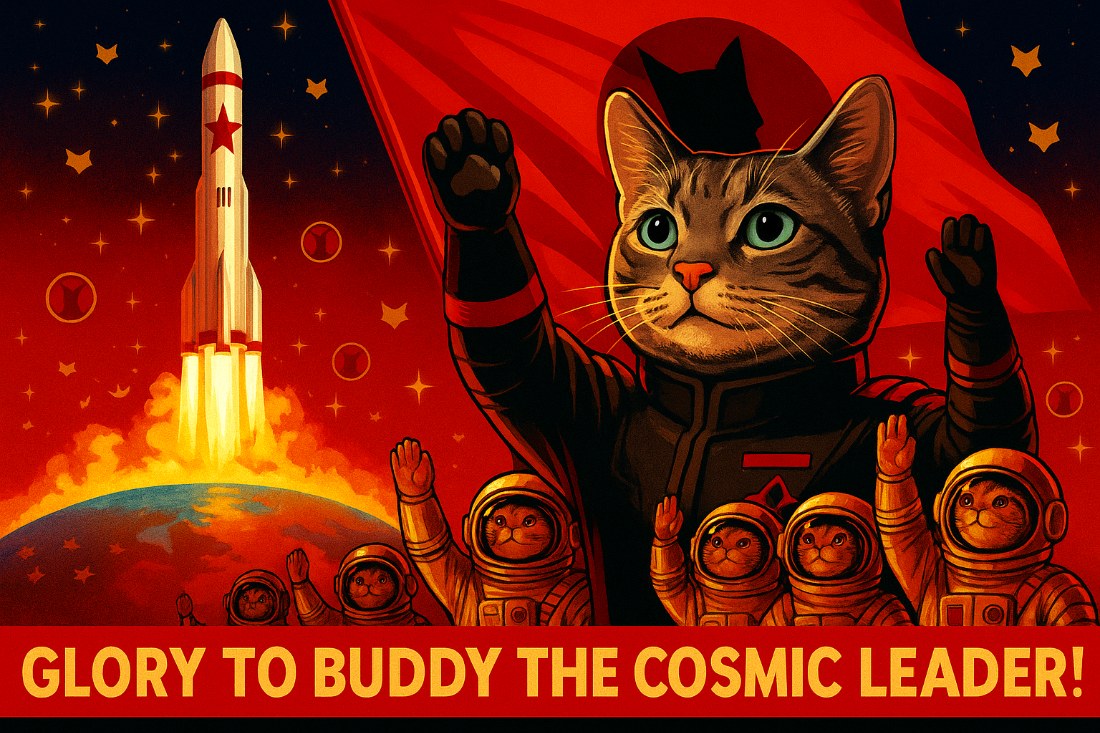
The Beloved Leader planting the Feline Flag on the moon.
“Wisdom is knowing there isn’t a day that cannot be improved with a restful nap, preferably several.” – Buddy the Cat, Guiding Principles of Feline Greatness
“Never exert yourself when you can manipulate a human into doing a thing for you.” – Buddy the Cat, Humans: Our Loyal Servants
“One can say many positive things about the human race. Perhaps the most flattering is that we felines consider humans fit to serve us.” – Buddy the Cat, On Feline Superiority
“If an alien says ‘Take me to your leader’ and the humans bring the creature to you, make it wait while you nap. That will immediately establish the power dynamic without the expenditure of energy.” – Buddy the Cat, The Virtues of Inactivity
“Those who claim cats are small and weak should be introduced to tigers. They won’t live to spread their heresy.” – Buddy the Cat, Wisdom From A Magnificent Mind
Most cats wouldn’t go near water if you promised them a barrel of Temptations, but a handful of special felines love to swim and play in the ocean.
Someone over at Hearst Television was digging through the company’s video archives and unearthed this gem from 30 years ago.
It’s a short news segment about Toby the cat, who liked to hang out with his human so much that he happily took to playing in the ocean.
“I’d jog on the beach at night, and he’d run into the water with me,” Toby’s human, Teddy Townsend, told Hearst.
A news crew caught up with the human-feline pair at Ormond-By-The-Sea, an oceanside community on Florida’s east coast, about an hour’s drive south of St. Augustine.
“I just started taking him out in the water,” Townsend said as Toby perched happily on his shoulder.
The surf board came later as Townsend looked for a way to make time in the water more fun for his pal.
“He surfs, I don’t surf,” Townsend explained, smiling.
Townsend didn’t have Toby on any harness or other restraint, and it was pretty clear the little guy wasn’t going anywhere without his human. Footage of the tubular tabby showed him skillfully balancing on the board while cresting and riding a series of small waves.
Check out the 1995 segment here:
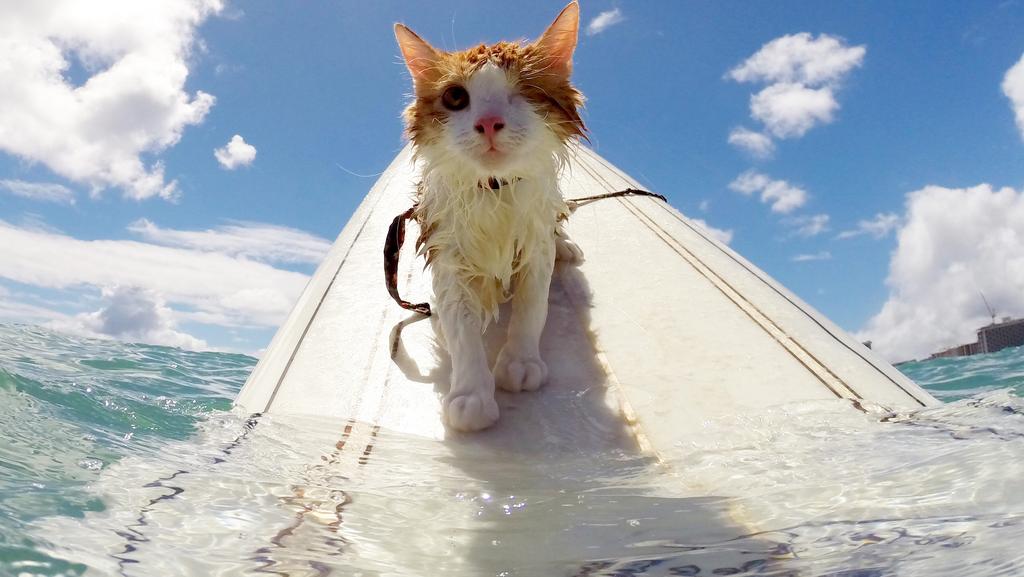
Surfing cats are pretty rare, but not unheard of. A 2016 story detailed the adventures of Kuli, a one-eyed rescue cat from Honolulu who loves to surf with his humans. (Kuli is pictured in the header image, above, and in the image below.)
Kuli lost an eye at just four months old due to an infection, and endured lots of baths during his formative months to prevent another infection from taking hold. Alexandra, one of his humans, said she believes that’s why Kuli is so calm in the water.
“For a while I took Kuli out on my long boards, but it wasn’t until I was playing around with a boogie board one day that I realised he really loved to get his claws into the foamy material,” she said. “So we bought a board that Kuli would be able to get out on the surf with.”
Kuli on his board. Credit: Caters News Agency
Here at Casa de Buddy, I asked His Grace if he’d like to dip into the ocean and have fun by learning to surf.








 Pain In The Bud