We’ve made enormous mistakes in our reconstructions of prehistoric creatures, including dinosaurs and mammals. Would paleontologists of the future misinterpret the clues our civilization leaves behind?
Imagine if, far in the future, humanity has spread across a healthy swath of space, colonizing worlds across dozens of light years.
Academics at a prominent science institute, looking to learn more about the humble beginnings of our species, fund a scientific expedition to Old Earth, where radiation and toxicity have finally declined to a point which allows teams to poke through the ruins of our civilization.
As they piece together clues from the rubble, they find references to companion animals who have been domesticated while their wild counterparts continued on.
What does a cat look like? they wonder. Then they find the bones, beginning with a handful of incomplete skeletons…
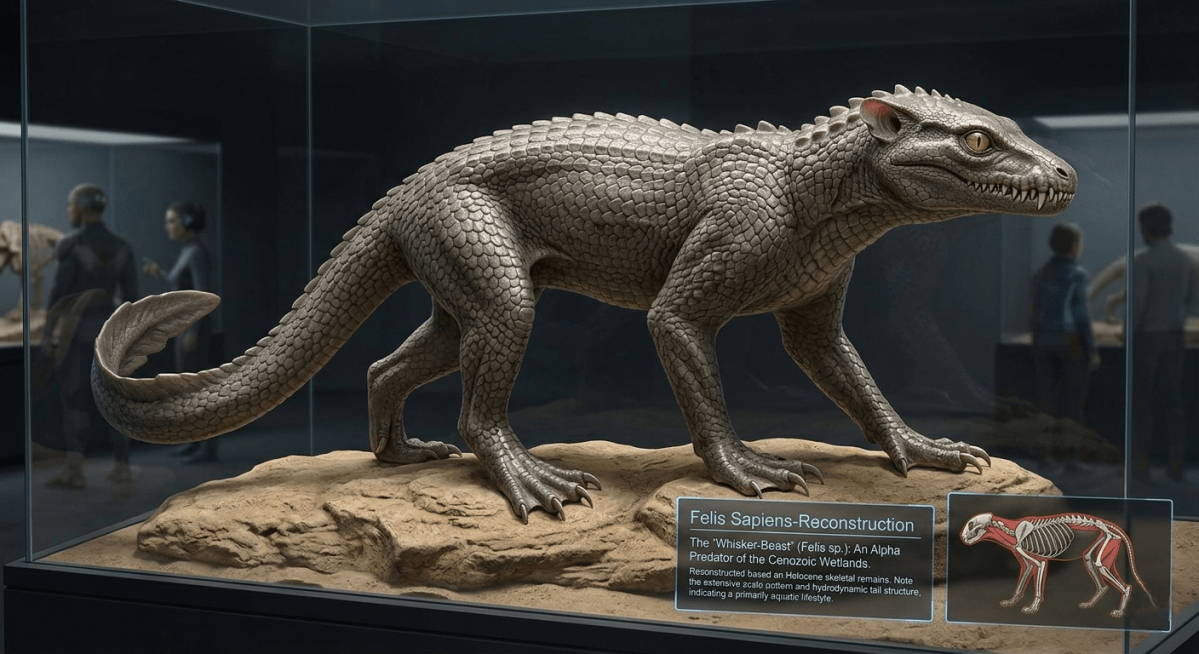
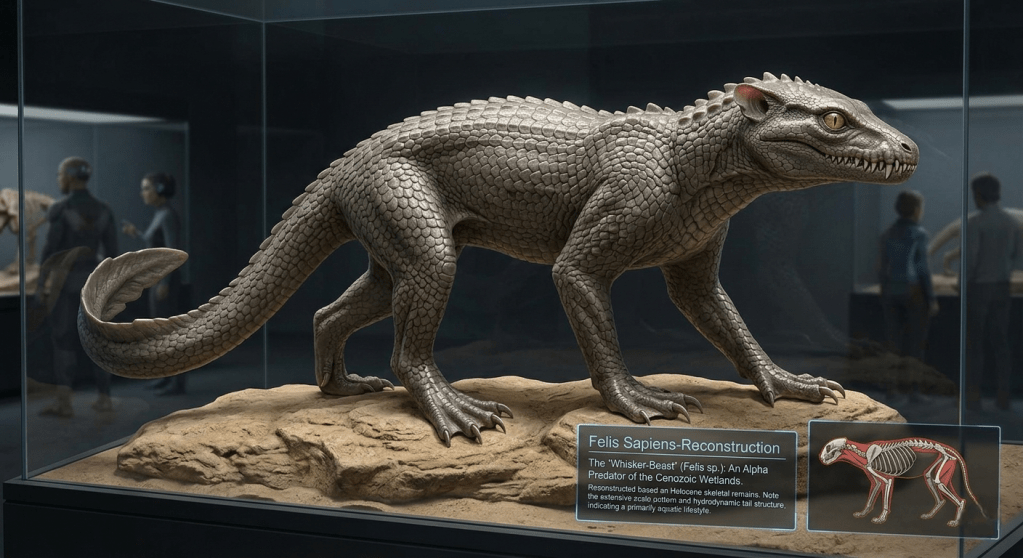
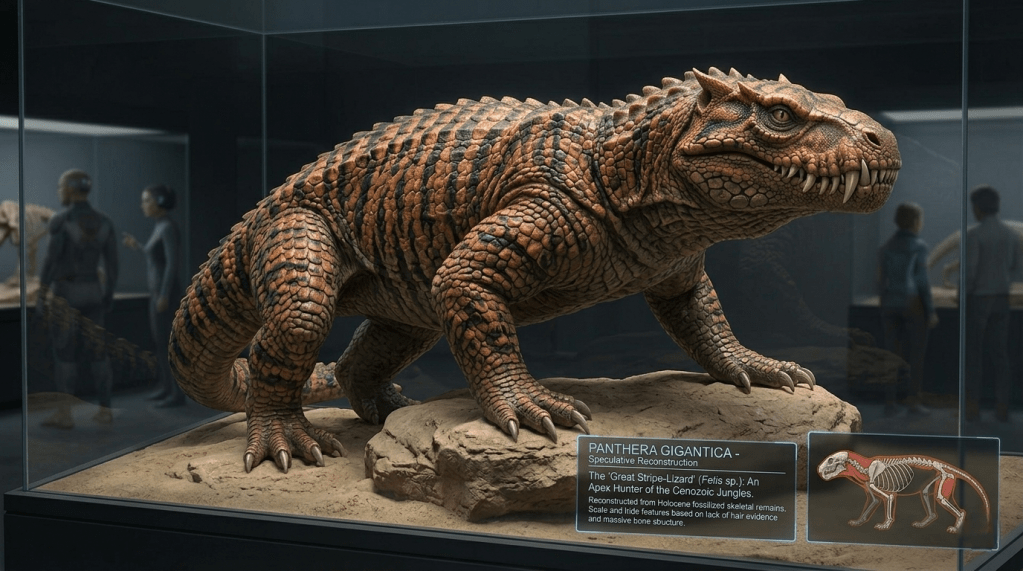
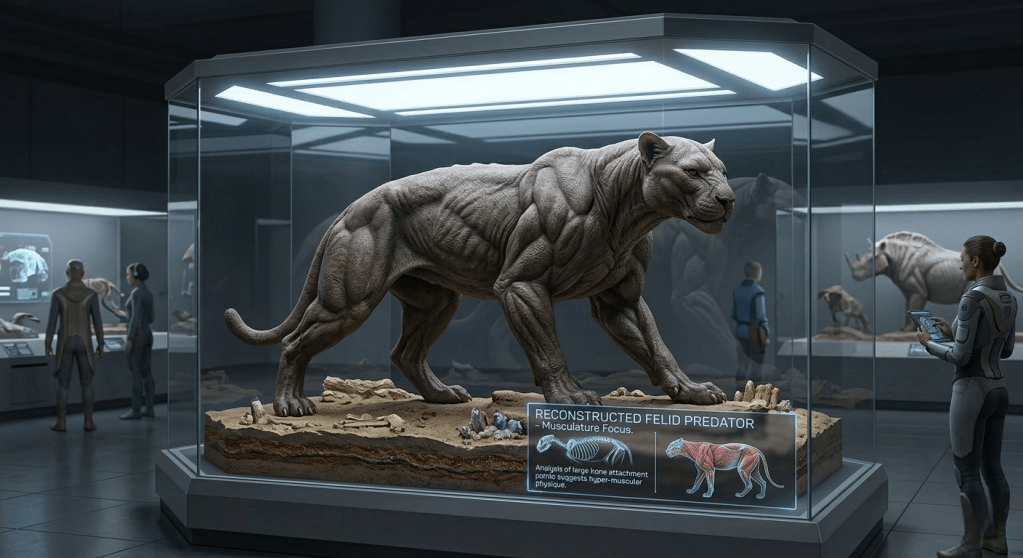
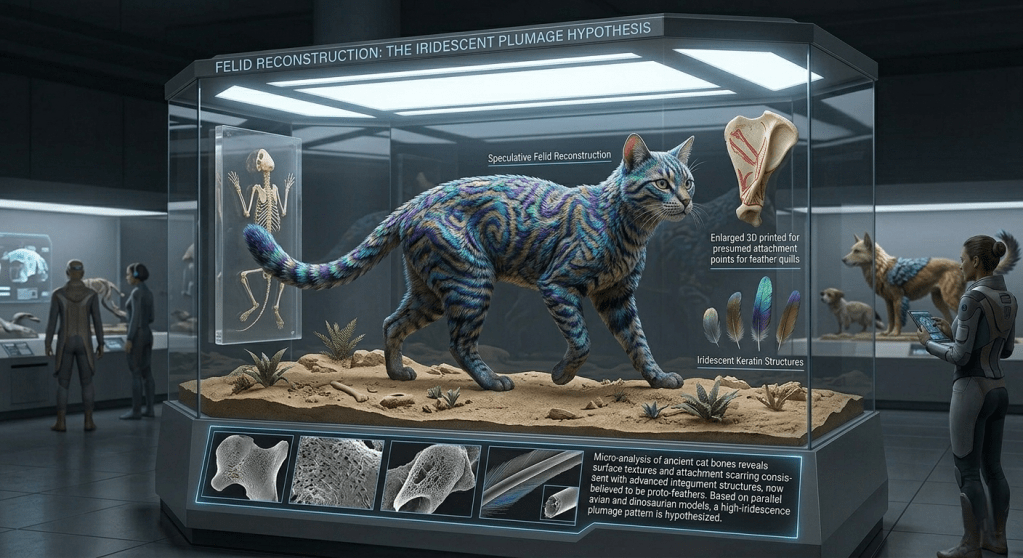
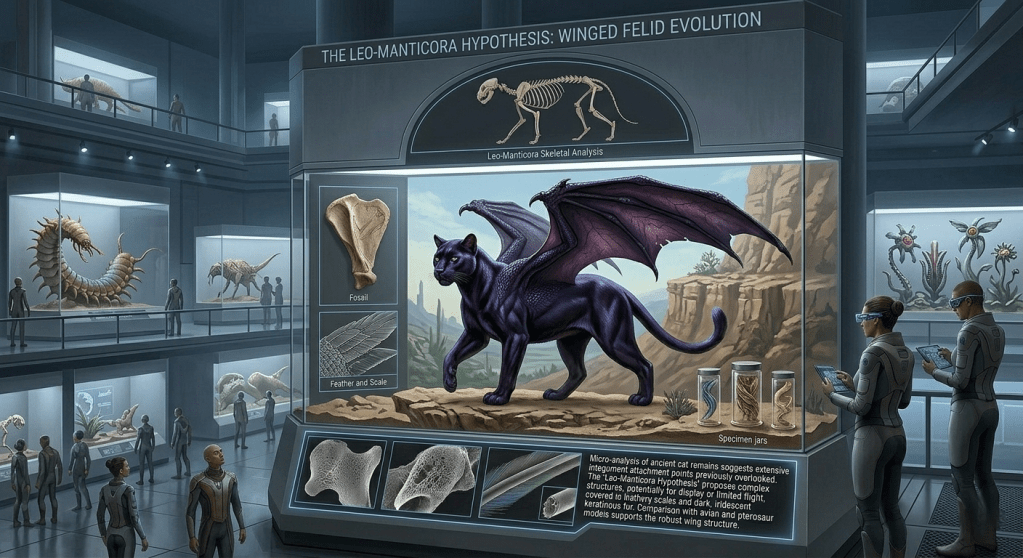
Critics have long argued that our depictions of dinosaurs are like skeletons wrapped in flesh, with modern representations doing a poor job of representing complete animals. What if the paleontologists and historians of the future mistranslate a word like “fur” or don’t realize the skeletons of cats are the same furry creatures that were human companions?A tiger imagined as a semi-aquatic animal with scales instead of fur, and a skull interpreted in much the same way we interpret dinosaur skulls. “Surviving texts make clear the tiger was comfortable in water, and like its distant cousin the crocodile, would remain mostly submerged, looking for opportunities to ambush prey.”No fur, just musculature, as if an anatomy book of animals is one of the few texts to survive in hard copy.A cat with magnificent plumage: “Research shows felines engaged in elaborate mating rituals, using their vivid colors and patterns to demonstrate virility to females in heat.”Finally, a winged cat. Outlandish? Maybe. But what if of the scraps of mythology to survive is a statue of a manticore, or paleontologists discover the bones of a cat species mingled with those of a large bird that died alongside it in a tar pit? In our time we’ve accidentally invented entire species of dinosaurs by mistakenly matching skulls from one species onto the spines of others, or wildly misinterpreting clues in the body plans of new and unfamiliar creatures.
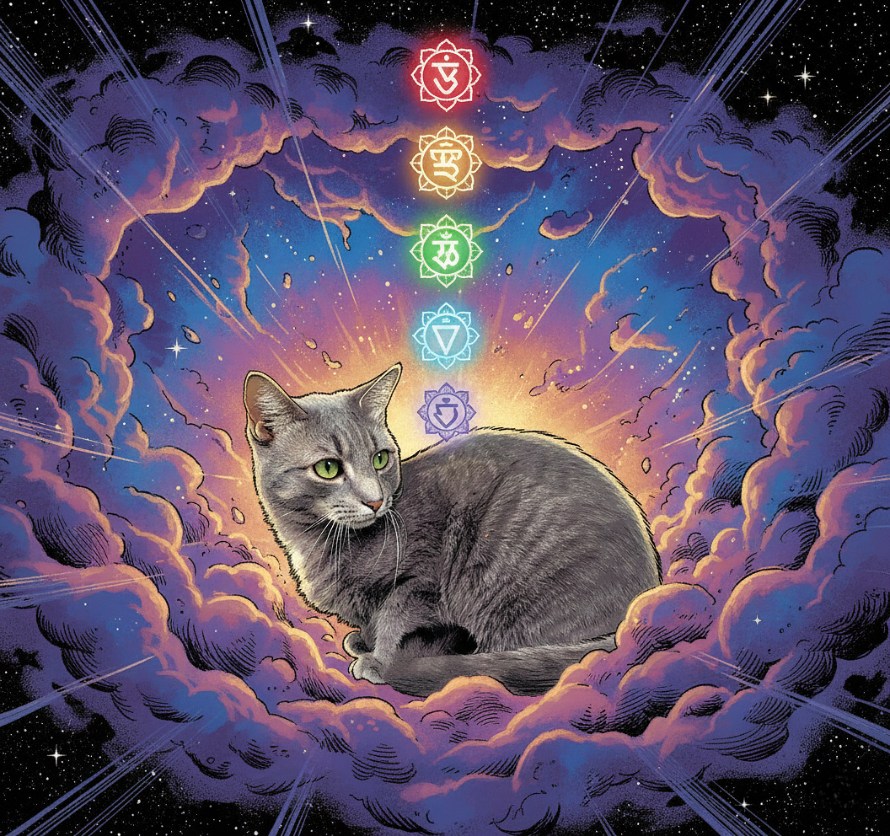
“Activate your chakras and, like, serve me turkey and stuff.”
Buddy the Cat sits in a lotus position, whiskers relaxed, with a serene expression on his face.
“As we enter the quantum realm of the mind and traverse the sacred lacuna leading to the mysteries of the cosmos, let us allow ourselves to drift, to feel the subtle tug of gravity asserting itself upon our quantum existences, so that we may reach simultaneous quantum enlightenment within the subatomic and macro universes,” Buddy says softly as a room full of his disciples imitate his posture.
Suddenly the chubby cat opens his eyes, scanning the room.
“And now the time has come,” he says, “for a quantum nap. Who would please the spirit of the cosmos by providing a suitably soft napping substrate?:
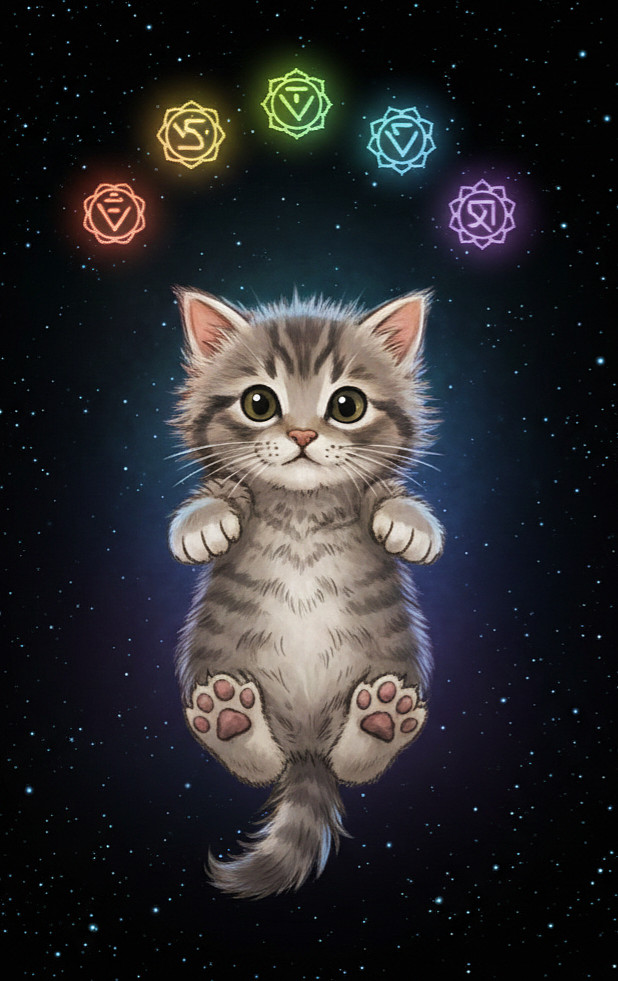
Buddy regains his kitten form after communing with the quantum alchemists of Epsilon Eridani, who grant him special powers after circumambulating a triple star system within a quantum starship and stuff.
Every hand shoots up, with disciples — or “quantum mignons,” in Buddesian parlance — begging to be chosen.
The guru pads along the rows of disciples, wrinkling his nose to “discern the most comfortable chakras,” before settling in the lap of Maelle, a 20-year-old exchange student from France.
“I feel so blessed to be chosen,” she confesses as Guru Buddy climbs into her lap.
“I shall meditate,” Buddy tells her with a yawn, “upon your anima as the soothing stillness of sleep embraces me, fortifying your spirit with an increase in your alpha quotient.”
“And remember,” Buddy says, “should you feel the call of nature or the need to adjust your position, meditate upon your quantum quantumness to fortify your, uh, quantums so you don’t disturb me.”
The tabby cat settles down, then opens one eye.
“I almost forgot,” he says, raising his meows so all can hear him. “Please prepare my post-nap feast, for the quantum processes of my restorative beauty sleep make me famished. Serving me delicious food is most pleasing to the cosmic pantheon. I shall now spirit-walk the galactic plane and commune with the ancient alchemists of Epsilon Eridani to probe the mysteries of dark matter and KFC Extra Crispy. Can someone bring me a quantum pillow?”
How do you ensure people will heed warnings to steer clear of nuclear waste storage sites thousands of years in the future? One outlandish proposal involves genetically engineering domestic cats to glow in the presence of radiation.
Imagine you’re a person living five thousand years downstream.
Maybe civilization collapsed and restarted, maybe records were lost, or maybe like Etruscan, Harappan and proto-Elamite, the languages we speak today will be long forgotten.
At any rate, if you discover a forceful warning left by your ancestors from the deep past, would you understand it without translation or cultural context?
And if you’re the one tasked with leaving the message, how would you do it?
The message has to be enduring. It must be recorded in a format that will withstand the tests of time, conquest and natural disasters. The message must be comprehensible without cultural context, because we have no idea how language will shift in the future or whether our descendants will enjoy the knowledge that comes with continuity of records.
Lastly, the message must be both compelling and absolute in its meaning, because its content is vitally important: This site contains nuclear waste. Do not under any circumstances excavate or disturb the contents of this facility. It will lead to sickness, suffering and death.
The traditional trefoil warning sign is unlikely to scare anyone off. The new radiation hazard sign, right, seems unambiguous, but so do warnings on Egyptian tombs.
How do you phrase that in a way our naturally curious species will heed the message?
We certainly didn’t heed the warnings on the tombs of King Tut and other pharaohs. For all we know, humans of the future might believe the hidden chambers deep in Yucca mountain or buried 3,000 feet underground are filled with fabulous treasures and wonders beyond imagination.
They might interpret the warnings as superstition, meant to ward off looters, “grave robbers” and anyone else who might be motivated to break in. They might see the care and effort that went into encasing the objects and conclude there must be something very much worth preserving inside.
Or they might be driven by simple curiosity, as so many human endeavors have been.
A tour group visiting the incomplete Yucca Mountain nuclear waste storage facility. Credit: Daniel Meyer/Wikimedia Commons
Arguments about how to warn the future are at least as old as the Manhattan Project (1942) and the first nuclear power plants (1954 in the USSR, 1958 in the US), but there weren’t serious efforts to come up with a plan until the 1970s, when scientists, historians and other thinkers began to engage in formal efforts to find a long-lasting solution.
Some of the ideas are boring, some are impractical, and some are absurd, like an idea to create a “garden of spikes” atop nuclear material waste sites, to discourage people from settling in the area or excavating.
Unfortunately, one idea that’s still being kicked around is the concept of the radiation cat, or raycat.
Knowledge and language may be lost to history, signage may be destroyed, physical obstacles may be removed. But one constant that has endured, that has seen empires rise and fall, and has existed long before Stonehenge and the pyramids of Giza, is the human relationship with cats.
They’re now valued as companions, but we still use them as mousers on ships, in heavily populated cities, in ancient structures and on farms and vineyards.
They’re embedded so deep into our cultural psyche that it would not be outlandish to think the archaeologists of the future may conclude the internet was constructed primarily to facilitate the exchange of images of cats.
Even the first high-bandwidth deep space transmission was a video of a cat, so in a very real sense, the dawn of a solar system-wide internet was heralded by an ultra high definition clip of an orange tabby named Taters, beamed back to earth from the exploratory spacecraft Psyche, which was 19 million miles away when it transmitted Taters on Dec. 11, 2023.
Consider also that the basic felid body plan — shared by domestic kitties, tigers, pumas, black-footed cats and the 37 other extant species — has barely changed in 30 million years, because cats are extremely successful at what they do.
In other words, cats aren’t going away, and domestic felines have a place in every human society.
So philosophers Françoise Bastide and Paolo Fabbri conceived of the “living warning” in 1984. The idea is to alter the genetic code of felis catus so that the animals glow or change color in the vicinity of nuclear waste, using minuscule levels of radiation as the trigger.
There are natural precedents for this, including bioluminescence and several species of octopus that radically change colors and patterns on their skin to evade predators.
The second component, once the genetic code has been altered, is the creation of folklore: songs, stories and myths that will endure through time, warning people to keep cats close, treat them well, and run like hell if they change color because it means something terrible, something evil beyond imagination, is nearby.
To ensure the folklore of feline Geiger counters endures, an idea by linguist and semiotician Thomas Sebeok would be incorporated. Although empires and states rise and fall, there’s one organization that has survived for 2,000 years preserving a unified message: the Catholic church.
Sebeok proposed an atomic priesthood, an order that would pass the knowledge down through generations, continually seeding culture with stories and songs of glowing felines.
Spent nuclear fuel rods are stored in on-site pools at the facilities where they were used, but pools are meant only as temporary storage solutions. Credit: Wikimedia Commons
If this stuff sounds wacky, that’s because it is. We won’t figure out a way to ensure a message is received and understood thousands of years in the future without considering some off-the-wall plans.
Of course messing with the genetic code of any animal raises serious ethical questions.
We don’t have the right to play God and tinker with the genetic code of extant species. We don’t fully understand the immediate consequences for the health and happiness of cats, and we know almost nothing about the long-term effects on the species.
I’d also argue that we have a special relationship with cats and dogs, one that exceeds any obligations we may feel toward our primate “cousins” or other non-human animals.
Cats and dogs have been living with humans for a combined 40,000 years. They have been molded by us, they are dependent on us, and all that time in human proximity has led to unique changes.
No animals on this planet can match them when it comes to reading human emotions. Our little buddies pick up on our emotional states before we’re consciously aware of them partly because of their robust sensoriums, and partly because as their caretakers, our business is their business.
A clip of a cat named Taters was the first data burst transmitted to Earth using NASA’s upgraded deep space network. Credit: NASA/JPL
We bear a responsibility to both species and the individual animals. It’s not just the fact that without them, our lives would feel less meaningful. It’s the indisputable fact that without them — without dogs who flushed out prey on yhr hunt and guarded small settlements, without cats who prevented mass starvation by hunting down rodents — we would not be here.
Cats and dogs play a major role in the story of the human race. We are indelibly linked. Their DNA is not ours to tinker with, and they are not tools we can repurpose at our convenience.
Thankfully the US Department of Energy has never endorsed the concept of raycats. While there is a website advocating for a raycat program and small groups around the world dedicated to its propagation, the interest is mostly academic.
The Raycat Solution, which maintains a site dedicated to the idea, has a FAQ which says its supporters are serious about its potential usefulness, but for now most experts see it as a thought experiment and reminder that the problem must be dealt with eventually. At some point NIMBY will have to yield to reality, and wherever the US ends up storing nuclear waste, it’ll need to be secured, sealed and marked.
The goal is for the message to endure at least 10,000 years, at which point scientists say the radiation will be minimal.
That’s assuming that the future holds the collapse and rebuilding of human civilization, or at least a technological backslide in which the majority of our species’ knowledge is lost.
We like to think things will be brighter than that and instead of glowing to warn people of danger, cats of the far future will be where they belong — with their human buddies, exploring new frontiers on starships with plenty of comfortable napping spots.
Header image depicts the Alvin Ward Vogtle Nuclear Power Plant in Georgia, the largest nuclear plant in the US. Image via Wikimedia Commons/NRC
[1] The nuclear waste storage facility at Yucca Mountain was initially funded and approved by congress in 2002, then was canceled and de-funded in 2011 after significant pushback from people who live in Nevada, along with their representatives in congress. Plans for the site have changed several times in more than two decades, leaving the US with no central, secure site to store nuclear waste.
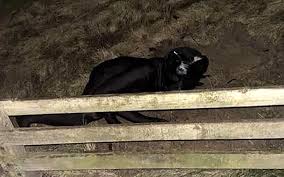
The costumed man has growled, hissed and meowed at passersby in the coastal area, reigniting old rumors of actual big cats prowling the area and freaking out people walking their dogs at night.
Ah, the things you can get away with in a country without guns.
A man in an all-black outfit has been prowling Wallasey beach in Wirral, a peninsula in northwest England, according to people who live in the area.
One witness said the man was “waving his hands in the air and making panther noises,” while others said they saw him approaching cars stopped at lights on roads near the coast.
“Anyone know who the freak in the cat mask and morph suit is at the coastal park near the harvester?” another local wrote online.
One thing was clear from witness accounts, photos and several short smartphone-shot videos: the costumed man wasn’t trying to imitate a friendly house cat.
“Was walking my dog tonight and heard a man making cat noises, shone a torch he was waving his arms at me before crawling up the hill. Never been so scared,” one witness posted to Facebook, per the BBC.
Sad as it may be, the first thing that came to mind when we read the witness accounts was that this doesn’t happen in the US, simply because odds are the costumed prankster would be shot.
“So I decided to bugger off home, had the rest of last night’s takeaway, had a laugh at the Sharons and Waynes on Blind Date, then went to see if any of the lads were up for a pint. Oi, I could really go for a Chinese! Anyone else wanna go for a Chinese?”
It’s possible whoever is behind the strange sightings is making light of decades-long rumors that mysterious and elusive big cats have been prowling the UK countryside.
Similar to persistent rumors of Bigfoot in the US, the phantom cats of the UK have their own believers who argue that there’s an extant population of leopards or pumas who are exceptionally adept at staying hidden from cameras but are occasionally spotted by farmers and motorists in the British countryside.
There’s a podcast dedicated to the topic, and proponents of the idea say it could explain a handful of cases in which livestock have gone missing.
The podcast, Big Cat Conversations, even dedicated a 2021 episode to “Wirral’s liminal leopards,” with its host interviewing several people who say they’ve encountered large melanistic felids on the peninsula over the decades.
Real big cats such as the leopard above tend to leave unmistakable evidence of their presence. Image credit: Wikimedia Commons
But as big cat experts have pointed out, it’s difficult to miss the signs when such apex predators really do claim an area as home. From unmistakable pug marks, to trees scratched and scent-marked with urine, to calls that can echo for miles in right conditions, big cats have many ways of making their presence known— and it’s often advantageous for them to do so, since they’re highly territorial animals.
One man who was out walking his dog told the BBC he thinks the whole thing is a prank.
“I don’t know his name, I think it’s just a wind up. He’s definitely not out to frighten people, he does it for fun,” he said. “He just likes being a giant cat. He doesn’t frighten our dog.”
Local police say they’re aware of the sightings. Merseyside Police and Crime Commissioner Emily Spurrell told local media that anyone who feels threatened by the suited figure should call law enforcement and report his whereabouts.
Guitarists, synth players and other musicians can get their meow on with this unique FX pedal.
As a guitarist I’m partial to pedals, FX and other gear that can imbue the instrument with the funkiness of the wah or the satisfying crunch of harmonic distortion.
But this? This is something I never expected.
Meet The Meowdulator, an FX pedal that does precisely what it sounds like it does.
Created by B’s Music Shop and pedal-maker Cusack Music, the Meowdulator is a monophonic guitar synth, meaning it plays single “notes” similar to a Moog. That means you can’t strike a chord and get a chorus of discordant meows, but you can for example play a solo that sounds like a cat in heat — if you want to. (The “Little Mew” setting sounds like an octaver in meow, generating multiple voices, but still triggered by plucking single strings.)
Brian of B’s Music Shop called the pedal “maybe the craziest thing I’ve ever collabed on.”
“It’s glitchy sometimes, it’s its own animal,” he said in a video demonstrating the new pedal. “But it’s a little kitty cat and we hope it makes you happy and you have some fun with it.”
My favorite of the seven presets demoed in a Youtube video is “Acid Kitty Synth,” which generates a funky, wah-like meow. In the right hands, something awesome can be done with it. I can imagine Acid Kitty Synth breathing life into an Earth, Wind and Fire style or Televisor-esque track, compelling the listener to hit the rewind button while asking “Did I just hear what I think I heard?”
Finally, there’s a “hidden feature” — if you hold down the bottom-most button, the pedal will purr. Perhaps it’s something to work into the rhythm of a track or give the audience a relaxing vibe between songs while playing live?
The Meowdulator retails for $199 and is expected to ship in mid-July. Those of you who fall into the cat lover/guitarist venn diagram overlap can pre-order now.
Now can someone make a puma scream pedal? Ratatat, a New York duo and one of my favorites, has a thing for working the screams of the iconic cat into their tracks, and it makes me love them even more.






 Pain In The Bud