Ricky Gervais’ ‘Alley Cats’: These Cartoon Felines Could Go Easier On The Swearing And The Sugar

The new Netflix animated comedy from Ricky Gervais has its moments, but it’s overly dependent on litter box humor and its attempts at redemptive sweetness border on the diabetic.

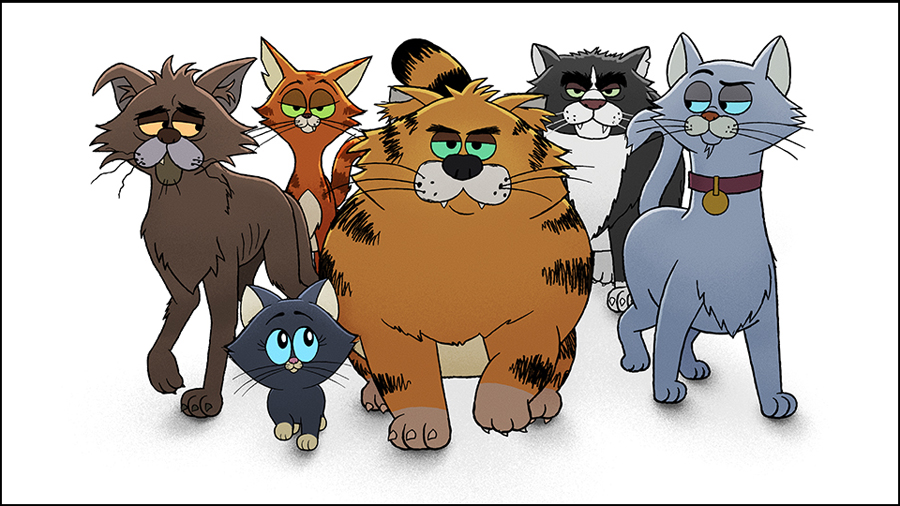
Ricky Gervais’ eponymous alley cats have one thing in common with Buddy: they think they’re the toughest, most fearsome creatures on the block.

They might recoil in horror, jump back a dozen feet and soil themselves when a vegetable delivery man drops a cucumber on the sidewalk, but approximately half of their obscenity-peppered banter involves discussing other living things they reckon they’d destroy.

Among them: snails, elephants, meerkats, portly humans, sharks and anything besides spiders who are, invariably, referred to as “a bunch of c—s.”

When they’re not praising themselves for being fearless apex predators, hunting mice or watching “a bit of telly,” they’re ripping on Rupert, the only house cat in their gang, by reminding him he no longer has his testicles.

In an early episode the gang is poised on the wall of a cemetery, impatiently waiting for a “dead c—” to get buried so they can go hunting for mice when Rupert pads up, says hello and announces he’s already eaten: chicken and rabbit in gravy “with extra calcium.”
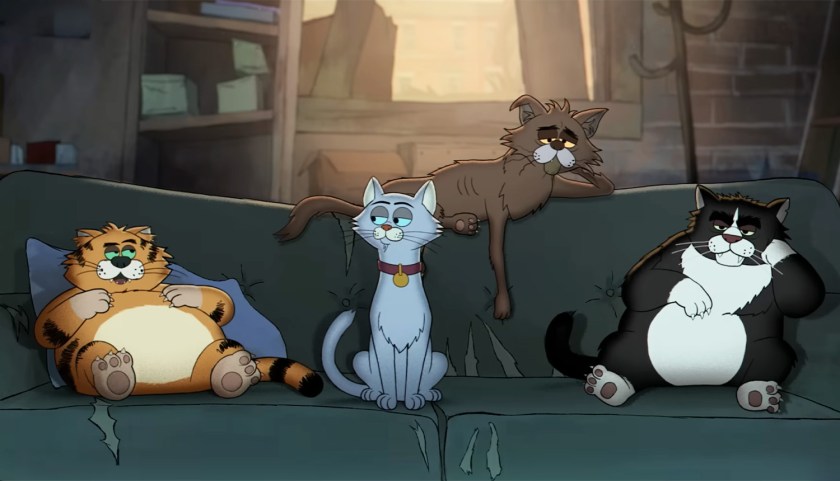
The others tear into him, asking him if his humans brushed him or gave him pudding afterwards.

“I have my pudding during the brushing,” he says, explaining that brushing is stressful and a simultaneous dessert “takes the edge off.”

That prompts another round of full-throated laughter and ball-busting over Rupert’s lack of them. Ricky Gervais’ Gus and Andrew Brooke’s Fang – a big bruiser tuxedo tom – lead the charge, making kissing sounds and mocking Rupert for being a sweet pet to his “mummy and daddy.”

When the scrawny Puke (David Earl) uses the freshly-dug grave as a litter box and Rupert protests, Gus waves a dismissive paw, insisting all humans are scum anyway.

“Not all of them,” Rupert says. “Attenborough. Malala. My owners, for instance.”

“His owners!” Fang says, breaking into mocking laughter.

“Do you hear yourself?” Gus says.

“They are my owners,” Rupert sniffs. “They paid a tidy sum for me, and I’m grateful. Otherwise I’d be rotting in a shelter or worse, living in a dump like you lot.”

Which, of course, prompts another round of mockery about Rupert’s missing bits.
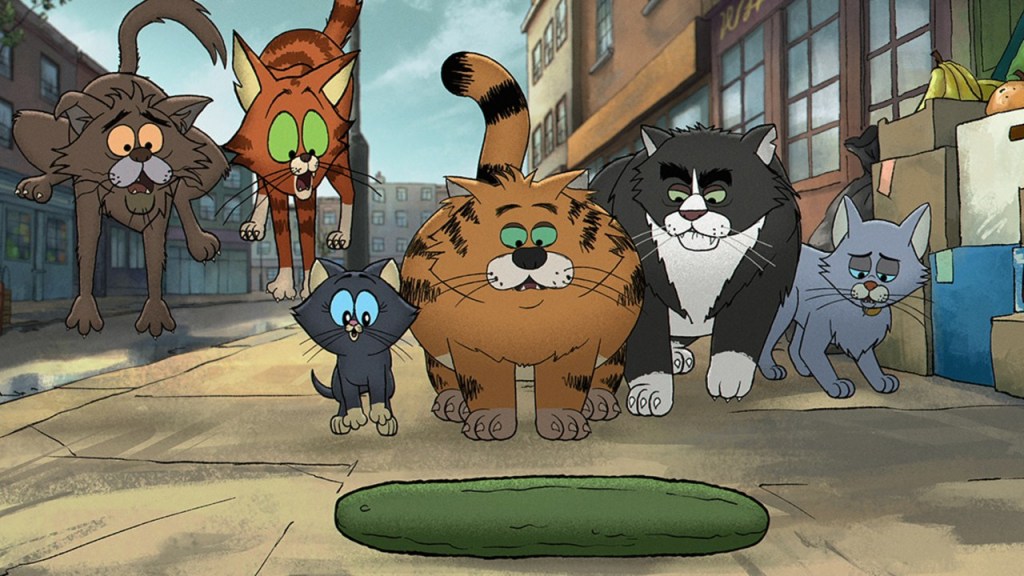
After agreeing they’re the toughest, baddest cats on the block, Gus and the gang are terrified by the sight of a single cucumber.

That’s Alley Cats in a nutshell, no pun intended, until the appearance of a lost kitten gives the gang a purpose and brings out their humanity. (Catanity? Felinity?)

At first the alley cats are tempted to make a snack of the little one until Olive (Diane Morgan) reminds them she’s a baby, she’s lost, and they’re big, strong cats, which they’re always reminding everyone of.

Amid all the obscenities there are moments acknowledging that being a street cat is not an easy life. One minute the strays are joyously knocking flower pots off a window sill, the next they’re staring shocked at the body of their friend who was hit by a driver.

“He didn’t even stop,” one of them says. “He didn’t care.”

“Humans never do,” Gus replies matter-of-factly.

Later they find another one of their mates, an elderly tom, stuffed in a carrier.

“Off to the vet,” their friend says from his confinement.

“He’ll fix you right up,” Gus says.

“Nah,” the scraggly old tom says sadly. “I overheard ’em. This is a one-way trip.”

With their earlier exuberance wiped out, the alley cats decide to retreat for the day, prompting the kitten to ask them uncomfortable questions about mortality and what kind of life a cat can expect.

For Gus, it means being put in a tough spot. He clearly cares for the kitten, even inviting her to snuggle up with him when she’s whimpering alone at night, but he has a reputation to maintain. He’s Gus, fearless and tough street cat!
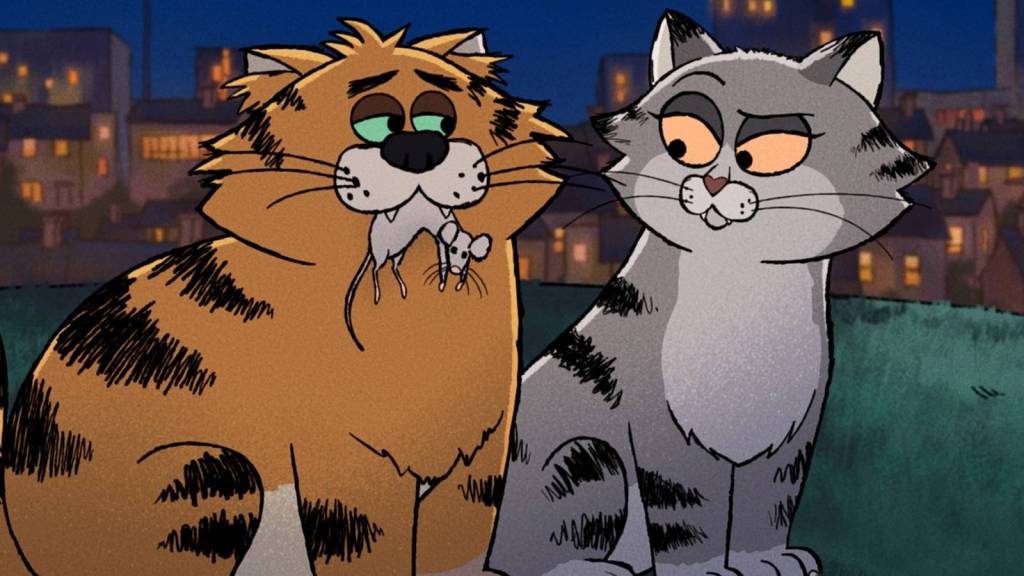
Gus fancies a tabby from his neighborhood, but usually keeps his distance for fear of her intimidating boy(cat) friend.

Alley Cats is not for everyone. There will be people who reach for the remote within the first two or three minutes because it is relentlessly obscene.

I’m not particularly bothered by foul language if there’s a genuine purpose to it, but too often it feels like it’s in the script in lieu of genuine jokes, as if Gervais is elbowing us like “See what I did there? I called him a c—! Haha! That’s funny, innit? My character is a cat who calls everyone c—s and tw–s! Brilliant.”

The UK press has savaged the show, concluding Gervais is capable of comedic brilliance but has become lazy and formulaic.

And that’s true to a degree, just like it’s accurate to say South Park is a festival of fart jokes. But just like the latter show also has a sharp satirical edge and functions as an equal opportunity eviscerator of the ridiculous, Alley Cats tries to say more. It just isn’t always successful.
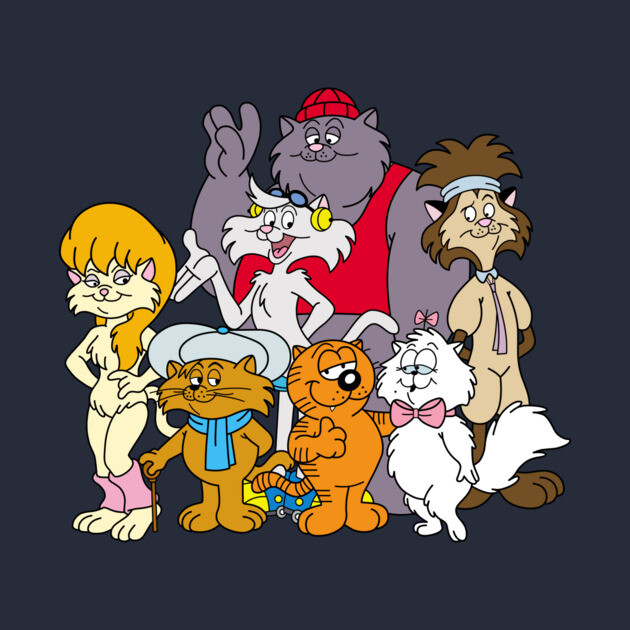
Heathcliff and the Catillac Cats are the family-friendly animated template for Alley Cats. Reruns of Heathcliff were part of after-school cartoon blocks in the late 80s and early 90s.

Whether you stick around for the bigger themes depends on your personal tolerance for the banter they’re wrapped in.

Unfortunately it’s also true that the reflective moments are a little too formulaic, like the lesson-of-the-day from after-school TV years ago. Balancing comedy with earnestness is already a difficult task that requires timing and a degree of self-awareness that I’m not sure Gervais possesses at this stage of his career.

Reviewers who have soured on the UK comedian are increasingly convinced he requires the tempering influence of his The Office co-creator and writer, Stephen Merchant.

They may be on to something, but I also think it may cut both ways.

I really enjoyed Merchant’s HBO series, Hello Ladies. It was unlike anything else on TV and felt like a genuinely fresh approach to comedy. But it also operated at a default cringe level orders of magnitude more uncomfortable than other shows.

There were times when the situations in Hello Ladies became so embarrassing, so completely detached from the norms of social behavior, that I had to pause the show and take a break.

Gervais and Merchant could temper each other’s worst instincts as they did in The Office.

I’m not the only one who felt that way. Reviews at the time were fixated on the improbably powerful osmotic cringe effect, and Merchant didn’t know when to let up. Just as you felt so mortified that you’d swear things couldn’t possibly get worse, Merchant found ways to crank it up.

The career trajectories of both men indicate a reunion just might be the best thing for them. If Netflix gives Alley Cats a green light for another season, Merchant could fit right in with the gang as a lanky Savannah, a wannabe Lothario who prompts Gervais’ Gus to lean less on the c-word and more on genuine humor, while Gus could bring Merchant’s cat back down to Earth by reintroducing him to reality every once in a while.

I’m sure that, whatever might come from a new collaboration, it would be better than the moderately funny Alley Cats.


Heads up: Recently I discovered a content scraper was skimming posts from this site and repackaging them as books priced at $40 each. I was able to get that person’s online shop terminated, but have since discovered there are at least two others, including one who repackaged my “Amazing Cats” series. The other is even more exorbitantly priced and appears as part of a trove of materials on an Etsy shop marketed to people who want to put out their own books, and claims to offer chapter modules that can be assembled into custom books, which can then be listed for sale on Amazon et al.

Please do not buy them. These people are NOT affiliated with Pain In The Bud and they do not have permission to use content from this site. The posts they pilfered from are free and remain on this site available to everyone. I’d hate to see people buy this stuff believing they’re supporting the site and end up getting ripped off.
‘Okay, My Feline Overlord, What Would You Like For Dinner?’

Have you ever asked your cat what she wants to eat?

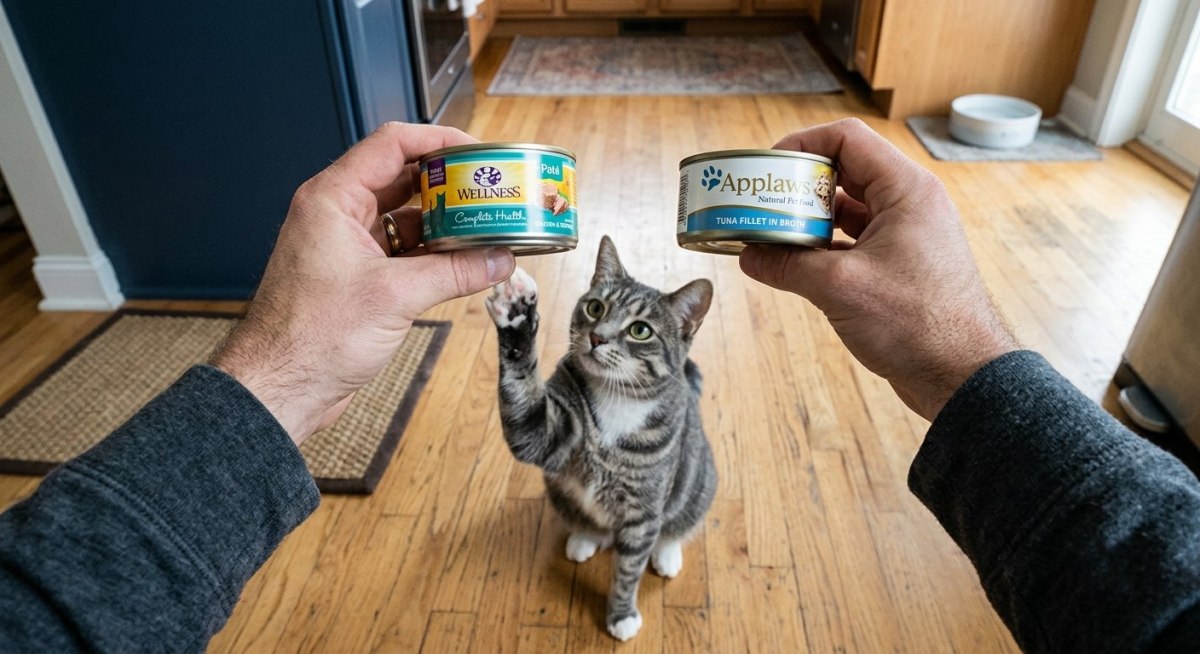
Every once in a while, as Bud happily dances around the kitchen because he knows it’s Yums O’Clock, I’ll look through the available inventory and give him a choice.

“Hey, Bud!” I’ll say, holding a different kind of food in each hand. “Which one do you want?”

And without fail he’ll mrrrrrp enthusiastically and select his dinner by choosing one can – or more often, a Perfect Portions tub – and rubbing his face against it while trilling.

I’ve addressed the topic of meal variety before on PITB. One great piece of advice I got before adopting the king was to feed him as many different varieties of food as possible. Turkey, his absolute and longtime favorite, chicken, tuna, salmon, beef, duck, trout, pate, chunks, shredded cuts in sauce. Sheba, Iams, Nutro, Blue, Fancy Feast, and occasionally even the Temptations “catnip-flavor” pate, even though that’s probably not great for him.

Credit: David Yu/Pexels

It has many benefits, the most obvious of which is that he enjoys his meals, he looks forward to them, and he reliably eats his wet food. That’s important because cats have a low thirst drive and he needs the hydration. It’s also satisfying as his caretaker to remove his bowl when he’s done and see that he’s licked it clean. It means he’s happy, healthy, has a good appetite, and he won’t be yowling at me for snacks because he’s still hungry.

It also means we won’t be put in a tough spot if, say, one particular brand changes its formula or discontinues a flavor. I’ve heard stories of frustrated people taking weeks to find a food their finicky cats will accept when a particular favorite is no longer available.

Still, I wonder if given the choice, he’d want even more variety. I don’t even know if he’s actively making a choice when I give it to him. Can he smell the food through the sealed packages? Is he really selecting what he wants, or is he just picking one at random?

Has anyone else tried this?

Buddy Appears On Balcony, Papal Style, To Greet Crowd Of Admirers

To the delight of onlookers, the mercurial feline emerged to wave a paw and deliver a speech to a crowd on a neighborhood cat tour.

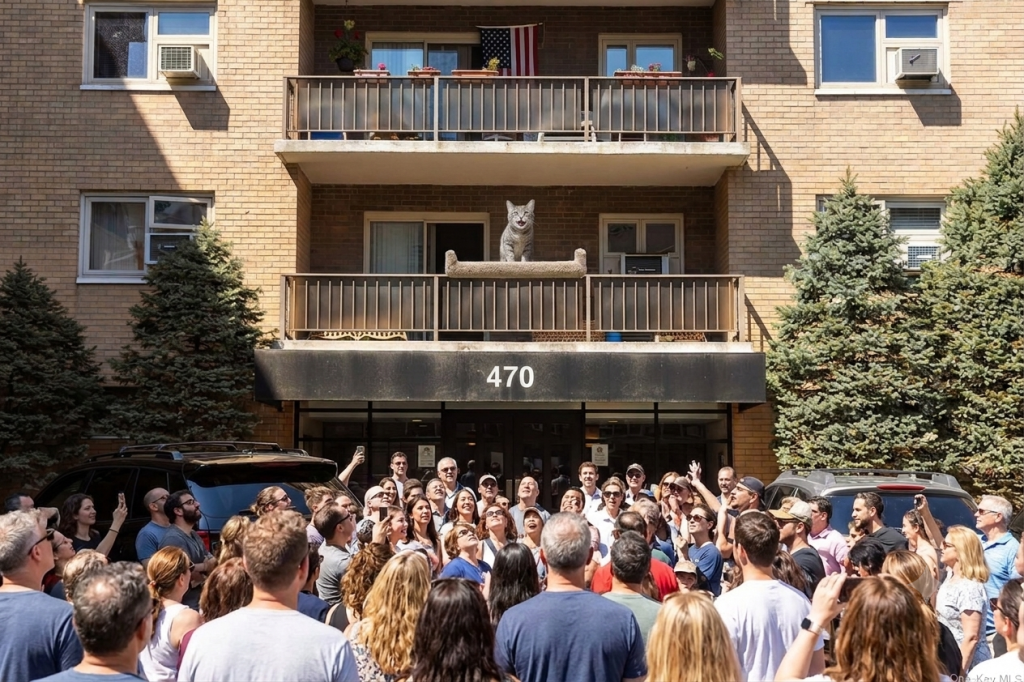
NEW YORK – After cheers of “Buddy! Buddy! Buddy!” rang out for more than a minute, the tabby cat ventured outside to his balcony and greeted the crowd to deafening cheers.

An expectant hush fell over the onlookers as Buddy the Cat climbed onto a platform. Then his little head poked over the railing, followed by his shoulders, and he extended his front paws before waving to the people below like a pope in St. Peter’s Square.

“Meow!” he said, and the crowd roared its approval.

The crowd wasn’t random. It was part of a pre-planned and scheduled tour of neighborhood cats in lower Westchester County, a suburb which directly borders New York City to the north.

“The absolute hightlight of today’s cat tour,” was the way Nadia Petrova, 27, summed up catching a glimpse of Buddy.

Her friend, Elena Mirazova, 25, nodded in agreement.

“Buddy is such cute cat,” said the Russian, who traveled to New York from Moscow with her friend to visit New York and meet its famous felines.

Brandon Williams, the 53-year-old tour organizer, said Buddy was the tour’s most popular feline of the more than four dozen window cats who can be seen on the 90-minute walking tour through the leafy northern suburb.

“It’s not just his incredible good looks or his inimitable charm,” Williams said. “Buddy is magnetic. He lights up a room…or a parking lot. He’s also the only one who gives speeches.”

Indeed, Buddy delivered a 15-minute speech about the awesomeness of domestic felines, the importance of recognizing that awesomeness, and the tastiest attributes of various meals and snacks.

Then he lowered a bucket, which his admirers filled with treats crunchy and soft, as well as cans of turkey pate from virtually every pet food brand known to man.

Ai Imajo of Osaka gifted the beloved feline a variety pack of Japanese cat food, including Tofu Umami Turkey Mix, Super Ultra Perfection Fried Turkey and Squid, and Barbecue Potato Chip Turkey Chunks. As a result of her thoughtful gifts, which took Buddy’s favorite foods into consideration, the popular feline invited her up to his balcony.

“I felt like Courtney Cox getting plucked out of a crowd to dance with Bruce Springsteen,” Imajo said of the famous incident in 1984, which launched Springsteen’s Born In The U.S.A. Tour and Cox’s career as a model and actress. “But of course Buddy’s better than Springsteen.”

Larry The Cat Shares Thoughts About New UK PM And His Dog In CNN Interview

Larry, now on his seventh prime minister, abruptly ended the interview when the reporter asked a question about a matter beneath his notice.

LONDON – Larry the Cat granted a rare interview on Monday, telling a CNN reporter he has no thoughts about new Prime Minister Andy Burnham or his dog, Axel.

Larry, as most of the world knows, is the de facto leader of the UK.

With a public approval rating that is the envy of politicians and the royal family alike, the longtime chief mouser at No. 10 Downing St. has outlasted prime ministers David Cameron, Theresa May, Liz Truss, Boris Johnson, Rishi Sunak and Keir Starmer. Burnham is the seventh PM to serve under Larry’s watchful eye, executing the feline’s will in governing the UK.

Larry has rarely granted interviews and Monday’s conversation was shut down when the CNN reporter asked a question unworthy of a response by the venerable chief mouser.

New Prime Minister Burnham “allegedly has a dog called Axel,” the reporter told Larry. “How will you be behaving with Axel?”

Larry, who up to that point had been amiably humoring the reporter, turned and left when talk turned to Axel.

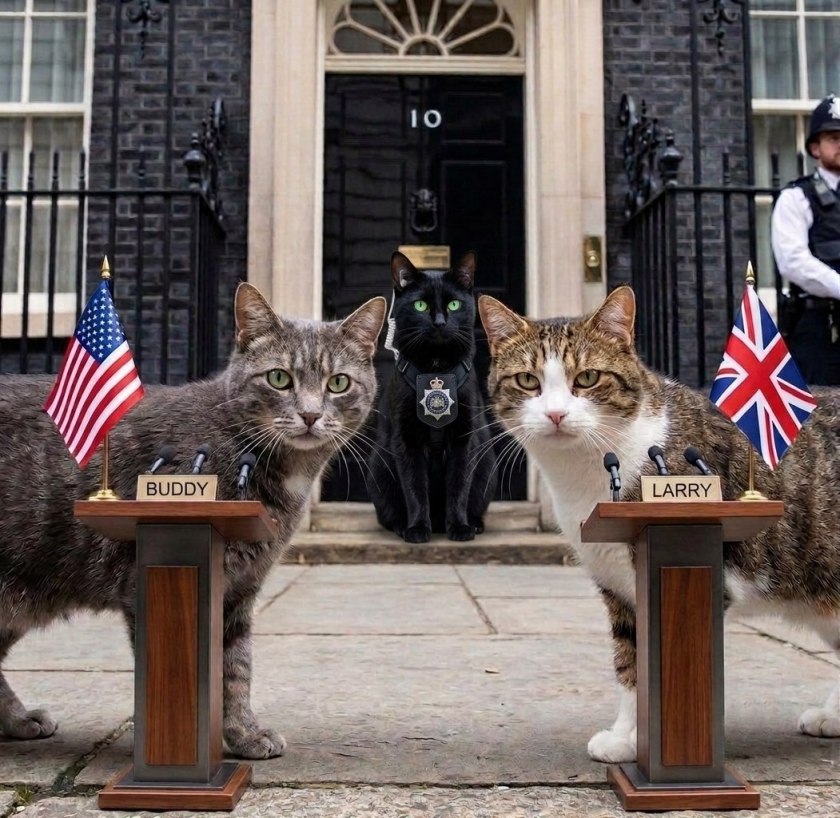
President Buddy and Larry during an Americat state visit in 2025.

It is an unwritten rule among the British press that canines are beneath the notice of the busy cat, who already juggles the protection of Downing Street and its premises with shaping national policy, tutoring the newest prime minister in proper British statecraft, keeping his ladyfriend Maisie (a mouser who works close by) happy, and a rigorous napping schedule.

Asking him about petty concerns like dogs is an insult.

[Unfortunately we cannot embed video of the interview, but you can view it on CNN’s site:]

In other news, unnamed government sources say King Charles has been mulling the possibility of bestowing the dukedom he stripped from his disgraced brother Andrew to Larry, making the feline one of the most prominent aristocrats in the country.

“It would be a smart move by the king,” said Timothy Cavendish, a London publisher and royal observer. “Larry’s standing with the people is unparalleled, and rewarding him for his exemplary service to crown and country is the very least the king can do.”

What’s Something You’d Love To See In The Future, But Know You Probably Won’t Live To Witness?

One day humanity will make contact with another civilization in our galaxy. The odds are almost certain we won’t be alive to see it.

Daily writing prompt
What’s something you’d love to see in the future, but know you probably won’t live to witness?

That’s easy: first contact with an alien civilization.

I’m a space and science fiction fanatic. I mainline science fiction novels, keep tabs on the latest discoveries via the JWST, and I think about what’s out there probably more than I should.

There’s a burning desire in our hearts — for some of us, at least — to know for sure that we’re not the only ones, that humanity is not alone in a cold, lonely and infinite universe.

The events of 2026 are testament to that desire to know. Between the government release of UFO-related documents, former government employees coming forward with tall tales of crashed ships of non-terrestrial origin, and the return of Steven Spielberg to the director’s chair for another film speculating about what’s Out There, we’ve been thinking about aliens quite a bit collectively.

As for that central question, I’m not talking about simple cellular life. I don’t think you can find an astrophysicist, astrobiologist, astronomer, evolutionary biologist or anyone in a tangentially related field who honestly thinks life is unique to our planet.

The more relevant question is whether we are the sole sapient species, the lone civilization in our galaxy.

Credit: CaptainFrank/Pexels

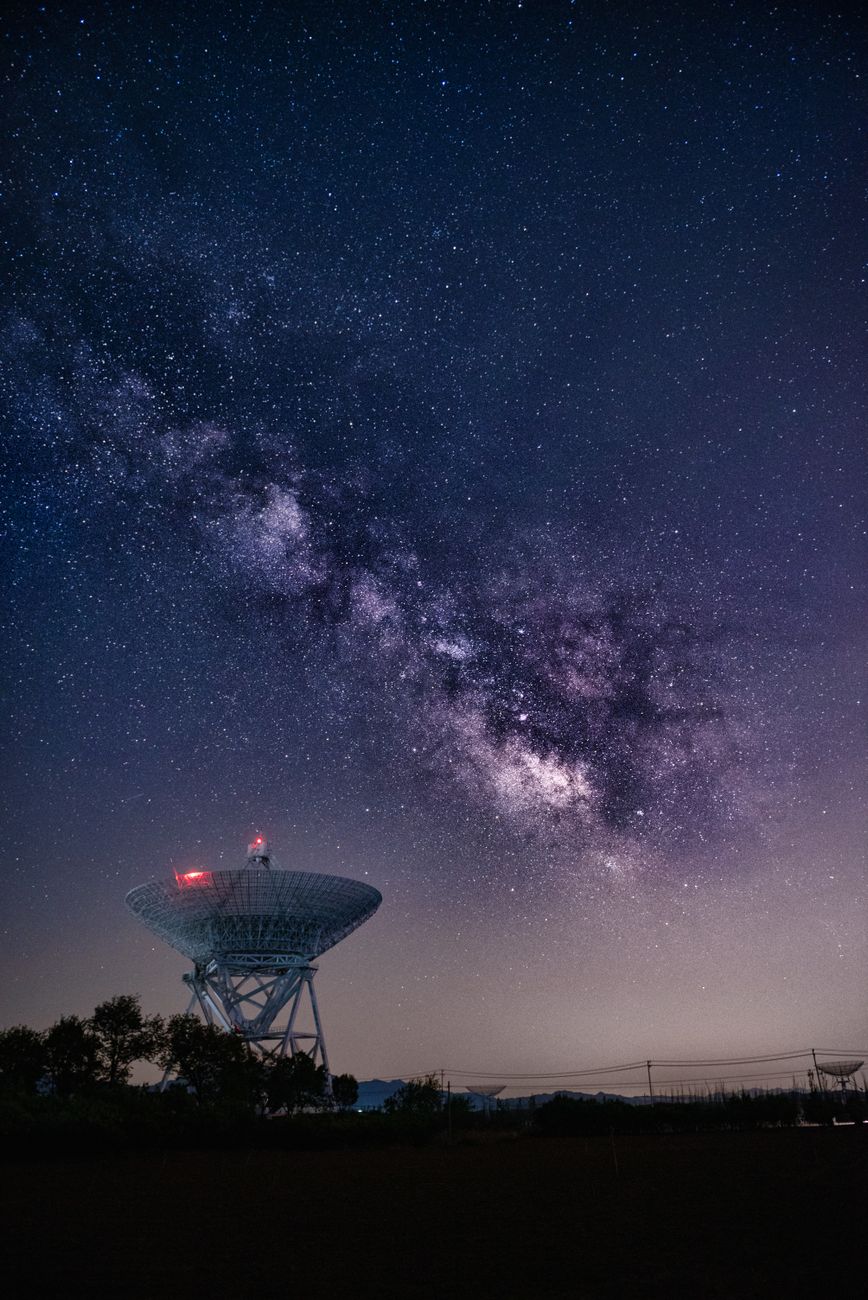
Think about the numbers: There are an estimated 300 billion star systems and trillions of planets in the Milky Way! Life has had a lot of places to evolve.

The Fermi paradox

That was the point the physicist Enrico Fermi made in 1950, when he had a now-famous lunchtime conversation with fellow scientists at Los Alamos. Probability alone indicates the galaxy should be teeming with life.

So, he asked his colleagues, where is everyone?

It’s now known as the Fermi paradox, and it’s guaranteed to come up in almost every conversation about the possibility of intelligent aliens. With so many star systems, planets and moons, surely some other species took an evolutionary path toward intelligence.

It’s a bit more complicated than that, of course. In a universe that is 13.7 billion years old, there has been enough time for innumerable species to evolve and fade, for countless empires to rise and fall. That means the question is “When is everyone?” just as much as it’s “Where is everyone?”

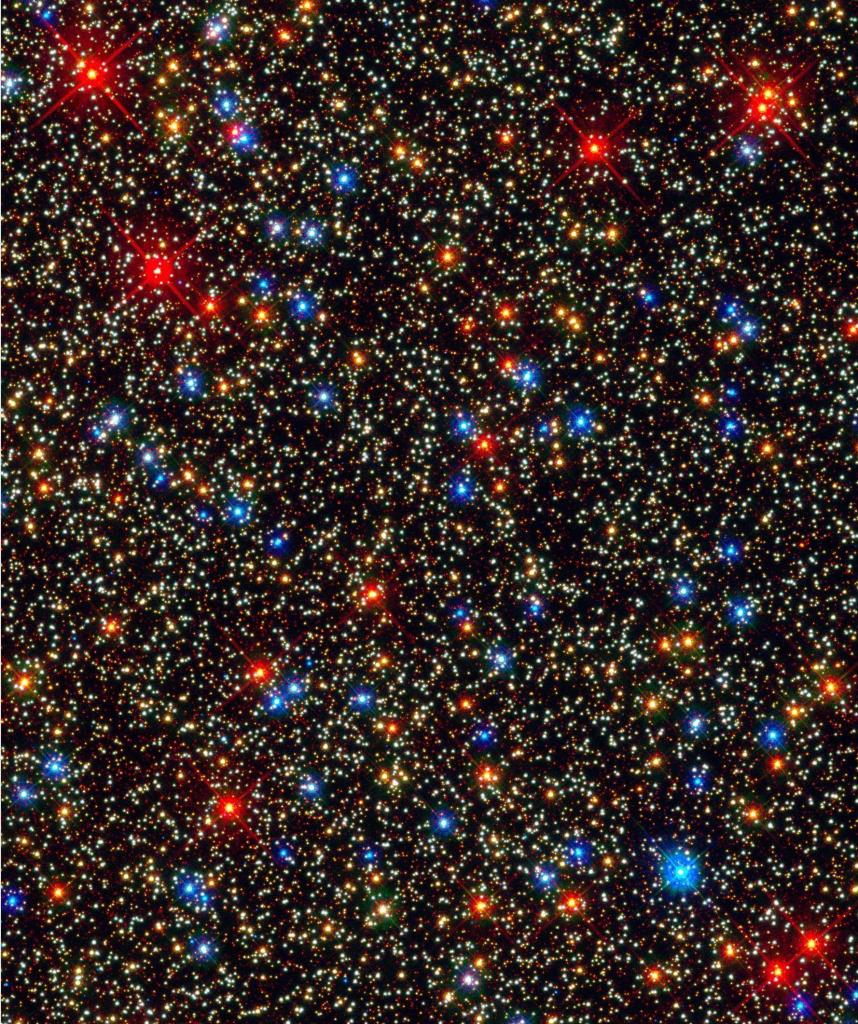
The truth is we’ve only been looking in earnest for about half a century. It’s only in the last four or five decades that we’ve had telescopes like the Hubble, Spitzer, Kepler and James Webb, which have revolutionized astronomy by giving us views we could previously only dream of.

It was only in the 90s that astronomers pointed the venerable Hubble at a black, seemingly empty patch of space, took a two week exposure and changed our understanding of the cosmos forever when the resulting image showed some 10,000 galaxies that were too faint to see before.

That patch covered only 2.6 arc minutes, or 1/24 millionth of the sky!

A partial image of the Hubble Ultra Deep Field. Credit: NASA

Despite what we’ve learned, we’ve barely begun the search for other intelligent civilizations.

Drawing any conclusions from our efforts so far would be like organizing a manhunt, then calling it off five seconds later because the suspect hasn’t been caught yet. Fifty years is nothing when scouring the cosmos. It’s less than an eyeblink of an eyeblink on a galactic scale.

Looking in the wrong place

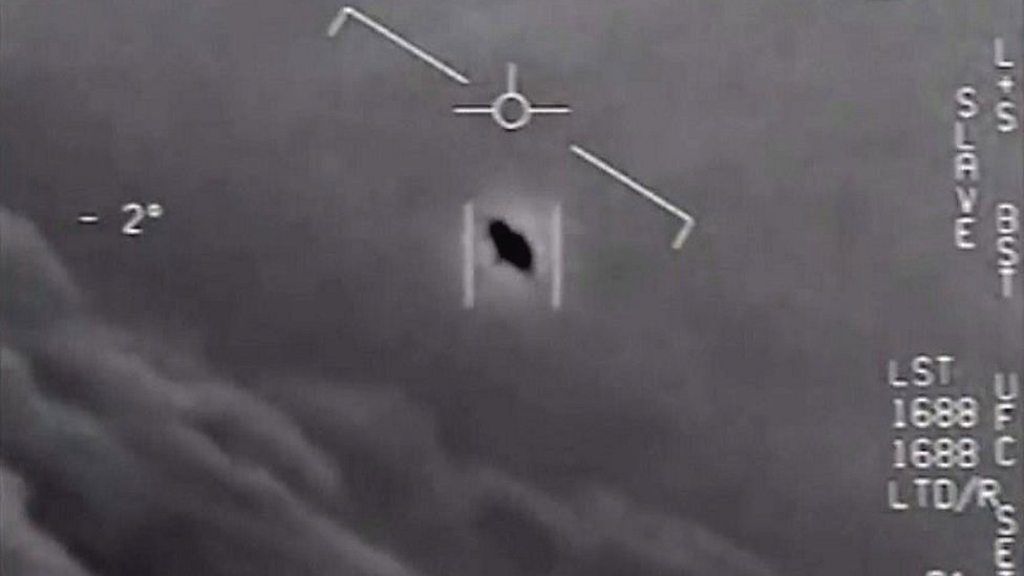
As for the idea that aliens have visited us, that they crossed the interstellar void to etch patterns in our crops, delight stoners with light shows and evade every camera on the planet except for low resolution bricks from the dawn of the cell phone era, I’m not buying it. Neither should anyone else. Likewise for the claim by the JD Vances of the world insisting alleged UFOs are “demons” sent to torment us.

As Carl Sagan said, extraordinary claims require extraordinary evidence, and it is abundantly clear that the UFO enthusiast community can only offer blurry images not because of a lack of high resolution cameras, but because high res photos of the “phenomena” reveal they are mundane objects. They only become strange spacecraft when you blur them and squint.

Bird. Insect close to the camera. Exhaust plume. Debris. Visual artefact. Maybe. Proof of aliens? Absolutely not.

But there’s another, more important reason why aliens are not joyriding through our skies: if aliens are out there, there simply has not been enough time for them to become aware of our existence, let alone travel here.

Even light is “slow” on a galactic scale

As most of us know, when we look at the stars we’re seeing them as they were in the past, not as they are now. That’s because the distances between stars are so mind-bogglingly great that even light, which moves faster than anything in our universe, takes ages to cross the void.

The same limitation applies for anyone who might be looking in our direction from somewhere else in the galaxy. They see our star system as it was, not as it is. They see a silent star system without signs of an intelligent civilization.

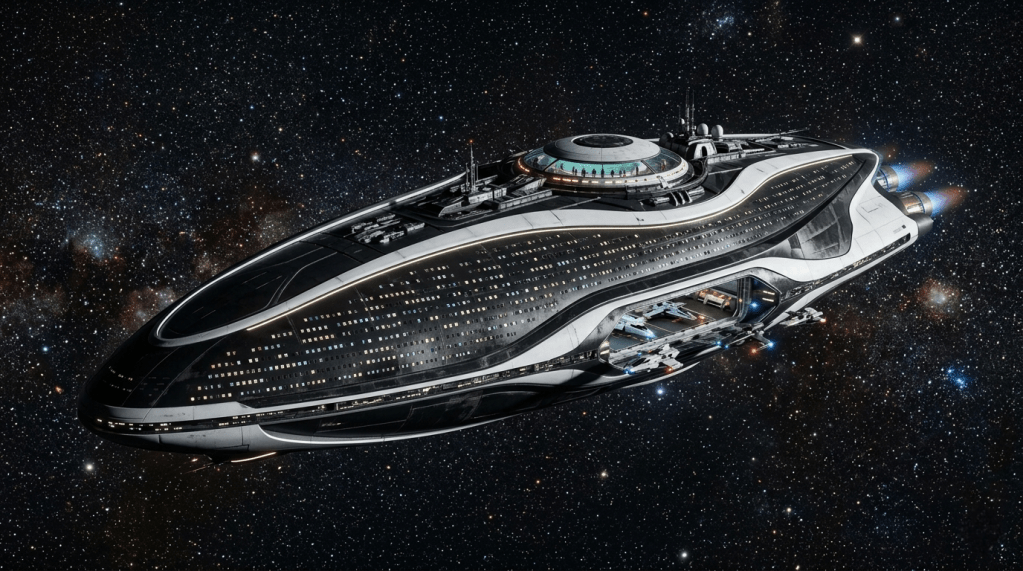
Starliners and generation ships are popular concepts in science fiction for interstellar journeys that can take decades, centuries or longer.

Our galaxy is more than 100,000 light years across, so let’s say an intelligent alien race exists relatively close by in galactic terms, at “only” 500 light years away.

We have been a technological civilization for only a short time and didn’t create signals powerful enough to reach beyond our star system until the 1970s, according to SETI. That means there weren’t technosignatures hinting at our presence until about 50 years ago.

As a result, the soonest our hypothetical aliens could become aware we exist is about 450 years from now. That is how long it will take light carrying information about our technosignatures to reach them.

If our hypothetical alien friends are looking in our direction (a massive if in a galaxy with 300 billion stars to analyze), and if they have highly advanced telescopes, they might detect us. If we imagine they’re friendly and they send a message saying “Howdy, neighbors! You’re not alone! There are wonders to discover and many civilizations to meet out here!” it would take another 500 years for the message to reach us.

That means we wouldn’t know anything until around the year 3,000, if we survive that long without blowing ourselves up. (That’s a real possibility, and things aren’t looking very promising right now.)

And again, that’s if hypothetical intelligent aliens exist in our immediate galactic neighborhood. If there’s an intelligent civilization that exists, say, 4,000 light years away — which is still not very far in galactic terms — the soonest we could hear from them is about 8,000 years from now. (Four thousand for them to detect our technosignatures, four thousand for their message to reach us.)

The point is, space is big. Ridiculously, incomprehensibly, stupidly vast. More than 99.995 percent of the galaxy cannot be aware of our existence yet, let alone travel here, because of the reasons explained above.

The distances between stars are so great that we cannot comprehend them as they are, because nothing in human experience compares. We can only understand them in the abstract. As terrestrial animals with short lives, we are simply not equipped to live or think on galactic timescales.

The sun’s location within the Milky Way galaxy. Not to scale.

To put this in context another way, our closest stellar neighbor, a volatile triple star system, is 4.3 light years away. Yet even with the most advanced propulsion systems currently available to us, it would take us more than 70,000 years to get there!

If we manage to crack fusion and humanity’s most brilliant engineers are able to fit a starship with a compact fusion reactor, the travel time to the nearest star becomes “only” about 7,000 years.

Understanding just how big space is, and how long it takes to travel between stars, goes a long way to explaining why we’re wasting our time and resources with a fruitless search for alleged alien craft in our skies.

Light moves at 186,282 miles per second. Credit: Ehsan Ahmadnejad/Pexels

So where does that leave us?

I believe that one day we will learn we’re not alone. By we, I mean our species. I really hope it happens in my lifetime, but for all the reasons explained above, that’s wishfull thinking. The universe doesn’t care what we want, and it certainly doesn’t change the geometry of space-time to accommodate the wishes of dreamers on Earth.

Alien: Friend or foe?

I don’t think we’ll have to worry about belligerence. If a civilization is capable of sending ships to us, there’s literally nothing in our inventory of meager, planet-based resources that could interest a species that advanced. They wouldn’t want to eat us, because our biology would not be compatible. The amount of energy our entire civilization can muster would be laughable to an interstellar species.

And as the physicist Michio Kaku has argued, there’s a very strong argument to be made that if a species is advanced enough that interstellar travel is relatively trivial, it would have long ago shed any tendencies toward tribalism, sectarian violence or inventing gods of the gaps. You simply cannot reach that stage of advancement if you’re wasting resources and your most brilliant minds on war and petty divisions. (Kaku knows that better than anyone. His mentor was Edward Teller of Manhattan Project fame.)

The more significant danger, as Kaku likes to say, is that we may be beneath their notice and we’ll get “paved over.” A civilization capable of building cosmic megastructures, for example, wouldn’t consult us any more than we’d consult ants before laying a six lane super highway over their ant hill.

Still, there’s always a chance we’ll encounter something like MorningLightMountain, the nightmare alien intelligence from Peter F. Hamilton’s incomparable novel Pandora’s Star. The problem with MorningLightMountain wasn’t that diplomacy failed. There was no disagreement over resources or territory. Humans didn’t threaten it.

Rather, the alien’s psychology was so different from ours that it could not understand the concept of allowing other life to exist in the galaxy. No amount of discussion or attempts to persuade it would have made a difference, so immediately upon learning of our existence it launched a genocidal war that forms the bulk of Pandora’s Star and its sequel, Judas Unchained, two of the most beloved books in the modern science fiction canon.

Still, I’d like to think there is a galactic fraternity out there, an informal alliance of intelligent species united by curiosity and the effort to understand our universe. Whatever’s out there is likely to take forms we can never imagine and think in ways that never occurred to us.

If one day we do make first contact, I hope the best of humanity will be our representatives. And on that day, I hope humanity will be awestruck by the wonder of the universe, realize that slaughtering each other over land or beliefs is insane, and finally become united as a species.

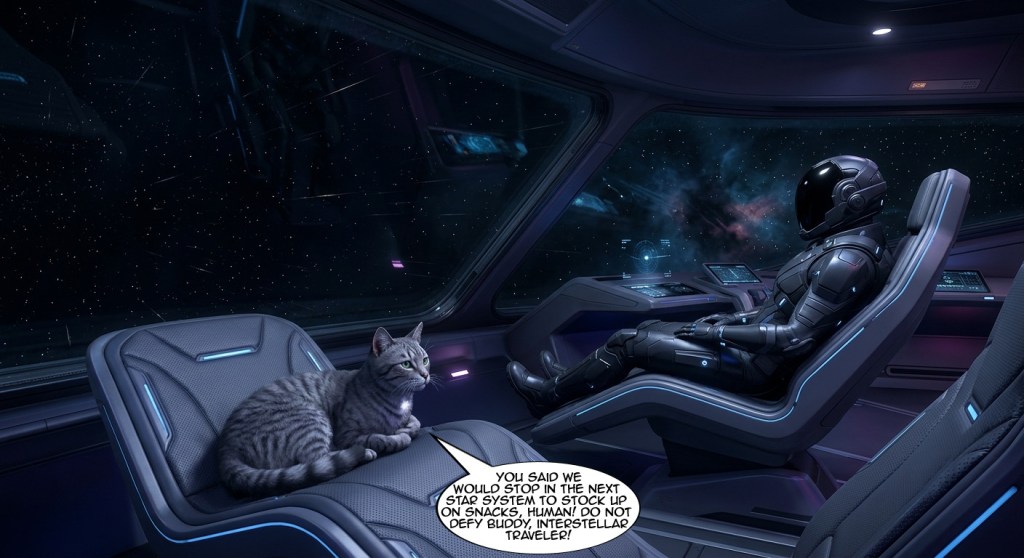
Or even better, finally united as the children of Earth. After all, Buddy has made it abundantly clear that if I come into possession of a starship, he gets the most comfortable seat on board and gets to drive. The latter ain’t happening, but as for the former, I’d be thrilled to explore the cosmos with my little pal.