Mars, The Pet Food Company, Claims There’s A ‘Treat Gap’ Between Cats And Dogs

The makers of Temptations want you to feed your cats more snacks, as if they don’t get enough!

In yet another indication that some people don’t seem to pay attention to their feline masters, the Wall Street Journal reports on Mars and its internal operation “Cattitude,” which as far as I can tell amounts to a few people within the company realizing they haven’t squeezed every last dollar of revenue from people who have cats.

That’s a problem, the company realized, because more people are adopting cats, younger generations are more likely to adopt felines, and anyone who hasn’t had their head in the sand knows the little ones rule the internet with their cuteness.

Through “Cattitude,” which apparently involves everything from executives walking around the office wearing cat ears, to handing out “I Love Cats” decals and consulting with “cat parents” on products, the company says it’s identified a “treat gap” between felines and canines, with dogs as the far more frequent beneficiary of yums:

“Feline insecurity can be self-fulfilling. If you think your cat doesn’t care, you might be less likely to shower them with perks. That may be why dogs get way more treats. 

Mars launched a campaign in May that spotlights the “treat gap” by the numbers: Dogs are nearly 32% more likely to get daily treats than cats in dogs-only and cats-only households; in homes with both, 38% of parents said they don’t give the same number of treats.

The story does not say how the company arrived at those numbers. Probably market research in the form of surveys. Not exactly scientific, as these things go.

This is one of those stories that makes me wonder if these people actually have cats.

From the moment I wake up until the second I settle into bed, Bud shrieks at me for snacks. He won’t even let me stumble into the bathroom before the first shrill reminders. He demands snacks before dinner, after dinner, after he’s had snacks, and sometimes while he’s eating them.

If he could speak English and hold a bull horn, I have no doubt he’d spend the majority of his day blasting the demands into my ears: “MOAR SNACKS, BIG BUDDY! MOAR! MOAR!”

Mars should know this. One of its most popular products, Temptations, turns cats into slobbering addicts. I had to wean the Budster off them, then stupidly bought them again months later and had to wean him off the Temps again because he has a one-track mind when they’re in his bloodstream. Two are not enough. Six are not enough. Ten are not enough.

One time, I left a big tub of the damn things unattended for a minute and he managed to pop the top off by knocking it off the coffee table. When I walked back into the living room, he was dragging his jaw along the floor like a bulldozer, inhaling as many as was felinely possible into his little mouth.

Frantically, I shooed him away and began picking them up, but the damage was done. He threw up a few minutes later. Then he shrieked for more!

He always looks innocent, doesn’t he?

Interestingly, the WSJ notes that if you type “Does my cat” into Google, the first two auto-complete suggestions are “Does my cat love me?” and “Does my cat know I love her?”

And that brings us to a point on which I agree with the people at Mars: cats still aren’t well understood.

Dogs happily slobber over their people. Cats show their love in subtle ways, like proximity, head bunting and momentary contact.

Just like the whole “cats love milk” thing is half myth, half misunderstanding, so is the idea that your cat doesn’t love you unless he’s leaping into your arms to hug you as saccharine orchestral music swells in the background.

While there are always outliers, most cats don’t like being hugged or picked up, and most have hard limits when it comes to the amount of physical affection they’ll tolerate. It’s not because they don’t care for us, but because they’re semi-domesticated carnivores who still retain the skittish tendencies of their wild brethren, and because they get easily overstimulated, among other reasons.

If Mars’ Cattitude is an ongoing thing, I hope the decision-makers in the company come to what I believe are two of the most important conclusions to keep in mind when it comes to cats. Giving them your love means giving them your time and attention, and treating them like the sentient, emotional creatures they are.

The best piece of advice I ever got was to always take your cat’s emotions into consideration.

It really is that simple.

Now if you’ll excuse me, I have snacks to dispense.
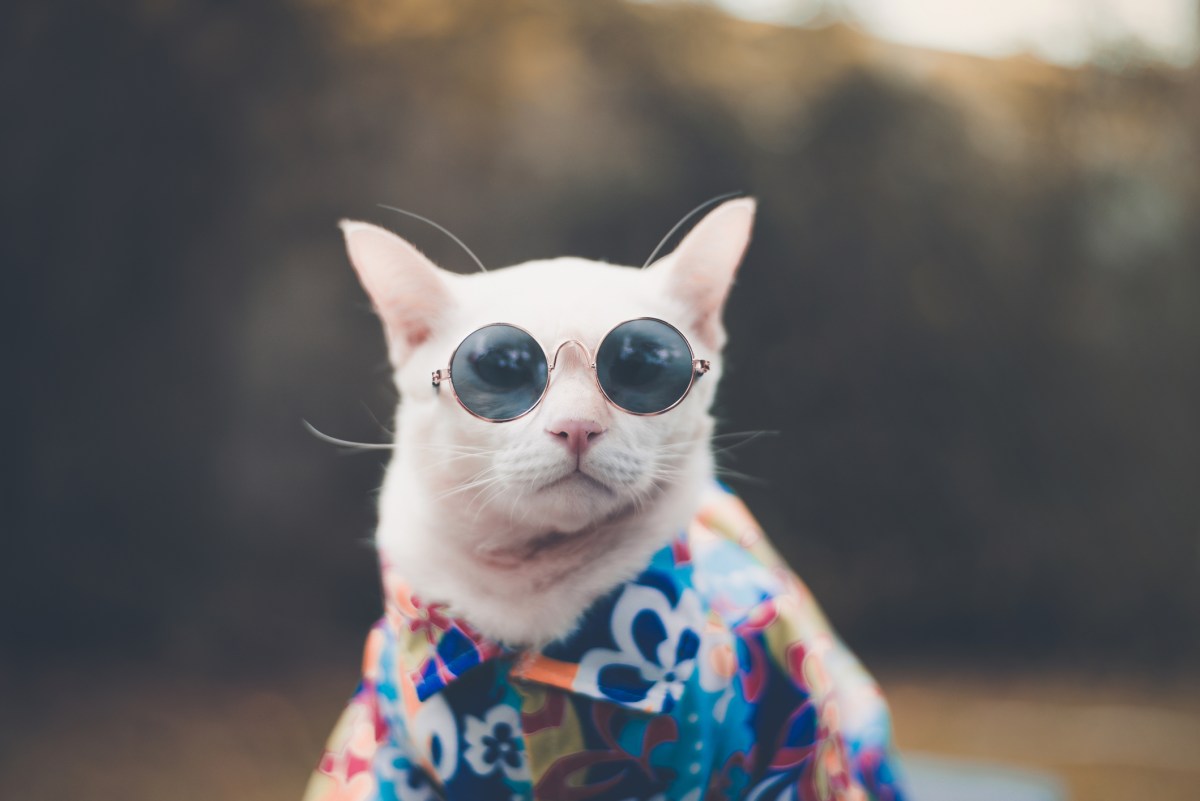
‘Petfluencers’ Make Their Cats Wear Clothes, Plus: Why A New Coat Color Has Emerged

The quest for clicks and attention is a race to the bottom, and “petfluencers” are willing to dive deep to differentiate themselves from the thousands of others trying to build an audience.

Clothes, sneakers and hats. Vitamin supplements, energy drinks and probiotics. Backpacks and costumes.

What do all those things have in common? People are buying them for their pets, not themselves, and they’re part of the reason people in the UK spent more on pets in 2024 than childcare, hobbies or dating, according to Nationwide UK.

The problem is, they’re not doing it for their pets. Experts, including veterinarians and animal behaviorists, tell The Guardian that most cats, aside from hairless varieties like Sphynx cats, don’t like wearing clothing, nor do they like wearing costumes, or taking baths with heavy perfumes and essential oils.

Influencers — or petfluencers — stage elaborate “pampering” scenes, and make their pets wear different clothes to show off their shopping “hauls.” Some pose their animals like dolls and find ways to coerce them to remain still. Audiences think it’s cute. It’s not.

As for me, I’ve got a handy chart when I’m unsure if Bud will be cool with something:

  • Make him wear clothes. Result: Get clawed to death
  • Give him baths with essential oils. Result: Get clawed to death
  • Make him wear sneakers. Result: Death by bite to the jugular
  • Force him to eat supplements or guzzle energy drinks. Result: Shredded skin and lots of blood, perhaps some light homicide.

While the animals themselves aren’t thrilled with these new trends, they probably won’t go away any time soon. There’s just too much money involved.

The average pet owner in the UK spent the equivalent of $163 per month on their companions, and only half of UK households have pets compared to 66 percent in the US. Although there’s not an apples to apples comparison of total expenses on pets per month by household in the US, Americans spend $68 a month on cats on average, according to research by ValuePenguin. For dogs, it’s about $110 a month.

‘Salty liquorice’ cats owe their unique coats to a missing snip of DNA

It’s always an interesting occasion when nature gives us something new, and the salmiak cat is definitely unprecedented in the world of feline aesthetics.

The unique cats, named after a popular liquorice candy from Finland, have a coat pattern that results from a gradient on individual strands of fur, starting out black and getting lighter toward the tip. It gives their coats a singular peppered look, and in photographs the unusual felines almost look as if they’re rendered in monochrome stippling.

Credit: Ari Kankainen

The Finnish candy the cats are named for.

The salmiak cat wasn’t the product of any breeding program, and reports in Finnish media say strays with the new coat pattern/color first emerged in 2007.

To find out how the salmiak emerged, a team of Finnish, British and American scientists sequenced the genomes of two salmiak cats. They found a mutation in genes that express coat color that resulted in a missing sequence of DNA, and they confirmed the mutation is recessive. That means to get salmiak kittens, both parents have to have the mutation.

Bird Flu Kills 20 Big Cats At US Sanctuary And Prompts Pet Food Recall

Cats of all kinds are at risk of avian flu infection if they hunt birds outdoors, consume raw meat or drink unpasteurized milk.

In a tragedy that underscores how vulnerable cats of all types are to bird flu, more than half the big cats residing at a sanctuary in Washington were killed by the virus in less than a month.

Twenty cats in total died at the Wild Felid Advocacy Center, including five servals, four bobcats, two Canada lynx and a Bengal tiger.

Only 17 cats are left at the sanctuary, according to its operators.

Mark Matthews, the sanctuary director, called the H5N1 avian influenza a “wicked virus” that killed the cats in his organization’s care within 24 hours of each animal contracting it.

“We’ve never had anything like this,” Matthews said, adding that he and his staff are accustomed to cats in their care dying of old age after living long, happy lives.

In California, Gov. Gavin Newsom declared a state of emergency on Dec. 18 after infected birds were found at more than two thirds of the state’s dairy producers.

cows in barn
California’s dairy industry has been hit hard by the spread of bird flu, with more than half the state’s dairy producers impacted. Credit: Ralf R/Pexels

As of Dec. 26, bird flu had infected 65 Americans, the majority in California.

And the virus has now resulted in its first pet food recall, with Northwest Naturals pulling its turkey recipe “raw diet” food. A cat in Oregon died after consuming the food, according to the Oregon Agriculture Department.

As we noted in our earlier post about the variant of avian influenza, there’s no reason to panic. Even if you live on the west coast, the chances of your cats being infected are small.

But it’s probably a good idea to make sure your cats remain indoors, as health authorities warn cats can contract the virus directly by catching and eating birds. In one case, health officials believe three indoor cats may have caught the virus after killing mice in their home.

In addition, the American Veterinary Medical Association advises caretakers to avoid giving their cats milk, which they should not be drinking anyway, and raw meat. Domestic cats are generally lactose intolerant, and while cats can be infected with bird flu by eating raw poultry, they can also contract the virus by eating raw meat from other animals.

The Meowdulator Is A Guitar Pedal That Makes Your Guitar Meow

Guitarists, synth players and other musicians can get their meow on with this unique FX pedal.

As a guitarist I’m partial to pedals, FX and other gear that can imbue the instrument with the funkiness of the wah or the satisfying crunch of harmonic distortion.

But this? This is something I never expected.

Meet The Meowdulator, an FX pedal that does precisely what it sounds like it does.

Created by B’s Music Shop and pedal-maker Cusack Music, the Meowdulator is a monophonic guitar synth, meaning it plays single “notes” similar to a Moog. That means you can’t strike a chord and get a chorus of discordant meows, but you can for example play a solo that sounds like a cat in heat — if you want to. (The “Little Mew” setting sounds like an octaver in meow, generating multiple voices, but still triggered by plucking single strings.)

Brian of B’s Music Shop called the pedal “maybe the craziest thing I’ve ever collabed on.”

“It’s glitchy sometimes, it’s its own animal,” he said in a video demonstrating the new pedal. “But it’s a little kitty cat and we hope it makes you happy and you have some fun with it.”

My favorite of the seven presets demoed in a Youtube video is “Acid Kitty Synth,” which generates a funky, wah-like meow. In the right hands, something awesome can be done with it. I can imagine Acid Kitty Synth breathing life into an Earth, Wind and Fire style or Televisor-esque track, compelling the listener to hit the rewind button while asking “Did I just hear what I think I heard?”

Finally, there’s a “hidden feature” — if you hold down the bottom-most button, the pedal will purr. Perhaps it’s something to work into the rhythm of a track or give the audience a relaxing vibe between songs while playing live?

The Meowdulator retails for $199 and is expected to ship in mid-July. Those of you who fall into the cat lover/guitarist venn diagram overlap can pre-order now.

Now can someone make a puma scream pedal? Ratatat, a New York duo and one of my favorites, has a thing for working the screams of the iconic cat into their tracks, and it makes me love them even more.


Why Are UK Cat Owners So Intent On Allowing Their Cats To Run Free?

A UK couple created a cat flap that uses algorithmic AI to determine if their cat is trying to come inside while carrying prey in her mouth. If she’s carrying prey, the cat flap won’t open.

Jinx the cat was so grateful to UK couple Martin Rosinski and Michelle Bowyer for giving her a home that she decided to bring them a gift.

“The first time I was working at home, I heard Michelle making a commotion because Jinx had come in with a mouse and dumped it on the carpet in front of her as a ‘thank you’. That’s their way of expressing love. You can’t tell her off, so we thanked her a lot for it and took it away from her,” Rosinski said.

“Then this started happening more and more often to the point where we would be woken up at 2 a.m. as Jinx would meow loudly and announce, ‘Hey I have a gift. If we didn’t get to her fast enough she would decide to eat it herself, which would involve piles of mouse parts being smeared into the carpet. This was happening at 2 a.m., then again at 4 a.m. on many nights and we’d not get any sleep having to deal with this. Her record was four in one night – that night was a frenzy of three mice and one bird. It was something that was a real cause of stress.”

The solution is pretty simple, right? Keep Jinx inside.

The former stray won’t like it at first. There will be an adjustment period when the meowing will be seriously annoying. But it’s better than allowing your cat to play Predator at night and waking up to find your cat sitting on your chest, proudly presenting a twitching mouse to you.

Rosinski and Bowyer didn’t take Jinx inside.

Instead they created a bespoke intelligent cat flap that allows Jinx to come and go as she pleases, but won’t open if she’s carrying prey. They both have backgrounds in tech: he’s a researcher who also tinkers with software and hardware, and she’s a web developer.

cute brown tabby cat
Despite being domesticated, cats retain their predatory instincts and many will kill small mammals and birds if allowed to wander on their own outdoors. Credit: Aleksandr Gorlov/Pexels

Their system, OnlyCat, uses a camera and an algorithm to determine if Jinx is carrying something in her mouth. If she is, the cat flap won’t grant her access, and Bowyer and Rosinski will get a text informing them Jinx has been up to her hi-jinx again, along with a photo of her entry attempt.

The OnlyCat prototype has prevented Jinx from bringing in 42 prey animals since June of 2021, the couple said. OnlyCat may prevent her from bringing her prey inside, but it hasn’t dissuaded her from killing.

“Two months ago I think something clicked and she realized, ‘I can’t bring these home. It’s just not going to work,’” Rosinski told the UK’s South West News Service. “She still catches them outside but she’s learned that there’s no point even trying to bring them home, which is a relief.”

The couple developed the OnlyCat into a full product, which launches on Aug. 16 at £499. (A little more than $600 USD.) Their site says the retail version of the flap has worked 100 percent of the time in tests, and the developers believe “99%+ accuracy should be achievable for everyone.”

It’s similar to a device built by Amazon engineer Ben Hamm which uses DeepLens, an AI-enabled camera system, and Sagemaker, a software tool for training machine-learning algorithms, to determine if cats are carrying prey.

Hamm’s version, which he created for his cat Metric in 2019, initiates a 15-minute lockout timer if Metric tries to enter while carrying a kill, and automatically sends a donation to the National Audubon Society, which protects birds and their habitats. The algorithm was trained using tens of thousands of images of cats approaching normally, and with prey in their mouths. So far, Hamm hasn’t developed a retail version of his AI-enabled cat flap.

orange tabby cat on gray rock
The feline predatory drive is instinctual. Indoor cats can exercise that drive with wand toy games and by chasing laser pointers. Credit: Aleksandr Nadyojin/Pexels

We don’t think there’s any one way to raise cats, and it’s obvious there are different cat cultures in various countries.

Nevertheless, seven out of 10 cat owners in the UK allow their cats to roam free, and anecdotes like the ones about Jinx, with her multiple kills a night habit, draw the ire of birders and conservationists.

Peter Marra is the author of Cat Wars: The Devastating Consequences Of A Cuddly Killer and co-author of many of the leading studies claiming cats are the primary threat to bird populations. He’s currently making the media rounds and endorsing strict policies — many of them in enacted in response to his studies — that would make it illegal to allow cats outdoors.

The Australian government is airdropping poisoned sausages by the ton in a plan to cull as many as two million cats, a town in Germany tried to ban outdoor cats, a US politician recently suggested starting a “hunting season” for feral and stray felines, and some people — including wildlife biologists and conservationists — have gone vigilante and convinced themselves they’re doing good by randomly picking off cats with shotguns and poisoning feeding stations for strays.

Maybe it’s time for more people to reconsider allowing their cats to roam free. Like putting a cat on a diet or trying to break a bad habit, there’ll be loud and annoying protests in meow, and it’ll get worse before it gets better, but eventually cats always adjust to changes if given long enough.

As domesticated animals they don’t have a natural habitat anymore, and they don’t actually need to be outside. It’s entirely possible to keep things fun and interesting for the furry little guys, and that’s on us. All that’s required is our time, attention and affection. Interactive play time. Toys that can keep a cat occupied by herself. Catnip. Condos and tunnels. Window perches. Cat TV on Youtube. Simple things to play with, like plastic bottle rings, crinkled tin foil and cardboard boxes.

We don’t think anyone should be required to keep their cats indoors, and that’s the point. We have an opportunity to meet conservationists halfway and make a real effort to reduce feline impact on small wildlife. If we don’t, eventually we’ll be forced to comply by laws that’ll be draconian compared to the voluntary measures we could have taken to prevent the government from getting involved.