Veterinarians tried their best to save Juliet, but noted “even with the best care, not every animal makes it.”
Juliet the cat and her two feline siblings were unceremoniously dumped outside their former home when their humans moved out of state a few weeks ago.
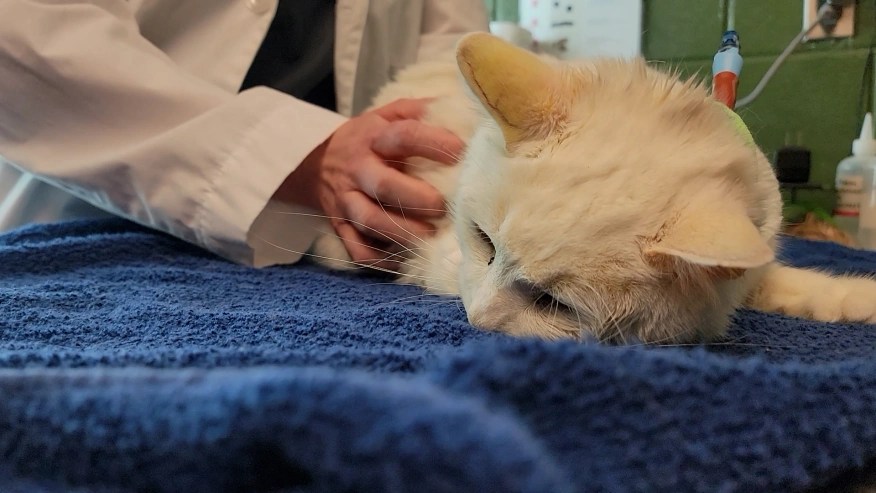
A Good Samaritan realized the trio had no one taking care of them and nowhere to go, and brought the cats to the Charleston Animal Society in South Carolina. After some time, Juliet stopped eating. A scan revealed why: The cream-and-white cat had an amorphous mass inside her stomach, a “seemingly endless bundle of strings” in the words of one veterinarian, which blocked Juliet’s stomach and prevented her from being able to eat or process food.
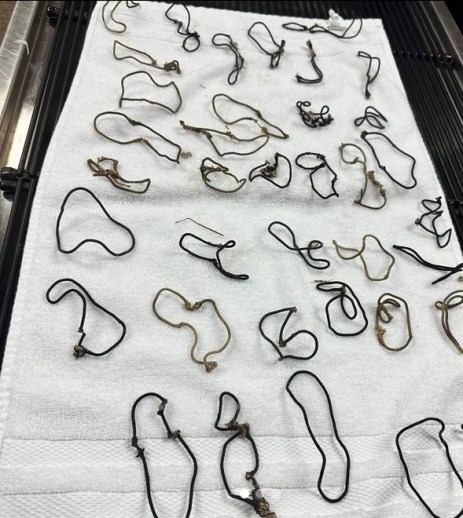
A vet performed emergency surgery on Juliet earlier this week and removed 38 hair ties.
“I’ve never seen anything like it,” said Leigh Jamison, the shelter’s associate director of veterinary care.
Hair ties removed from the stomach of Juliet the cat.
Vet techs monitored Juliet closely and fed her carefully, making sure she got the nutrients she desperately needed without overwhelming her shocked system, which had suffered a buildup of fat in her liver.
They thought Juliet would pull through, but the ailing kitty took a turn for the worse on Friday and died a few hours later, the shelter announced.
“Our expert veterinarians and lifesaving team perform what we think are miracles every single day. Unfortunately, even with the best care, not every animal makes it,” staff wrote in an Instagram post. “Even though Juliet was loved and was not suffering during her last days, she did succumb to this tragic accident. We are all heartbroken.”
Pica, an eating disorder that affects humans, also occurs with cats. Defined as the consumption of items which are not food, pica can manifest in cats as a predilection for things like paper, plastic bags, rubber bands, small pieces of plastic and, as was the case with Juliette, items like hair ties that are made of fabric, wool or synthetic materials.
While there are medical reasons pica can present in felines, it’s also sometimes brought on by environmental stress, and it wouldn’t be a stretch to imagine the kind of people who would abandon their pet cats may not have been good caretakers. No one except her former caretakers know what Juliet’s been through, and they’re unlikely to come forward.
Likewise, adoption isn’t a part time, halfway or temporary thing. Adopting a cat means committing to taking care of the animal for his or her entire life. Despite the stubbornly persistent idea that cats are aloof, solitary animals who are indifferent to companionship, research studies show felines are just as sociable as dogs and form strong emotional attachments with their humans. They care deeply, but they express affection in different and less overt ways. That doesn’t mean they suffer less when they lose their homes and the people they’ve grown to love.
After a judge barred them from caring for a cat colony, Mary Alston and Beverly Roberts say they’re worried about the strays, who have been left to fend for themselves as winter sets in.
They’d been treated like hardened criminals and insulted by the same police officers who were supposed to protect them, but Beverly Roberts and Mary Alston didn’t think they’d be convicted.
Not for taking care of cats.
“I felt it was very unlikely that we would be found guilty,” Alston told PITB, “with all of the evidence that we had on our side with the body camera footage, and we never broke any laws.”
Roberts and Alston were arrested on June 25, when a trio of police cars pulled up and officers from the Wetumpka, Alabama, police department confronted them. Police body camera footage shows the women, who had been caring for a colony of stray cats, were surprised by the tone and impatience of the officers.
What they didn’t know was that Wetumpka Mayor Jerry Willis was the one who’d in effect dispatched the officers to the small wooded lot owned by Elmore County, grounds that are open to the public. They didn’t know that the officers — who warned the confrontation was “going to get ugly,” told the women they’re “too old to be acting this way” and later joked that they were “a bunch of cops beatin’ up on some old ladies” — were told by the assistant chief of police to arrest them after Willis spotted Alston’s parked car and called the assistant chief directly.
On Tuesday, despite the fact that Willis’ role was revealed during a trial, and despite the fact that Wetumpka has no laws against managing cat colonies or conducting “trap, neuter, return” activities, Alston and Roberts were convicted of a pair of misdemeanors each. Lacking laws to charge them directly, the authorities instead accused the women of trespassing on public land and being uncooperative with the officers.
“That’s what I kept going back to – that feeding and trapping cats is not illegal,” Roberts told PITB. “I was not in the location I was [accused of trespassing], and I was sitting in my car talking to my friend. I was not feeding cats.”
During the trial, Willis and the police argued that they’d already told Alston and Roberts to stop interacting with the cats, and said the pair chose to ignore earlier warnings to stay away from the stray colony. They reiterated their view that the colony is a nuisance.
Roberts said she’s had her disagreements with Willis in the past about the way the town handles animal-related issues, but says Wetumpka’s animal control officer gave her and Alston his blessing to manage the cat colony at their own expense. The animal control officer confirmed that during the Tuesday trial. Public-private partnerships to care for stray cats are common in towns and cities across the US, with many elected leaders welcoming the opportunity to work with local rescues and volunteers.
Roberts and Alston say they plan to appeal their conviction, hoping a county judge will see the charges as “politically motivated” accusations. They pointed out that Wetumpka municipal Judge Jeff Courtney is employed directly by the town, not elected to the post by voters, and they believe they’re more likely to get a fair shake when the people deciding their fate aren’t serving at the pleasure of the people making the accusations.
In the meantime, the cat colony remains in Wetumpka, and the cats haven’t been cared for since late June.
“We are very worried about them,” Roberts told PITB. “A few animal lovers have said they would help, but we are not sure this will happen. I’m not sure there is enough food available to hunt. The weather is getting colder, and they need protein.”
Since the terms of the sentencing include two years’ probation, Alston and Roberts are prohibited from caring for the strays. Alston noted the irony of local authorities claiming TNR was exacerbating a “nuisance” while, in the absence of care and neutering, the free felines “are left to go hungry and continue to multiply and branch out searching for food.”
Roberts says she still finds it hard to believe Wetumpka officials refused to compromise or find a way to establish cooperative care for a community problem.
“I thought that they surely had more pressing issues to attend to,” she said. “I really thought the judge would dismiss it and tell the city to work it out.”
Two new reports estimate the cost of caring for a cat over a typical 15-year lifespan.
Two stories published in recent days give wildly varying estimates of how much it costs for the privilege of serving a cat.
First we should note that both reports assume the cats are adopted in kittenhood and the average lifespan of a cat is 15 years. That’s in line with current data showing well cared-for, indoor-only cats live between 12 and 18 years, with outliers on both ends. It’s not uncommon to hear about cats living well into their 20s just as some cats sadly pass on before their time, whether due to natural causes, illness or accidents.
A Texas cat named Creme Puff is the Guinness World Record holder for longest-lived house cat, holding on for an astonishing 38 years until her death in 2005.
Caring for a house panther can cost between $4,250 and $31,200 over kitty’s lifetime, according to an analysis of associated costs by The Ascent, a vertical of financial literacy site The Motley Fool.
The estimates break costs down into recurring expenses — which include food, treats, litter and veterinary care — and fixed expenses like scratching posts, toys, additional cat furniture, bowls, grooming tools and similar items.
Not surprisingly, the biggest expense is food, the cost of which has been exacerbated by inflation, rising fuel costs and lingering supply chain issues that caused a cascade effect during the pandemic. Everything from sourcing metal for cat food tins to meat availability was impacted as ports were closed and meat processing plants were shuttered at various points since early 2020.
An unrelated estimate from OnePoll, based on a survey commissioned by pet food company Solid Gold, put the lifetime estimate of cat servitude at $25,304. Like the Motley Fool analysis, OnePoll’s respondents cited food as the primary expense, followed by veterinary care.
The wide range from the Motley Fool analysis could be attributable to geography, how well the cat is fed, and how many extra things caretakers do for their cats. A person who lives in Manhattan, splurges on bespoke feline furniture and buys ultra-premium cat food at almost $3 a can is going to spend significantly more than an eastern European cat servant who feeds raw or home-cooked food and builds their own ledge loungers and scratching apparatus.
“Welcome to Teh Bank of Kitteh, you may make a deposit but not withdraw!” Credit: @catsandmoney/Twitter
Here in New York the cost of cat food in local grocery stores has spiked dramatically, but online prices have remained steady. Keeping in mind we’ve never really endorsed any particular brand or vendor on PITB, I switched from occasionally buying food online to Chewy auto-shipments during the pandemic because Bud’s favorite food was becoming very difficult to find locally, and that arrangement has worked out cost-wise as well.
Bud’s a true Pain In The Bud when it comes to “leftovers” so his primary wet food is Sheba Perfect Portions. It’s reasonably priced, comes in variety packs and helps avoid waste since each meal comes in its own 1.3oz recyclable blister-like plastic package. (Recycling is especially important with these single-serve packages, tiny as they are.) His dry food is Blue Buffalo Wilderness Adult Chicken recipe, although occasionally I’ll buy the weight control version of the same dry food when it looks like Little Man has gotten a bit chubby. He doesn’t protest, thankfully.
I feed him two 1.3oz wet meals a day and fill his dry bowl less than halfway at night so he can have his late snack and doesn’t have to wake me up if and when he gets hungry overnight. Sometimes I’m dimly aware of him sliding off me, padding over to his little dining nook and munching on dry food before hopping back onto the bed and dozing off again.
Overall it works out to about $21 a month, so I’d call it an even $25 with treats. You can schedule your auto-ship at any interval you choose, edit it at any time, and prompt the shipment immediately if you’re running out of food, so you can save more by ordering a few months’ worth of food at a time and taking advantage of free shipping on orders of more than $50.
Has inflation impacted cat food prices in your local area? How much does it cost to feed your cat(s) every month?
For the first time, veterinarians and regular cat parents have a tool that can tell them if their cats are hurting.
Although there’s been lots of talk claiming cats don’t have facial expressions humans can parse — or even the muscles to noticeably change expressions — that’s not actually true.
It’s more accurate to say feline facial expressions are far more subtle than their human or even canine equivalents, and it takes an expert — a veterinarian or behaviorist with specialized training — to accurately read them.
This is a brand new frontier for veterinary science, and it’s all thanks to the feline grimace scale, a system developed by researchers at the University of Montreal in 2019. Using video clips of cats in various moods and stages of pain or pain-free expression, the researchers built a system that could reliably determine how a cat is feeling. (You can read more about how they did that here.)
“I call it the Rosetta Stone for interpreting how a cat is feeling,” veterinarian Liz Bales says in a new video at dvm360. “It turns out that very subtle changes in cat’s facial expressions can tell us whether or not they’re in pain. It includes the position of the ears, the opening of the eyes, the expression on the mouth, how the cat is holding its whiskers, and how they’re holding their head.”
Each of the five elements of feline facial expression are scored on a three-point scale, then added up. The result provides an accurate assessment of how a cat feels.
“It’s amazing, and it allows us to interpret feline pain in a way we never could before,” Bales says. “The hard part is, it can be a little bit tricky to learn. It is learnable, but I specialize in this and I’m still struggling to get it right every single time.”
Despite the challenge, she says, it’s well worth learning.
“The applications of this are so far and wide, and I think as the technology grows and it becomes easier and easier to use the grimace scale, the more exciting it’s going to be.”
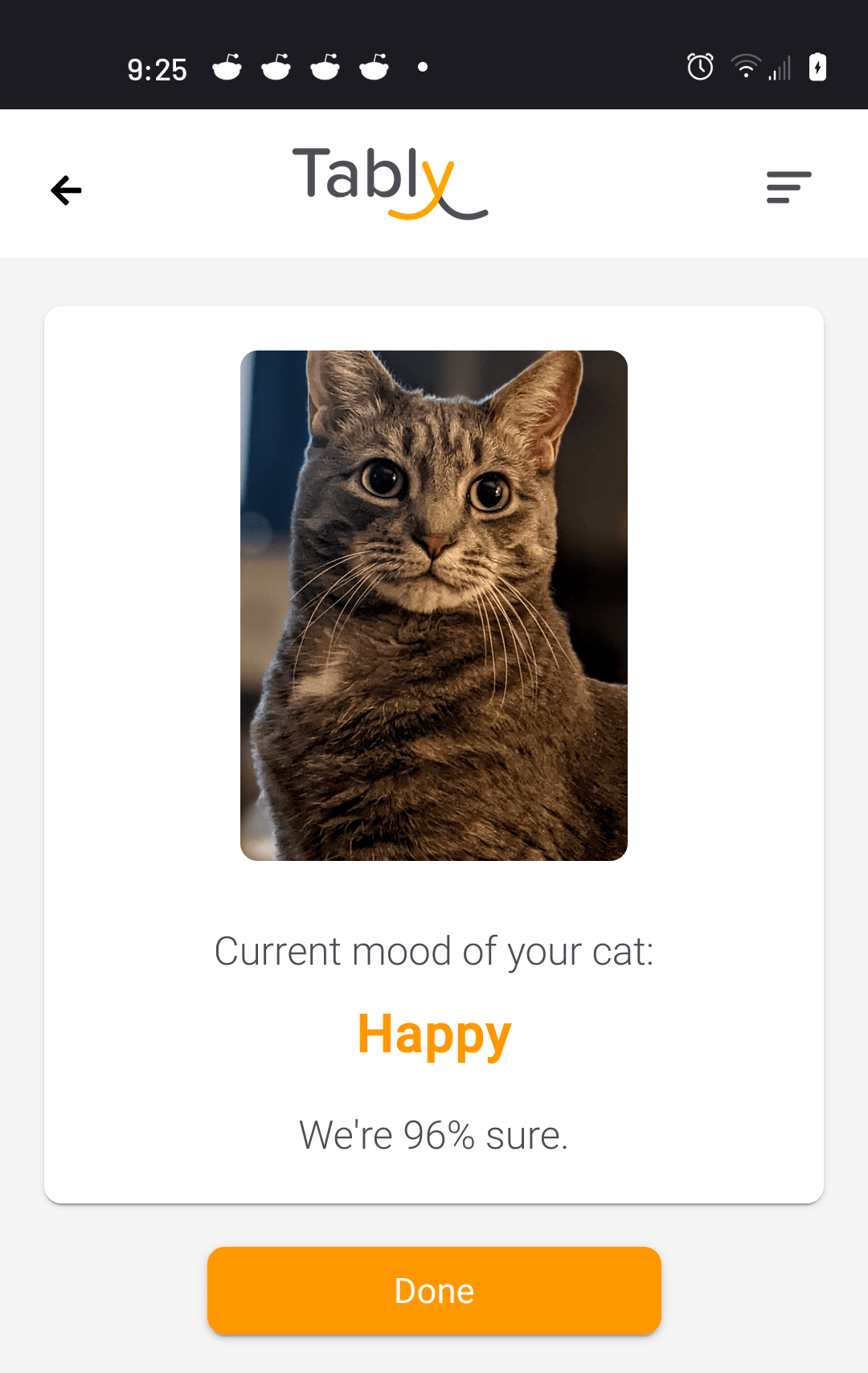
Thanks to an app named Tably, cat servants don’t have to know how to read the most subtle feline facial expressions anymore. By running a photo of your cat through the app’s algorithm, Tably can read your cat’s expression for you.
Tably gauges cats’ moods in addition to their pain levels. We used the web app to evaluate Buddy last year. Thankfully he was happy!
Bales says she envisions a near future in which pet parents monitor their cats’ health and mood daily, and the scale becomes the standard for end-of-life care. With a “validated, consistent way to measure pain, we can look into more pain drugs for cats, what’s working, what isn’t.”
“A cat in pain looks like a resting cat to most people, but now we have this tool,” Bales says. “And I think as the tool evolves and we give cats a way to really speak for themselves through this Rosetta Stone of the grimace scale, then the more we understand that we can do for them, the more we’re going to do for them.”
We wrote about the feline grimace scale and Tably last year, and noted it had a lot of promise for veterinarians and us cat servants. At the time Tably was in beta and had a web app that allowed anyone to use the technology.
Unfortunately the web app seems to have disappeared, and the app is now available only to iOS users. Since we switched from an iPhone to Android, we can’t access Tably for the time being. (Let’s hope an Android version is forthcoming.) But if you have an Apple device, the app is definitely worth checking out.
This is why we always say it’s better for cat servants to regulate themselves than allow the government to get involved.
A Karen in Australia issued a $280 fine to a homeowner for allegedly allowing his cats to roam — after she lured the kitties onto the street herself.
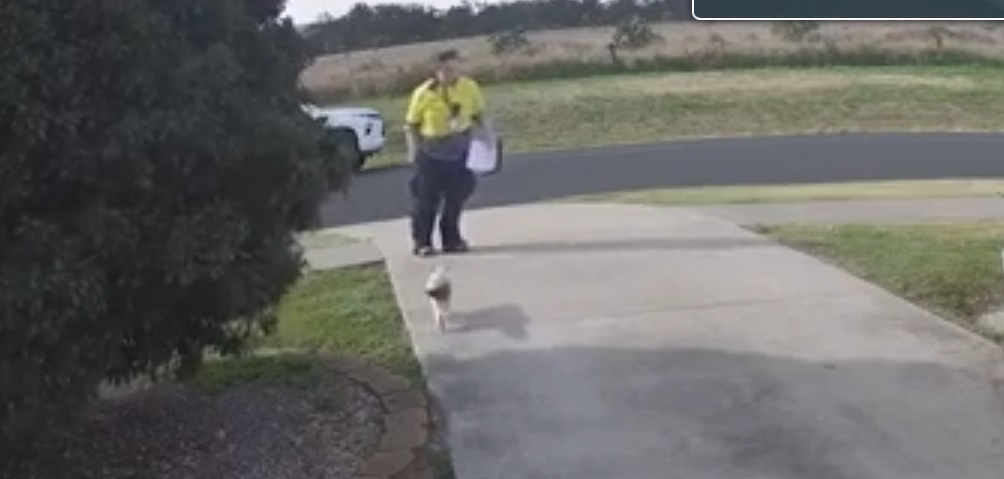
The entire bizarre spectacle was captured on security cameras at the home of Julie and Steven Stephens, a couple in Toowoomba, about 80 miles west of Brisbane. The uniformed Karen, who is employed by the Queensland council, totes a clipboard in one hand as she walks up the Stephens’ driveway in broad daylight.
As one of the curious cats approaches, Karen reaches for a pen in her pocket and starts scribbling on her clipboard, apparently eager to get started on the paperwork, before slowly backpeddling so the kitty will continue to follow her. When the cat reaches the sidewalk, the unnamed woman scoops it up and walks to her government-issued vehicle parked in front of the Stephens’ home.
Steven Stephens was watching the episode unfold via his camera system and bolted outside to stop the government employee from taking his cat, he told Yahoo News Australia.
The Karen wasn’t able to “impound” the cat, but she wrote Stephens a hefty fine for “allowing his cat to roam,” and promised she’d be back to inflict more misery.
“She said she would be back in two weeks with the police to take all but two of our dogs,” Mr Stephens said.
A municipal employee from the Queensland council is seen luring a cat away from its home in this still shot from surveillance video. Credit: Steven Stephens
We’re unable to embed the video, but you can watch it at Yahoo News Australia.
Unbelievably, Toowoomba Regional Council “CEO” Brian Pidgeon doubled down and quoted the relevant section of law on pet roaming when a local newspaper asked him about the incident. Pidgeon did acknowledge his employee was accused of luring the Stephens’ cat, but said he couldn’t talk about that because he’s conducting an “internal investigation,” which is bureaucrat-speak for figuring a way to worm his way out of the situation. There is, after all, clear video showing the Karen luring the cat away. There is nothing ambiguous about what happened.
Stephens admitted he and his wife have “too many” dogs according to local law, which has set arbitrary limits on animal custodianship, but said there are good reasons for that. The dogs sooth his wife, he said.
“A few years ago she had a severe car accident, her partner at the time died, she has a metal plate in her head and now has severe depression and anxiety,” Stephens said. “The dogs help with her anxiety.”
The family has been so rattled by the incident, and apparently has so little faith in their local government to treat them fairly, that they told Yahoo News they’re looking to sell their home and move to “a larger parcel of land in the bush.”
That in itself is an extraordinary admission, indicating they don’t expect basic courtesy, honesty or professionalism from the local authorities.
Now imagine how this would have played out if the Stephens family did not have security cameras. The council worker would have said their cats wandered off the family’s property of their own accord, and that would have been it. The Stephens would be forced to pay the fines, have a legal battle on their hands to get their cats back, and would be fretting over the impending confiscation of their dogs.
I know I sound like a broken record with regard to how local governments, guided by bunk “research” studies, impose themselves on pet caretakers, especially those of us who have cats. That’s why it’s important not to give them any reason to interfere — and to make sure everything is recorded, as the Stephens family wisely did.
Who knows what the government Karen’s motivations were. Was she trying to meet a quota? Does she dislike animals? Does she enjoy flexing the little bit of power she has, or inflicting misery on others? By preempting legislation on cat ownership and roaming, we can avoid putting ourselves at the mercy of such people in the first place, which is in the best interest of cat caretakers, and most importantly cats themselves.
Feline fact fail
I’m sure Nigel Barber, PhD., is a nice guy. I don’t mean to give him any grief. But when you present yourself as an expert on a topic and you write an authoritative column on a trusted site that has millions of readers, you really should make sure you’re not spreading misinformation or providing a picture of a situation that is decades behind the current science.
In a column for Psychology Today titled “Does Your Cat Love You?“, Barber rattles off a list of cliches, half-truths and outright falsehoods about cats, the kind of thing you might have expected 20 or 30 years ago before a wealth of research helped us dispel incorrect assumptions about felis catus.
Credit: Sevra Karakuu/pexels
After mucking up the domestication timeline, Barber says cats are “fearful of people,” “tend to withdraw from strangers,” and paints an outdated picture of aloof animals who technically don’t need human care to thrive. He also says cats attack people, including their caretakers, without warning or provocation.
Then there’s this nugget:
“As essentially wild predators, cats can be quite unpredictable. Many owners who are devoted to their cats complain that the cat often scratches them unexpectedly. One acquaintance had the cat declawed and found that the pet reverted to using its teeth on her!”
Can you believe it?!?! A woman had her cat declawed, and the cat bit her!
It’s not just that we know cats give off plenty of nonverbal warnings when they’re uncomfortable, or that declawing makes a cat much more likely to bite. Organizations like the Humane Society, SPCA, The Paw Project and others have been saying that for years.
It goes well beyond that — studies, including the most comprehensive study to date on the effects of declawing, have proven without a doubt that cats are much more likely to bite when they’re subjected to the cruel and painful declawing procedure. (See “Pain and adverse behavior in declawed cats,” a 2017 paper in the Journal of Feline Medicine and Surgery.)
That’s because declawing a cat not only inflicts a lifetime of physical pain and psychological trauma, it robs felines of their primary defense mechanism, making them feel much more vulnerable. Without claws with which to warn off unwanted handling, the poor declawed cats have only one defensive weapon available to them — their teeth.
An evolutionary psychologist should understand that, and should also understand that scratching is a natural and necessary behavior for cats. It’s not right or wrong, it’s cats being cats. Mutilating innocent animals to protect inanimate objects like furniture is objectively wrong and cruel. When you adopt a cat, scratching comes as part of the package along with all the positives like unconditional love, amusing antics and calming purring.
There are ways to dissuade and train your cats to mostly avoid scratching furniture, but no one should expect their cats will never put a claw on their couches. If you don’t want your furniture scratched, don’t get a cat. End of.

 Pain In The Bud