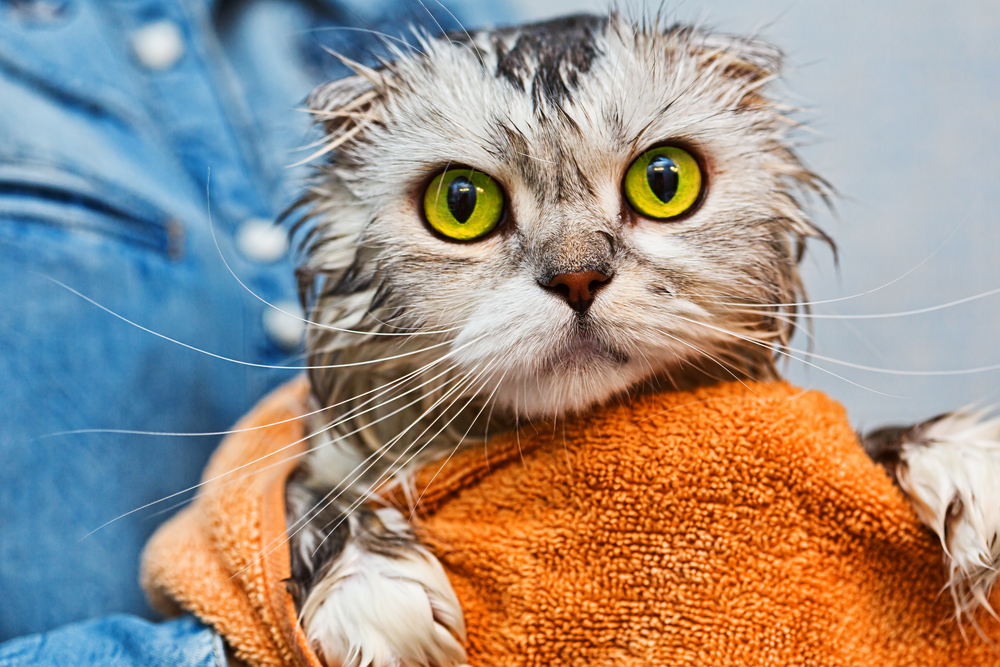
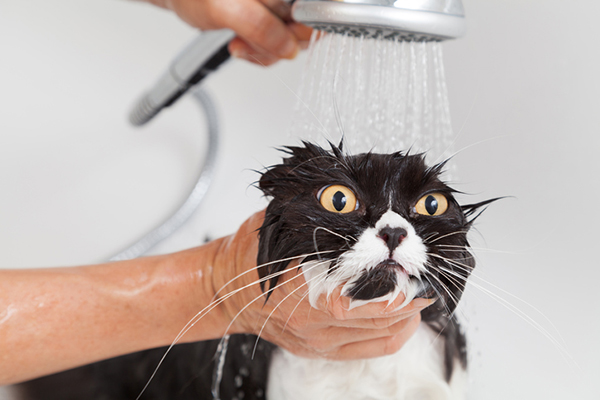
To say cats hate baths would be a spectacular understatement.
Julie’s comment on our last post about cat photos got me thinking: I haven’t given Buddy a bath since he was a kitten.
There are a few good reasons: Many veterinarians don’t think it’s necessary if the cat doesn’t go outdoors, doesn’t have any flea problems and doesn’t come into contact with potential toxins. A short-haired indoor cat who is healthy and flexible enough to thoroughly groom himself doesn’t need bathing, according to trusted animal organizations like the ASPCA.
Unless your cat is a rescue off the street, unable to groom herself or is one of the “hairless” breeds — like a Sphinx — caretakers should “absolutely not” bathe their cats, feline guru Jackson Galaxy agrees.
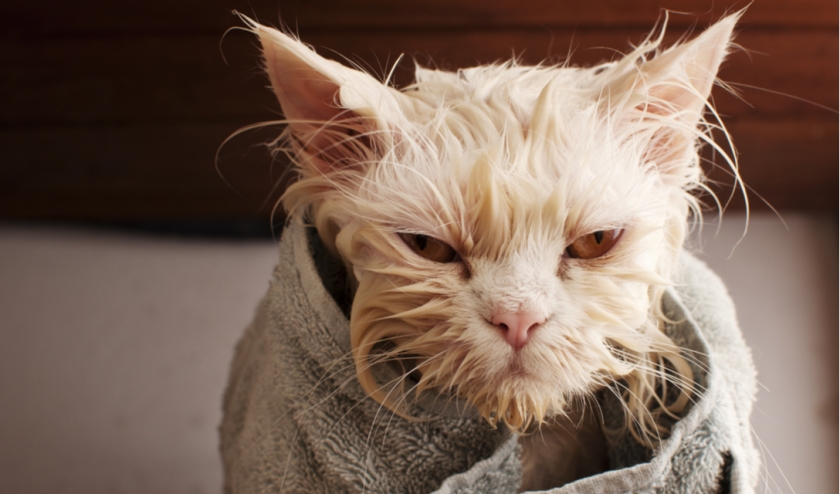
Not a happy camper: Most domestic cats loathe baths. (Credit)
Since Buddy is young and healthy, and the little guy was always seriously distressed by taking a bath, I decided not to put him through the stress. Fear of water may seem ridiculous to us humans, but for cats it’s a big deal.
He does a good job grooming himself, I’ve never detected any odor on him, and perhaps most importantly I’d need heavy gloves, a plastic mask and a family size tube of antimicrobial ointment for the inevitable wounds in places where I’m not heavily armored.
I am, however, open to feedback. Are there good reasons why I should be bathing Bud? Have I been too eager to accept the anti-cat-bathing argument because I don’t want to get soaked and scratched by an angry cat? Am I being negligent by not bathing him?
If you do advocate bathing cats, how often do you bathe your own little buddies, and how do handle the ordeal?
Cats may be stoic, but not when it comes to enduring baths. (Credit)
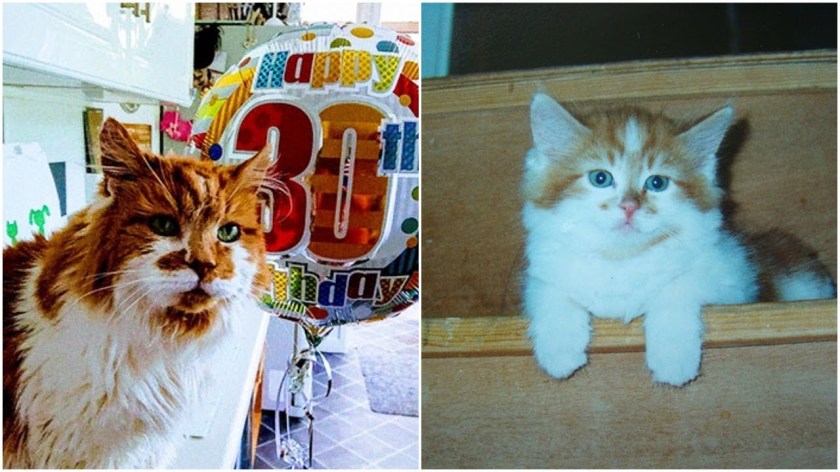
When Rubble the cat came into the world the radio waves were dominated by The B-52’s Love Shack, Debbie Gibson’s Lost In Your Eyes and De La Soul’s Me Myself and I.
George Herbert Walker Bush was in the White House, America hadn’t yet become a politically polarized wasteland and a gallon of gas cost 97 cents. Ghostbusters and Lethal Weapon both returned to theaters with sequels, the USSR withdrew from its war in Afghanistan and hundreds of thousands filled China’s Tiananmen Square to protest the communist government.
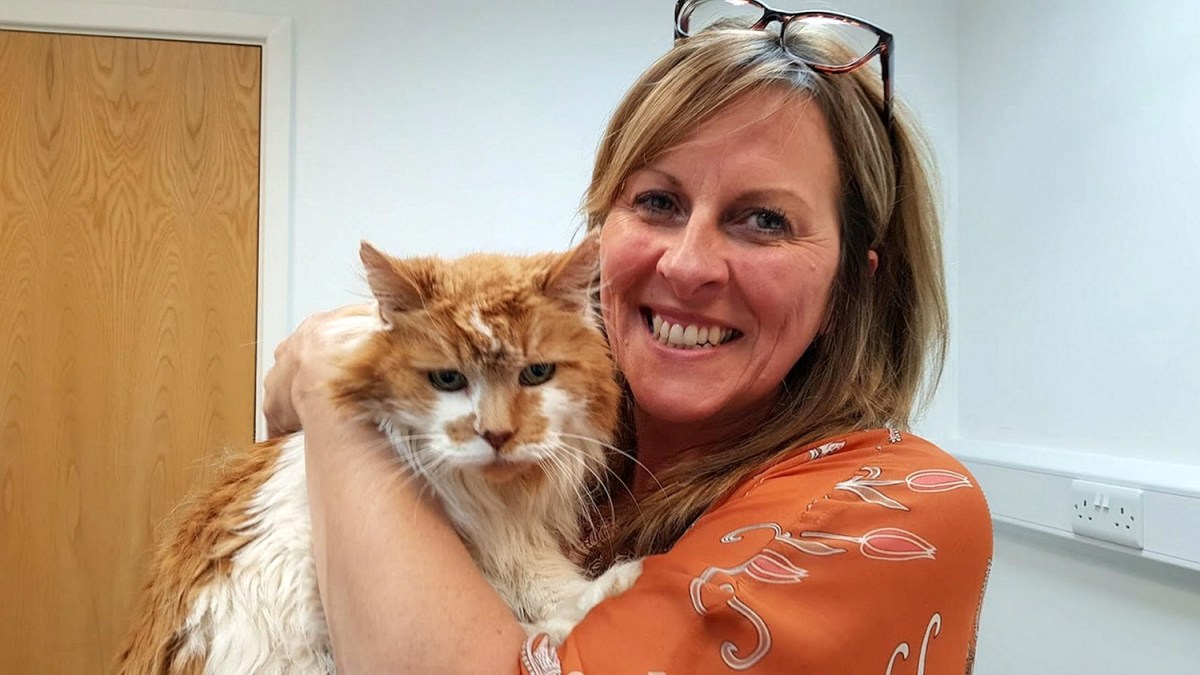
“It was just before my 20th birthday when I got him,” Michele Heritage, Rubble’s human, told the Daily Mail in 2018, for a story marking Rubble’s 30th birthday. “He was part of a litter [from a] cat that my sister’s friend had and I had just left home. I was lonely living on my own so got him in as a kitten.”
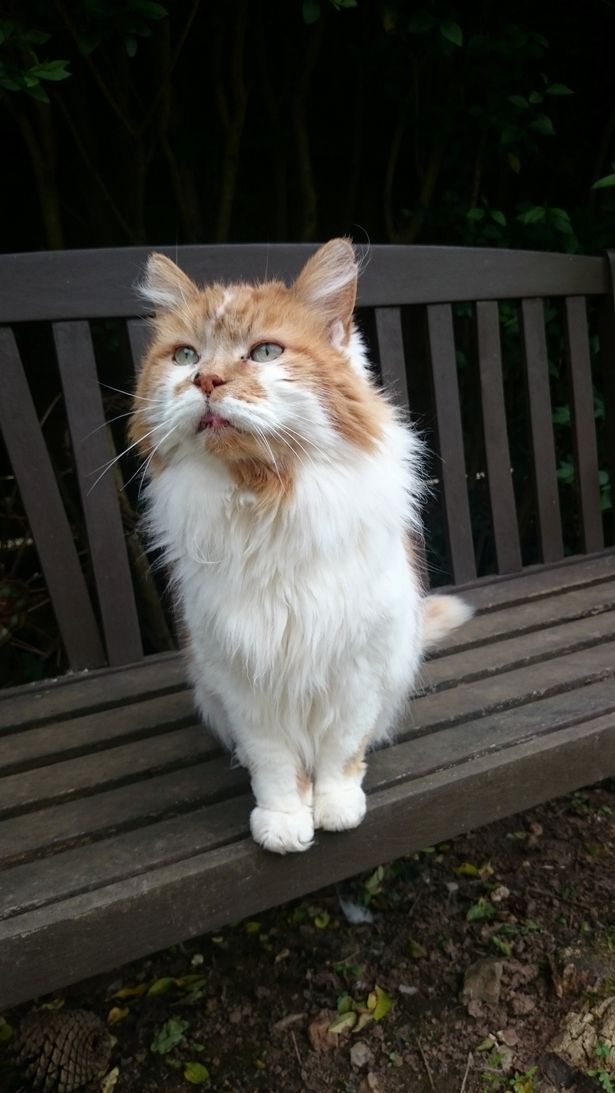
Rubble — a Maine Coon who became the world’s oldest cat a few years ago after the death of a 30-plus Texas feline named Scooter — died in May, just short of his 32nd birthday. His death wasn’t reported publicly by Heritage until July 3.
Heritage, who lives in Exeter, UK, said she’s inconsolable over Rubble’s death, but attributes his longevity to lots of love and affection.
“I have always treated him like a child,” she said. “I don’t have any children and had another cat called Meg, who passed at the age of 25. If you care about something, no matter what it is, it does last.”
At almost 32, Rubble lived the equivalent of about 150 human years. The record for the oldest-ever cat belongs to Creme Puff, who died at 38 years old.
As stray cats suffer, their plight has been mostly overlooked. Cat lovers in cities across the world are trying to keep them fed and safe during the pandemic.
Years ago I worked with a guy who started a food pantry from scratch.
This man, a retired software engineer, approached the biggest restaurants, bakeries and food distributors in the area, asking them to donate their leftover/unused food so his pantry could distribute it to the poor.
Many obliged, but they all had the same request: “Don’t tell anyone we’re participating,” they told him.
The request wasn’t prompted by humility. These businesses didn’t want the public to know how much food they waste, and they waste a lot of perfectly good food, a dirty little secret of the restaurant, hospitality and food industries.
The reason I bring this up is because there’s another demographic that depends on the food those businesses toss out: Stray cats.
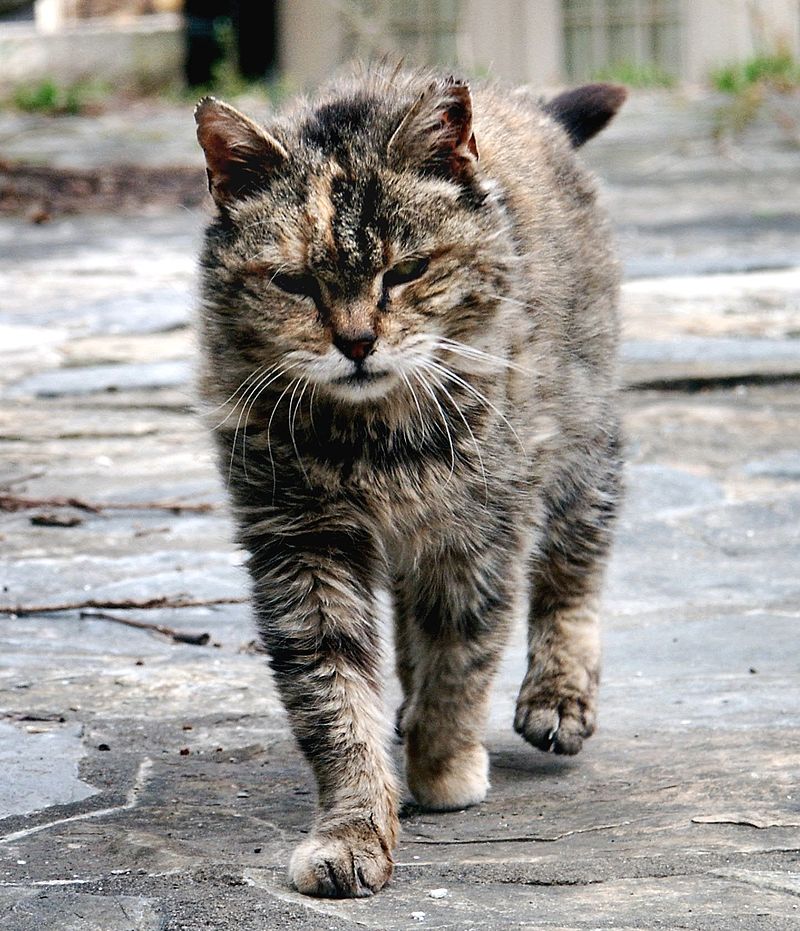
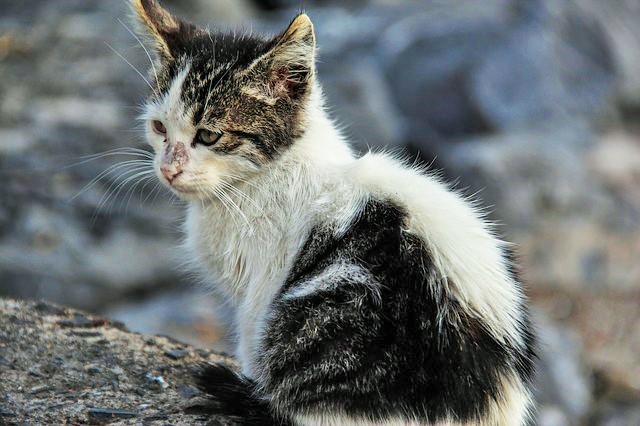
With restaurants shuttered because of the Coronavirus, stray cats are going hungry and dying for lack of the scraps they scavenge from rubbish bins, dumpsters and sidewalks. It’s happening here in New York, across the United States, and in countries like Turkey, India, Greece and Morocco.
For animals who already live difficult lives, the pandemic made things worse.
“The strays have no means of feeding themselves as all offices, restaurants [and] roadside eateries are closed,” an animal rights activist in India told the environmental news site Mongabay, in a story headlined ‘Slim pickings for strays and pets during COVID-19 lockdown.’
Cats aren’t the only animals suffering. One particularly dramatic example was caught on video in a Thai city where thousands of long-tailed macaques live and depend on food given to them by tourists.
Hundreds of starving monkeys stopped traffic in a chaotic brawl over a single piece of food, shrieking, clawing and pushing each other aside to get at it.
As if things weren’t bad enough, stray cats are now competing with former house pets for the little food available.
In India, where bad actors have been spreading false information about COVID-19, animal rights activists are finding abandoned pets — including pedigreed cats and dogs — on the streets after their caretakers abandoned them.
“A lot of this is happening because of misinformation that went viral earlier about pets being carriers of the virus in China. It turned out to be fake, of course, but a lot of damage has been done now,” People For Animals’ Vikram Kochhar told Quartz.
Much of the damage has been done on social media, where conspiracy theories and rumors about contracting COVID-19 from animals are rampant. In China, where pet owners abandoned cats and dogs en masse during the first wave of Coronavirus, some social media users on Mandarin-language platforms called for the “extermination” of cats after a pair of studies conducted by Chinese research labs suggested cats are susceptible to catching the virus.
It isn’t easy to combat waves of viral misinformation, even as health authorities across the world stress cats cannot transmit the virus to humans.
In Greece, abandoned pets — many with their collars still on — are following strays to food sources, especially in larger cities like Athens.
“We are seeing an increase in the numbers of cats in areas where we feed, some appear to have been abandoned, while others have roamed far from their usual spots in search of food,” animal welfare advocate Serafina Avramidou told Barron’s.
In feline-loving Turkey, where taking care of street cats is considered a cooperative responsibility, the central government has told local officials to make sure strays are well fed and taken care of. By making it a government responsibility, their thinking goes, citizens who normally care for the cats will be much more likely to stay inside during the pandemic.
“There are lots of cats on the side streets where there are only closed businesses,” a Turkish Twitter user wrote. “I haven’t seen food anywhere for days. The cats are running after us [looking for food].”
In Istanbul, Muazzez Turan fed some 300 stray cats daily before the pandemic, but said she’s had to stay home: Not only has her country been particularly hard hit by COVID-19, but she has pre-existing medical problems that make her susceptible to complications should she contract the virus.
Still, she said, her mind “was always with the cats,” and she told Turkish news agency Anadolu that she was relieved to hear the strays hadn’t been forgotten.
“I will sleep peacefully for the first time today,” Turan said.
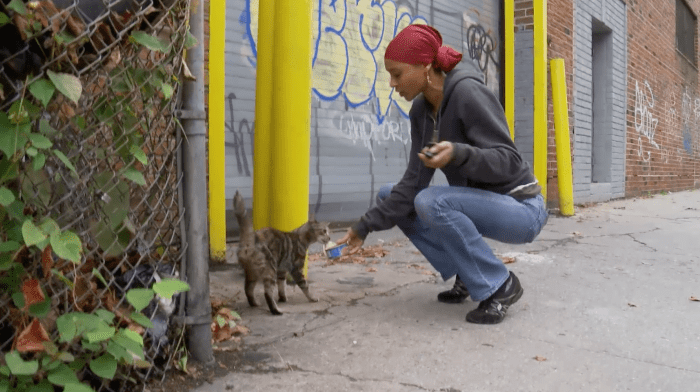
LaTonya Walker of Brooklyn feeds a stray in Canarsie. Credit: 24 Cats Per Second
Here in New York, some animal lovers are picking up the slack for closed restaurants as well as at-risk people who normally feed strays.
Among them is Latonya Walker, who told the New York Post she normally spends $600 a month feeding several colonies of strays but expects her costs this month will be “way more since there’s less restaurant garbage they can eat from, and more hungry cats walking around.”
“The cats have no clue what’s going on because nothing has changed for them,” Walker said. “It’s not in my DNA to see a cat suffering and not do anything about it. I’m equipped to make a cat’s life better, so I’m going to.”
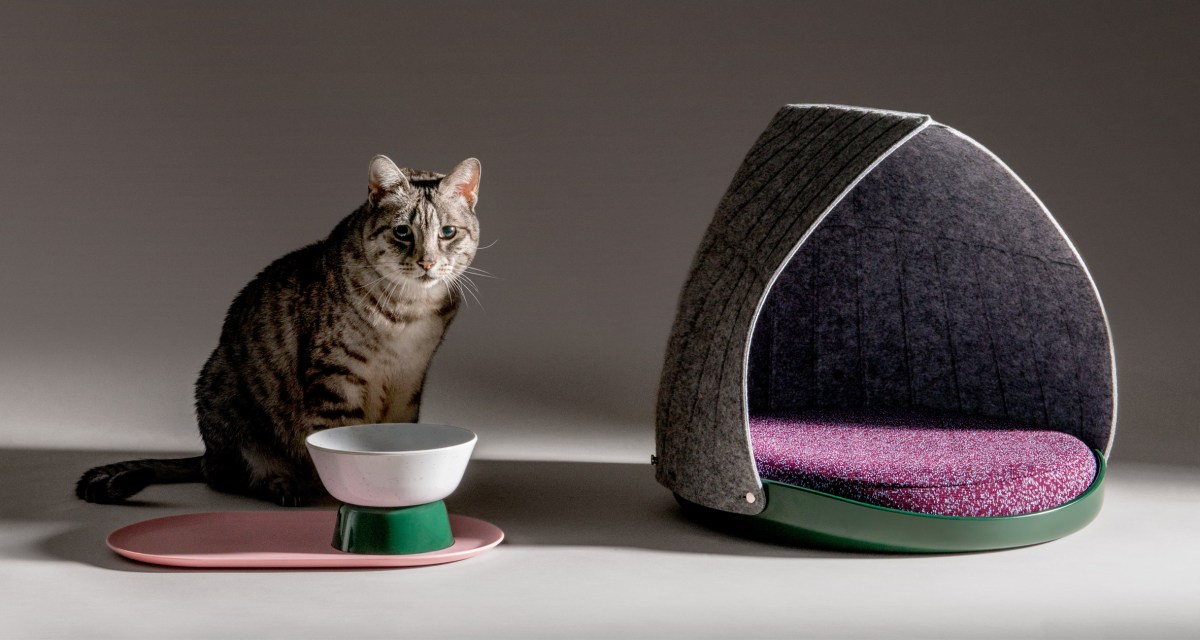
Cat Person collaborated with “design agency” Layer for the Cat Person Collection, utilizing what its creators call a “minimal, contemporary aesthetic” meant to be “proudly displayed in the home and on social media.”
If by contemporary they mean overpriced crap in pastel colors that wouldn’t look out of place on the 80s-era USS Enterprise D, then I suppose it could work.
“Where do you want the litter box, Captain?”
The “collection” has two items — the $40 “Mesa Bowl” that was allegedly designed to combat whisker fatigue, but looks like one bowl stacked on top of another and placed on a cafeteria tray; and the “Canopy Bed,” an $80 cushion that your cat will never use.
The press release for the Cat Person collection, which contains much self-congratulatory language about “disrupting industries” and other marketing-speak, claims the “collection” was based on extensive research into the wants and needs of cat owners, particularly millennials.
As a millennial who almost qualifies as a Gen-Xer, I suspect someone swapped out that research with a home decor survey from 1986, and this is the result.
We don’t accept money from sponsors or advertisers — hell, we don’t even have any ads — so any mention of cat-related products and food on this site is purely for the benefit of our readers. If at some point we get greedy and some company buys Buddy’s loyalty with a lifetime’s supply of turkey treats, we’ll fully disclose that conflict of interest.
Ingredients can change without any indication on pet food packaging or acknowledgment from the companies that manufacture pet food, the study revealed.
We’ve all heard the oft-quoted factoid claiming domestic cats kill billions of birds and small animals every year, and unsurprisingly that number is contested and controversial.
One reason skeptics doubt those numbers is because researchers didn’t observe cat behavior and extrapolate the ecological impact — they handed out questionnaires to owners and asked them how often their cats brought dead animals home. To get accurate results, researchers have to be confident people are answering honestly and have reliable memories. It’s really not the best way to do a study.
So a team at North Carolina State University came up with a better way to measure cat predation on wildlife: They’d take hair samples from more than 400 cats, which would reveal how much of their diets consist of cat food versus prey.
Hair analysis can reveal different isotopes, so the team would be able to directly note each cat’s diet by distinguishing between pet food isotopes and those from prey animals. As the team explained:
A common way to understand the composition of animal diets is to collect samples of fur, nails, or blood from an animal and analyze its carbon and nitrogen isotopes. All organic materials contain isotopes of elements that get locked into body tissues, following the basic principle that you are what you eat. For example, the ratios of nitrogen isotopes present in carnivores are dependably distinct from those of plant eaters. Similarly, researchers can distinguish the types of plants that an animal eats by measuring the ratio of carbon isotopes.
It was a good idea, but the study was derailed by an unexpected discovery: No one knows what the heck is in pet food.
Cat food manufacturers fill their products with mystery ingredients, the team found, which means one bag of kibble or one can of wet food doesn’t have the same ingredients as the next, even if they’re the same flavor from the same company.
Although they can meow in protest, our cats can’t tell us their food tastes different. (Source)
Additionally, pet food manufacturers can — and do — change what they put in their products without notifying customers or acknowledging the changes on the packaging.
As a result, the research team couldn’t identify which isotopes were from cat food and which ones were from hunted meals.
“We really thought this was going to be an ideal application of the isotope methodology,” said scientist Roland Kays, a co-author of the study. “Usually these studies are complicated by the variety of food a wild animal eats, but here we had the exact pet food people were giving their cats.”
That discovery essentially rendered the study useless for its original purpose, but like all good scientists, the North Carolina State team realized that failure reveals just as much as success, even if it’s not necessarily what you’re looking for.
“This isn’t what we aimed to study, but it is important in as much as there are hundreds of millions of cats (perhaps more) on Earth,” said Rob Dunn, a professor in NC State’s Department of Applied Ecology and co-author of the study. “The diets of cats, dogs and domestic animals have enormous consequences for global sustainability, cat health and much else. But they are very non-transparent. In short, at the end of this study we are still ignorant about why some cats kill more wildlife than others, and we have also found we are ignorant about something else, the shifting dynamics of ‘Big Pet Food.'”
As veterinarian Shawn Messonnier put it in an editorial for Pet Age, “the pet food industry remains shrouded in mystery about what’s really inside the pet food bag and how it’s created.”
Calling for more transparency in the manufacture and packaging of pet food, Messonnier pointed out ingredients can have a drastic effect on the health of our furry friends.
“For pet parents, a big leap of faith is required of them because unlike fresh human food, you can’t visually verify the ingredients used, their sources, freshness or the safeness of their handling,” he wrote. “Label language can be difficult to discern, too, so people rely mostly on the observations and opinions of friends and family they trust. Inevitably, people hope what goes in the bowl will translate into well-being and happiness for their dog or cat.”


 Pain In The Bud